
Our readers keep the lights on and my morning glass full of iced black tea. As an Amazon Associate, I earn from qualifying purchases.
I’m Min — the co-founder and writer behind Gadgets Feed. This guide is built by comparing the manufacturers’ published specifications and the patterns across verified customer reviews, so you get each pick’s real strengths and trade-offs instead of marketing spin.
How To Choose The Best Battery Framing Nailer
Choose your battery framing nailer around three factors. First, voltage decides how many nails you get per charge. The Metabo HPT 36V model drives about 900 nails on its 2.5Ah battery, while an 18V model typically gets 400. Second, the feed system (paper strip vs. plastic collation) affects how reliably nails feed. Third, weight decides how long you can hold it overhead without your arm giving out. Match those to your typical job — punch-out work, all-day framing, or occasional DIY decks — and the choice gets simpler.
Voltage and battery system
Higher voltage (36V) means more nails per charge, so you stop to recharge less often — the Metabo HPT 36V model drives about 900 nails on its 2.5Ah battery, while an 18V model typically gets 400. If you already own batteries from a certain brand (like Makita LXT or Craftsman V20), staying in that ecosystem saves you the cost of new batteries and chargers.
Nail collation type
Most cordless framing nailers use either paper strip collation or plastic strip collation. Paper strips cost less per nail and feed smoothly in cold weather, while plastic strips are more rigid and less prone to jamming in dusty conditions. If you work in very cold temperatures (below freezing), paper strip collation tends to feed more reliably because the plastic doesn’t get brittle and snap.
Weight and balance
A cordless framing nailer is heavier than a pneumatic one because it carries its own power source. Most models weigh between 10 and 22 pounds. If you are nailing overhead (like roof sheathing or ceiling joists), a lighter model around 10 pounds like the Metabo HPT 18V will save your shoulder. For ground-level framing where raw power matters more, the extra weight is easier to tolerate.
Quick Comparison
On smaller screens, swipe sideways to see the full table.
| Model | Category | Best For | Key Spec | Amazon |
|---|---|---|---|---|
| Makita XNB03Z | Premium | Driving into dense lumber all day | 1,000 nails per charge (battery not included) | Amazon |
| Metabo HPT NR1890DRS | Mid-Range | Punch-out work and light framing | 400 nails per charge (battery included) | Amazon |
| CRAFTSMAN CMCN621PLB | Mid-Range | DIY and small projects on a budget | Drives up to 3¼” nails, 10.75 lbs | Amazon |
| FLEX FX4351A-1C | Premium | High-speed production framing | 1,100 nails per charge, 0 ramp-up | Amazon |
| Metabo HPT NR3690DC | Premium | All-day framing with paper-strip nails | 900 nails per charge, 36V, 10.6 lbs | Amazon |
In‑Depth Reviews
1. Makita XNB03Z 18V LXT 21° Full Round Head Framing Nailer (Tool Only)
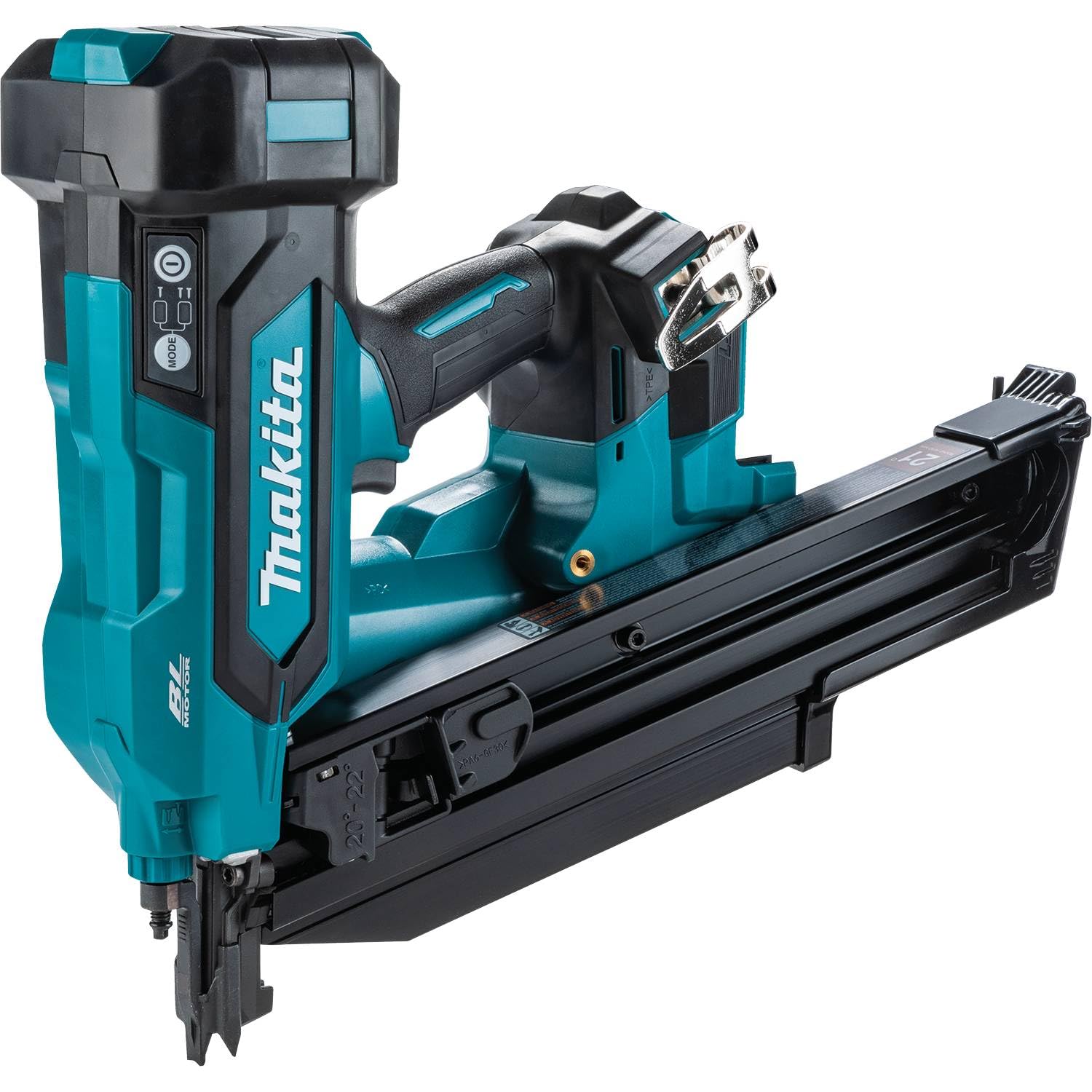
The 1,000-nail-per-charge capacity on a single 18V LXT battery makes the Makita XNB03Z the top pick for anyone framing dense engineered lumber or treated-pine additions who wants to minimize battery swaps. It fires up to 1,000 framing nails on a single 18V LXT charge — that is about 100 more per charge than the Metabo HPT 36V, even though the Makita runs on lower voltage. This is the pick if you frame commercial decks or treated-pine additions and do not want to swap batteries every half hour. Buyers report it is an “awesome tool, solid performance driving 3.25″ ring shanks into treated southern yellow pine for a new deck with zero jams,” which tells you the anti-jam engineering works on real jobs.
The weight sits around 11.9 pounds with a battery attached, and the 41-nail magazine is on the small side. Owners mention it “holds 2 sleeves when empty but only 1 when reloading,” meaning you stop to reload more often than with a full-round-head pneumatic. The 2-mode selector switch lets you bounce between sequential nailing (one trigger pull per nail) and bump fire (hold the trigger and bump the nose to fire repeatedly), which speeds up sheathing work noticeably. The built-in LED light and anti-slip nose for angled nailing are nice extras in tight corners.
The honest limit is that this is a tool-only purchase — no battery or charger included. You must already own Makita LXT 18V batteries or budget for them. If you are already in the Makita ecosystem, this is the nailer for raw power and reliability, especially over the FLEX FX4351A if you value a lighter 11.9-pound tool over the FLEX’s 22.2 pounds. For Makita users, this is the framing nailer that delivers unbeatable runtime and jam-free performance.
Why it’s great
- Drives 1,000 nails per charge on 18V battery system
- Tool-less depth adjustment for flush or countersink nailing
- Anti-dry fire mechanism prevents firing on empty magazine
Good to know
- Battery and charger sold separately
- 41-nail magazine means frequent reloads
- Heavier than some competitors at 20.6 pounds (tool only)
2. Metabo HPT NR1890DRS 18V Cordless Framing Nailer Kit

Where the Makita XNB03Z leads on raw nail count (1,000 vs 400 nails per charge), the Metabo HPT NR1890DRS wins on convenience because it includes a battery, charger, and contractor bag right in the box — you can start working immediately without buying anything else. Its unique air-spring drive system delivers the same feel as a pneumatic nailer, but without any compressor or hose, and the 18V brushless motor keeps the weight down to 10.1 pounds. That makes it 10.3 pounds lighter than the FLEX 24V kit, which is critical for overhead nailing.
Buyers confirm it “drives 3″ ring shank nails every ~2 seconds into 1/2″ OSB on 2×4 after depth adjustment.” One reviewer noted they fired 2,000 nails with “no misfires” — including 3.5-inch ring shank nails into pressure-treated lumber and white oak siding. That kind of reliability makes it great for punch-out work on a job site where you need to fix things without dragging a compressor across half-built rooms. The tool-less depth adjustment and the easy bump-to-sequential switch on the control panel are helpful when switching between sheathing and trimming.
If you want a complete kit that works out of the box for light framing, decks, and punch-out work, and you do not need the max nail-count per charge for all-day framing, choose this over the Makita XNB03Z.
Where it shines
- Includes battery, charger, bag, and safety glasses
- Air-spring drive mimics pneumatic feel without compressor
- Lifetime tool warranty (2-year battery warranty)
Worth noting
- Only 400 nails per charge with included 3.0Ah battery
- Slightly slower than pneumatic for production work
- 1.5-second power button auto-off timer can be annoying
3. CRAFTSMAN V20 Cordless Framing Nailer, 21 Degree (CMCN621PLB)

If you already own Craftsman V20 batteries and want a framing nailer that shares the same platform without buying into a new battery system, this is your move. The CRAFTSMAN CMCN621PLB drives up to 3¼-inch round head nails into laminated veneer lumber (a tough engineered beam material) and weighs 10.75 pounds — about 10 pounds lighter than the FLEX 24V kit, making it much easier for overhead nailing. Customers note “I have only shot the long 3 inch galvanized ring shank decking nails with it, but drives them home no problem, about 2 second delay between shots,” which is consistent for a mid-range cordless framer.
The tool-free depth adjustment lets you dial in flush or countersink nailing without any wrenches. The rafter hook (included) plus VERSATRACK compatibility (clip sold separately) make storage on a wall-track system convenient. The 20V brushless motor delivers good run time with a 4Ah or 5Ah battery, and buyers confirm “long battery life with 4/5Ah” and “excellent performance, easy depth adjustment, no jams” in extended use. It also jams occasionally — one reviewer notes “does it jam every now and again? Yes. But so does every other nail gun” — which is honest context for cordless framers in general.
The standout spec: at 17.8 x 17.75 x 5.95 inches, this is the most compact framing nailer on this list, fitting in tight spaces between studs or in a packed tool bag.
What stands out
- Compact dimensions fit in tight spaces
- VERSATRACK compatible for wall storage
- 3-year limited warranty
The trade-offs
- Battery and charger sold separately
- Only holds one rack of nails at a time
- Plastic rafter hook feels less durable
4. FLEX 24V Brushless 21° Framing Nailer Kit (FX4351A-1C)
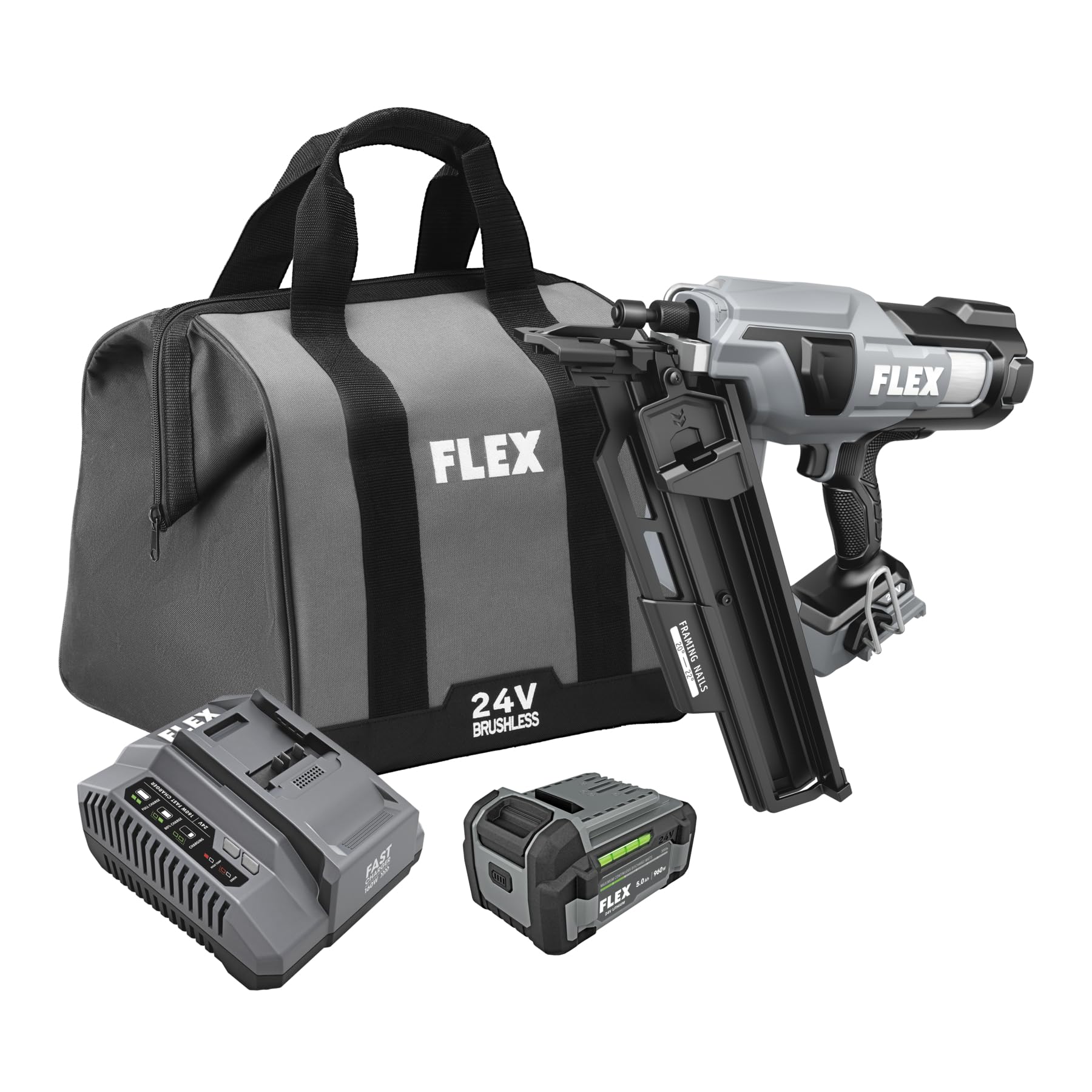
The single number that matters most in this category is 1,100 — that is how many nails you get per charge on the included 5.0Ah battery. It beats the Makita XNB03Z (1,000) and the Metabo HPT 18V (400) by a wide margin, so you can frame an entire wall section before reaching for a spare battery. The FLEX runs on a 24V platform, and the maker claims “20% more power” than 18V, with zero ramp-up time — meaning you pull the trigger and the nail fires instantly, with no spool-up delay. Buyers confirm it “hits hard with no spool-up” and one buyer mentioned it “beats the Dewalt 20v framer easily.”
The catch for that power is weight: at 22.2 pounds (tool plus battery), this is the heaviest nailer in the lineup. Reviewers point out it feels “heavy (2x Dewalt)” and rate its weight at 4/5, saying “overhead one-hand nailing is tough.” The kit includes the nailer, a 5.0Ah battery, and a 160W fast charger, so you get everything you need out of the box. The power adjustment dial on the side lets you fine-tune nailing depth without tools, and the dual LED worklights are useful in dim crawlspaces or attic framing.
For the price-to-performance calculation: if you do production framing all day and need the highest nail count per charge with instant firing, this kit delivers. The weight means it best suits crews working at ground level, and it is the pick to beat the Makita XNB03Z on nail count if you can handle the extra pounds — that is the price-to-value read.
The upsides
- 1,100 nails per charge — highest in this group
- Zero ramp-up time fires as fast as you pull the trigger
- Includes 5.0Ah battery and 160W fast charger
Keep in mind
- 22.2 pounds makes it the heaviest in the lineup
- Auto-shuts down after 10 minutes of inactivity
- Some units may arrive used or tampered with
5. Metabo HPT 36V MultiVolt Paper Strip Framing Nailer Kit (NR3690DC)
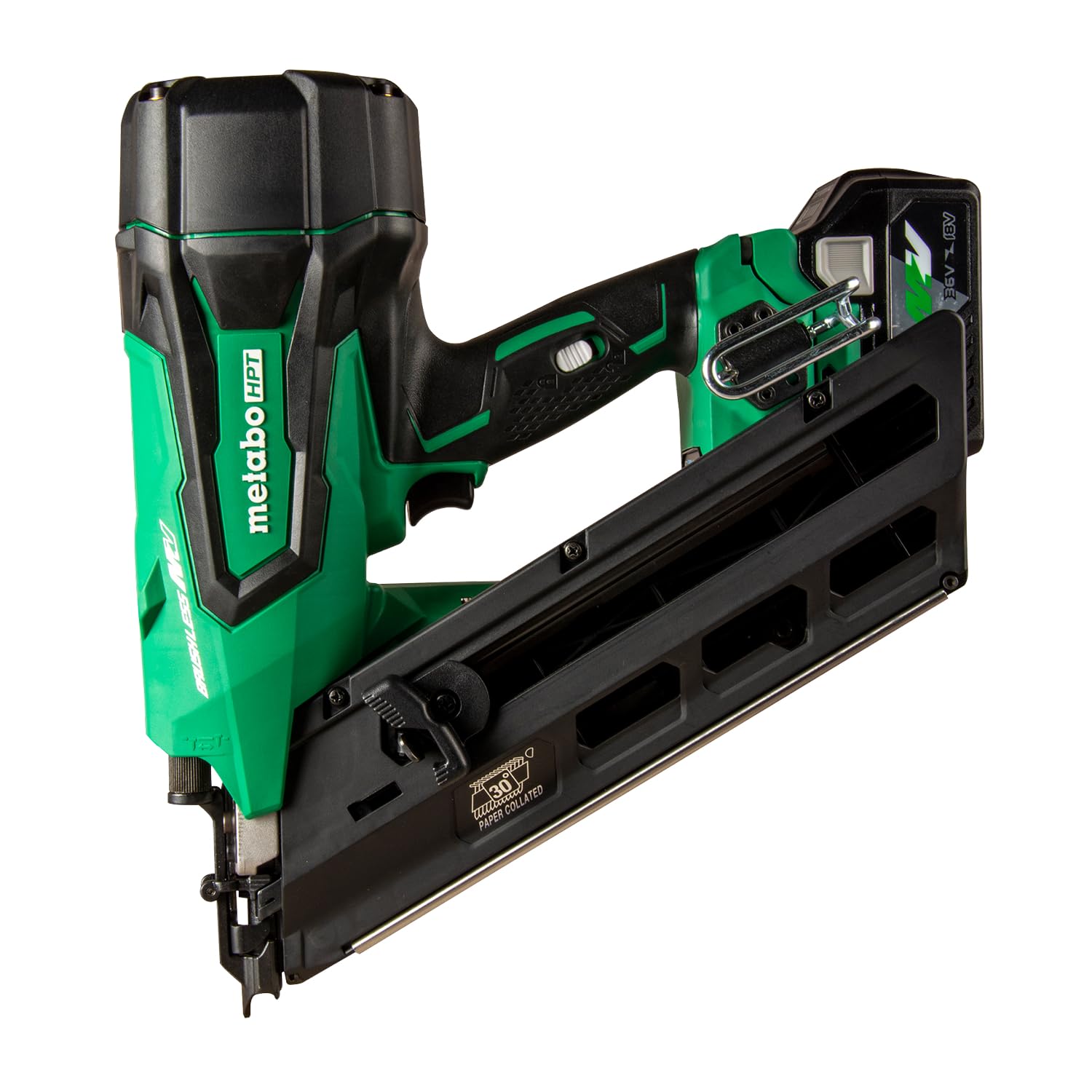
At this lower price, you get a 36V system that drives 900 nails per charge — more than double the 400 nails of the Metabo HPT 18V model, and enough to frame an entire small shed on a single battery. The 36V MultiVolt battery also works with other Metabo HPT 36V tools, like saws and grinders, so if you expand your collection later, the same battery fits everything. Weight is surprisingly low for a 36V tool: at 10.6 pounds, it is only half a pound heavier than the 18V model and far lighter than the FLEX 24V kit at 22.2 pounds.
What you give up is paper strip collation — this nailer uses paper-strip nails rather than the more common plastic collation. Paper strips are cheaper per nail and tend to feed better in cold weather, but you may need to hunt for them at local hardware stores compared to the plastic-strip nails that every big-box retailer stocks. The air-spring drive system delivers a pneumatic-like firing feel, and the selective actuation switch lets you flip between sequential mode and contact (bump) mode instantly. One buyer who used this for nearly a year noted “I have yet to recharge the battery” — a real-world sign of battery longevity.
This is the exact nailer for a professional framer or serious DIY homeowner who works in cold climates (paper strips feed better below freezing) and wants the longest battery life between charges without the heavy weight of competitors like the FLEX 24V. It delivers more nails per charge than the Metabo HPT 18V and does it with nearly the same weight.
Why we’d pick it
- 900 nails per charge on 36V system — excellent battery life
- Only 10.6 pounds, well-balanced for reduced fatigue
- Paper strip collation feeds reliably in cold weather
A few caveats
- Paper-strip nails are less commonly stocked
- Must manually switch modes between single and bump fire
- Heavy enough that some older users find it tiring overhead
Understanding the Specs
Voltage and battery system
The voltage rating (18V, 20V, 24V, or 36V) on a battery framing nailer directly determines how many nails you can drive on a single charge. Higher voltage tools generally have larger battery packs that provide more energy, but they also weigh more. The Metabo HPT 36V model drives 900 nails per charge (about 2.2 times more than its 18V sibling at 400 nails), while the FLEX 24V drives 1,100 nails — enough for an entire day of framing on one battery. Always check the battery voltage and amp-hour (Ah) rating together: a 5.0Ah battery holds roughly 67% more capacity than a 3.0Ah battery, meaning fewer stops to recharge.
Air-spring drive system vs. traditional motor
Several cordless framing nailers — including the Metabo HPT models — use an air-spring drive system that compresses air inside a sealed chamber and releases it to drive the nail, mimicking the feel of a pneumatic nail gun. This results in less recoil and a smoother firing cycle than a traditional motor-driven solenoid. The alternative is a pure motor-and-flywheel system, which can be heavier and noisier. If you are used to pneumatics, the air-spring feel is much more familiar and comfortable for all-day use.
FAQ
Can I use any brand of nail in my cordless framing nailer?
How many nails can I expect from a single charge?
What is the difference between sequential and bump fire mode?
Are cordless framing nailers as powerful as pneumatic ones?
Final Thoughts: The Verdict
For most people, the battery framing nailer winner is the Makita XNB03Z because it delivers 1,000 nails per charge with the proven reliability of the Makita LXT platform and drives into dense engineered lumber without jamming. If you want a complete ready-to-work kit with a battery and charger included, grab the Metabo HPT NR1890DRS. And for maximum nail count per charge and instant firing with zero ramp-up time, the FLEX 24V FX4351A-1C delivers more nails per charge than anything else here, with the downside of its 22.2-pound weight.