
Our readers keep the lights on and my morning glass full of iced black tea. As an Amazon Associate, I earn from qualifying purchases.
You found a fishing kayak at a bargain price. You get to the water. Then you spend half the day bailing water or fighting the wind instead of fishing. The real trick to buying an affordable fishing kayak is matching the hull shape, weight capacity, and seating system to the water you paddle — a glassy lake, a weedy river, or a choppy bay.
I’m Min — the co-founder and writer behind Gadgets Feed. This guide is built by comparing the manufacturers’ published specifications and the patterns across verified customer reviews, so you get each pick’s real strengths and trade-offs instead of marketing spin.
Every kayak below was chosen because it delivers genuine fishing utility — like integrated rod holders, stable platforms for standing casts, and comfortable seats that don’t leave you numb after two hours — without asking you to spend four figures. This is your straight-talk guide to the best affordable fishing kayak you can buy right now.
How To Choose The Best Affordable Fishing Kayak
Getting a good deal on a fishing kayak means knowing which features are worth paying for and which you can skip. Here are the three specs that make or break a budget-friendly fishing kayak.
Hull Shape & Stability
A wide, flat-bottomed or multi-chine hull (a hull with several angled panels instead of a single curved bottom) gives you the stability to stand up and cast without tipping. This is the single most important feature if you plan to fish from a standing position. Narrower, V-shaped hulls track better in a straight line but are tippier — you trade paddling speed for fishing confidence.
Weight Capacity vs. Your Real Load
You are not just carrying your body weight. Add a cooler, a tackle box, rods, a battery for a fish finder, and maybe a trolling motor. A good rule of thumb: add 50 to 75 pounds to your body weight and look for a kayak that meets that number. Most affordable fishing kayaks advertise between 275 and 425 pounds of capacity, which works for most anglers with moderate gear.
Seat Comfort & Adjustability
A cheap kayak with a flat, unpadded seat will leave your lower back aching before you catch your first fish. Look for an elevated seat frame (often called a “lawn chair” seat) that lifts you off the hull floor. Adjustable backrests and seat pans let you shift positions throughout the day, which is the difference between a four-hour trip and an all-day outing.
Quick Comparison
On smaller screens, swipe sideways to see the full table.
| Model | Category | Best For | Key Spec | Amazon |
|---|---|---|---|---|
| Pelican Catch Mode 110 | Mid-Range | Stand-up fishing on lakes & rivers | 75 lbs, 34.5″ width, retractable skeg | Amazon |
| LIFETIME Triton Angler 100 | Budget-Friendly | Calm-water beginners | 49 lbs, 120″ length, 275 lb capacity | Amazon |
| Pelican Catch Classic Angler | Mid-Range | Heavier anglers & gear-heavy trips | 350 lb capacity, 68 lbs, 4 rod holders | Amazon |
| Pelican Sentinel 100X Angler | Budget-Friendly | Solo transport & storage | 44 lbs, 9.5 ft, 275 lb capacity | Amazon |
| Perception Outlaw 11.5 | Premium Pick | Plus-size anglers & big gear loads | 425 lb capacity, 35″ width, 77 lbs | Amazon |
| BKC Brooklyn 12.5 Tandem | Value | Fishing with a partner or child | 600 lb capacity, 6 rod holders, 68 lbs | Amazon |
| Wilderness Systems Tarpon 120 | Premium Pick | Long-distance paddling & touring | 63 lbs, 12.25 ft, 350 lb capacity | Amazon |
| Pelican Catch PWR 100 | Premium Pick | Adding a trolling motor later | Pre-wired, 75 lbs, 360° swivel seat | Amazon |
| Reel Yaks Raptor | Premium Pick | Compact storage & pedal-drive fishing | Modular design, 62 lbs, fin pedal drive | Amazon |
In‑Depth Reviews
1. Pelican Catch Mode 110 Kayak

The 34.5-inch width makes the Pelican Catch Mode 110 one of the widest hulls at this price, ideal for anglers who want to stand and cast without wobbling. A retractable skeg (a small fin at the back that helps the kayak track straight) tucks away when not needed. This makes it the single best-balanced fishing kayak in the affordable tier for anglers who fish both lakes and moderate rivers and refuse to sacrifice comfort for cost.
Buyers report loading 320 total pounds (a 200-pound person plus a 100-pound dog plus gear) and still having the scupper holes stay above the waterline. The Ergoboost seat lifts you higher than a standard pad, giving you a better view and relieving back pressure during long sessions. Unlike the LIFETIME Triton Angler 100 (49 pounds), this kayak is heavier at 75 pounds — 53% more weight makes solo roof-loading harder, and owners mention the skeg can pop off on hard impacts.
Who should pick this: the value-minded angler who wants real fishing features — stable standing, good tracking, and comfort — without hitting the premium price bracket. Who should skip: anyone who must load a kayak alone onto a tall SUV roof; the 75-pound weight makes it a two-person job. This is the most stable affordable fishing kayak for anglers who value comfort and tracking over portability.
Why it’s great
- Wide 34.5-inch hull enables stable standing casts
- Ergoboost seat with EVA pad keeps you comfortable for hours
- Retractable skeg improves tracking in wind without permanent drag
Good to know
- At 75 pounds, it’s heavy for one person to roof-load alone
- Skeg can pop off if you hit a submerged object
2. LIFETIME Triton Angler 100 Fishing Kayak

You can load this LIFETIME Triton Angler 100 by yourself because it weighs only 49 pounds — 53% less than the Pelican Catch Mode 110 (75 pounds). That weight gap makes a real difference if you are solo car-topping. But you give up some stability and tracking: the Triton sits higher on the water, and customers note it gets pushed around by wind more easily.
Where it shines is pure calm-water value. One buyer called it “the most stable one I have been on,” which tracks with the stable hull design and the integrated skeg that helps you go straight without fighting the paddle. Self-bailing scupper holes (drain holes in the deck that let water flow out instead of pooling in the cockpit) mean you won’t sit in a puddle. The tankwell with bungees keeps your crate or cooler secured.
Pick this over the Pelican Catch Mode 110 if your budget is tighter, you weigh under 250 pounds, and you mainly fish small lakes or slow rivers on calm days. The catch: less stability for standing and a seat that reviewers point out starts showing wear after a season. The entry price is hard to beat.
Where it shines
- Weighs just 49 pounds for easy solo car-topping
- Self-bailing scuppers keep the cockpit dry
- Multiple footrest positions fit different paddler heights
Worth noting
- Sits high and catches wind, making tracking harder in breezy conditions
- Seat cushion durability is a common complaint after a season of use
3. Pelican Catch Classic Angler

You are loading a 50-pound cooler, a fish finder battery, rods, and a tackle crate onto the Pelican Catch Classic Angler, and its 350-pound capacity gives you the headroom to do it without worry. Most kayaks at this price cap at 275 or 300 pounds, so this is a real advantage without a huge jump in cost.
Buyers consistently highlight that this kayak is stable enough to stand in at 5’10” and 250 pounds with an additional 50 pounds of gear. A water-resistant front storage hatch with a quick-lock seal keeps your phone and keys dry. Four flush-mount rod holders let you troll multiple lines without cluttering the deck. One buyer summed it up: “stable but not fast/maneuverable.” The 34-inch length and 15-inch width dimensions mean it is optimized for sitting still and fishing, not sprinting across the lake.
Who needs this: anglers who carry a lot of gear and value a weight rating that doesn’t fudge the numbers. Who should look elsewhere: anyone wanting a fast, maneuverable kayak for covering long distances quickly. That 350-pound capacity is the standout spec that no other budget kayak matches.
What stands out
- 350-pound capacity handles larger anglers plus full gear
- Front quick-lock hatch keeps valuables dry and accessible
- Four flush-mount rod holders for hands-free trolling
The trade-offs
- Not designed for speed or quick maneuvering
- Shipping damage and missing parts reported by some buyers
4. Pelican Sentinel 100X Angler

44 pounds — that is the single number that matters most in this category, and the Pelican Sentinel 100X Angler scores a perfect lightweight win at 41% less than the Pelican Catch Mode 110 (75 pounds).
The downside: a lighter hull means less heft in the water, so the Sentinel feels less planted. Shoppers say the low freeboard (the distance between the water and the deck) means you rock more easily than on wider boats. The seat sits in a non-draining well that leaves your bottom wet unless you add an aftermarket seat riser. For the price, you get a 9.5-foot kayak with a multi-chine flat bottom hull (angled panels that improve stability without adding width), two flush-mount rod holders, and the removable ExoPak storage compartment.
This is the pick for solo anglers whose top priority is easy transport and storage. skip it if you fish in choppy water or want a dry, comfortable seat without modifications — a price-to-value read that trades comfort and stability for unmatched portability.
The upsides
- At 44 pounds, it’s among the lightest fishing kayaks you can buy
- Multi-chine hull gives you decent stability for its size
- ExoPak removable storage compartment keeps gear organized
Keep in mind
- Low freeboard and narrow beam make it feel tippier than wider models
- Non-draining seat well leaves you sitting in water without modifications
5. Perception Kayaks Outlaw 11.5

What you actually get at this lower price is a 425-pound capacity that tops even the Pelican Catch Classic Angler’s 350 pounds by 21%, letting bigger anglers stand and fish comfortably. One reviewer at 6’3″ and 370 pounds reports they can stand up in it; another at 6’3″ and 310 pounds says it “goes right through light wake” without feeling unstable.
The 35-inch width gives it a bathtub-like stability that makes standing feel safe. A fold-away lawn-chair seat lifts you off the hull so your back doesn’t ache by lunchtime. Four integrated rod holders and built-in tackle trays mean you can show up with your gear organized. What you give up is portability: at 77 pounds, this is the heaviest kayak in the roundup, and buyers report the carry handles feel poorly secured.
Grab this for the big-and-tall angler with a truck bed or a partner to help load it. pass on it if you need to solo-load onto a roof rack regularly. This is the exact budget buyer it is perfect for: the larger angler who values stability and capacity over lightweight portability.
Why we’d pick it
- 425-pound capacity comfortably fits larger paddlers and heavy gear
- Fold-away lawn-chair seat provides all-day back support
- 35-inch wide hull gives you confidence to stand and cast
A few caveats
- At 77 pounds, it’s heavy for solo roof-top transport
- Carry handle design is a common durability complaint
6. BKC Brooklyn 12.5 Tandem
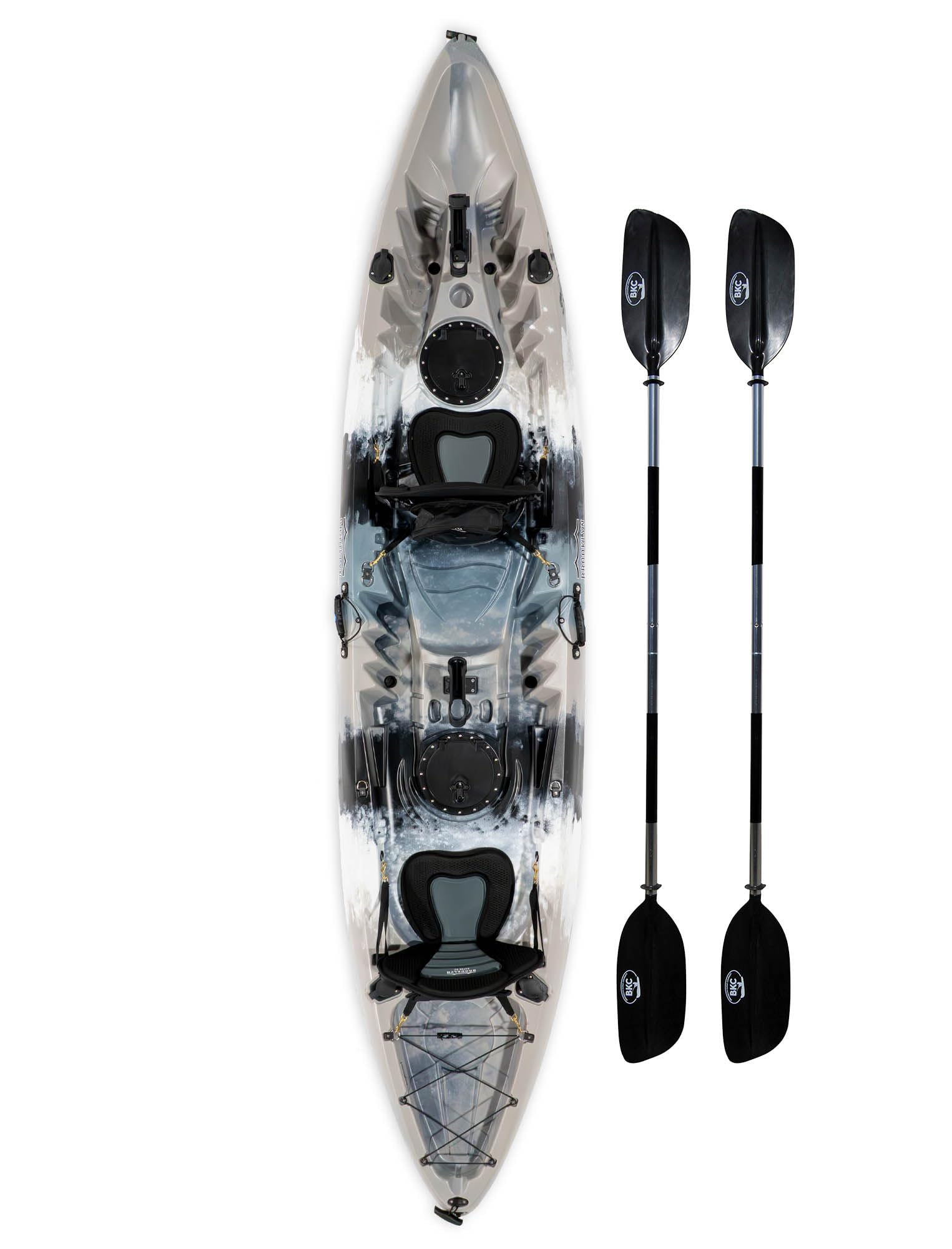
Instead of buying two solo kayaks, you can take a partner or a child on one platform with the BKC Brooklyn 12.5 Tandem. Its 600-pound capacity fits two adults (or two adults plus gear) and makes it completely different from the solo-focused Pelican Catch Mode 110. Six rod holders (four flush-mount and two articulating) let both anglers manage lines without tangling. A 34-inch beam keeps the boat stable even when one person stands to cast.
The included memory foam seats and two paddles mean you are ready to paddle out of the box. The built-in trolling motor mount gives you an upgrade path to motorized fishing. The honest limit: owners mention the aluminum-framed seats slide forward during paddling, and a few received units with minor quality-control issues like misaligned hatch seals.
This is the pick for fishing with a partner. For the price of two solo kayaks, you get one platform that works for pairs.
Strong points
- 600-pound capacity fits two adults plus a child or extra gear
- 6 rod holders give both anglers hands-free trolling
- Motor-ready mount lets you add a trolling motor without drilling
Before you buy
- Seats tend to slide forward during paddling, requiring aftermarket fixes
- Some units arrive with minor cosmetic or alignment issues
7. Wilderness Systems Tarpon 120
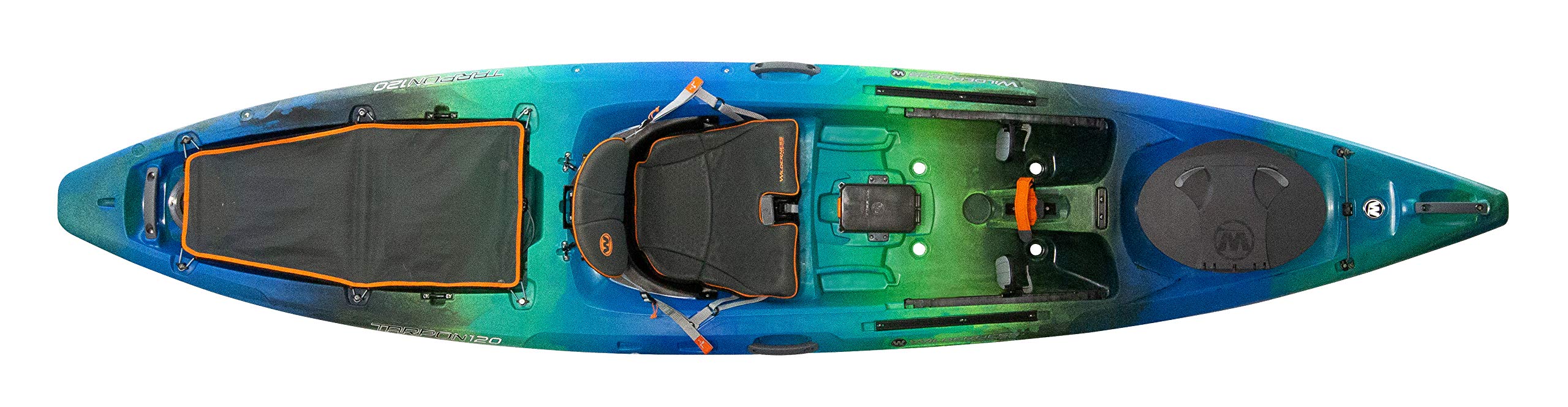
The Wilderness Systems Tarpon 120 costs more than most of the field, but it sits in a different value category: a performance touring hull that also fishes well, whereas the Pelican Catch Mode 110 is a pure fishing barge.
You can paddle across bigger lakes with less effort because its 12.25-foot hull delivers superior glide and straight-line tracking. The Phase 3 Air Pro seat uses a mesh fabric that stays cool and provides excellent lumbar support. One buyer called it comfortable “with great lumbar support” even though they later added a lumbar pad. A large rear well fits a crate or cooler, and the Dry Tec removable box keeps your phone and keys dry without needing a separate dry bag. The 350-pound capacity matches the Pelican Catch Classic Angler.
Choose this over the cheaper competition if you paddle as much as you fish. It is slower than a dedicated touring kayak but faster than any of the wider fishing hulls here. The one clear reason to choose it is that it offers the best paddling performance among affordable fishing kayaks.
What we like
- 12.25-foot hull delivers excellent glide and tracking for long paddles
- Phase 3 Air Pro seat stays cool and provides great lumbar support
- Large rear storage well fits a crate or scuba gear
The downsides
- Slower in the water than dedicated touring kayaks
- Some customers note shipping damage and missing replacement parts
8. Pelican Catch PWR 100

The Pelican Catch PWR 100 comes pre-wired for a trolling motor, making it the top pick for anglers who plan to add a motor without any DIY wiring. This is a major advantage over the Pelican Catch Mode 110, which requires full DIY wiring. The Ergo360 seat swivels a full 360 degrees, so you can face the bow, stern, or either side without twisting your back — a real benefit when fighting a fish that runs around the boat.
Anti-slip traction pads on the deck include a built-in ruler, letting you measure your catch without rummaging for a tape measure. One buyer paired it with a Newport trolling motor and reports it “moves great” and is “stable and comfortable.” The trade-off: at 75 pounds, it is no lighter than one limitation Mode 110. The 10-foot length is shorter than most competitors, which means less deck space for gear and slightly more effort to track straight when paddling.
Buy this if you know you want to add a motor within the first season and prefer a factory-ready solution; it’s not for you if you need a long hull for efficient paddling across large lakes.
Why it’s great
- Pre-wired transom and front battery compartment simplify motor installation
- 360-degree swiveling seat lets you face any direction without strain
- Anti-slip traction pads with a built-in ruler add utility
Good to know
- 10-foot length gives less deck space and tracking than longer hulls
- At 75 pounds, it is heavy and can be awkward to transport solo
9. Reel Yaks Raptor Modular Fishing Kayak
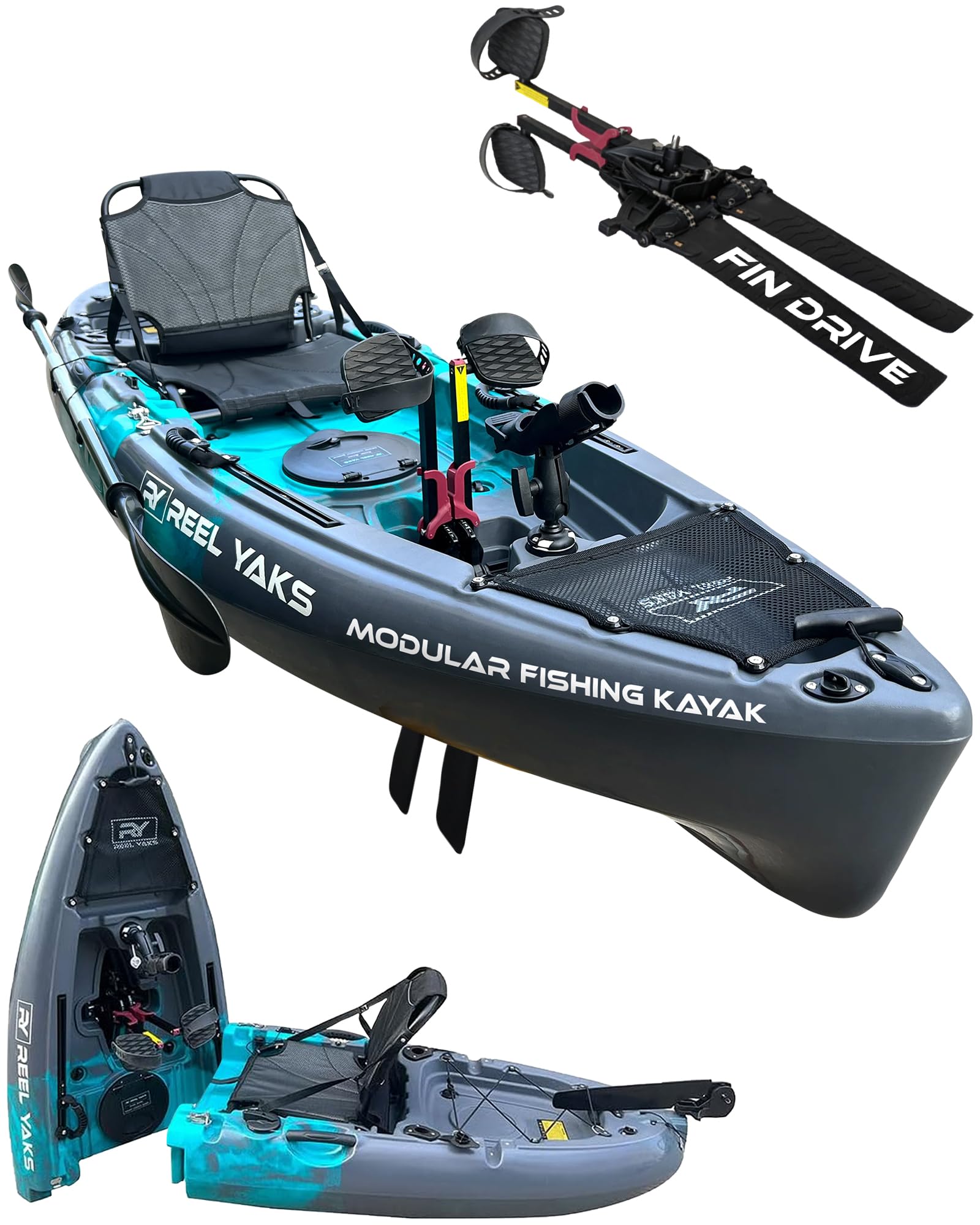
You can fit this kayak in a midsize SUV trunk or a closet because the Reel Yaks Raptor breaks into two 31-pound sections — the top pick’s one-piece hull takes up a full 12 feet of space. This modular design changes the storage equation completely, impossible with a traditional 12-foot hull. It costs more than any other kayak here, but it delivers something none of the Pelican or LIFETIME models can match: a pedal-drive system that frees your hands for casting.
The fin pedal drive weighs just 11 pounds, is knee-friendly, and won’t snag on weeds like propeller drives. Reviewers point out the pedal system and rudder are pre-assembled and take about 20 minutes to get on the water. One reviewer noted it is a “great value vs. Hobie” — a direct comparison to a brand that typically costs twice as much. The W-hull provides good balance in choppy conditions. The included stadium seat lifts you off the deck.
The compromise: while most buyers love it, a few report missing hardware (like a rudder safety ring) and unclear assembly instructions. Choose the Raptor over the top pick if you have limited garage space or want hands-free pedal propulsion without spending Hobie money — it’s the only kayak in this range that delivers that capability.
Where it shines
- Modular two-part design fits in small cars and apartment closets
- Lightweight 11-pound fin pedal drive is weed-free and quiet
- Includes paddle, stadium seat, and rod holder out of the box
Worth noting
- Some shoppers say missing parts and unclear assembly guidance
- Delivery logistics can be unreliable, with occasional cosmetic damage
Understanding the Specs
Hull Width & Stability
Width is measured in inches at the widest point of the kayak. A wider hull — 34 inches or more — gives you a more stable platform for standing up to cast. Narrower hulls under 30 inches are faster to paddle but feel tippy when you shift your weight. For fishing, prioritize width over length unless you plan to cover long distances.
Weight Capacity & Real Load
The maximum weight capacity listed by the manufacturer includes your body weight plus all your gear. A 275-pound capacity is fine for a 200-pound paddler with a light tackle box, but a 425-pound capacity gives you room for a cooler, battery, rods, and a trolling motor. Always add 50 pounds to your body weight before comparing to the capacity number.
FAQ
Is a sit-on-top kayak better than a sit-in kayak for fishing?
How much should I spend on a first fishing kayak?
Do I need a paddle or a pedal drive for kayak fishing?
Final Thoughts: The Verdict
For most people, the best affordable fishing kayak is the Pelican Catch Mode 110 because it balances a wide 34.5-inch stable hull, a comfortable elevated seat, and genuine fishing features like the retractable skeg and gear rails while staying affordable. If you want maximum 425-pound capacity for bigger anglers or heavy gear, grab the Perception Outlaw 11.5. And for those who need a pedal-drive system that stores in a closet, the Reel Yaks Raptor is the only option in this range that delivers that capability.