
Our readers keep the lights on and my morning glass full of iced black tea. As an Amazon Associate, I earn from qualifying purchases.
Picking a fitness watch that keeps up with your workouts means getting one that tracks your heart rate accurately, locks onto GPS quickly, and stays charged longer than your training week. With watches from Garmin, Apple, Amazfit, and COROS, the specs can blur together fast. This guide covers six of today’s top options, comparing battery life, display quality, and tracking accuracy so you see the real differences before you buy.
I’m Min — the co-founder and writer behind Gadgets Feed. This guide is built by comparing the manufacturers’ published specifications and the patterns across verified customer reviews, so you get each pick’s real strengths and trade-offs instead of marketing spin.
You will find a fitness watch on amazon that matches your daily routine and your budget, whether you need a rugged outdoor partner, a runner’s training tool, or a seamless iPhone companion.
How To Choose The Best Fitness Watch On Amazon
Choosing a fitness watch comes down to matching the watch’s strengths to your workout habits. You don’t need a titanium smartwatch if you mostly track walks and sleep. A budget watch won’t handle marathon training with offline maps. Focus on these three things to narrow your list.
Battery Life
Battery life is the most practical difference between fitness watches. A watch that lasts 24 days (like the Amazfit Active Max) means you can wear it for a month without a second thought. An Apple Watch Series 11 lasts about 24 hours, so you will charge it daily. If you want sleep tracking that does not interrupt your routine, look for a watch that goes at least a week between charges.
Display Type and Brightness
AMOLED displays offer vibrant colors and deep blacks, making data easy to read indoors. The Amazfit Active Max has a 3,000-nit display, which is exceptionally bright for direct sunlight. The Garmin Instinct E uses a different display type (MIP — Memory-In-Pixel) that is less vivid but stays readable under direct sun and uses less power. The Garmin Forerunner 165, COROS PACE 4, Apple Watch Series 11, and Apple Watch Ultra 3 also use AMOLED.
GPS and Navigation
If you run, hike, or bike outdoors, GPS accuracy matters for tracking distance and pace. The COROS PACE 4 features dual-frequency GPS, which locks onto satellites faster and maintains accuracy in challenging conditions like tree cover or city canyons. The Garmin Forerunner 165 and the Apple Watch Ultra 3 offer precise GPS for serious runners and adventurers. The Amazfit Active Max also includes offline maps, so you can navigate without a phone signal.
Quick Comparison
On smaller screens, swipe sideways to see the full table.
| Model | Category | Best For | Key Spec | Amazon |
|---|---|---|---|---|
| Amazfit Active Max | Mid-Range | All-day health tracking with long battery | 24-day battery, 1.5″ AMOLED | Amazon |
| Garmin Instinct E | Mid-Range | Rugged outdoor use with 10 ATM water resistance | 16-day battery, 22mm band | Amazon |
| Garmin Forerunner 165 | Mid-Range | Running-specific training and recovery insights | 11-day battery, AMOLED display | Amazon |
| COROS PACE 4 | Premium | Ultralight design with advanced GPS | 19-day daily use, 1.2″ AMOLED | Amazon |
| Apple Watch Series 11 | Premium | Seamless iPhone integration with health features | 24-hour battery, always-on display | Amazon |
| Apple Watch Ultra 3 | Premium | Extreme sports and multi-day adventures | 42-hour battery, 49mm titanium case | Amazon |
In‑Depth Reviews
1. Amazfit Active Max Smart Watch
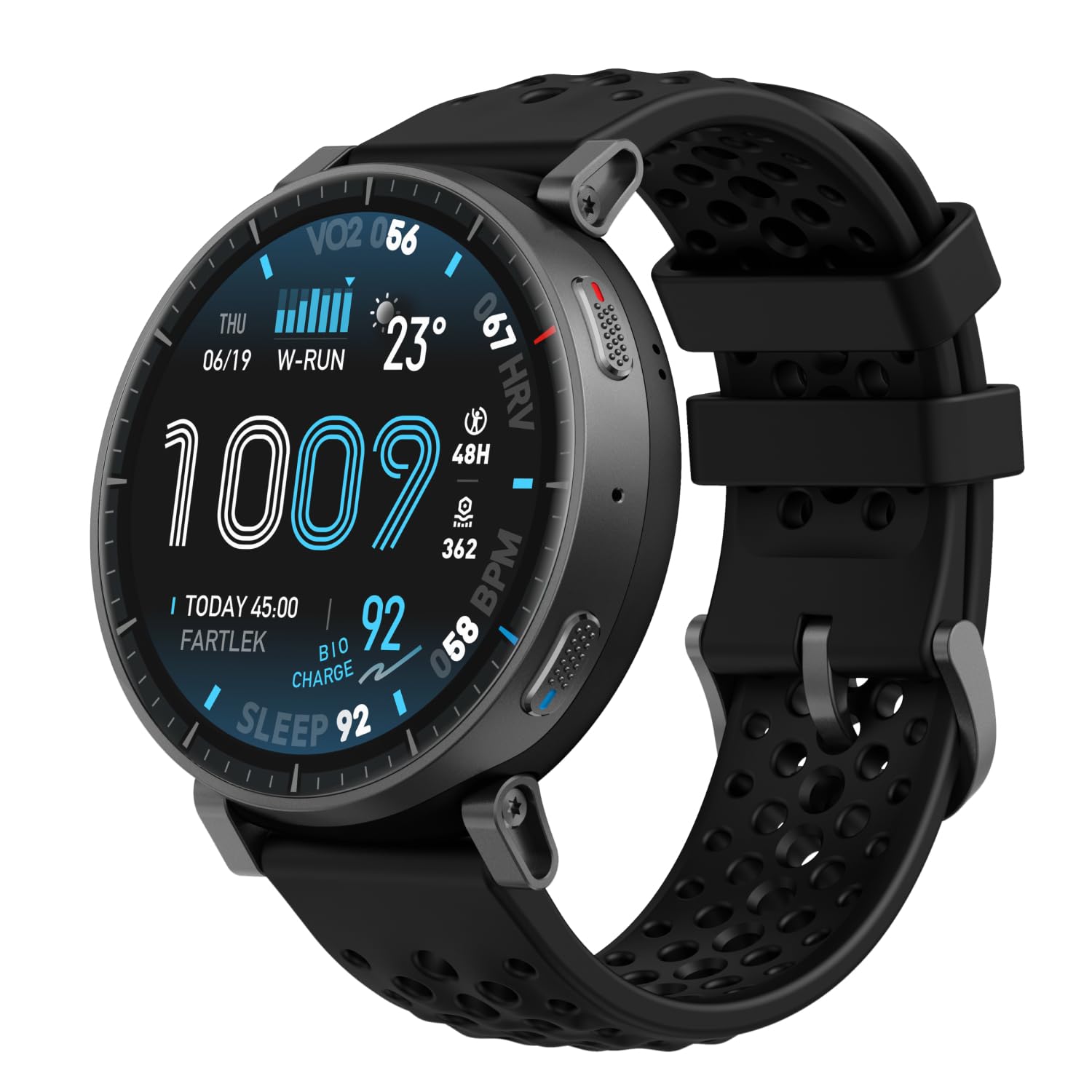
The 24-day battery life makes the Amazfit Active Max the top pick — it eliminates the need for a charging routine for nearly a month — and it is the best choice for someone who wants comprehensive health tracking (heart rate, SpO2, sleep, stress) without the daily charging hassle. The 1.5-inch AMOLED display is the largest in this group — 25% more screen area than the COROS PACE 4’s 1.2-inch display — and at 3,000 nits, it stays perfectly readable even in direct sunlight.
This watch gives you data you can actually use. It has 170+ sport modes and a BioCharge energy monitoring system that tells you when to push harder and when to rest. With 4GB of onboard storage, you can download offline maps and terrain maps for navigation without a phone signal, using five satellite systems for fast GPS lock. Buyers report that the “accurate HR and SpO2 readings verified against medical device” gave them real confidence in the data.
The honest trade-off is the 5 ATM water resistance (50 meters), which is fine for swimming but not for deep diving — the Garmin Instinct E offers 10 ATM (100 meters) for double the water protection. Overall, the Amazfit Active Max delivers the best balance of long battery, bright display, and health features at a mid-range price point.
Why it’s great
- 24-day battery lasts 2.2x longer than the Garmin Forerunner 165’s 11 days
- 3,000-nit AMOLED display is the brightest in this comparison
- 4GB storage for offline maps and music
- BioCharge energy monitoring helps you balance training and recovery
Good to know
- 5 ATM water resistance is half the depth rating of the Garmin Instinct E
- Band is slightly small for larger wrists according to some reviewers
2. Garmin Instinct E 45mm

If the Amazfit Active Max is the all-day lifestyle tracker, the Garmin Instinct E is the tough outdoor specialist you would trust on a multi-day backpacking trip. It beats the Amazfit on water resistance by a 2.0x gap — 10 ATM (100 meters) vs 5 ATM (50 meters) — and it is built to MIL-STD-810 standards for thermal and shock resistance, so it can survive drops and extreme temperatures that would crack a typical smartwatch. Its 300 mAh battery is 50% larger than the Amazfit’s 200 mAh, delivering up to 16 days of juice.
This watch is a simple, no-nonsense tool for people who need accurate GPS, a 3-axis compass, and a barometric altimeter for navigation. Owners mention that the “battery lasts 2 weeks, charges in ~1 hour,” which is a strong real-world performance. The 22mm band width is 10% wider than the Garmin Forerunner 165’s 20mm band, giving it a more substantial feel. Health monitoring includes wrist-based heart rate, advanced sleep tracking, and Pulse Ox (a sensor that measures your blood oxygen level).
Choose the Instinct E over the Amazfit if you spend serious time in rugged environments, swim regularly in open water, or need a watch that can take a beating. Its display is a lower-power MIP (Memory-In-Pixel) type, which is less colorful than the AMOLED screens on the Amazfit or Forerunner 165, but it stays readable in bright sun without draining the battery.
Where it shines
- 10 ATM water resistance is good for swimming and snorkeling to 100 meters
- MIL-STD-810 certified for extreme temperatures, shock, and thermal resistance
- 16-day battery with a 300 mAh capacity that charges in about an hour
- Compass, barometric altimeter, and multi-GNSS support for navigation
Worth noting
- MIP display is less vibrant than AMOLED screens on comparable watches
- Some reviewers found the stock band too short for average wrists
3. Garmin Forerunner 165

If you’re a runner who wants detailed training metrics without the premium price tag of the Forerunner 265 or 975, the Garmin Forerunner 165 is built for you. It has a bright AMOLED touchscreen with traditional button controls, so you can swipe through data or press buttons during sweaty runs. Its battery lasts 11 days in smartwatch mode, which is solid — one reviewer noted that with “notifications off, no always-on display: 13-day battery” is achievable. In GPS mode, it lasts 19 hours, enough for a full marathon plus training sessions.
What makes this watch stand out are the recovery insights. It gives you a morning report with your sleep, recovery, and training outlook so you know if you are ready for a hard workout or need an easy day. It also has 25+ activity profiles (running, cycling, HIIT, strength, swimming) and supports Garmin Coach, which offers adaptive training plans based on your performance. The 20mm band is a bit narrower than the Instinct E’s 22mm band, but the 43mm case size is comfortable for all-day wear and sleep tracking.
The Forerunner 165 is the right choice if you are a runner who wants accurate GPS, heart rate, and HRV (Heart Rate Variability — a measure of your nervous system recovery) tracking, but you do not need the extreme durability or 10 ATM water resistance of the Instinct E. Its AMOLED display is a significant upgrade over the Instinct’s MIP screen for indoor visibility.
What stands out
- Personalized daily suggested workouts adapt to your recovery and performance
- AMOLED touchscreen with button controls for easy use during workouts
- 19 hours of GPS battery life covers long runs and races
- Garmin Pay for contactless payments without your phone or wallet
The trade-offs
- 11-day battery is shorter than the Amazfit Active Max’s 24 days
- Band width at 20mm may be small for men with larger wrists
4. COROS PACE 4 Ultralight Sport GPS Watch
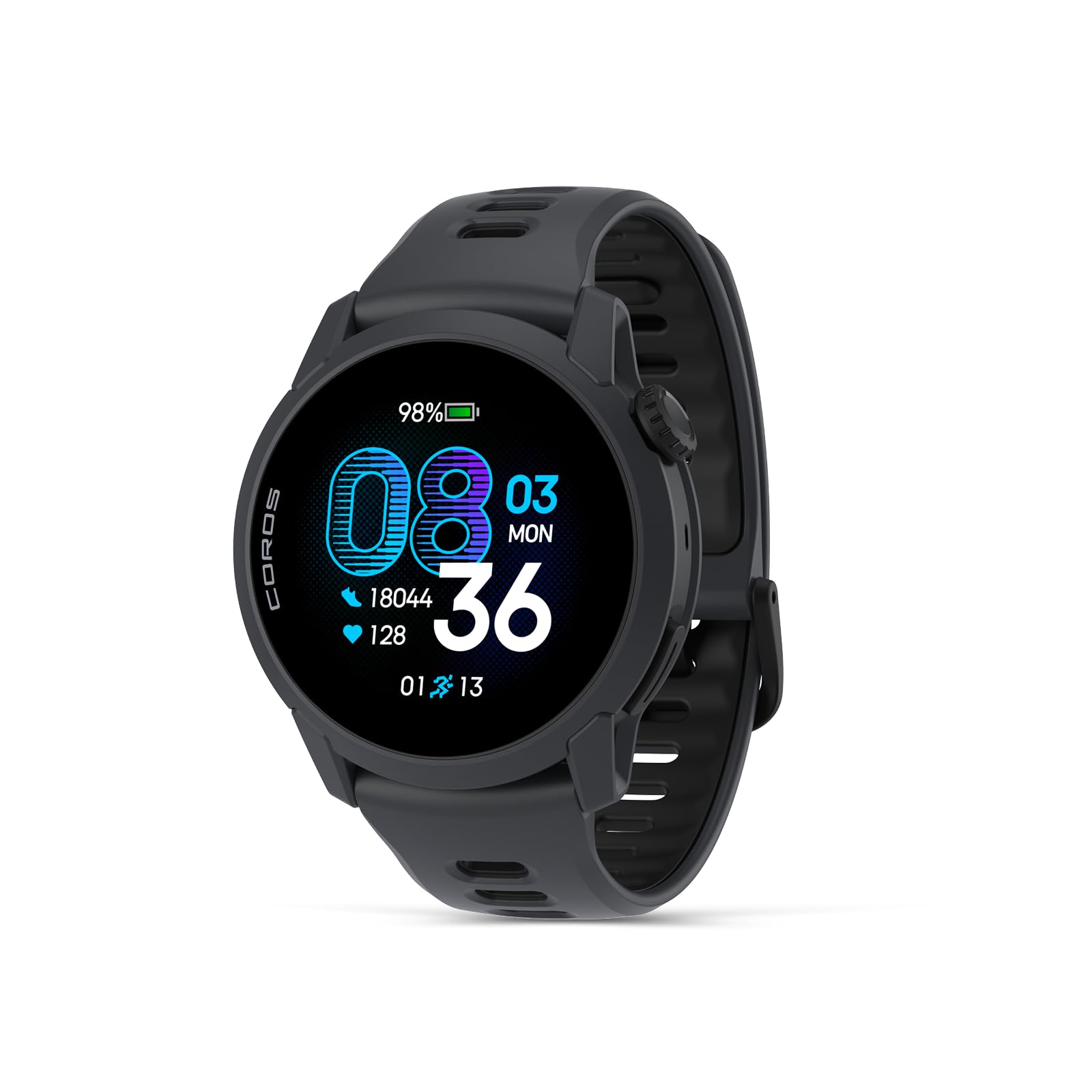
The single number that defines the COROS PACE 4 is its weight — just 32 grams with the nylon band, which is lighter than many running watches and virtually unnoticeable on your wrist during a run or while sleeping. It scores extremely high on the “forget it’s there” metric, which matters if you plan to wear it 24/7 for sleep and recovery tracking. Despite being ultralight, it packs a 1.2-inch AMOLED touchscreen with 164% higher resolution than the previous PACE 3, and it runs for up to 19 days of daily use or 41 hours of continuous GPS.
The catch you accept with the PACE 4 is that it focuses heavily on running and endurance sports, with fewer smartwatch features than the Apple Watch Series 11. It has voice control and voice recording for training logs, but its core strength is the training ecosystem — recovery time, HRV tracking, sleep stages, and the COROS app that analyzes your fitness. One reviewer who switched from a Garmin noted it is a “great watch for running” with “three buttons + scroll wheel/touchscreen” navigation that feels intuitive even during high-intensity intervals.
For the price, you get dual-frequency GPS (more accurate than single-band GPS, especially under tree cover), 4GB of storage for music, and a two-year warranty. If ultralight comfort and running-focused analytics are your priorities, the PACE 4 delivers performance that rivals Garmin’s higher-end models at a fraction of the weight.
The upsides
- 32g weight with nylon band is the lightest in this comparison
- 41 hours of continuous GPS battery life for long training sessions
- Dual-frequency GPS provides accurate tracking in challenging environments
- Voice recording and voice control add convenience without bloat
Keep in mind
- Smartwatch features are more limited than Apple Watch or Garmin
- 1.2-inch display is smaller than the Amazfit’s 1.5-inch screen
5. Apple Watch Series 11
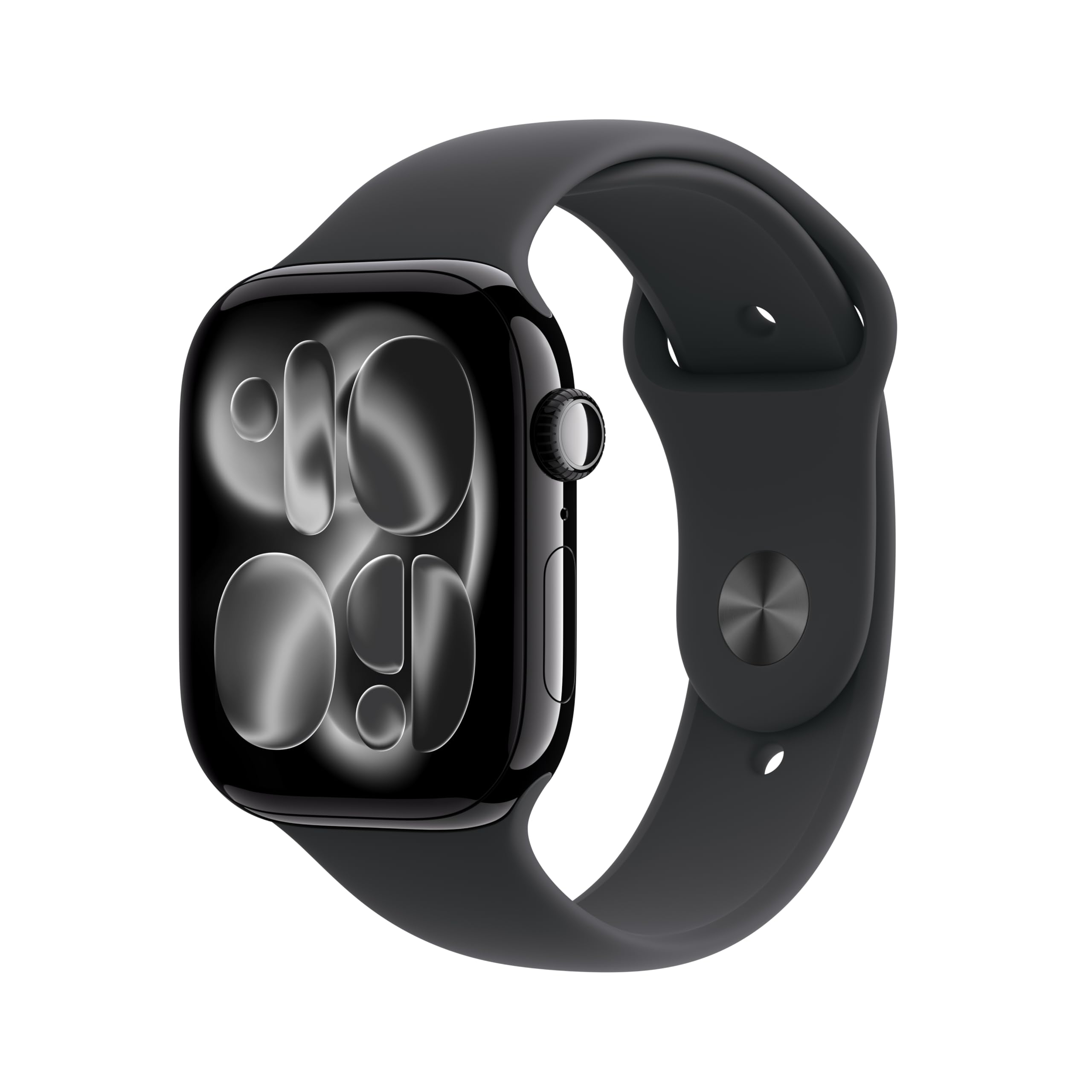
What you actually get at this lower price is a full-featured health tracker that can take an ECG (electrocardiogram — a reading of your heart’s electrical activity), monitor sleep apnea, and notify you of possible hypertension by analyzing how your blood vessels respond to your heartbeat. The always-on display is bright and durable, with 2x more scratch resistance than the Series 10. If you own an iPhone, the Apple Watch Series 11 is the easiest fitness watch to set up and use — it pairs instantly, shares data with Apple Health seamlessly, and lets you take calls, send texts, and use Siri from your wrist.
The big thing you have to give up with the Series 11 is battery life — it only lasts about 24 hours on a full charge, so you will charge it daily. The upside is fast charging: 15 minutes gives you 8 hours of normal use, so a quick top-up while showering can get you through the day. Weighing just 1.28 ounces, it is comfortable for sleep tracking and daily wear. Customers note that it is a “good upgrade from previous Apple watch series” with a “bigger, larger screen” that makes reading data easy.
The Apple Watch Series 11 is ideal for anyone deeply embedded in the Apple ecosystem — it offers the best app selection, third-party accessory support, and seamless integrations with iPhone, AirPods, and Mac. If you are not an iPhone user, though, it will not work, so steer toward the Amazfit or Garmin options instead. This is the exact budget buyer it is perfect for: an iPhone owner who wants the most seamless smartwatch experience and is willing to charge daily in exchange for deep ecosystem integration.
Why we’d pick it
- ECG, sleep apnea detection, and hypertension notifications for advanced health monitoring
- Seamless pairing and integration with iPhone and the Apple ecosystem
- Fast charging — 15 minutes gives 8 hours of normal use
- Always-on display with 2x more scratch resistance than Series 10
A few caveats
- 24-hour battery requires daily charging
- Only works with iPhone; no Android compatibility
6. Apple Watch Ultra 3
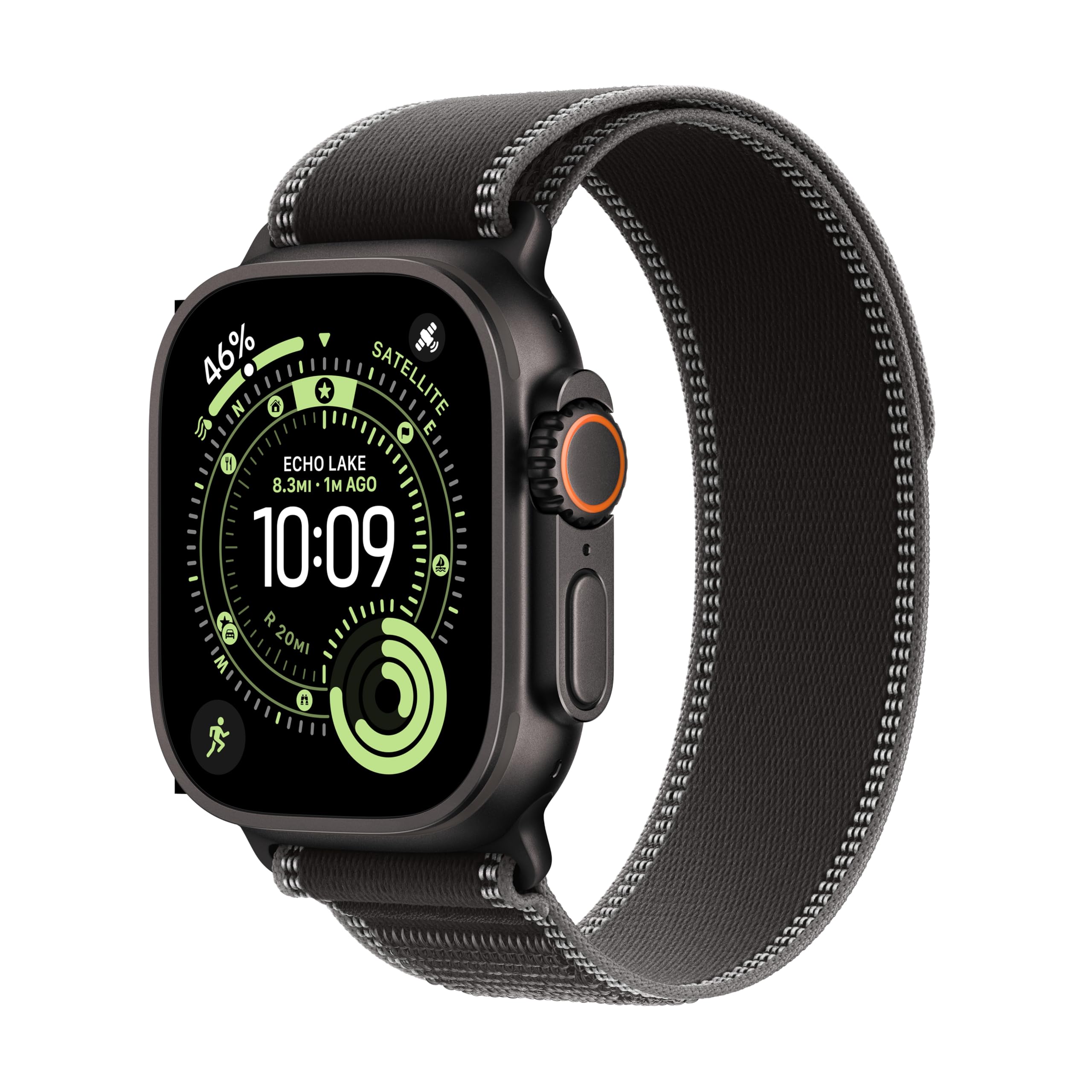
The Apple Watch Ultra 3 is perfect for the extreme athlete or adventurer who runs ultramarathons, dives to 100 meters, hikes in remote areas, or engages in high-speed water sports — its 49mm titanium case with sapphire crystal display is built for those conditions, with water resistance double the rating of the Amazfit Active Max. Battery life reaches 42 hours of normal use (72 hours in Low Power Mode), a big leap from the Series 11’s 24 hours — one buyer mentioned the battery was “nearly double” their previous Series 10.
The feature that serves the adventurer best is satellite communication: if you lose cell service, you can text emergency services via satellite to get help. The precision dual-frequency GPS tracks your location with extreme accuracy, whether you are in a dense forest or between tall buildings. The customizable Action Button lets you start a workout, turn on the flashlight, or mark a trail point with a single press. At 2.24 ounces, it is noticeably heavier than the COROS PACE 4, but the titanium case keeps it surprisingly comfortable for a 49mm watch.
The one honest limit is the price, which is the highest in this comparison by a wide margin — if you do not need satellite texting, 100-meter water resistance, or multi-day battery for extreme expeditions, the Apple Watch Series 11 or the Garmin Forerunner 165 will serve you better for daily fitness tracking.
Strong points
- 42-hour battery life (72 hours in Low Power Mode) for multi-day adventures
- Satellite communication for texting emergency services without cell service
- 100-meter water resistance for diving and high-speed water sports
- Precision dual-frequency GPS for accurate outdoor tracking
Before you buy
- Highest price in the comparison; overkill for casual daily fitness tracking
- Heavier than many dedicated fitness watches at 2.24 ounces
Understanding the Specs
AMOLED vs MIP Displays
The display type determines how you see your data in different lighting. AMOLED (Active Matrix Organic Light Emitting Diode) screens — found on the Amazfit Active Max, Garmin Forerunner 165, COROS PACE 4, Apple Watch Series 11, and Apple Watch Ultra 3 — produce vibrant colors and deep blacks, making data easy to read indoors and in low light. MIP (Memory-In-Pixel) displays, like the one on the Garmin Instinct E, are less colorful but stay very readable in direct sunlight and consume much less power, extending battery life. For most indoor use, AMOLED is better; for constant outdoor use, MIP is the practical choice.
GPS Accuracy and Multi-GNSS
GPS (Global Positioning System) is the core of any fitness watch for outdoor tracking. Multi-GNSS means the watch can connect to multiple satellite systems (like GPS, GLONASS, Galileo, and BeiDou) for faster and more accurate location locking. The COROS PACE 4 and Apple Watch Ultra 3 feature dual-frequency GPS, which uses two different radio frequencies to cancel out signal errors from the atmosphere — this means better accuracy under tree cover or near tall buildings. The Amazfit Active Max uses five satellite systems, which gives solid accuracy for most runners and hikers.
Water Resistance Ratings
The water resistance rating tells you how much water exposure the watch can handle. 5 ATM (like the Amazfit Active Max) means it is tested to a pressure equivalent to 50 meters, so it is fine for swimming, showering, and light water sports. 10 ATM (like the Garmin Instinct E at 100 meters and the Apple Watch Ultra 3 at 100 meters) means it is suitable for high-speed water sports, snorkeling, and even shallow diving. The Apple Watch Series 11 is rated to 50 meters, which covers swimming but not more extreme water activities.
Battery Capacity and Real-World Life
Battery capacity is measured in milliamp hours (mAh), but the real-world battery life depends heavily on how you use the watch. The Amazfit Active Max’s 200 mAh battery delivers 24 days because of efficient power management and its lower-power AMOLED screen. The Garmin Instinct E’s larger 300 mAh battery provides 16 days because its MIP display uses less power. The Apple Watch Ultra 3’s 42-hour battery is roughly 1.75x longer than the Apple Watch Series 11’s 24 hours, but both are still daily-charge devices compared to the multi-week watches.
FAQ
Which fitness watch has the longest battery life on Amazon?
Are Garmin watches better than Amazfit for running?
Can I use an Apple Watch without an iPhone?
Final Thoughts: The Verdict
If you want one dependable pick, the fitness watch on amazon winner is the Amazfit Active Max because it combines a 24-day battery, a brilliant 1.5-inch AMOLED display, and comprehensive health tracking at a mid-range price. If you want a rugged watch for outdoor adventures and superior water resistance, grab the Garmin Instinct E. For the best running-specific training tool with recovery insights, choose the Garmin Forerunner 165.