
You just made a perfect cut — except for that ragged, chipped edge staring back at you from your freshly sawn board. That ruined workpiece is the difference between a blade that delivers smooth, splinter-free results and one that doesn’t. This guide focuses on the exact specs that give you glass-smooth finishes from your compact table saw.
I’m Min — the co-founder and writer behind Gadgets Feed. This guide is built by comparing the manufacturers’ published specifications and the patterns across verified customer reviews, so you get each pick’s real strengths and trade-offs instead of marketing spin.
Whether you are building cabinets, laying laminate flooring, or breaking down plywood sheet goods, you need a blade that makes precise, chip-free cuts without burning the wood. Here are the best options for an 8 1/4 table saw blade that will actually deliver on its promises.
How To Choose The Best 8 1/4 Table Saw Blade
Picking the right blade for your saw does not require a degree in metallurgy, but a few key numbers will tell you everything about how the blade will perform. Here is what to focus on.
Tooth Count: The Smoothness Dial
The number of teeth a blade has is its primary control for cut quality. A blade with 24 teeth is built for speed — ripping boards along the grain with fast, aggressive cuts, but it leaves a rougher surface. A blade with 40 teeth is the general-purpose sweet spot offering a decent finish for most jobs. For fine finish work like crosscuts on plywood or cutting melamine, you want 60 or even 80 teeth, which produce a much smoother edge with minimal to zero chipping.
Carbide Tips and Coatings: The Durability Factor
Not all carbide (an extremely hard and wear-resistant material at the tooth tip) is the same quality. Look for C4 micro-grain carbide or TiCo Hi-Density Carbide — these stay sharper for longer than standard carbide. A non-stick coating like Perma-SHIELD is also a huge advantage because it prevents pitch and resin from wood from building up on the blade, which causes friction, heat, and eventually burning the wood you cut.
Kerf Thickness: The catch Between Speed and Stability
The kerf is the width of the cut the blade makes, essentially the thickness of the blade body. A thin kerf blade (like 0.079 inches or thinner) removes less material, meaning your saw’s motor faces less resistance. This is great for battery-powered saws or simply making faster cuts. The downside is that a thinner blade can flex or deflect during a cut, which is where anti-vibration stabilizer vents and a laser-cut body come into play to keep it stiff and accurate.
Quick Comparison
On smaller screens, swipe sideways to see the full table.
| Model | Category | Best For | Key Spec | Amazon |
|---|---|---|---|---|
| Diablo D0860X | Premium | Ultra-smooth fine finish on hardwoods and plywood | 60 ATB Teeth, TiCo Carbide | Amazon |
| Diablo D0840X | Premium | All-around smooth cuts on jobsites | 40 ATB Teeth, Perma-SHIELD | Amazon |
| Norske NCSBP272 | Premium | Ultra-smooth melamine and laminate cuts | 60 ATB Teeth, 35° Bevel | Amazon |
| Makita D-21521 | Mid-Range | Ripping boards and heavy framing work | 24 Teeth, 5/8″ Arbor | Amazon |
| SHUZIYU 80T | Value | Ultra-fine cuts on laminates and veneers | 80 ATB Teeth, Anti-Stick | Amazon |
| FOXBC 60T | Budget | Budget-friendly finish cuts on plywood and decking | 60 ATB Teeth, Thin Kerf | Amazon |
In‑Depth Reviews
1. Diablo D0860X 60-Tooth Fine Finish Blade
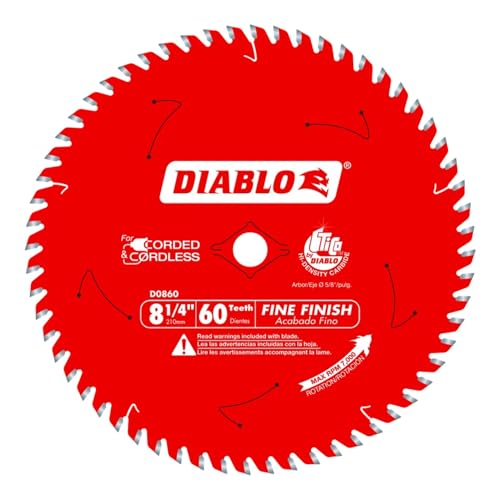
60 teeth in an ATB grind with TiCo Hi-Density Carbide tips make the Diablo D0860X the top pick for anyone who cuts plywood, birch, or walnut and demands a finish so clean it looks like it came off a factory edge without needing sanding.
Its Perma-SHIELD non-stick coating prevents resin buildup, so you do not get burn marks on your workpiece even after prolonged use. The laser-cut stabilizer vents in the body reduce vibration, keeping the blade cool and stable, and the super thin kerf design (just 0.05 inches thick) minimizes resistance so your saw motor works less hard. Buyers report that it cuts 1/4-inch plywood perfectly with zero chipping, producing a laser-like finish.
The only honest limit is the thin kerf itself — if you are doing rough framing or high-volume ripping of thick, nail-embedded lumber, a thicker blade might feel more resilient. For every fine-finish job, this is the one to reach for.
Why it’s great
- Zero chipping on plywood and melamine with its 60 ATB teeth
- TiCo Hi-Density carbide tips provide exceptional edge life
- Perma-SHIELD coating prevents heat and gumming
- Laser-cut stabilizer vents keep cuts accurate and quiet
Good to know
- Thin kerf may flex slightly under heavy force
- Premium price compared to commodity blades
2. Diablo D0840X 40-Tooth Finishing Saw Blade

Compared to the top-pick 60-tooth D0860X, the D0840X trades some ultra-fine finish specialization for speed and versatility: its 40 ATB teeth cut faster and handle everything from ripping framing lumber to crosscutting plywood, while still delivering a smooth, splinter-free result.
The TiCo Hi-Density Carbide is the same high-quality material as its more expensive sibling, just arranged across fewer teeth. The super thin laser-cut kerf and Perma-SHIELD non-stick coating are present here too, providing heat protection and durability. Owners mention that Diablo is one of the best blades out there, especially for wet or treated wood, and that it works great for all types of cutting tasks.
Choose the D0840X over the D0860X if your work is a mix of rough ripping and finish cuts, or you run a cordless saw and want less motor strain. One buyer did mention the red paint transfers to the material slightly, needing sanding, but overall they were still happy and would repurchase.
Where it shines
- Versatile 40-tooth count handles ripping and crosscutting well
- TiCo Hi-Density Carbide for long edge life
- Perma-SHIELD coating prevents gumming and corrosion
- Thin kerf reduces motor load on cordless saws
Worth noting
- Red paint coating may transfer to cut edges on light-colored wood
3. Norske Tools NCSBP272 60-Tooth Melamine Plus Blade

If you’re cutting melamine, laminate, or laminate flooring day in and day out, the Norske NCSBP272 is built exactly for that purpose. It features a special 35-degree high ATB (Alternate Top Bevel) tooth design — a steeper angle than standard finish blades — that slices through coated materials by shearing the brittle surface layer before the main body of the tooth hits it.
The C4 Micro-grain carbide tips are precision sharpened on all four sides, not just the face, which extends the useful life of the blade. Its laser-cut body includes anti-vibration and expansion slots to keep the blade running quietly and true even through thick laminates. Buyers confirm it delivers accurate, efficient cuts on 14mm laminate flooring and made it a breeze to break down melamine sheets without worrying about chip out.
One buyer did note that the blade dulled near the very end of a whole-house flooring project, which is a realistic lifespan for this specialty use — and with a 35-degree ATB, it’s the sharpest angle in this guide for shearing coated surfaces clean.
What stands out
- 35° ATB grind is specifically optimized for melamine and laminate
- C4 Micro-grain carbide tips precision sharpened on all sides
- Anti-vibration slots reduce noise and improve cut quality
- Laser-cut body provides stable, accurate cuts
The trade-offs
- Primarily a finishing blade — not ideal for ripping thick lumber
- May dull faster on high-volume flooring projects
4. Makita D-21521 24-Tooth Saw Blade
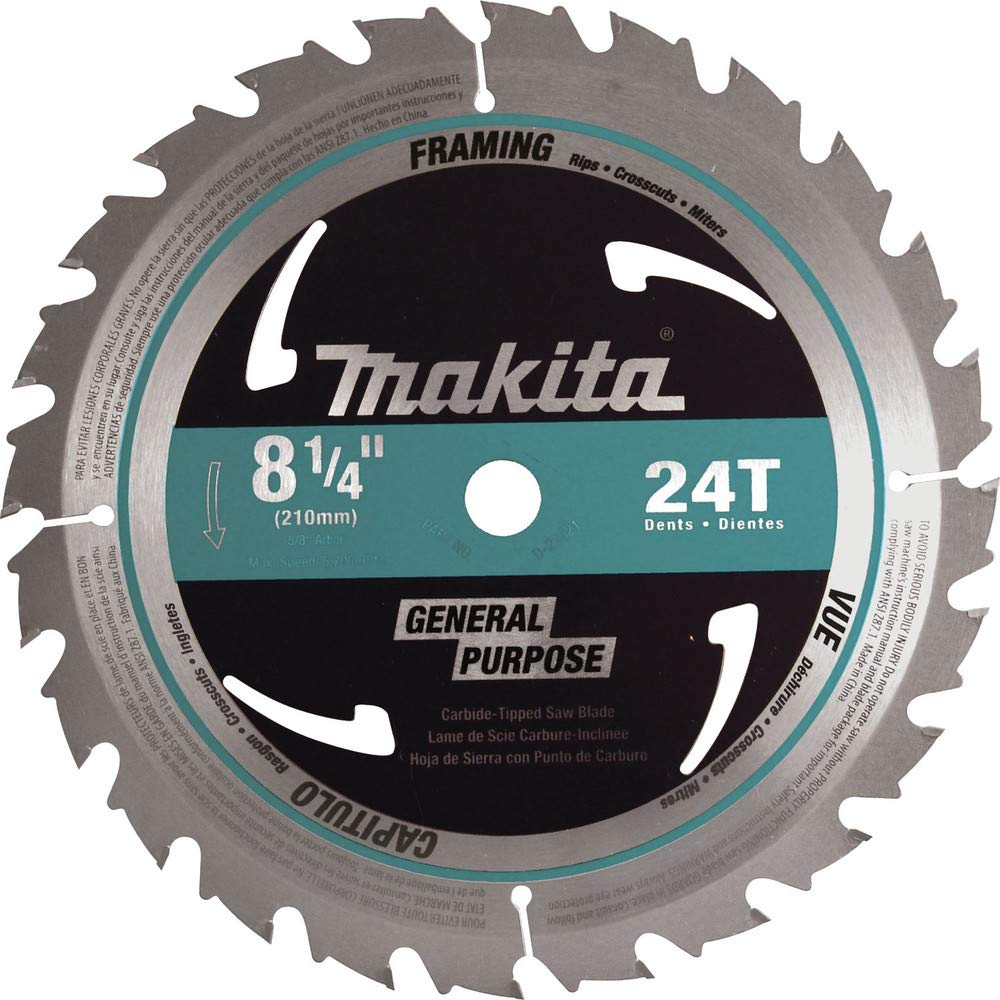
In this category, the single number that matters most is the tooth count, and the Makita D-21521 scores a 24-tooth count, placing it at the opposite end from finishing blades. With an aggressive 20-degree hook angle, this blade is designed for speed, not finish.
The trade-off you accept is a rough cut edge that will need sanding or jointing afterward — this is not a blade for cabinet-grade plywood. Buyers confirm it does not flex or warp under stress when ripping boards, and it runs smoothly on a table saw.
The price-to-value here is strong if you already own the 60-tooth finishing blade above and need a dedicated ripping companion. Makita’s construction is solid, and the carbide tips hold up well under heavy work.
The upsides
- 24 teeth with a 20° hook angle deliver fast, aggressive ripping
- Carbide tips are sharp and durable under heavy use
- Does not flex or warp even under stress
- Reliable Makita build quality
Keep in mind
- Rough finish requires additional sanding or jointing
- Not suitable for fine crosscuts or sheet goods
5. SHUZIYU 80-Tooth Circular Saw Blade

At an entry-level price point, the SHUZIYU 80-tooth blade gives you the highest tooth count in this comparison — 80 ATB teeth — which is normally a feature reserved for premium-grade finishing blades. For the price, you get a blade designed to cut materials like laminate, veneer, hardwood plywood, MDF, and HDF with a remarkably smooth finish.
What you give up is the longevity of the carbide tips. One reviewer noted it is less durable than other blades, but praised its clean cuts on both sides of melamine when using a scoring pass. The electroplate black anti-stick coating helps prevent rust and keeps the blade running smoothly. Another reviewer raved that it cuts laminate flooring “like butter — precise, smooth, and easy feed” on a table saw with extremely quiet operation.
This is the perfect pickup for the DIYer or hobbyist who does not cut sheet goods every day but wants a near-professional finish when they do. If you are a pro running high volumes, the edge life may not satisfy, but for weekend project work, the finish quality per dollar is unmatched.
Why we’d pick it
- 80 ATB teeth produce an ultra-smooth finish on laminates and veneers
- Anti-stick coating prevents rust and keeps cuts clean
- Extremely quiet operation on table saw
- Great value for finishing cuts
A few caveats
- Carbide is less durable than premium blades
- Not as effective for ripping thick boards
6. FOXBC 60-Tooth Fine Finish Blade

This blade is perfect for the budget-conscious woodworker who wants premium finishing-blade performance without the premium price tag. On a pure price-to-features basis, the FOXBC 60-Tooth stands out because it packs the same 60-tooth count as premium finishing blades into a very accessible price. You get high-density tungsten carbide tips, an ultra-thin kerf of 0.079 inches (just 2.0mm wide), and a 5/8-inch arbor with diamond knockout to fit a wider range of saws.
What that money actually gets you is a blade that handles hardwood, softwood, and plywood with zero tear-out according to buyers, who noted “excellent blade — ripping and crosscutting on a table saw using a sled to make miters — zero tear-out and smooth cuts.” The thin kerf means less waste and less strain on your saw motor, making it a great match for compact table saws with less torque.
The one reason to choose the FOXBC over the rest of the field is pure value — if you need a solid finishing blade for jobsite work like cutting decking, fascia, OSB, and stacked plywood without spending a premium, this is the blade that delivers a surprising cut quality for the investment. Just keep in mind that its ultra-thin kerf can be more prone to deflection in very thick or dense hardwoods than a full-kerf blade.
Strong points
- 60 ATB teeth deliver smooth, tear-out-free cuts
- Ultra-thin kerf (0.079″) reduces motor strain and waste
- High-density tungsten carbide for durability
- Excellent price-to-performance ratio
Before you buy
- Thin kerf may not be as durable as thicker blades for rough work
- Not recommended for high-volume commercial use
Understanding the Specs
ATB (Alternate Top Bevel) Tooth Grind
This is the most common tooth geometry for woodworking blades. The teeth alternate between tipping left and right at the top, much like shearing scissors. This alternating bevel creates a slicing action that cuts across wood fibers cleanly instead of ripping them, which is why ATB blades are your go-to for crosscuts, plywood, and melamine with minimal chipping on the surface edge.
Thin Kerf vs. Regular Kerf
The kerf is the width of the cut the blade makes — the amount of wood it turns into sawdust. A thin kerf blade (under 0.087 inches or about 2.2mm) removes less material, which means less resistance and heat. This is especially helpful for lower-horsepower table saws, as the motor does not have to work as hard. One limitation is that thin blades can deflect more easily, which is why high-end designs add stabilizer vents.
FAQ
Can I use an 8 1/4-inch blade on a saw designed for a 10-inch blade?
What is the diamond knockout on the arbor of some blades?
How many teeth do I need for cutting laminate flooring?
Can I sharpen an 8 1/4 table saw blade at home?
Final Thoughts: The Verdict
When it comes down to it, the 8 1/4 table saw blade winner is the Diablo D0860X because its 60 TiCo Hi-Density carbide teeth and Perma-SHIELD coating deliver flawless finish cuts on everything from plywood to walnut, with no chipping or burning. If you want a versatile blade that handles ripping and crosscutting on the jobsite, grab the Diablo D0840X. And for the best value on a finishing blade that punches well above its price, the standout is the FOXBC 60-Tooth for weekend projects and DIY builds.