
Getting clean, loud sound from your speakers starts with one piece of gear — a 2-channel power amplifier. But pick the wrong one, and you will battle muddy audio, a buzzing fan that drowns out quiet scenes, or a channel that cuts out mid-show. You need an amp that delivers real, continuous power (RMS, the wattage the amp can sustain) to your passive speakers without draining your wallet on inflated peak wattage numbers that vanish when you crank the volume.
I’m Min — the co-founder and writer behind Gadgets Feed. This guide is built by comparing the manufacturers’ published specifications and the patterns across verified customer reviews, so you get each pick’s real strengths and trade-offs instead of marketing spin.
Whether you need raw output for a loud venue or audiophile-grade detail for your living room, these picks cut through the confusion to help you find the right 2-channel power amplifier for your exact setup.
How To Choose The Best 2-Channel Power Amplifier
Picking the right amp is about matching your speakers’ needs to the amp’s real output without overpaying for peak wattage numbers. Here are the three things to get right.
RMS Power vs. Peak Power: Ignore the Bloat
Peak power is the absolute maximum an amp can hit in a split second, but RMS (continuous, sustainable power) is what you actually hear during a song or a movie. Match the amp’s RMS rating at your speaker’s ohm load (4 ohms or 8 ohms) to the speaker’s program rating, not its peak. A 1400-watt RMS amp like the Rockville D12 will drive a 500-watt RMS speaker cleanly and loudly; a 5000-watt peak claim on the box means nothing about sustained, clean output.
Class D vs. Class AB: Heat, Weight, and Sound
Class D amps use switching technology that runs cool and light — the Crown XLS1002 weighs 8.6 pounds and barely gets warm. Class AB amps like the Monolith deliver a more traditional, linear signal with potentially richer harmonic detail but run hot and heavy (that Monolith weighs 48 pounds). For portable PA use or rack-mounted gear on tour, Class D is the practical choice. For a dedicated listening room where you want every last ounce of sonic purity and don’t mind the heat, Class AB wins.
Fan Noise: The Overlooked Dealbreaker
The loudest thing in your system might not be the music — it might be the cooling fan. Amps like the Gemini XGA-5000 run constant fans at full speed regardless of temperature, which buyers report is a problem in quiet rooms. The Crown XLS1502, by contrast, has a temperature-controlled fan that barely spins during normal use. If your amp will sit in a living room, a home theater cabinet, or a studio control room, prioritize an amp with a quiet, variable-speed fan.
Quick Comparison
On smaller screens, swipe sideways to see the full table.
| Model | Category | Best For | Key Spec | Amazon |
|---|---|---|---|---|
| Crown XLS1502 | Mid-Range/Pro | Home theater & live sound | 525W RMS per channel at 4 ohms | Amazon |
| Monolith Two-Channel | Premium/AB | Audiophile stereo systems | 200W per channel at 8 ohms (Class AB) | Amazon |
| Rockville RPA16 | Mid-Range/Pro | High-SPL live sound & subs | 1500W RMS per channel at 4 ohms | Amazon |
| Crown XLS1002 | Value/Pro | Small PA & home stereo | 350W RMS per channel at 4 ohms | Amazon |
| Marantz MM7025 | Premium/Audiophile | High-end home theater | 140W per channel at 8 ohms | Amazon |
| Gemini XGA-5000 | Budget/High-Power | Large PA & DJ rigs | 5000 watts peak (2500W per channel at 4 ohms) | Amazon |
| Rockville D12 | Budget/Compact | Portable DJ & backline use | 700W RMS per channel at 4 ohms | Amazon |
| Sound Town UPDM-D3 | Budget/Compact | Rack-mount installation | 1150W RMS per channel at 4 ohms | Amazon |
In‑Depth Reviews
1. Crown XLS1502

The Crown XLS1502 earns the top spot because it gives you 525 watts of continuous RMS power per channel at 4 ohms in a lightweight 8.6-pound Class D chassis — and you get clean, reliable output for both home theater and live sound without needing a second person to lift it. A built-in DSP (digital signal processor, a chip that manages filters and protection) lets you set per-channel crossover points (low or high pass) and Peakx limiters (automatic volume cuts to prevent speaker damage). Owners mention that the variable-speed fan barely ever spins at normal home listening levels, a relief compared to constant-fan amps like the Gemini XGA-5000.
At 525W RMS per channel (4 ohms) it delivers 50 percent more continuous power than the Crown XLS1002’s 350W RMS, making it a smarter step-up if you want headroom for dynamic peaks. Reviewed by customers as running cool with a very low noise floor — 6 dB lower than the previous generation, per verified reviews — so you hear your music, not the amp. The catch: the low-pass filter (which sends bass to a subwoofer) is less effective below 35 Hz, so purists chasing deep sub-bass may want a dedicated subwoofer amp.
Need the most versatile, well-rounded 2-channel amp for real-world use? This is it.
Why it’s great
- 525W RMS per channel at 4 ohms in a light 8.6-lb rackmount chassis
- Quiet, temperature-controlled fan with minimal turn-on pop
- Flexible DSP with crossover, limiters, and sleep mode
Good to know
- Low-pass filter less effective below 35 Hz for deep sub-bass
- Lacks dedicated 2-zone outputs — all speakers must share one wiring pair
2. Monolith Two-Channel Stereo Power Amplifier

While the Crown XLS1502 is lightweight, the Monolith Two-Channel delivers Class AB brute force — 200 watts per channel into 8 ohms with no current-limiting circuitry in the signal path. This means your power-hungry speakers (like Dynaudio or Magnepan) get every watt without electronic “coloration” that can alter sound. Customers note it drives demanding speakers effortlessly and stays cool to warm even during long sessions.
Reviewers point out it outperforms amps at five times its price in resolution and soundstage depth. With a signal-to-noise ratio (SNR, a measure of hiss and hum the amp adds) above 120 dB, quiet musical passages and explosive dynamic swings are equally clear — one reviewer noted it sounded “less forward, more natural” than their Denon AVR’s internal amplification, with a noticeably wider soundstage. The downside: at 48 pounds, this needs two people to rack-mount safely, and a handful of shoppers say a ground-loop hum that requires an isolator or dedicated power conditioner.
Choose the Monolith Two-Channel over the Crown XLS1502 if you are building a no-compromise stereo listening room and value Class AB purity over the Crown’s lighter weight and simpler integration into most home theater systems.
Where it shines
- True 200W RMS per channel at 8 ohms, no current limiting
- Class AB design with 120 dB+ SNR for audiophile-grade detail
- Massive toroidal transformer delivers clean, sustained power
Worth noting
- Very heavy at 48 pounds; needs two people to rack-mount
- Some units may introduce ground-loop hum requiring a power conditioner
3. Rockville RPA16

You are a DJ or live-sound engineer setting up for a packed 500-capacity club, and you need an amplifier that can drive two 18-inch subwoofers so hard the floor shakes. The Rockville RPA16 delivers 2 x 1500 watts RMS at 4 ohms and can bridge to a single 3000-watt RMS channel at 8 ohms — that is three times the continuous power of the Rockville D12’s 1400 watts RMS total. Buyers report this amp powers those subs so hard it “earthquakes the whole basement.”
The integrated LCD display shows volume per channel in dB and real-time operating temperature, giving you precise control that DJs and sound engineers use on the fly. Owners mention it runs loud bass without overheating even after a full six-hour gig — critical if you rely on this amp for a paid show. At 40.8 pounds, that weight signals the large toroidal transformer inside that delivers sustained current. However, the fan gets noticeably loud when pushing bass-heavy material, so this is a stage amp, not a quiet living-room amp.
If your priority is maximum clean RMS power for subs or PA mains and you have rack space, the RPA16 delivers more real-world output than any comparably priced amp here — 3000 watts bridged at 8 ohms, continuous.
What stands out
- 1500W RMS per channel at 4 ohms, bridgeable to 3000W RMS mono
- Real-time LCD display for dB level and temperature monitoring
- Proven reliability through long gigs without overheating
The trade-offs
- Fan noise is significant under high bass load
- Very heavy at 40.8 pounds — not a portable grab-and-go amp
4. Crown XLS1002

The single number that matters most in this category is watts per channel at 4 ohms, and the Crown XLS1002 delivers 350 watts RMS — enough to drive most bookshelf or floorstanding speakers to live-performance levels in a medium room, without the weight and heat of a Class AB amp. For a home theater setup or small PA rig, this is Crown’s pro-grade reliability at the most accessible price point.
The trade-off is power headroom versus the XLS1502: 350W RMS vs 525W RMS means you lose about a third of the power, so you will run out of clean volume sooner with inefficient speakers or subwoofers. Customers note it benefits from a pre-amp line driver (like the Rolls Pro Match 15b) if paired with a consumer AV receiver, because the amp’s input sensitivity is set for pro-level signals.
It weighs just 8.6 pounds, runs almost silent with a variable-speed fan, draws very little power in standby, and offers a PureBand crossover system, Peakx limiters, and both XLR and RCA inputs. It is the budget-friendly buy that genuinely sounds good and lasts through years of use — for its price, phenomenal value.
The upsides
- 350W RMS per channel at 4 ohms in a lightweight 8.6-lb chassis
- Quiet variable-speed fan with minimal turn-on pop
- Built-in DSP, crossover, and Peakx speaker protection
Keep in mind
- May require a pre-amp line driver for full volume with consumer AVRs
- Less power than the XLS1502 — not ideal for very large venues or demanding subwoofers
5. Marantz MM7025
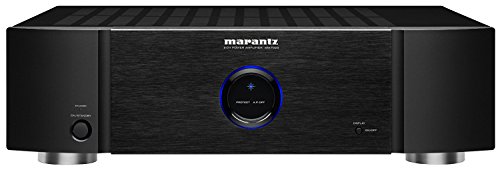
The Marantz MM7025 delivers 140 watts per channel into 8 ohms and a warm, musical sound that has made it a favorite among home theater enthusiasts wanting audiophile-grade stereo output. It accepts both single-ended RCA and balanced XLR inputs, so you can connect it to a high-end preamp or AV receiver without signal loss.
Reviewers consistently praise its ability to improve clarity, balance, and depth over a standard AV receiver’s internal amplification — one buyer mentioned it brought “110% improved clarity and depth” when added to a Denon AVR. The cooling fan is virtually silent even when it speeds up, so no buzzing during quiet movie scenes. With a depth under 14 inches, it fits neatly into standard AV cabinets. The honest limit: a few critical listeners found the sound “muddy” with poor soundstage depth compared to high-end separates, likely from units used for critical music listening rather than home theater. For a dedicated music system needing analytical detail, the Monolith’s Class AB design offers more raw current.
For a premium home theater needing clean, musical power for front channels, the Marantz MM7025 is a refined choice — perfect for the budget buyer who prioritizes tonal warmth and silent operation over raw wattage numbers.
Why we’d pick it
- Warm, musical 140W per channel at 8 ohms from a respected audiophile brand
- Both RCA and balanced XLR inputs for flexible system integration
- Nearly silent cooling fan — perfect for living room or home theater
A few caveats
- Less raw power and current than the Monolith for demanding speaker loads
- A minority of critical listeners find the sound slightly muddy compared to purist Class AB designs
6. Gemini XGA-5000

The Gemini XGA-5000 is for DJs and sound engineers who need maximum peak power at a budget price — it claims 6000 watts peak output and delivers a serious 5000 watts peak into 4/8 ohm loads, making it common for large PA systems where volume matters more than nuance. At 25.3 pounds, it is 61 percent lighter than the Rockville RPA16’s 40.8 pounds, a real benefit when loading gear into a venue.
The front-to-rear fan system keeps it running reliably during long outdoor events, and XLR, 1/4-inch TRS, and RCA inputs plus three Speakon outputs give flexible connectivity for any pro sound rig. A limiter and DC output protection help safeguard speakers at high volume.
For the budget-focused buyer who needs maximum wattage for live sound and does not care about fan noise, the XGA-5000 delivers — but the constant fan roar makes it unsuitable for any room where you want to hear quiet passages. This is a brute-force PA amp, not a living room component. However, buyers consistently report a major issue: “Fans run at 100% constantly, not temperature-controlled,” which makes this amp genuinely loud in quiet environments.
Strong points
- Extreme 6000-watt peak output at a budget-friendly price
- Light 25.3-lb weight for its power class (61% lighter than RPA16)
- Flexible XLR, 1/4″, and RCA inputs with Speakon outputs
Before you buy
- Fans run at 100% speed constantly — very loud in quiet rooms
- Packaging and build quality can be inconsistent per buyer reports
7. Rockville D12

The Rockville D12 delivers 1400 watts RMS total (700W RMS per channel at 4 ohms) in a lightweight 9.7-pound Class D chassis — that is nearly double the continuous power of the Crown XLS1002 at a lower weight. The built-in LCD display shows you volume in dB per channel and operating temperature, giving real-time feedback most amps in this bracket lack.
Reviewers point out it powers 400-watt PA speakers cleanly for eight-hour events without overheating, and one owner reported it “makes bass hit three times louder” than two separate older amps while drawing less power. The switchable crossover (bypass, 80Hz, 160Hz) lets you use it for full-range or subwoofer duty without an external crossover. The honest limit is build quality — some shoppers say misaligned rack ears and jammed XLR inputs, suggesting fit and finish is inconsistent.
Choose the D12 if you want lightweight, high-efficiency Class D power for a portable rig and are comfortable inspecting your unit on arrival.
What we like
- 1400W RMS total power in a lightweight 9.7-lb Class D chassis
- Built-in LCD display shows dB levels and temperature
- Switchable crossover (80Hz/160Hz) for subwoofer or full-range use
The downsides
- Build quality can be inconsistent — rack ears and XLR jacks may be misaligned
- Some units have a noticeable low-frequency hum
8. Sound Town UPDM-D3
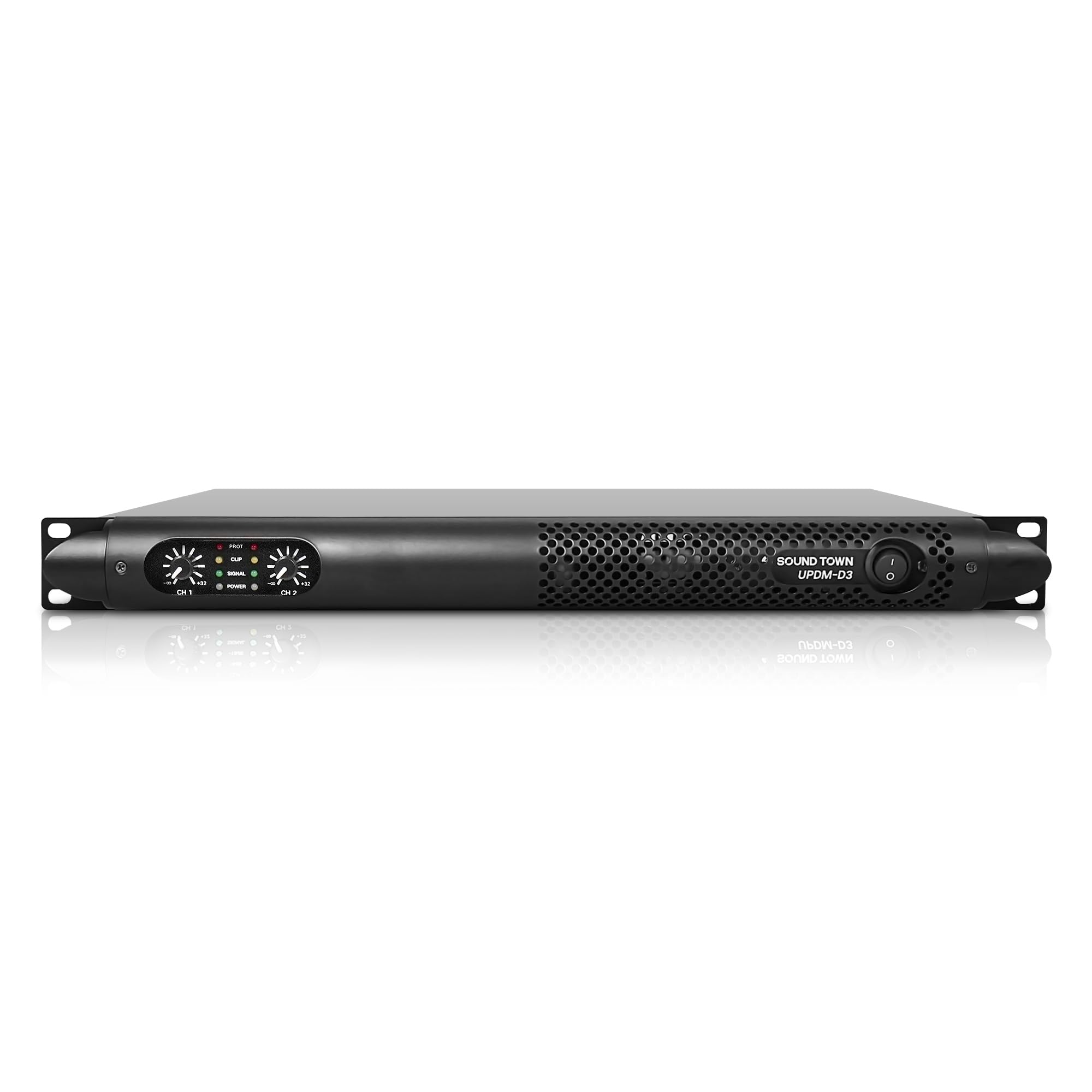
The Sound Town UPDM-D3 is the most space-efficient option — it delivers 2 x 1150 watts RMS at 4 ohms in a slim 1U rackmount chassis (about 1.75 inches tall), making it ideal for installation work where rack space is tight.
What that money gets you is a Class D design with XLR inputs, Speakon outputs, and STEREO/PARALLEL/BRIDGE switching for flexible routing. The integrated low-pass filter (LPF) lets it handle subwoofer duty cleanly. However, build quality is the weak point — one buyer received a unit with a broken power switch, describing it as “cheaply made.” The fans are also noticeably loud, with multiple buyers mentioning they need to be swapped for quieter alternatives. Choose the Sound Town if you absolutely need a 1U-height amp and accept rougher edges on fit and finish.
For most live sound or home theater users, the extra half-rack unit of height on the Rockville D12 offers more reliable build and better overall value.
Why it’s great
- 1150W RMS per channel at 4 ohms in a compact 1U rackmount size
- Flexible STEREO/PARALLEL/BRIDGE switching and built-in LPF
- Very lightweight for convenient rack installation
Good to know
- Build quality is inconsistent — some units arrive with broken switches
- Loud fans that many buyers recommend swapping out
Understanding the Specs
RMS Power (Continuous Power)
RMS (Root Mean Square) is the amount of power an amplifier can deliver continuously without distortion. This is the number that matters for matching speakers — if your speaker is rated for 500 watts RMS, you want an amp that delivers about 500 to 700 watts RMS per channel at that speaker’s impedance (4 or 8 ohms). Peak power claims are marketing numbers; always compare RMS to RMS.
Bridge Mode
Bridge mode combines both channels into a single, more powerful mono output. For example, a 2-channel amp rated at 500 watts RMS per channel at 4 ohms might produce 1400 watts RMS in bridged mono into 8 ohms. This is a trick for powering a single subwoofer with more wattage, but you must use speakers rated for the higher bridged load — and the amp must be bridgeable in the first place.
Signal-to-Noise Ratio (SNR)
SNR measures how much hiss, hum, or electronic noise the amp adds to your signal. A number like 100 dB means the music signal is 100 dB louder than the noise floor, so the amp is effectively silent. Numbers above 100 dB are good for pro audio; audiophile amps often claim 120 dB or more for dead-quiet backgrounds during quiet passages.
Class D vs. Class AB
Class D amps use switching transistors that run cool and efficient (like Crown XLS series) but can introduce a small amount of high-frequency switching noise. Class AB amps (like Monolith) use a linear design that produces warmer harmonic content and requires massive heatsinks or fans, making them heavy and hot. For live sound and home theater, Class D is fine; for dedicated stereo listening, purists prefer Class AB.
FAQ
What size 2-channel power amplifier do I need for my speakers?
Can I use a 2-channel amplifier for a subwoofer?
Why does my 2-channel amp have loud fans?
Final Thoughts: The Verdict
If you want one dependable pick, the best 2-channel power amplifier winner is the Crown XLS1502 because it offers the best balance of power (525W RMS per channel at 4 ohms), weight (8.6 pounds), quiet fan operation, and built-in DSP for both home theater and live sound. If you need maximum brute-force output for subs or a large PA system, grab the Rockville RPA16 — its 1500W RMS per channel at 4 ohms will shake any venue. And for audiophile-grade sonic purity with a traditional Class AB circuit, the standout is the Monolith Two-Channel if you have the rack space and a strong lifting partner.