
The fastest way to ruin a great trail ride is shaking, blurry footage that makes viewers dizzy instead of stoked. You need an action camera that cancels out vibrations from roots and rocks, keeps the horizon level when you lean into a turn, and survives a crash or a splash. This guide covers seven top options for mountain biking, focusing on stabilization, battery life, and mounting compatibility.
I’m Min — the co-founder and writer behind Gadgets Feed. This guide is built by comparing the manufacturers’ published specifications and the patterns across verified customer reviews, so you get each pick’s real strengths and trade-offs instead of marketing spin.
You need a camera that locks focus, kills vibration, and lasts the whole ride. After looking at specs and real rider feedback, here is the breakdown of the action camera for mountain biking that works on the trail.
How To Choose The Best Action Camera For Mountain Biking
Buying a camera for the trail is different than picking one for snorkeling or vlogging. The three specs that matter most are stabilization method, battery endurance, and how the camera attaches to your helmet or bars. Ignore marketing about “professional color science” if the camera shakes when you hit a rough section. Focus on these three things instead.
Stabilization: EIS vs. OIS vs. Horizon Lock
Electronic image stabilization (EIS — software and gyroscopes that smooth out vibration by cropping the edges of the frame) keeps your footage from looking like a washing machine run. On a mountain bike trail, you want a camera with advanced EIS (often called “RockSteady,” “HorizonSteady,” or “FlowState”) that actively corrects up to a 360-degree roll axis — so the camera can rotate fully and still keep the horizon level. Horizon Lock is a feature newer DJI and GoPro models have that keeps the horizon line perfectly level even if the camera rotates on its mount, which is huge for g-out landings and steep switchbacks.
Battery Life: Real-World Ride Time
Camera makers advertise maximum battery life in ideal lab conditions, which almost always means recording at lower resolutions with the screen off. On a bike ride, you are usually running 4K with stabilization and Wi-Fi turned on, which drains the battery faster. Look for cameras that offer at least two hours of real-world battery life in 4K to cover a typical afternoon ride. Many models now come in Adventure Combos with three batteries and a charging case, which is the safest way to ensure you don’t run out halfway down the trail.
Mounting and Durability
Your camera will get bumped, dropped, and caked in mud. A camera that needs a separate waterproof housing to survive a creek crossing is one more thing to break. Cameras with native waterproofing down to 33 feet (10 meters — the depth a camera can be submerged without a case) or more are ideal because you can mount them directly without a bulky case. Also check the mounting system — most use standard GoPro-style mounts, but some higher-end cameras have magnetic quick-release systems that make moving the camera between your helmet and handlebars faster at the trailhead.
Quick Comparison
On smaller screens, swipe sideways to see the full table.
| Model | Category | Best For | Key Spec | Amazon |
|---|---|---|---|---|
| DJI Osmo Action 6 Enhanced | Premium | Best overall trail footage | 8K video, Variable Aperture f/2.0–f/4.0 | Amazon |
| DJI Osmo Action 5 Pro | Premium | Longest battery life | 4K/120fps, 12h extended with 3 batteries | Amazon |
| GoPro HERO13 Black | Premium | Brand ecosystem and HyperSmooth stability | 5.3K HDR video, HyperSmooth 6.0 | Amazon |
| DJI Osmo Action 6 Bundle | Premium | Best value bundle with accessories | 8K video, 50GB built-in storage | Amazon |
| Insta360 Ace Pro 2 | Mid-Range | Low-light trail riding | 8K video, 1/1.3″ sensor, Leica lens | Amazon |
| AKASO Brave 7 LE | Mid-Range | Budget-friendly dual-screen riding | 4K30fps video, 131FT waterproof | Amazon |
| 4K Body Action Mini | Budget | First-time rider on a tight budget | 4K UHD video, 33FT waterproof | Amazon |
In‑Depth Reviews
1. DJI Osmo Action 6 Enhanced Combo
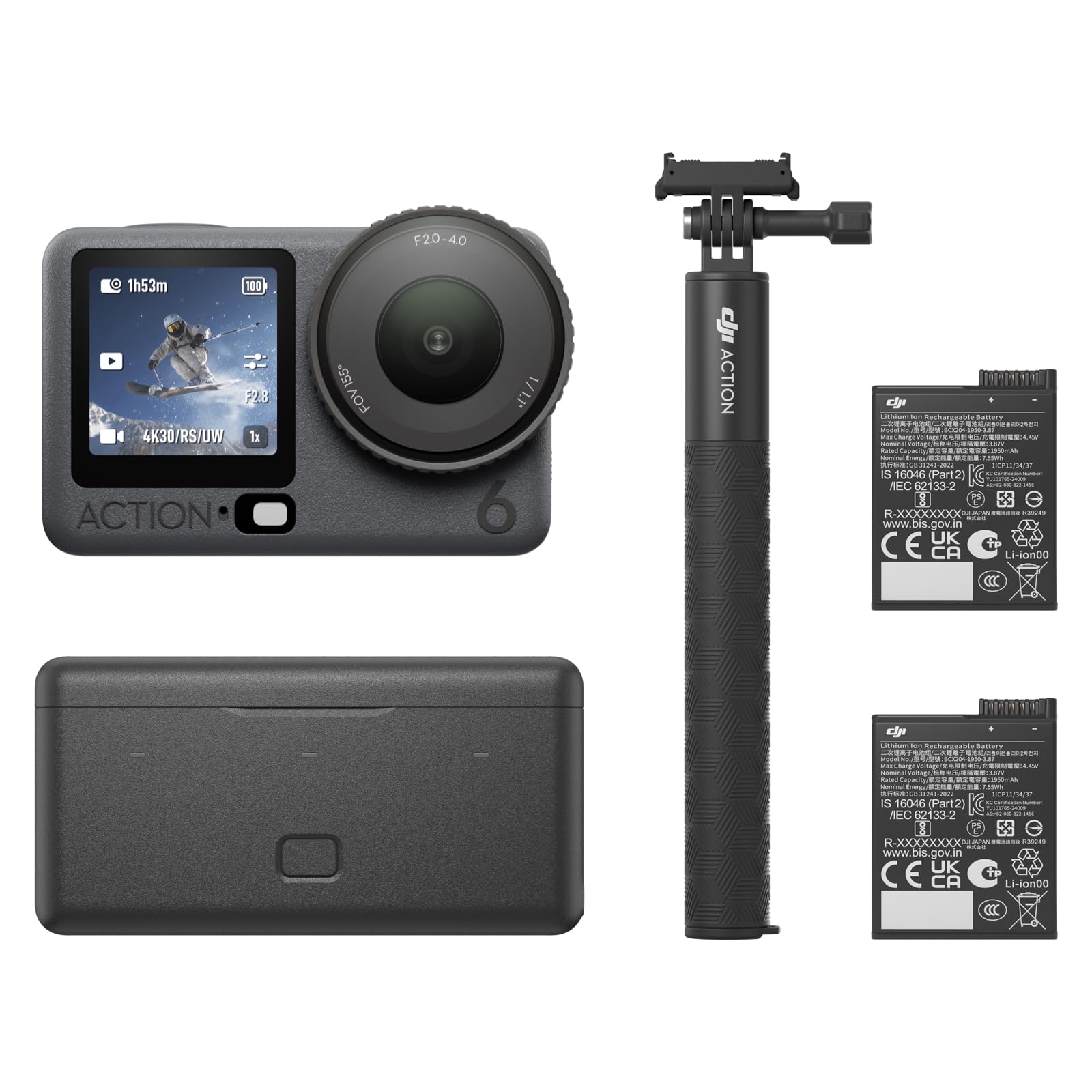
The single spec that makes the DJI Osmo Action 6 Enhanced Combo the top pick is its variable aperture (f/2.0 to f/4.0), and it is for mountain bikers who ride in changing light from bright midday sun to dusk.
The 1/1.1-inch square sensor captures 38-megapixel stills and 8K video, but the real riding benefit is the 360-degree HorizonSteady stabilization (a feature that keeps your horizon perfectly level even when the camera rotates 360 degrees), so your footage stays level when you lay the bike into a berm or bounce down a rock garden. Buyers report that the magnetic quick-release mount makes switching the camera from your helmet to the handlebars effortless at the trailhead. The Enhanced Combo includes a 1.5m extension rod and two batteries in a multifunctional case, giving you roughly 8 hours of combined recording time — enough for a full day of riding.
The catch is that 8K video files are large (you will want a fast microSD card), and the variable aperture mechanism adds a bit of complexity over fixed-lens rivals like the GoPro HERO13 Black. For dedicated trail builders, weekend racers, or anyone who films in mixed lighting — early morning rides, after-work dusk laps — this is the most versatile, future-proof action camera available.
Why it’s great
- Variable aperture gives you smooth low-light footage without grain
- HorizonSteady keeps the trail level through rough sections
- Compact build with 50GB built-in storage for backup
Good to know
- 8K footage demands a fast UHS-II microSD card
- Variable aperture adds a slight premium over other DJI models
2. DJI Osmo Action 5 Pro Adventure Combo

Your biggest worry is running out of battery on a long backcountry loop, and the DJI Osmo Action 5 Pro Adventure Combo beats the Action 6 on sheer ride endurance. While the Action 6 delivers a 4-hour single-battery life, the Action 5 Pro pushes that to 4 hours per battery with the same 1950mAh Extreme Battery Plus, and the Adventure Combo packs three batteries plus a multifunctional charging case for a combined 12 hours of recording — enough for an entire multi-stage race weekend without touching a wall outlet.
The 1/1.3-inch sensor and 13.5-stop dynamic range (the camera’s ability to capture detail in both bright and dark areas of the same shot) mean your footage stays vibrant in the dappled light of a forest trail where shadows and sun patches alternate every second. The 360-degree HorizonSteady stabilization is identical in class to the Action 6, so your landing from a drop-off stays level. Owners mention that the subject tracking feature (which keeps the camera centered on you even as you move across the frame) works well for self-filmed riding where you mount the camera on a tripod or extension rod.
If your biggest frustration is running out of battery on a long backcountry loop or you ride in cold conditions where batteries drain fast, this Adventure Combo removes that anxiety completely.
Where it shines
- Three 4-hour batteries with a charging case cover all-day rides
- Superb dynamic range handles harsh forest lighting
- Voice control lets you start/stop recording without taking gloves off
Worth noting
- Maxes out at 4K/120fps — no 8K like the Action 6
- Larger sensor body is slightly heavier on a helmet mount
3. GoPro HERO13 Black

You already have GoPro mounts on your helmet and chest straps, or you love the GoPro Quik app ecosystem for auto-editing, so the GoPro HERO13 Black is your natural upgrade over earlier GoPro models. Its HyperSmooth 6.0 stabilization with 360-degree Horizon Lock (a feature that detects rotation and keeps the horizon line level even when the camera tilts) is still the most effective at cancelling out trail vibrations.
It records up to 5.3K60 HDR video (high-dynamic-range footage that holds detail in shadows and highlights) and captures 27-megapixel photos. The 1/1.9-inch sensor paired with GP-Log color depth gives you plenty of flexibility to color-grade the footage later if you want a cinematic look. The 1900mAh Enduro battery is cold-weather resistant, so you can ride in sub-freezing temps without the camera shutting down, and Wi-Fi 6 support makes transferring clips to your phone for quick social uploads fast. Customers note that the bundle’s accessory kit (50 pieces) is mostly fluff — the suction cup mount is weak and the foam case is useless — but the camera itself is durable enough to survive crashes and the waterproof body goes to 33 feet without a housing.
Just budget for better third-party mounts and a separate battery charger, because the bundled kit won’t cover your needs on rough terrain — but the HERO13 Black itself remains the most trail-tested upgrade path in the GoPro ecosystem.
What stands out
- HyperSmooth 6.0 Horizon Lock is the best in the business for rough terrain
- 5.3K HDR captures highlight-rich footage under forest canopies
- Bluetooth audio support lets you use a wireless mic for commentary
The trade-offs
- Bundled accessory kit includes cheap parts that may need replacement
- Battery life at 5.3K is about 1.5 hours — carry spares for long rides
4. DJI Osmo Action 6 Bundle
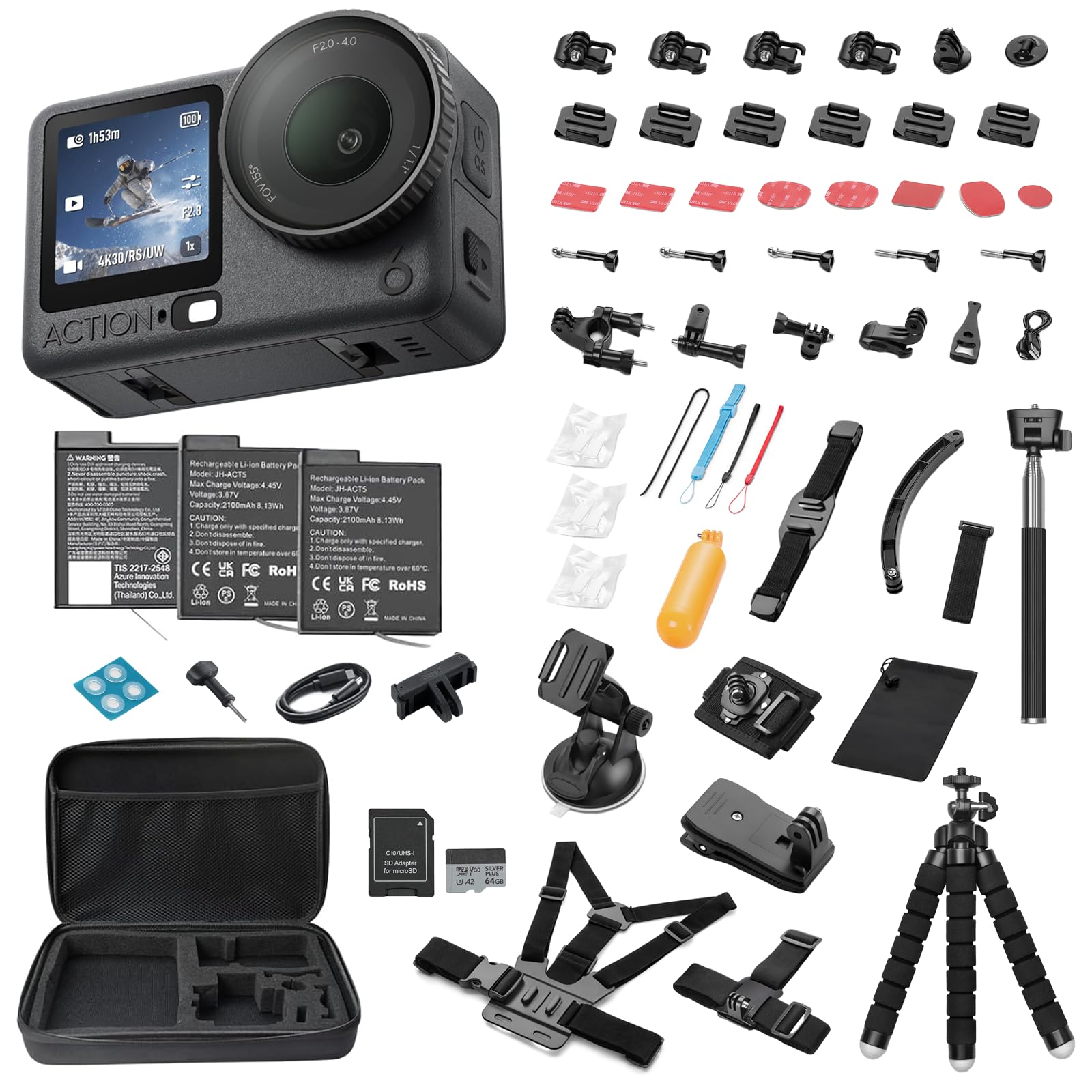
The single number that matters most for a mountain biker buying this bundle is the 50GB of built-in storage. That is enough for roughly 45 minutes of 4K footage without any microSD card inserted, which means if you show up to the trailhead and realize you left your card at home, you can still record a full descent without scrambling.
The downside here is that this Essential Combo’s base does not include the multifunctional battery case or the 1.5m extension rod, so you get the camera with a single 1950mAh battery and a few adapter mounts. However, the bundle adds two extra batteries and a 58-piece accessory kit, so you end up with three batteries total and most of the mounts you would need for a helmet setup. Reviewers point out that the magnetic mounting system is quick and secure, and the 4:3 4K 30fps ultra-wide setting with RockSteady delivers smooth, immersive first-person footage.
If you want the 8K sensor and variable aperture of the Action 6 but are unwilling to pay for the Enhanced Combo’s full accessory spread, this bundle gives you the camera core plus enough extras to get riding immediately. It is the smartest price-to-performance ratio for someone who knows they need spare batteries.
The upsides
- 50GB internal storage is a lifesaver for forgetful riders
- Three batteries cover a full afternoon of recording
- Variable aperture f/2.0–f/4.0 adapts to changing trail light
Keep in mind
- No battery case or extension rod included (separate from Enhanced Combo)
- 58-piece accessory kit has some pieces you may never use
5. Insta360 Ace Pro 2 Xplorer Bundle
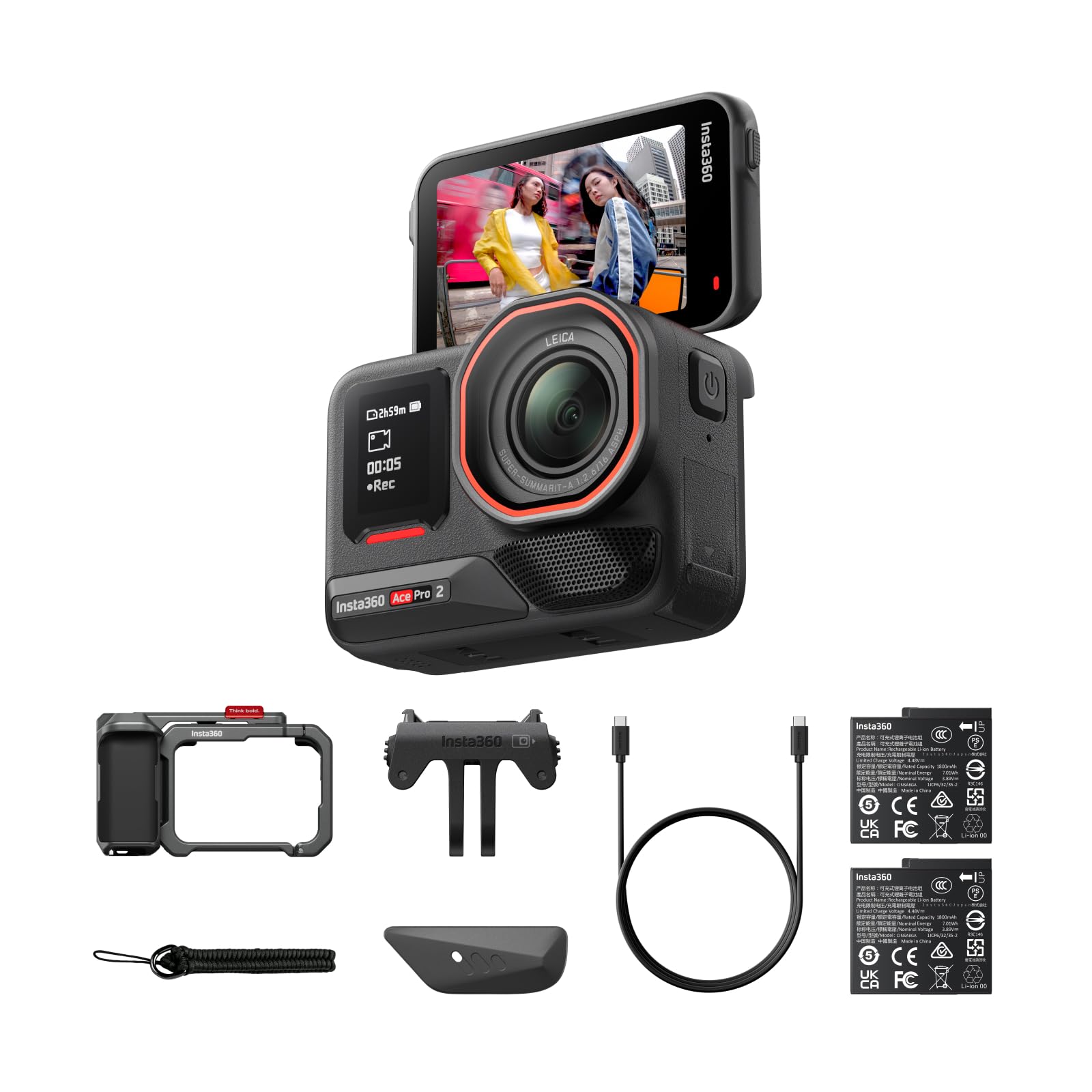
You get the Insta360 Ace Pro 2 camera plus the Xplorer Bundle, which includes a grip, utility frame, and wrist strap, giving the camera a confident handheld feel at this lower price. The 1/1.3-inch sensor co-engineered with Leica captures 33-megapixel stills and 8K video, and with 13.5 stops of dynamic range it holds detail in shadows that cheaper cameras would turn into black blobs.
The Dual AI Chip setup gives you PureVideo Mode (a dedicated noise-reduction mode for low-light recording) at up to 4K60fps, which means your twilight runs look crisp instead of grainy. The 2.5-inch flip touchscreen is sturdy and visible in bright sun, making it easy to check your framing before a drop. However, at 33-megapixel effective still resolution, it falls short of the 40-megapixel DJI Osmo Action 5 Pro by a noticeable margin for photo-first riders. Waterproof depth is 39 feet compared to the 131 feet of the AKASO Brave 7 LE, but that is still more than enough for creek crossings and rain.
The single included battery means you will need to buy a second one for longer rides. For the dedicated rider who posts cinematic edits of their descending lines and wants the richest color science available, this is the camera to grab.
Why we’d pick it
- Leica color profiles produce rich, cinematic trail footage out of the box
- PureVideo Mode keeps low-light clips usable without extra noise
- Flip touchscreen is glare-free and durable for helmet mounting
A few caveats
- Single battery in the bundle needs a spare for rides over two hours
- Waterproof to 39ft — fine for rain but not deep-water sports
6. AKASO Brave 7 LE

You want to frame your trail commentary without guesswork, and the AKASO Brave 7 LE gives you a front-facing screen for that — a feature you would normally pay double for. It records 4K at 30 frames per second and 20-megapixel photos, and the 6-axis electronic image stabilization (EIS 2.0 — software that uses gyroscopes to detect movement and shifts the frame to cancel shakes) provides gimbal-like smoothness for the price range.
Its 131-foot waterproof depth is a huge advantage over the 33-foot budget offerings. Shoppers say a roughly 2-hour constant filming battery life with one charge, and the bundle includes two batteries plus a remote control, so you can start and stop recording without reaching up to the camera on your helmet. On the trade-off, the included mounting kit has too many adapters and missing the specific chest-mount piece some buyers need, and the EIS can cause some image wobble in fast cornering. For the entry-level trail rider or a parent buying for a child who wants to film their first jumps, this is the best price-to-feature ratio available.
Just keep in mind that the electronic stabilization can introduce noticeable image wobble during fast cornering, so it is not the best choice for aggressive, high-speed descents.
Strong points
- Dual screens (front + rear) make framing easy for self-recorded rides
- 131FT waterproof depth beats many cameras costing three times more
- Comes with two batteries, remote, and waterproof housing
Before you buy
- EIS can introduce slight image wobble in aggressive cornering
- Quick-release mount selection may not include the exact adapter you need
7. 4K Body Action Mini Camera
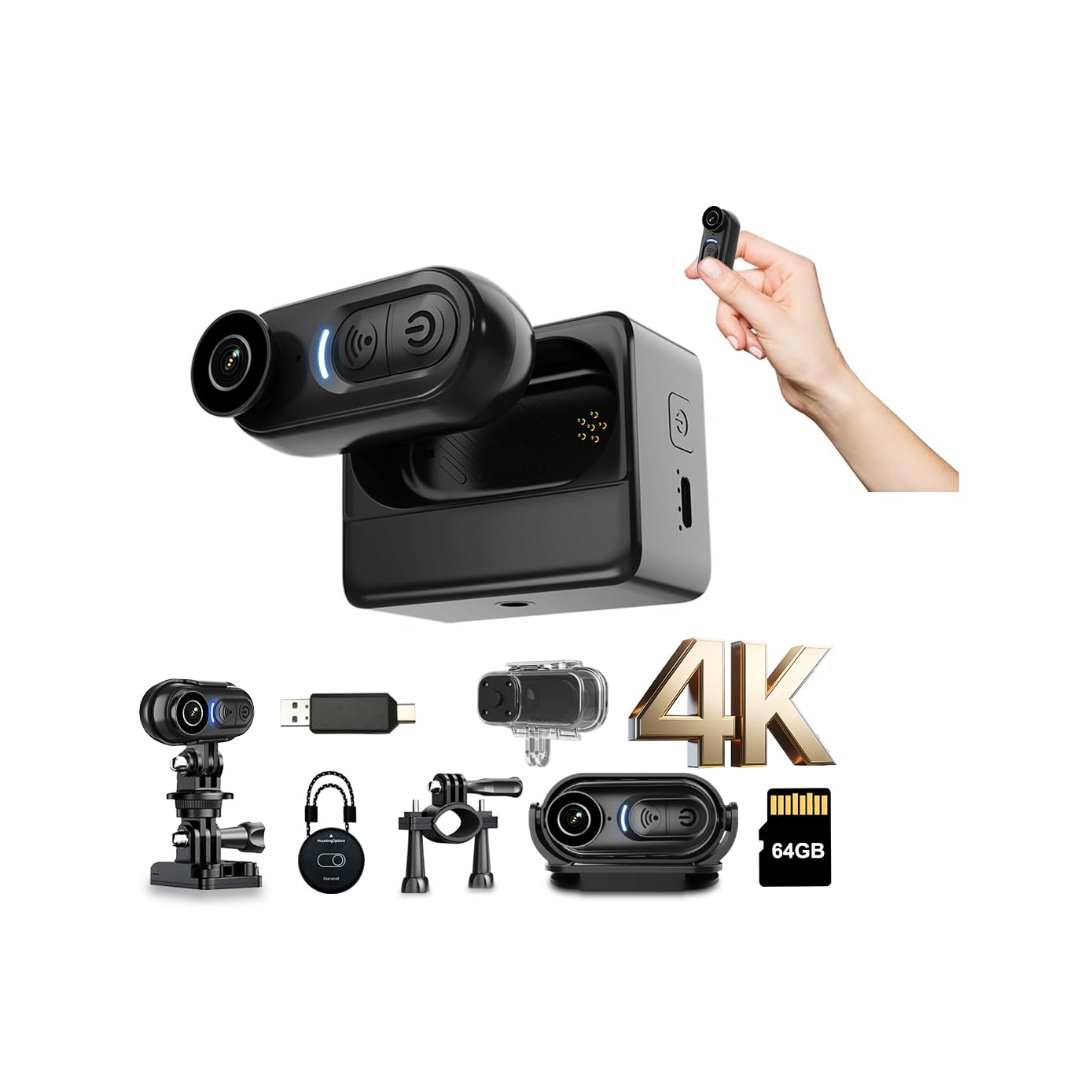
This thumb-sized camera costs a fraction of the DJI and GoPro options, making it the most affordable way to try trail filming. It shoots 4K UHD (3840×2160 resolution) video and includes 64GB of built-in storage so you do not need to buy a memory card upfront.
The reality of the budget tier is visible here: the 6-axis stabilization does not work as consistently as the pricier cameras. One reviewer noted that the stabilization does not have a dedicated setting, so “every time stepped the image would bounce,” and the claimed 100-minute battery drops to about 90 minutes with active recording. However, the included 2500mAh charging case gives you extra charges on the go, and it is waterproof to 33 feet with the housing, enough for rain and creek splashes.
The one clear reason to choose it is for a new rider who wants to experiment with helmet or POV filming before committing to a higher-end system.
What we like
- 64GB built-in storage means zero upfront card cost
- Thumb size fits in a jersey pocket and weighs almost nothing
- Charging case extends total run time to around 6 hours
The downsides
- Stabilization struggles on rough trails — footage bounces on roots
- Battery lasts about 90 minutes under real use, not the full 100 minutes
Understanding the Specs
Electronic Image Stabilization (EIS)
EIS is software that uses gyroscopes inside the camera to detect movement and then shifts the video frame to cancel out shakes. On a mountain bike, you want a camera with at least 6-axis EIS, and ideally one with a “Horizon Lock” or “HorizonSteady” feature that keeps the horizon completely flat even when your bike tilts in a turn. Without it, your footage will look like a first-person view of an earthquake.
Waterproof Rating Without Housing
This tells you how deep you can submerge the camera without a separate waterproof case. For mountain biking, you rarely dive deeper than a puddle or a creek crossing, but a rating of 33 feet (10 meters) or more means you can wash mud off the camera under a tap without worry. Higher ratings (like 131 feet) are overkill for riding but indicate a very well-sealed body.
FAQ
Is 4K or 8K video more important for mountain biking footage?
Can I mount any action camera to my full-face helmet?
Does image stabilization work at all frame rates?
How do I stop my action camera from overheating on hot summer rides?
Final Thoughts: The Verdict
For most riders, the action camera for mountain biking winner is the DJI Osmo Action 6 Enhanced Combo because its 8K video, variable aperture, and HorizonSteady stabilization deliver the smoothest, sharpest trail footage across every light condition. If you want maximum battery endurance for multi-day trips, grab the DJI Osmo Action 5 Pro Adventure Combo. And for a budget-friendly entry point that still includes dual screens and deep waterproofing, the AKASO Brave 7 LE is hard to beat.