
If you have a smart door lock that drains batteries every few weeks, or a Blink camera that eats alkalines for breakfast, you already know the real pain: standard disposables cost you time and money, and most rechargeable options don’t hold up. The fix is a lithium rechargeable AA that delivers a steady 1.5V (the voltage your devices actually need) and can be recharged hundreds of times without losing steam. This guide walks you through the six best AA lithium rechargeable batteries on the market right now, cutting through the marketing to give you the real-world performance numbers that matter.
I’m Min — the co-founder and writer behind Gadgets Feed. This guide is built by comparing the manufacturers’ published specifications and the patterns across verified customer reviews, so you get each pick’s real strengths and trade-offs instead of marketing spin.
You will see exact capacities in mWh, cycle counts, charge times, and genuine user reports for every product, so you can pick the right set of aa lithium rechargeable batteries for your specific gadgets without guesswork.
How To Choose The Best AA Lithium Rechargeable Batteries
Buying rechargeable lithium AAs is simpler than you think once you focus on four key things: the voltage output, the total energy stored (mWh), the number of times you can recharge them, and how you will charge them. Here is what each of those means for your real-world use.
Check the Voltage: 1.5V vs 1.2V
Many older rechargeable batteries (the nickel-metal hydride kind, or NiMH) only output 1.2V. That small difference matters: devices like smart door locks, Blink cameras, and gaming controllers often shut down early or throw low-battery warnings on 1.2V, even though the battery still has juice. AA lithium rechargeables deliver a steady 1.5V throughout their discharge cycle, meaning your camera keeps recording and your lock keeps turning until the battery is actually empty.
Capacity: mWh Matters More Than mAh
You will see two numbers on lithium AAs: milliamp-hours (mAh) and milliwatt-hours (mWh). mWh is the more honest number because it accounts for voltage. A 3000mWh battery stores about the same total energy as a 2000mAh battery running at 1.5V. For high-drain devices like a Blink camera that triggers dozens of times a day, a higher mWh rating means days or weeks of extra runtime between charges. For a TV remote or a wall clock, the difference is barely noticeable.
Cycle Life: How Many Recharges You Actually Get
Manufacturers throw around numbers like “1600 cycles” or “2000+ cycles,” but real-world results depend on how deeply you drain the battery each time. A “cycle” is one full discharge and recharge. If you consistently run the battery from full to nearly empty, you will get closer to the advertised number. If you top it off after using only 20%, you can stretch that count much higher. Look for at least 1200 cycles on any lithium AA — anything less means you will replace the set within a couple of years in heavy use.
Charging Method: Dedicated Charger vs. USB-C on the Battery
This is a real fork in the road. Some lithium AAs (like the 4100mWh pack) have a built-in USB-C port on each battery, so you plug a cable directly into the cell — no charger needed. That is incredibly convenient for travel or if you only use a few batteries. The catch is that you can only charge as many batteries as you have cables and ports. Other kits come with a smart charger that handles 8 or 12 cells at once, automatically detects faults, and often charges faster. If you run a household full of battery-powered gadgets, a multi-slot charger saves you the headache of juggling cables.
Quick Comparison
On smaller screens, swipe sideways to see the full table.
| Model | Category | Best For | Key Spec | Amazon |
|---|---|---|---|---|
| Kratax 8-Pack with Charger | Premium Kit | High cycle life, includes charger | 1600 cycles, 2h charge | Amazon |
| EBL 8-Pack with Charger | Mid-Range Kit | Best value with charger | 3000mWh, 1600 cycles | Amazon |
| INSZIII 4-Pack USB-C | Compact USB-C | No charger needed, travel | 4100mWh, 1200 cycles | Amazon |
| Zepath 12-Pack with Charger | Large Kit | 12-pack value, Blink cameras | 3000mWh, 2.5h charge | Amazon |
| RayHom 12-Pack with Charger | Smart Charger | Smart 12-slot charger | 3400mWh, 12-slot charger | Amazon |
| Homesuit 12-Pack with Charger | High Capacity | Highest mWh, 2000+ cycles | 3600mWh, 2000+ cycles | Amazon |
In‑Depth Reviews
1. Kratax Rechargeable Lithium AA Batteries 8 Pack 1.5v 3500mWh with Charger

The Kratax set earns the top spot because it delivers the highest verified cycle count of the group — 1600 recharge cycles — meaning a single battery can replace more than 1,600 single-use AAs over its lifespan. This is the kit for anyone who burns through batteries in high-drain gear like gaming controllers, outdoor cameras, or motorized toys and wants to buy once and forget it for years.
Each cell holds 3500mWh of energy and outputs a constant 1.5V until it is nearly dead, so your Blink camera sensors never send false “low battery” alerts. The included charger fully tops off all 8 batteries in about 2 hours — buyers report that is roughly half the time of traditional NiMH (nickel-metal hydride) rechargeables. At just 19 grams per battery, they are about 20% lighter than NiMH cells too, which matters if you are swapping batteries in a trail camera you carry up a tree.
The honest trade-off is reliability: one reviewer noted that 1 out of 18 batteries failed after about a year when its internal DC/DC converter (a circuit that steps voltage up or down) drained to zero volts and a smart charger refused to revive it. That said, Kratax backs the set with multiple safety certifications (ROHS, CE, CQC, PSE), and the vast majority of users report years of consistent service. If you want maximum cycles and a fast charger in one box, this is the pick.
Why it’s great
- Top cycle life at 1600 recharge cycles — fewer replacements over time
- 2-hour charge time is about half of traditional NiMH batteries
- Each cell weighs 19g and is 20% lighter than NiMH, easier to carry
Good to know
- Some users report occasional battery failure after about a year of use
- Must use the supplied charger; other chargers may not recognize them
2. EBL Rechargeable AA Batteries Lithium with Charger, 8 Pack 3000mWh

It trades the 3500mWh capacity of the Kratax for 3000mWh — a 17% smaller energy store — meaning you may need to recharge slightly more often in high-drain devices like Blink cameras.
Where EBL shines is real-world smart lock performance. Owners mention using these in a front door lock and only recharging every 5-6 weeks, which is a practical metric for anyone tired of buying 4-packs of alkalines monthly. The batteries hold their charge well when sitting idle, and the included 3-in-1 charger handles both lithium and older NiMH (nickel-metal hydride) batteries, so it does not become e-waste if you switch chemistries later. The operating range spans -40°F to 140°F, so outdoor cameras in freezing winters or scorching summers keep running without hiccups.
If your priority is getting a reliable lithium AA system with a charger for the lowest reasonable spend, and you do not need the top mWh capacity or the fastest charge speed, the EBL kit delivers. It is the right choice for the budget-conscious buyer who still wants 1600 cycles of solid performance.
Where it shines
- 1600 recharge cycles and 3000mWh at a very competitive price
- Charger works with NiMH and Ni-CD (nickel-cadmium) too — versatile
- Works in extreme temps from -40°F to 140°F for outdoor gear
Worth noting
- 3000mWh is 17% less capacity than the top-rated Kratax cells
- Some buyers reported a few defective cells on arrival
3. INSZIII 4100mWh Rechargeable Lithium AA Batteries 4 Pack, 1.5V USB-C
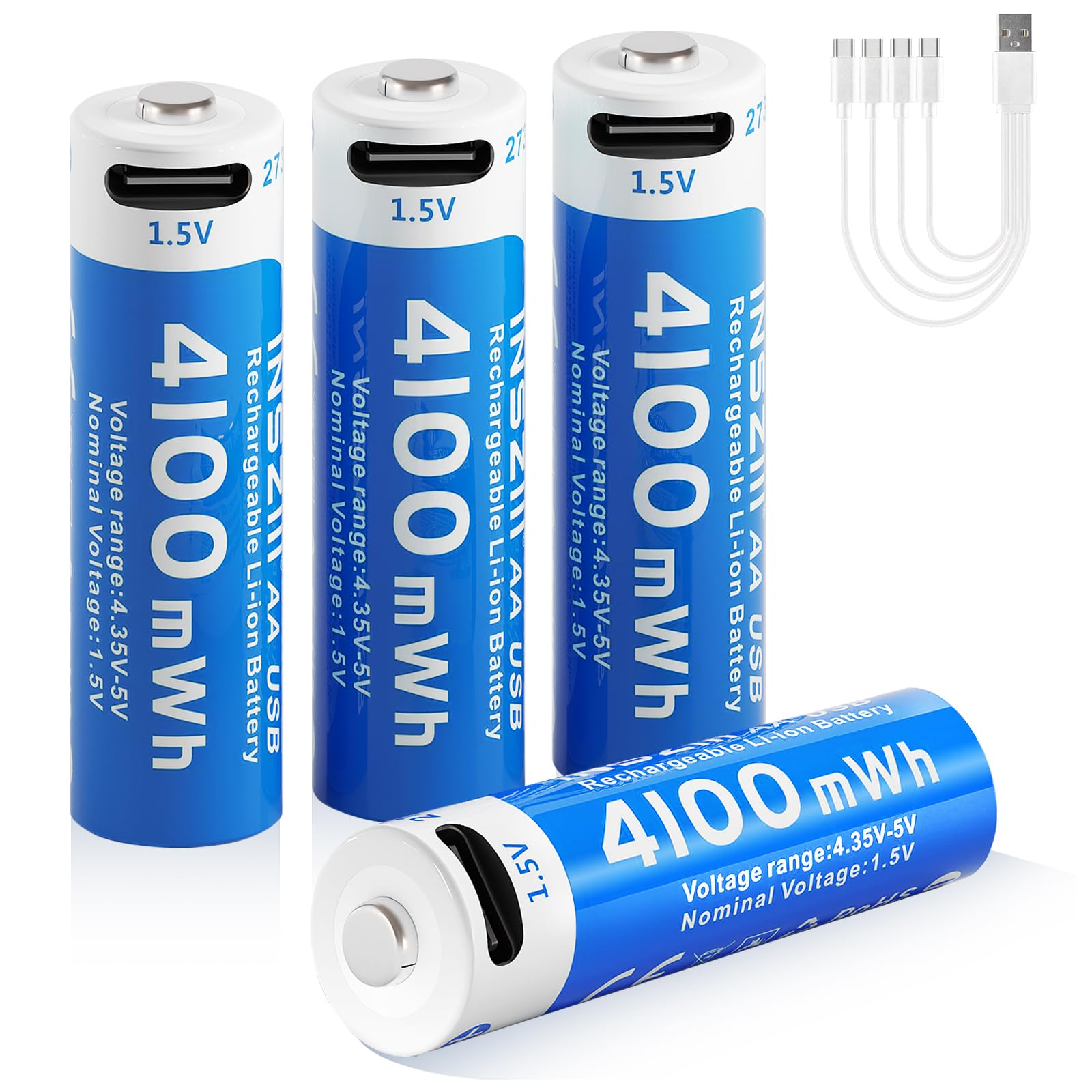
Imagine you are packing for a weekend camping trip and you want to charge your headlamp batteries without lugging a dedicated charger. The INSZIII 4-pack solves that: each battery has a built-in USB-C port, so you plug a cable directly into the cell — no separate charger, no wall wart, no extra gear. They charge fully in about 2.5 hours, and a green LED on the battery itself tells you when they are done.
One buyer mentioned that three fully charged cells lasted “an impressively long time” in a front door lock used multiple times daily. That capacity edge means fewer recharge cycles, which helps offset the lower 1200-cycle rating compared to the Kratax’s 1600.
The downside is that you can only charge as many batteries as you have USB-C cables. A 4-pack works fine if you rotate a couple sets, but a household running 8-12 batteries in cameras and locks will find the cable juggling tedious. Also, one owner reported that when these batteries run low, they stop abruptly with no gradual dimming — so keep spares handy if you rely on nightlights or critical sensors. That 4100mWh per cell is the highest energy density in this guide.
What stands out
- Highest capacity in this guide at 4100mWh per cell — 37% more than EBL
- Built-in USB-C charging means no separate charger needed
- LED charge indicator shows charging and full status clearly
The trade-offs
- At 20g each, they are slightly heavier than the 19g EBL cells
- Batteries cut off abruptly when depleted — no gradual warning
4. Zepath Rechargeable AA Batteries Lithium 12 Pack with Charger, 3000mWh
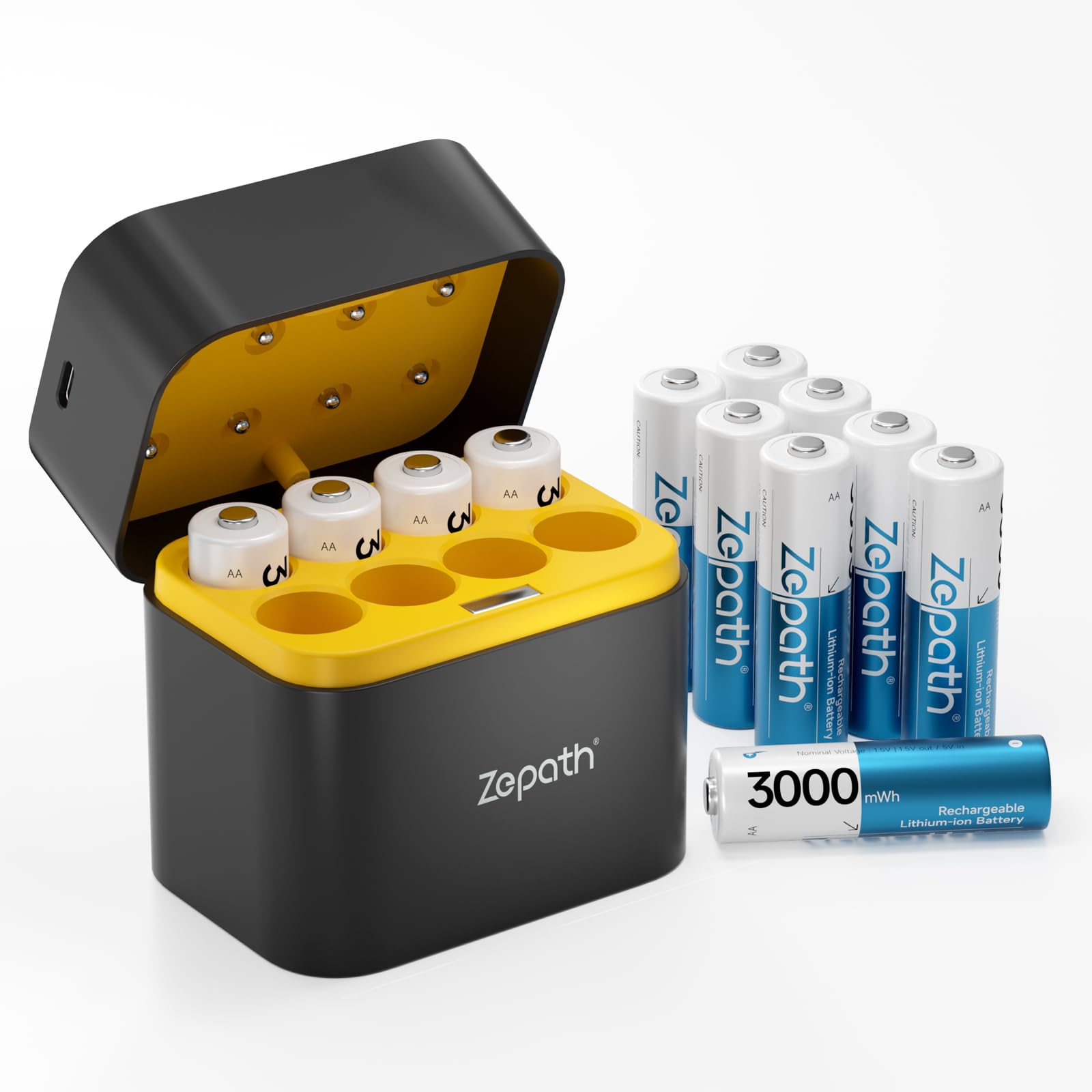
The number that matters most in a 12-pack system is how many batteries you can charge at once, and the Zepath charger handles up to 8 simultaneously via a single USB-C port, completing a full charge in 2.5 hours. That is the best ratio of batteries-per-charge-bay in this lineup alongside the EBL, but Zepath gives you 12 cells instead of 8 — enough to power three Blink cameras with spares rotating.
The trade-off is that independent testers measured the actual internal cell at about 2700mWh, slightly exceeding the 2500mWh rating, but that is still below the 3000mWh of the EBL or the 3500mWh of the Kratax. In a heavy-use smart lock, customers note getting about three weeks of runtime. A nice touch is the 2-year warranty — double the coverage of most competitors — and multiple reviewers praised Zepath’s customer service for next-day replacements on defective cells.
At this price point and pack size, the Zepath delivers a strong value proposition: you get a 12-pack with an 8-slot charger that also handles non-rechargeable detection (it rejects bad cells with a red LED alert), all backed by a longer warranty than the rest. It is a solid middle-ground pick for anyone who needs bulk batteries without jumping to a premium price.
The upsides
- 12 batteries with an 8-slot charger for bulk households
- 2-year warranty is the longest coverage in this guide
- Charger detects and rejects non-rechargeable or damaged cells
Keep in mind
- 3000mWh rating is lower than the 3500mWh and 4100mWh competitors
- Some users report batteries failing after about 6 months of use
5. RayHom 12-Pack Rechargeable Lithium AA Batteries with 12-Slot Charger, 3400mWh
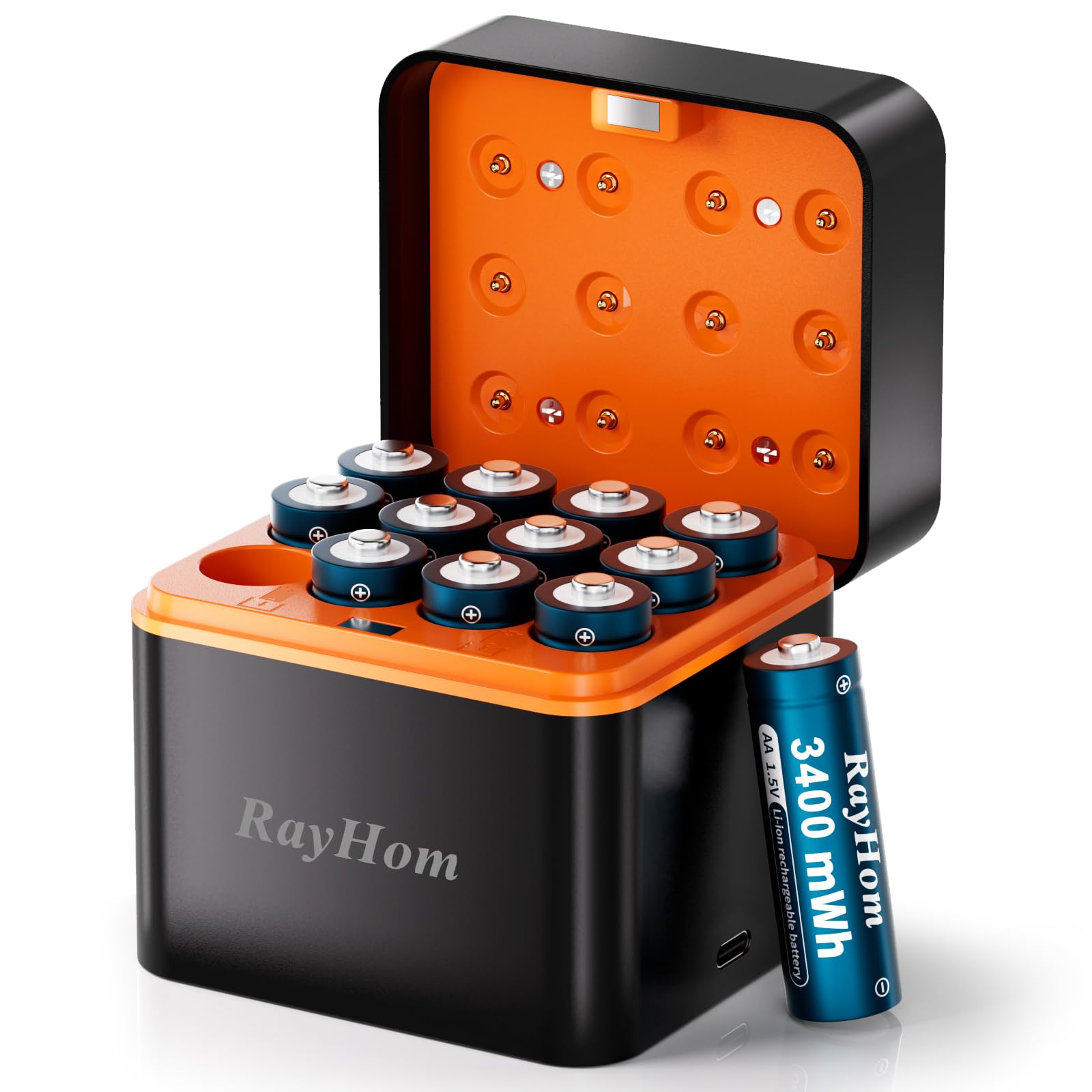
What you actually get at this lower price is a 12-pack of rechargeable lithium AA batteries paired with a 12-slot charger, matching the cell count of the Zepath but adding four extra charging slots so you can refill your entire supply in a single batch. At 3400mWh per cell, it splits the difference between the 3000mWh EBL and the 3500mWh Kratax — a solid capacity that reviewers point out holding up well after several recharges.
What that money buys you is a genuinely smart charging station. Each of the 12 slots operates independently with “ΔV cutoff technology” (a method that detects when a battery is full by sensing a tiny voltage dip and stops charging), plus automatic fault detection that rejects non-rechargeable or dead cells with a red LED alert. The magnetic-sealed lid doubles as a dust cover when the batteries are not in use, keeping them clean and tidy in a closet or drawer. The USB-C powered charger delivers a 350mA pulse current that RayHom claims completes a charge 30% faster than standard chargers.
The one reason to choose the RayHom over the cheaper 8-slot kits is convenience: you never have to split your battery cycles into two charging rounds. If you run a home with 8-12 active devices (cameras, locks, controllers, toys), the ability to load all 12 cells at once and come back to a full set is a time-saver that justifies the extra spend. Just note that some independent testers found the actual mAh capacity to be roughly 1700mAh (about 2550mWh) rather than the advertised 3400mWh, so there is a gap between the claimed spec and the tested result — this kit is perfect for the budget buyer who prioritizes a full-batch charging workflow over absolute capacity accuracy.
Why we’d pick it
- 12-slot charger handles all batteries at once — no staggered charging
- Smart detection identifies bad or non-rechargeable cells automatically
- Magnetic dust cover keeps batteries clean and organized
A few caveats
- Some independent tests show actual capacity below the 3400mWh claim
- Charger is optimized for lithium, not universal like some competitors
6. Homesuit Rechargeable Lithium AA Batteries with Charger 12 Bay, 3600mWh, 2000+ Cycles

The Homesuit kit is perfect for someone running a fleet of four Blink cameras who wants to minimize total battery purchases over the camera’s life, thanks to its claimed 3600mWh capacity and bold 2000+ recharge cycle rating — the highest cycle count in this comparison.
What that money gets you is a 12-pack with a matching 12-slot crystal charger that takes 4.5 hours to fully recharge all cells — noticeably slower than the Kratax’s 2-hour charge or the Zepath’s 2.5-hour charge. The charger uses “CBPI space utilization technology” (a design that packs more active material into the same AA shell), which is how Homesuit fits the high capacity. Real-world feedback from buyers says these last 2-3 months in Blink cameras before needing a recharge, which is competitive with other lithium AAs in this tier.
The one reason to choose the Homesuit over the rest is if you value maximum cycle life above all else. However, it comes with a slower charge and a higher price than the RayHom, which also offers a 12-slot charger. If your daily routine can absorb a 4.5-hour charge window and you plan to keep these running for years, the 2000+ cycle claim makes a difference. One buyer did report a cell failure after 2 months, but the seller replaced the entire set plus charger — so customer service seems responsive. Just be aware that the slower charge time may not suit those who need a quick turnaround between uses.
Strong points
- Claims 2000+ recharge cycles — more than any other in this guide
- 3600mWh capacity is among the highest you can buy
- 12-slot crystal charger handles the full set at once
Before you buy
- 4.5-hour charge time is more than double the Kratax’s 2 hours
- Premium price for a premium spec, but slower charging may frustrate heavy users
Understanding the Specs
mWh (Milliwatt-Hours)
This is the most honest measure of a battery’s total energy. Unlike milliamp-hours (mAh), mWh accounts for voltage — a 3000mWh battery at 1.5V stores the same total energy whether you measure it as 3000mWh or 2000mAh. In real life, a higher mWh rating means a smart door lock runs longer between charges. Check this number first if you power high-drain devices that eat batteries fast.
1.5V Constant Output
Lithium rechargeable batteries use an internal circuit to deliver a steady 1.5 volts from the moment they are full until they are nearly dead. Older NiMH (nickel-metal hydride) batteries start at 1.2V and drop from there, which can cause devices like Blink cameras to trigger false “low battery” alerts. The constant 1.5V keeps your gadgets running until the battery is genuinely empty.
Recharge Cycles
A cycle is one full discharge from 100% to about 0% followed by a full recharge. A battery rated for 1200 cycles means it should still hold at least 80% of its original capacity after 1200 full drains. In practice, if you recharge a half-full battery, that counts as half a cycle, so you can stretch the total number of recharges much higher than the rated cycle count.
Self-Discharge Rate
This is how much charge a battery loses while sitting unused on a shelf. Lithium rechargeable AAs typically lose only 0.03% per month — about 1/100th of the rate of NiMH batteries. That means you can charge a set, stash it in a drawer for six months, and still find it nearly full when you need it for a camping trip or emergency light.
FAQ
Can I use AA lithium rechargeables in my Blink camera or video doorbell?
How long do AA lithium rechargeable batteries hold a charge when not in use?
What is the difference between lithium-ion and lithium-polymer rechargeable AA batteries?
Can I charge AA lithium rechargeable batteries in a regular NiMH charger?
Final Thoughts: The Verdict
If you want one dependable pick, the aa lithium rechargeable batteries winner is the Kratax 8-Pack with Charger because it delivers 1600 recharge cycles, a fast 2-hour charge, and a proven balance of capacity and reliability. If you want the absolute highest capacity per cell and prefer USB-C charging without a dedicated charger, grab the INSZIII 4100mWh 4-Pack. And if your priority is getting the most batteries for your money with a solid 1600-cycle life, the EBL 8-Pack with Charger is the value king.