
Our readers keep the lights on and my morning glass full of iced black tea. As an Amazon Associate, I earn from qualifying purchases.
Stripping rust and old paint by hand is tedious, slow work, and most cheap sandblaster guns end up clogging, leaking, or just not having enough power to finish the job. The real challenge is finding one that actually works with the air compressor you already own, delivers a steady stream of abrasive, and doesn’t leave a mountain of media all over your driveway. This guide cuts through the noise to help you pick the right air compressor sandblaster for your specific project — whether that is a quick spot-cleaning on a car fender or stripping an entire piece of furniture.
I’m Min — the founder and writer behind Gadgets Feed. This guide is built by comparing the manufacturers’ published specifications and the patterns across verified customer reviews, so you get each pick’s real strengths and trade-offs instead of marketing spin.
Every blaster here is a pneumatic tool that hooks up to an air compressor, and we have focused on the specs that actually dictate whether you finish a job or just get frustrated — pressure, weight, and media type compatibility. The goal is to help you find the best air compressor sandblaster for your budget and the scope of work you are tackling.
Quick Picks
- Performance Tool M549 Portable Abrasive Blaster Kit — Best for Big Jobs
- VEVOR 5 Gallon Sand Blaster, 60-110 PSI — Pro-Grade Tank
- Zendex Tool – SpeedBlaster Portable Media Blaster — Best All-Rounder
- Inokraft Leak-Proof Portable Sand Blaster Gun Kit with Oil-Water Separator — Best Value Package
- LE LEMATEC Sand Blaster Gun Kit (Pistola de Arena) — Precision Work
- LE LEMATEC Portable Sand Blaster Gun Kit, 150 PSI — Budget Champion
- TCP Global Sand Blaster Gun Kit with Recovery System — Mess-Controlled
How To Choose The Best Air Compressor Sandblaster
Not all sandblasters are created equal. Your air compressor’s output — the PSI (pounds per square inch of pressure) and the CFM (cubic feet per minute of air volume) — dictates which blaster will even work. If your compressor is small, you are limited to lightweight, gravity-fed guns. If you have a big tank, a pressurized hopper can let you work for much longer between refills.
Match the Blaster to Your Compressor
A handheld gravity-feed gun might only need 4 CFM at 90 PSI, which a small 6-gallon pancake compressor can barely manage for a few seconds. A pressurized 5-gallon tank unit can demand 6-25 CFM, meaning you need a large, stationary shop compressor that costs thousands. Check your compressor’s sticker before you buy anything.
Gravity Feed vs. Siphon Feed vs. Pressure Tank
Gravity-feed guns (the most common in this guide) have a hopper on top where media drops into the air stream. They are simple, cheap, and easy to clean — but the hopper is small and you must keep the gun upright. Siphon-feed guns pull media from a bucket below; they work for longer sessions but require more air volume. Pressure tanks hold 50 pounds of media, blasting for 10-15 minutes straight before a refill, but they are heavy and expensive.
Nozzle Material Matters
Cheaper guns use hardened steel mixing chambers that wear out quickly under hard abrasives like aluminum oxide. Ceramic nozzles are much more resistant to wear and won’t spark, a safety bonus when blasting near flammable materials. If you plan to blast regularly, paying a little more for a ceramic or carbide nozzle saves money over time on replacements.
Quick Comparison
On smaller screens, swipe sideways to see the full table.
| Model | Best For | Max PSI | Weight | Feed Type | Amazon |
|---|---|---|---|---|---|
| Performance Tool M549 | Long-duration single-pass jobs | 90 | 3.25 lbs | Gravity / Siphon | $77.00Amazon |
| VEVOR 5 Gallon | Heavy outdoor rust removal | 110 | 24.7 lbs | Pressure Tank | $109.90$116.90Amazon |
| Zendex SpeedBlaster | Versatile medium restore jobs | — | 1.25 lbs | Gravity Feed | $65.99Amazon |
| Inokraft Premium Kit | All-in-one beginner package | 120 | 2.92 lbs | Gravity Feed | $59.99Amazon |
| LE LEMATEC (Gun B) | High-psi auto restoration | — | 1.3 lbs | Gravity Feed | $48.99Amazon |
| LE LEMATEC Portable | Budget-friendly detail work | 150 | 1.19 lbs | Gravity Feed | $44.79$53.89Amazon |
| TCP Global SB8048 | Low-mess spot cleaning | 90 | 4.6 lbs | Gravity Feed | $39.99Amazon |
In‑Depth Reviews
1. Performance Tool M549 Portable Abrasive Blaster Kit
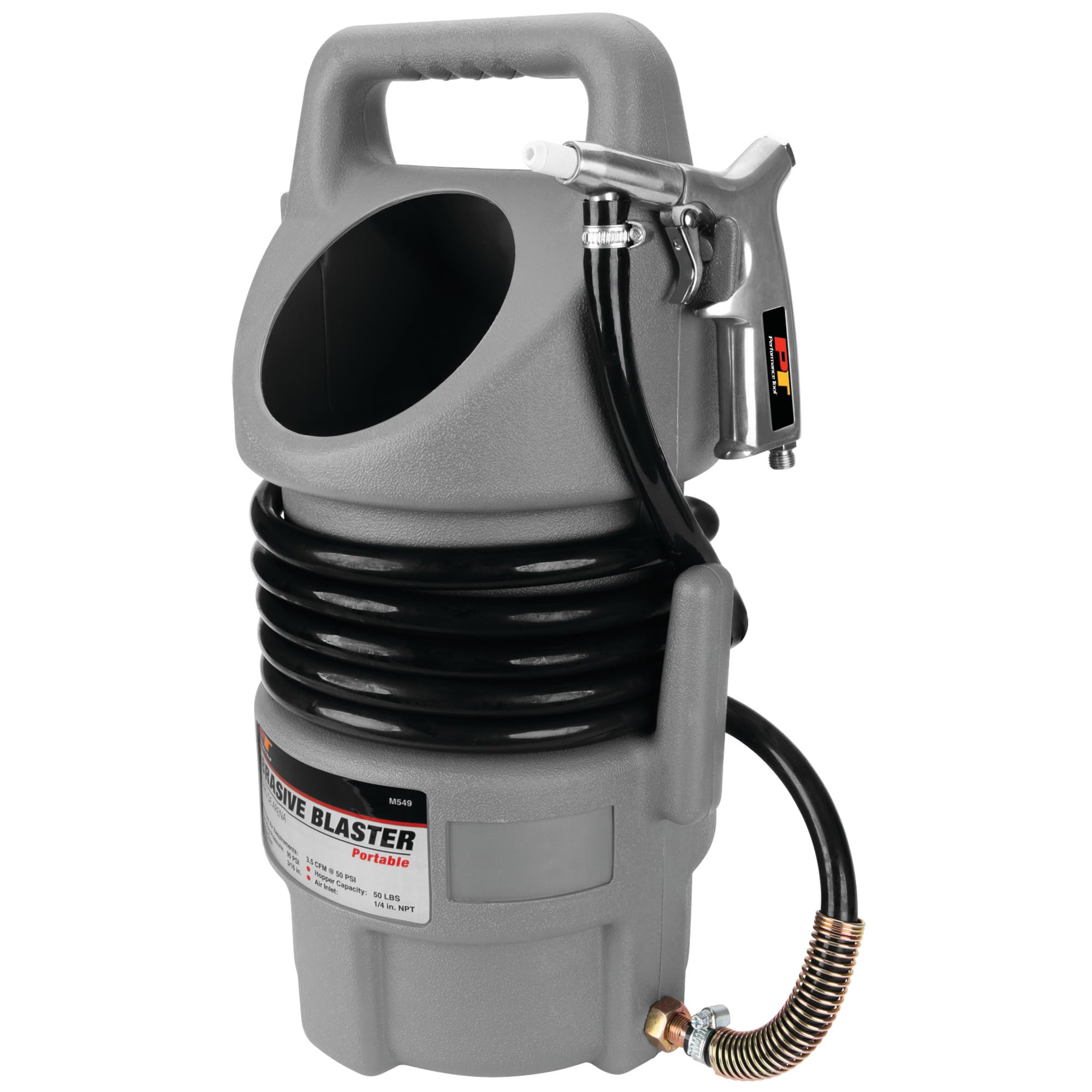
The heavy hitter that lets you blast for 15 minutes without a refill.
If you are stripping an entire car door or a large iron gate, you do not want a tiny hopper that empties every 90 seconds. The Performance Tool M549 holds a full 50 pounds of abrasive media, giving you sustained blasting time that no gravity-feed gun in this list can match. Gravity feed is still an option, but you can also use it as a siphon-feed unit by connecting it to a bucket. The 15-foot hose length is generous, meaning you can walk around a vehicle without moving the compressor.
Buyers report that it removes rust and paint from a car door frame in about 15 minutes using 25 lbs of 70 grit aluminum oxide at 60 PSI. Some reviewers noted inconsistent media siphoning at lower pressures, but most said it works well within the stated 50-90 PSI operating range. The unit itself weighs just 3.25 pounds, though it is awkwardly shaped at 21.5 x 5.3 x 11.5 inches.
The catch is that it requires a minimum of 3.5 CFM at 50 PSI from your compressor, and the build quality is basic — you are paying for capacity, not premium materials. It is a solid pick for anyone who needs to cover a lot of surface area quickly.
Why it’s great
- Industry-leading 50-pound media capacity extends shifts between refills
- 15-foot hose provides excellent reach around vehicles
- Versatile siphon or gravity feed options handle different media types
Good to know
- Siphon feed can be finicky and may require troubleshooting at lower PSI
- Some units shipped with internal air leaks that stop the siphon effect
- Bulkier shape is more difficult to store than compact hand-held guns
Best for: Large jobs like car door frames or iron gates where a small hopper would frustrate you.
Skip if: You only need to spot-clean a small part — the 50-lb capacity is overkill and the bulky design wastes garage space.
2. VEVOR 5 Gallon Sand Blaster, 60-110 PSI

The pressurized tank that chews through rust on outdoor structures without any stopping.
VEVOR’s 5-gallon pressure tank is a different beast from the hand-held guns on this list. Instead of a small hopper, you fill a 30-inch-tall tank with up to 2.8 gallons of abrasive, pressurize it, and blast continuously for much longer periods. The steel tank holds 60-110 PSI, and the included oil-water separator with a pressure gauge is a real help in keeping dry air flowing to prevent clogs. It ships with four ceramic nozzles (3/32″, 7/64″, 1/8″, and a pre-installed 9/64″) so you can match the nozzle to the grit size.
The obvious requirement here is a very large air compressor — the unit demands 6-25 CFM, which means you need at least a 5.5 kW (roughly 7.5 HP) shop compressor. Owners mention it works great for tasks like stripping iron frames and car paint, but they also warn that fine, bone-dry grit is mandatory to avoid clogging the valve. One experienced reviewer noted that the brass fittings inside can be soft and can distort if overtightened with thread locker, making it a non-serviceable unit once they fail.
At 24.7 pounds with two 6-inch rubber wheels, it is surprisingly easy to move around the yard. The 8-foot hose is a bit short for the tank’s reach, but it is enough for most stationary jobs. This is a solid buy for anyone with the right compressor who needs to tackle large-scale rust removal outside a cabinet.
The case for it: A 5-gallon pressure tank that provides long, uninterrupted blasting sessions on large outdoor projects, complete with a moisture separator and four ceramic nozzles.
The downside: The air compressor requirement of 6-25 CFM rules out most home-shop compressors, and some units have suffered from soft brass fittings that are not user-serviceable.
Best for: Heavy-duty outdoor rust removal from iron gates, statues, and vehicle bodies when you own a large stationary compressor.
Skip if: You only have a small portable compressor — this tank will starve your unit and barely produce a stream.
3. Zendex Tool – SpeedBlaster Portable Media Blaster
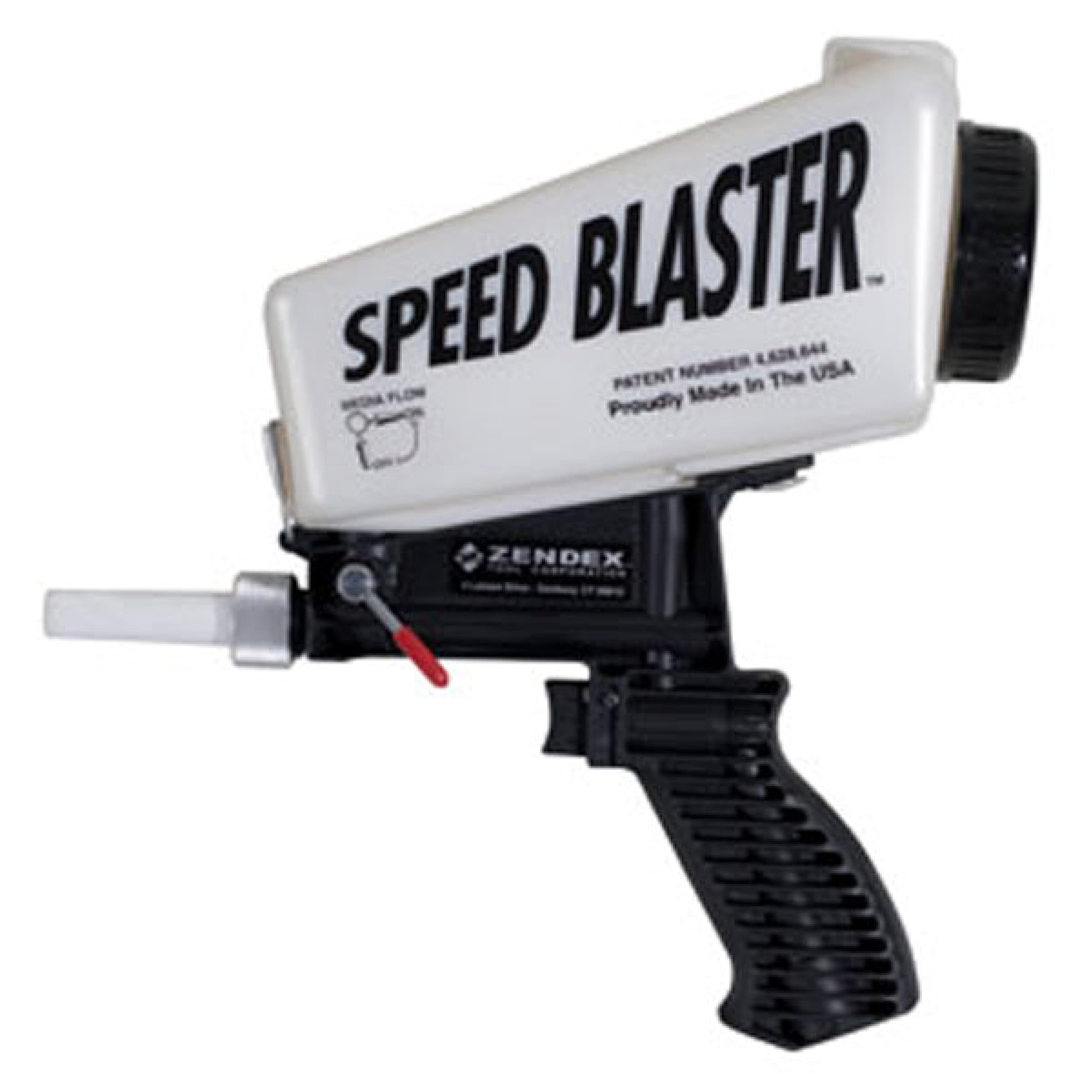
The lightweight workhorse that one owner kept running for eight years before replacing it.
If you need one gun that handles everything from snowmobile exhaust parts to rusty light fixtures and small auto spots, the Zendex SpeedBlaster is built for that. It weighs just 1.25 pounds, so you can work with it all day without fatigue, and the ergonomic one-piece handle feels solid. The gravity-feed design uses a hardened steel mixing chamber that is replaceable, and a safety-vented tank reduces the risk of pressure buildup.
The biggest selling point here is the 7-year warranty — a strong signal of confidence from the company. Reviewers confirm the durability: one reviewer noted the first unit lasted about eight years of heavy use before failing, and they immediately bought a replacement. Another noted that while it does a “fine job,” you occasionally have to shake the gun to keep media flowing into the nozzle. Setup is simple: connect your air compressor, fill the hopper, and adjust the flow rate.
What holds it back is the small hopper, which empties quickly on continuous work. It also requires some shaking to maintain flow, which interrupts the rhythm of the job. But for the mid-range price, the combination of a proven long life and a 7-year warranty makes this a smart pick for anyone who wants to buy once.
Why it’s great
- Ultra-light 1.25-pound body reduces arm fatigue during long use
- Industry-leading 7-year warranty from a family-owned US company
- Replaceable hardened steel mixing chamber extends the gun’s life
Good to know
- Small gravity hopper needs frequent refills on longer jobs
- Media flow can stall occasionally, requiring you to shake the unit
- Not ideal for heavy industrial use despite the durable steel components
Best for: A versatile, long-lasting hand blaster for medium restoration tasks in a home garage.
Skip if: You need to blast continuously for more than a few minutes and hate stopping to refill the hopper.
4. Inokraft Leak-Proof Portable Sand Blaster Gun Kit with Oil-Water Separator
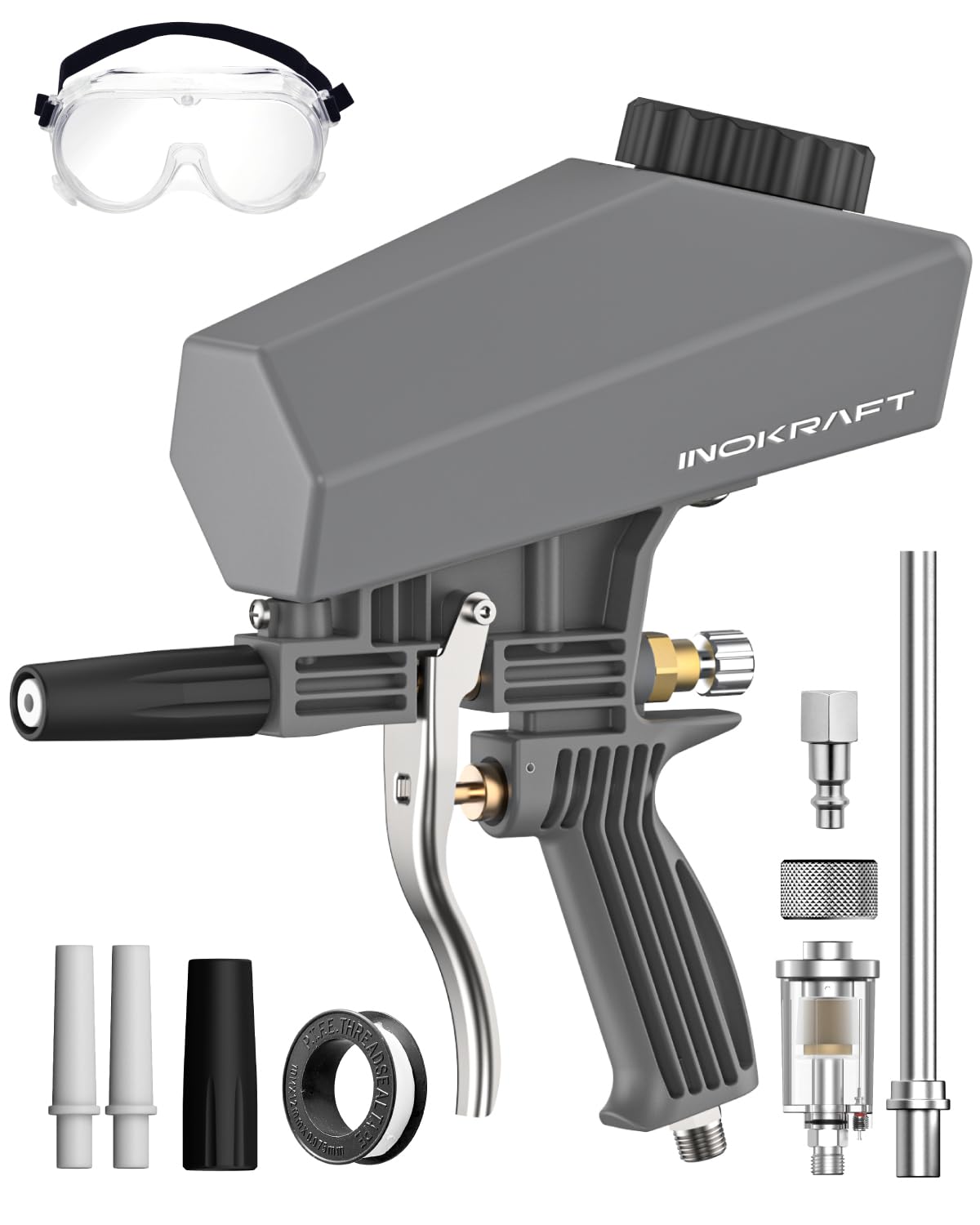
The complete beginner’s kit that throws in everything you need except the compressor.
Inokraft’s kit is built for someone who is opening their first sandblaster and does not want to piece together accessories. The box includes a 900cc gravity-feed gun, an extension nozzle for reaching inside engine ports, an oil-water separator (a device that removes moisture from the air) — the part beginners always forget, which then clogs their gun — plus a set of ceramic nozzles, a quick connector, and even safety goggles. The gun delivers up to 287 m/s airflow through the ceramic nozzle and works between 60 and 120 PSI.
Customers note using this kit for walnut blasting engine manifold ports at 80-100 PSI with excellent results. The trigger-only media flow is a smart design — no knobs to adjust, you just pull the trigger and abrasive flows. One reviewer who used it to strip exhaust headers down to bare metal with 70-grit aluminum oxide said it was “better than Harbor Freight” and that there was no grit dump when the trigger was released. The trade-off is that the whole unit feels mostly plastic, and a few users had the trigger lock open, requiring disassembly to clean out the housing.
The package dimensions are 12.95 x 10.28 x 4.69 inches, making it about 18% larger in the box than the TCP Global unit but still compact enough to store. At 2.92 pounds it is heavier than the LE LEMATEC blasters but still manageable for handheld use. For the price, the included separator alone is a clear advantage over a bare-bones gun.
The case for it: An all-in-one kit with a 900cc hopper, oil-water separator, extension nozzle, and goggles so you can start blasting right out of the box without hunting for adapters.
One limitation: The mostly plastic construction feels less durable than metal-bodied units, and the trigger mechanism can jam with fine dust requiring cleaning.
Best for: A first-time buyer who wants a complete setup without extra shopping trips for accessories.
Skip if: You already own a moisture separator and shop goggles, and you want a more rugged metal gun.
5. LE LEMATEC Sand Blaster Gun Kit (Pistola de Arena)
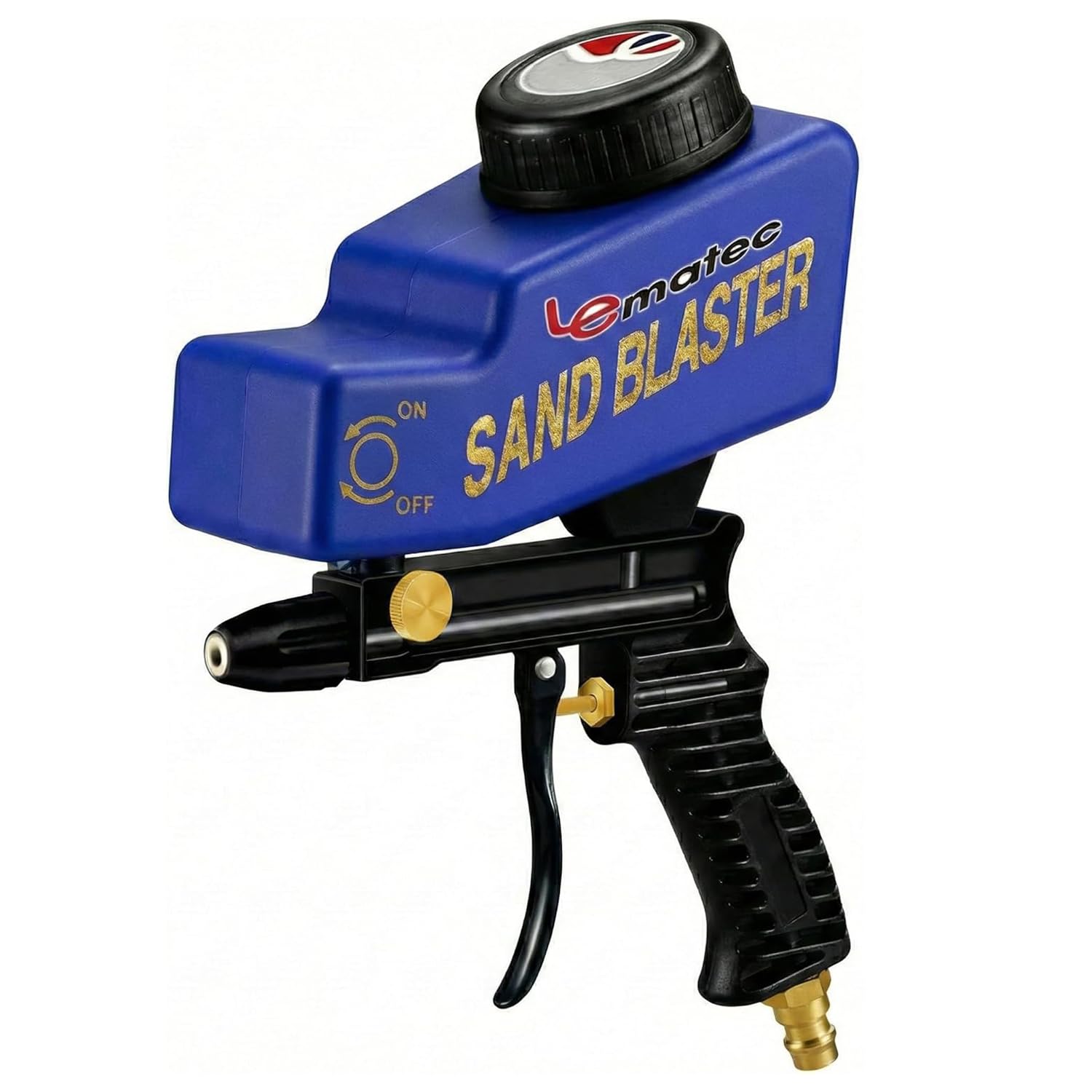
The lightweight precision gun that car restorers buy for intricate door trim and ornament work.
Weighing only 1.3 pounds with a wear-resistant ceramic nozzle, this LE LEMATEC gun is designed for detail work on auto restoration and furniture refinishing. It operates best at 90 PSI and needs 4 CFM, which is a reasonable ask for a 20-gallon compressor. The gravity-fed design accepts #46 to #100 grit media including aluminum oxide, silicon carbide, glass beads, and walnut shells.
Reviewers praise its performance on small car restoration parts, specifically noting that it cleaned complex door trim in 30 minutes that would take hours by hand. One owner said it “ate rust and epoxy paint” with 120 grit aluminum oxide at 140 PSI, leaving a matte finish, though the hopper emptied fast. The rugged ABS (a strong plastic) housing holds up well, but the airline connector on the unit may not match a standard 1/4″ quick connect in every case, so check your fittings. Unlike the TCP Global blaster at 4.6 pounds, this one is 3.3 pounds lighter and easier to maneuver into tight spaces.
The comparison with the TCP Global SB8048 is clear: the LE LEMATEC leads on pressure (the TCP maxes out at 90 PSI) and is 3.3 pounds lighter, but it lacks the recovery bag that contains some of the mess. For focused spot work, this is the better tool.
Why it’s great
- Ultra-light 1.3-pound weight with a wear-resistant ceramic nozzle for precision work
- Compatible with a wide range of media including aluminum oxide and walnut shells
- Ergonomic easy-pull trigger and rugged ABS housing for comfortable control
Good to know
- The air inlet connector may not fit standard 1/4″ quick-couplers without an adapter
- Small hopper empties quickly making it unsuitable for continuous large-area blasting
- Produces a dusty cloud that requires a tarp and full protective gear for indoor use
Best for: Intricate automotive restoration work like motorcycle parts and door trim that needs precision.
Skip if: You intend to blast a large flat surface like a hood or a bed frame where the small hopper will annoy you.
6. LE LEMATEC Portable Sand Blaster Gun Kit, 150 PSI
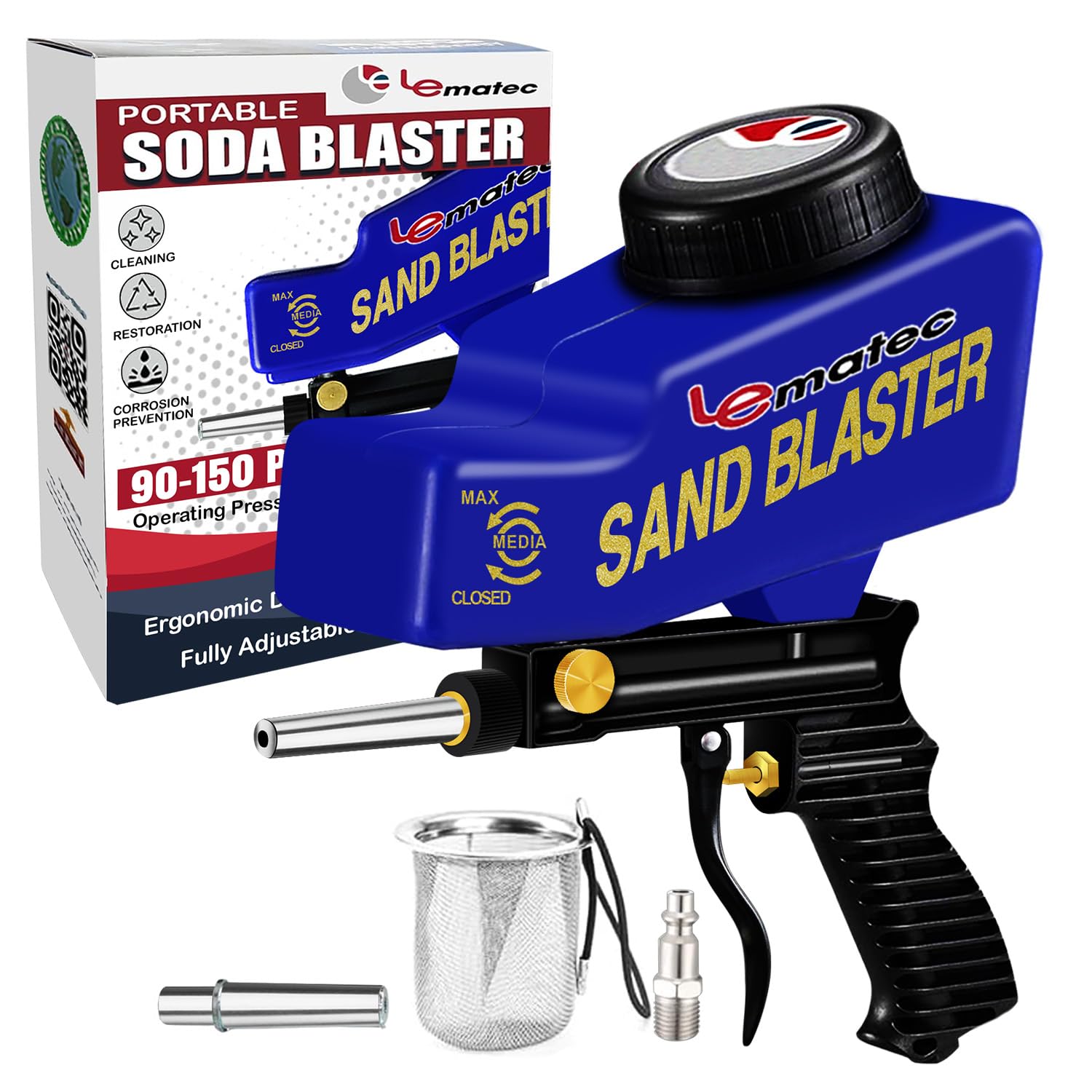
The budget gun that punches way above its weight for small detail stripping.
This is the lightest gun on the list at just 1.19 pounds, and it is the only one here rated for a full 150 PSI — which gives it a real edge against rust and stubborn finishes. The gravity-fed design is compatible with soda, sand, walnut shells, and aluminum oxide, making it flexible for different jobs. The adjustable flow control valve on the blasting gun lets you dial in the media flow to minimize waste.
Reviewers point out using it to strip paint from plastic horse models with sodium bicarbonate in 5 minutes versus an hour of hand sanding. Another mentioned it removed old varnish from chair crevices effectively but left the wood rougher at 50% feed, requiring follow-up sanding. The hopper is small, so one owner went through 3 pounds of baking soda to clean six chairs. The steel nozzle is durable, but the gun body is primarily plastic, so treat it carefully.
The standout metric here is the pressure: at 150 PSI, this LE LEMATEC gun delivers 67% more pressure than the TCP Global SB8048 (90 PSI) and is 3.41 pounds lighter. For small jobs, it offers the best balance of power and low weight at a budget-friendly price, provided you accept the need for frequent refills.
The case for it: An extremely lightweight 150 PSI gravity-feed gun that outperforms heavier competitors on pressure, ideal for spot cleaning and detail work.
The compromise: The small hopper empties quickly on medium projects, and the plastic body feels less durable than metal alternatives for continuous heavy use.
Best for: Budget-conscious buyers who need a powerful gun for small detail work like stripping furniture crevices or plastic models.
Skip if: You plan to strip a large item like a king bed frame — the constant refilling will drive you crazy.
7. TCP Global Sand Blaster Gun Kit with Recovery System

The sandblast gun with a recovery bag that actually catches some of the mess.
This TCP Global kit stands out because it includes a steel-tip blaster gun and a fabric recovery bag that surrounds the blast area. The idea is that the bag catches the spent media and loose debris, letting you reuse some of it. It works — but shoppers say a catch: the recovery is poor when the nozzle is not held horizontal, with one reviewer noting 75% media loss if the gun is angled. In practice, for spot cleaning it keeps the dust cloud much smaller than an open gun, which is a major plus if you are working in a shop without a full blast cabinet.
The maximum pressure is 90 PSI (6 Bar), which is enough for spot rust removal and paint stripping on small areas before welding. The three nozzles (surface, corner, and panel spot) cover a range of tasks. At 4.6 pounds, it is the heaviest gravity-feed gun on the list, and the recovery bag adds to the bulk when handling. Buyers generally love it for the price, with multiple 5-star reviews calling it a “great deal” and “perfect for small areas.” The 1/4″ NPS (National Pipe Straight) air inlet is standard for most compressors.
The honest trade-off is that the recovery bag is effective only when the gun stays horizontal, which is limiting for overhead work or angled corners. And at 90 PSI, it is less powerful than the LE LEMATEC alternatives that hit 150 PSI. For low-mess spot cleaning on a workbench, it is a clever solution; for anything else, you will want a more powerful open gun.
Why it’s great
- Built-in recovery bag captures spent media and reduces dust for spot work
- Three included nozzles (surface, corner, panel spot) provide useful versatility
- Standard 1/4″ NPS air inlet fits most compressors without adapters
Good to know
- Recovery bag is only effective when the gun is kept horizontal — angled blasting loses 75% of media
- Heaviest gravity-feed gun at 4.6 pounds, which adds arm fatigue during longer sessions
- Maximum 90 PSI is lower than competing guns that offer 150 PSI
Best for: Shop-based spot cleaning where you want to contain the dust cloud and reuse media on horizontal surfaces.
Skip if: You need the highest blast pressure or need to work at odd angles where the bag stops working.
Understanding the Specs
PSI (Pounds per Square Inch)
PSI is the force of the air stream; higher PSI means more aggressive material removal. The hand guns in this guide range from 90 PSI (standard for gravity feed) up to 150 PSI. If your compressor cannot deliver the rated PSI continuously, the gun will not pull its full abrasive stream. For simple paint removal, 90 PSI is fine. For removing deep rust or thick epoxy, shoot for 150 PSI if your compressor can handle it. The CFM (Cubic Feet per Minute) number is equally important — a 150 PSI gun that needs 6 CFM will not work on a tiny pancake compressor that only supplies 2 CFM.
Gravity Feed vs. Pressure Tank
Gravity-feed guns have a hopper on top that feeds media into the air stream by gravity. They are simple, cheap, and light — the whole gun might weigh only 1.19 pounds — but the hopper holds just 1 to 2 cups of media and empties every 1-2 minutes of continuous use. Pressure tanks hold 50 pounds of media in a sealed tank that is pressurized separately, giving you 10-15 minutes of steady blasting before you need to refill. The drawback is weight and cost: tanks are heavy (24.7 pounds for the VEVOR) and expensive, plus they require a much larger compressor to pressurize the tank itself.
FAQ
What size air compressor do I need for a sandblaster?
Can I use a sandblaster without an oil-water separator?
What media works best for removing car paint?
Is a gravity-feed or siphon-feed blaster better?
How long does a ceramic nozzle last?
Will a small 6-gallon compressor work with a sandblaster?
Can I use a sandblaster on wood furniture?
What PPE should I wear when sandblasting?
Why does my sandblaster keep clogging?
Which sandblaster is best for a beginner?
Final Thoughts: The Verdict
For the majority of shoppers, the best air compressor sandblaster is the Performance Tool M549 because its 50-pound capacity and 15-foot hose let you tackle a wide range of jobs without constant refills. If you want the most powerful hand gun for precision automotive restoration, grab the LE LEMATEC Portable 150 PSI. And for a complete beginner-friendly kit that includes every accessory you need, the standout is the Inokraft Leak-Proof Kit with Oil-Water Separator.
How We Picked
We do not accept paid placement, and we did not hands-on test every unit. Instead, we match each pick to a real buyer and use-case by comparing the manufacturers’ published specifications against the patterns in verified customer reviews — so you get each pick’s real strengths and trade-offs instead of marketing copy.
Sources & Methodology
Specifications: manufacturer listings and product documentation. Review insights: verified customer reviews, as of July 2026. Pricing: not shown on this page (it changes often); check the current price via the retailer link.
As an Amazon Associate, Gadgets Feed earns from qualifying purchases. This does not affect which products we feature.
Product prices and availability are accurate as of the date/time indicated and are subject to change. Any price and availability information displayed on Amazon at the time of purchase will apply to the purchase of this product. As an Amazon Associate I earn from qualifying purchases.
CERTAIN CONTENT THAT APPEARS ON THIS SITE COMES FROM AMAZON. THIS CONTENT IS PROVIDED "AS IS" AND IS SUBJECT TO CHANGE OR REMOVAL AT ANY TIME.
Amazon and the Amazon logo are trademarks of Amazon.com, Inc. or its affiliates.