
Our readers keep the lights on and my morning glass full of iced black tea. As an Amazon Associate, I earn from qualifying purchases.
You finally traded gas-station stops for a plug in your own garage — but the charger that came with your car trickles power so slowly you are still planning your week around a full battery. A Level 2 (240V) home charger changes that, cutting charge time from overnight-plus to a few hours. The trick is picking the right amperage (the electrical current it can push, measured in amps) and features so you do not pay for speed you cannot use or miss a feature you actually need.
I’m Min — the founder and writer behind Gadgets Feed. This guide is built by comparing the manufacturers’ published specifications and the patterns across verified customer reviews, so you get each pick’s real strengths and trade-offs instead of marketing spin.
Whether you drive a Tesla, a Ford F-150 Lightning, or a Chevy Bolt, the right at home car charger gets you back on the road faster with less fuss — and this guide breaks down eight solid options to help you decide.
Quick Picks
- EMPORIA Level 2 EV Charger – NEMA 14-50 EVSE w/NACS — Best Overall
- AIMILER Level 2 Electric Vehicle (EV) Charger 48A — Smart Value
- MACH 1: Fast 48 Amp Level 2 EV Charger — Dual Connector
- WOLFBOX Level 2 EV Charger 40amp — Feature-Rich
- EVIQO NACS Charger for Tesla 48 Amp — Tesla Hardwire
- Autel Level 2 EV Charger up to 50Amp — 50-Amp Power
- Level 2 EV Charger 40 Amp — Budget Champion
- Grizzl-E Ultimate Level 2 Fastest 80A — Top Performer
How To Choose The Best At Home Car Charger
Picking a Level 2 charger depends on three things: your car’s maximum charge rate, your home’s electrical panel capacity, and how much you want the charger to “think” for you. A 40-amp charger is plenty for most EVs, while a 48-amp unit needs a 60-amp breaker and hardwiring to reach full speed. Smart features like app scheduling let you charge during off-peak hours when electricity is cheaper, but if you just want a plug-and-forget device, a simpler unit saves you money.
Amperage and Your Home’s Electrical Panel
Your charger’s speed is set by its amperage — think of it as the size of the electrical pipe filling your car’s battery. A 40-amp charger needs a 50-amp breaker and delivers about 9.6kW, which adds around 30-40 miles of range per hour for most EVs. A 48-amp charger needs a 60-amp breaker and pushes up to 11.5kW. The catch is that many plug-in units are limited to 40 amps even if the hardware can handle more — you must hardwire to get the full 48 amps. Before buying, check your breaker panel for available space and capacity; if you only have a 50-amp outlet, a 40-amp charger is your ceiling.
Plug-In vs Hardwired Installation
A plug-in charger (NEMA 14-50) is the easier route — you just install a 50-amp outlet and plug the unit in. It is portable, so you can take it with you if you move. The downside is that most plug-in chargers are capped at 40 amps for safety, and the connection point (the outlet) is an extra failure point that can overheat over time. Hardwired units connect directly to the breaker panel, which lets them safely pull higher amperage (48A or more) and eliminates the outlet risk. Hardwiring requires an electrician and is a permanent installation, but it is the cleaner, more reliable setup for long-term use.
Smart Features and App Control
Not everyone needs a WiFi-connected charger. If your utility offers time-of-use rates (cheaper electricity late at night), a smart charger with scheduling lets you fill up during those off-peak hours automatically. Some apps track your charging cost per session, which helps you see exactly what you are spending. Other features like voice control (Alexa or Google Assistant) or RFID cards for guest access are nice extras but not essential. If you just want to plug in and have it work, a “dumb” charger without an app is simpler, cheaper, and one less thing to troubleshoot.
Quick Comparison
On smaller screens, swipe sideways to see the full table.
| Model | Best For | Amperage | Cable Length | Weight | Amazon |
|---|---|---|---|---|---|
| EMPORIA Level 2 EV Charger | Tesla owners wanting a no-adapter smart charger | 48 Amps | 25ft | — | Amazon |
| AIMILER Level 2 EV Charger 48A | Buyers wanting app control and adjustable amperage | 48 Amps | 25ft | — | Amazon |
| MACH 1 48 Amp Level 2 EV Charger | Multi-EV households needing both J1772 and NACS | 40.0 Amps | 30ft | 14.98 Pounds | Amazon |
| WOLFBOX Level 2 EV Charger 40amp | Buyers wanting a big LCD screen and voice control | 40 Amps | 25ft | 13.49 pounds | Amazon |
| EVIQO NACS Charger 48 Amp | Tesla owners wanting a native NACS hardwired charger | 48 Amps | 25ft | 18.86 pounds | Amazon |
| Autel Level 2 EV Charger 50Amp | Buyers wanting adjustable amperage and a trusted brand | 50 Amps | 25-Foot | — | Amazon |
| Level 2 EV Charger 40 Amp | Budget-minded buyers wanting a simple, reliable unit | 40 Amps | 25ft | 15 Pounds | Amazon |
| Grizzl-E Ultimate 80A | Fastest possible home charging with load balancing | 80 Amps | 25ft | — | Amazon |
In‑Depth Reviews
1. EMPORIA Level 2 EV Charger – NEMA 14-50 EVSE w/NACS
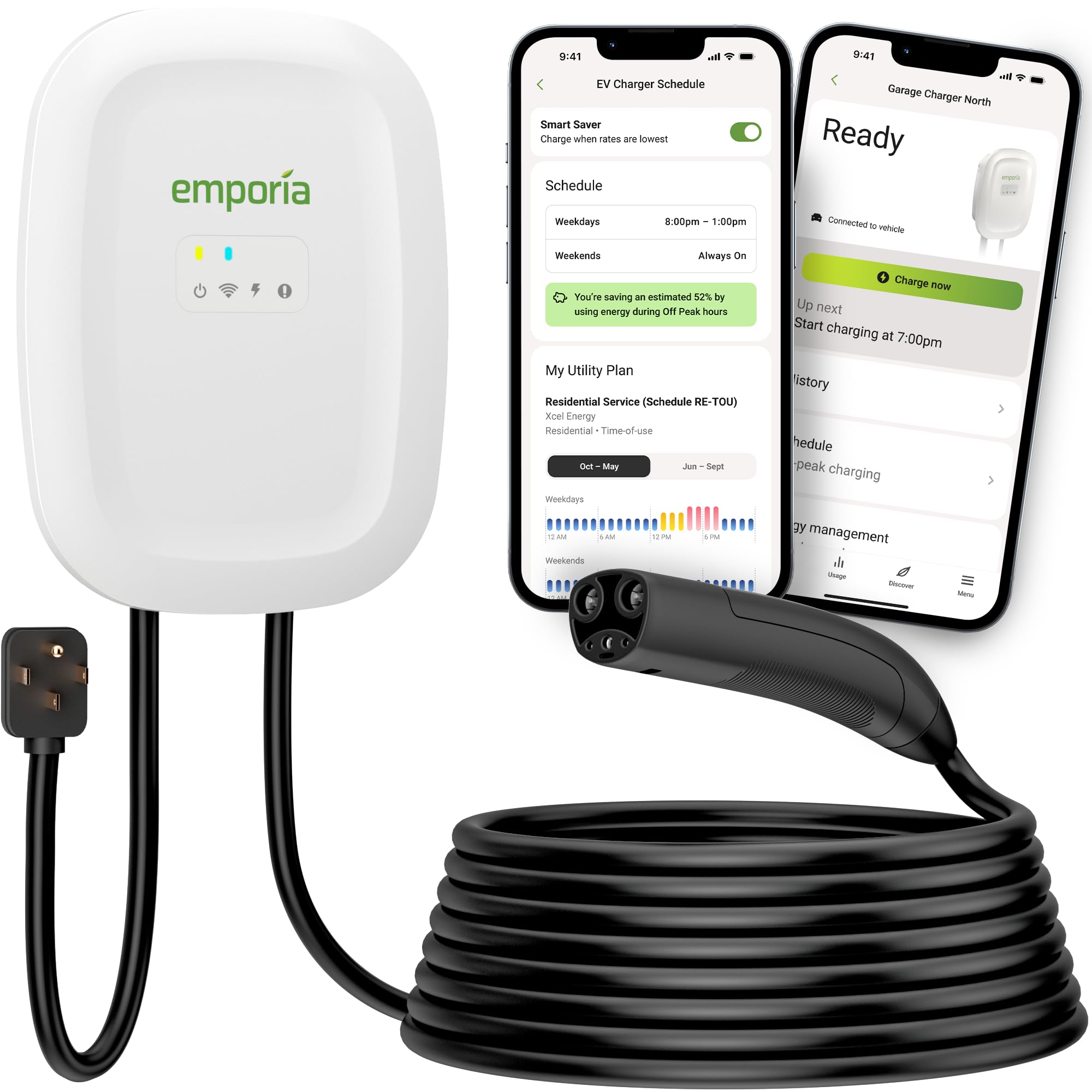
A Tesla-native charger that skips the adapter without skimping on smart features.
If you drive a Tesla, this EMPORIA removes a headache right away. It comes with a native NACS connector (the Tesla-style plug), so you plug straight into your Tesla without needing a clunky J1772-to-Tesla adapter — and the built-in button on the handle pops open your charge port door just like the factory Tesla unit. When hardwired on a 60-amp breaker, it pushes 48 amps and adds up to 46 miles of range per hour, which is about 9 times faster than a standard 110-volt wall outlet. Plugged into a NEMA 14-50 outlet (a standard 240V RV plug), it runs at 40 amps and still delivers up to 38 miles per hour.
Buyers report that the app tracks cost per session based on your electricity rate, making it easy to compare savings versus public charging. The 25-foot cable is long enough for most garages, and one reviewer noted the charger runs cool even at 40 amps with no overheating issues. It connects over 2.4 GHz WiFi for real-time energy data and scheduling, and it is UL listed and ENERGY STAR certified for safety standards (NEC 625, UL 817, UL 991, UL 2231, UL 2251, and UL 2594). The unit is preconfigured for a NEMA 14-50 plug; you convert to hardwire for the full 48-amp output.
The white plastic enclosure is less sleek than Tesla’s own wall connector, as some buyers observed, but it is also noticeably more affordable. It works with Tesla Powerwall, which is a nice bonus if you already have solar or home battery storage.
The case for it: Native NACS means no adapter for Teslas, plus a sturdy app that tracks charging cost per session and supports Powerwall integration.
The trade-off: The plastic housing feels less premium than some competitors, and the app is more of a stats tracker than a control center.
Best for: Tesla owners who want a reliable, app-connected charger without paying for a brand-name wall unit.
Skip if: You drive a J1772 EV (non-Tesla) — this NACS-native unit requires an adapter for those vehicles.
2. AIMILER Level 2 Electric Vehicle (EV) Charger 48A
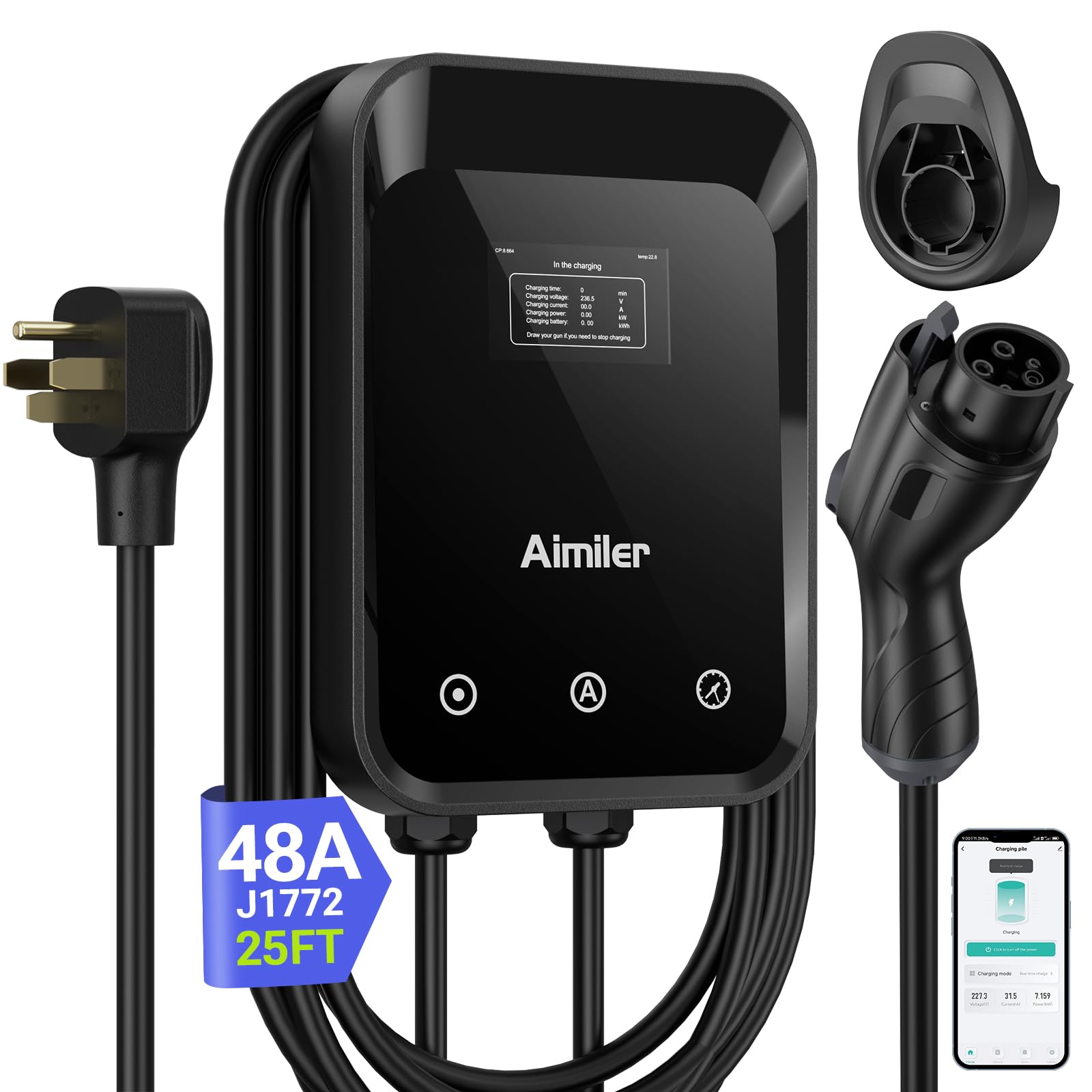
Packs app smarts and a crisp touch screen into a mid-range price.
The AIMILER brings features normally found on premium units down to a more accessible price point. It has a built-in LED touch screen that shows amperage (how much current is flowing), charging speed, input voltage, and even a delay timer, so you are not stuck guessing what is happening. The included WiFi app lets you set charging periods to take advantage of off-peak utility rates, check your charging history, and get a notification when the battery is full. It is ETL and FCC certified, and buyers confirm that “they charge at 48A consistently” — the full rated output.
Plugged into a NEMA 14-50 outlet, it delivers 40 amps (38 miles per hour); hardwired on a 60-amp breaker, it reaches the full 48 amps for 46 miles per hour. Charging speed is a step up from most chargers at this price — it beats the 40-amp competition by a 20% margin in amperage. The 25-foot cable is military-grade and built to withstand over 10,000 plug cycles, though owners mention the cable can be a bit stiff in cold weather. The unit has a NEMA Type 4 protection rating (weatherproof) with an IP66 waterproof rating (meaning it is protected against powerful water jets), so outdoor installation is fine as long as you keep it out of direct sunlight and heavy rain.
One quirk: the app requires a 2.4 GHz WiFi connection, and some buyers had to factory reset the unit (by long-pressing the A and time buttons) when switching phones. The touch screen buttons are also unresponsive unless the charging gun is pulled out first — a minor design choice but worth knowing.
Why it’s great
- LED touch screen shows real-time charging data and amperage
- WiFi app enables off-peak scheduling and cost tracking
- ETL and FCC certified for safety
Good to know
- Cable stiffens in cold weather, per buyer reports
- Touch screen can be hard to read in bright sunlight
- Requires 2.4 GHz WiFi for app connectivity
Best for: Buyers who want a smart charger with a visual display and adjustable amperage without paying premium prices.
Skip if: You need a charger that works reliably in extreme cold without the cable stiffening up.
3. MACH 1: Fast 48 Amp Level 2 EV Charger
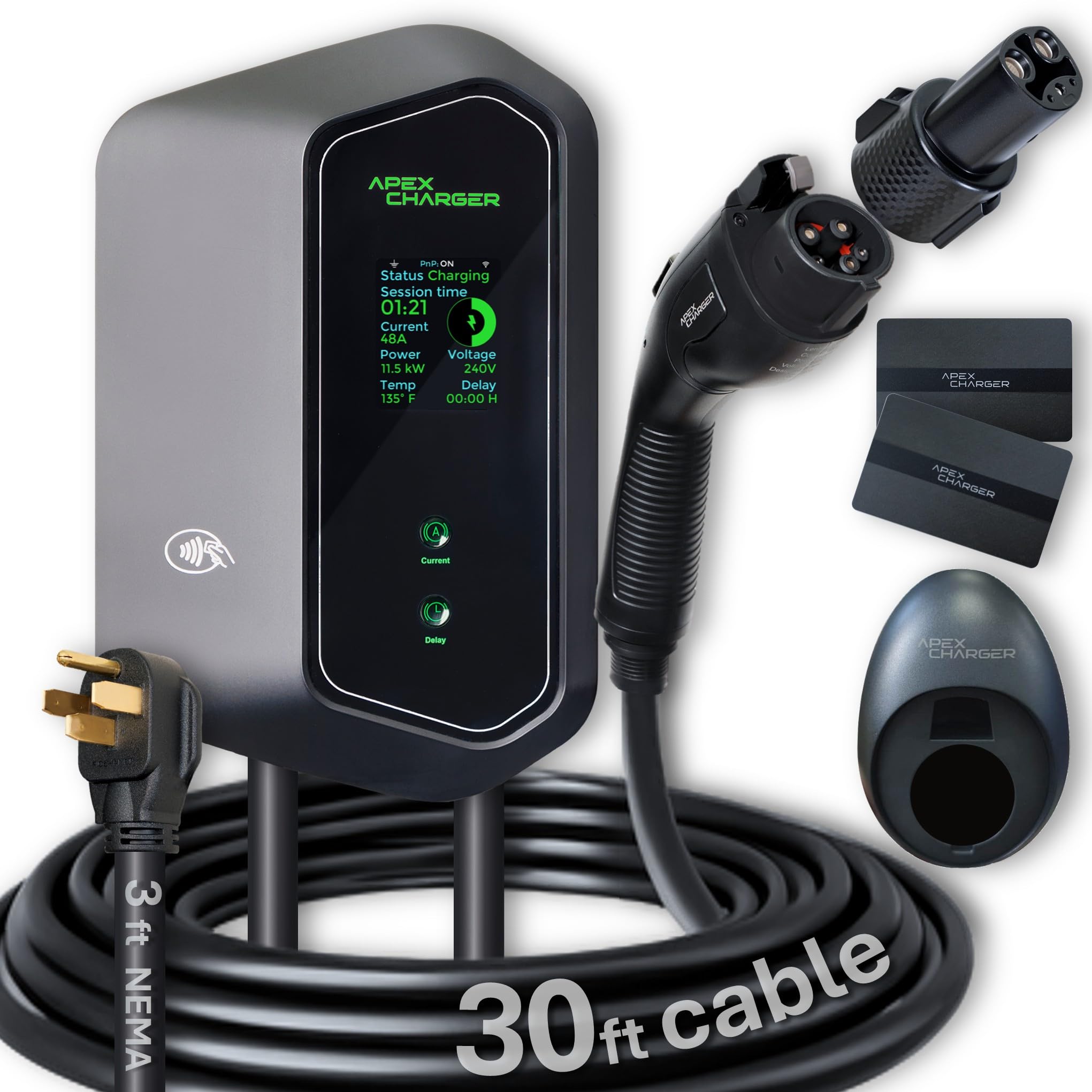
An American-made charger that comes ready to serve both J1772 and Tesla vehicles.
The MACH 1 from ApexCharger is designed for households with more than one type of EV. It ships with both a J1772 connector (the standard for non-Tesla EVs like Chevy Bolt and Ford Mustang Mach-E) and the PRO 1 NACS adapter (with its own carrying bag), so you can charge a Chevy Bolt and a Tesla Model Y from the same unit without buying extra parts. The 30-foot cable is a full 20% longer than the 25-foot cables on most competitors, which is a real help if your parking spot sits far from the charger mount — it stretches easily across a two-car driveway. The unit itself weighs 14.98 pounds and measures 3.15 by 6.72 by 10.35 inches, making it fairly compact for wall mounting.
A 2.4-inch LED display panel shows charging status, and the built-in Bluetooth and Wi-Fi connect to the mobile app for scheduling and monitoring. You also get two RFID cards (like hotel key cards you tap to start charging), so you can let a friend or neighbor charge without handing over your phone. Buyers mention the adjustable amperage (0-48A) is useful — one reviewer ran it at 24 amps on a 30-amp outlet via an adapter, then switched to 40 amps on a NEMA 14-50 setup. For the full 48 amps, the unit must be hardwired with the included kit and a 60-amp breaker. When plugged in as a 40-amp unit, it uses a NEMA 14-50 plug on a 50-amp breaker.
Customer support gets high marks from reviewers, with one noting a Sunday evening “overheating” error was resolved within an hour. The only nagging limitation is the time-of-day scheduling: customers note it lacks individual day selection, so you cannot set different schedules for weekdays versus weekends.
The case for it: Comes with both J1772 and NACS connectors plus RFID cards, and the 30-foot cable is the longest in this roundup.
One limitation: The time-of-day scheduling in the app is basic — you cannot set different schedules per day of the week.
Best for: Multi-EV households with both J1772 and Tesla vehicles who want one charger that handles both.
Skip if: You need per-day scheduling control in the app for complex time-of-use utility plans.
4. WOLFBOX Level 2 EV Charger 40amp

A 4.3-inch LCD screen turns charging data into something you actually want to read.
The WOLFBOX E40 stands out visually with its large 4.3-inch LCD screen that displays the charging rate, elapsed time, voltage, and total energy delivered — so you can glance at the charger itself rather than fishing for your phone. It also integrates with Alexa and Google Assistant for voice control, which is handy when your hands are full with groceries. The unit is CSA certified and meets UL 2594 safety standards, and it has a NEMA 4X waterproof housing rated for outdoor use. It weighs 13.49 pounds, making it lighter than most 40-amp chargers in this list.
As a 40-amp unit on a NEMA 14-50 plug, it delivers 9.6kW and adds about 38 miles of range per hour. The app supports Google account login, device sharing for multiple household users, and scheduled charging during off-peak hours to save on electricity costs. One reviewer shared that the federal tax credit covers 30% of the purchase and installation cost. The 25-foot cable is a nice bonus, though some buyers noted the WiFi connection was tricky to establish at first. The RFID card feature lets guests start a charge without the app — but one reviewer pointed out that the card must be swiped again to stop charging, which leaves the charger active if you forget.
The rubber plug is described as “hard rubber” and solid by a buyer. A buyer who replaced a 10-year-old charger reported the installation was simple and the app’s scheduling worked well for cost tracking.
Why it’s great
- Large 4.3-inch LCD shows charging stats at a glance without needing the app
- Works with Alexa and Google Assistant for hands-free control
- Lighter than most at 13.49 pounds, easier to mount
Good to know
- WiFi setup can be finicky initially, per buyer reports
- RFID card must be swiped to stop charging, not just to start it
- Time-of-use scheduling requires the car to already be plugged in before the window opens
Best for: Buyers who want a big on-unit screen and smart-home voice control without breaking the budget.
Skip if: You want a simple plug-and-charge unit with no app or RFID card interaction.
5. EVIQO NACS Charger for Tesla 48 Amp
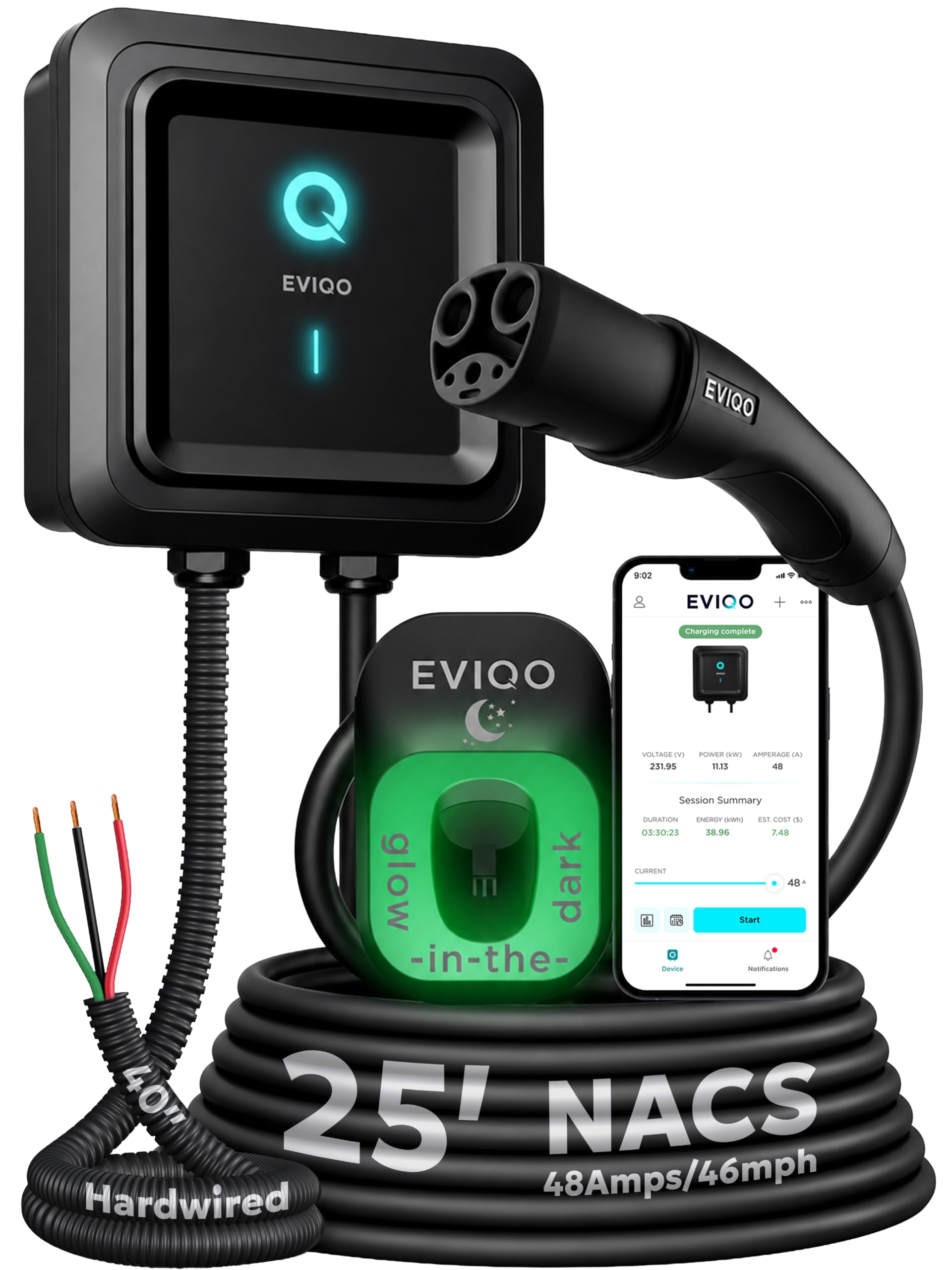
A tank of a charger built for Teslas, with a glow-in-the-dark holster you will appreciate at midnight.
The EVIQO EVIPOWER is a hardwired-only unit designed specifically for Tesla’s NACS connector (the Tesla charging plug) — it works natively with Model S, 3, X, and Y, and the button on the handle opens the charge port just like Tesla’s own unit. It delivers up to 48 amps on a dedicated 60-amp/240V circuit, and you can even set DIP switches (small switches inside the unit) to unlock 50 amps (which requires a 70-amp circuit). The unit is heavy at 18.86 pounds, partly because of the IP66/NEMA-4 weatherproof enclosure and the steel shielding around the mainboard. Reviewers confirm the charger works perfectly after five months and that the app allows current adjustment (one reviewer uses 18A for overnight charging).
One unique feature is the fluorescent holster — it absorbs both natural and artificial light, and just 10 minutes of charge boosts its brightness by about 60 percent. After 3-4 hours of exposure, it glows for an extended period, making it easy to find the connector in a dark garage. The WiFi antenna is enhanced to stay online in basements and garages, and the app shows session summaries with kWh used (kilowatt-hours, the unit of energy), cost, and weekly/monthly totals. It can also send off-peak charging reminders. Reviewers point out that charging a VW ID.4 takes 5-7 hours from empty, and the app estimates charging cost accurately.
The compromise noted by reviewers is that the soft plastic plug scratches easily, and installation is not DIY-friendly — you need a licensed electrician per the National Electrical Code. If your home does not have a 60-amp circuit available, factor in that upgrade cost.
The case for it: Built like a tank with IP66 weatherproofing, a glow-in-the-dark holster, and an app that tracks cost per session.
The drawback: Hardwired-only with a heavy 18.86-pound enclosure, and professional installation is required.
Best for: Tesla owners who want a rugged, weatherproof, hardwired charger with smart app features.
Skip if: You need a plug-in portable unit or you drive a J1772 EV without an adapter.
6. Autel Level 2 EV Charger up to 50Amp
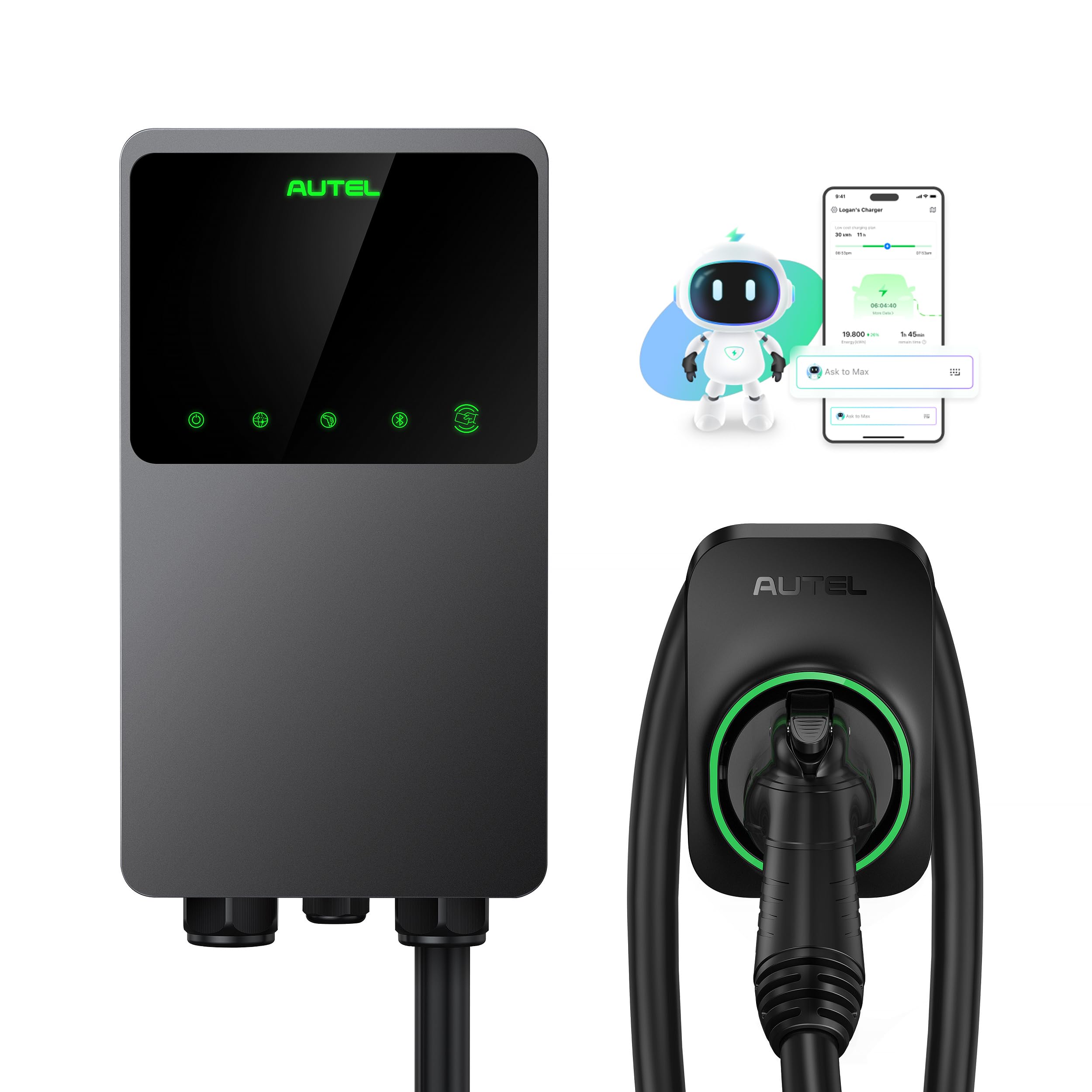
Autel brings its diagnostic expertise to home charging with a flexible 50-amp max output.
The Autel MaxiCharger AC Home goes beyond the standard 48-amp ceiling by delivering up to 50 amps (12kW), which adds 37 miles of range per hour. It uses a J1772 connector (the standard for non-Tesla EVs), so it works with all non-Tesla EVs from the start, and the 25-foot cable is engineered to stay flexible even in temperatures as low as -40°C (-40°F) — a genuine help if you park in an unheated garage in a cold climate. The unit is CSA certified and has a NEMA Type 4 rating (weatherproof), meaning it handles snow, rain, hail, and sleet without issue. It is also fire-resistant with over-current, over-voltage, and over-temperature protection built in.
The Autel Charge app connects via Bluetooth, Wi-Fi, or even Ethernet for over-the-air firmware updates (software updates without needing a cable), so you never need to physically update the unit. You can schedule charging for off-peak hours and track your savings right in the app. One buyer mentioned they bought this specifically because they needed adjustable amperage for a 30-amp circuit — the Chevy Bolt they drive lacks Level 2 amp settings in the car itself, so the charger’s flexibility was essential. They confirmed the physical amp selector on the unit plus the app adjustment let them dial in 32 amps on a 40-amp breaker. The build quality is excellent, with a thick, heavy-duty cable that buyers describe as well-made.
The 3-year warranty and around-the-clock support from Autel’s service team are reassuring, though one buyer had a slow initial support response before getting a fast resolution. At 50 amps, it is the highest-amperage J1772 charger in this guide — more than the 48-amp EMPORIA or AIMILER — but it is also one of the more expensive options.
Why it’s great
- Up to 50 amps (12kW) — highest J1772 amperage in the guide
- Cable stays flexible in extreme cold down to -40°C
- 3-year warranty with over-the-air firmware updates
Good to know
- Premium price compared to 40-amp competitors
- One owner reported a slower initial support response
- Slightly heavier than competing 40-amp units
Best for: Buyers in cold climates who need a flexible cable at low temperatures and want max amperage for J1772 vehicles.
Skip if: You drive a Tesla — this unit requires an adapter for NACS vehicles.
7. Level 2 EV Charger 40 Amp

A no-nonsense 40-amp unit that skips the frills and focuses on reliable daily charging.
The VEIPHLOX 40-amp charger is the entry-level workhorse of this list. It delivers 9.6kW and adds 30-40 miles of range per hour, fully charging most EVs in 4 to 7 hours from empty. The unit is UL-certified (tested by Underwriters Laboratories for safety), with an IP65/NEMA 5 waterproof, dustproof, and fire-resistant housing, so it handles outdoor installation in all weather. Shoppers say that the “Nema 14-50 plug stays cool after 3hrs Level 2 charging,” which is a solid sign of safe thermal performance. It weighs 15 pounds and measures 18.5 by 8.66 by 14.17 inches, making it one of the larger units — but the size comes partly from the internal cord holding design that stores both the cable and connector inside the enclosure.
There is no screen or app — just color-coded LED lights (red for emergency stop, blue for ready, green flashing for charging, solid green for done). The simplicity is a feature, not a flaw, if you just want to plug in and have it charge without configuring anything. The internal switches let you adjust a few settings, but the interface is basic. At 40 amps, it charges at the same rate as the WOLFBOX and the plug-in mode of the EMPORIA, but at a more budget-friendly price point. One reviewer described it as a “simple, reliable no-frills Level 2 charger” that delivers the promised 40 amps without issues after months of use.
The 25-foot cable is long and flexible, and the build quality feels premium according to buyer feedback. Installation is straightforward: mount it on the wall, plug it into a NEMA 14-50 receptacle (standard 240V outlet), and you are done in about 5 minutes. The manufacturer recommends installing it on a circuit breaker rated at 50 amps or greater to avoid tripping.
The case for it: UL-certified with IP65 weatherproofing, a cool-running plug, and a simple interface — it just works.
The catch: No app, no screen, no smart scheduling — you get what you plug into.
Best for: Budget-focused buyers who want a reliable, no-app charger for plug-and-forget daily use.
Skip if: You need smart features like scheduling, cost tracking, or voice control in your charger.
8. Grizzl-E Ultimate Level 2 Fastest 80A
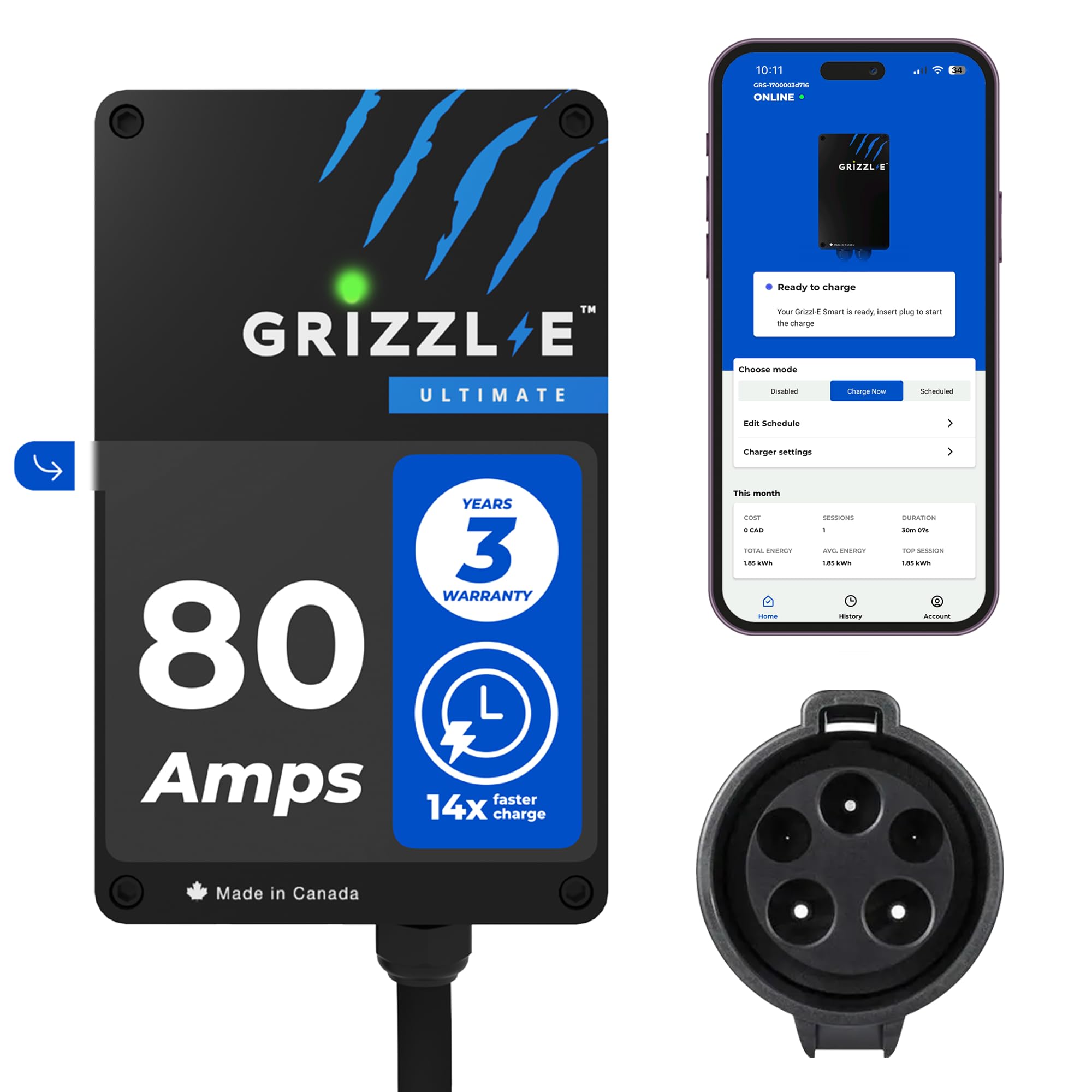
The 80-amp beast that recharges a pickup truck faster than most chargers can manage.
The Grizzl-E Ultimate is in a different league. With an 80-amp maximum output delivering 19.2kW, it is the fastest residential charger here — it can fully charge a Chevy Silverado EV from 25% to 100% in about 7 hours and 20 minutes, according to one buyer. It requires a dedicated 100-amp circuit breaker and is hardwire-only (a kit with terminal lugs and heat shrink wrap is included). The unit comes in a heavy-duty UL Type 4 metal enclosure made in Canada, designed to withstand indoor or outdoor conditions without issue. It is UL tested and certified with protections against over-current, over-voltage, under-voltage, missing diode, ground fault, and over-temperature.
Smart features are handled by the Grizzl-E Connect software, which offers real-time monitoring, charging schedules, detailed energy consumption stats, and firmware updates. An external antenna boosts WiFi connectivity. One standout feature is Intelligent Power Distribution: if you install multiple Grizzl-E chargers, they can automatically balance charging power across units — you can choose equal sharing or priority charging for your daily driver. Buyers report that the app is intuitive and stable after six months of use, and the sturdy thick cable handles 80 amps without issue. One reviewer even mentioned it works with a fuel card reimbursement program.
The adjustable amperage is flexible: you can run it at 48 amps on a 60-amp breaker, 40 amps on a 50-amp breaker, 32 amps on a 40-amp breaker, 24 amps on a 30-amp breaker, or 16 amps on a 20-amp breaker. This makes it future-proof if you upgrade your panel later. However, at this power level, you really need a 100-amp circuit to get the full 80-amp benefit, and not every home has that spare capacity. One buyer had issues connecting to the internet, which turned their unit into a dumb charger with no scheduling, and their vehicle (F-150 Lightning) only drew 46 amps instead of 80 amps — though the truck itself charges at 100 amps elsewhere, so the limitation might be vehicle-specific.
Why it’s great
- 80-amp / 19.2kW output — fastest home charging available
- Intelligent Power Distribution for multi-charger homes
- Rugged metal enclosure made in Canada, UL tested
Good to know
- Requires a 100-amp circuit breaker for full 80A output
- Hardwire-only — not portable for moving homes
- A few owners mention WiFi connectivity issues
Best for: Owners of large EVs (Silverado, F-150 Lightning) who want the absolute fastest home charging and have a 100-amp circuit available.
Skip if: Your home electrical panel cannot support a 100-amp circuit, or you need a portable plug-in unit.
Understanding the Specs
Amperage
The amperage of a charger determines how much electrical current it can push to your car’s battery — measured in amps (A). Higher amps = faster charging, but your car’s onboard charger also has a limit. Most EVs max out at 48 amps or 40 amps, so buying an 80-amp charger only helps if your car can accept that much power (like the Chevy Silverado EV or Ford F-150 Lightning). The circuit breaker in your panel must also match: a 40-amp charger needs a 50-amp breaker, a 48-amp charger needs a 60-amp breaker, and an 80-amp charger needs a 100-amp breaker.
NEMA 14-50 vs Hardwired
NEMA 14-50 is the standard 240-volt plug used for most Level 2 chargers — the same plug your electric range or RV uses. A plug-in charger is easier to install and portable, but it is typically limited to 40 amps for safety. Hardwired chargers connect directly to your breaker panel, which lets them handle higher amperage (48A or 80A) and removes the risk of a loose outlet overheating over time. Hardwiring requires an electrician and is a permanent installation, but it is the safer, more reliable option for daily use.
FAQ
Can I install a Level 2 charger myself?
Will a 40-amp charger work with my 50-amp breaker?
Can I use a Level 2 charger outdoors in the rain?
What is the difference between J1772 and NACS connectors?
How long does it take to fully charge an EV with a Level 2 charger?
Do I need a smart charger with an app?
Can I use an adapter to charge a Tesla with a J1772 charger?
What circuit breaker size do I need for a 48-amp charger?
Is it worth paying more for an 80-amp charger?
How do I pick between a plug-in and a hardwired charger?
Final Thoughts: The Verdict
Across the board, the at home car charger winner is the EMPORIA Level 2 EV Charger because it combines native NACS compatibility for Tesla owners with a smart app, 48-amp hardwired capability, and UL certification at a price that undercuts premium rivals. If you want a large on-unit display and voice control, grab the WOLFBOX Level 2 EV Charger 40amp. And for the absolute fastest charging possible for a large electric truck, the standout is the Grizzl-E Ultimate 80A.
How We Picked
We do not accept paid placement, and we did not hands-on test every unit. Instead, we match each pick to a real buyer and use-case by comparing the manufacturers’ published specifications against the patterns in verified customer reviews — so you get each pick’s real strengths and trade-offs instead of marketing copy.
Sources & Methodology
Specifications: manufacturer listings and product documentation. Review insights: verified customer reviews, as of July 2026. Pricing: not shown on this page (it changes often); check the current price via the retailer link.
As an Amazon Associate, Gadgets Feed earns from qualifying purchases. This does not affect which products we feature.