
Our readers keep the lights on and my morning glass full of iced black tea. As an Amazon Associate, I earn from qualifying purchases.
Specs are compiled from manufacturer listings and verified buyer reviews and can change over time — please confirm the key details on the product page before buying.
A lecture recorder needs to do one thing well: make the professor’s voice the only voice you hear, whether you are sitting in the back row or recording a three-hour seminar. The problem is that most cheap models pick up every shuffling paper, cough, and air conditioner hum alongside the words you actually need. This guide cuts through the noise to find the recorders that deliver clear audio, long battery life, and enough storage for a full semester — without making you fight a confusing menu.
I’m Min — the founder and writer behind Gadgets Feed. This guide is built by comparing the manufacturers’ published specifications and the patterns across verified customer reviews, so you get each pick’s real strengths and trade-offs instead of marketing spin.
You need a recorder that captures every word clearly without running out of battery or space mid-lecture. These seven models earn their spot as the best audio recorder for lectures because each one delivers on battery life, storage capacity, noise reduction, and ease of use — the four things that matter most when you are sitting in a classroom.
Quick Picks
- Sony ICD-PX370 Mono Digital Voice Recorder — Best Overall
- OM SYSTEM Olympus WS-882 Digital Voice Recorder — Pro Pick
- 128GB Digital Voice Recorder (arungo ZD70) — Massive Storage
- 64GB Digital Voice Recorder with Playback (EVISTR L357) — Best Value
- 72GB Digital Voice Recorder w/USB Type-C (Yegolito 0529-B) — USB Direct
- AI Digital Voice Recorder with Transcribe & Summarize (Yorlu B3) — AI Smart
- 128G Magnetic Voice Recorder (AFFETUNI MC-01) — Magnetic Beast
How To Choose The Best Audio Recorder For Lectures
A lecture recorder is a specialized tool. You do not need studio-grade audio, but you do need a recorder that captures a lecturer’s voice clearly, runs long enough for a full day of classes, and stores weeks of recordings without running out of space. Here are the specs that matter most.
Battery Life: Your Primary Concern
This is the single most important feature for a lecture recorder. A recorder that dies mid-lecture is useless. For a single day of classes, you need at least 50 hours of rated battery life. Some models claim 100 hours or more, which means you can charge once and use it for weeks without thinking.
Storage Capacity: How Much is Enough?
Most recorders store audio in compressed MP3 format (a file type that shrinks size by removing some sound detail). A 64GB recorder can hold roughly 4,660 hours of recording at low bitrates (the amount of data used per second of audio). For a student taking 15 hours of notes a week, that is years of recordings. Aim for at least 32GB. the balance is 64GB or 128GB, which gives you freedom to record without checking remaining space.
Recording Quality and Noise Reduction
Look for PCM (Pulse Code Modulation) recording at 1536kbps, which captures audio with less compression. Noise reduction — either DSP (Digital Signal Processing) or AI-based — cuts down background hum and shuffling so the lecturer’s voice stays crisp. An omnidirectional microphone (one that picks up sound from all directions) also helps because you do not have to point it directly at the speaker.
Voice Activation: The Feature That Saves You Time
Voice activation tells the recorder to pause recording when no one is speaking and resume when sound is detected. This eliminates long silences from your recording and saves you hours of playback time. It is especially useful for lectures where the instructor pauses for questions or activities.
Quick Comparison
On smaller screens, swipe sideways to see the full table.
| Model | Best For | Battery Life | Storage | Recording Quality | Amazon |
|---|---|---|---|---|---|
| Sony ICD-PX370 | Simple, trusted brand | 57 Hours | 4 GB | Mono MP3 | $66.55$74.99Amazon |
| OM SYSTEM Olympus WS-882 | Professional use | 68 Hours | 4 GB + microSD | Linear PCM/MP3 | $77.99Amazon |
| 128GB Arungo ZD70 | Maximum storage | 50 Hours | 128 GB | PCM 1536kbps Stereo | $29.99$31.99Amazon |
| 64GB EVISTR L357 | Budget-friendly value | 100 Hours | 64 GB | PCM 1536kbps Stereo | $35.99Amazon |
| 72GB Yegolito 0529-B | Built-in USB convenience | 35 Hours | 72 GB | WAV (DSP noise reduction) | $37.99$49.99Limited time dealAmazon |
| 64GB Yorlu B3 (AI) | AI transcription | 30 Hours | 64 GB | AI Noise Reduction Dual Mic | $69.99$99.99Amazon |
| 128GB AFFETUNI MC-01 | Magnetic & long battery | 35 Days | 128 GB | AI Triple Noise Reduction | $71.87$79.86Limited time dealAmazon |
In‑Depth Reviews
1. Sony ICD-PX370 Mono Digital Voice Recorder

The no-fuss Sony that just works for lecture recording without any learning curve.
You can record MP3 audio quickly and easily with the Sony ICD-PX370, and its up to 57 hours of battery life means you are not hunting for a charger between classes. The built-in direct USB connection lets you transfer files to your PC without hunting for a separate cable — just flip out the connector and plug it in. Buyers report that the voice pickup is excellent from several feet away, with one reviewer noting it “works well as a portable pocket recorder” with “good battery life.”
This is a mono recorder with just 4GB of internal storage, which is a very small amount compared to the 128GB capacity in the Arungo ZD70 below. For a single lecture or daily notes the storage is fine, but if you want to archive an entire semester you will need to offload files regularly. The battery life (57 hours) is solid, and it uses standard AAA batteries, so you can swap in fresh ones if you forget to charge.
The headphones jack is 2.5 millimeters instead of the standard 3.5mm, so you will need an adapter for most headphones — a minor hassle that buyers have mentioned. The interface is simple and user-friendly, making it a great choice if you just want to press record and forget about it.
What stands out
- 57-hour battery life on standard AAA batteries
- Built-in USB connector for direct file transfer
- easy, simple interface that anyone can use
- Excellent voice pickup from several feet away
The trade-offs
- Only 4GB storage — very limited for long-term archiving
- 2.5mm headphone jack requires an adapter
- Mono recording only, not stereo
- Feels less premium for the price, per some buyers
Reach for it if: You want a dead-simple recorder from a trusted brand with long battery life and zero setup fuss.
Look elsewhere if: You need to archive hundreds of hours of lectures without offloading, or you want stereo recording.
2. OM SYSTEM Olympus WS-882 Digital Voice Recorder

The professional’s choice with studio-grade formatting and expandable storage.
The OM SYSTEM Olympus WS-882 earns its spot because it records in both Linear PCM (a lossless format that preserves every detail of the original sound) and MP3 formats, giving you the highest audio fidelity for critical recordings while keeping the option for compressed files when storage is tight. It has 68 hours of battery life, which outlasts the Sony ICD-PX370’s 57 hours. With 4GB of internal memory and the ability to take a microSD card (up to 32GB according to one buyer), you can easily expand storage far beyond the base 4GB — unlike the Sony which has no expansion slot. This is the recorder for you if you need long battery life and expandable storage; skip it if you want a built-in USB plug for direct file transfer, which this model lacks.
One buyer who used it for podcasting noted that the built-in microphones are “surprisingly good” and that with an external mic the recorder achieves podcast-quality MP3 128 stereo. Another reviewer mentioned it is a “nice recorder for audio interviews” with stereo recording that works well in large rooms. The USB direct feature lets you use it as a USB stick, though one buyer warned the connector is prone to breakage if you are not careful.
The biggest catch is that the WS-882 uses AAA batteries rather than a rechargeable internal battery, so you cannot charge it via USB. Buyers also report that the manual is unhelpful and that you need to spend time learning the advanced features. At 77 grams (0.17 pounds), it is noticeably lighter than the Sony at 136 grams.
Why it wins
- Linear PCM recording for studio-quality audio
- Expandable storage via microSD (up to 32GB reported)
- 68-hour battery life — top of the mid-range
- Lightweight at just 77 grams
Consider these
- Uses AAA batteries, not rechargeable via USB
- USB connector may be fragile
- Requires reading the manual to unlock all features
Best for: Advanced users who want professional-grade recording quality and expandable storage for archiving.
pass on it if: You prefer rechargeable batteries or want a simpler “press and go” experience.
3. 128GB Digital Voice Recorder (arungo ZD70)

128GB of built-in storage so you never have to think about offloading files.
The arungo ZD70 packs 128GB of internal storage (a 2x capacity over the 64GB EVISTR L357 below), which is enough to hold years of lectures without ever checking available space. It records in PCM format at 1536kbps HD with an omnidirectional stereo microphone — so voices sound like the speaker is standing beside you even from the back of a lecture hall. The one-button recording means you press once to start and once to save, no menus to navigate during class.
Smart voice activation auto-starts when sound is detected and stops during silence, which owners mention saves about 50% storage compared to continuous recording. One reviewer noted it is a “rock solid built machine, reliable and made of metal” with excellent sound quality and multiple recording options. However, another buyer reported it “stopped working properly after a few months light use” and became glitchy, which is a durability concern worth noting. At 50 hours of battery life, it is mid-range compared to the 100-hour EVISTR, but the massive storage may be a fair trade-off.
The package includes a 128GB TF card (pre-installed), earphones, a Type-C charging cable, and a user manual. Time-stamped files make it easy to find a specific lecture by date and time.
Massive Storage
- 128GB pre-installed storage — enough for years of lectures
- PCM 1536kbps HD stereo recording for clear audio
- One-button recording for no-fuss operation
- Voice activation saves storage space
Potential drawbacks
- 50-hour battery is good but not class-leading
- Reports of glitchiness after a few months of use
- Confusing interface noted by some buyers
Choose this if: You need maximum storage for archiving without ever offloading, and you want great PCM sound quality.
Be aware: Some customers note durability issues, so consider a warranty or backup plan if reliability is critical.
4. 64GB Digital Voice Recorder with Playback (EVISTR L357)

100 hours of battery for a price that leaves room in the budget for a bigger SD card.
The EVISTR L357 has a 100-hour battery life, which is a 2.9x gap over the 35 hours in the Yegolito 72GB recorder below — meaning you can forget about charging for weeks. It records in PCM 1536kbps stereo sound with a dynamic noise reduction microphone that picks up sound from 360°. You can adjust 7 levels of recording gain, so if the lecturer is soft-spoken you can boost the capture range without amplifying background noise.
Reviewers point out this is an exceptional value. One buyer mentioned “for the price, this thing is amazing” and noted it captured clearer sound than a cardioid microphone at a metal festival. Another mentioned it is “small enough to toss in your pocket or purse” and “very durable” because the body is metal. The voice activation mode lets you set 7 levels of sensitivity, so it only records when the teacher is talking and stops during silence — saving playback time and disk space.
The main complaint is that the controls can be unintuitive. One owner reported the microphone quality is bad enough to affect functionality, with audio sounding “blown out,” though other reviews praise the clarity. At 64GB (with a 2.0x capacity gap to the 128GB Arungo), you get plenty of storage for a semester or more.
The highlights
- 100-hour battery life — best in class for this price tier
- 64GB storage with 7-level gain adjustment
- Metal body is durable and pocket-sized
- PCM 1536kbps stereo recording quality
The downsides
- Controls can be unintuitive, per some buyers
- Microphone quality inconsistent across units
- Poor instructions from the start
Perfect for: Budget-conscious students who want the longest battery life and solid recording quality without overspending.
Only if: You are willing to spend a few minutes learning the controls.
5. 72GB Digital Voice Recorder w/USB Type-C (Yegolito 0529-B)

A built-in USB-C connector that plugs straight into your phone or laptop.
The Yegolito 0529-B stands out because of its built-in USB-C connector, which lets you plug it directly into a compatible computer, phone, or tablet without hunting for a separate cable. It can also work as a temporary external USB drive for convenient file storage. With 72GB of memory, it sits between the 64GB EVISTR and the 128GB Arungo in capacity. The 360° omnidirectional microphone with DSP noise reduction helps capture lectures cleanly even in hallways or open-plan classrooms.
One customer observed “it takes a minute to figure out how to use effectively but the sound and range are great,” and noted to go for the larger capacity if you plan to use auto-record extensively. Another reviewer praised the “one-touch recording and voice-activated mode” for saving storage, and the timestamped file organization makes finding a specific lecture easy. The 35-hour battery life is significantly shorter than the 100-hour EVISTR (a 2.9x gap), so you will need to charge it more often if you record multiple lectures daily.
The package includes a USB-C to USB-A cable, 3.5mm headphones, a USB-C to 3.5mm headphone cable, 5 replacement refills, a screwdriver, and a user manual — a generous accessory bundle.
what separates it
- Built-in USB-C connector for direct plug-and-play transfer
- 72GB storage with timestamped file organization
- 360° mic with DSP noise reduction
- One-touch recording and voice-activated modes
The trade-offs
- 35-hour battery is shorter than many competitors
- Requires a learning curve, per buyer feedback
- Small screen makes navigation less intuitive
Choose this for: Frequent file transfer between devices, or if you love the convenience of a built-in USB-C connector.
it’s not for you if: Battery life is your top priority — the 100-hour EVISTR outlasts it by nearly 3x.
6. AI Digital Voice Recorder with Transcribe & Summarize (Yorlu B3)
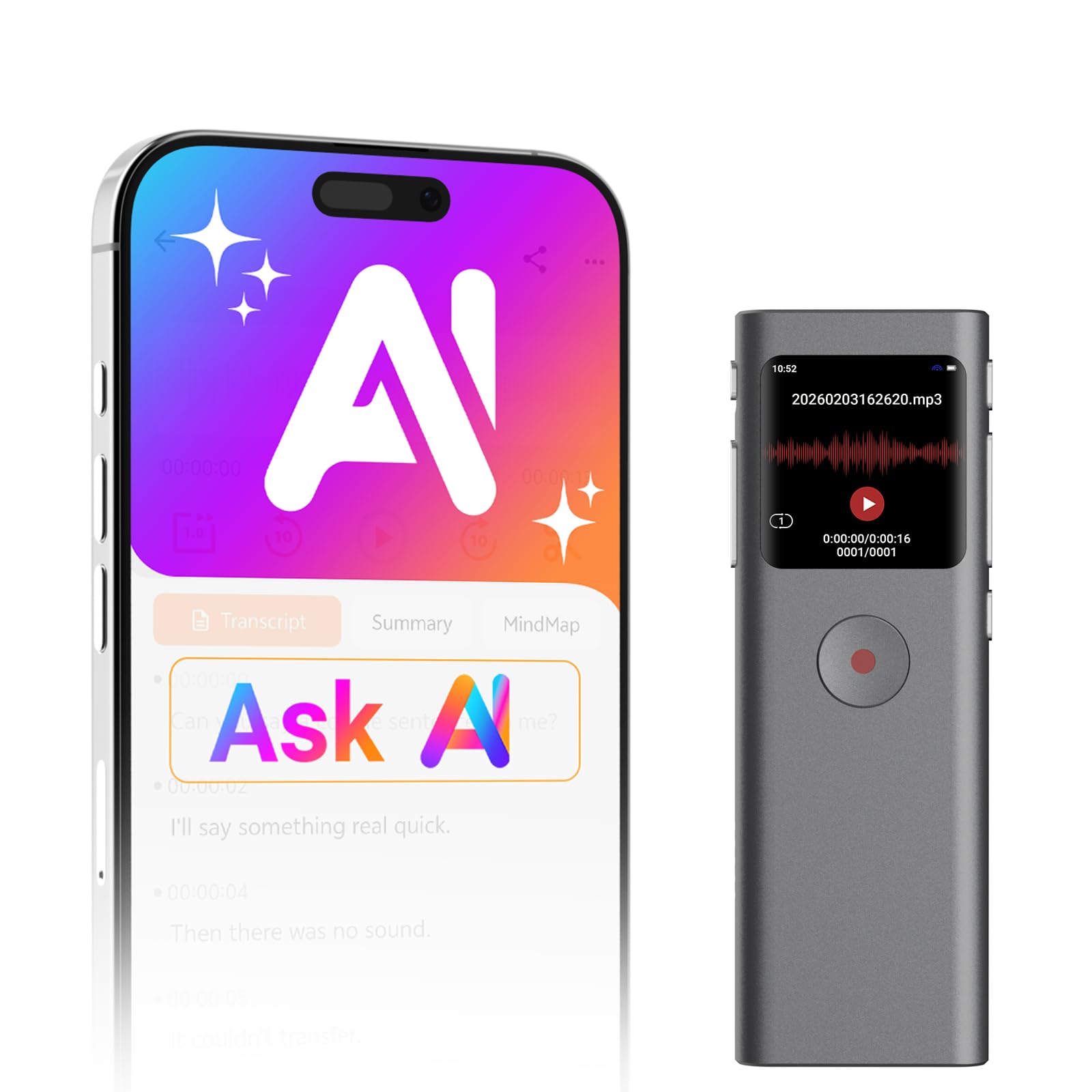
An AI-powered recorder that transcribes and summarizes your lectures automatically.
It supports transcription and summarization in 90+ languages, making it ideal for international students or multilingual lectures. The dual high-sensitivity microphones with AI noise reduction capture voices from 360° and activate only when someone speaks, saving storage and playback time.
Buyers consistently praise its compact and lightweight design, with one reviewer calling it “compact, lightweight, easy to carry” with “clear voice pickup from short distance.” Another noted it is “practical for lectures, meetings, notes” and has “reliable battery life.” The 30-hour battery is shorter than many recorders on this list, but the AI features (automated transcription and note summarization) may justify the trade-off for students who want instant notes. The device includes password protection and cloud storage options for security. If you value AI note-taking over raw battery life, this is your pick; if you need a full week of recording without recharging, choose the OM SYSTEM WS-882 instead.
The catch is that the AI transcription is app-based, so you need a smartphone and the Boean app to access it. The free tier includes 200 minutes of transcription per month, which may not be enough for heavy use. If you need more transcription time, you will have to upgrade to a paid plan. The 64GB storage is generous for recordings alone, but may fill faster if you store audio files for processing.
AI Features
- AI transcription and summarization in 90+ languages
- Dual AI noise reduction for clear voice capture
- Voice-activated recording
- Password protection and cloud security
Limitations
- 30-hour battery is below average
- AI features require app and may need paid subscription
- No Wi-Fi for direct recording, only Bluetooth for transfer
Best for: Students who want automated notes and summaries from lectures, especially in multilingual settings.
look elsewhere if: You just want a simple recorder and do not need transcription, or if battery life is critical.
7. 128G Magnetic Voice Recorder (AFFETUNI MC-01)
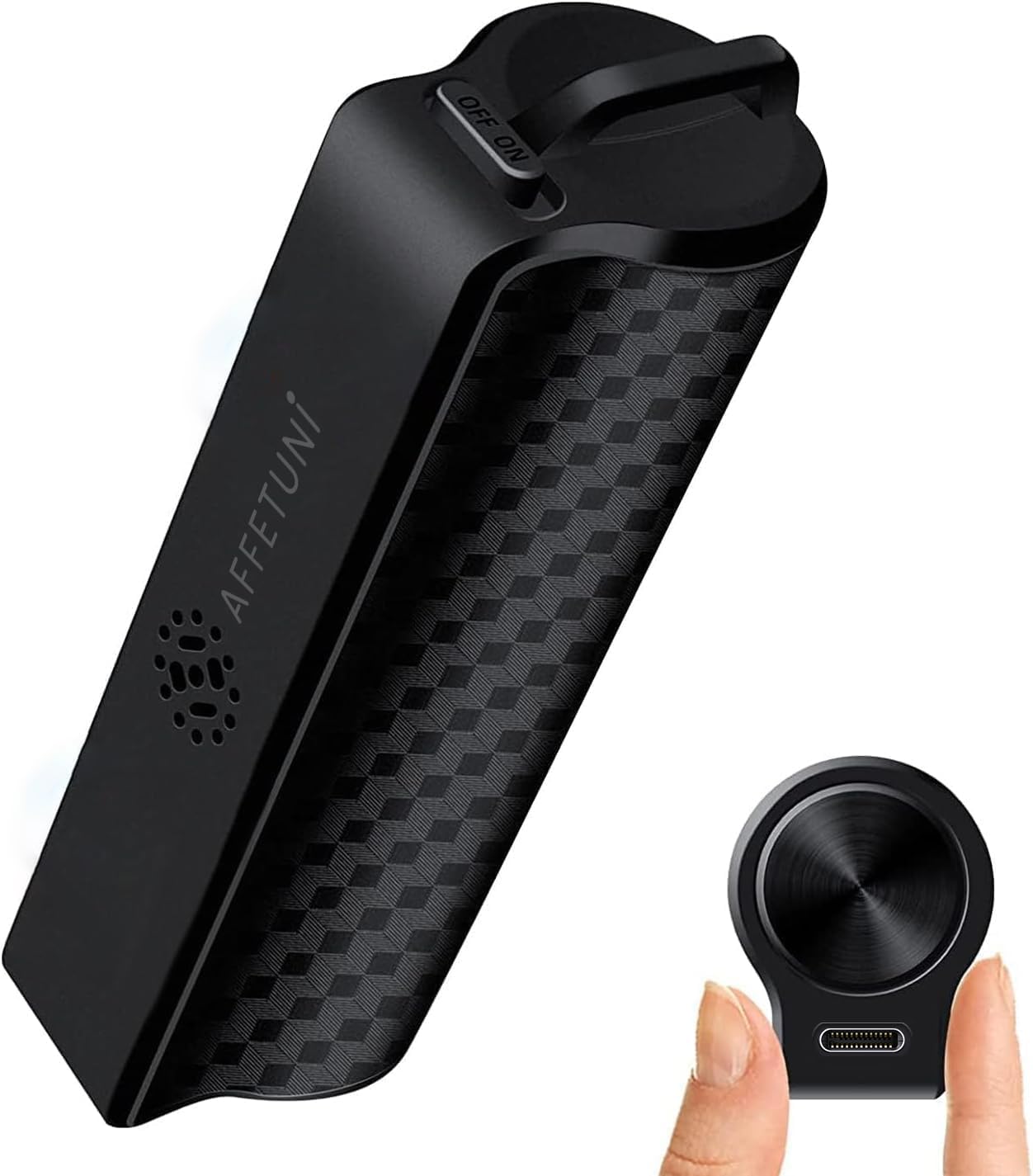
Attach it to a metal surface and record for 35 days on a single charge.
The AFFETUNI MC-01 has a 35-day continuous recording battery life — that is 840 hours, dwarfing the 100-hour EVISTR and the 35-hour Yegolito. With 128GB of built-in storage (same as the Arungo ZD70), you can archive hundreds of hours of high-quality WAV recordings. The AI-intelligent triple noise reduction system filters out background interference effectively, so lectures in crowded classrooms or busy offices come out crisp.
Buyers love the magnetic design. One user highlighted it has a “strong magnet for secure attachment” and that the AI noise reduction works well. Another called it a “solid choice” with “nice build quality/materials” and noted that “AI noise reduction very effective” and the voice activation works well. The one-touch operation and voice activation make it easy to use in lectures — just stick it on a metal podium or whiteboard edge and press start.
The catch is that some buyers have reported quality degradation over time. One shopper added that after 6 months, “quality/time degraded” and new units had “poor recording (background noise, skips)” and “<1 week battery.” This suggests the magnetic recorder may have consistency issues across units. At 65 grams (0.14 pounds), it is very portable.
Incredible battery
- 35-day battery life — truly exceptional
- 128GB storage for massive archiving
- Magnetic design for discreet, hands-free placement
- AI triple noise reduction works well, per buyers
Risk factors
- Some shoppers say quality degradation after months
- Inconsistent performance across units reported
- Accessories may be non-functional per one review
Reach for it if: You need the absolute longest battery life possible and the convenience of a magnetic mount for lectures.
Be cautious: Quality control may vary; consider buying from a seller with a good return policy.
Understanding the Specs
Battery Life (Hours vs Days)
Battery life is measured in either hours of continuous recording or days of standby/light use. A rating of 50 hours means the recorder can capture audio non-stop for 50 hours before recharging. For a student attending 3 hours of lectures daily, that is over two weeks of use on a single charge. A 35-day rating means the recorder can last 35 days in voice-activated mode (only recording when sound is present), which is very different from 35 days of continuous recording. Always check whether the spec refers to continuous recording or standby time.
Noise Reduction (DSP vs AI)
DSP (Digital Signal Processing) noise reduction is a hardware-based filter that reduces constant background hum like air conditioners or fans. AI noise reduction uses software algorithms to analyze and remove a wider range of background sounds, including irregular noises like shuffling papers or footsteps. Both improve voice clarity, but AI systems generally perform better in complex environments like crowded lecture halls. Look for “PCM” recording (Pulse Code Modulation), which captures audio with less compression for higher quality.
FAQ
Can I use a voice recorder in a lecture hall without being noticed?
How long does a 64GB recorder last for lectures?
What is the difference between PCM and MP3 recording?
Does voice activation work well in a noisy classroom?
Can I transfer recordings to my phone without a computer?
What is a good battery life for a student recording lectures daily?
How do I know if a recorder has good noise reduction?
Can I expand storage on a voice recorder?
Final Thoughts: The Verdict
For most buyers, the best audio recorder for lectures is the Sony ICD-PX370 because it combines a trusted brand, long 57-hour battery life, and drop-dead simple operation that works from the start. If you want maximum storage and don’t want to offload files, grab the Arungo ZD70 with its 128GB capacity. And for the best value that also offers class-leading battery life, the EVISTR L357 delivers 100 hours of recording for a fraction of the price.
How We Picked
We do not accept paid placement, and we did not hands-on test every unit. Instead, we match each pick to a real buyer and use-case by comparing the manufacturers’ published specifications against the patterns in verified customer reviews — so you get each pick’s real strengths and trade-offs instead of marketing copy.
Sources & Methodology
Specifications: manufacturer listings and product documentation. Review insights: verified customer reviews, as of July 2026. Pricing: not shown on this page (it changes often); check the current price via the retailer link.
As an Amazon Associate, Gadgets Feed earns from qualifying purchases. This does not affect which products we feature.
Product prices and availability are accurate as of the date/time indicated and are subject to change. Any price and availability information displayed on Amazon at the time of purchase will apply to the purchase of this product. As an Amazon Associate I earn from qualifying purchases.
CERTAIN CONTENT THAT APPEARS ON THIS SITE COMES FROM AMAZON. THIS CONTENT IS PROVIDED "AS IS" AND IS SUBJECT TO CHANGE OR REMOVAL AT ANY TIME.
Amazon and the Amazon logo are trademarks of Amazon.com, Inc. or its affiliates.