
Our readers keep the lights on and my morning glass full of iced black tea. As an Amazon Associate, I earn from qualifying purchases.
Specs are compiled from manufacturer listings and verified buyer reviews and can change over time — please confirm the key details on the product page before buying.
The biggest pain for a home user buying a 3D printer is the hours of assembly and calibration before you get a single good print. You want to design something, hit print, and hold a part in your hands — not spend your weekend building a machine. This guide cuts through the tech-speak to show you which printer actually delivers that promise without the hassle.
I’m Min — the founder and writer behind Gadgets Feed. This guide is built by comparing the manufacturers’ published specifications and the patterns across verified customer reviews, so you get each pick’s real strengths and trade-offs instead of marketing spin.
Whether you are buying your first machine or upgrading from an older model, these are the top choices for a 3d printer for home users that balance easy setup with real print speed and quality.
Quick Picks
- ELEGOO Centauri Carbon 3D Printer — Best Overall
- Creality Ender-3 V3 KE 3D Printer — Best Value
- FLASHFORGE Adventurer 5M Pro 3D Printer — Best for Beginners
- Creality K1C 3D Printer — Carbon Fiber Ready
- ELEGOO Saturn 4 Ultra 16K Resin 3D Printer — Best Resin Detail
- QIDI PLUS4 3D Printer — Best Large Build
How To Choose The Best 3D Printer For Home Users
A home 3D printer needs to be easy to set up, reliable enough to finish a long print overnight, and fast enough that you do not lose patience. Here are the key specs that separate a smooth first-year experience from a frustrating one.
Build Volume (What You Can Actually Make)
This is the biggest physical space your printer can create a part in. For home users, a 220x220x250mm volume lets you print phone cases, small figures, brackets, and many tools. If you want larger items like a helmet or a lamp shade, look for something around 256x256x256mm or bigger. A larger build volume also means fewer split-and-glue jobs for bigger projects.
Print Speed and Acceleration
Speed is measured in millimeters per second (mm/s) and acceleration in mm/s². A printer rated for 500mm/s at 20000mm/s² can finish a small part in under an hour, while older ones take four. But speed means nothing if the print quality suffers — look for printers with a CoreXY motion system, which keeps the print head stable at high speeds.
Auto Bed Leveling
A beginner’s biggest enemy is an uneven bed, which causes the first layer to fail. Auto leveling uses a sensor to measure the bed surface and compensates automatically. This removes the most common frustration for a 3D Printer For Home Users: manually adjusting four corners with a piece of paper.
Nozzle Temperature and Material Support
The nozzle heat determines which plastics you can use. Standard PLA only needs about 200°C. If you want stronger, flexible, or heat-resistant materials like PETG, ABS, TPU, or even carbon-fiber blends, you need a nozzle that reaches 300°C or higher. A 320°C or 370°C nozzle opens up engineering-grade materials.
Quick Comparison
| Model | Best For | Print Speed | Build Volume | Max Nozzle Temp | Amazon |
|---|---|---|---|---|---|
| ELEGOO Centauri Carbon | Best Overall | 500 mm/s | 256x256x256 mm | 320°C | $359.99Amazon |
| Creality Ender-3 V3 KE | Best Value | 500 mm/s | 220x220x250 mm | 300°C | from $378.08Amazon |
| FLASHFORGE Adventurer 5M Pro | Best for Beginners | 600 mm/s | 220x220x220 mm | 280°C | $379.00Amazon |
| Creality K1C | Best for Carbon Fiber | 600 mm/s | 220x220x220 mm | 300°C | $399.00$438.99Amazon |
| ELEGOO Saturn 4 Ultra 16K | Best Resin Detail | 150 mm/h | 8.33×4.66×8.66 inches | — | $519.99$649.99PrimeAmazon |
| QIDI PLUS4 | Best Large Build | 600 mm/s | 12x12x11 inches | 370°C | $299.00Amazon |
In‑Depth Reviews
1. ELEGOO Centauri Carbon 3D Printer

The print-ready machine that outperforms others on build size, temperature, and speed.
You can pull it from the start, remove three screws, install the touchscreen, and start printing. The ELEGOO Centauri Carbon is fully assembled and pre-calibrated, so you skip the hours of setup most printers demand. It uses a CoreXY structure (a motion system that keeps the print head stable at high speed) to hit 500 mm/s with 20000 mm/s² acceleration, so you get a detailed part fast. The 256x256x256 mm build volume is a full 16% larger than the FLASHFORGE Adventurer 5M Pro’s 220x220x220 mm, giving you more room for projects without needing to split models.
Buyers report that the Centauri Carbon prints a benchy in 18 minutes, which is “better than old printer.” The built-in camera lets you watch your print remotely and capture time-lapse videos. The 320°C brass-hardened steel nozzle handles carbon-fiber filaments and tough materials — that is a 14% higher max temperature than the 280°C on the FLASHFORGE Adventurer 5M Pro — so you can make strong, heat-resistant parts for drones or car parts.
One trade-off: at 38.5 pounds, it is heavy compared to the 21.7-pound Creality Ender-3 V3 KE, so place it on a sturdy table. Reviewers also note that vibration feet do not fully stop shaking on a light desk, so a solid surface matters.
Fast and Capable: The 320°C nozzle and 256mm build cube mean you can print advanced materials and larger parts right away.
The One Catch: Its weight and motion require a stable table, and the slicer (the software that turns your 3D model into printer instructions) can struggle with complex files on an old laptop.
Reach for this if: you want the best balance of print-ready setup, large build volume, and high-temperature material support.
Look elsewhere if: you only print small PLA models and want a lighter machine you can move around.
2. Creality Ender-3 V3 KE 3D Printer

An ultra-reliable workhorse that delivers great prints at a low entry price.
The Ender-3 V3 KE is among the most beginner-friendly models in Creality’s lineup. It comes with a CR Touch sensor for automatic bed leveling (a sensor that measures the bed’s surface and adjusts the nozzle height automatically), so you do not have to manually adjust the bed. The Sprite Direct Extruder (a mechanism that pushes filament directly into the nozzle) with a 60W ceramic heater hits 300°C, which means you can print PLA, PETG, ABS, TPU (95A — a flexible rubber-like plastic), and ASA filaments without an upgrade. Owners mention that “first 10 prints were spot on,” which is rare in this price range.
It prints at up to 500 mm/s with 8000 mm/s² acceleration, making it competitive with higher-priced models. The 0.1 mm printing accuracy ensures that phone stands, cosplay parts, and replacement parts come out sharp. Assembly takes about 10 minutes thanks to the all-in-one design, and it includes filament detection (it pauses if the plastic runs out) and power-outage recovery — so if your print is interrupted, it can resume.
One reviewer noted that the fans are a bit loud, and the Z-axis grease can collect dust if you do not clean it. But for the price, this is the closest you get to a low-maintenance 3D Printer For Home Users that still allows modding later.
Community Favorite: A huge community means hundreds of tutorials, mods, and spare parts available.
The Trade-off: Some units have reported feed issues after many prints, and the loud fans may bother you in a quiet room.
Best for: beginners who want a reliable, upgradable printer with a huge community behind it.
skip it if: you need a fully enclosed printer for noise-sensitive spaces or high-temperature filaments like carbon fiber.
3. FLASHFORGE Adventurer 5M Pro 3D Printer

A fully enclosed machine that makes your first high-speed print a 15-minute reality.
The Adventurer 5M Pro heats its nozzle to 200°C in just 35 seconds, so you are not waiting around. It uses a CoreXY all-metal structure to travel at 600 mm/s with 20000 mm/s² acceleration — that is 20% faster than the 500 mm/s on both the ELEGOO Centauri Carbon and Creality Ender-3 V3 KE. Pressure sensing for auto bed leveling (a sensor that feels the bed surface) means you never touch a knob, and the dual-sided PEI platform (a flexible steel sheet that parts pop off of) lets parts pop off without tools.
Customers note “successful prints after 15-minute setup,” which is the absolute best experience for a total beginner. The enclosed design includes a dual circulation system that reduces dust, plus active carbon filtration for safer indoor use. It supports PLA, ABS, PETG, ASA, TPU, PC (polycarbonate — a very strong plastic), and even carbon-fiber filaments. You can swap between four nozzle sizes (0.25mm, 0.4mm, 0.6mm, 0.8mm) to balance speed against fine detail.
The main limitation is the 220x220x220 mm build volume, which is a compact cube. Some reviewers wished for a larger work area, but the ease of use and reliability make up for it for home users.
Beginner Perks
- Unbox to first print in under 15 minutes
- 600mm/s speed with fully enclosed chassis
- HEPA filtration (catches tiny dust particles) and active carbon filter (absorbs fumes)
Size Trade-off
- 220mm³ build volume limits larger projects
- Software can have macOS compatibility issues
Reach for this if: you are buying your first printer and want the fastest path to successful prints with minimal effort.
Look elsewhere if: you need a larger build volume for helmets, lamp shades, or multi-part projects.
4. Creality K1C 3D Printer

A clog-free design that handles carbon fiber filaments and prints at 600mm/s with silent mode.
The K1C is the upgraded version of the K1 and K1 SE, built specifically for printing tough materials like PLA-CF (PLA mixed with carbon fiber), PA-CF (nylon with carbon fiber), and PET-CF (PETG with carbon fiber). It uses a clog-free direct extruder with a ball plunger and a tri-metal “Unicorn” nozzle — a steel-tipped copper nozzle integrated with a titanium alloy heatbreak (a part that stops heat traveling upward) — that resists wear from abrasive filaments. The 300°C hotend is enough for high-temp materials, and the enclosed chamber keeps temperatures stable.
This printer matches the 600 mm/s speed of the FLASHFORGE Adventurer 5M Pro, but adds an AI camera that monitors your print for failures or foreign objects and can create time-lapse videos. Silent mode drops noise to ≤45dB (about as loud as a quiet library), so you can sleep in the same room while it runs. Reviewers point out that the K1C “prints fast” and is simple enough that kids can use it on their own.
The trade-off is the software: some reviewers found the multicolor printing setup confusing and the slicer integration buggy, making it less plug-and-play for total beginners. You may need to tweak settings like bed temperature for different materials.
Carbon Fiber Ready: The hardened nozzle and clog-free extruder make this the go-to for abrasive filaments.
The Software Snag: Multicolor printing and slicer sync can be frustrating for non-experts.
Best for: home users who want to experiment with carbon fiber and other tough filaments without paying for a professional machine.
pass on it if: you want a truly beginner-friendly experience with no software hurdles.
5. ELEGOO Saturn 4 Ultra 16K Resin 3D Printer
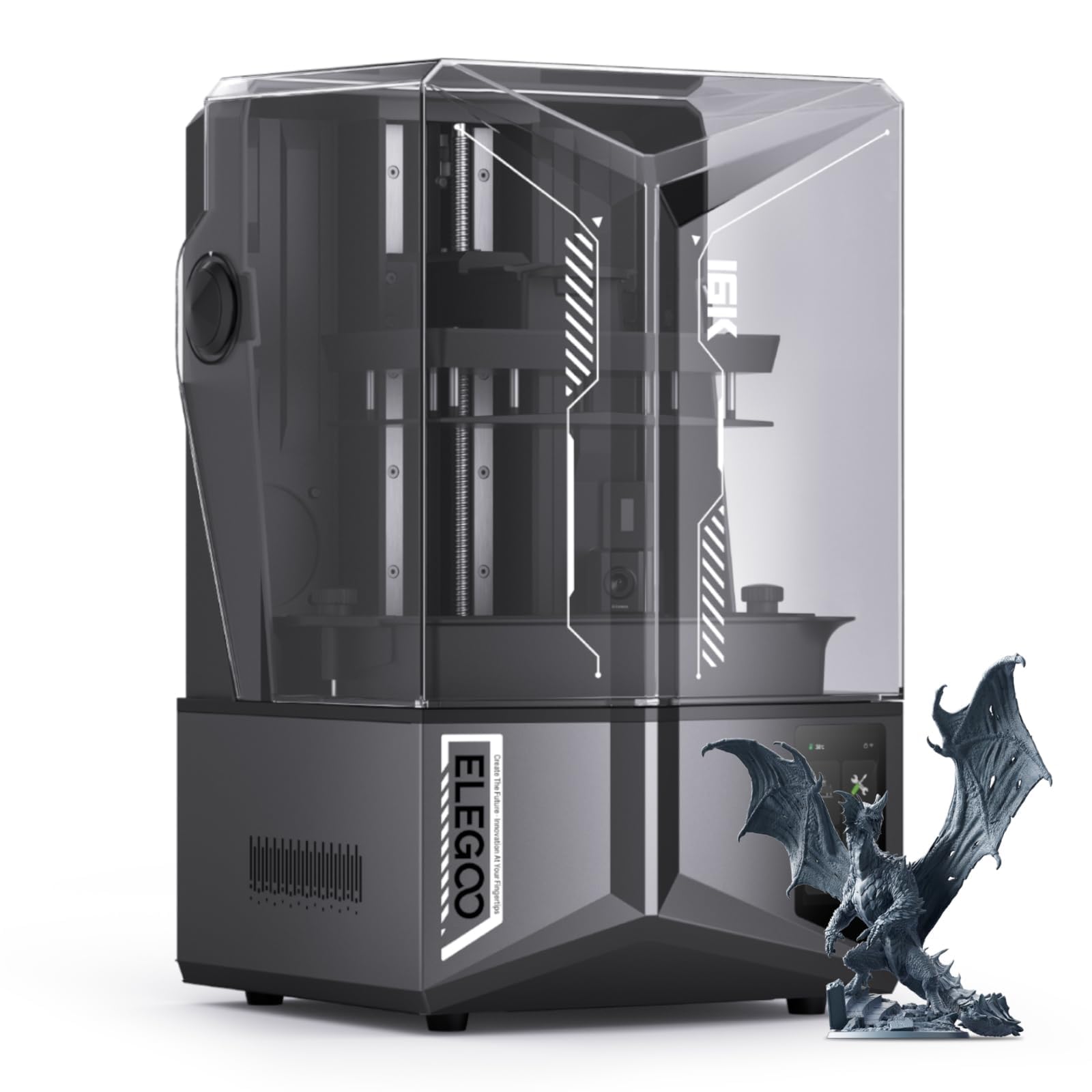
Resin printing with 16K resolution that captures fabric textures and individual hairs.
The Saturn 4 Ultra 16K uses a 10-inch 16K mono LCD (a high-resolution screen that cures resin layer by layer) to achieve ultra-high detail that FDM printers simply cannot match. If you want to print miniatures, jewelry masters, or decorative figurines with smooth surfaces and lifelike textures, this is your machine. The smart tank heating system keeps the resin at a steady 30°C, which improves fluidity and layer adhesion, reducing bubbles and separation failures.
This is a resin printer, so it works differently than the other picks here. It uses liquid resin cured by UV light, which means you get much finer detail but also need to handle and wash the prints in isopropyl alcohol. The build volume is 8.33 x 4.66 x 8.66 inches, which is good for small parts but not large objects. The AI camera monitors for empty build plates and warped models, sending alerts to your phone.
Shoppers say the print quality is excellent, with visible hairs and fabric textures, and that the printer is quiet and reliable. One buyer mentioned that resin tends to pool on the build plate, but a printed drip bracket solves that. The flip-up lid and auto-leveling make it as simple as using a smartphone.
Detail Champion
- 16K resolution for stunning detail
- Smart heating at 30°C for consistent layers
- Quiet operation with auto-leveling
Resin Realities
- Requires post-processing washing and curing
- Small build volume limits project size
- Liquid resin and fumes need ventilation
Reach for this if: you want the finest possible detail for miniatures, jewelry, or models with intricate textures.
Look elsewhere if: you want to print functional parts, helmets, or anything larger than 8.66 inches tall.
6. QIDI PLUS4 3D Printer

A massive 12x12x11 inch print volume with a 65°C chamber for engineering-grade materials.
The QIDI PLUS4 is for the home user who wants to print big functional parts or multiple models in one run. With a print size of 12x12x11 inches, you can make a full-size helmet, air duct covers, or a batch of brackets without splitting your design. The second-generation active chamber heating system uses a 400W heater to keep the enclosure at a steady 65°C, which prevents warping and cracking when printing high-temperature filaments like ABS, PC (polycarbonate), or PA (nylon).
This printer reaches 600 mm/s with a CoreXY structure, matching the FLASHFORGE Adventurer 5M Pro for speed. But the real difference is the 370°C nozzle, which supports advanced filaments like PPS-CF (polyphenylene sulfide with carbon fiber) and PPA-CF (partially aromatic nylon with carbon fiber) that other printers cannot handle. The 80W high-temperature hotend with a multi-metal integrated throat reduces clogging risks. It also has an independent dual motor-driven Z-axis with 10mm diameter lead screws for extra precision and stability.
Buyers report excellent print quality near a Bambu Lab machine, with the added benefits of open-source Klipper firmware (software you can customize with no cloud requirement) and a very active community. One owner reported a factory jammed hotend on arrival, but customer service resolved it with replacement parts. The firmware lacks power-loss resume, which is a notable omission for long prints, and some units had initial QC issues.
Chamber-Heated Beast: The 65°C chamber and 370°C nozzle let you print engineering-grade materials that other home printers cannot touch.
The Size Cost: At 59.4 pounds and with a large footprint, it needs a dedicated heavy table and some patience for initial QC checks.
Best for: advanced home users who need a large build volume and want to print strong, heat-resistant parts.
it’s not for you if: you are a beginner or you want a small, lightweight printer for simple PLA projects.
Understanding the Specs
Print Speed (mm/s)
This is how fast the print head can move across the bed. A 500 mm/s printer can finish a small part in under an hour, while an older 150 mm/s printer would take three. Higher speeds require a stable frame like CoreXY to prevent vibrations from ruining the print. For home users, 500-600mm/s is the balance — fast enough to be useful, reliable enough to be consistent.
Nozzle Temperature (°C)
The heat your nozzle can generate determines which plastics it can melt and push through. Standard PLA works at 200°C. Higher temperatures unlock stronger materials: PETG (250°C), ABS (260°C), and carbon-fiber blends (300°C+). A 320°C or 370°C nozzle means you can print tough parts for real-world use, not just decoration.
FAQ
How long does a typical home 3D printer last?
Do I need ventilation for a 3D printer at home?
What is the difference between FDM and resin 3D printing?
Can I print metal objects with a home 3D printer?
What is auto bed leveling and why does it matter?
Will a 3D printer work with my laptop or tablet?
How much does it cost to run a 3D printer per month?
Is it safe to leave a 3D printer running overnight?
Final Thoughts: The Verdict
For most buyers, the 3d printer for home users winner is the ELEGOO Centauri Carbon because it strikes the best balance of print-ready setup, large 256mm build volume, and a 320°C nozzle for advanced materials. If you want the fastest beginner path with an enclosed design, grab the FLASHFORGE Adventurer 5M Pro. And for the largest build volume and chamber heating for engineering materials, the standout is the QIDI PLUS4.
How We Picked
We do not accept paid placement. Every pick is matched to a real buyer and a real use-case; we do not hands-on test units.
Sources & Methodology
Specifications: manufacturer listings and product documentation. Review insights: verified customer reviews, as of July 2026. Pricing: not shown on this page (it changes often); check the current price via the retailer link.
As an Amazon Associate, Gadgets Feed earns from qualifying purchases. This does not affect which products we feature.
Product prices and availability are accurate as of the date/time indicated and are subject to change. Any price and availability information displayed on Amazon at the time of purchase will apply to the purchase of this product. As an Amazon Associate I earn from qualifying purchases.
CERTAIN CONTENT THAT APPEARS ON THIS SITE COMES FROM AMAZON. THIS CONTENT IS PROVIDED "AS IS" AND IS SUBJECT TO CHANGE OR REMOVAL AT ANY TIME.
Amazon and the Amazon logo are trademarks of Amazon.com, Inc. or its affiliates.