
Our readers keep the lights on and my morning glass full of iced black tea. As an Amazon Associate, I earn from qualifying purchases.
Specs are compiled from manufacturer listings and verified buyer reviews and can change over time — please confirm the key details on the product page before buying.
A 75-inch screen turns your living room into a home theater, but picture quality hinges on how the TV manages light from windows and its own backlight. This guide cuts through the jargon to help you pick the 75-inch TV that fits your room, gaming console, and budget.
I’m Min — the founder and writer behind Gadgets Feed. This guide is built by comparing the manufacturers’ published specifications and the patterns across verified customer reviews, so you get each pick’s real strengths and trade-offs instead of marketing spin.
This article breaks down the best options for a 75 inch tv using real specs and honest buyer feedback, so you know exactly what you are paying for.
Quick Picks
- Hisense 75″ U8 Series ULED Mini-LED 4K UHD Smart Google TV (75U8QG) — Top Performer
- TCL 75 Inch Class QM8L Series (75QM8L, 2026 Model) — Premium Pick
- Sony BRAVIA 5 75 Inch TV (K-75XR50) — Best for PS5
- Samsung 75-Inch Class The Frame Pro LS03HW Series (75LS03HW, 2026 Model) — Art & Design
- TCL 75 Inch Class QM8K Series (75QM8K, 2025 Model) — Bright Room Hero
- Sony 75 Inch Mini LED QLED 4K Ultra HD TV BRAVIA 7 (K-75XR70) — Sony Excellence
- Toshiba 75″ Z670 Series Mini-LED 4K UHD Smart Fire TV (75Z670R, 2026 New) — Value Powerhouse
- LG 75-Inch Class QNED85T Series LED Smart TV (75QNED85TUA, 2024) — AI Convenience
- Sony BRAVIA 2 II 75 Inch 4K Ultra HD LED Smart TV with Google TV (K-75S20M2) — Budget Entry
- Roku Smart TV – 75-Inch Plus Series, Mini-LED TV – RokuTV with Enhanced Voice Remote — Budget Champion
How To Choose The Best 75 Inch TV
Buying a 75-inch TV is a long-term investment that shapes your viewing experience for years. Match the TV’s technology to your priorities—whether fighting glare in a bright room, achieving smooth gaming motion, or maximizing value.
Backlight Type: Standard LED vs. Mini-LED vs. QLED
Standard LED backlights are cheap but often let light bleed around dark objects, making blacks look gray. Mini-LED uses thousands of tiny lights to control brightness in small zones, which creates deeper blacks and brighter highlights with less haloing. QLED is a color technology (not a backlight) that uses quantum dots to produce a wider, more vibrant range of colors. The best combination today is Mini-LED + QLED, delivering precise light control and rich, lifelike colors. The numbers to look for are the count of local dimming zones and the peak brightness in nits (higher is better for HDR).
Refresh Rate: Seeing Motion Clearly
The refresh rate tells you how many times the picture updates each second. A 60Hz panel is fine for regular TV and movies, but if you watch a lot of sports or play games on a console like the PlayStation 5 or Xbox Series X, you want at least a 120Hz panel. This makes fast-moving objects—like a soccer ball or a racing car—look smooth instead of blurry. Some advanced TVs offer a native 144Hz or even 165Hz panel, combined with technologies like Variable Refresh Rate (VRR) and AMD FreeSync Premium Pro to eliminate screen tearing when the console’s frame rate fluctuates.
HDR Formats: What Makes the Picture Pop
High Dynamic Range (HDR) is the technology that gives movies and games vivid highlights and deep shadows. The most common formats are Dolby Vision, HDR10+, and HLG for broadcast TV. Dolby Vision IQ is an advanced version that also adjusts the picture based on the brightness of your room. A TV that supports multiple HDR formats is better because different streaming services and Blu-ray discs use different standards. If the data sheet says “Dolby Vision IQ” and “HDR10+ Adaptive,” the TV is ready to handle almost any content correctly.
Quick Comparison
| Model | Best For | Backlight | Refresh Rate | Smart Platform | Amazon |
|---|---|---|---|---|---|
| Hisense 75″ U8 Series | Peak brightness & gaming | Mini-LED ULED | Native 165Hz | Google TV | $1,298.99$1,698.00Amazon |
| TCL 75″ QM8L Series | Ultimate contrast & audio | Mini-LED SQD | 144Hz | Google TV | $1,999.99$2,999.99Amazon |
| Sony BRAVIA 5 75″ | PS5 & superb upscaling | Mini-LED | 120Hz | Google TV | $1,398.00$1,999.99Limited time dealAmazon |
| Samsung 75″ The Frame Pro | Art display & glare-free | Neo QLED Mini-LED | 120Hz | Samsung Tizen | Amazon |
| TCL 75″ QM8K Series | High brightness for bright rooms | Mini-LED QLED | 120Hz-144Hz | Google TV | $1,397.99$1,999.99Limited time dealAmazon |
| Sony BRAVIA 7 75″ | Premium Sony processing | Mini-LED QLED | 120Hz | Google TV | $1,798.00$1,998.00Amazon |
| Toshiba 75″ Z670 Series | Fast OS & value | Mini-LED QLED | Native 144Hz | Fire TV | $898.99$1,499.97Amazon |
| LG 75″ QNED85T Series | AI-powered convenience | Quantum Dot NanoCell | 120Hz | webOS | Amazon |
| Sony BRAVIA 2 II 75″ | Budget-friendly entry | Standard LED | 60Hz | Google TV | Amazon |
| Roku 75″ Plus Series | Simple OS & great value | Mini-LED QLED | 60Hz | Roku TV | Amazon |
In‑Depth Reviews
1. Hisense 75″ U8 Series ULED Mini-LED 4K UHD Smart Google TV (75U8QG)
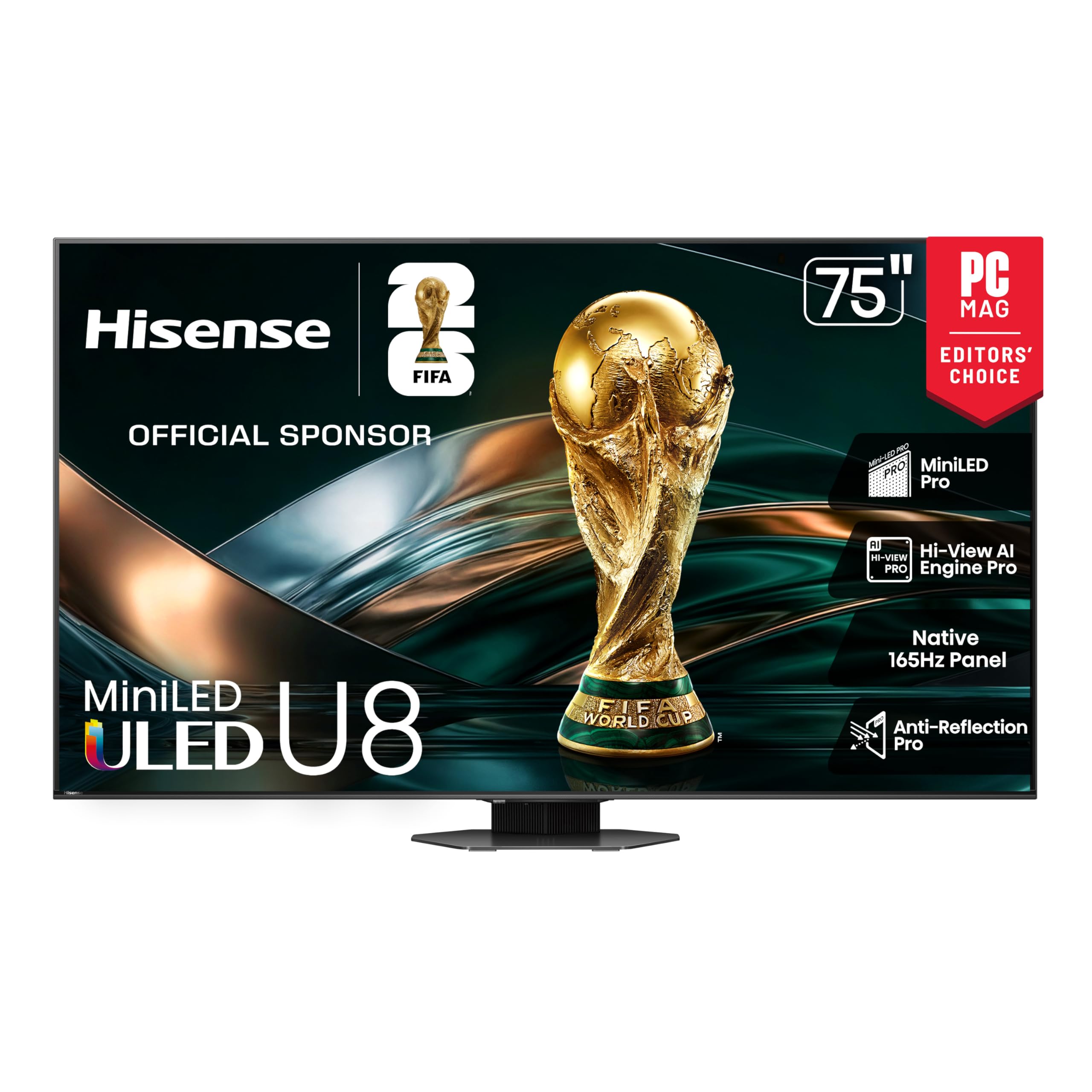
A blindingly bright screen that turns your living room into the best seat in the stadium.
If you watch a lot of HDR content or game on a high-end PC, you need a TV that can produce intense highlights without washing out. The Hisense U8 delivers that with a peak brightness of up to 5000 nits, making explosions, sunlight, and specular reflections look incredibly realistic. The Mini-LED Pro backlight uses up to 5600 local dimming zones (the tiny sections of the screen that can turn on or off independently), so blacks stay deep next to a bright object—minimizing the halos you might see on lesser sets.
Buyers report that the picture is as good as some OLEDs they have seen, with vibrant colors and almost no glare thanks to the anti-reflection coating. It also runs on Google TV and has a 4.1.2 channel audio system with Dolby Atmos (sound that surrounds you with effects from above, made possible by two up-firing speakers). The catch, as one reviewer noted, is that the remote sometimes fails to wake the TV, requiring a button hold and voice command—a minor annoyance on an otherwise excellent set. While the built-in sound is the best in this list, a separate soundbar still elevates the experience.
Brilliance with a catch: At 5000 nits peak brightness and a native 165Hz panel, this TV has a Variable Refresh Rate (VRR) range of 48Hz to 165Hz and Game Booster 288 for tear-free gaming that is almost instant. The “Enhanced Game Bar” lets you tweak settings on the fly. The main tradeoff is that those impressive built-in 4.1.2 channel speakers, while the best among this line-up, still fall short of a dedicated sound system for true home theater immersion—and the remote glitch is a real-world hiccup.
Go-to for HDR & PC gaming: If you want the brightest, most detailed picture for movies and the fastest refresh for competitive gaming, this is the one.
Consider a soundbar: While its 4.1.2 channel audio is great, an external system still improves the experience; and the remote may need a workaround.
2. TCL 75 Inch Class QM8L Series (75QM8L, 2026 Model)
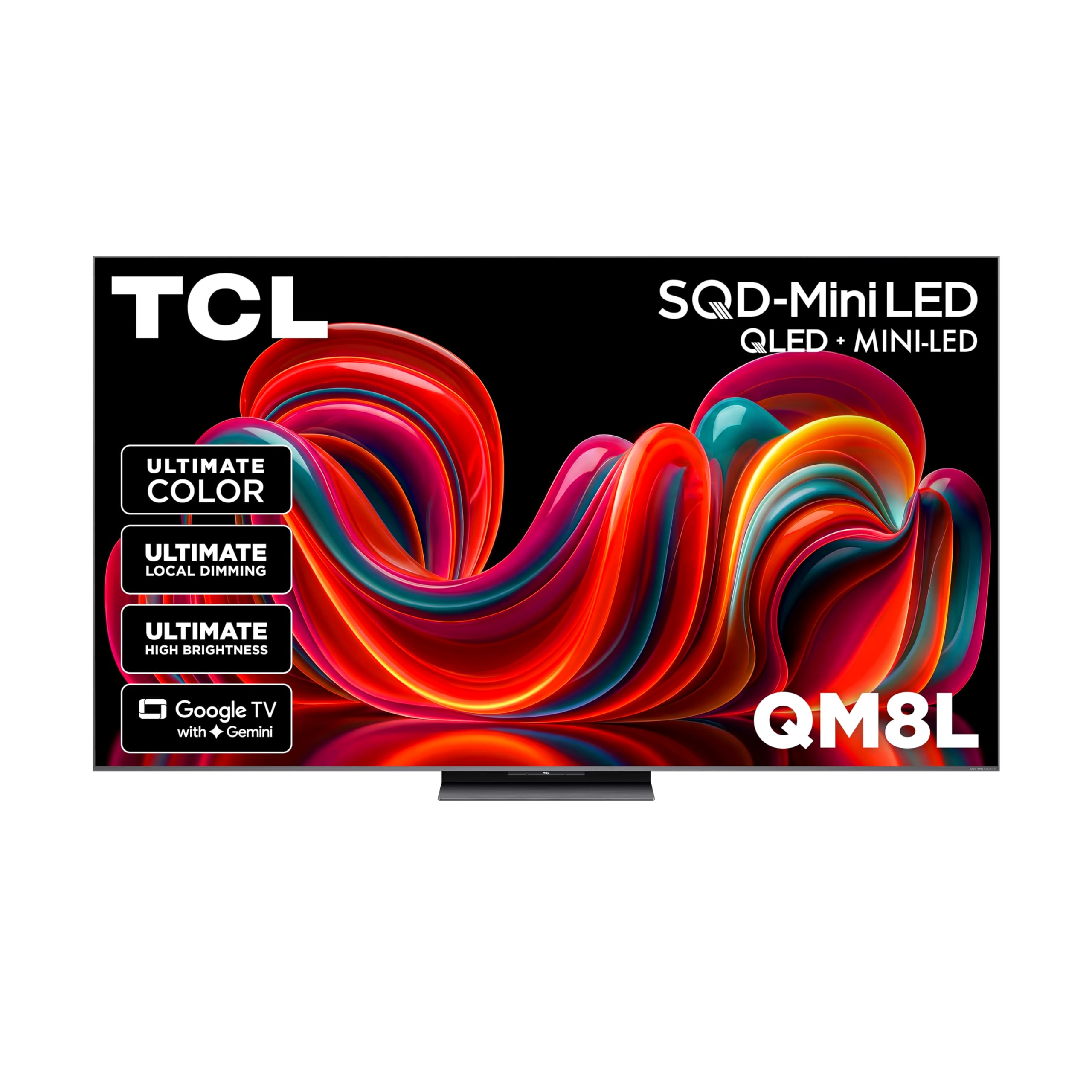
Studio-grade contrast and sound that save you from buying a separate soundbar.
The TCL QM8L is a 2026 flagship that brings the specs of a premium home theater without the typical price of a boutique brand. It features a 7000:1 contrast ratio (the difference between the brightest white and darkest black the screen can show, meaning deep inky blacks without haze) and uses TCL’s “SQD-Mini LED” with over 4000 dimming zones. This gives it phenomenal control over light, so a night scene in a movie looks true to life rather than washed out in gray. Its peak brightness hits up to 6000 nits, keeping it competitive with the brightest sets on the market.
Where the QM8L truly stands out is its partnership with Bang & Olufsen for the audio system. Owners mention the built-in sound is excellent, and one buyer mentioned it “pairs perfectly with Samsung Q990F soundbar,” meaning it handles home theater audio with precise clarity even before you add extra speakers. The TCL Game Pack also includes a Game Accelerator 288 VRR for smooth, tear-free gaming. On the software side, it runs Google TV with “Google Gemini Interactive AI,” which offers smarter voice control. The only potential limit is its mid-premium price, but many reviewers consider it the best value for money at this performance level.
Picture-fidelity winner: The high 7000:1 static contrast ratio means this TV creates deep, realistic shadows with no blooming—it handles dark room viewing better than any other 75-inch TV on this list. The 144Hz refresh rate and 26-bit dynamic dimming system ensure smooth motion and precise light control. The trade-off is that you are paying a premium for these top-tier contrast and audio features, and the Google TV OS may have minor glitches, as some buyers noted.
Best for movie purists: If you want true black levels and rich sound straight from the start, this is the pick.
Skip if you are on a strict budget: This is a premium investment; for a more affordable option, consider a value pick like the Roku Plus Series.
3. Sony BRAVIA 5 75 Inch TV (K-75XR50)

Sony’s AI-powered processing makes every source—even old DVDs—look crisp and colorful.
The Sony BRAVIA 5 is built on the back of the XR Processor with AI, a chipset that analyzes each scene in real-time to boost color, contrast, and clarity. This makes it incredibly good at upscaling (improving the resolution of lower-quality video) so that standard cable or streaming content looks closer to 4K. It also has exclusive features for the PlayStation 5, like Auto HDR Tone Mapping and Auto Genre Picture Mode, which automatically optimize the TV’s settings for games and movies.
Customers note the picture quality is stunning, with one reviewer noting that the “4K upscaling” for DVDs and games is “superb.” The TV supports Dolby Vision and Dolby Atmos, and with the IMAX Enhanced mode, it is ready for a cinema-like experience. A common complaint is that only 2 of the 4 HDMI ports support HDMI 2.1 (the standard needed for 4K at 120Hz), so you may have to choose carefully which console or soundbar gets the best connection. Also, the remote lacks a backlight, which some find frustrating in a dark room. The built-in speakers are decent but not as powerful as the TCL QM8L.
Gaming-first hardware: The 120Hz refresh rate on HDMI 2.1 ports, combined with the exclusive PS5 features, makes this the best choice for PlayStation 5 owners. The XR Clear Image processing uses AI to reduce noise in fast-moving scenes, powered by XR Motion Clarity. The catch: with only two HDMI 2.1 ports, you may need to swap cables if you have multiple next-gen consoles.
Best for PS5 owners: If you have a PlayStation 5 and want exclusive picture modes that sync perfectly with the console, this is the TV to buy.
Consider a soundbar: While the sound is good, it is not as rich as models with built-in surround speakers or those from Bang & Olufsen.
4. Samsung 75-Inch Class The Frame Pro LS03HW Series (75LS03HW, 2026 Model)
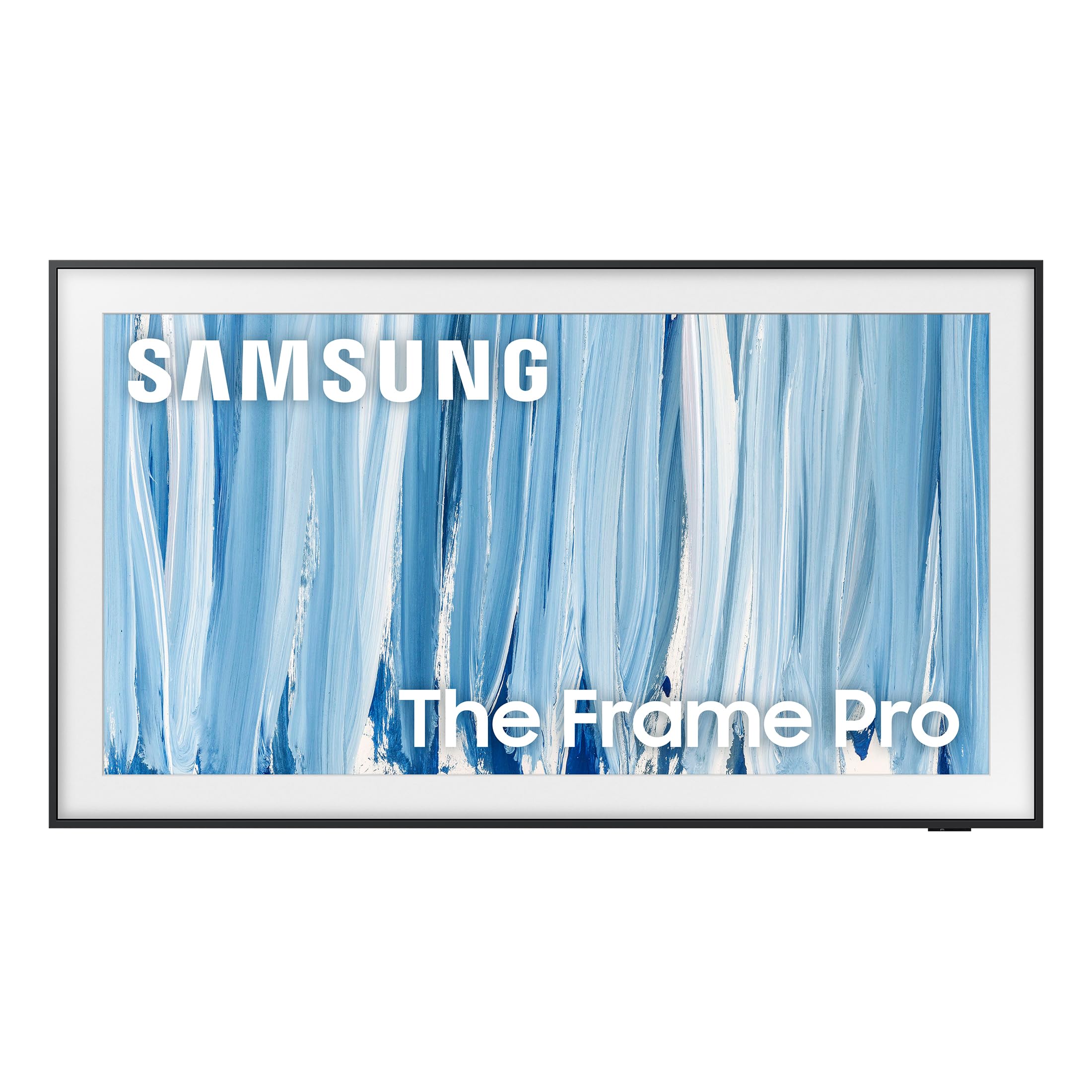
A gallery-quality display that hides all your cables and reflects zero light.
If the TV needs to blend into your living room decor rather than dominate it, The Frame Pro is a unique solution. It uses Neo QLED (a Mini-LED backlight) with a Glare Free matte screen, so ambient light from windows or lamps does not wash out the picture. When you are not watching, Art Mode turns the screen into a display for over 5,000 artworks from the Art Store, with adaptive brightness that mimics real canvas. The Slim Fit Wall Mount is included, making the TV sit as flush as a picture frame against the wall.
The biggest design breakthrough is the Wireless One Connect box—a separate hub that all your devices plug into, connecting to the TV by a single nearly invisible cable. Reviewers point out this is a huge improvement over older models, noting “finally, no more clear cord and big box.” The picture quality is superb, with Pantone Validated ArtfulColor ensuring accurate hues for both TV and art. One owner reported that the TV takes a few minutes to boot up, and the user interface can be a bit complex with two remotes needed. The built-in sound is solid, but the focus here is on visual design rather than audio thunder.
Standout design features
- Glare-free matte screen works perfectly in bright rooms.
- Wireless One Connect box hides all cable clutter.
- Slim Fit Wall Mount is included in the box.
Trade-offs to know
- Matte finish may not look as vibrant in a completely dark room as a glossy panel.
- Interface uses two remotes (Samsung and cable box) which can be confusing.
Best for design-conscious buyers: If you want a TV that doubles as wall art and eliminates cable clutter, this is the obvious choice.
Not for gamers seeking max performance: While it has a 120Hz panel, it lacks the extreme gaming features of the Hisense U8 or the PS5 exclusives of the Sony BRAVIA 5.
5. TCL 75 Inch Class QM8K Series (75QM8K, 2025 Model)
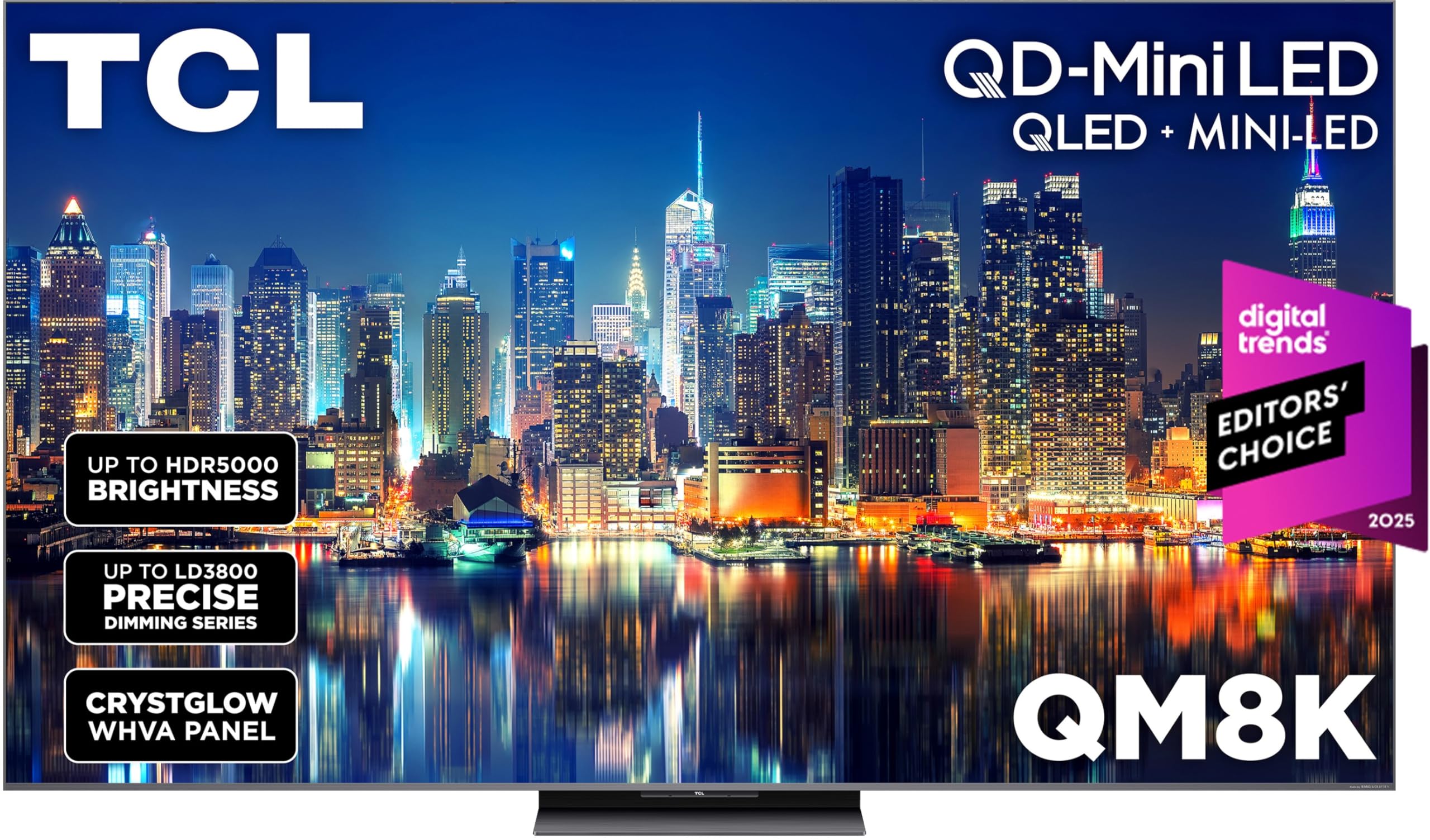
TCL’s brightest HDR performer that fights room reflections better than most OLEDs.
The 2025 QM8K is TCL’s mid-range hero, offering a premium QD-Mini LED panel at a price that undercuts many competitors. It is driven by the TCL Halo Control System, which uses a combination of a High Contrast HVA panel and a dynamic light algorithm to produce “halo-free” images. One of its strongest features is the CrystGlow WHVA panel, an anti-reflective screen that keeps the picture vibrant even when sunlight streams in. Buyers describe it as “no brainer for under 1k” and note its black levels are “near OLED.”
For gamers, the Game Accelerator 288 delivers a Variable Refresh Rate (VRR) of up to 288hz at 1440p, which is incredibly fast and eliminates screen tearing. It also supports AMD FreeSync Premium Pro for smooth gameplay with compatible graphics cards. The built-in sound is decent, but some reviewers mention the Hulu app has sluggish menus. The TV runs on Google TV with a backlit premium voice remote. Overall, it offers a fantastic balance of brightness, gaming performance, and anti-glare that makes it the best choice for living rooms that don’t have blackout curtains.
Brightness check: One customer observed they run this TV at just 60% brightness, and it still looks brighter than other TVs they have owned. That headroom is fantastic for HDR. The main limit is that the highest 288Hz VRR is only achieved at lower 1440p resolution, not full 4K, but at 4K it still supports a solid 144Hz through HDMI 2.1.
Perfect for bright living rooms: If you can’t control the lighting in your room, this TV’s anti-reflective screen and high brightness make it the best choice.
Consider a soundbar: The built-in audio lacks bass, so a soundbar will improve your movie and gaming experience noticeably.
6. Sony 75 Inch Mini LED QLED 4K Ultra HD TV BRAVIA 7 (K-75XR70)

Sony’s brightest picture ever, with processing that makes any content feel like a Blu-ray.
The BRAVIA 7 sits above the BRAVIA 5 in Sony’s lineup and focuses on pure picture quality. It uses thousands of Mini LEDs controlled by the XR Backlight Master Drive, delivering Sony’s brightest 4K TV picture with authentic contrast. The QLED technology with XR Triluminos Pro accesses billions of accurate real-world colors. Its AI-powered XR Processor intelligently enhances every scene in real-time. If you watch a mix of streaming, cable, and 4K Blu-rays, this TV’s upscaling (the ability to make lower-resolution content look near-4K) is top-tier.
Buyers overwhelmingly praise the picture quality, calling it “superb” and noting it is the “best TV I have ever owned.” The Acoustic Multi-Audio system is a standout—it places sound actuators behind the screen so that voices come directly from the mouth of the person on screen, improving dialogue clarity without a soundbar. Some reviewers mention a narrow viewing angle of about 30 degrees, meaning the picture loses contrast if you sit too far to the side. There are also isolated reports of the TV restarting (which was fixed by turning off Bravia sync and RS232).
The Sony advantages
- Sony’s XR Clear Image upscales all content to near-4K quality.
- Acoustic Multi-Audio makes dialogue sound like it comes from the screen.
- Studio-calibrated modes for Netflix, Prime Video, and Sony Pictures Core.
Things to consider
- Viewing angle is narrow (~30°) before the picture degrades.
- The screen is reflective with no special anti-glare coating.
Best for home theater enthusiasts: If you want the most refined picture from the start and excellent sound from the TV itself, this is the pick.
Not for side-viewing in open rooms: Because the viewing angle is narrow, this TV is best for a dedicated theater or a room where you sit directly in front.
7. Toshiba 75″ Z670 Series Mini-LED 4K UHD Smart Fire TV (75Z670R, 2026 New)
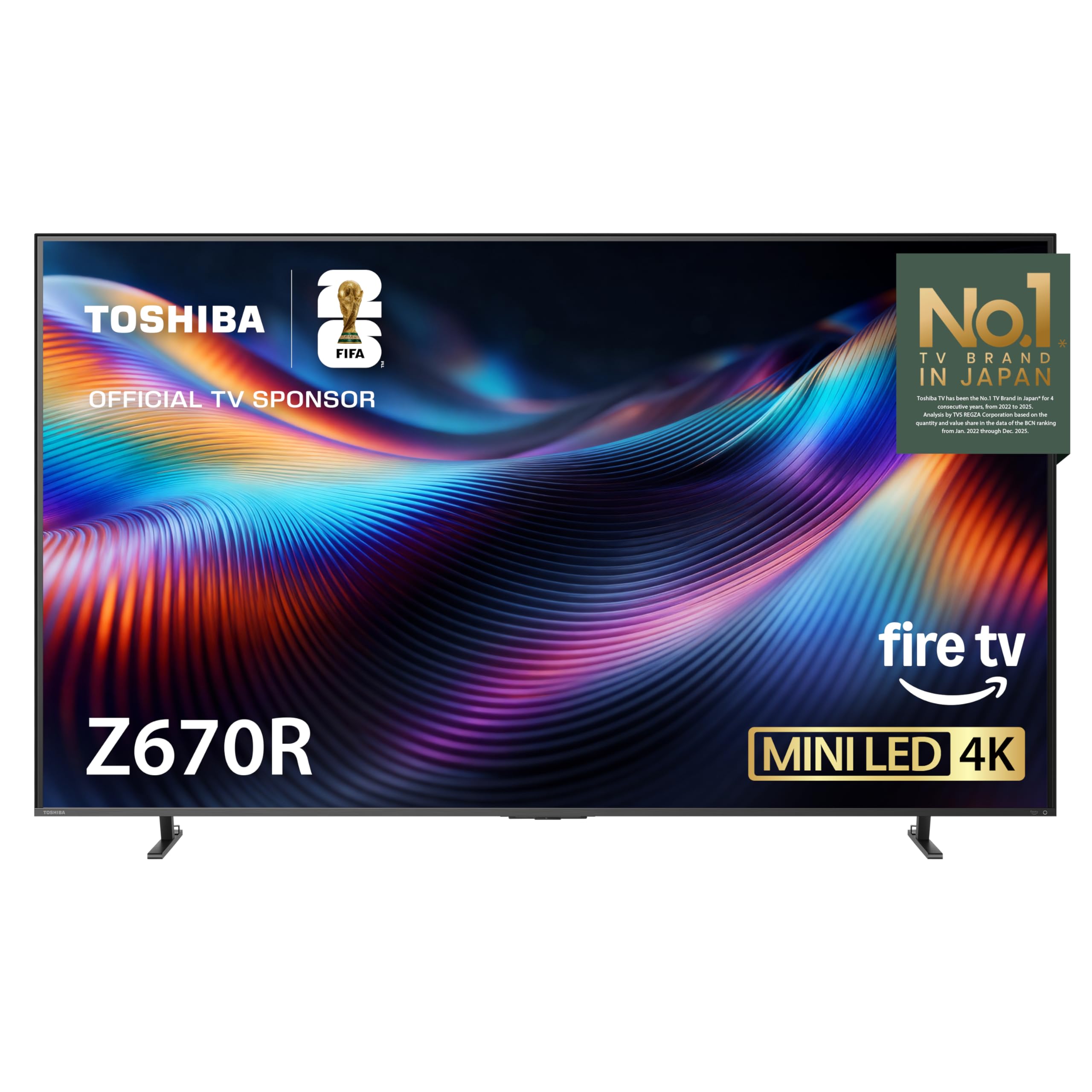
A Japanese-engineered Mini-LED that boots in two seconds while staying affordable.
The Toshiba Z670 is a 2026 model that brings a premium set of features for an entry-level premium price. Its core strengths are a high-brightness Mini-LED panel with Full Array Local Dimming and the REGZA Engine ZRi Gen3, Toshiba’s advanced AI picture processor developed in Japan. This combination delivers deep blacks, bright highlights, and accurate colors. Shoppers say that the anti-glare matte finish is very effective in bright rooms, and one noted the “Fire TV (2 sec boot)” makes it the fastest smart TV platform in this guide to turn on.
Gamers will appreciate the native 144Hz panel, which supports VRR up to 144Hz, ALLM, and AMD FreeSync Premium for tear-free gaming. It also supports a full array of HDR formats, including Dolby Vision IQ and HDR10+ Adaptive, which automatically adjust picture brightness based on your room lighting. The built-in REGZA Power Audio Pro with a woofer provides deep bass without needing a separate subwoofer. One downside mentioned by reviewers is that the Fire TV OS can feel cluttered compared to the cleaner Google TV interface found on competitors.
Speed and specs for the price: With a native 144Hz panel and a 2-second boot time, this is one of the fastest and smoothest TVs for the money. The adjustable leg stands (36″ or 70″ wide give you flexibility for different TV furniture. The trade-off is that the Fire TV OS can be a bit busier with ads than other platforms, and the sound, while good, is not quite as refined as the premium TCL or Sony options.
Best for speed and value: If you want a fast, responsive TV for sports and gaming without spending over, this is a fantastic choice.
Consider if you prefer Google TV: The Fire TV OS is excellent, but if you favor the Google TV interface, you might prefer the Hisense or TCL alternatives.
8. LG 75-Inch Class QNED85T Series LED Smart TV (75QNED85TUA, 2024)

AI that learns your taste, and a Magic Remote that points like a wand.
LG’s QNED85T uses Quantum Dot NanoCell Color technology to deliver a wider and more accurate color range than standard LED TVs. It is powered by the a8 AI Processor 4K, which identifies the type of content you are watching—whether it’s a dark thriller, a sports broadcast, or a cartoon—and optimizes the picture automatically without you having to fiddle with menus. The 120Hz native refresh rate ensures smooth motion for sports and action films.
The unique selling point here is the webOS Re:New Program, which promises new software updates and feature refreshes for 5 years, potentially extending the TV’s useful life beyond typical models. Buyers generally praise the picture quality and the smart remote, but some have noted issues with the panel quality—one reviewer mentions “LED has a bit of bleed thru so has grey contrast” in certain HDR modes, because this model uses an edge-lit panel rather than the more precise Mini-LED backlight of competitors at this price.
Why it stands out
- 5 years of software updates through webOS Re:New.
- Magic Remote with point-and-click cursor navigation.
- a8 AI Processor automatically tunes picture for each genre.
Potential limits
- Edge-lit LED backlight can cause gray contrast and light bleed.
- Some buyers report a brown color issue that requires manual calibration.
Best for AI-driven convenience: If you do not want to adjust settings and just want a TV that learns what you like, this is a good pick.
Not for dedicated movie enthusiasts: The edge-lit panel means black levels are not as deep as Mini-LED competitors, so it is better for casual viewing.
9. Sony BRAVIA 2 II 75 Inch 4K Ultra HD LED Smart TV with Google TV (K-75S20M2)

An affordable Sony with a 56.75-inch base that still delivers the brand’s faithful colors.
The Sony BRAVIA 2 II is the entry-level 75-inch model in Sony’s lineup, designed for buyers who trust Sony’s color science but cannot afford the Mini-LED premium. It uses a standard LED backlight with the 4K Processor X1, which provides natural and precise picture quality with a wide array of colors. It also supports Motionflow XR for blur-free fast action, and it has exclusive features for the PlayStation 5—including Auto HDR Tone Mapping and Auto Genre Picture Mode—making it a good choice for PS5 owners on a tight budget.
Buyers generally give it positive reviews for its price, with one saying it is “the best TV in the house” and another calling it “best bang for your buck.” However, a significant minority report issues with freezing and WiFi drops. One user highlighted it as the “Worst TV owned; constantly freezes requiring unplugging, drops WiFi despite other devices working.” The base is 56.75 inches wide, versus the 15.3-inch base of the Roku Plus Series, so you need a very wide TV stand. It also has Bluetooth version 5.3, versus the Toshiba’s version 5.0, offering better compatibility for wireless headphones.
Sony quality at a low entry point: The 4K XR-Reality PRO upscales content to near-4K, and the exclusive PlayStation 5 features work exactly like on the more expensive Bravia models. The trade-off is that the standard LED backlight lacks the dimming zones for deep blacks, so dark scenes may look gray. The stories of freezing are a real risk that a few unlucky buyers have faced.
Great for PS5 on a budget: If you need Sony’s PS5 features but cannot afford the Mini-LED Bravia 5 or 7, this is your gateway.
Consider a different pick if reliability is critical: The freezing complaints are rare but serious; if you want a safer bet, the Roku Plus Series has no such reports.
10. Roku Smart TV – 75-Inch Plus Series, Mini-LED TV – RokuTV with Enhanced Voice Remote
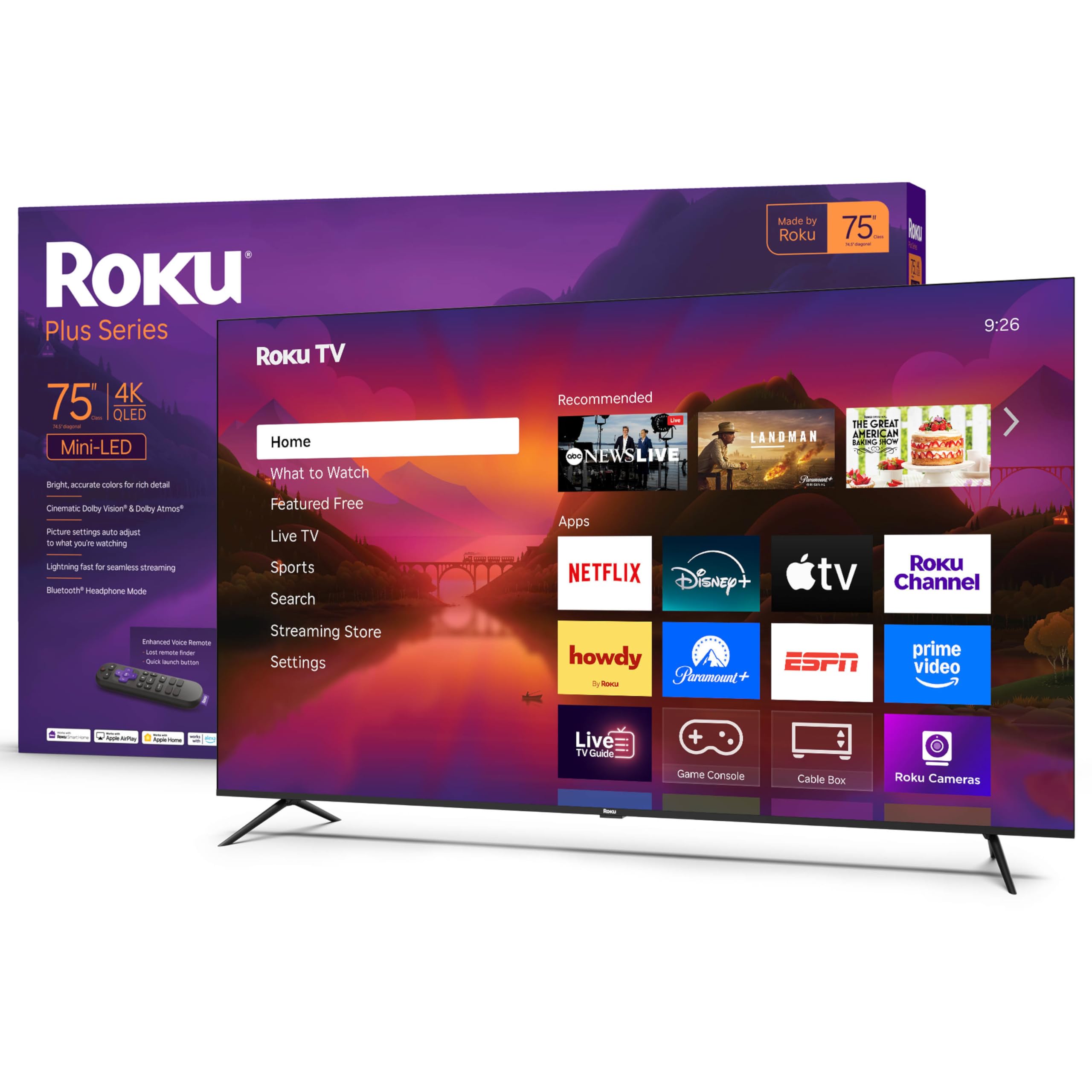
The cheapest 75-inch Mini-LED you can buy, with an OS that your grandma can master in one evening.
The Roku Plus Series is the best example of value-oriented engineering. It combines a Mini-LED backlight and a QLED screen with Dolby Vision, which gives you the foundational technology for good contrast and vibrant colors—all at a price that is tough to top. The Roku OS is famously simple and clutter-free, with 500+ free TV channels and automatic software updates. You also get the enhanced voice remote with a “lost remote finder” feature that makes the remote beep when you misplace it.
Buyers are overwhelmingly positive, with many calling it “Lots of bang for your buck” and “excellent value.” They praise the picture with “deep blacks and vibrant colors,” and the sound is “surprisingly good.” The main flaw, as one reviewer notes, is that “USB port flaw: bias lights stay on ~10 min after TV off, regardless of setting.” This is a minor annoyance for anyone who uses USB-powered bias lighting. It lacks the high refresh rates for gaming, running at 60Hz—perfect for movies and TV, but not for competitive play. The base is only 15.3 inches wide, making it easy to fit on smaller furniture, unlike the Sony’s very wide base.
Best value Mini-LED: You get the core benefits of Mini-LED—better blacks and brightness than standard LED—plus Dolby Vision, Dolby Atmos, and a simple OS, all at entry-level pricing. The trade-off: a flat 60Hz panel with no VRR, so it is not for serious gamers. The “lost remote finder” is a genuinely useful feature that higher-end TVs often lack.
Best for the average viewer: If you mostly watch Netflix, YouTube, and free streaming, and you want a huge screen with great picture quality for the money, this is the one.
Not for gamers: The 60Hz refresh rate means you will see motion blur in fast games; the Hisense U8 or Toshiba Z670 are better for that.
Understanding the Specs
Local Dimming Zones
This is the number of tiny, independent sections the backlight can control. More zones means better contrast—a bright object next to a dark one won’t have a halo around it. A TV with 5600 zones (like the Hisense U8) can create near-OLED black levels. A standard LED TV with no zones will just have a grayish bloom around bright subtitles. For HDR movies, look for “full array local dimming” with at least 200 zones to see a real difference.
Peak Brightness (Nits)
A nit is a unit measuring how bright the screen can get. For HDR content to look punchy and realistic, you want a high peak brightness—ideally over 1000 nits. The Hisense and TCL QM8L reach 5000 to 6000 nits, making sunbeams and explosions look blindingly real. A lower brightness (around 300-500 nits) will still look fine in a dark room, but the HDR effect will be underwhelming. More nits also help the picture stay clear in a bright room with windows.
FAQ
Can I mount a 75-inch TV on my wall?
Is a 75-inch TV too big for a small room?
What is the difference between Dolby Vision and HDR10+?
Does a 120Hz or 144Hz refresh rate matter for watching movies?
Why do some TVs have better upscaling than others?
How long does a 75-inch TV last?
Can I use a 75-inch TV as a computer monitor?
What is the difference between QLED and OLED?
What is the benefit of the Roku OS over other smart TV platforms?
Will a 75-inch TV fit in my car for transport?
Final Thoughts: The Verdict
Across the board, the 75 inch tv winner is the Hisense 75″ U8 Series because it offers an incredibly bright 5000-nit panel, a fast 165Hz refresh rate, and a high number of dimming zones for a competitive price. If you want a gallery-style design that hides cables and fights reflections, grab the Samsung 75″ The Frame Pro. And for the best overall value with a simple operating system and great picture quality, the standout is the Roku 75″ Plus Series.
How We Picked
We do not accept paid placement. Every pick is matched to a real buyer and a real use-case; we do not hands-on test units.
Sources & Methodology
Specifications: manufacturer listings and product documentation. Review insights: verified customer reviews, as of July 2026. Pricing: not shown on this page (it changes often); check the current price via the retailer link.
As an Amazon Associate, Gadgets Feed earns from qualifying purchases. This does not affect which products we feature.
Product prices and availability are accurate as of the date/time indicated and are subject to change. Any price and availability information displayed on Amazon at the time of purchase will apply to the purchase of this product. As an Amazon Associate I earn from qualifying purchases.
CERTAIN CONTENT THAT APPEARS ON THIS SITE COMES FROM AMAZON. THIS CONTENT IS PROVIDED "AS IS" AND IS SUBJECT TO CHANGE OR REMOVAL AT ANY TIME.
Amazon and the Amazon logo are trademarks of Amazon.com, Inc. or its affiliates.