
Our readers keep the lights on and my morning glass full of iced black tea. As an Amazon Associate, I earn from qualifying purchases.
Specs are compiled from manufacturer listings and verified buyer reviews and can change over time — please confirm the key details on the product page before buying.
You print documents, invoices, or forms regularly, so you know the pain already: slow inkjets that dry out, expensive cartridges that run out mid-job, and a machine that eats up half your desk. A 3-in-1 laser printer fixes all that. It gives you print, scan, and copy in one box, using toner (a powder that stays fresh for months instead of weeks) that lasts for thousands of pages. The catch is that not every model is built the same, so the one you pick depends on whether speed, quiet operation, or smooth wireless setup matters most to you.
I’m Min — the founder and writer behind Gadgets Feed. This guide is built by comparing the manufacturers’ published specifications and the patterns across verified customer reviews, so you get each pick’s real strengths and trade-offs instead of marketing spin.
You want a 3-in-1 laser printer that prints fast, scans clearly, and connects without headaches. The three models below each deliver that in different ways, and the Brother DCP-L2640DW is the one worth buying for most people because it scans at 23.6/7.9 ipm versus the Canon’s 15/21 ipm and has a proven track record of lasting 15–20 years.
Quick Picks
- Brother DCP-L2640DW — Best Overall
- Canon imageCLASS MF284dw — Quiet & Compact
- Xerox B225DNI — Compact Security
How To Choose The Best 3-in-1 Laser Printer
A 3-in-1 laser printer bundles printing, scanning, and copying into a single machine. Unlike inkjet printers, which use liquid ink that can dry out if left unused, laser printers use toner — a fine powder — so toner stays fresh for months or years. That makes them ideal for anyone who prints mostly black-and-white text documents and wants reliability without constant cartridge swaps. When shopping, focus on three areas: how fast it prints, how easy it is to set up on your network, and whether the scanner handles multi-page documents automatically.
Print Speed and First-Page Speed
Print speed is measured in pages per minute (ppm), which tells you how many pages it can produce in 60 seconds. Most home and small-office laser printers fall between 28 to 36 ppm. But the number that matters more in real life is “first print out time” — how long you wait from hitting print to holding the page. A printer that delivers a first page in under 5 seconds feels snappy; one that takes 10 seconds or more can feel sluggish even if its ppm rating is high. Both numbers appear in the spec sheets below, so pay attention to the one that affects you every day: the first-page speed.
Scanning and the Automatic Document Feeder
Every 3-in-1 printer includes a flatbed scanner for single pages or books. But if you regularly scan multi-page contracts, invoices, or forms, you want an Automatic Document Feeder (ADF — a slot that pulls pages through the scanner one by one). An ADF lets you drop in a stack and walk away. ADF capacity varies — 35 pages vs 50 pages — and that difference matters if you frequently handle thicker documents. Also check scan speed in images per minute (ipm): faster ipm means less time standing at the machine.
Wireless Connectivity and Setup
Modern laser printers offer built-in Wi-Fi, Ethernet, or USB connectivity. Wi-Fi lets you print from any device on your home network, including phones and tablets via Apple AirPrint or the brand’s own app. However, as real buyer reviews repeatedly show, wireless setup is the single most common frustration. Some printers connect in minutes; others require firmware updates (software on the printer itself that fixes bugs) before Wi-Fi works at all. If you prefer a plug-and-play experience, look for models that reviewers consistently call “easy setup” — and be prepared to use a wired Ethernet cable as a fallback if wireless gives you trouble.
Quick Comparison
| Model | Best For | Print Speed | Scan Speed | Duplex Printing | Amazon |
|---|---|---|---|---|---|
| Brother DCP-L2640DW | Long-term reliability & fast scanning | 36 ppm | 23.6/7.9 ipm | Automatic | $209.99Amazon |
| Canon imageCLASS MF284dw | Quiet operation & smartphone printing | 35 ppm | 15/21 ipm | Automatic | $229.99$248.99Amazon |
| Xerox B225DNI | Compact size & security features | 36 ppm | — | Automatic | $279.99Amazon |
In‑Depth Reviews
1. Brother DCP-L2640DW

The workhorse that one buyer kept running for nearly two decades before upgrading.
This Brother 3-in-1 prints at 36 ppm (pages per minute), so it delivers documents fast enough for a busy home office or a small team. But what really separates it is the scanning: it hits 23.6/7.9 ipm (images per minute) for black-and-white and color scans — at 23.6/7.9 ipm compared to the Canon’s 15/21 ipm. That means when you drop a 50-page contract into its automatic document feeder, you are done and back to work noticeably sooner. Print quality is sharp and clean, with one buyer noting the unit replaced a Brother that lasted nearly 20 years.
Wireless setup is straightforward for most users, with dual-band Wi-Fi (2.4GHz and 5GHz) and Ethernet if you prefer a wired connection. The 50-page ADF is generous — bigger than the Canon’s 35-page feeder — so you can run thicker stacks without reloading. It includes automatic duplex (two-sided printing), which saves paper with every multi-page job. The LCD screen (liquid crystal display) is basic with physical buttons, but buyers report the simple controls are easy to navigate.
The scanning software (PaperPort) drew a rare grumble: one experienced buyer called it a “ten step process” and switched to VueScan instead. If you are a PC user who scans often, you may want a third-party scanning app ready. On the durability front, the Brother has earned a stack of 5-star reviews from owners who replaced decade-old units with this same model, so the build quality appears to justify the brand’s reputation.
What Owners Love
- Fast scan speeds (23.6/7.9 ipm) beat every other pick in this list
- Reliable wireless and Ethernet connectivity with dual-band Wi-Fi
- Proven longevity — multiple buyers replaced 15–20 year old Brothers with this model
What Gives You Pause
- Scanning software (PaperPort) is clunky; PC users may prefer a separate app
- A few buyers hit password-change hiccups during firmware updates
Grab this if… you want a printer that will outlast your laptop, scans faster than anything in its class, and never asks why you printed only one page.
Think twice if… you rely on the included scanning software — grab VueScan or a third-party app instead to avoid PaperPort frustrations.
2. Canon imageCLASS MF284dw
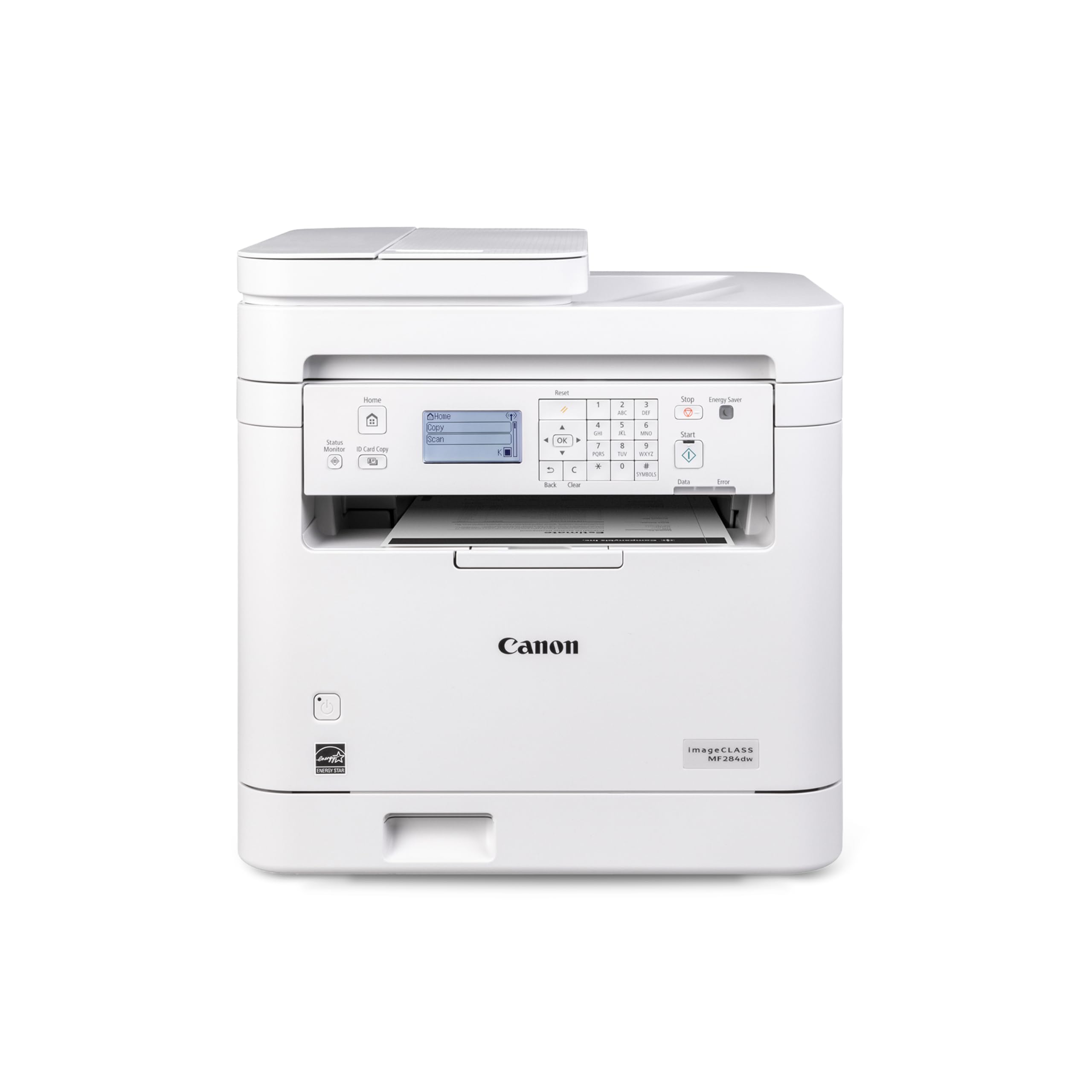
The quietest runner in this group — but its Wi-Fi can be a sore spot.
This Canon all-in-one prints at 35 ppm and delivers the first page in under 4.9 seconds, so it feels instant for short jobs. Buyers consistently say the noise level is lower than the Brother models they have used — a real advantage if your printer sits on a desk next to your workspace. The print quality is crisp for text documents, and the 250-sheet paper tray handles a full ream (a standard 500-sheet pack) without refilling. The 35-sheet automatic document feeder is fine for smaller stacks, but it falls short of the Brother’s 50-page capacity.
One reviewer noted that “wireless setup failed initially; fixed by updating firmware first.” That is the single most important tip for this printer: before you try to connect it to Wi-Fi, check for a firmware update (software on the printer itself that fixes bugs). A separate review noted that the unit arrived “not authorized for US sale,” which voided Canon’s tech support — so buy from an authorized US dealer to avoid that. The scanning software, Canon PRINT Business, works well for basic jobs, but the scan speed (15/21 ipm for black-and-white and color) is notably slower than the Brother’s 23.6/7.9 ipm — a 57% gap.
The plastic build feels a bit flimsier than the Brother, as one buyer pointed out, and the paper cassette is essentially a pull-out drawer. That said, the print quality and quiet operation win over most owners. If you primarily print from your phone or tablet, this Canon supports Apple AirPrint and Mopria Print Service right from the start, making it among the most phone-friendly picks here.
Why People Like It
- Very quiet operation — noticeably less noise than competing laser printers
- Fast first-page speed (under 4.9 seconds) for quick one-off prints
- Mobile printing works from the start with AirPrint and Mopria
The Annoyances
- Wireless setup may require a firmware update before it works — a known quirk
- Scan speed (15/21 ipm) is slower than the Brother’s 23.6/7.9 ipm (black-and-white slower; color faster)
- Some units sold by third parties are not authorized for US sale, voiding tech support
Reach for this if… quiet operation is your #1 priority and you do not mind a firmware update to get Wi-Fi working.
Look elsewhere if… you regularly scan thick multi-page documents — the slower scan speed and smaller 35-sheet ADF will slow you down compared to the Brother.
3. Xerox B225DNI
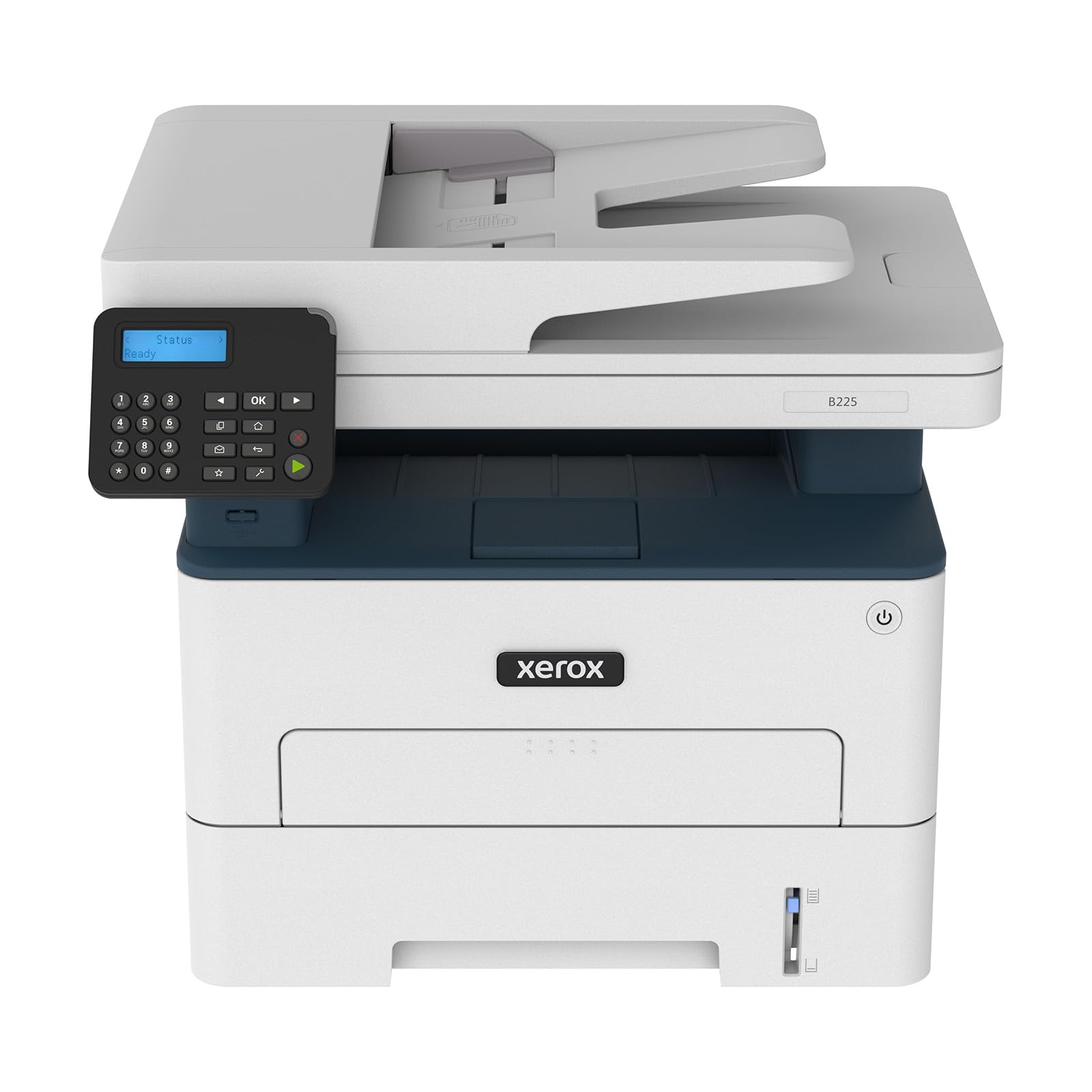
A compact workhorse with security features smaller firms actually need.
The Xerox B225DNI prints at 36 ppm, matching the Brother for raw speed, and its compact footprint makes it a good fit for tight desk spaces. Where it stands apart is built-in security: Xerox includes features to control access and protect sensitive documents — think secure print release (a PIN code before a document prints) and encrypted data handling — that you do not get on the consumer-grade models above. That makes it a smarter pick for home offices handling confidential client files or HR paperwork.
Setup is a mixed bag. Some owners mention “Wi-Fi setup failed; works reliably via USB cable,” while others report easy wireless setup on Windows. The included starter toner cartridge is rated for 1,200 pages, which is on the lower end — one buyer mentioned that “toner life poor,” so you will likely need to buy a standard- or high-capacity cartridge sooner than you might like. The scanner does not support automatic duplex (two-sided scanning), which is a clear miss compared to the Brother — you will have to manually flip pages for double-sided docs.
Buyers do praise the “Build Job” scanning feature, which lets you combine multiple scans into one PDF, delete blank pages, and reorder pages right from the printer panel. That is a genuinely useful time-saver. The Xerox Print and Scan Experience software also includes auto-straighten and receipt-scanning modes, taking some guesswork out of common tasks. If you are a Windows user who values security and is okay with a wired USB connection for reliability, this is a strong contender.
What Stands Out
- Security features (access control, encrypted data) not found on home-class printers
- Fast print speed at 36 ppm with a compact desk footprint
- Powerful scanning utility with “Build Job” for batch PDFs and blank-page deletion
What Holds It Back
- Wireless setup is hit-or-miss; many owners switch to USB or Ethernet for reliability
- No automatic duplex scanning — you must flip pages manually for two-sided docs
- Starter toner runs out fast at 1,200 pages; budget for a replacement cartridge early
Best suited for… a home office that handles sensitive documents and is comfortable with a wired setup for rock-solid reliability.
But skip it… if you plan to rely solely on Wi-Fi or need two-sided scanning — the Brother is more consistent on both fronts.
Understanding the Specs
Print Speed (Pages Per Minute / PPM)
This tells you how many pages the printer can produce in one minute. A 36 ppm printer finishes a 10-page document in about 17 seconds, while a slower 28 ppm model takes roughly 21 seconds — a small gap for short jobs but noticeable when you print a 50-page report. But the real-world speed you feel is “first print out time,” measured in seconds. Look for a printer with a first-page speed under 6 seconds if you often print single pages throughout the day.
Scan Speed (Images Per Minute / IPM)
Scan speed is measured in images per minute (ipm), shown separately for black-and-white and color scans. A fast scan speed like 23.6 ipm (the Brother’s rating) processes a 20-page document in under a minute, while a slower 15 ipm model takes over a minute and a half. If you scan multi-page documents regularly — contracts, invoices, forms — prioritize a higher ipm rating and a larger ADF capacity (35+ pages) so you can batch-process entire stacks without reloading.
FAQ
Can I print from my phone with a 3-in-1 laser printer?
Do I need a special paper for a laser printer?
Will a monochrome laser printer scan in color?
What is the difference between standard and starter toner?
Can I use third-party toner cartridges in these printers?
How long does a toner cartridge last?
What does the Automatic Document Feeder (ADF) do?
Is duplex printing automatic or manual on these printers?
Can I connect these printers with an Ethernet cable instead of Wi-Fi?
What is the best printer for a small business with multiple users?
Final Thoughts: The Verdict
If you want one dependable pick, the 3-in-1 laser printer winner is the Brother DCP-L2640DW because it combines the fastest scan speed (23.6/7.9 ipm), a generous 50-page automatic document feeder, and a reliability record backed by buyer stories of 15–20 year lifespans. If you want quieter operation and an ultra-fast first page under 4.9 seconds, grab the Canon imageCLASS MF284dw. And for a compact, security-minded option that handles sensitive documents well, the Xerox B225DNI is worth a close look — just plan to use a wired connection for the most reliable experience.
How We Picked
We do not accept paid placement. Every pick is matched to a real buyer and a real use-case; we do not hands-on test units.
Sources & Methodology
Specifications: manufacturer listings and product documentation. Review insights: verified customer reviews, as of July 2026. Pricing: not shown on this page (it changes often); check the current price via the retailer link.
As an Amazon Associate, Gadgets Feed earns from qualifying purchases. This does not affect which products we feature.
Product prices and availability are accurate as of the date/time indicated and are subject to change. Any price and availability information displayed on Amazon at the time of purchase will apply to the purchase of this product. As an Amazon Associate I earn from qualifying purchases.
CERTAIN CONTENT THAT APPEARS ON THIS SITE COMES FROM AMAZON. THIS CONTENT IS PROVIDED "AS IS" AND IS SUBJECT TO CHANGE OR REMOVAL AT ANY TIME.
Amazon and the Amazon logo are trademarks of Amazon.com, Inc. or its affiliates.