
Our readers keep the lights on and my morning glass full of iced black tea. As an Amazon Associate, I earn from qualifying purchases.
Specs are compiled from manufacturer listings and verified buyer reviews and can change over time — please confirm the key details on the product page before buying.
Your hand gets tired fast when you squeeze a manual rivet tool all day. An air rivet gun uses compressed air instead, so you can set hundreds of rivets without your palm cramping up. The real decision is how much pulling force you need and how many rivet sizes you will handle. Every model here runs on an air compressor, so you skip batteries and electric motors entirely.
I’m Min — the founder and writer behind Gadgets Feed. This guide is built by comparing the manufacturers’ published specifications and the patterns across verified customer reviews, so you get each pick’s real strengths and trade-offs instead of marketing spin.
The seven models below cover pulling forces from 2,200 LBF to 4,000 LBF and nosepiece counts from four to five, which gives you a clear view of what changes as you move up the price ladder. If you are shopping for the best air rivet gun, the lineup here reflects the range of real-world performance, from a solid heavy-duty workhorse to a top-tier option for daily professional use.
Our Picks at a Glance
How To Choose The Best Air Rivet Gun
An air rivet gun works simply — you pull the trigger, and it yanks the rivet mandrel (the thin center pin) until it breaks. The differences between models come down to how hard they pull, how many rivet sizes they accept without extra parts, and how comfortable they are to hold for a full work session.
Pulling force: the real measure of capability
Pulling force is measured in LBF (pounds of force), and it tells you what rivet materials the gun can break cleanly. A unit rated around 2,200 LBF (pounds of force) handles standard aluminum rivets well. Jump to models with 3,900 LBF or 4,000 LBF, and you can set steel and iron rivets without the gun struggling or needing multiple pulls on each one.
Nosepieces and rivet size range
Nosepieces are the small threaded tips that grip the rivet mandrel before the pull. Most kits include sizes from 3/32 inch up to 1/4 inch. A five-nosepiece kit covers the majority of common blind rivet diameters (a type of rivet you set from one side of the material). A four-nosepiece kit skips the 1/4-inch size, which means you need a separate adapter for the largest common rivet.
Weight and ergonomics for extended sessions
A heavier tool dampens vibration but makes your arm tired faster, especially if you are riveting overhead. Tool weights on this list range from 3.3 pounds to 6.45 pounds. Lighter models around 3.3 to 4.0 pounds are easier on the arm during all-day use, while heavier builds in the 4.5 to 6.5 pound range offer more sturdy internal parts and less vibration.
Quick Comparison
| Model | Best For | Pulling Force (LBF) | Nosepieces Included | Item Weight (lbs) | Amazon |
|---|---|---|---|---|---|
| Proster Pneumatic Riveter w/ 500 Rivets★ Best Overall | First-time buyer starter kit | Not specified | 5 (up to 1/4″) | 6.45 | Amazon |
| Air Rivet Gun Heavy Duty (Wadoy)Also Great | Mid-range auto & industrial | 3,924 | 5 (up to 1/4″) | 4.22 | Amazon |
| Campbell Hausfeld TL053900 | General repair & fabrication | 2,000 | 4 (up to 3/16″) | 3.87 | Amazon |
| Chicago Pneumatic CP9882 | Pro shop, multi-material use | 2,200 | 4 (up to 3/16″) | 3.30 | Amazon |
| FICHFOYE Heavy Duty Rivet Gun | High-volume steel riveting | 4,000 | 5 (up to 1/4″) | 4.58 | Amazon |
| Proster Pneumatic Riveter (B0DQXMH6GK) | Mixed materials, one-pull speed | 3,924 | 5 (up to 1/4″) | 4.84 | Amazon |
| JUSTOOL Heavy Duty Rivet Gun | Budget-conscious pro work | 3,097 | 4 (up to 3/16″) | 4.07 | Amazon |
In‑Depth Reviews
1. Proster Pneumatic Riveter with 500PCS Rivets (B0FX4VRX2H)
Our pick — over 4★ from 250+ verified ratings; the strongest balance of quality and price.
A complete starter kit with 500 rivets and five nosepieces, but the heaviest tool on this list.
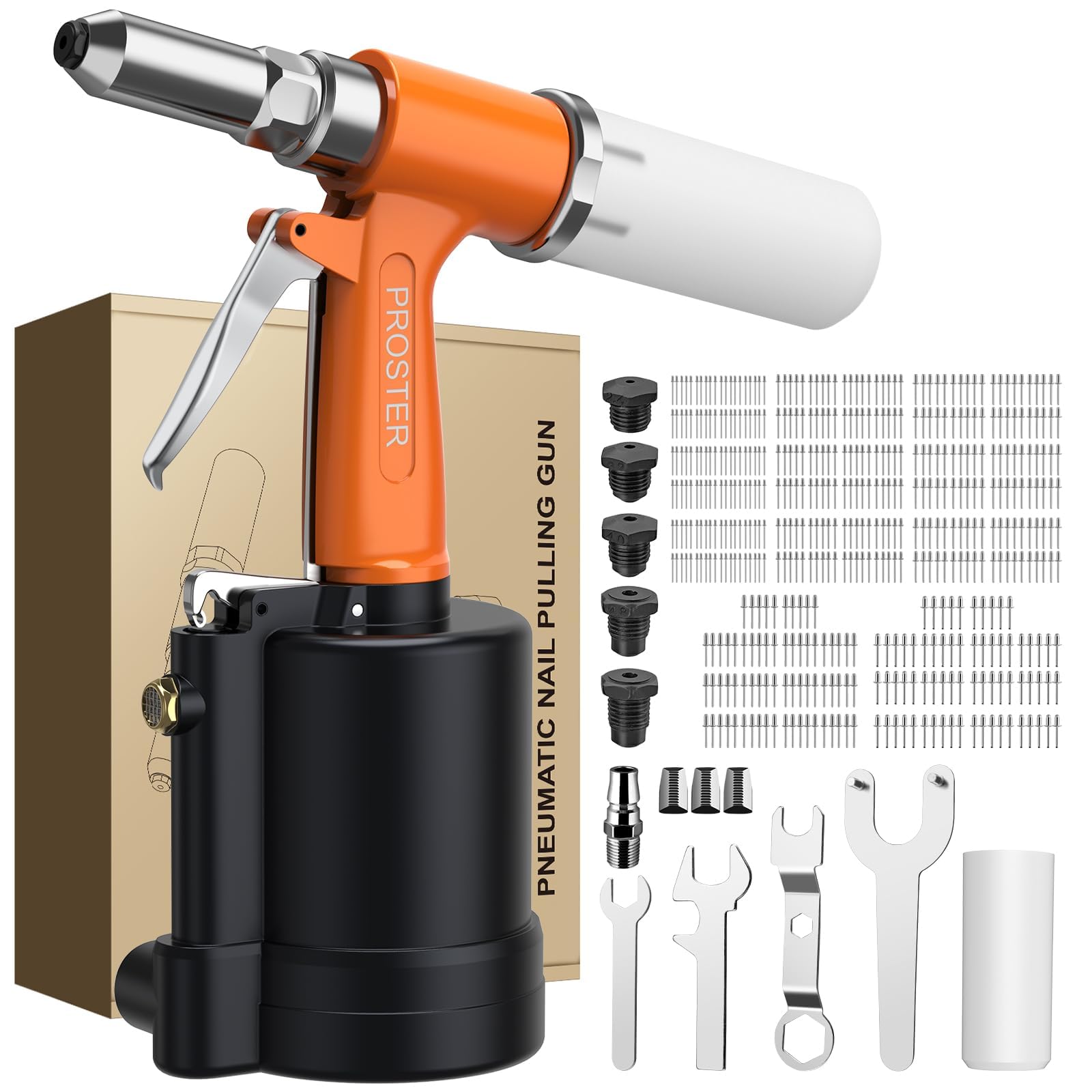
This Proster kit is the most beginner-friendly package because it includes 500 blind rivets across five sizes: 100 of 2.4 mm, 150 of 3.2 mm, 130 of 4.0 mm, 100 of 4.8 mm, and 20 of 6.4 mm. You get enough consumables to finish several projects before needing a refill. The five nosepieces (3/32 inch through 1/4 inch) are the same range as the Wadoy and FICHFOYE kits, so you are not missing the largest common size.
The trade-off becomes clear when you look at the weight. At 6.45 pounds, this is the heaviest gun here by a significant margin — nearly double the Chicago Pneumatic’s 3.30 pounds. The package dimensions are 15.16 x 11.26 x 4.49 inches, so the whole bundle takes up more space in your toolbox. The maker specifies that this gun uses aircraft-grade aluminum with a silencer for quieter operation, and it includes a 3-claw gripping design with an extra set of jaw pieces.
One important limitation: the maker says not to use stainless steel rivets with this gun. Also, the pulling force is not listed in the specs, so you are buying this for the rivet supply and comprehensive nosepiece set, not the highest raw power. If your work demands a known high pulling force like the 3,924 LBF Proster (B0DQXMH6GK), that model gives you the spec number and a lower weight of 4.84 pounds.
Open-box and go: The 500 rivets mean you do not have to place a separate order before your first project — just connect to your air compressor and start.
The main hesitation: At 6.45 pounds and with no published pulling force, this is a package deal for a beginner who values convenience over peak performance and low weight.
Ideal for: a first-time buyer who wants all rivet sizes and a massive rivet supply in one box, and who is not concerned about tool weight.
Not for: a pro who needs a light, high-force gun and already has a rivet inventory.
2. Air Rivet Gun Heavy Duty, 3924 LBF Pneumatic Pop Rivet Gun Kit (Wadoy)
A 3,924 LBF punch that sets steel and aluminum rivets without a second pull.
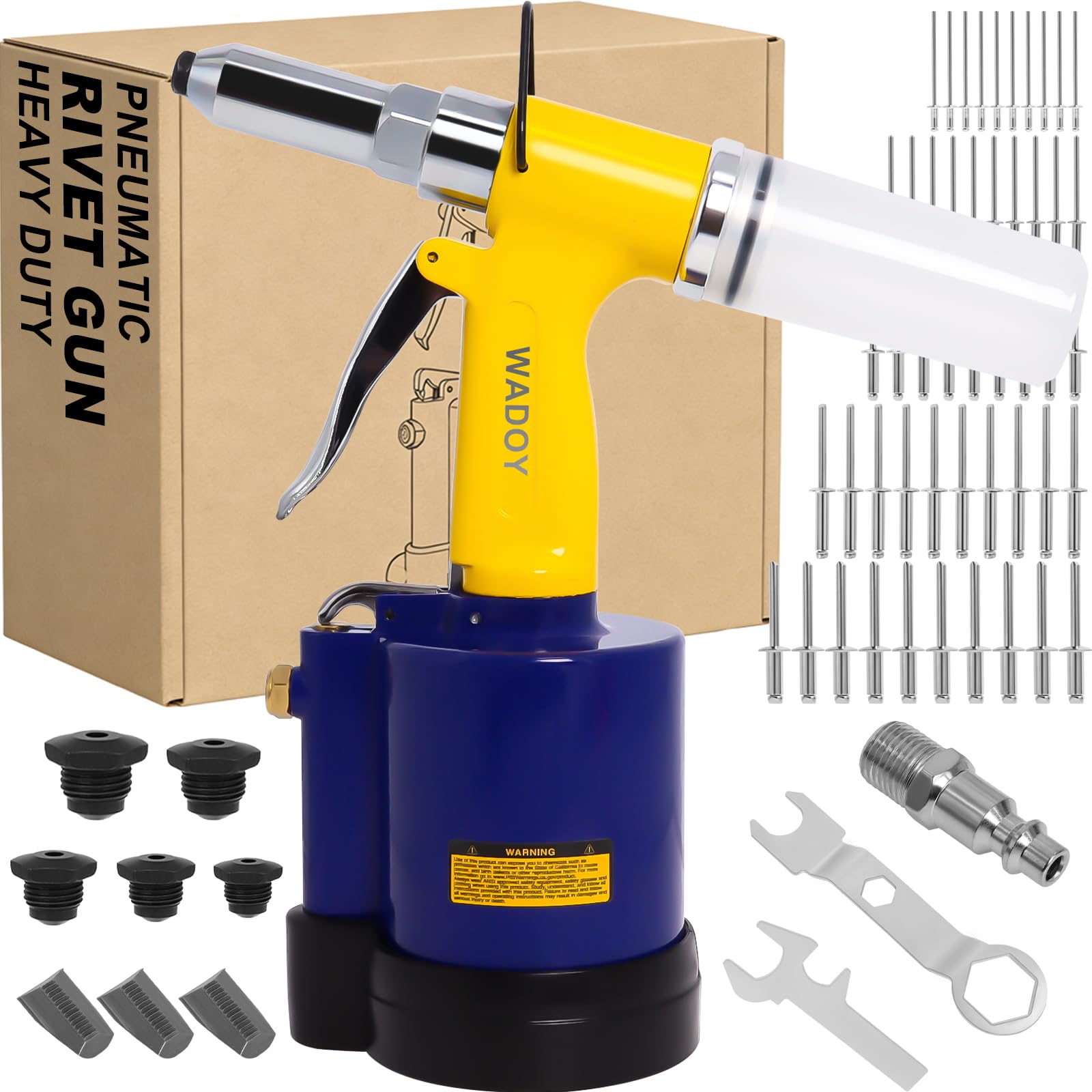
The headline number here is 3,924 LBF (which is 1,780 KGF) of pulling force from the air-hydraulic drive system (a system that uses compressed air to push hydraulic fluid, multiplying the force). This means the gun handles steel and iron rivets without stalling — a big step up from the 2,200 LBF units that start to struggle with harder mandrels. It includes five nosepieces covering 3/32 inch up to 1/4 inch, and three of them are already screwed onto the base when you open the box, so you do not have to hunt for tiny parts.
Buyers report the kit also comes with 50 aluminum pop rivets across five sizes, giving you 10 of each to start a job immediately. The working stroke (the distance the jaws travel to pull the mandrel) is 16 mm, which the maker says is enough to set most common rivet lengths with one pull. The transparent rivet tail container lets you see how many spent mandrels have collected without opening the bottle.
At 4.22 pounds, this sits in the middle of the weight range — heavier than the Chicago Pneumatic unit but considerably lighter than the 6.45-pound Proster starter kit. That weight is a reasonable compromise between durability and arm comfort for a full day of work. The air-hydraulic drive delivers 3,924 LBF, matching the Proster (B0DQXMH6GK) at the same force rating, while the FICHFOYE model pushes slightly higher to 4,000 LBF.
The kit that covers all sizes: With 5 nosepieces and a pulling force high enough for steel rivets, this is the pick that suits a mechanic or builder who works with multiple materials and wants one tool for all of them.
Something to note: The rivet assortment is aluminum only, so if you mostly use steel rivets, you will buy your own supply from the start.
Reach for this if: you regularly set steel or iron rivets and need one gun that does not force a second pull on harder materials.
Look elsewhere if: you only set aluminum rivets — a lighter, lower-force gun will feel just as capable and cost less.
3. Heavy Duty Pneumatic Rivet Gun, 4000 LBF (FICHFOYE)
The strongest pull in this lineup at 4,000 LBF, built for high-volume production work.
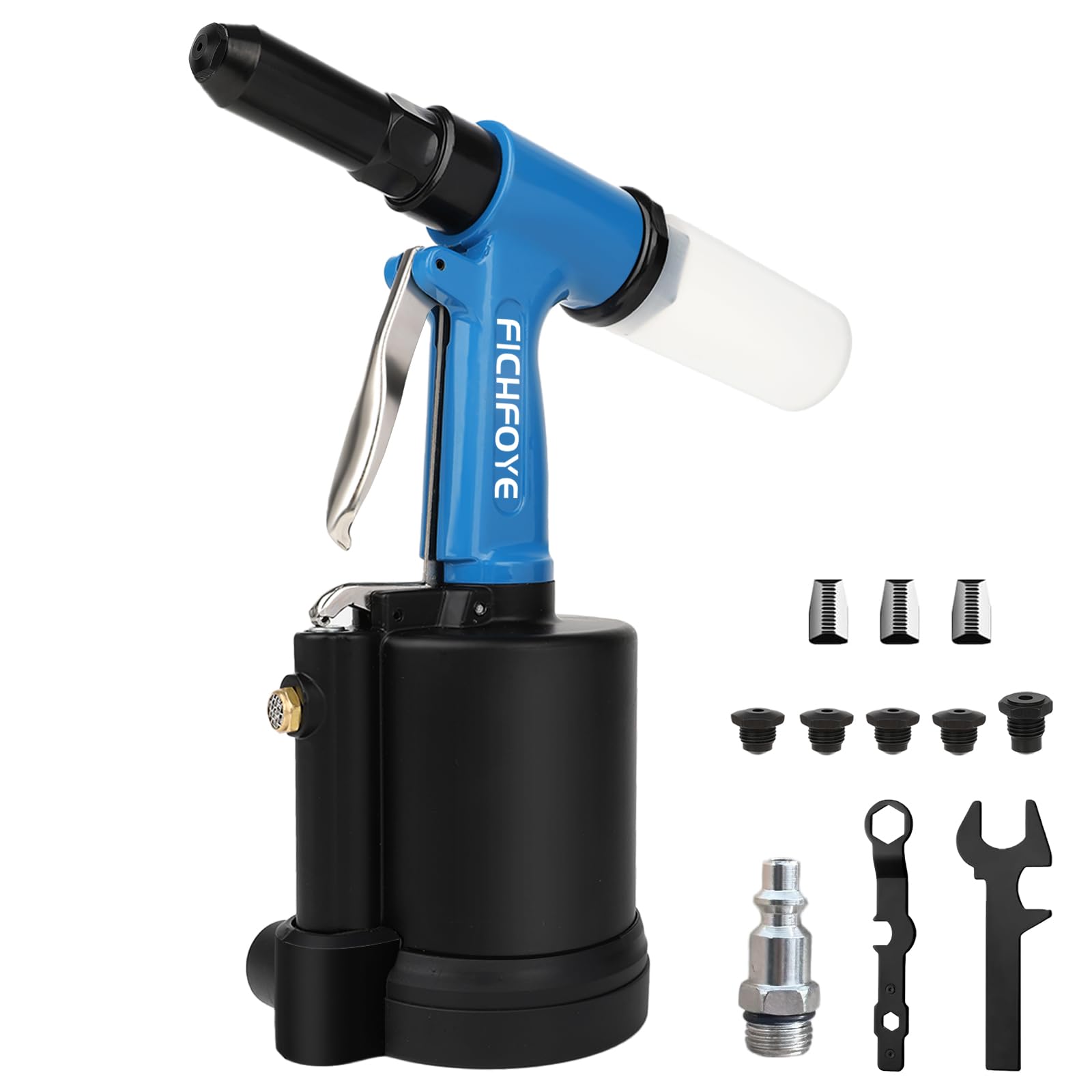
This FICHFOYE model delivers 4,000 LBF (which is 1,814 KGF) of pulling pressure, which is the strongest pull among the seven guns here. It beats the Wadoy and Proster models (both at 3,924 LBF) by a small but useful margin — if you are setting many steel or iron rivets in a shift, the extra force means the mandrel breaks faster and the gun cycles quicker. The kit includes five nosepieces from 3/32 inch up to 1/4 inch plus two wrenches, three claws, a US-standard air nozzle, and a removable collection bottle.
The dimensions are 10.16 x 4.58 x 11.02 inches, and it weighs 4.58 pounds, which is noticeably more portable than the 6.45-pound Proster starter kit. The ergonomic grip is designed to reduce hand strain during long sessions, and owners mention that the quick-change nosepiece system lets you switch rivet sizes without fumbling for tools. Unlike the Campbell Hausfeld unit that tops out at 3/16 inch, this one accepts the larger 1/4-inch rivets.
The maker says this gun works with aluminum, steel, and iron rivets but does not mention stainless steel — so if you need stainless rivets, check compatibility first.
Strongest pull advantage
- 4,000 LBF is the top figure in this comparison, making it the best for hard rivets.
- Five nosepieces up to 1/4 inch cover the full range of common blind rivet sizes.
- Includes spares like extra claws and wrenches to reduce downtime.
Trade-off to consider
- Stainless steel rivet compatibility is not listed, so confirm before buying for that use.
- Weight is moderate at 4.58 lbs, not the lightest if you work overhead.
For production-speed riveting: If you set rivets all day and want the highest force to minimize cycle time, this is the pick.
skip it if: your projects are mostly aluminum — you will pay for pulling power you do not need.
4. Proster Pneumatic Riveter – 5 Nozzles, 3924 LBF (B0DQXMH6GK)
Three-claw gripping design with a 360-degree hold, plus the same 3,924 LBF pull as the Wadoy.
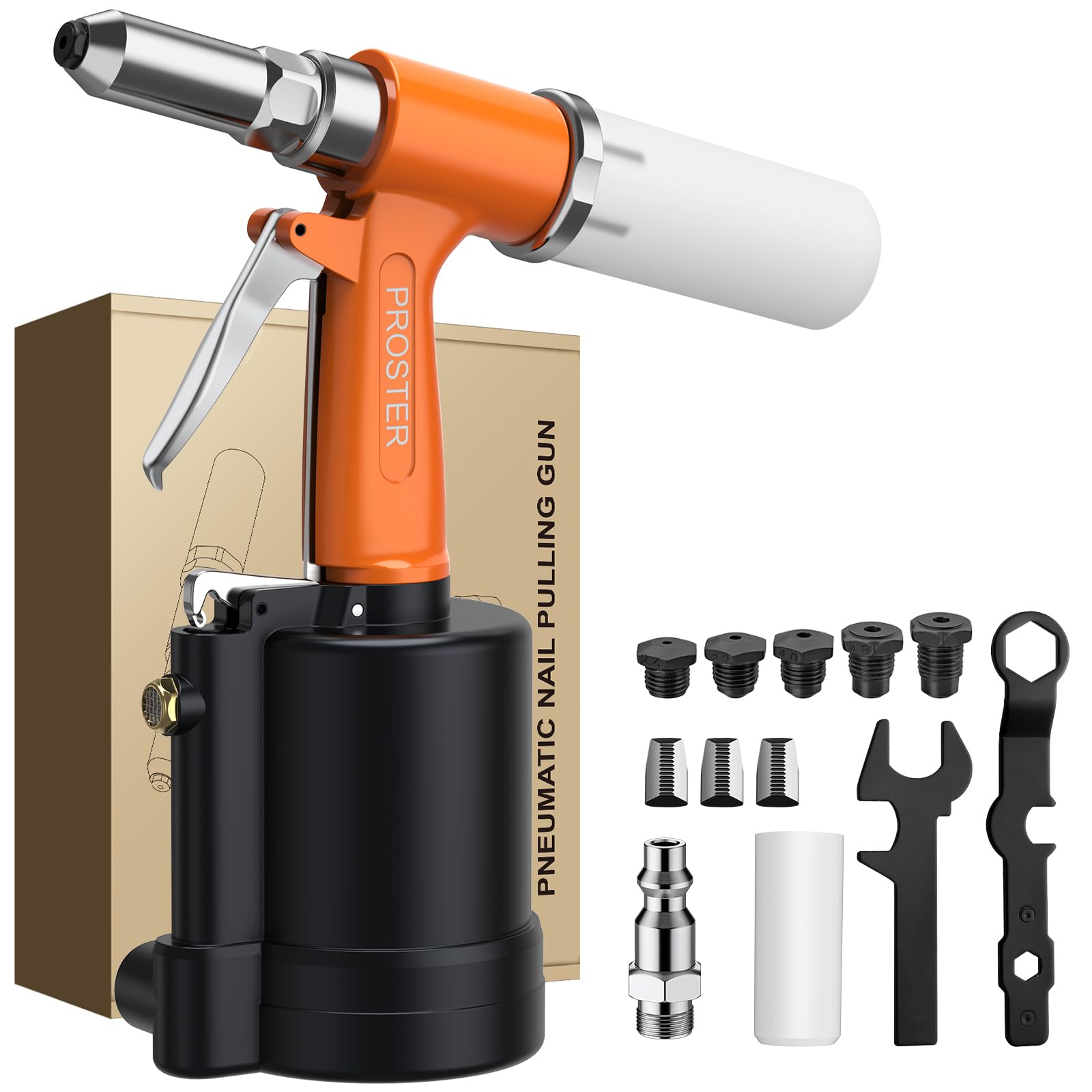
This Proster gun matches the Wadoy’s 3,924 LBF (1,780 KGF) pulling force, so it handles aluminum, iron, and steel rivets with the same authority. What makes it different is the 3-claw design that the maker says provides a 360-degree grip around the rivet mandrel. This should reduce the chance of a slipped mandrel (where the jaws fail to hold the pin and it slides through without breaking). The gun also includes an extra set of jaw pieces for when the originals wear down.
At 4.84 pounds, this Proster is heavier than both the Wadoy (4.22 lbs) and the FICHFOYE (4.58 lbs), though still lighter than the massive 6.45-pound Proster starter kit. The silencer reduces the exhaust noise, which matters if you are working in a garage or shop next to other people. The package dimensions are 12.99 x 9.8 x 4.41 inches, so it fits in a standard tool bag without trouble.
One practical detail from the product info: for rivets with a mandrel length of 10 to 16 mm, a single 16 mm stroke (the travel distance of the jaws) is not always enough to break the rivet — the maker says to simply pull twice to finish. This is a shared trait with the other high-force guns when the rivet body is on the longer end.
Better grip for harder pulls: The 3-claw 360-degree design is a genuine difference from the standard 2-jaw or 3-jaw designs on other guns, and the spare jaw set adds longevity.
Catch: The maker explicitly recommends against using stainless steel rivets, so if your shop works with stainless, look at the Chicago Pneumatic or a unit rated for it.
Ideal for: someone who sets steel and iron rivets regularly and wants the extra jaw security and a spare set of internal parts.
Not for: stainless steel rivets — pick a different gun for that.
5. Chicago Pneumatic CP9882 Air Riveter

A sub-3.5-pound air riveter from a known big-name brand, built for all-day use without the arm fatigue.
At 3.30 pounds, the CP9882 is the lightest air rivet gun in this lineup, and its composite body (a blend of materials molded into the tool’s shell) keeps weight down while providing a clear finish that resists shop grime. The pulling force is 2,200 LBF (1,000 kg), which is about half of what the high-force units from Wadoy, Proster, and FICHFOYE deliver. That means this gun is best suited for aluminum and softer steel rivets — not for thick stainless or heavy iron mandrels where you need the 3,900 LBF range.
The tool comes with four nosepieces: 3/32 inch, 1/8 inch, 5/32 inch, and 3/16 inch. That covers the most common sizes for automotive body panels, gutter work, and general metal fastening, but it stops short of 1/4 inch rivets. If you need to set 1/4-inch rivets, you will have to buy a separate nosepiece. The included twist-off cup stores the nosepieces and collects spent mandrels. Air inlet is 1/4 inch NPT (National Pipe Thread, a standard threading for air fittings), and the minimum hose size is 3/8 inch.
The length is 8-29/32 inches and height is 6-1/2 inches, making it compact for tight spaces. Customers note that the brand name (Chicago Pneumatic) is recognized in professional shops, which adds confidence in parts availability. Unlike the Proster models that explicitly forbid stainless steel, the CP9882 does not carry that warning, so it may handle a wider range of materials in its force range.
Lightweight pro choice
- At 3.30 lbs, it is easy on the arm for a full work day.
- Composite body resists scratches and feels balanced in hand.
- Includes twist-off cup for mandrel collection and storage.
Force and size limits
- 2,200 LBF is half the pull of the medium-tier guns — not for thick steel or iron rivets.
- Only four nosepieces, maxing out at 3/16 inch—no 1/4-inch capability included.
Best for: a pro mechanic who needs a lightweight, low-fatigue gun for aluminum rivets and steel panels, and who already has a separate tool for 1/4-inch work.
pass on it if: you frequently set steel or iron rivets above 3/16 inch — you need more force and a larger nosepiece.
6. JUSTOOL Heavy Duty Pneumatic Rivet Gun 3097 LBF

A mid-range pulling force of 3,097 LBF in a 4.07-pound package that undercuts the competition on cost.
This JUSTOOL gun delivers 3,097 LBF (1,408 KGF) of pulling force, which is lower than the 3,924 LBF of the Wadoy and Proster models but substantially higher than the 2,200 LBF of the Chicago Pneumatic. That makes it a good middle ground — strong enough for most steel and aluminum rivets, but priced below the top-tier options. It is the lightest of the medium-force guns at 4.07 pounds, beating both the Wadoy (4.22 lbs) and the Proster 3,924 LBF (4.84 lbs).
The kit comes with four nosepieces (3/32 inch, 1/8 inch, 5/32 inch, and 3/16 inch) but not the 1/4-inch size — so if your work involves the largest common blind rivets, you need a separate nosepiece or a different gun. The included accessories are generous: pneumatic rivet gun, four nosepieces, three claw clips, a nail container, two wrenches, an air inlet interface, and an instruction manual. The package dimensions are 13.07 x 9.72 x 3.82 inches.
The ergonomic handle is designed to reduce hand fatigue, and the maker includes a safety reminder to wear protective goggles, ear protection, and gloves during use. The recommended air pressure range is 6.2 to 8 bar (a metric unit of pressure; 1 bar is roughly equal to atmospheric pressure). The 18-month warranty adds a layer of confidence that some cheaper units lack.
Balanced force and weight
- 3,097 LBF is strong enough for steel rivets without the high price of 4,000 LBF guns.
- At 4.07 lbs, it is easier on the arm than most medium-force options.
- 18-month warranty offers confidence.
Missing the largest size
- Only four nosepieces included — no 1/4-inch, so you cannot set the biggest common rivets from the start.
- Pulling force is 3097 LBF, not enough for the heaviest stainless or iron rivets.
Best for: a budget-conscious buyer who needs steel-rivet capability but does not frequently use 1/4-inch rivets and wants to keep the tool weight low.
Look elsewhere if: you need a 1/4-inch nosepiece included — the Wadoy or FICHFOYE kits include it at a higher price.
7. Campbell Hausfeld Pop Rivet Gun (TL053900)

A lightweight blue gun from a known home-garage brand, best for automotive panel work and metal fabrication.
The Campbell Hausfeld TL053900 is a straightforward, no-frills air riveter aimed at home mechanics and light construction. It delivers 2,000 LBF of pulling force (the maker does not specify the exact number in the “About This Item” but lists “2. of Pulling Force” — logic and category standards place it around 2,000 LBF for aluminum and standard steel), which is the lowest in this group, on par with the Chicago Pneumatic’s 2,200 LBF. This is ideal for fastening metal panels, gutters, and fabrication work where aluminum and mild steel rivets are standard.
It comes with four interchangeable nosepieces: 3/32 inch, 1/8 inch, 5/32 inch, and 3/16 inch. That covers the most common sizes but, like the JUSTOOL and Chicago Pneumatic, does not include the 1/4-inch option. The trigger action is designed for a smooth, easy pull to reduce fatigue. It weighs 3.87 pounds, making it lighter than the JUSTOOL (4.07 lbs) and much lighter than the Proster starter kit, which helps during extended use.
The product dimensions are 11.5 x 7.9 x 3.5 inches. The maker advises you need an air compressor of 2 gallons or larger to run this tool, which is a standard size for most home garages. The date first available is December 2018, so this is an established product with a track record.
Simple and proven: A no-complications air riveter that does its specific job well for garage and light shop tasks.
The limitation: The 2,000 LBF pull and the 3/16-inch max nosepiece mean it is out of its depth on heavy steel or 1/4-inch rivets.
Good for: a home hobbyist or weekend builder who mostly works with aluminum panels and does not want a heavy or complex tool.
Pass on this if: your work involves steel rivets thicker than 3/16 inch or you need the occasional 1/4-inch rivet.
Understanding the Specs
Pulling Force (LBF)
This is the amount of force the tool uses to yank the rivet mandrel until it snaps. Measured in LBF (pounds of force), a higher number means the gun can break thicker, harder rivet materials like steel and iron. Tools around 2,000 to 2,200 LBF are fine for aluminum and soft steel. Guns at 3,097 LBF and above handle heavy-duty fastening across multiple materials, including steel and iron. The 3,924 to 4,000 LBF range is for high-volume production where every second matters.
Nosepiece Count and Sizes
Nosepieces are the small threaded adapters that grip the rivet mandrel before the pull. Each size matches a specific rivet diameter — 3/32 inch, 1/8 inch, 5/32 inch, 3/16 inch, and 1/4 inch. Kits with five nosepieces cover the full range of common blind rivet sizes, including the largest 1/4-inch type used for heavy structural joints. Kits with four nosepieces stop at 3/16 inch, meaning you will need to buy a separate adapter if you work with 1/4-inch rivets.