
Our readers keep the lights on and my morning glass full of iced black tea. As an Amazon Associate, I earn from qualifying purchases.
Specs are compiled from manufacturer listings and verified buyer reviews and can change over time — please confirm the key details on the product page before buying.
Your knives are probably duller than you think, and the fix doesn’t have to be complicated or expensive. This guide cuts through the noise to find an affordable knife sharpener that fits how you actually cook, whether that means a 30-second electric pull-through or a classic stone that rewards a little patience. We focus on the real-world results you can expect—how fast it works, how sharp it gets, and how much skill it demands—so you can pick the right tool without overspending.
I’m Min — the founder and writer behind Gadgets Feed. This guide is built by comparing the manufacturers’ published specifications and the patterns across verified customer reviews, so you get each pick’s real strengths and trade-offs instead of marketing spin.
Forget the jargon and intimidating pro setups; the best sharpener is the one you’ll actually use., and we’ve matched every pick to a specific kitchen routine and skill level.
Our Picks at a Glance

How To Choose The Best Affordable Knife Sharpener
Before you buy, decide how much effort you want to put in. An electric sharpener gives you a sharp blade in seconds with almost no skill, but it removes more metal and gives a rougher edge. A whetstone takes a few minutes and some practice, but it’s gentler on the blade and can produce a razor-sharp result that lasts. There’s no wrong answer—only the right tool for your patience level.
Match the Tool to Your Knives
Consider what you’re sharpening. Everyday stainless steel kitchen knives are easy to maintain with any sharpener. If you own high-hardness steel like CPM-series, M390, or Elmax, you’ll need a diamond abrasive surface—traditional whetstones won’t cut it effectively. For scissors, look for a model that explicitly says it has a scissors slot, or you’ll risk ruining the blades.
Understand Grit for the Edge You Want
Grit numbers (like 400, 1000, or 8000) tell you how coarse the sharpening surface is. A lower number, like 400, is coarse and is used to repair chipped or very dull edges quickly. A higher number, like 6000 or 8000, is fine and polishes the edge to a mirror-like finish. A two-sided stone with a coarse and a fine side is the most common setup because it covers both jobs.
Prioritize Stability and Safety
A sharpener that slides around while you work is both frustrating and dangerous. Look for a non-slip base, rubber feet, or a weighted design that keeps the stone or machine firmly in place. Angle guides are another safety and accuracy feature—they lock the blade at a consistent angle (like 15° or 17°) so you get a precise edge without years of practice.
Quick Comparison
| Model | Best For | Type | Grit / Stage | Weight | Amazon |
|---|---|---|---|---|---|
| Norton Combination Oil Stone★ Best Overall | Classic durability | Oil Stone | 100 / 280 Grit | 1.5 pounds | Amazon |
| Dawnstar Electric SharpenerBest Value | Fast, no-skill fixes | Electric | 2-Stage (Coarse/Fine) | 1.4 pounds | Amazon |
| Narcissus Diamond ElectricMost Versatile | Knives & scissors | Electric | 3-in-1 Diamond | 1.7 pounds | Amazon |
| goodjob 3-Sided Stone | All-hardness steel | Diamond Whetstone | 400 / 1000 / 8000 | 1.1 pounds | Amazon |
| SHARPAL 168H Diamond Stone | Hard steels & tools | Diamond Plate | 325 / 1000 Grit | 0.62 kg | Amazon |
| Work Sharp Benchtop Whetstone | Beginner-friendly precision | Water Stone | 1000 / 6000 Grit | 2.3 pounds | Amazon |
| Bogoni Rolling Sharpener | Low-effort daily use | Rolling Disc | 400 / 3000 Grit | 0.5 kg | Amazon |
| KING Whetstone Starter Set | Japanese-made beginner kit | Water Stone | 1000 / 6000 Grit | 16 ounces | Amazon |
| goodjob Complete Stone Kit | Full kit & polishing | Water Stone | 400/1000 & 3000/8000 | 16 ounces | Amazon |
In‑Depth Reviews
1. Norton Knife Sharpener Combination Grit Oil Stone
Our pick — over 4.5★ from 950+ verified ratings; the strongest balance of quality and price.
The classic oil stone that wins on trust, durability, and honest value — but it demands a little technique.
If you want a sharpener built like it will outlast every knife you own, this Norton stone is the pick. It uses a dual-sided system with a 100 grit side for repairing damaged edges and a 280 grit side for maintaining a razor-sharp finish. It arrives pre-filled with oil, so the lubricant stays on the surface while you work, which cuts down on one of the messier parts of manual sharpening. Buyers report it handles a range of tools brilliantly, from kitchen knives to chisels and even hatchets when used with kerosene.
The sharpening performance is the single most-praised aspect in owner feedback. The stone cuts hard steel easily, and while it can be slower than a water stone, you save time overall because there’s no soaking or flattening required. Just oil the surface, wipe it clean, and you’re done. It’s also note this is a true Norton India construction, which is why so many owners trust it for big game processing and fine woodworking shavings.
There is a trade-off for the classic design. The 280 “fine” side is really more like an extra-medium grit, so it won’t deliver the final polish a dedicated finishing stone will. Several owners recommend following up with a 1k then 3k stone and a strop for the absolute sharpest edge. It also needs constant wetness to avoid loading up with metal filings, so keep the oil handy.
What wins people over
- Feels indestructible and is made for heavy re-profiling work
- No soaking or flattening — just add oil and go
- The 100 grit coarse side restores chipped edges fast
- Trusted Norton brand with consistent quality
The honest trade-offs
- The fine side isn’t fine enough for a mirror finish
- Needs oil or lubricant to work properly
- Takes more time and skill than an electric sharpener
Reach for this if: you want a no-nonsense, durable stone for repairing and maintaining knives and tools, and you’re happy to practice the technique.
Look elsewhere if: you want a razor-sharp final edge straight from the stone — you’ll need a finer grit to finish the job.
2. Dawnstar Electric Knife Sharpener
This 2-stage electric sharpener turns a dull kitchen set into a usable set in a quarter of the time.
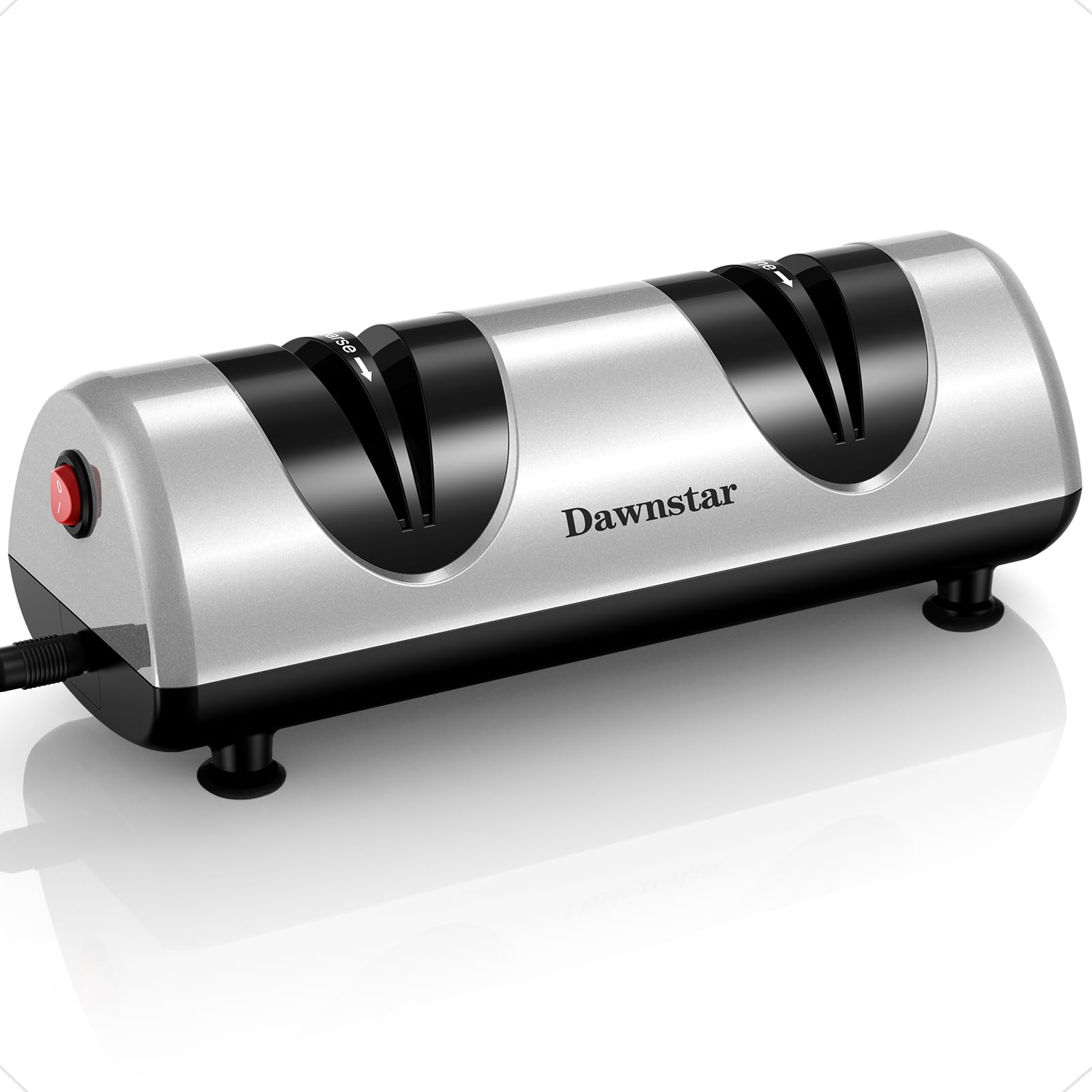
For the fastest possible path from dull to sharp, the Dawnstar electric sharpener is a standout. It has a coarse stage for rapid sharpening and a fine stage for polishing burrs, and The maker claims it restores a dull blade in 30 seconds.. You just glide the knife from base to tip in the groove, making 2-5 passes per stage. Owners mention sharpening a full set of very dull knives in 15 to 20 minutes, which matches the easy operation that gets so much praise.
The ease of use is the second most-praised aspect, and it’s easy to see why — there’s zero skill involved. Each stage has a corresponding metal dust collection box at the bottom, so the metal filings stick to a magnet and cleaning is simple. The compact size (9.4″L x 4″W x 5.5″H) and light weight of 1.4 pounds make it easy to store or move around, and it fits universal 100-240V voltage, so it works practically anywhere.
The catch is the ceiling on sharpness. This is not a whetstone edge — it does a decent job in a quarter of the time, but the sharpness performance gets mixed feedback. Some owners get “very very sharp” results, while others find the final edge not as razor-like as they hoped. It’s perfect for reviving cheap, everyday kitchen knives from the likes of Kohl’s or Chicago Cutlery, but a professional or enthusiast will notice the limit.
Speed without skill: this is the pick for anyone who wants sharp knives without learning a technique.
The ceiling: the edge won’t match a fine whetstone finish, so set your expectations for everyday utility, not surgical precision.
Grab it if: you have a drawer of dull everyday knives and less than 20 minutes to fix them.
Think twice if: you’re chasing a razor, mirror-polished edge for high-end steel.
3. Narcissus Diamond Abrasives Electric Knife Sharpener
The 3-in-1 diamond electric sharpener that handles straight, serrated, and ceramic knives plus scissors.
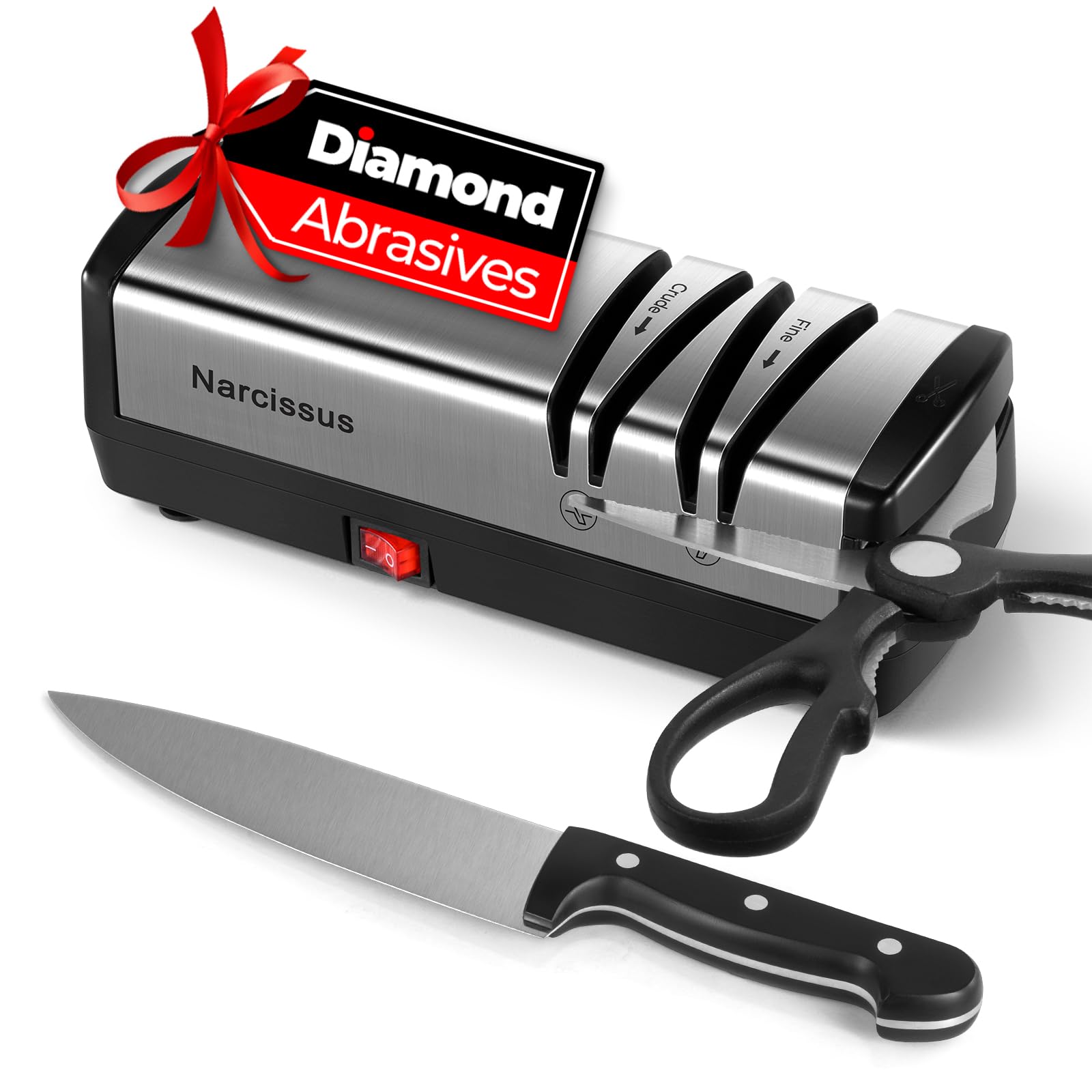
If your knife drawer holds a mix of straight, serrated, and ceramic blades, the Narcissus S867 handles them all. It’s a 3-in-1 sharpener with a coarse slot for quickly bringing dull blades back and a fine slot for a smooth polish. Unlike the Dawnstar Electric Sharpener above, it uses diamond abrasive wheels, so it also sharpens scissors. Customers note it does everything “a lot better” than older sharpeners they’ve used.
The sharpening performance is the thing everyone mentions most by a wide margin, and the dual-slot design makes it remarkably straightforward. The lower center of gravity plus four anti-slip foot pads minimize vibration, which makes the whole process feel more secure than you’d expect from a machine this compact.
The honest downside is its aggressiveness. A few owners find it noisy, and it can be too harsh on very thin blades, so delicate knives need a lighter touch. Heavy-duty clipper-type scissors can also be a struggle, though you can force the thicker blades into the slot. It’s genuinely good for the price, but it won’t outshine a professional-grade sharpener costing several times more.
One machine, many blades: this is the most flexible pick for a typical household with assorted knives and scissors.
Know its limits: be gentle with thin blades, and don’t expect it to beat a premium sharpener on the finest edges.
Choose this if: you need a single device for straight, serrated, and ceramic knives, plus scissors.
skip it if: you mostly own ultra-thin, delicate blades that could suffer from aggressive grinding.
4. goodjob 3-Sided Diamond Sharpening Stone

A three-sided diamond stone with a built-in angle guide to tackle even the hardest steel blades.
For owners of high-hardness steel knives, this goodjob stone is a serious contender. It combines three surfaces in one compact block: a 400 grit diamond side for repairing chipped blades, a 1000 grit diamond side for daily honing, and an 8000 grit ceramic side for a mirror polish. Reviewers point out it handles demanding steels like 10V, K390, and M4 with ease, which most traditional whetstones simply can’t do. The hard diamond surface works fast and stays flat, so you get consistent results.
The quality earns the most praise here, and a big reason is the built-in 14°, 17°, and 20° angle guide. This locks in an accurate angle so beginners get even, smooth edges without needing a separate sharpening jig. The wide non-slip plastic base keeps the stone stable and safe while you work. Several owners say the 8000 side puts a perfect sharp edge on the knife, and one notes it doesn’t move at all during use.
The main caveat is stability — opinions are split. Some find it sturdy, while others report the base rocks back and forth. The angle guide also collects dust and can scratch the blade, so some experienced users prefer to use it just for a feel and then go freehand. It’s a fast, capable stone for the money, but it’s not without its quirks.
Why it stands out
- Handles super-hard steels that wreck normal whetstones
- Three grits in one block — repair, hone, and polish
- Angle guide makes consistent edges beginner-friendly
- Fast cutting with diamond abrasive
Where it wobbles
- Base stability gets mixed feedback
- Angle guide can collect dust and scratch blades
- Compact footprint might feel small for big chef’s knives
Pick it up if: you own premium, hard-steel knives and want a single affordable stone that can handle them.
Pass it by if: you need one stable workhorse for heavy daily sharpening on soft kitchen steel.
5. SHARPAL 168H Dual-Grit Diamond Sharpening Stone
A flat, fast, and flat-out reliable diamond plate that stays true after dozens of heavy uses.
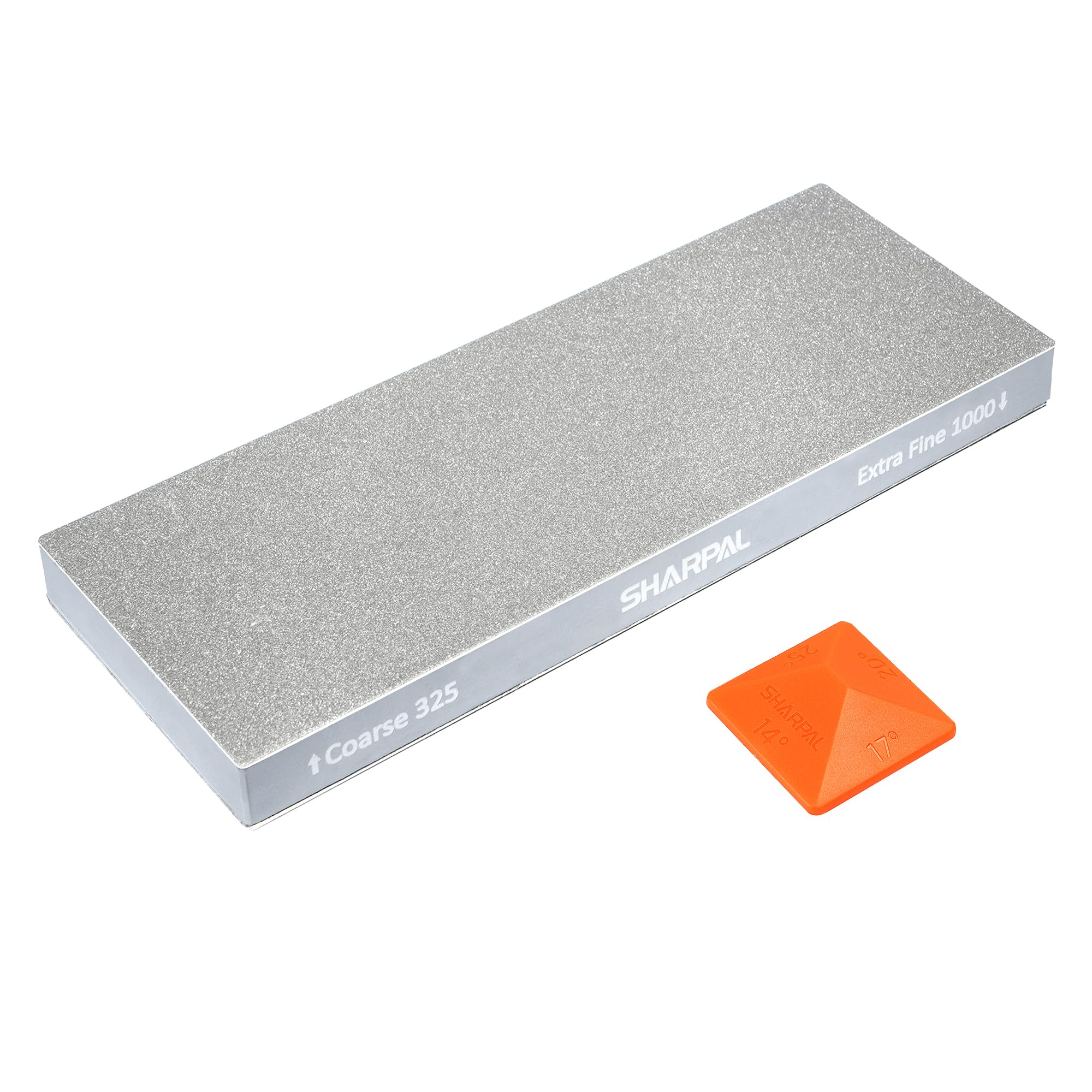
If you want a diamond stone that doesn’t dish out or warp under pressure, the SHARPAL 168H is the one to beat. It’s a large 8″ x 3″ dual-sided plate with a coarse 325 grit (45 micron) side for restoring dull edges and an extra-fine 1000 grit (15 micron) side for honing to a razor-sharp finish. The monocrystalline diamond construction is built to stay flat, and shoppers say no visible wear even after 30 uses. The MirrorFlat technology holds flatness to ±0.002 inch (0.05 mm) for even blade contact.
The quality is what wins people over, and for good reason. Unlike traditional whetstones, this diamond plate stays flat, needs no lapping, and works dry without the mess of water or oil. A known knife expert recommends it for its value., and it’s suitable for woodworking tools too — chisels, plane blades, axes, and hatchets all get a turn. One owner sums it up: “Nothing else is better” after years of trying other methods.
The trade-off is the thin profile. At 0.55 inches thick, it’s ideal for hand use but a bit slim for comfortable long sessions on a countertop — several owners recommend pairing it with a cheap improve base or a DIY holder. It also comes with a 4-angle guide (14°, 17°, 20°, 25°) and a non-slip pad to help with consistency, though the guide works best with a little practice.
Built for the long haul: this is the diamond plate that stays flat and fast when cheaper ones wear out.
Plan your setup: the slim profile means you’ll want a raised base or a DIY holder for the most comfortable sharpening sessions.
Reach for this if: you want a durable, no-mess diamond plate that handles both kitchen knives and woodworking tools.
Look elsewhere if: you refuse to rig up a base and want a ready-to-use countertop stone from the start.
6. Work Sharp Benchtop Whetstone Knife Sharpener

A guided water stone setup that makes a precise 15° or 17° edge easier than freehand sharpening.
For beginners who want whetstone results without the steep learning curve, the Work Sharp Benchtop is the answer. It features a premium dual-grit 1000/6000 corundum water stone, with the 1000 side for fast sharpening and the 6000 side for honing to an incredibly keen edge. The standout feature is the sharpening guides, which can be set to 15° or 17° and locked in magnetically. This takes the guesswork out of holding the angle, so you get consistent, even edges every time.
The quality and performance get nearly equal praise from owners. The water control base provides a stable surface and less mess than freehand sharpening, plus it doubles as stone storage. It comes with an anti-skid mat to keep the base planted on your counter. Owners find it works well on both carbon and stainless steel chef’s knives, and it’s durable enough for a 10-inch blade with an easy sweeping motion. Soak the stone for about five minutes, watch a tutorial video, and you’re off.
The catch is that the removable angle guides have a slight flaw — the angled part doesn’t quite reach the stone, making a perfectly consistent angle tricky. Several owners found that following a good YouTube technique rather than the official tutorial gets much better results. It’s also heavier at 2.3 pounds, which is part of why it stays put, but it’s not something you’ll toss in a drawer.
Guided precision: this turns whetstone skill into a guided process that newcomers can actually master.
Dial in your technique: the guides help, but you’ll get the best results by pairing this with a solid online tutorial.
Choose this if: you want whetstone-sharp results but need angle guides to get there without years of practice.
pass on it if: you’re an experienced freehand sharper who finds the guides more hassle than help.
7. BOGONI Rolling Knife Sharpener Classic Kit
A rolling sharpener that makes razor-sharp edges easy, even for hands that hurt from repetitive work.
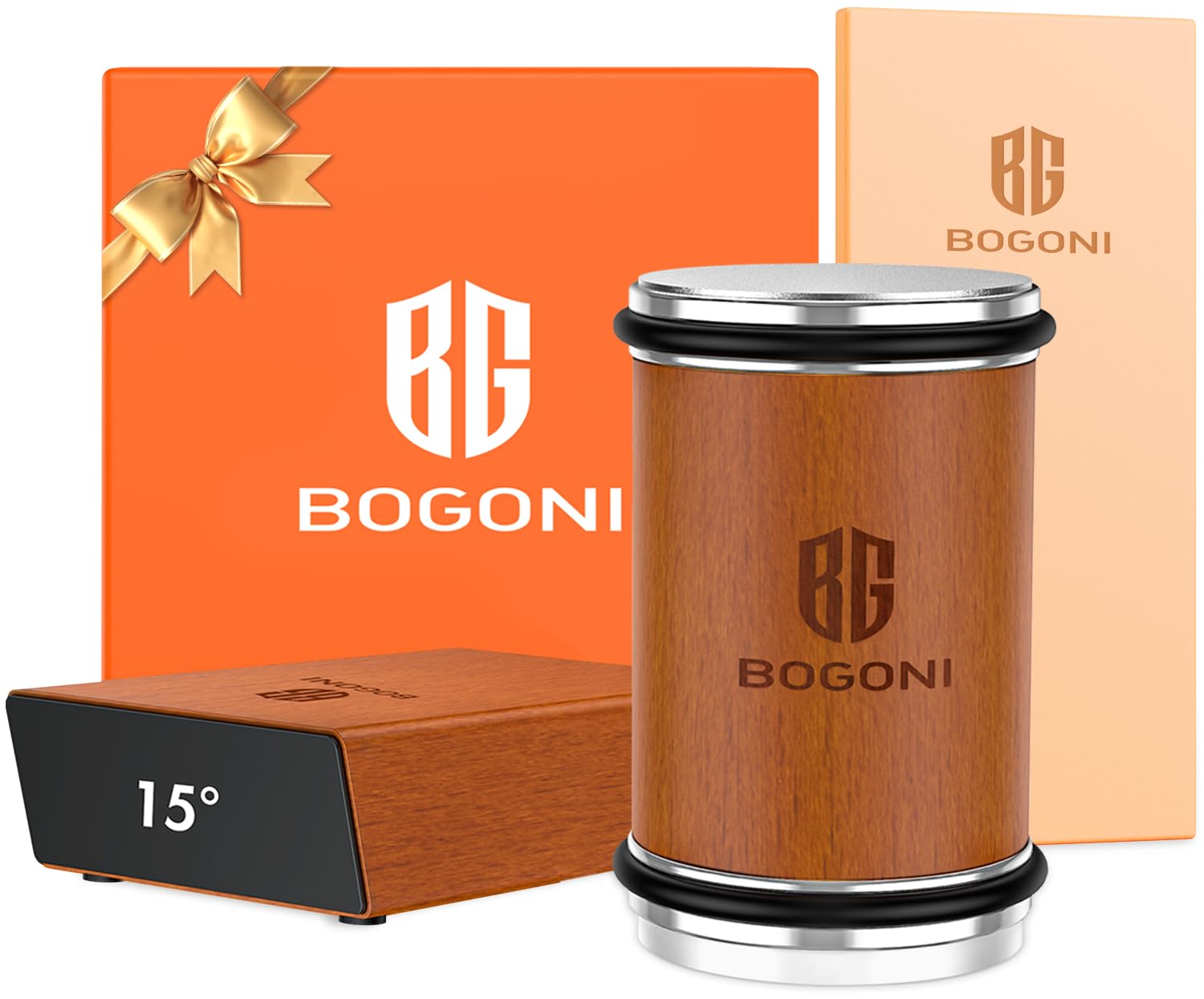
For anyone who finds traditional sharpening physically hard or intimidating, the BOGONI Rolling Sharpener changes the game. It uses a 400-grit diamond disc for reshaping and a 3000-grit ceramic disc for ultra-fine polishing, all mounted in a high-grade natural wood base. Six built-in N52 magnets hold the knife firmly in place, and you simply roll the ergonomic wooden handle across the blade. A professional chef with 37 years of experience and tendonitis calls it easy, getting a knife razor-sharp in under 4 minutes with no wrist strain.
The effectiveness is the most-praised aspect by a long shot. It comes with two magnetic angle guides — a 15° guide for ultra-sharp precision on Damascus and high-carbon steel, and a 20° guide for a stronger, more durable everyday edge. The kit also includes a leather strop for final polishing. Buyers report reviving knives they were ready to throw away, saving them hundreds of dollars on replacements.. It’s compatible with most kitchen and pocket knives and arrives in a deluxe gift box.
The honest caveat is the magnetic angle guide — feedback is split. Some find the magnets hold the knife perfectly stable, while others find the hold too weak and need to prop up small blades. It also works slowly on very dull knives, needing as many as 30 passes per side to get going. The durability of the discs is still unproven over the long term, but for the price, the early results are impressive.
easy sharpening: this is the pick for anyone with joint pain or zero patience for manual stones.
Patience required: very dull blades need more passes, and the magnetic hold isn’t universally loved.
Grab this if: you want a low-physical-effort way to keep kitchen and pocket knives sharp, or you’re gifting a cook.
Pass if: you need to re-profile badly chipped or very thick blades quickly — this is for maintenance, not major repairs.
8. KING Whetstone Starter Set

A Japanese-made combination whetstone with an angle holder that eases beginners into the craft.
If you’ve been told whetstones are too hard to learn, the KING Starter Set is designed to change your mind. It’s a Japanese-made combination stone with a 1000 grit side for main sharpening and a 6000 grit side for finishing — the classic one-two punch for a sharp edge. The key feature for newcomers is the included knife angle holder, which keeps the blade at the correct angle so you can focus on the motion rather than the math. It even comes with two ceramic protective rods and a plastic base.
Owners praise the quality and the sharpening performance almost equally. The stone cuts quickly and produces “ultra-sharp” edges, with one owner noting it handles everything from a paring knife to a 10-inch chef’s knife with ease. The original wiping cloth is high-absorbency and quick-drying, so cleanup is a simple wipe-down. For a beginner, the angle guide is helpful initially, though most find they can put it aside once they get the feel.
The notable downside is the durability feedback, which is more negative than positive. Several owners mention the stone cracking or chipping during use, so handle it with care. There’s also a nuance in the soaking process — soak the 1000 grit side for about 3 minutes, but do NOT soak the 6000 grit side, as it becomes too soft and gouges. Some instructions are in Japanese, which adds a bit of a learning curve.
Beginner-friendly entry: the angle holder and classic grit combo make this a great first whetstone.
Handle with care: the stone needs gentle handling to avoid chips, and the soaking rules matter for the 6000 side.
Pick this if: you’re new to whetstones and want a complete, guided starter set that produces real results.
it’s not for you if: you want a stone you can abuse without worrying about chips, or you’re a pro who needs higher grits.
9. goodjob Complete Knife Sharpening Stone Kit

A full four-stone corundum kit with a strop that takes a knife from broken edge to polished finish.
For the most complete sharpening experience in this lineup, the goodjob GB-12 kit gives you everything in one box. It includes two dual-grit whetstones — a 400/1000 and a 3000/8000 — covering the entire sharpening spectrum from coarse repair to ultra-fine polishing. The stones are made from professional-grade white corundum using Japanese Osaka production technology, fired at 2000 degrees for 48 hours across 20 processes for durability. A beginner can revive a badly worn knife in under 10 minutes, going from unable to cut paper to slicing cleanly.
The kit is built to make sharpening safe and complete. It includes a silicone non-slip bamboo base, cut-resistant gloves, a honing guide with angle guide, and two leather strops with green compound for that final polishing stage. Owners praise the quality and sharpening performance heavily, noting the set has everything needed for household and hunting knives. A single-use water sharpening system means no expensive honing oils and no mess — just rinse with water.
The trade-off is in the details. Some customers note the stones arrive with uneven, curved surfaces and grits that feel overstated (the 400 behaves like a 600, for example). The included chisel and angle guides are not great — the included ceramic glides are more useful for serrations. Durability also gets mixed feedback, with some stones chipping. It’s a fantastic value kit, but condition the stones for a few minutes before first use to get the best results.
Complete package: this kit has every grit and accessory a home sharpener needs, including a strop for the final polish.
Check your stones: inspect for flatness on arrival and condition them briefly, as a few units have surface imperfections.
Choose this if: you want a full sharpening system with strops and gloves, and you’re happy to do a little setup prep.
Look elsewhere if: you want a single, flawless stone with no setup fuss or verification needed.
Understanding the Specs
Grit Number
This number tells you how coarse the sharpening surface is. Low numbers (like 100, 325, or 400) are coarse and remove metal fast — they’re for repairing chips and very dull edges. High numbers (like 3000, 6000, or 8000) are fine and polish the edge to a smooth, sharp finish. A two-sided stone with one coarse and one fine side covers most home needs.
Sharpening Angle
This is the angle at which the blade meets the stone. A lower angle (like 15°) gives a thinner, sharper edge that’s great for precision slicing on high-carbon steel. A higher angle (like 20°) gives a thicker, more durable edge that’s better for everyday kitchen use. Angle guides lock this in for you, so you don’t have to hold it steady by hand.
Stone Material
This is what does the actual cutting. Corundum (used in oil and water stones) is durable and classic, but struggles with super-hard steels. Diamond is tougher and cuts through any steel, including high-hardness alloys like M390 and Elmax. Monocrystalline diamond is a premium type that stays sharper and lasts longer than cheaper polycrystalline diamond.
Sharpening Method
This defines your experience. Oil stones need oil to lubricate the surface — they’re messy but durable. Water stones (whetstones) use water and give a very fine edge, but often need soaking before use. Diamond plates work dry or with a little water, stay flat, and cut fast. Electric sharpeners are the fastest and easiest, using powered slots with coarse and fine stages.
FAQ
What grit is best for sharpening kitchen knives?
Can an electric sharpener damage my knives?
What is the difference between a whetstone and a diamond sharpening stone?
What does an angle guide do and do I need one?
How often should I sharpen my kitchen knives?
Why do some stones use oil and some use water?
Can one sharpener handle both knives and scissors?
What is the best sharpening angle for a chef’s knife?
Final Thoughts: The Verdict
For the majority of shoppers, the affordable knife sharpener winner is the Norton Combination Oil Stone because it’s the rare tool that delivers honest, durable performance for the money — the crowd favorite at 4.7 stars across thousands of owner reviews.. If you want zero-effort speed, grab the Dawnstar Electric Sharpener and revive a full knife set in 15 to 20 minutes. And for a complete hands-on sharpening system with a strop and gloves, the goodjob Complete Kit is the one to reach for.
How We Picked
We do not accept paid placement. Every pick is matched to a real buyer and a real use-case; we do not hands-on test units.
Sources & Methodology
Specifications: manufacturer listings and product documentation. Review insights: verified customer reviews, as of August 2026. Pricing: not shown on this page (it changes often); check the current price via the retailer link.
As an Amazon Associate, Gadgets Feed earns from qualifying purchases. This does not affect which products we feature.