
Our readers keep the lights on and my morning glass full of iced black tea. As an Amazon Associate, I earn from qualifying purchases.
Specs are compiled from manufacturer listings and verified buyer reviews and can change over time — please confirm the key details on the product page before buying.
When blackberry canes swallow your fence line or poison ivy creeps near the back door, you need a concentrate that kills the root, not just the leaves. This guide helps you pick the brush killer concentrate that fits your property size, your timeline, and the specific weeds you face.
I’m Min — the founder and writer behind Gadgets Feed. This guide is built by comparing the manufacturers’ published specifications and the patterns across verified customer reviews, so you get each pick’s real strengths and trade-offs instead of marketing spin.
From a gallon jug that covers 2.23 acres to small bottles for a backyard patch, here are the brush killer concentrate options that earn their place in your shed.
Our Picks at a Glance


How To Choose The Best Brush Killer Concentrate
To choose a brush killer concentrate, match three things: the area you need to treat, the plants you are fighting, and how soon you want to replant. Get those right, and the rest is just mixing water.
Match the coverage to your property
A 32-ounce bottle that covers 4,000 square feet is perfect for a suburban yard, but it will run out fast on a multi-acre pasture. For large properties, a gallon jug that stretches across 2.23 acres saves you from buying twice. Measure your problem area before you pick a bottle.
Know your enemy plant
Some concentrates specialize in woody brush and vines, while others handle broadleaf weeds in lawns. Check the label for the plants you actually have. If you are fighting established blackberry canes or poison ivy, you want an active ingredient like triclopyr that penetrates woody stems down to the roots.
Quick Comparison
| Model | Best For | Coverage | Volume | Key Active | Amazon |
|---|---|---|---|---|---|
| Southern Ag Crossbow★ Best Overall | Large acreage | 2.23 acres | 128 fl oz | Garlon, 2,4-D | Amazon |
| Roundup Poison Ivy PlusFast Action | Fast visible results | 1500 sq ft | 32 fl oz | Triclopyr blend | Amazon |
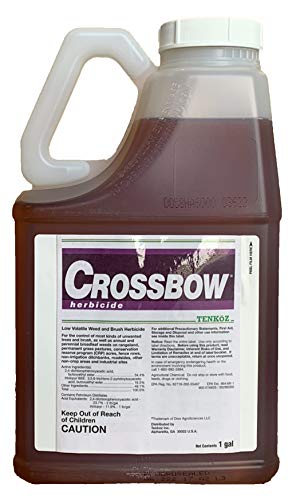
| Tenkoz CrossbowFarm Favorite | Fence rows | ~1 acre | 128 fl oz | — | Amazon |
| Remedy Ultra | Pasture restoration | Selective | 128 fl oz | Triclopyr | Amazon |
| BioAdvanced Extended | Long-term control | 4000 sq ft | 32 fl oz | — | Amazon |
| Bonide 332 | Lawn safe broadleaf | 240+ weeds | 128 fl oz | MCPA, Triclopyr | Amazon |
| Pro Brush & Poison Ivy | Stump treatment | 2-4 pints/acre | 32 fl oz | Triclopyr, 2,4-D | Amazon |
| Image Brush & Vine | Horsetail & blackberry | 4000 sq ft | 32 fl oz | Imazaquin | Amazon |
| Southern AG 01113 | Stump sprout prevention | 512-1024 sq ft/gal | 32 fl oz | Triclopyr | Amazon |
In-Depth Reviews
1. Southern Ag Crossbow Specialty Herbicide
Our pick — over 4.5★ from 800+ verified ratings; the strongest balance of quality and price.
The gallon jug that clears a small farm without a single refill trip.
This is the heavy-hitter for people with serious ground to cover. A single 128 fluid ounce jug stretches to 2.23 acres of spray solution, which is the difference between one weekend of work and a whole month of buying refills. The active pair of Garlon and 2,4-D tackles most unwanted trees, brush, and broadleaf weeds in one pass.
The proof is in the overgrowth stories. Buyers report that it “killed 7 years of overgrowth: ivy, vines, 8ft weeds, small trees, bushes, grass” while sparing the spider lilies planted nearby. That kind of selective knockout matters when you want the brush gone but the flower bed intact. Visible die-off shows in about 48 hours, with a complete kill inside a week.
It is the pricier option, and buyers openly say so — but they describe it as more efficient than competitor brands they tried first. For a property measured in acres rather than feet, that efficiency pays for itself in time saved.
Why the big jug wins
- 128 oz makes up to 96 gallons of spray
- Covers 2.23 acres in one bottle
- Spares desirable plants like spider lilies
What to know first
- Strong odor requires gloves and care
- Results vary by soil type — poor on some soils
Reach for this if: you are reclaiming acreage, fence lines, or a pasture and want one jug to finish the job.
Look elsewhere if: you only have a small backyard patch — the 32 oz bottles cover that for less money.
2. Roundup Poison Ivy Plus Tough Brush Killer2 Concentrate
The impatient gardener’s pick, with visible results in hours instead of weeks.
If waiting three weeks for weeds to brown feels like an eternity, this concentrate is built for you. Its three-part active blend — Triclopyr, Fluazifop-P-Butyl, and Diquat Dibromide — starts showing visible results in hours, not days. That speed is the headline, and it is backed by a rainproof window of just 30 minutes after spraying.
The trade-off for that speed is coverage. Each 32 fluid ounce bottle treats 1,500 square feet, which is a smaller footprint than some rivals. For a residential yard or a trail that is plenty, and the label covers poison ivy, poison oak, poison sumac, wild blackberry, and kudzu. Owners describe it as the only weed killer they use, often mixing it heavier than the label suggests.
Value gets a mixed read from the crowd — some call it a great deal, others grumble that the price has climbed. If speed and convenience matter more than stretching every last drop, this is the one.
Speed demon: visible kill in hours and rainproof in 30 minutes, which beats the standard 4-hour rainproof window you see on other concentrates.
Grab it when: you want to see your poison ivy problem die the same day you spray it.
Think twice if: you need to cover a large acreage — the smaller 1,500 sq ft footprint means more bottles.
3. Tenkoz Crossbow Herbicide Brush Killer
A farmer-recommended gallon that kills poison ivy the same day you spray.
This is the gallon jug that shows up on farm properties because it gets results fast. One 128 fluid ounce jug covers approximately 1 acre, and the reviews read like a rural endorsement list: poison ivy dead the same day, weeds gone for months, and high growth that needs no pre-mowing before treatment. One owner reported the effect lasting two full years.
It shines on fence rows and under bushes — the awkward spots where brush likes to hide. Buyers pair it with a battery backpack sprayer to handle large areas efficiently, and they note a strong chemical smell that signals it is working. The feedback on price is split, with some calling it a good deal and others finding it a touch spendy for the acreage.
This one is for the person who wants immediate, visible death in the foliage — dead by day 2 is the recurring timeline — without babying the application process.
Two-year effect: one owner reports the kill lasting 2 years, making this a rare “spray once and forget it” option for fence lines.
Choose it for: fast action on poison ivy and woody brush along property borders.
skip it if: you need to protect a delicate flower bed — this kills anything green it touches.
4. Remedy Ultra Specialty Herbicide
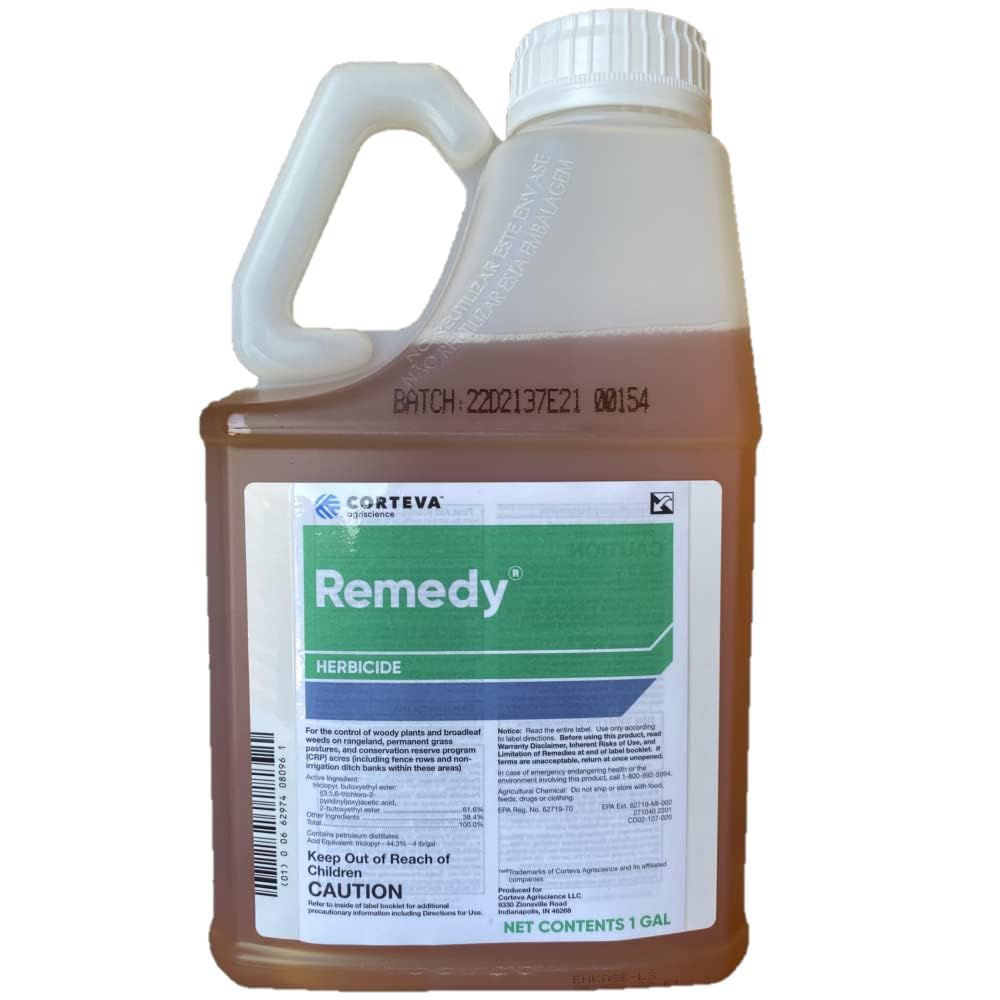
The low-odor triclopyr that landscaping crews trust to save the lawn while killing the weeds.
This one earns its keep on pasture and fence lines, where the goal is killing brush without wrecking the grass underneath. The active ingredient triclopyr works on the entire plant — roots and top growth — which is why a Florida landscaping business has used it for years as the only product that kills weeds without killing the lawn. That is a rare guarantee in this category.
The label markets it as safe around children and pets when applied per instructions, and it pairs flexibly as a tank mix with GrazonNext or ForeFront HL herbicide for bigger operations. Real-world results track the claims: pasture trees and brush up to 5 feet tall showed a good kill using a ratio of 4.5 cups to 26 gallons of water, with wilt visible in about a week. It is also the go-to for prickly pear and cogon grass control.
The catch is price — buyers call it expensive — but they also call it a must-have that annihilates problems other products cannot touch.
Lawn-safe triclopyr: kills broadleaf weeds and brush while sparing the turf, a balance most concentrates fail to hit.
Best suited for: pasture restoration and fence-line maintenance where protecting grass matters.
Not ideal if: you are on a tight budget — this is the premium end of the category.
5. BioAdvanced Extended Control Brush Killer Concentrate
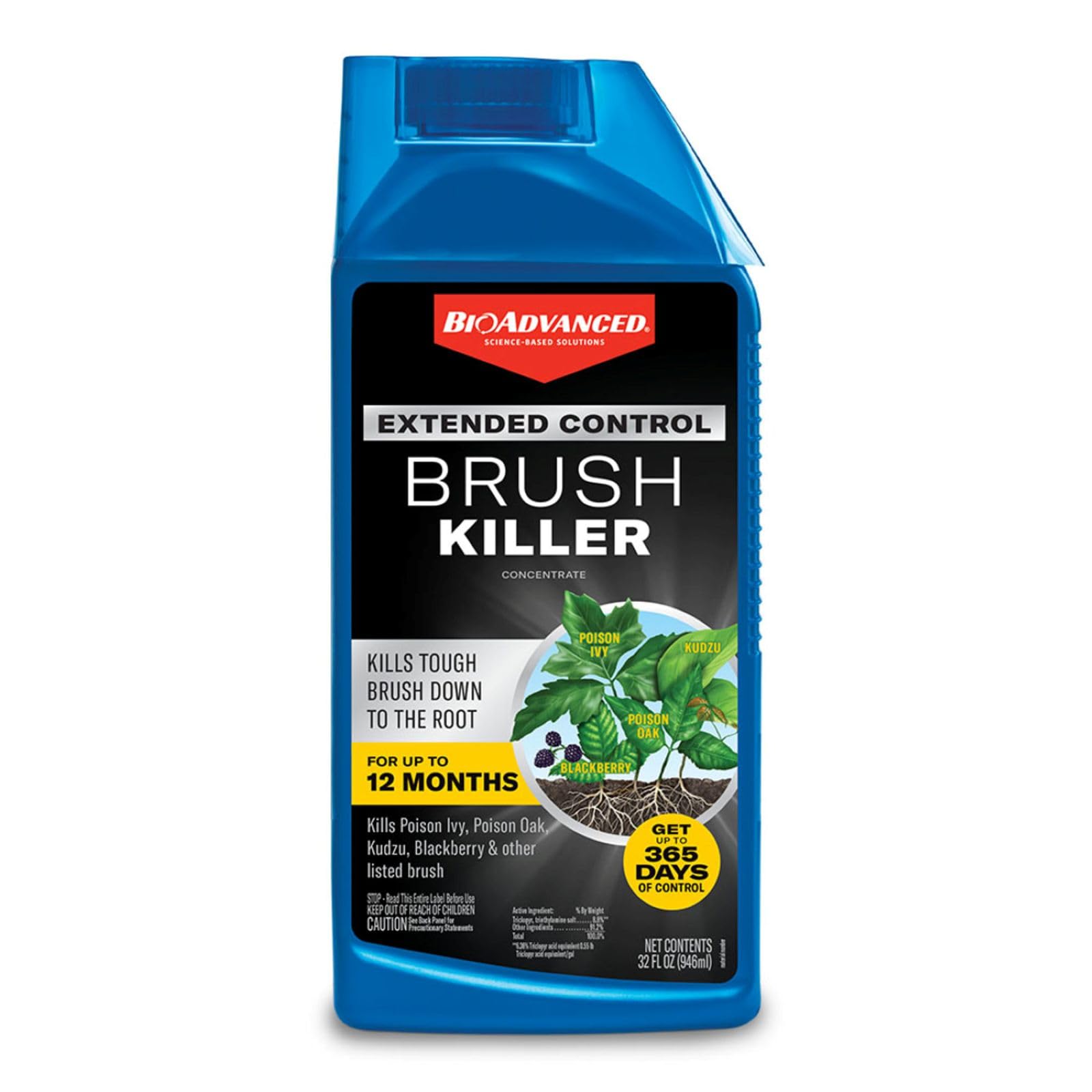
The “extended” in the name means up to 365 days of keeping brush from coming back.
Most concentrates kill what is there today; this one is designed to keep it dead for a full year. The 32 fluid ounce bottle treats up to 4,000 square feet of poison ivy, poison oak, kudzu, and blackberry, and it locks in rainproof protection just 4 hours after you spray. The built-in measuring cup on the bottle takes the guesswork out of mixing with a gallon of water.
The speed impresses even the skeptical. Owners mention poison ivy dead in just 2 days, with browning visible in the same window on other brush. One owner was surprised that Poplar and Aspen runners — notoriously persistent — died without affecting the surrounding grass. The formula targets listed roots and vine weeds around homes, fences, and wooded trails.
The honest caveat: the “extended” control had some owners scratching their heads about what it means in practice, and a few found themselves re-spraying. Read it as strong control with a possible need for follow-up on the toughest stands.
Year-long promise: up to 365 days of control is miles ahead of concentrates that die off in a month.
Reach for it when: you want to spray once and not think about the fence line again for a year.
Manage expectations if: you are fighting a massive, established thicket — some stands need a second pass.
6. Bonide 332 Poison Ivy & Brush Killer Concentrate

A gallon of lawn-safe muscle that kills over 240 weed types without browning the grass.
This brush killer protects your lawn while it kills broadleaf weeds. The 128 fluid ounce jug mixes MCPA, Triclopyr, and Dicamba (three herbicides that target broadleaf plants) to handle poison ivy, poison oak, kudzu, wild blackberries, chickweed, thistle, and over 240 other listed weeds — yet it stays safe for Bluegrass, Fescues, Rye, Bent, Bermuda, Bahia, and Zoysia lawns. You can also use it undiluted with a paintbrush as a stump killer, so you do not need a separate product for cut stumps.
The owner consensus is that it is worth the money and easy to apply, instantly mixing with water for a tank or hose-end sprayer. One memorable result: it killed an intrusive thick vine that had been choking a fence for years. The honest limits show up on the toughest stuff — bindweed shrugs it off, and some ivy ground cover needs two or three treatments before results appear.
One safety note from the reviews: this is strong chemistry. A stray drip onto the lawn left a ruined spot, so shield desirable plants while you spray.
Lawn-safe formula: kills broadleaf weeds down to the roots while leaving seven common turf grasses standing.
Choose it if: your brush problem sits right next to a lawn you refuse to sacrifice.
Look past it if: bindweed is your main enemy — it survives this one.
7. Pro Brush & Poison Ivy Killer
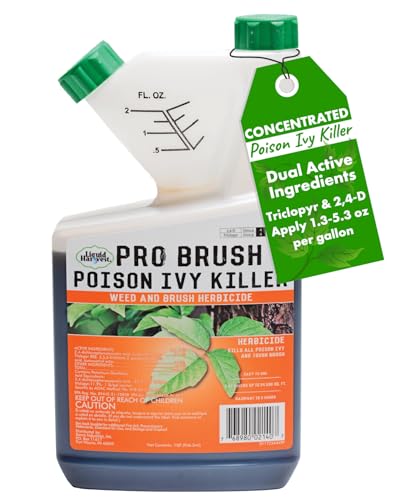
The stump treatment that stops honeysuckle resprouting after you cut it down.
If your battle is cutting brush and hoping it stays gone, this concentrate is your second half of the fight. Its dual active ingredients — triclopyr and 2,4-D — form a combination that works in both cool and warm weather, and it can be applied in-season or during dormant periods. The flexibility means you are not racing the calendar to treat fresh stumps.
The stump story is the strongest one. Customers note treating hundreds of bush honeysuckle stumps on their property and seeing them stay dead without resprouting. Others took down lilac bushes 3 feet tall, Russian olive trees, and wild roses with a single application. The mixed ratio is forgiving: 1.3 to 5.3 ounces per gallon of water, or 2 to 4 pints per acre for bigger jobs.
This one asks for patience and persistence — a two-week window with a second application at day four did a great job on the toughest vegetation. It is priced as a mid-range option that punches like a premium.
Resprout prevention: hundreds of treated stumps stayed dead, which is the real measure of a brush killer.
Reach for this if: you cut brush down and are tired of it growing back within the month.
Plan for patience if: you want instant results — the best outcomes came after two applications.
8. Image Brush & Vine Killer Concentrate
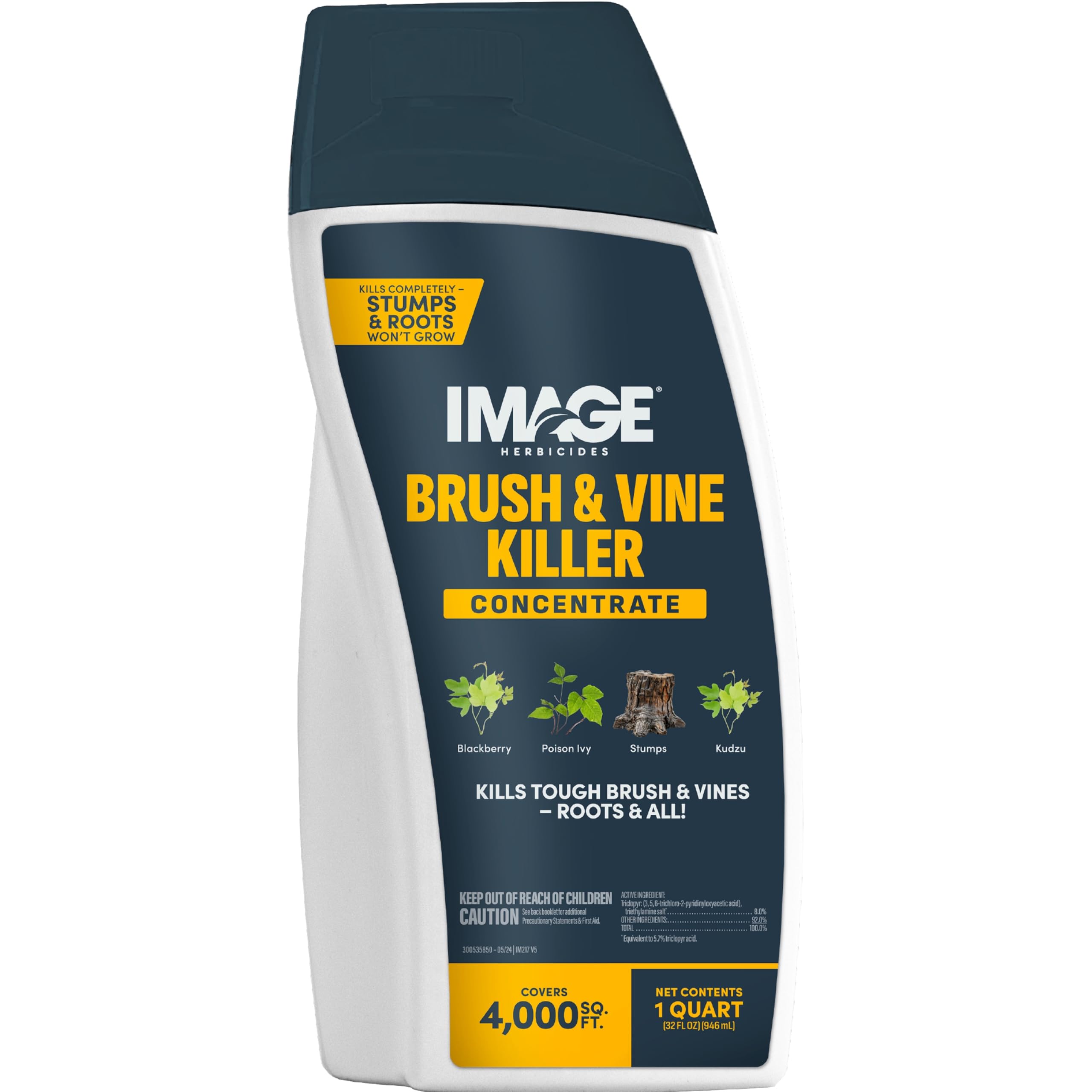
The budget bottle that kills horsetail and Himalayan blackberries when pro services fail.
This is the value pick that wins on stubborn weeds. Its active ingredient, the ammonium salt of imazaquin, took down horsetail weed where other products and even professional services came up short — and owners say the concentrated version is cheaper than hiring the pros. The 32 fluid ounce bottle covers 4,000 square feet of poison ivy, poison oak, poison sumac, wild blackberry, and kudzu.
The blackberry math is the proof. On a 12 to 15 thousand square foot property, a 4 oz per gallon mix showed yellowing by 3 weeks, while a stronger 5 oz per gallon mix went brown and dry by week 4. The label-approved play is a fall application for the best kill. One owner notes it needs a surfactant — a squirt of dish soap in the sprayer — to really grip the leaves.
At this price point, it delivers root-and-all kills that the big-box brands miss. The main asterisk is that timing and mix strength genuinely matter to get the full effect.
Stubborn weed specialist: horsetail and kudzu — plants that defeat other products — fall to this formula.
Grab it for: a budget-friendly shot at weeds that survived everything else you tried.
Know the catch if: you do not want to add surfactant — it wants a squirt of dish soap to work its best.
9. Southern AG 01113 Brush Weed Killer

The triclopyr quart that prevents stumps from sprouting after you clean-cut them.
This one specializes in stopping regrowth at the source. Its triclopyr formula kills vines and hard-to-control plants while preventing sprouting on clean-cut stumps — the exact job that keeps fence lines and pastures clear. It is positioned for non-crop areas like roadsides, rangeland, pastures, and fence lines.
The Oregon blackberry story is the one that resonates. Reviewers point out it works on blackberry and other shrubs, with larger shrubs taking about two weeks to dry and turn brown. It also handled bindweed growing among peonies, browning the vines so the roots pulled out easily. Owners who failed with big-box store weed killers found this one worked exactly as expected.
The honest limit: it did nothing to a strangler fig plaguing one buyer’s tree. It is a broad tool, not a magic wand for every species. For the price, it is a solid entry point into serious brush control.
Sprout prevention: stops regrowth on clean-cut stumps, which keeps you from re-treating the same spot for months.
Choose it for: a budget-friendly triclopyr that covers vines, shrubs, and stump sprouting.
Pass on it if: you are fighting a specific species like strangler fig — it survived this treatment.
Understanding the Specs
Coverage: square feet vs acres
Coverage tells you how much ground a bottle will treat, and it varies wildly. A 32 oz bottle might cover 4,000 square feet, while a gallon jug stretches to 2.23 acres. The gap matters: the Southern Ag Crossbow covers 2.23 acres, while the Southern AG 01113 covers just 512-1024 square feet per gallon — a 7.8x difference. Match the coverage number to your actual property size before you buy.
Liquid volume: 32 oz vs 128 oz
Volume is about how much concentrate you get, and it is not the same as coverage. A 32 oz bottle is convenient for a backyard, but a 128 oz gallon jug is the economy size. The Southern Ag Crossbow holds 128 fluid ounces, four times the volume of the Image concentrate at 32 fluid ounces — a 4.0x gap. If you have a large property, the gallon saves you repeat purchases.
Active ingredients: triclopyr and 2,4-D
The active ingredients decide what dies. Triclopyr is the workhorse for woody brush, vines, and stumps — it penetrates stems down to the roots. 2,4-D is the classic broadleaf killer. Products like the Pro Brush Killer combine both for cool and warm weather effectiveness. A concentrate’s active list tells you whether it will handle your specific weed or just wilt it.
Rainproof window: hours vs minutes
Rainproof time is how long you need dry weather after spraying. The Roundup concentrate locks in at just 30 minutes, while the BioAdvanced needs 4 hours. If you are spraying on a day that might rain, a shorter rainproof window means you are not racing the clouds. Check this number against your local forecast before you mix a batch.
FAQ
Will a brush killer concentrate kill poison ivy down to the root?
How much area will a 32 oz bottle of concentrate cover?
Can I use brush killer concentrate on my lawn without killing the grass?
How long does a brush killer concentrate take to show results?
What is the difference between a concentrate and a ready-to-spray brush killer?
How do I stop tree stumps from sprouting after I cut them?
Is brush killer concentrate safe around children and pets?
Why does my brush killer need a surfactant added to it?
Final Thoughts: The Verdict
Across the board, the brush killer concentrate winner is the Southern Ag Crossbow because its 128 oz gallon jug covers 2.23 acres and kills the toughest overgrowth without a refill trip. If you want fast visible results on poison ivy, grab the Roundup Poison Ivy Plus, which shows results in hours and is rainproof in 30 minutes. And for a budget-friendly assault on stubborn weeds like horsetail and blackberry, the Image Brush & Vine Killer is the one to reach for.
How We Picked
We do not accept paid placement. Every pick is matched to a real buyer and a real use-case; we do not hands-on test units.
Sources & Methodology
Specifications: manufacturer listings and product documentation. Review insights: verified customer reviews, as of August 2026. Pricing: not shown on this page (it changes often); check the current price via the retailer link.
As an Amazon Associate, Gadgets Feed earns from qualifying purchases. This does not affect which products we feature.