
That sinking feeling when you turn the key and get nothing but a click or dead silence — it’s the sound of a battery that has been slowly starving for weeks. A battery maintainer is the difference between a reliable daily start and a frantic jump-start ritual, yet most people confuse it with a simple trickle charger and end up with a cooked battery. Getting this right means picking a unit that actually talks to your battery chemistry, compensates for temperature, and knows when to stop.
I’m Min — the co-founder and writer behind Gadgets Feed. I’ve spent years deep-diving into battery charging technology, parsing the difference between 9-stage profiles and basic float modes, and analyzing real-world recovery data across lead-acid, AGM, and LiFePO4 chemistries to separate genuine smart maintainers from dumb power supplies..
A smart maintainer does more than just sit there — it desulfates, reconditions, and adapts to temperature so your battery lasts years longer. After testing the field, here is the definitive breakdown of the best battery maintainer for every garage, from weekend riders to fleet operators.
How To Choose The Best Battery Maintainer
Picking a battery maintainer comes down to matching the charging profile to your battery’s chemistry and your typical usage cycle. A 1A unit that works perfectly for a motorcycle stored all winter will frustrate you if you need to recover a deeply discharged truck battery overnight.
Amperage and Charge Speed
Amperage determines how fast the maintainer can replenish a depleted battery. A 0.75A unit like the Battery Tender Junior is ideal for maintaining an already-healthy battery during storage, but it can take 36-48 hours to bring a deeply discharged battery back from the brink. Higher-amperage options — 5A or even 15A — slash that recovery time to a matter of hours, making them suitable for vehicles used weekly or for reviving neglected batteries.
Chemistry Compatibility: Lead-Acid vs. LiFePO4
Not all maintainers handle lithium iron phosphate (LiFePO4) batteries. If you own a modern motorcycle, powersport vehicle, or solar backup system with a lithium battery, you need a unit with a dedicated LiFePO4 charging profile — otherwise you risk undercharging or damaging the battery. Units like the PZP and NEXPEAK explicitly support both lead-acid (AGM, Gel, Flooded) and LiFePO4 in one device.
Smart Charging Stages vs. Basic Float
Basic trickle chargers just dump current continuously — they can overcharge and boil batteries if left connected for weeks. A true smart maintainer uses multiple stages (often 4 or 9): bulk charge, absorption, float mode, and sometimes a desulfation or pulse repair stage. The 9-stage units actively detect sulfation and acid stratification, sending controlled pulses to break down lead sulfate crystals and restore lost capacity.
Desulfation and Pulse Repair
If your battery has been sitting for months, sulfation is the #1 killer. A maintainer with a dedicated desulfation mode sends high-frequency pulses that can recover batteries that seem dead. This feature alone can double a battery’s usable life, making it a key differentiator between a basic maintainer and a true battery rehab tool.
Quick Comparison
On smaller screens, swipe sideways to see the full table.
| Model | Category | Best For | Key Spec | Amazon |
|---|---|---|---|---|
| NOCO GENIUS1 | Smart Maintainer | All-around, desulfation, 1V recovery | 1A output, 35% smaller than G750 | Amazon |
| PZP 15A | High-Amp Charger | Fast charging, LiFePO4, pulse repair | 15A output, 9-stage charging | Amazon |
| NEXPEAK 15A | Feature-Packed | Large color screen, 1.75A trickle | 15A charge, 8.9ft cord | Amazon |
| Battery Tender Junior 12V | Entry Maintainer | Motorcycles, powersports, long-term storage | 0.75A, 4-step charging | Amazon |
| Battery Tender Junior 8V | 8V Specialist | 8V batteries, classic cars, specialty vehicles | 1.25A, 8V output | Amazon |
| CRAFTSMAN 1.5A | Value Maintainer | 6V/12V, reconditioning, wall-mount | 1.5A, desulfation mode | Amazon |
| ECO-WORTHY 5A | Mid-Range 5A | Lithium batteries, faster charging | 5A output, LCD display | Amazon |
In‑Depth Reviews
1. NOCO GENIUS1

The NOCO GENIUS1 takes the top spot because it packs genuine smart-charging intelligence — temperature compensation, desulfation, and the ability to charge a battery down to 1 volt — into a chassis that is 35% smaller than its predecessor. Its pulse charging automatically reverses sulfation and acid stratification, which extends battery life beyond what a basic float charger can do. The integrated thermal sensor dynamically adjusts the charge based on ambient temperature, preventing overcharging in hot weather and undercharging in cold conditions.
Real-world performance tells the story: users report bringing completely dead SUV batteries back to life in about 36 hours using the smart charge mode, then leaving the unit connected indefinitely for maintenance without worrying about overcharge. The package includes both battery clamps and permanent eyelet terminals — the latter is a huge convenience for hard-to-reach batteries on motorcycles or marine applications. It supports both 6V and 12V lead-acid (AGM, Gel, SLA, VRLA) and lithium-ion (LiFePO4) chemistries, covering almost every vehicle in a typical garage.
The only consistent feedback is that the instruction manual is minimal, and the LED state meanings (solid red vs. fading red) are not well documented for first-time users. Still, for anyone who wants a set-and-forget device that actively rehabilitates batteries, this is the gold standard in the sub-2A category.
Why it’s great
- Temperature compensation adjusts for hot/cold environments
- Desulfation pulse charging restores lost battery capacity
- Charges batteries from as low as 1 volt
Good to know
- Manual lacks clear LED state descriptions
- Slow charge speed for deeply discharged batteries (36+ hours)
2. PZP 15A Smart Charger
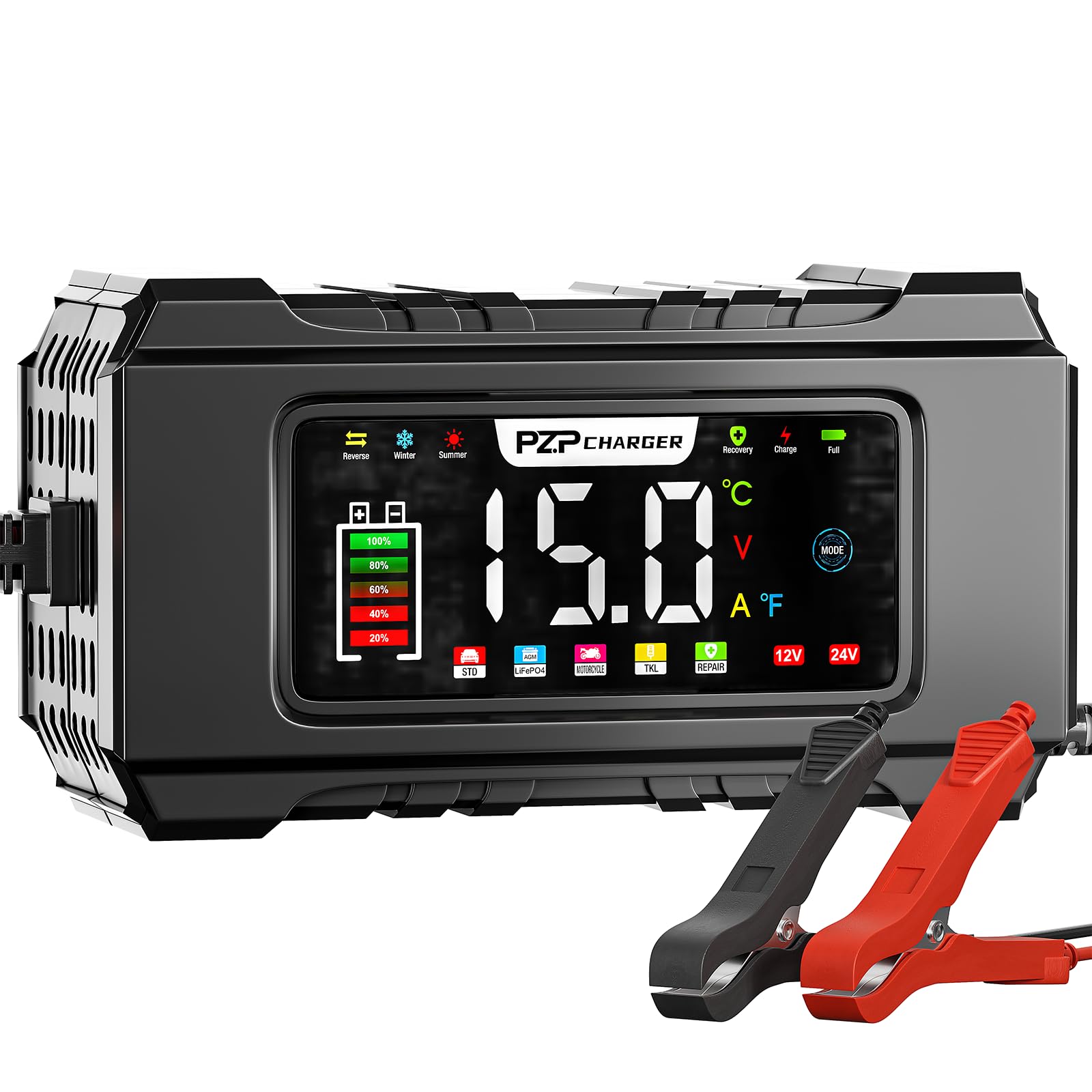
The PZP 15A is a serious leap in charging speed compared to the 1A crowd, delivering 15 amps for 12V batteries and 8 amps for 24V. This means it can recharge a near-empty battery in roughly 5 minutes for a top-up, and fully recover a heavily depleted battery in a fraction of the time a small maintainer would take. The 9-stage charging process includes bulk, absorption, and a float mode (TKL) that automatically activates once the battery is full, making it safe for long-term connection.
A standout feature is the large color LCD screen that displays real-time voltage, current, internal temperature (in Fahrenheit or Celsius), charge percentage, and even seasonal modes (summer/winter). The extended 6.7-foot charging cable is helpful when your battery is buried deep in a trunk or engine bay.
One nuance: the unit does not automatically switch to trickle charge for all users — some report needing to manually select the mode after the battery finishes, which is less convenient than fully automatic competitors. Also, the manufacturer notes that it cannot activate or charge totally dead batteries (below 0.3V), so it won’t replace the NOCO for extreme recovery scenarios.
Why it’s great
- Very fast 15A charging cuts recovery time to minutes/hours
- Large color screen with full real-time data
- Supports both LiFePO4 and lead-acid batteries
Good to know
- Does not auto-enter trickle mode for all users
- Cannot charge dead batteries below 0.3V
3. NEXPEAK 15A
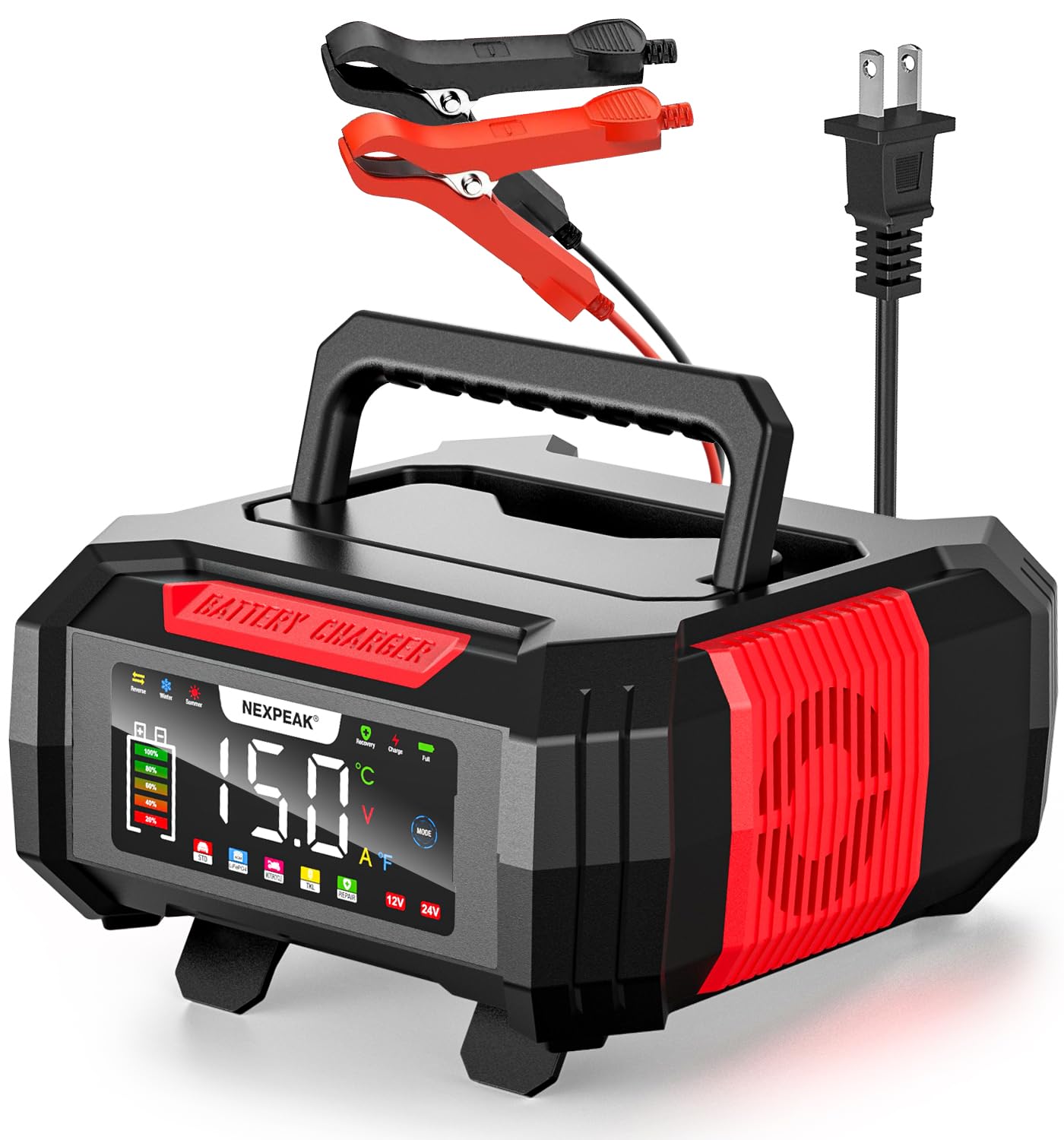
The NEXPEAK 15A competes head-on with the PZP as a high-amp smart charger, but it differentiates itself with a brighter, larger color LCD screen that stays readable even in direct sunlight — a real advantage if you charge outdoors. It delivers the same 15A on 12V and 8A on 24V, with a 1.75A trickle/float mode that is safer and more efficient than the standard 0.75A units. The 9-stage charging process includes pulse repair to detect sulfation and restore lost performance.
The physical design is a highlight: an 8.9-foot charging cord (from clips to AC plug) is one of the longest in this class, making it easy to reach batteries in tight spots without an extension cord. The unit also has a cord compartment for tidy storage, and users praise its lightweight, compact build for being easy to carry between vehicles. It automatically switches to trickle mode after reaching full charge, and the display dims after a while to save power — small touches that add up.
On the downside, the build feels less rugged than some competitors — a drop onto concrete could be enough to damage it, so it’s best kept on a shelf or workbench. And like the PZP, it cannot charge a battery that is completely dead (below 0.3V). But for anyone who values a clear, informative display and long reach, this is a strong mid-range pick.
Why it’s great
- Exceptionally bright large color screen readable in sunlight
- Long 8.9ft cord for hard-to-reach batteries
- 1.75A trickle mode is safer than basic chargers
Good to know
- Build is less rugged — fragile if dropped on concrete
- Cannot charge batteries below 0.3V
4. Battery Tender Junior 12V

The Battery Tender Junior is the most recognized name in the category for a reason — it has been keeping motorcycle and powersport batteries healthy for decades. Its 4-step charging program (Initialization, Bulk Charge, Absorption Mode, Float Mode) is simpler than the 9-stage units but proven to be reliable and safe. The 0.75A output is deliberately slow to be gentle on small batteries, and the float mode maintains voltage without overcharging, even if left connected for months.
Real-world longevity speaks volumes: owners report the same unit working flawlessly for 6-8 years straight, keeping batteries in storage alive through multiple winters. The included ring terminal harness lets you permanently attach a pigtail to the battery, making hookup a 5-second task — just plug in the quick-disconnect. It supports all 12V lead-acid chemistries (flooded, AGM, gel) and includes spark-proof circuitry and reverse polarity detection.
The tradeoff is speed — at 0.75A, it takes 36-42 hours to fully charge a deeply discharged battery, and the two-color LED (red/green) is hard to read in bright daylight. It also lacks desulfation or pulse repair features, so it is best suited for maintaining healthy batteries rather than recovering dead ones. For pure storage duty on seasonal vehicles, nothing beats its track record.
Why it’s great
- Proven 6+ year lifespan with consistent use
- Permanent ring terminal mount for easy quick-connect
- Spark-proof and reverse polarity protected
Good to know
- Very slow charge speed (0.75A) for deeply discharged batteries
- No desulfation or pulse repair mode
- LED is hard to read in sunlight
5. Battery Tender Junior 8V

This is a specialized tool built specifically for 8V battery systems — common in older classic cars, some diesel trucks with dual 8V banks, and specialized marine or industrial equipment. The 1.25A output is noticeably faster than the 12V Junior’s 0.75A, but still gentle enough for long-term connection. It uses the same trusted 4-step charging process (Initialization, Bulk Charge, Float Mode) and automatically switches to float maintenance once the battery reaches full charge.
The build quality matches the standard Battery Tender — compact at 4.4 x 2.9 x 2.15 inches and lightweight at 0.7 pounds, with spark-proof circuitry and reverse polarity detection. The cable set includes both alligator clips and ring terminals, giving flexibility for permanent installation or temporary hookup. The two-color LED provides basic charge status feedback (charging vs. fully charged).
The main limitation is the lack of a voltage display — you only see “charging” or “fully charged” states, so you cannot track progress without a multimeter. And since it is designed for 8V systems only, it cannot be used on standard 12V automotive batteries. For owners of 8V-equipped vehicles, this is the most dependable maintainer available; for everyone else, it is a non-starter.
Why it’s great
- Dedicated 8V charging profile for specialty batteries
- Compact and lightweight, easy to store
- Spark-proof and reverse polarity protection
Good to know
- No voltage display — only basic LED feedback
- Cannot be used on standard 12V batteries
6. CRAFTSMAN 1.5A

The CRAFTSMAN 1.5A offers a compelling balance of price and features, bundling charging, maintaining, and reconditioning (desulfation) in a single 3-in-1 device. The desulfation mode uses advanced pulse technology to break down lead sulfate crystals and extend battery life — a feature typically reserved for more expensive units. It supports both 6V and 12V batteries, including standard, AGM, gel, and deep-cycle types, and auto-detects the voltage without needing a manual switch.
The physical design is thoughtful: the 6-foot power cord and 5-foot booster cables provide decent reach, and the unit is wall-mountable for permanent installation in a garage or workshop. Users report it works well for charging zero-turn mower batteries and maintaining motorcycle batteries, with most topping up in about 3 hours. The reverse polarity protection prevents damage if clamps are accidentally swapped.
Where it falls short is its inability to charge truly dead batteries — it is designed for topping off and maintenance, not recovery from 0V. The build quality, while good for the price, does not match the ruggedness of the NOCO or Battery Tender. But for budget-conscious buyers who want desulfation without paying extra, this is a solid entry-level smart maintainer.
Why it’s great
- Desulfation mode extends battery life at a low price
- Works with both 6V and 12V batteries automatically
- Wall-mountable for permanent garage installation
Good to know
- Cannot charge dead batteries — only for topping off
- Build quality is adequate but not premium
7. ECO-WORTHY 5A

The ECO-WORTHY 5A targets owners of lithium (LiFePO4) batteries who need a dedicated charging profile that will not damage the battery’s internal BMS. It delivers 5 amps of output — significantly faster than the 0.75A and 1.5A maintainers, making it suitable for medium-sized batteries in cars, motorcycles, and marine applications. The fully automatic bulk/absorption/float cycle ensures the battery is never overcharged, and the float mode keeps it topped up indefinitely.
The package is impressively complete: it comes with battery clips, O-ring terminal cables, and an SAE connector with a 10A fuse — three connection options out of the box. The LCD display shows charging status, though it is not as high-resolution as the NEXPEAK or PZP screens. Users have reported successful long-term maintenance on propane generator batteries and Harley-Davidson motorcycles, with units performing well after weeks of continuous connection.
The tradeoff is that the unit runs noticeably warm during bulk charging, so it needs ventilation — do not stash it in an enclosed space. A small number of users found that it failed to charge an ECO-WORTHY-brand LiFePO4 battery when a small parasitic load (LED lights) was present, requiring the load to be disconnected first. For straightforward lithium battery maintenance, this is a capable and affordable choice.
Why it’s great
- Dedicated LiFePO4 profile for lithium batteries
- 5A output is faster than standard 1A maintainers
- Includes three connection types (clips, rings, SAE)
Good to know
- Runs warm during bulk charging — needs ventilation
- May struggle with parasitic load on lithium batteries
FAQ
Can I leave a battery maintainer connected for months at a time?
What is the difference between a battery maintainer and a trickle charger?
Final Thoughts: The Verdict
For most users, the best battery maintainer winner is the NOCO GENIUS1 because it combines smart temperature compensation, effective desulfation, and the ability to recover batteries from as low as 1 volt — all in a compact, reliable package that supports both lead-acid and lithium chemistries. If you need fast charging for a LiFePO4 battery and want real-time data on a large screen, grab the NEXPEAK 15A. And for pure, set-and-forget storage duty on a motorcycle or seasonal vehicle, nothing beats the legendary reliability of the Battery Tender Junior 12V.