
A 135mm F2.0 lens occupies a rare space in any camera bag — long enough to compress backgrounds into painterly washes, fast enough to shoot in near-darkness, and optically demanding enough to separate legendary glass from marketing hype. The choice between manual focus legacy designs, third-party AF bargains, and flagship G Master or Plena optics defines not just your budget but the very character of your portraits.
I’m Min — the co-founder and writer behind Gadgets Feed. My analysis of this category draws from poring over MTF charts, comparing element counts and coating technologies across eleven models, and cross-referencing hundreds of real-world user reports to separate genuine optical breakthroughs from placebo specs. (And Homer 🐱 inspected each lens case for box-tumbleworthiness with his usual thoroughness.)
Whether you shoot Sony, Nikon, Canon, Fujifilm, L-Mount, or the GFX system, the decision comes down to autofocus speed, build ruggedness, and the specific rendering of out-of-focus backgrounds. This guide breaks down every serious contender for the best 135mm f2.0 lens across the full spectrum of mirrorless and DSLR systems, with hard specs and real trade-offs.
How To Choose The Best 135mm F2.0 Lens
Choosing the right 135mm F2.0 lens means weighing autofocus performance against pure optical character, and weather-sealing against weight. The following criteria will steer you toward the right mount, budget, and rendering style for your work.
Autofocus Motor & Speed
For fast-moving subjects or event work, the autofocus system matters more than any other spec. Dual XD linear motors in the Sony G Master line and the Quad Hyper VCM system in the Viltrox LAB deliver near-instantaneous lock-on with eye tracking. Single STM stepping motors, as found in manual-focus legacy designs, are suitable only for stationary subjects.
Optical Construction & Coatings
Element counts between 8 and 14 groups with special-dispersion (ED) and aspherical elements define sharpness, chromatic aberration control, and flare resistance. The Nikon Plena uses both Meso Amorphous Coat and ARNEO Coat to cut ghosting in extreme backlight, while the Canon L-series relies on a single fluorite element. More elements generally correct aberrations better but add weight.
Build Quality & Weather-Sealing
A 135mm prime is often used outdoors or in dusty environments. The Viltrox LAB, Sony G Master, and Nikon Plena all feature dust and moisture resistance with metal barrels. The Rokinon and older Canon L lack formal sealing, making them riskier for wedding or outdoor work in wet conditions.
Aperture Ring & Manual Focus Control
Video shooters should prioritize lenses with a de-clickable aperture ring and linear focus response. The Viltrox LAB offers a CLICK switch and LCD display for distance readout, while the Zeiss Batis uses an OLED display. The Nikon Plena allows the manual focus ring to be set to either rotation direction — a rare level of customization.
Quick Comparison
On smaller screens, swipe sideways to see the full table.
| Model | Category | Best For | Key Spec | Amazon |
|---|---|---|---|---|
| Sony SEL135F18GM | Premium | Professional portraits & events | 11-blade aperture, XD linear motors | Amazon |
| Nikon NIKKOR Z 135mm f/1.8 S Plena | Premium | Nikon Z mount high-end portraits | Meso Amorphous Coat, dual STM motors | Amazon |
| Canon EF 135mm f/2L USM | Mid-Range | Canon DSLR portrait shooters | Fluorite element, micro USM motor | Amazon |
| ZEISS Batis 135mm f/2.8 | Premium | Compact Sony E mount with OLED display | OLED distance readout, OSS stabilization | Amazon |
| VILTROX AF 135mm F1.8 LAB | Mid-Range | Budget-friendly Sony AF with pro build | Quad Hyper VCM motor, LCD display | Amazon |
| Rokinon 135mm F2.0 ED UMC | Budget | Manual focus portrait on Sony E | UMC coating, 9-blade diaphragm | Amazon |
| Sigma 70-200mm F2.8 DG DN OS | Mid-Range | Versatile zoom for L-Mount | HLA motor, optical stabilization | Amazon |
| Fujifilm XF50mmF1.0 R WR | Premium | Fujifilm X-mount shallow DoF | F1.0 aperture, weather-resistant | Amazon |
| Sony FE 85mm f/1.4 GM II | Premium | Lightweight Sony portrait prime | XD linear motors, 1.41 lb weight | Amazon |
| FE 135mm F1.8 G Master (second listing) | Premium | Sony E-mount fast telephoto prime | Four XD motors, 11-blade aperture | Amazon |
| Fujifilm GF110mmF2 R LM WR | Premium | GFX medium format portraits | LM linear motor, dust/weather resistant | Amazon |
In‑Depth Reviews
1. Sony SEL135F18GM G Master

The Sony 135mm f/1.8 GM sets the benchmark for E-mount telephoto primes. Its XA and Super ED elements deliver edge-to-edge resolution that remains clinically sharp at f/1.8, while the Nano AR Coating eliminates flare and ghosting even with strong backlight. Two XD linear motors drive the focus group with near-instantaneous speed and absolute silence, making it a top choice for wedding and event photographers who cannot afford a missed critical moment.
The 11-blade circular aperture creates smooth, rounded bokeh that transitions naturally from sharp focus to soft backgrounds, though some users note the rendering can appear busy with complex background textures. The dust and moisture-resistant design, combined with a metal barrel, ensures reliable operation in challenging outdoor conditions. At 950 grams, it is heavy enough to feel premium without becoming a burden during a full-day shoot.
Where this lens truly excels is in combination with Sony’s real-time eye AF for both humans and animals — the autofocus system locks onto a subject’s eye and tracks it across the frame with freakish consistency. The only real concession is the price, which positions it firmly in professional territory. For Sony shooters who demand the absolute best in sharpness, AF speed, and bokeh quality, this is the reference standard.
Why it’s great
- Clinical sharpness wide open with excellent contrast
- Blazing-fast, silent XD linear autofocus
- Effective dust and moisture sealing
Good to know
- Bokeh can appear busy with very detailed backgrounds
- Hefty at 950g for its class
- Premium pricing limits accessibility
2. Nikon NIKKOR Z 135mm f/1.8 S Plena

Nikon’s Plena name has become synonymous with extraordinary optical performance, and the Z 135mm f/1.8 S Plena lives up to that legacy. It combines a Meso Amorphous Coat with ARNEO Coating — Nikon’s most advanced anti-reflective technologies — to handle harsh directional light better than any 135mm lens on the market. Point light sources such as city lights or stars are rendered as clean, round discs across the entire frame, with no sagittal coma flare at the edges.
The Multi-Focus System uses dual STM stepping motors that move in precise synchronization, delivering fast and near-silent autofocus. Users on Z8 and Z9 bodies report excellent eye-tracking with boosted accuracy, though some note that the AF can hunt when cycling through the full focus range. The manual focus ring offers customizable rotation direction and linear or non-linear response — a rare level of control for hybrid shooters.
Build quality is typically Nikon S-Line robust, with dust and moisture resistance, though the filter threads are plastic and the included lens bag is basic for a lens at this tier. Weight comes in at 2.19 pounds, placing it on the heavier side. For Nikon Z system users, this lens represents one of the finest portrait optics ever made, with bokeh that many describe as peerless.
Why it’s great
- Best-in-class flare and ghosting resistance
- Beautiful, round bokeh across the entire frame
- Customizable focus ring for video work
Good to know
- AF can hunt when seeking through full focus range
- Plastic filter threads feel cheap for the price
- Heavier than some competing primes
3. Canon EF 135mm f/2L USM

The Canon EF 135mm f/2L USM is a legend in the Canon ecosystem — an L-series prime that delivers stunning sharpness at f/2 with creamy, buttery bokeh that photographers have adored for decades. Its optical formula uses a single fluorite element and ultra-low dispersion glass to keep chromatic aberration virtually non-existent, even wide open. Colors are rich and saturated, with a three-dimensional pop that is difficult to replicate with modern zoom lenses.
The micro Ultrasonic Motor (USM) provides fast and accurate autofocus that is well-suited for portrait and event work on Canon DSLRs. On bodies like the 5D Mark III or IV, the AF locks quickly and reliably, though the lack of image stabilization means you need a steady hand or shutter speed of at least 1/200s. The solid L-series build is reassuring, but it is not fully weather-sealed, so caution is needed in rain or dusty environments.
On the downside, the 135mm focal length is tight for indoor use, and the lens hood makes removing the front cap awkward. The optical performance remains competitive with many modern primes, but the lack of native compatibility with mirrorless systems without an adapter is a growing inconvenience. For Canon shooters who still use DSLRs or adapted RF bodies, this lens remains an incredible value proposition.
Why it’s great
- Exceptional sharpness and creamy bokeh at f/2
- Fast and accurate micro USM autofocus
- Legendary L-series color and contrast
Good to know
- No image stabilization requires high shutter speeds
- Not weather-sealed despite L-class build
- Hood impedes front cap removal
4. ZEISS Batis 135mm f/2.8
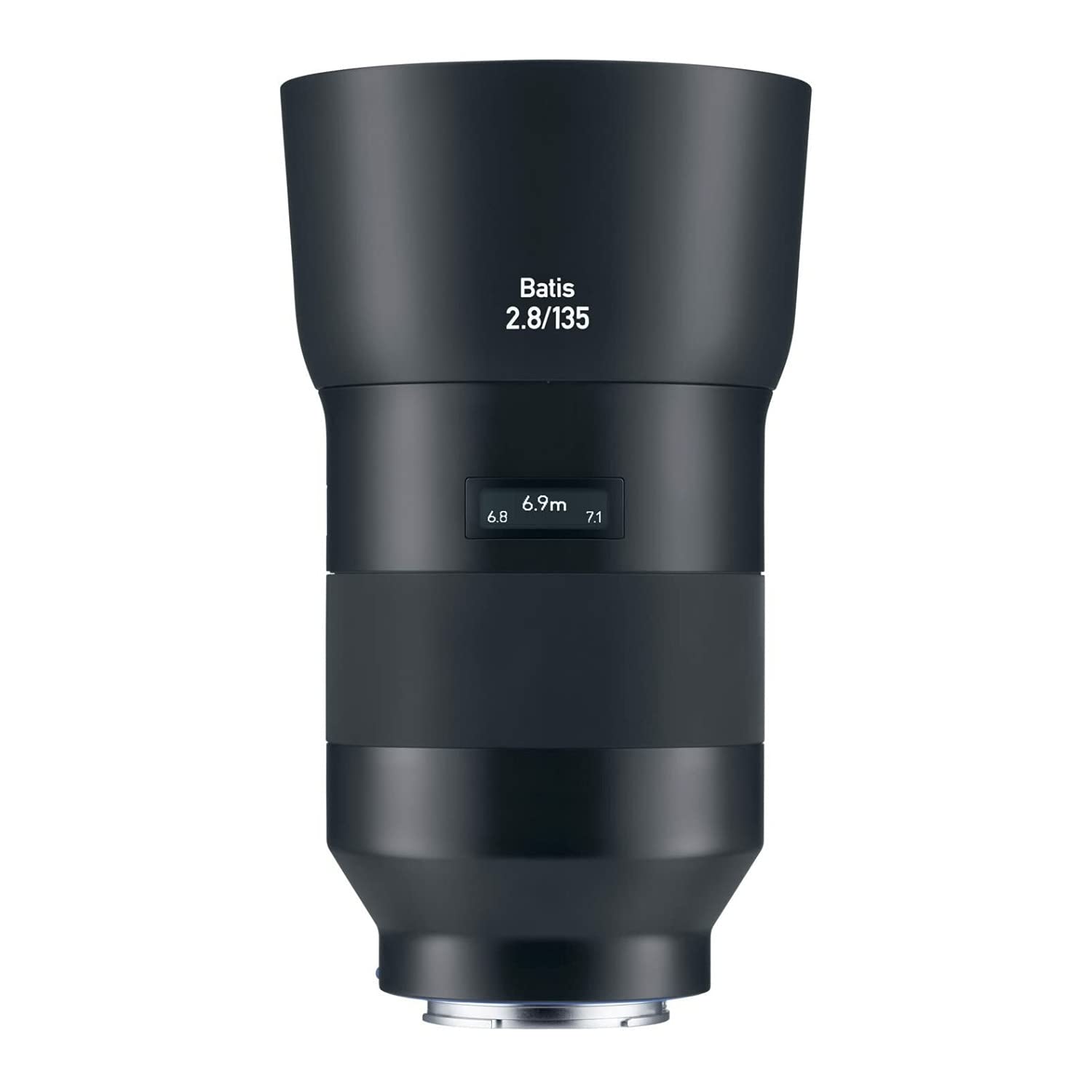
The Zeiss Batis 135mm f/2.8 is a uniquely compact and lightweight telephoto prime for Sony E-mount that prioritizes portability without sacrificing optical quality. At just 21.6 ounces, it is significantly lighter than the Sony GM 135mm f/1.8, making it an excellent choice for travel and extended handheld shooting. Its standout feature is the innovative OLED display on the lens barrel, which shows focus distance and depth of field — particularly useful in low-light conditions where traditional distance scales are hard to read.
Optically, the Batis delivers the renowned Zeiss rendering with excellent resolution, high contrast, and rich, saturated colors. The f/2.8 maximum aperture is one stop slower than the f/2 or f/1.8 competition, but it includes optical stabilization (OSS), which helps offset that loss in low-light situations. The autofocus is smooth and reliable, well-suited for portraits and events, and the weather-sealed metal construction provides durability in outdoor conditions.
The main trade-off is the f/2.8 aperture, which yields less subject separation and background blur compared to f/1.8 or f/2 alternatives. Additionally, the OLED display only activates in manual focus mode, and there is no aperture ring for direct control. For Sony shooters who value a lightweight, compact 135mm with excellent Zeiss color science and the convenience of an OLED readout, this lens is a compelling option.
Why it’s great
- Compact and lightweight at 21.6 oz for travel
- Innovative OLED display for distance and depth of field
- Excellent Zeiss color and contrast with weather sealing
Good to know
- f/2.8 max aperture limits bokeh compared to f/1.8 options
- OLED display only works in manual focus mode
- No dedicated aperture ring
5. VILTROX AF 135mm F1.8 LAB
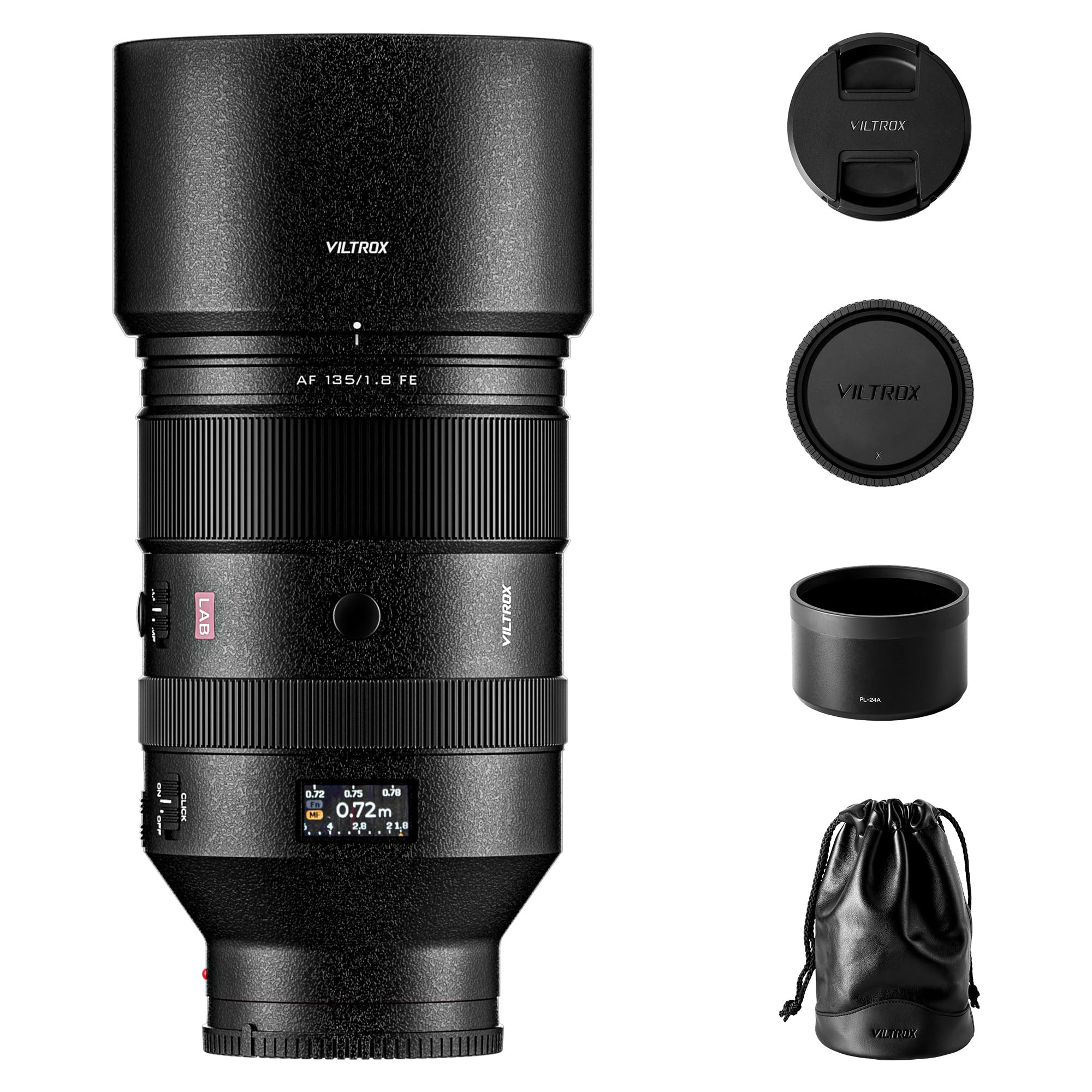
The Viltrox AF 135mm F1.8 LAB is a striking example of how far third-party lens manufacturers have come. It features a sophisticated optical design with 14 elements in 9 groups, including 4 ED elements and 2 high-refractive elements, delivering resolution and contrast that genuinely competes with first-party G Master glass. The F1.8 maximum aperture provides excellent low-light performance and shallow depth of field, while the 11-blade diaphragm creates smooth, natural bokeh.
The autofocus system is powered by Viltrox’s Quad Hyper VCM Motor, which delivers fast, accurate, and quiet focusing that works well with Sony’s eye-tracking technology. The all-metal barrel includes dust and splash-resistant seals, a de-clickable aperture ring with a CLICK switch for video, two bidirectional Fn buttons, and an AF/MF toggle. The integrated LCD display shows aperture, focus distance, and other information in real time — a feature typically found on lenses costing twice as much.
In real-world use, the lens produces stunningly sharp images with creamy bokeh and minimal chromatic aberration. For Sony E-mount shooters on a budget who want professional-level results, the Viltrox LAB represents the best value proposition in the 135mm category today.
Why it’s great
- Excellent optical quality with 4 ED elements
- Weather-sealed metal build with LCD display
- Fast and quiet Quad Hyper VCM autofocus
Good to know
- AF can hunt slightly in low-contrast scenes
- Lacks native optical stabilization
- Pincushion distortion requires Lightroom correction
6. Rokinon 135mm F2.0 ED UMC
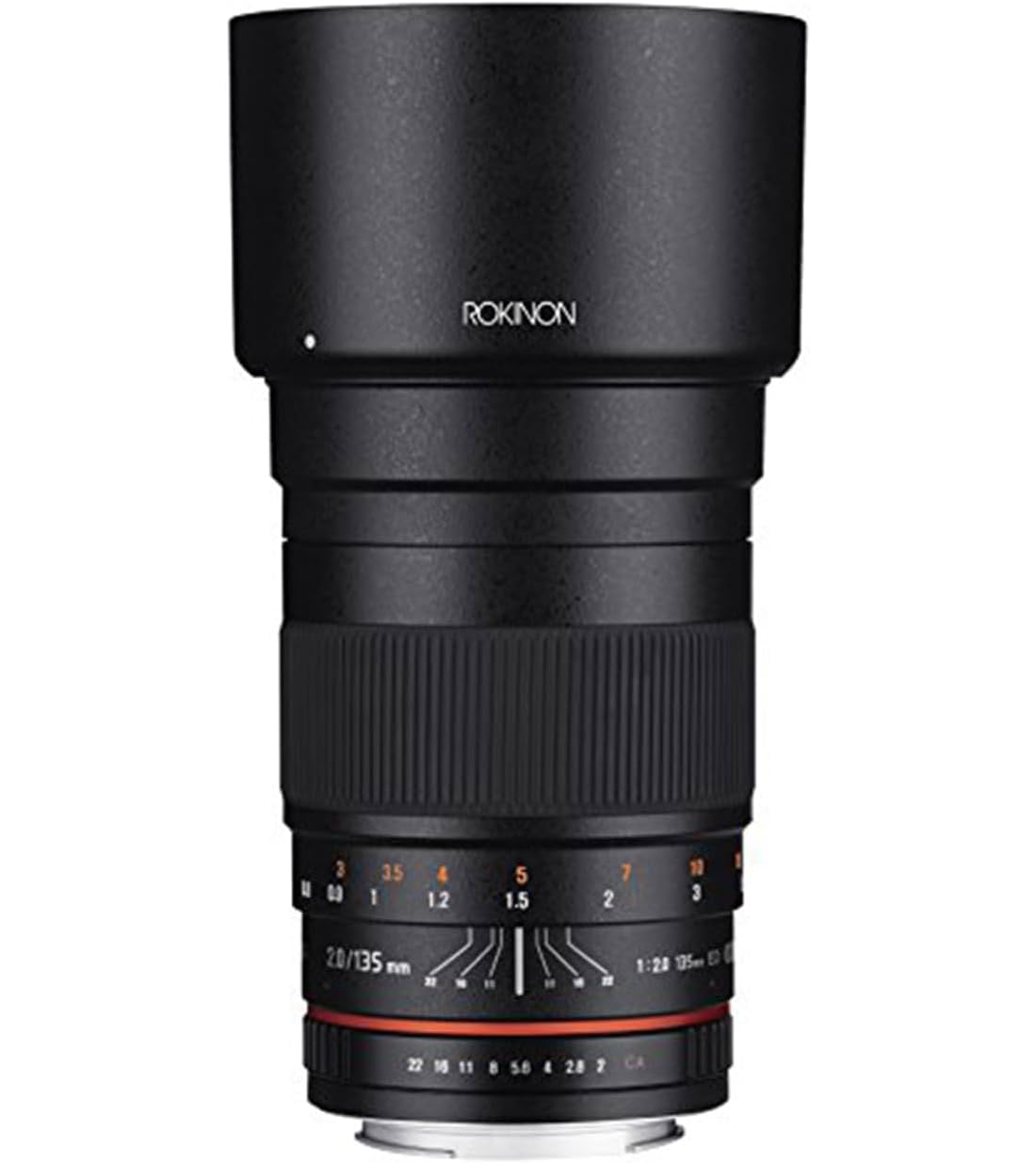
The Rokinon 135mm F2.0 ED UMC is a manual-focus prime that has earned a devoted following among budget-conscious portrait photographers on Sony E-mount. Its optical formula is remarkably sharp even wide open at f/2.0, with gorgeous bokeh that rivals lenses costing several times more. The ultra multi-coated (UMC) optics help control flare, and the 9-blade diaphragm produces pleasing background blur for subject separation.
Being a fully manual lens, it relies entirely on the user’s focusing skill and the camera’s focus peaking aids. On modern Sony bodies with peaking and magnification, achieving precise focus is very manageable for portraits and still subjects. The build quality is decent with a metal barrel, but the lens lacks weather sealing and any image stabilization. It weighs 1.9 pounds, making it a substantial piece of glass, and includes a removable lens hood and pouch in the box.
A significant caveat is that the focus ring has a hard stop before true infinity, which makes this lens unsuitable for astrophotography — the moon and stars cannot be brought into perfect focus. Rokinon explicitly states this is not a defect and not intended for astro use. For dedicated portrait photographers on a tight budget who are comfortable with manual focus, this lens delivers image quality that punches far above its price class.
Why it’s great
- Exceptional sharpness and bokeh at f/2
- Incredible value for the optical quality
- Decent metal barrel construction
Good to know
- Manual focus only — no autofocus
- Cannot focus to infinity for astrophotography
- No weather sealing or image stabilization
7. Sigma 70-200mm F2.8 DG DN OS

While not a 135mm prime, the Sigma 70-200mm F2.8 DG DN OS for L-Mount deserves consideration for photographers who need focal length flexibility without sacrificing the f/2.8 aperture. It employs a High-response Linear Actuator (HLA) for fast, accurate autofocus that nearly matches first-party performance. The optical stabilization system is effective for handheld shooting at the long end, making it a practical choice for events and weddings.
The optical quality is very strong, with sharpness across the frame and good contrast. The dust and splash-resistant construction meets Sigma’s Sports line standards, providing reliable operation in adverse conditions. However, the zoom ring placement can interfere with the hood, and the reversed focus/zoom ring orientation compared to Lumix Pro lenses may disrupt muscle memory for Panasonic users. This lens completes Sigma’s f/2.8 zoom trio alongside the 14-24mm and 24-70mm.
Some users on Panasonic S5 II bodies report focus hunting during video when zooming, even in cloudy daylight, which may be a firmware compatibility issue. At 1345 grams, it is a heavy lens that will give your arms a workout. For L-Mount shooters who need the flexibility of a zoom but still demand f/2.8 light-gathering, this is an excellent option that offers very strong value.
Why it’s great
- Fast HLA autofocus with strong accuracy
- Effective optical stabilization for handheld use
- Dust and splash-resistant construction
Good to know
- Focus/zoom ring orientation may conflict with muscle memory
- Hood impedes zoom ring operation
- Can exhibit focus hunting during video zoom on some bodies
8. Fujifilm XF50mmF1.0 R WR

The Fujifilm XF50mmF1.0 R WR is an extraordinary lens that achieves the widest aperture in the XF lineup, delivering an F1.0 maximum aperture that provides astonishingly shallow depth of field. On Fujifilm’s APS-C sensor, the 50mm focal length yields a field of view equivalent to roughly 76mm on full-frame, placing it in the portrait sweet spot. The precision-engineered rounded diaphragm produces large, smooth bokeh that creates a professional, three-dimensional look.
The optical design uses premium glass elements to maintain edge-to-edge sharpness even at F1.0 — a feat that is optically very difficult. The 120-degree rotation of the focusing ring allows for precise manual focus adjustments, and the weather-resistant construction operates in temperatures down to 14°F. The autofocus is deliberate and accurate for single-point work, using the 120-degree throw to minimize focus shift during shooting.
However, the AF is not as fast as modern linear-motor designs, and the minimum focusing distance of 70cm means you cannot get extremely close to subjects. Some users have reported moisture ingress issues. For Fujifilm X-mount shooters who prioritize ultra-shallow depth of field, beautiful bokeh, and weather resistance in a compact package, this lens delivers a look that is difficult to achieve with any other system.
Why it’s great
- F1.0 aperture for extreme shallow depth of field
- Beautiful, smooth bokeh with professional rendering
- Weather-resistant construction for outdoor use
Good to know
- Autofocus is slower than linear motor designs
- Minimum focus distance of 70cm limits close-up work
- Some reports of moisture internal condensation
9. Sony FE 85mm f/1.4 GM II

The Sony FE 85mm f/1.4 GM II is the second-generation G Master portrait prime for E-mount, offering a significant weight reduction to 1.41 pounds compared to the original. It uses two XD linear motors for fast, precise, and quiet autofocus that works seamlessly with Sony’s real-time tracking for both stills and video. The F1.4 aperture provides excellent low-light performance and subject isolation, with the classic G Master rendering of beautiful bokeh and sharp focus.
The optical design delivers breathtaking sharpness right to the edges, with innovative optics that control chromatic aberration and flare. The compact and lightweight form factor makes it an ideal companion for travel and event photography, where every ounce matters. The advanced feature set includes intuitive controls that appeal to filmmakers as well as still photographers, with smooth aperture transitions and minimal focus breathing.
The primary limitation is the 85mm focal length, which does not provide the same level of compression and subject-background separation as a true 135mm lens. It also lacks optical image stabilization, relying on the camera body’s IBIS. For Sony portrait shooters who prefer the more classic 85mm perspective and want the lightest possible professional prime, this lens represents the best in class.
Why it’s great
- Significantly lighter than the original GM at 1.41 lb
- Fast, quiet XD linear autofocus with eye tracking
- Excellent sharpness and bokeh quality
Good to know
- 85mm focal length offers less compression than 135mm
- No built-in optical stabilization
- High price point compared to third-party alternatives
10. FE 135mm F1.8 G Master

This listing represents the same Sony 135mm F1.8 G Master optical formula as Product 1 but is offered as a distinct retail SKU. The optical design uses XA, Super ED, and standard ED elements to achieve edge-to-edge high resolution with minimal chromatic aberration.
The 11-blade circular aperture produces gorgeous, smooth bokeh that is highly regarded for portrait and wedding work. The autofocus is consistently described as the fastest among Sony E-mount primes, with accurate eye-tracking and silent operation that is ideal for video. At 33.6 ounces, it is lighter than the Nikon Plena but heavier than the Batis, finding a middle ground in portability.
User reports consistently highlight the razor-sharp image quality across the entire aperture range, with no visible chromatic aberration even in high-contrast scenes. The aperture ring is a welcome addition for manual exposure control. The main downside remains the high price, which places it out of reach for many enthusiasts. For professionals who demand the absolute best autofocus speed and optical performance from a Sony 135mm prime, this is the definitive choice.
Why it’s great
- Four XD motors for the fastest AF in the category
- Exceptional sharpness and contrast across the frame
- 11-blade aperture with beautiful bokeh
Good to know
- Very high price point limits accessibility
- No optical image stabilization
- Heavier than compact alternatives like the Batis
11. Fujifilm GF110mmF2 R LM WR

The Fujifilm GF110mmF2 R LM WR is the definitive portrait lens for the GFX series of medium format cameras. On the GFX sensor, the 110mm focal length delivers a field of view equivalent to approximately 87mm on full-frame, with the unique rendering characteristics and shallow depth of field that only a larger sensor can provide. The lens employs a linear motor (LM) for fast and quiet autofocus, though the speed is ultimately limited by the GFX body’s autofocus system rather than the lens itself.
Optically, this lens is widely regarded as one of the finest portrait lenses ever made for any system. The image quality is stunningly sharp, with beautiful contrast and color rendition. The bokeh is smooth and creamy, with a three-dimensional quality that makes subjects pop from the background. The dust and weather-resistant construction is built to operate in temperatures as low as 14°F, making it suitable for demanding outdoor portrait sessions.
The primary limitation is the autofocus speed, which is slower than comparable full-frame primes due to the larger, heavier focus groups required for the medium format sensor. Additionally, the weight is substantial, though well-balanced on GFX bodies. For medium format photographers who demand the absolute best portrait lens money can buy, the GF110mmF2 R LM WR delivers an image quality that full-frame systems simply cannot match in terms of tonal gradation and shallow depth of field.
Why it’s great
- Unmatched medium format image quality and rendering
- Beautiful bokeh with 3D subject separation
- Weather-resistant construction for outdoor use
Good to know
- Autofocus speed limited by GFX body performance
- High price point reserved for professionals
- Heavy build requires steady support for long sessions
FAQ
What is the difference between f/1.8 and f/2.0 in a 135mm lens for portraits?
Can I use a manual focus 135mm F2.0 lens for wedding photography?
How important is weather sealing for a 135mm lens?
Final Thoughts: The Verdict
For most users, the best 135mm f2.0 lens winner is the Sony SEL135F18GM G Master because it offers the best combination of blazing-fast autofocus, clinical sharpness, beautiful bokeh, and weather sealing — making it the definitive choice for professional Sony shooters. If you want the best value for Sony E-mount with near-GM performance, grab the VILTROX AF 135mm F1.8 LAB. And for Nikon Z system users who prioritize flare resistance and exquisite bokeh, nothing beats the Nikon NIKKOR Z 135mm f/1.8 S Plena.