
Tracking your heart rate with precision is the single best way to know if your workout is actually pushing you toward your goals or just spinning its wheels. Optical wrist sensors on smartwatches are convenient, but they lag during interval sprints, miss the first few beats of a hill climb, and often report a random number when you need accuracy most. That is where a dedicated heart rate monitor steps in — a chest strap or armband removes the noise and delivers the real-time beats-per-minute your training plan demands, without breaking your budget.
I’m Rikta — the co-founder and writer behind Gadgets Feed. I spend weeks analyzing optical sensor chipset specifications, Bluetooth 5.0 radio stability in crowded gym environments, and ECG-derived heart rate variability algorithms so readers like you never waste money on a strap that drops out mid-sprint. (And Homer 🐱 inspected every charging cable pile before I typed a word).
Whether you are a Zwift rider chasing a new power zone or a runner building base miles, this guide breaks down seven proven models that deliver medical-grade data without the luxury price tag. You are about to find the absolute best affordable heart rate monitor for your specific sport, body type, and device ecosystem.
How To Choose The Best Affordable Heart Rate Monitor
Before you pull the trigger on a sensor, you need to match its technology to your primary activity. An optical armband that works beautifully on a spin bike may drift wildly during burpees, while an ECG chest strap hates the dry air of an indoor treadmill but loves a sweaty outdoor run. Here is what matters most.
Optical Armband vs. ECG Chest Strap
Optical sensors use green and red LEDs to measure blood volume changes through the skin. They are comfortable, easy to put on, and work well during steady-state cycling and weightlifting. ECG chest straps detect the heart’s electrical signal directly through the skin of the torso. They capture every single beat with virtually zero delay, making them the gold standard for high-intensity interval training, rowing, and any sport that involves rapid heart rate changes. If comfort across chest sizes matters more than split-second accuracy, an armband is the better choice.
Wireless Protocol: Bluetooth vs. ANT+
Bluetooth 5.0 is the default for smartphone apps like Strava and Peloton. ANT+ is the standard for dedicated bike computers from Garmin and Wahoo. A monitor that supports both protocols — known as dual-mode — gives you the freedom to stream data simultaneously to a phone and a head unit without ever re-pairing. If your gym equipment only accepts ANT+, a Bluetooth-only band will be a frustrating dead end.
Battery Life and Power Source
Coin-cell CR2032 batteries (like the ones found in many chest straps) deliver hundreds of hours of runtime, but you must remove the battery between uses to prevent parasitic drain. Rechargeable lithium-ion armbands offer convenient 20- to 35-hour runtimes with magnetic USB charging, but the internal battery will degrade after a few hundred charge cycles. For daily trainers, a rechargeable armband saves the hassle of coin-cell replacements. For occasional cyclists who want a set-it-and-forget-it sensor, a coin-cell chest strap is the lower-maintenance option.
Water and Sweat Protection
Look for an IP67 or IP68 rating if you train outdoors in rain or sweat heavily. IP67 means the sensor survives dust ingress and immersion up to one meter for 30 minutes. IP68 extends that depth further. A splash-resistant sticker (IPX4) is insufficient for a runner who soaks through a strap every session.
Quick Comparison
On smaller screens, swipe sideways to see the full table.
| Model | Category | Best For | Key Spec | Amazon |
|---|---|---|---|---|
| CYCPLUS H2Pro | ECG Chest Strap | Precision interval training & cycling | 500-hour CR2032 battery, 21g sensor | Amazon |
| Magene H603 | ECG Chest Strap | Long battery life & multi-device pairing | 1000-hour CR2032, IP67 rating | Amazon |
| COOSPO HW807 | Optical Armband | Gym equipment & zone training | 20-hour rechargeable, LED zone indicator | Amazon |
| Scosche Rhythm+ 2.0 | Optical Armband | HRV recovery data & multi-sport | 24-hour battery, IP68, RRi data output | Amazon |
| COOSPO HW9 | Optical Armband | Vibration alerts & custom HR zones | 35-hour lithium-ion, Bluetooth 5.0 & ANT+ | Amazon |
| Fitbit Inspire 3 | Wrist Fitness Tracker | 24/7 HR & sleep tracking | 10-day battery, 50m water resistance | Amazon |
| Fitbit Charge 6 | Advanced Fitness Tracker | Built-in GPS & gym machine pairing | 7-day battery, ECG, Google Maps | Amazon |
In‑Depth Reviews
1. COOSPO HW9 Armband

The COOSPO HW9 delivers the best balance of accuracy, battery endurance, and smart features in the optical armband class. Its ±1BPM optical engine uses a proprietary algorithm that closely tracks ECG-grade readings during steady-state runs and indoor cycling, and the 5-color LED heart rate zone indicator lets you see your intensity level without glancing at a phone screen. The sensor weighs only 10 grams and sits securely on the forearm or bicep with a soft, breathable strap that does not slip during sweaty HIIT sessions.
Dual Bluetooth 5.0 and ANT+ connectivity means you can stream HR data simultaneously to a Garmin Edge bike computer and a Zwift-equipped phone with zero conflicts. The 35-hour rechargeable lithium-ion battery with magnetic charging is a real-world improvement over the HW807’s 20-hour capacity — you can train two to three weeks on a single charge if you average an hour daily. The vibration alert that triggers when your heart rate exceeds a custom max threshold is a genuine safety net for all-out interval efforts.
Setup through the Heartool or Coosporide app is straightforward, and the customizable max heart rate value corrects the factory-default 200 bpm ceiling for athletes outside the young-adult demographic. The only catch is the lack of automatic shut-off — you must long-press the button to power it down after each session, or the sensor stays on until its battery drains. Some users also report that the included strap can stretch over several months of heavy use, but replacement straps are inexpensive and widely available.
Why it’s great
- Highly accurate ±1BPM optical sensor, tracks HRV and five heart rate zones
- 35-hour battery with fast magnetic charging, outlasts most armband competitors
- Vibration warning for exceeding custom max heart rate, great for interval safety
Good to know
- No automatic power-off; must manually long-press to shut down after every workout
- Armband strap can stretch with prolonged use, may need periodic replacement
2. CYCPLUS H2Pro Chest Strap
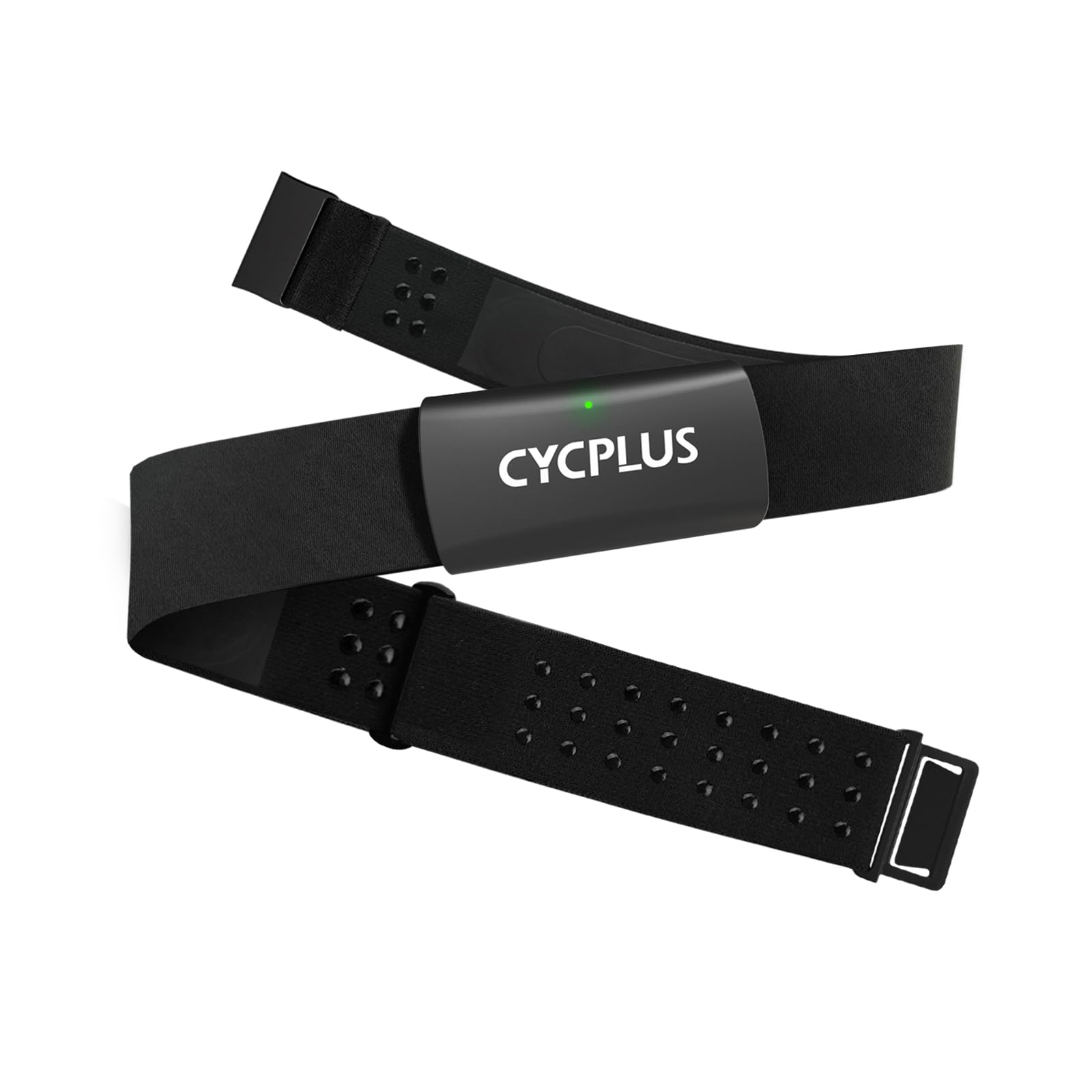
The CYCPLUS H2Pro is the ECG chest strap that punches well above its entry-level price point. Its proprietary ECG algorithm specifically reduces interference from movement, breathing, and muscle tension — a problem that plagues cheaper chest straps during high-cadence cycling or explosive weightlifting. The sensor module itself weighs just 21 grams, and the total package with the adjustable cloth strap lands at 55 grams, making it one of the lightest chest-mount options on the market. Real-world customer reports confirm that its reading graph closely mirrors straps costing three times as much when paired with a Garmin Edge or Wahoo computer.
Battery life is the headline here: a single CR2032 coin-cell delivers up to 500 hours of continuous operation. For an athlete training three times a week at roughly one hour per session, that is nearly three years of use before you need to replace the battery. The H2Pro also supports heart rate variability (HRV) capture by detecting R-wave peaks with ECG-level precision, which is rare at this tier and invaluable for athletes who use HRV data to adjust daily training load and avoid overtraining.
Seamless Bluetooth and ANT+ dual compatibility ensures it works with Strava, Zwift, CYCPLUS FIT, and most bike computers. However, a few users have noted that the sensor cannot connect to a phone directly via Bluetooth — it must be linked through a compatible app. Additionally, if the air is very dry, wetting the electrode area of the strap before wearing is necessary to get a clean signal. The IPX7 rating means it can survive heavy sweat and rain, though it is not rated for submersion swimming.
Why it’s great
- ECG-grade accuracy with proprietary motion and sweat interference rejection
- 500-hour battery life from a CR2032 coin-cell; lasts years for most athletes
- Ultra-light sensor (21g) with HRV monitoring for overtraining prevention
Good to know
- Requires app-mediated Bluetooth pairing; no direct phone-to-sensor connection
- Electrodes may need moisture to start reading in dry indoor environments
3. Magene H603 Chest Strap

The Magene H603 is the endurance king of affordable chest straps. Its CR2032 battery is rated for a staggering 1000 hours of runtime — that is over four years of daily one-hour sessions before you need to open the battery compartment. The split design separates the sensor module from the strap, making it easy to detach the electronics for storage or washing without exposing the circuit board to moisture. The strap itself is fully adjustable and most users report it stays comfortable even during long road rides and mountain bike sessions.
Connectivity is dual-mode Bluetooth and ANT+, so you can pair simultaneously with a Garmin Edge head unit, a phone running Zwift, and a Peloton treadmill without any dropout complaints. The H603 also includes a red LED status indicator that flashes ten times when the sensor first activates, giving you immediate visual confirmation that the strap is powered and searching for a connection. The IML (In Mold Label) injection molding on the shell resists scratching and fading, which matters when you are rinsing a sweaty strap under the faucet after every ride.
The biggest risk with the H603 is quality consistency. While many customers report perfect functionality for months, a subset has experienced the sensor drifting 30-40 bpm high after about a month of use, and the same issue appears across multiple paired devices (Garmin, Wahoo, Apple TV). This suggests a potential manufacturing variability in the ECG front-end chip. The IP67 rating offers solid dust and water protection for rain and sweat, but the sensor is not replaceable, so if it fails, you are buying a new unit. At this price, the gamble is acceptable, but it is worth buying from a seller with a hassle-free return policy.
Why it’s great
- Industry-leading 1000-hour battery life from a single CR2032 coin-cell
- Split strap design for easy sensor detachment and strap washing
- IP67 dust and waterproof rating with fade-resistant IML shell
Good to know
- Some units show HR drift (30-40 bpm high) after a month of daily use
- Non-replaceable sensor; a defective unit requires a full replacement
4. Scosche Rhythm+ 2.0 Armband

The Scosche Rhythm+ 2.0 is the most mature optical armband on the market, and its accuracy and connectivity reflect years of refinement. The sensor uses a triple-LED optical array that delivers readings within ±1 BPM of a chest strap during steady-state exercise, and it captures RR interval data for heart rate variability analysis — a feature often locked behind medical-grade hardware. The IP68 rating means it survives submersion beyond one meter, so rainy runs and drenched gym floors are no threat. The polyester strap breathes well and stays put on the forearm or bicep even during aggressive rowing strokes.
Battery life is rated at 24 hours of continuous use, which translates to roughly two weeks of daily gym sessions between charges. The Rhythm+ 2.0 connects via Bluetooth and ANT+ simultaneously, and its pairing reliability with Coros, Garmin, and Apple Watch is consistently praised. The specific value of this unit lies in its HRV and RRi data output — apps like HRV4Training and Morpheus Training use that raw data to measure recovery readiness, giving strength athletes and endurance runners a recovery score that is far more actionable than a generic resting heart rate number.
The proprietary magnetic charging cable is a notable downside — lose it, and you are stuck sourcing a replacement from Scosche’s store rather than a standard micro-USB or USB-C cable. Some users also report occasional Bluetooth dropouts during high-intensity paddling or rowing that require a manual repower of the sensor. The strap adjustment can feel tight if you try to fit it on a larger bicep after putting the armband on; it is best to pre-position the strap at the correct tension before sliding it up. Despite these quirks, the raw data quality and recovery insights make it the best armband for serious HRV-guided training.
Why it’s great
- ±1 BPM optical accuracy with RR interval data for HRV-based recovery analysis
- IP68 waterproof rating, among the highest durability standards in armbands
- Reliable simultaneous Bluetooth and ANT+ connectivity with multiple device ecosystems
Good to know
- Proprietary magnetic charging cable; loss requires a specific replacement
- Strap adjustment can feel tight when pre-positioned on a larger bicep
5. COOSPO HW807 Armband

The COOSPO HW807 is the armband that proved optical HRMs could be accurate without costing triple digits. Its patented optical sensor technology claims a ±1 BPM error margin, and in practice, it tracks heart rate reliably during running, stationary cycling, and gym machine workouts. The color-coded LED indicator on the sensor body glows green, blue, yellow, orange, or red to show your current heart rate zone at a glance — a feature that keeps you in the correct training zone without breaking stride or looking at a watch. The sensor ships with two different arm straps, accommodating a range of forearm and bicep circumferences.
Bluetooth 5.0 and ANT+ connectivity is standard, and users confirm hassle-free pairing with Peloton bikes, Concept2 rowers, Nordic treadmills, and Garmin Edge computers. The IP67 rating covers sweat and rain, though COOSPO warns against swimming. Battery life is 20 hours per charge, which covers about a week of training for most people, and the included USB charging cable works with standard 5V adapters. The HW807 also supports heart rate variability (HRV) logging, though it lacks the raw RR interval export depth that the more expensive Scosche provides.
The biggest compromises are in software polish and long-term consistency. Several users have reported that after a few months, the sensor begins to produce wild readings — for example, showing 175 bpm during a slow walk while a wrist-based monitor recorded 120 bpm. This appears to be a firmware or optical sensor aging issue, and it is inconsistent across units. The LED indicator is also difficult to read in bright direct sunlight, and the green and yellow zone colors can look nearly identical to some eyes. If you get a good unit, the HW807 is a steal. If you get a flaky one, the return process determines whether you stick with COOSPO or move up to the HW9.
Why it’s great
- Color-coded heart rate zone LED indicator for real-time intensity awareness
- Dual Bluetooth 5.0 and ANT+ compatibility with gym equipment and bike computers
- Lightweight 10g sensor with included two-arm-strap kit for a customizable fit
Good to know
- Some units develop erratic HR readings after a few months of use
- LED zone indicator is hard to see in bright sunlight; green/yellow colors blend
6. Fitbit Inspire 3

The Fitbit Inspire 3 takes a different approach — it is not a dedicated sports HRM but a lightweight everyday fitness tracker that happens to log 24/7 heart rate very well. Its PurePulse optical sensor sits on the wrist and tracks resting heart rate, heart rate variability trends over days, and high/low heart rate notifications. The battery lasts up to 10 days, which is significantly longer than most wrist-based competitors, and the water resistance rating of 50 meters means it survives swimming and showering without any caution. The small, rounded case design is unobtrusive and comfortable for round-the-clock wear, even for side sleepers.
For heart rate monitoring during exercise, the Inspire 3 offers 40+ exercise modes and Active Zone Minutes, which buzz when your heart rate enters fat burn, cardio, or peak zones. The daily Stress Management Score combines HRV, sleep data, and activity levels to give you a single number reflecting your readiness for stress. SpO2 monitoring and irregular heart rhythm notifications add a layer of wellness awareness that pure sports HRMs do not provide. The included 3-month Fitbit Premium membership unlocks deeper analytics like the Daily Readiness Score, but the device remains functional without paying for the subscription.
The wrist-based optical sensor is categorically less responsive during interval changes than a chest strap or dedicated armband — it takes 10 to 20 seconds longer to register a heart rate spike during a sprint, and it can miss brief peaks entirely. The Inspire 3 also lacks ANT+ connectivity, so it cannot pair with a Garmin bike computer or Peloton screen. Proprietary charging cable is another constraint: lose it, and you must wait for a Fitbit-branded replacement. If your primary goal is 24/7 lifestyle heart rate tracking with minimal friction, the Inspire 3 is a fine choice. If you need real-time sports accuracy, a dedicated sensor is essential.
Why it’s great
- Up to 10-day battery life with 24/7 heart rate, sleep, and SpO2 tracking
- 50-meter water resistance, suitable for swimming and shower wear
- Stress Management Score and irregular heart rhythm alerts for overall wellness
Good to know
- Wrist-based sensor lags 10-20 seconds behind ECG straps during interval changes
- No ANT+ connectivity; cannot pair with bike computers or gym consoles
7. Fitbit Charge 6

The Fitbit Charge 6 steps into hybrid territory — it is a full-featured fitness tracker with an onboard ECG app, built-in GPS for phone-free run tracking, and the ability to broadcast your heart rate to compatible gym equipment like treadmills and ellipticals. The optical heart rate sensor on the Charge 6 is upgraded from the Charge 5, featuring a new multi-path architecture that reduces the dropout rate during rapid arm movement. Real-world tests show improved cadence lock rejection compared to most wrist devices, though it still cannot match the reaction time of a chest strap during explosive intervals.
The 7-day battery life is respectable given the inclusion of GPS, a color AMOLED touchscreen, and Google services like Maps and Wallet. The triple-tap accessibility shortcut to enlarge the display text and the physical side button (a welcome return from the Charge 5’s all-touch design) make operation intuitive even with sweaty hands. The ECG app has received FDA clearance for atrial fibrillation detection, which is a genuine medical tool that no armband or coach-level HR strap provides. For athletes who also want contactless payments and turn-by-turn navigation from their wrist, the Charge 6 consolidates that into one device.
The critical flaws center on software reliability. The Google Maps and YouTube Music apps are widely reported as beta-quality, with frequent crashing and broken sync. GPS accuracy during runs can drift significantly — some users report a 70% distance discrepancy on an elliptical compared to the actual workout distance. The battery drain can accelerate to daily charging if you enable always-on display and GPS tracking simultaneously. The built-in HR broadcast also requires compatible gym equipment, and the pairing process is not as seamless as a dedicated ANT+ chest strap. If heart rate accuracy during structured training is your top priority, the Charge 6 is a compromise. If you want a smart-fitness hybrid with medical-grade ECG, it is a compelling multi-tool.
Why it’s great
- FDA-cleared ECG app for atrial fibrillation detection, a medical-grade feature
- Built-in GPS for phone-free outdoor run tracking with turn-by-turn directions
- Heart rate broadcast to compatible gym treadmills, ellipticals, and bike consoles
Good to know
- Google Maps and YouTube Music apps have unreliable beta-level performance
- Distance and GPS accuracy can drift, especially on indoor machines or under trees
FAQ
Is an armband heart rate monitor as accurate as a chest strap for running?
Can I use a heart rate monitor with my Peloton bike without an Apple Watch?
How often should I replace the battery or charge my heart rate sensor?
Will a wrist fitness tracker like the Fitbit Inspire 3 give me reliable data for heart rate zone training?
Final Thoughts: The Verdict
For most users, the best affordable heart rate monitor winner is the COOSPO HW9 because it combines ±1BPM optical accuracy, 35-hour battery life, and a vibration safety alert in a comfortable armband that works with both Bluetooth and ANT+ devices. If you need ECG-grade precision for interval training and long battery life measured in years, grab the CYCPLUS H2Pro. And for athletes who prioritize HRV recovery metrics and IP68 durability above all else, nothing beats the Scosche Rhythm+ 2.0.