
Our readers keep the lights on and my morning glass full of iced black tea. As an Amazon Associate, I earn from qualifying purchases.
Specs are compiled from manufacturer listings and verified buyer reviews and can change over time — please confirm the key details on the product page before buying.
A true 1:1 macro lens lets you fill the frame with a subject the size of a postage stamp — a coin, a flower petal, a watch gear — and capture details your naked eye simply cannot see. The challenge is finding one that locks on fast enough for a moving bug, stays sharp at f/2.8, and still works as a portrait or walkabout lens when you are not shooting extreme close-ups. This guide breaks down the real-world trade-offs between five top contenders so you can pick the one that actually fits how you shoot.
I’m Min — the founder and writer behind Gadgets Feed. This guide is built by comparing the manufacturers’ published specifications and the patterns across verified customer reviews, so you get each pick’s real strengths and trade-offs instead of marketing spin.
Whether you are after the lightest carry-everywhere option or a professional prime that doubles as a portrait lens, the right 1:1 macro lens balances working distance, aperture brightness, and overall weight for your specific gear bag.
Quick Picks
- Nikon NIKKOR Z MC 105mm f/2.8 VR S — Top Performer
- Sigma 105mm F2.8 DG DN Macro Art (Sony E-mount) — Best Value
- Sony SEL90M28G FE 90mm f/2.8-22 Macro G OSS — Premium Pick
- Fujifilm Fujinon XF30mmF2.8 R LM WR Macro Lens — Ultra Compact
- Sony SEL30M35 30mm f/3.5 e-mount Macro Fixed Lens — Budget Champion
How To Choose The Best 1:1 Macro Lens
A true 1:1 macro lens reproduces your subject at life size on the camera sensor — that is what “1:1” actually means. But three other specs matter just as much for real-world shooting.
Focal length and working distance
The most common mistake beginners make is buying a short macro lens (around 30mm) and discovering they have to press the glass almost against the subject to get a 1:1 shot. A 105mm macro lens gives you a comfortable gap between the lens and your subject — crucial for insects that flinch or for lighting without casting your own shadow. The flip side is that longer lenses are heavier and cost more.
Maximum aperture (f-stop) and light
A macro lens with a bright aperture — like f/2.8 — throws backgrounds beautifully out of focus (bokeh) and lets you shoot in dimmer natural light. But at 1:1 distances, any lens loses light, so even a bright f/2.8 can feel dark. Some shooters supplement with a ring light or flash. Buyers report that a narrow aperture like f/3.5 is not a dealbreaker if you already have good lighting.
Stabilization and autofocus speed
Shaking hands are magnified at macro distances. Optical image stabilization (sometimes called VR or OSS) helps keep handheld shots sharp. Autofocus speed and quietness also vary: some macro lenses use older screw-drive mechanisms that are noisy and hunt, while newer linear motors lock on in milliseconds. Several owners mention that for extreme close-ups, manual focus is often more precise anyway.
Quick Comparison
| Model | Best For | Focal Length | Max Aperture | Weight | Amazon |
|---|---|---|---|---|---|
| Nikon NIKKOR Z MC 105mm f/2.8 VR S | Nikon Z shooters wanting pro-grade sharpness | 105mm | f/2.8 | — | $896.95Amazon |
| Sigma 105mm F2.8 DG DN Macro Art (Sony E-mount) | Uncompromising optical quality | 105mm | f/2.8 | 715 Grams | $828.96Amazon |
| Sony SEL90M28G FE 90mm f/2.8-22 Macro G OSS | Integrated stabilization | 90mm | f/2.8 | 602 Grams (21.3 oz) | $948.00Amazon |
| Fujifilm Fujinon XF30mmF2.8 R LM WR Macro Lens | Ultra-portable Fujifilm system companion | 30mm (46mm equiv.) | f/2.8 | 195 Grams | $699.00Amazon |
| Sony SEL30M35 30mm f/3.5 e-mount Macro Fixed Lens | Budget-friendly Sony E-mount entry | 30mm | f/3.5 | — | Amazon |
In‑Depth Reviews
1. Nikon NIKKOR Z MC 105mm f/2.8 VR S
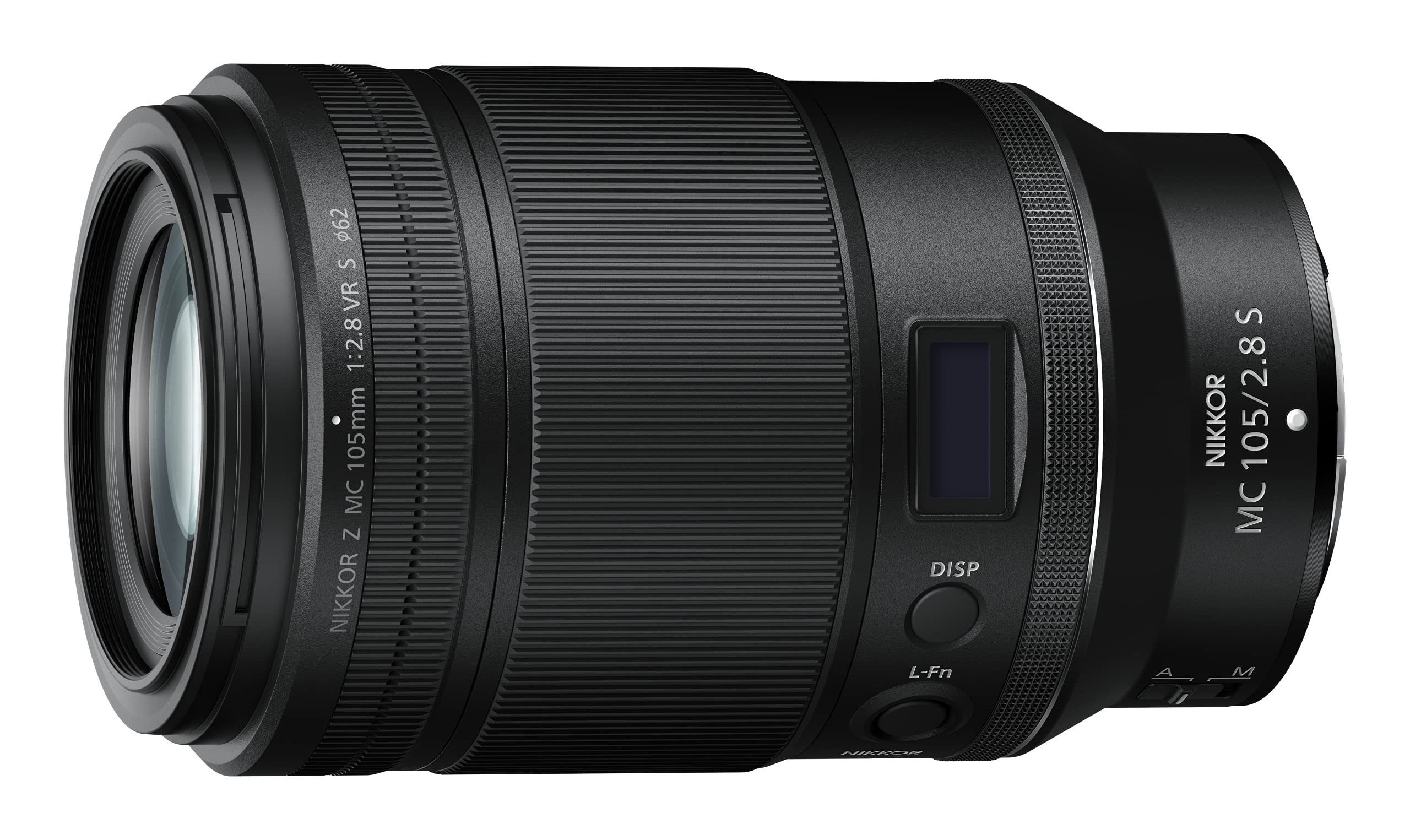
The Nikon Z macro that is tack-sharp at 1:1 and doubles as a flawless portrait prime.
You get life-size 1:1 magnification (where the subject appears the same size on the sensor as in real life) with the Nikon NIKKOR Z MC 105mm f/2.8 VR S, and the bright f/2.8 aperture plus S-Line optics also make portraits pop. Customers note it is “sharp macro lens with versatile use; autofocus issues only in crop mode; excellent value; remains sharp even shooting through glass.” The Vibration Reduction (VR) system (a built-in stabilizer) lets you shoot handheld without camera blur — a real asset when a flower is swaying in the wind and you cannot set up a tripod.
It is also a full 105mm telephoto, so you get a comfortable working distance from bugs that spook easily. One reviewer noted this lens is “extremely sharp for product photography; excellent contrast, clarity, VR+IBIS; lightweight” and that it works with Meike extension tubes for even greater-than-1:1 magnification. The only catch mentioned is that autofocus can be slow in crop mode, but for precise macro work that is rarely an issue.
Who it fits: Nikon Z users who want one lens that does pro-grade macro and flattering portraits without swapping glass.
The trade-off: Autofocus hesitates in crop mode, and the 105mm f/2.8 design is too sharp for some portrait shooters who prefer softer skin rendering.
Best for Nikon Z owners: If you shoot a Z6, Z7, Z8, or Z9, this is the macro prime to buy for both detail work and everyday shooting.
Consider another if: You primarily shoot on a Z50 in crop mode — the AF lag might frustrate you on moving subjects.
2. Sigma 105mm F2.8 DG DN Macro Art (Sony E-mount)

Sigma Art-grade sharpness at 1:1 with a 715-gram all-metal build that means serious business.
At 715 grams this is the heaviest lens on the list — 3.7x heavier than the Fujifilm XF30mm — but that heft comes from the same Sigma Art line optical quality that makes it “Excellent macro lens for Sony E-mount,” as buyers consistently report. The 105mm focal length gives you the same comfortable working distance as the Nikon NIKKOR Z MC 105mm f/2.8 VR S, and the clickable/de-clicked aperture ring with a lock switch is a real treat for video shooters who want silent iris pulls.
Where this Sigma falls short of the native Sony 90mm G lens is autofocus: reviewers point out the AF is noisy and slower, with “heavy focus breathing” that makes it less ideal for continuous tracking. But for still-life macro, product photography, and even scanning old slides (one buyer specifically uses it on a Sony A7RV for that), the optical performance is genuinely Art-series quality at a more accessible price. The focus limiter switch lets you restrict AF range to macro, portrait, or full — a simple speed boost.
Optics like the Art line: Sharp at f/2.8 with minimal distortion, vibrant colors, and beautiful bokeh that one reviewer says rivals the Sigma 35mm f/1.4.
The catch: Autofocus is not as fast or quiet as native Sony lenses, and the aperture ring must be set to “A” for camera-controlled operation.
Reach for it if: You want Sigma Art optics in a macro lens that also works for portraits and scanning — all without paying the native-Sony premium.
skip it if: You need fast, silent autofocus for active subjects or video — the Sigma’s focus motor is noticeably audible and slower.
3. Sony SEL90M28G FE 90mm f/2.8-22 Macro G OSS

Sony’s own 90mm G-series macro with Optical Steady Shot and a silent DDSSM motor.
This is the lens that feels purpose-built for Sony full-frame cameras like the A7 III and A7R IV. The 90mm focal length is slightly shorter than the 105mm options above, but the Optical Steady Shot image stabilization makes a real difference when you are handholding a macro shot and your pulse is magnified 1:1. At 602 grams (21.3 oz) it is also noticeably lighter than the Sigma 105mm (715 grams), so your wrist will thank you after an hour crawling around a garden.
Shoppers say it is “extremely sharp; no autofocus hunting issues” and call it an excellent portrait lens with a subtle compression effect. The Direct Drive SSM (a quiet, precise piezoelectric motor) keeps autofocus smooth and silent — a clear advantage over the Sigma 105mm f/2.8 DG DN Macro Art’s louder mechanism. There is a real catch, though: several reviewers mention that even with the focus limiter, the AF hunts slightly in macro mode, and the lens is decidedly dark at 1:1 distances, often needing a ring light or flash for insects or other small subjects.
What stands out
- Internal OSS image stabilization sharpens handheld macro shots
- Silent, accurate autofocus with a push‑to‑lock manual focus ring
- Nano AR coating effectively suppresses reflections and ghosting
The real-world limits
- Needs supplemental light (ring flash or speedlight) at 1:1 even in sunlight
- Some buyers received defective units shipped without proper packaging
- Autofocus can hunt slightly even with the focus limiter engaged
Who should buy it: Sony E-mount users who want a native lens with stabilization and silent AF for both macro and portrait work.
Consider the Sigma instead if: You are on a tighter budget and do not mind heavier weight and noisier autofocus — the Sigma 105mm Art is optically excellent for less.
4. Fujifilm Fujinon XF30mmF2.8 R LM WR Macro Lens

A barely-there 195-gram macro that slips into any bag and delivers 1:1 on Fujifilm X Series.
At 195 grams, this Fujifilm prime is 3.7x lighter than the Sigma 105mm Art (715 grams) — making it the clear choice for street photographers and travelers who do not want to feel a lens on their camera. The 30mm focal length (46mm equivalent on APS-C) means you have to get very close — the minimum focusing distance is just 10cm (3.94in) from the sensor — but the bright f/2.8 aperture gives you a shallow depth-of-field for beautiful background blur (bokeh) even with wide shots.
The lens barrel is sealed in nine places against moisture, dust, and temperatures down to -10°C, so you can take it on an outdoor shoot in light rain without worry. The linear motor inner focus system locks focus in as little as 0.02 seconds, which is genuinely fast for a macro lens. The trade-off is that 30mm is a very short working distance: at 1:1 you are almost touching the subject, which can scare insects and makes lighting tricky. This lens is best for tabletop photography, product details, flowers that do not move, and flat-lay shots.
The lightest true macro: At just 195 grams, it is the most portable 1:1 macro you can mount on a Fujifilm X Series body.
The big but: 30mm means you must be inches from your subject — not ideal for living bugs or any situation where you cannot block the light.
Best for Fujifilm minimalist shooters: If you carry your X-T5 or X-S20 everywhere and want true 1:1 macro without adding noticeable weight, this is it.
Not for insect macro: The short working distance will spook most bugs before you can focus — look at a longer lens for living subjects.
5. Sony SEL30M35 30mm f/3.5 e-mount Macro Fixed Lens

Sony’s entry-level 30mm macro that is sharper up close than zoom lenses twice its price.
This is the most affordable way into true 1:1 macro on a Sony E-mount body. At 30mm f/3.5, it is the same short-focal-length design as the Fujifilm above — you need to get amazingly close to your subject (the minimum working distance is only 2.4cm at 1:1 magnification). But buyers on a Sony ZV-E10 report it is “sharper up close than kit 16-55mm and Sigma 16mm f1.4,” which is genuinely impressive performance for its tier. One reviewer calls it “best Sony SEL lens for macro work” — sharp, simple, and affordable.
The internal stepping motor gives you smooth autofocus for video, and the rear-focusing design keeps the lens length constant while focusing. The f/3.5 maximum aperture is narrower than the f/2.8 options, meaning you will need more light or a higher ISO at macro distances. Several buyers report that “f/3.5 not an issue with experience” and that it works well with a Neewer ring light for flat items and focus stacking. The plastic build is lightweight but feels well-made, and the lack of OSS means you need steady hands or a tripod for handheld macro.
Bang for your buck
- True 1:1 macro at an entry‑level price point
- Sharper up close than many kit zooms and wide primes
- Lightweight and compact with smooth AF for video
What you give up
- f/3.5 is dark — you will need a flash or ring light for indoor macro
- No image stabilization (OSS), so handheld shots require a steady grip or tripod
- Plastic build feels less premium than the metal‑barreled options
Perfect for first-time macro shooters: If you own a Sony E-mount camera and want to try 1:1 macro without a big investment, start here.
Upgrade if you need working distance: Once you want to photograph insects or keep distance from your subject, a 90mm or 105mm macro becomes necessary.
Understanding the Specs
Focal Length (mm)
Focal length determines how close you need to stand to get a 1:1 shot. A 30mm lens forces you to be just a few centimetres from the subject — fine for flat objects on a table, bad for bugs that fly away. A 105mm lens gives you a comfortable meter or more of working distance, which also helps with placing lights without blocking them.
Maximum Aperture (f-stop)
This number controls how much light the lens lets in and how easily it blurs the background. Wider apertures (f/2.8) let you shoot in dimmer conditions and create creamy bokeh. Tighter apertures (f/3.5) are still usable with good lighting and are often found on lighter, budget-friendly lenses — but you may need a flash for close-up work.
FAQ
What does 1:1 macro actually mean?
Can I use a 1:1 macro lens for regular photography?
What is the difference between a macro lens and a close-up filter?
Does image stabilization matter for macro photography?
Why are some macro lenses much heavier than others?
Can I use extension tubes for more than 1:1 magnification?
Does a brighter aperture like f/2.8 matter at macro distances?
How do I know if a macro lens is compatible with my camera?
Final Thoughts: The Verdict
For most buyers, the 1:1 macro lens winner is the Nikon NIKKOR Z MC 105mm f/2.8 VR S because it combines life-size 1:1 magnification, VR stabilization, and S-Line optics into a single lens that works for both macro and portraits without compromise. If you want a native Sony macro with image stabilization, grab the Sony SEL90M28G FE 90mm f/2.8-22 Macro G OSS. And for a budget-friendly way to enter true macro on Sony E-mount, the Sony SEL30M35 30mm f/3.5 e-mount Macro Fixed Lens gives you 1:1 magnification at a lower price point.
How We Picked
We do not accept paid placement. Every pick is matched to a real buyer and a real use-case; we do not hands-on test units.
Sources & Methodology
Specifications: manufacturer listings and product documentation. Review insights: verified customer reviews, as of July 2026. Pricing: not shown on this page (it changes often); check the current price via the retailer link.
As an Amazon Associate, Gadgets Feed earns from qualifying purchases. This does not affect which products we feature.
Product prices and availability are accurate as of the date/time indicated and are subject to change. Any price and availability information displayed on Amazon at the time of purchase will apply to the purchase of this product. As an Amazon Associate I earn from qualifying purchases.
CERTAIN CONTENT THAT APPEARS ON THIS SITE COMES FROM AMAZON. THIS CONTENT IS PROVIDED "AS IS" AND IS SUBJECT TO CHANGE OR REMOVAL AT ANY TIME.
Amazon and the Amazon logo are trademarks of Amazon.com, Inc. or its affiliates.