
Choosing the right gaming monitor is the single most impactful hardware decision you can make for your entire gaming experience. A higher refresh rate directly translates to smoother motion, a faster response time eliminates ghosting and blur in fast-paced shooters, and the right panel technology—whether IPS, VA, or OLED—dictates color accuracy, contrast, and viewing angles. The overlap of resolution (1080p, 1440p, or 4K) and frame rate capability (144Hz, 240Hz, 360Hz) defines whether your setup is ready for competitive esports or immersive single-player worlds, and getting the balance right means the difference between winning a clutch round or missing a critical pixel.
I’m Min — the co-founder and writer behind Gadgets Feed. I have spent countless hours analyzing technical specifications, refresh rate ladders, response time data, adaptive sync compatibility, and panel uniformity across hundreds of models to separate marketing claims from real-world performance, ensuring every recommendation in this guide is grounded in measurable specs.
From blistering 360Hz OLED panels to budget-friendly 240Hz IPS displays, I have curated the definitive list of the best 10 gaming monitors covering every resolution tier, refresh rate target, and panel technology that actually matters for competitive and casual play alike.
How To Choose The Best 10 Gaming Monitors
The gaming monitor market is flooded with specs that look good on paper but fail in real-world usage. Understanding which features genuinely impact your experience versus which are marketing vanity metrics is the first step to making a confident purchase. Every decision here revolves around three pillars: refresh rate versus resolution trade-offs, panel technology limitations, and adaptive sync compatibility with your graphics card.
Refresh Rate vs. Resolution: The Core Trade-Off
At 1080p, a 240Hz or 360Hz panel gives competitive first-person shooter players the lowest input lag and smoothest motion tracking, ideal for tracking fast-moving enemies. Jumping to 1440p QHD offers a sweet spot, balancing high pixel density with the ability to drive 180Hz to 240Hz on modern GPUs like the RTX 4070 or RX 7800 XT. Moving to 4K UHD at 120Hz to 165Hz is best for story-driven games and content creation, but requires a high-end card to maintain frame rates. If you play a mix of genres, a monitor with dual-mode capability—like the ASUS ROG Strix XG32UCG—lets you toggle between 4K 160Hz and FHD 320Hz on the fly.
Panel Technology: IPS, OLED, and the Trade-Offs
IPS panels dominate the mid-range segment because they offer wide viewing angles, decent contrast (around 1,000:1), and fast response times (1ms to 0.5ms GtG). They are affordable and widely available at high refresh rates. OLED panels, particularly QD-OLED and WOLED variants, deliver infinite contrast ratios, true blacks, and response times as low as 0.03ms—eliminating ghosting entirely. However, OLED panels can be more expensive, have lower peak brightness in some modes, and require careful mitigation for potential burn-in over years of static HUD use. VA panels sit between them, offering high contrast but slower response times and narrower viewing angles.
Adaptive Sync: Matching Your GPU
NVIDIA G-Sync and G-Sync Compatible monitors synchronize the display’s refresh rate with a GeForce GPU’s frame output, eliminating screen tearing and stutter within the variable refresh rate window. AMD FreeSync and FreeSync Premium Pro do the same for Radeon GPUs and are often more widely supported across monitors. Many modern monitors are certified for both, but always check the official certification list for your specific GPU to ensure your cable (DisplayPort for most, HDMI 2.1 for 4K 120Hz+ on consoles) can handle the bandwidth.
Quick Comparison
On smaller screens, swipe sideways to see the full table.
| Model | Category | Best For | Key Spec | Amazon |
|---|---|---|---|---|
| ASUS ROG Swift PG32UCDM | Premium QD-OLED | Elite 4K gaming & media | 240Hz, 0.03ms, 4K QD-OLED | Amazon |
| LG UltraGear 32GX850A-B | Premium WOLED | Glossy 4K & dual-mode | 165/330Hz, 0.03ms, 4K WOLED | Amazon |
| ASUS ROG Strix XG32UCG | High-End IPS | Versatile dual-mode gaming | 4K 160Hz / FHD 320Hz, 0.3ms | Amazon |
| MSI MPG 271QRX QD-OLED | Premium QD-OLED | Competitive 360Hz 1440p | 360Hz, 0.03ms, 1440p QD-OLED | Amazon |
| Alienware AW2725DM | Mid-Range IPS | Solid 1440p all-rounder | 180Hz, 1ms, 1440p IPS | Amazon |
| Dell S2725QS | Mid-Range IPS | Productivity & light gaming | 120Hz, 0.03ms, 4K IPS | Amazon |
| AOC Q27G41ZE | Value QHD | Affordable 260Hz QHD gaming | 260Hz, 0.3ms, 1440p IPS | Amazon |
| Acer Nitro KG271U | Value QHD | Budget 1440p high refresh | 180Hz, 0.5ms, 1440p IPS | Amazon |
| Samsung Odyssey G4 | Value FHD | Competitive 1080p esports | 240Hz, 1ms, 1080p IPS | Amazon |
In‑Depth Reviews
1. ASUS ROG Swift PG32UCDM

The ASUS ROG Swift PG32UCDM sets the benchmark for premium 4K gaming with its 32-inch QD-OLED panel running at 240Hz with a 0.03ms GtG response time. The QD-OLED technology delivers a 1,500,000:1 contrast ratio, producing true blacks with zero blooming, while the 99% DCI-P3 color gamut and VESA DisplayHDR 400 True Black certification make HDR content genuinely pop. The custom heatsink and graphene film work together to mitigate burn-in risk, a common concern with OLED panels, and ASUS backs this with a three-year warranty including burn-in coverage.
Connectivity is comprehensive: one DisplayPort 1.4 with DSC, two HDMI 2.1 ports capable of 4K 120Hz on consoles, and a USB-C port delivering 90W power delivery, making it a true hub for a modern gaming setup. The uniform brightness setting ensures consistent luminance across the screen, which is critical for color-critical work, and the anti-glare coating is minimal enough to preserve the panel’s glossy-like clarity without harsh reflections. The 1000-nit peak brightness in HDR highlights ensures specular details are punchy and realistic.
Beyond specs, the built-in DisplayWidget Center software lets you adjust OLED Care functions, switch profiles, and tweak settings with a mouse rather than fiddling with OSD buttons. The 32-inch size at 4K resolution (140 PPI) offers a perfect balance of screen real estate and pixel density for both gaming and productivity. For anyone building a no-compromise high-end rig, this monitor delivers elite-tier performance that justifies its premium positioning.
Why it’s great
- QD-OLED panel delivers infinite contrast and true blacks with zero blooming.
- 240Hz at 4K with 0.03ms response eliminates ghosting completely.
- Three-year warranty includes burn-in coverage for peace of mind.
- USB-C 90W PD acts as a single-cable hub for laptops.
Good to know
- Glossy coating can show reflections in bright rooms.
- Requires a high-end GPU to drive 4K 240Hz in demanding titles.
- Text fringing is slightly noticeable on small fonts due to QD-OLED subpixel layout.
2. LG UltraGear 32GX850A-B
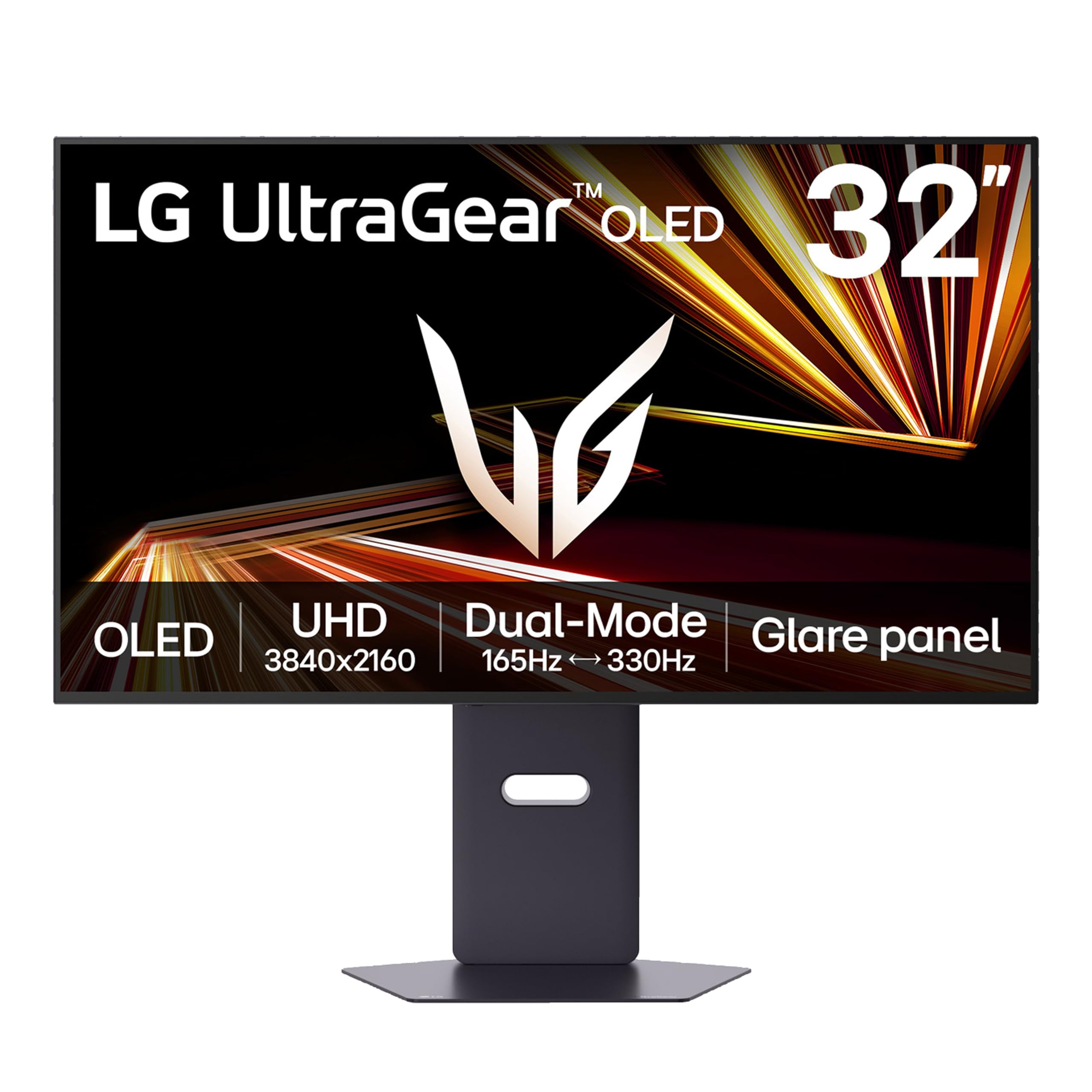
The LG UltraGear 32GX850A-B brings a glossy WOLED panel to the 32-inch 4K segment, with a native 165Hz refresh rate that scales up to 330Hz in FHD dual-mode. This is a unique offering: gamers can enjoy story-driven titles at 4K 165Hz with perfect blacks and vibrant colors, then toggle to 1080p 330Hz for competitive shooters where every millisecond counts. The 0.03ms GtG response time is the fastest available, completely eliminating motion blur in fast-paced scenarios. The Micro Lens Array+ technology boosts typical brightness to 275 nits, making HDR content more vivid than previous WOLED generations.
Color performance is excellent with DCI-P3 98.5% coverage and a 1.5M:1 contrast ratio, delivering deep blacks that make IPS panels look washed out in comparison. The glossy finish enhances perceived contrast and color saturation significantly over matte panels, though it does reflect direct light sources in bright environments. The stand offers full ergonomics—height, tilt, swivel, and pivot—and the virtually borderless design optimizes desk space for multi-monitor setups.
For connectivity, it includes one DisplayPort 1.4, two HDMI 2.1 ports, and a USB hub, supporting full 48Gbps bandwidth for console gaming at 4K 120Hz. The G-Sync Compatible and FreeSync Premium Pro certifications ensure tear-free gameplay with both NVIDIA and AMD GPUs. The triple UL certification (Anti-Glare, Flicker-Free, Low Blue Light) adds a layer of comfort for marathon sessions. For gamers seeking a glossy OLED experience with the flexibility of dual-mode, this is the standout choice.
Why it’s great
- Glossy WOLED panel delivers superior contrast and color vibrancy over matte alternatives.
- Dual-mode lets you switch between 4K 165Hz and FHD 330Hz instantly.
- 0.03ms response time is the fastest available on any monitor.
- Full ergonomic stand with height, tilt, swivel, and pivot adjustments.
Good to know
- Glossy screen reflects ambient light in brightly lit rooms.
- Peak brightness (275 nits typical) is lower than high-end QD-OLED panels.
- Text clarity and banding can be slightly noticeable on edges.
3. ASUS ROG Strix XG32UCG
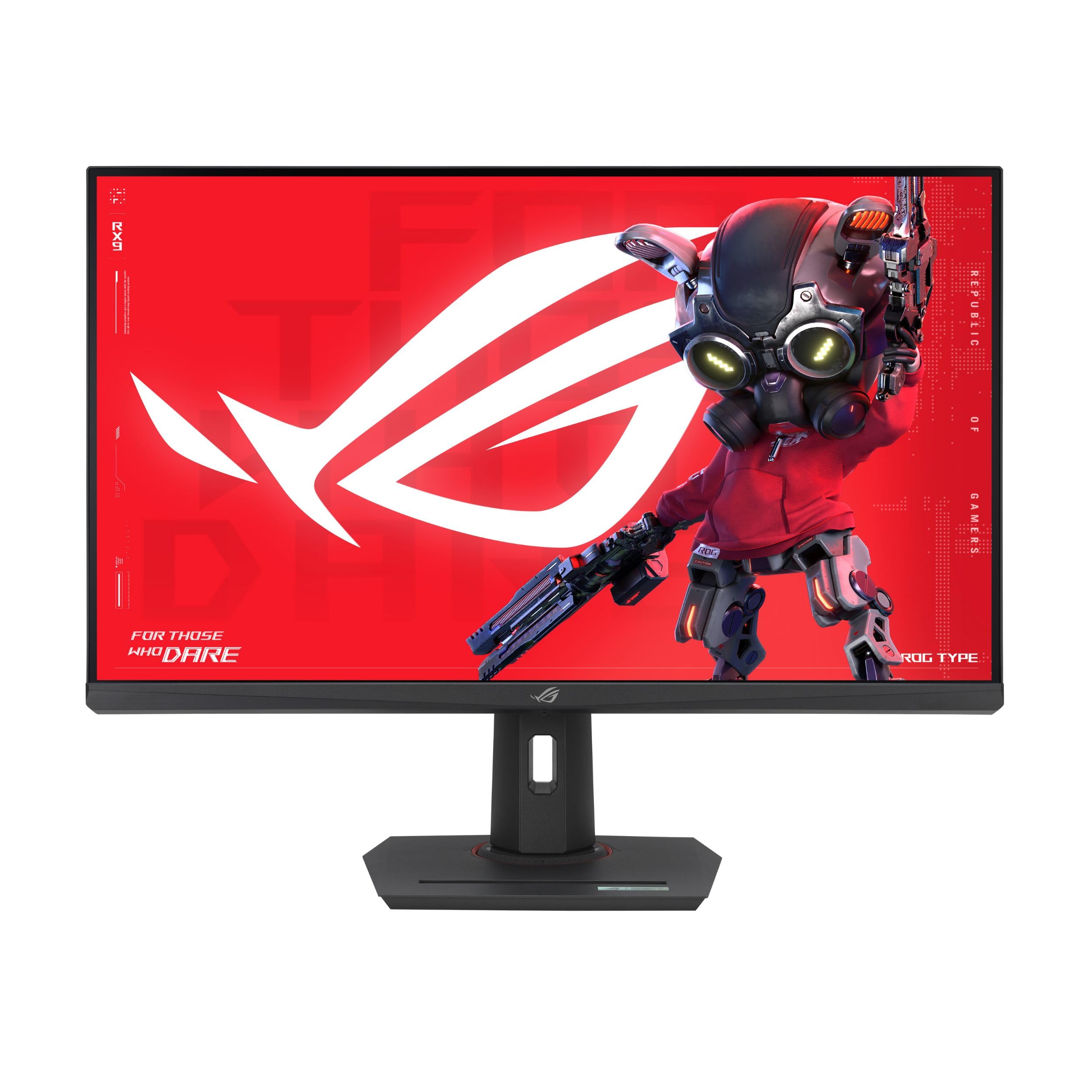
The ASUS ROG Strix XG32UCG offers a compelling solution for gamers who need both high-resolution clarity and extreme refresh rates without switching monitors. Its Fast IPS panel delivers 4K at 160Hz or FHD at 320Hz, all with a 0.3ms MPRT response time. This dual-mode flexibility is enabled by the panel’s physical pixel architecture, not software scaling, meaning you get native 1080p performance at 320Hz for esports titles without image degradation. The 95% DCI-P3 color gamut and ASUS’s advanced gray-scale tracking ensure color gradations are smooth and banding-free.
The ELMB Sync technology combines ELMB (Extreme Low Motion Blur) backlight strobing with variable refresh rate, a rare combination that eliminates both ghosting and tearing simultaneously. The monitor includes a full ergonomic stand with height, tilt, swivel, and a 1/4-inch tripod socket for mounting streaming cameras or microphones directly to the display—a thoughtful touch for streamers. Connectivity covers DisplayPort 1.4, two HDMI 2.1 ports, USB-C with DP Alt mode, and a USB hub.
ROG Gaming AI technology dynamically adjusts visual settings based on in-game content, and the DisplayWidget Center allows mouse-based control of all monitor functions. The 32-inch size at 4K provides a spacious canvas, while the tripod socket and KVM-like setup through USB-C make it a versatile hub for a multi-device desk. For gamers who play across genres and want one monitor that does everything, the XG32UCG is the most versatile option available.
Why it’s great
- Dual-mode delivers native 4K 160Hz and FHD 320Hz for genre flexibility.
- ELMB Sync eliminates ghosting while maintaining variable refresh rate.
- Built-in tripod socket at the top of the stand is unique for streamers.
- USB-C with DP Alt mode acts as a single-cable hub for laptops.
Good to know
- IPS panel has a 1,000:1 contrast ratio, not infinite blacks like OLED.
- 0.3ms MPRT is fast, but OLED panels achieve even lower GtG response times.
- This monitor is larger and heavier than 27-inch options.
4. MSI MPG 271QRX QD-OLED

The MSI MPG 271QRX QD-OLED is built for the competitive edge: a 27-inch 1440p QD-OLED panel running at 360Hz with a 0.03ms GtG response time. This combination is the sweet spot for high-level competitive gaming—1440p resolution offers sharpness without the GPU demand of 4K, and 360Hz provides buttery-smooth motion tracking that gives a tangible advantage in fast-twitch shooters like Valorant or Counter-Strike 2. The QD-OLED panel delivers infinite contrast and true blacks, making enemies in dark corners instantly visible.
Color accuracy is exceptional with Delta E ≤ 2 out of the box, and VESA DisplayHDR True Black 400 certification ensures HDR content retains shadow detail without crushing blacks. The Gaming Intelligence App gives you software-level control over monitor settings, and MSI OLED Care 2.0 includes pixel shift, panel refresh, and taskbar detection to reduce burn-in risk over time. The monitor includes a KVM switch, allowing you to control multiple devices with a single keyboard and mouse.
For console gamers, the HDMI 2.1 port supports full 48Gbps bandwidth, enabling 4K 120Hz VRR on PS5 and Xbox Series X. The adjustable stand provides height, tilt, and swivel adjustments, and the 27-inch size is ideal for competitive setups where you want full peripheral awareness without head movement. The only trade-off is the typical QD-OLED behavior under direct light, where the anti-reflection coating can show a slight purple tint. For pure competitive performance at 1440p, this is the fastest monitor on the market.
Why it’s great
- 360Hz refresh rate at 1440p is the fastest QD-OLED combination available.
- 0.03ms response time eliminates all ghosting and motion blur.
- Delta E ≤ 2 ensures color-accurate performance out of the box.
- KVM switch enables seamless device management with one keyboard and mouse.
Good to know
- QD-OLED can show a purple tint on dark content under direct ambient light.
- 360Hz requires a high-end CPU and GPU to be fully utilized in competitive titles.
- No built-in speakers or headphone jack.
5. Alienware AW2725DM

The Alienware AW2725DM is a 27-inch 1440p IPS monitor that nails the mid-range sweet spot with a 180Hz refresh rate and 1ms GtG response time. The QHD resolution at 27 inches (109 PPI) offers sharp text and detailed game environments without the GPU tax of 4K. The DCI-P3 95% color coverage and VESA DisplayHDR 400 certification provide vibrant colors and decent HDR highlights, making it a solid choice for both immersive single-player games and competitive multiplayer sessions.
The stand is a standout feature—it offers full ergonomic adjustments including height, tilt, swivel, and pivot, all with a sturdy metal build that feels far more premium than its positioning suggests. The anti-glare screen coating minimizes reflections effectively, and the hardware-based low blue light solution reduces eye strain without the yellow tint that plagues software solutions. The Alienware design language is clean and iconic, with a small LED strip on the chin.
Connectivity includes DisplayPort 1.4 (required for full 180Hz), two HDMI 2.0 ports (limited to 144Hz), and a USB Type-B hub with downstream USB-A ports. Note that the full 180Hz is only achievable over DisplayPort; HDMI caps at 144Hz. It also lacks a headphone jack and built-in speakers. For gamers seeking a reliable, color-accurate 1440p monitor with a premium-feeling stand at a reasonable investment, the AW2725DM is an excellent choice.
Why it’s great
- Full ergonomic stand (height, tilt, swivel, pivot) with metal construction feels premium.
- 1440p at 180Hz hits the ideal balance for mid-range GPUs.
- DCI-P3 95% color coverage delivers vibrant visuals for gaming and media.
- VESA DisplayHDR 400 adds decent HDR highlights for the price tier.
Good to know
- HDMI ports are limited to 144Hz; full 180Hz requires DisplayPort.
- No built-in speakers or headphone jack.
- IPS glow is present in dark scenes, typical for the panel type.
6. Dell S2725QS

The Dell S2725QS is a 27-inch 4K IPS monitor that pushes 120Hz with AMD FreeSync Premium, making it a rare hybrid that excels at both productivity and casual gaming. The 4K resolution at 27 inches (163 PPI) provides razor-sharp text and incredible detail for spreadsheets, coding, and photo editing. The 1500:1 contrast ratio is noticeably better than typical 1000:1 IPS panels, delivering deeper blacks and better depth in dark scenes. The 99% sRGB coverage and HDR readiness ensure accurate colors for content creation.
ComfortView Plus reduces harmful blue light emissions to ≤35% without the yellow tint that makes screens look warm, a huge plus for all-day work. The monitor includes built-in speakers with improved frequency response over previous generations, offering usable audio for calls and casual media without needing separate speakers. The ergonomic stand provides height, tilt, swivel, and pivot adjustments, and the ultra-thin bezels in an ash white finish make it a clean addition to any desk.
For gaming, the 120Hz refresh rate with FreeSync Premium provides smooth motion in titles that don’t require 240Hz+, and the 0.03ms response time (MPRT) keeps ghosting in check. However, some users report noticeable ghosting in fast-paced competitive games, so this is best suited for story-driven, strategy, or RPG titles. It’s an excellent choice for the user who spends 60% of their time working and 40% gaming on a single, beautiful screen.
Why it’s great
- 4K at 27 inches provides the sharpest text and highest pixel density in this guide.
- FreeSync Premium and 120Hz deliver smooth gameplay for non-competitive titles.
- Built-in speakers with improved frequency range reduce desk clutter.
- ComfortView Plus cuts blue light without yellow tint, great for all-day work.
Good to know
- Ghosting in fast-paced FPS games makes it a poor choice for competitive play.
- 120Hz is half the refresh rate of dedicated gaming panels at this price.
- Some units have reported a persistent yellow tint after prolonged use.
7. AOC Q27G41ZE
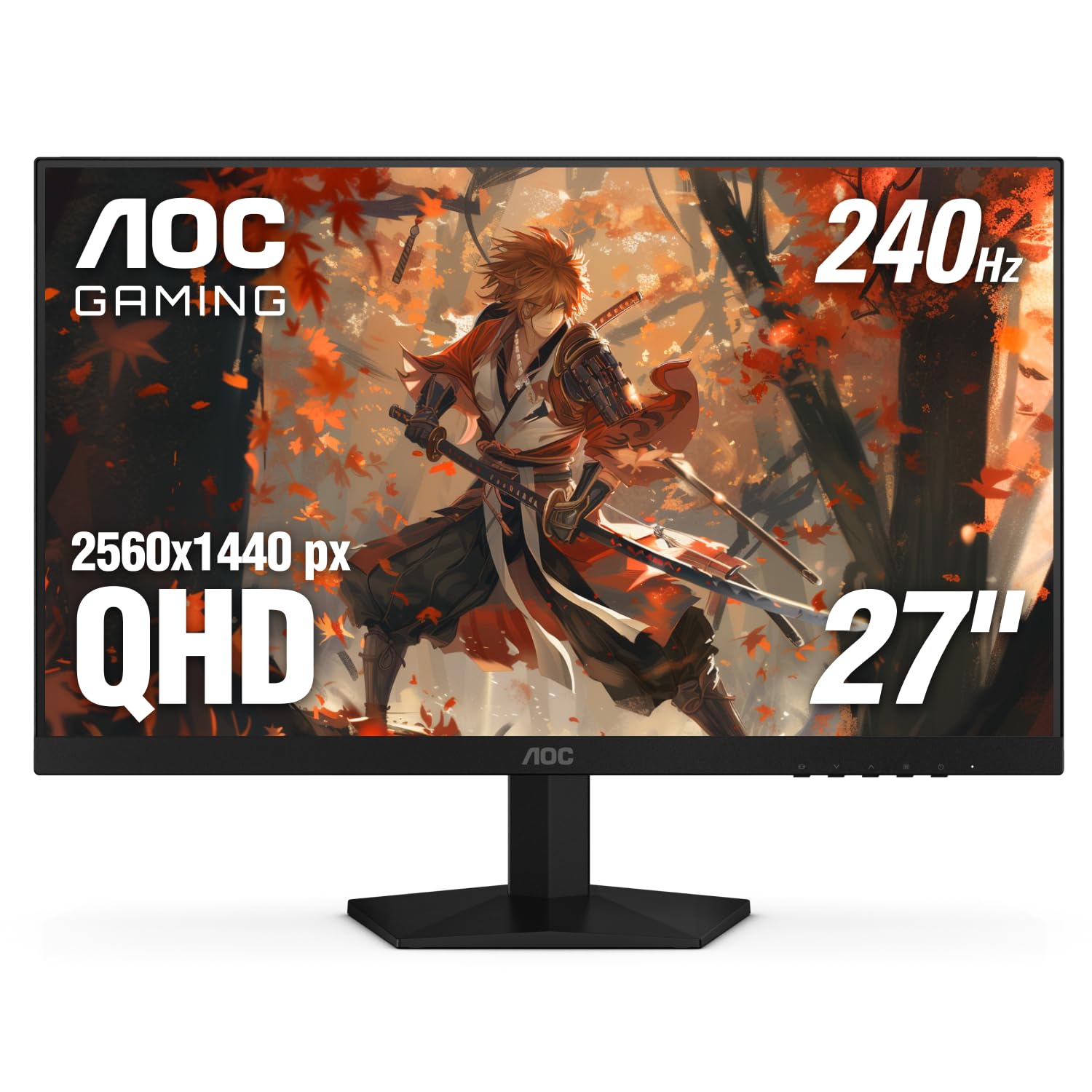
The AOC Q27G41ZE rewrites the value equation for 1440p gaming monitors. It features a 27-inch IPS panel running at a native 240Hz, overclockable to 260Hz via DisplayPort, with a 0.3ms MPRT response time—all at a price point that undercuts most 165Hz 1440p monitors. This aggressive spec sheet is backed by real-world performance: users report excellent motion clarity, vivid colors out of the box, and no dead pixels or severe backlight bleed. The 300-nit brightness and 1,000:1 contrast ratio are standard for the panel type but deliver a punchy image.
The three-sided frameless design gives it a clean appearance, and the included features—Shadow Control, Game Mode presets, and a user-friendly OSD—cater specifically to gamers who want quick adjustments without diving into menus. The Adaptive-Sync support works with both G-Sync Compatible and FreeSync, ensuring smooth tear-free gameplay with any modern GPU. The 3-Year Zero-Bright-Dot warranty from AOC provides peace of mind for dead pixel issues, a nice touch at this price.
The stand offers tilt adjustment only (-3° to +21°), so you will want a VESA mount (100x100mm) for full ergonomic control. Connectivity includes 1x DisplayPort 1.4 (required for 260Hz) and 2x HDMI 2.0 (limited to 144Hz). For gamers building a high-refresh 1440p rig on a budget, the Q27G41ZE delivers a 260Hz experience for less than many 165Hz monitors, making it the undisputed value champion of this list.
Why it’s great
- 260Hz refresh rate (overclocked) at 1440p is unheard of at this budget-friendly tier.
- 0.3ms MPRT response time minimizes motion blur effectively.
- 3-Year Zero-Bright-Dot warranty protects against dead pixels.
- Adaptive-Sync works with both G-Sync and FreeSync GPUs.
Good to know
- Stand only offers tilt adjustment; a VESA mount is recommended for ergonomic setups.
- HDMI ports cap at 144Hz; full 260Hz requires DisplayPort.
- Brightness (300 nits) is adequate but not class-leading.
8. Acer Nitro KG271U
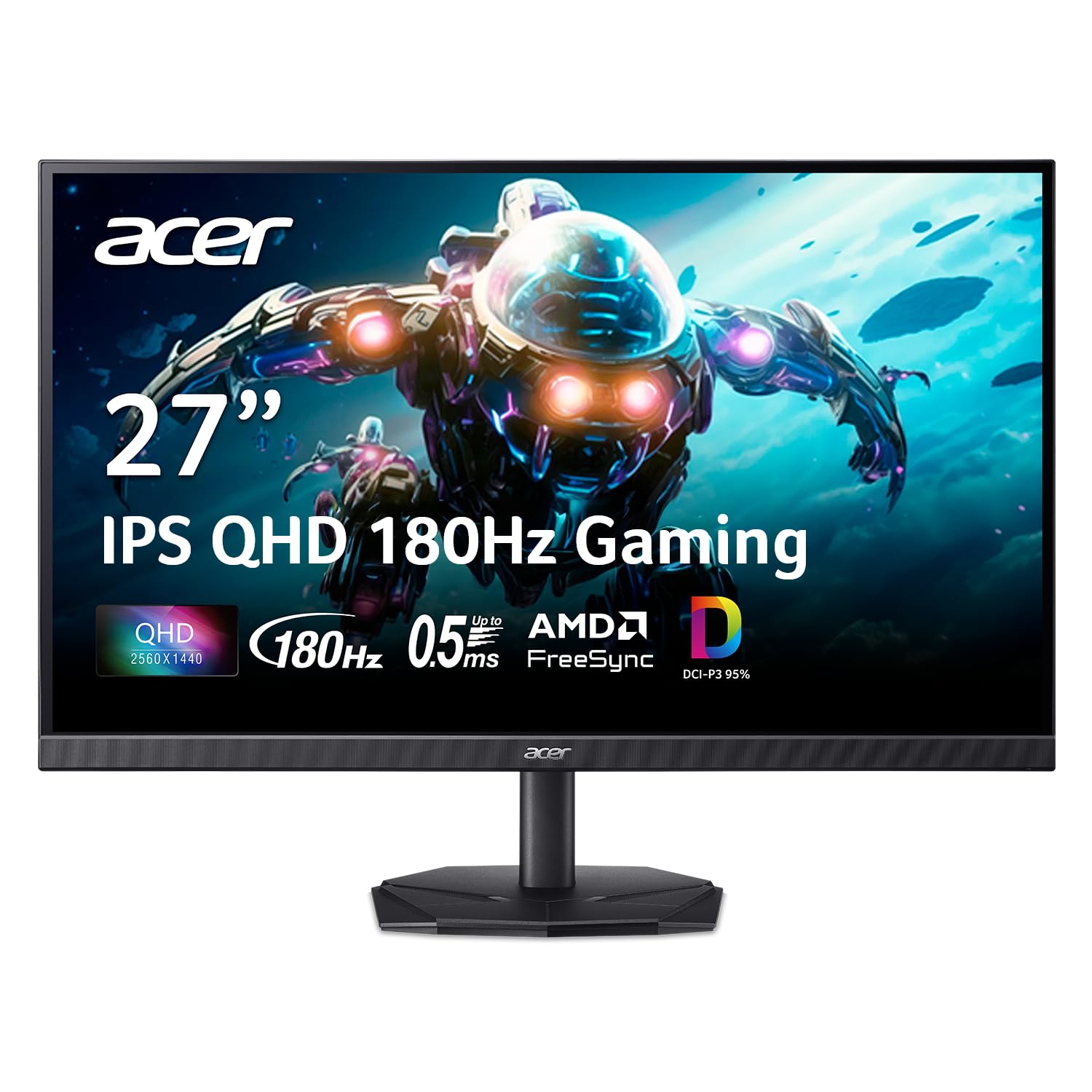
The Acer Nitro KG271U is a no-frills 27-inch 1440p IPS monitor that delivers 180Hz with a 0.5ms GtG response time, making it one of the most accessible ways to get into high-refresh 1440p gaming. The DCI-P3 95% color coverage is a standout feature at this price, producing punchy, saturated colors that rival more expensive IPS panels. AMD FreeSync support ensures tear-free gameplay with Radeon GPUs, and the zero-frame design maximizes screen real estate.
The built-in speakers are a convenient inclusion for casual use, though users consistently describe them as mediocre—fine for system sounds, not for immersive gaming. The stand is the unit’s weakest point: it only offers tilt adjustment and feels flimsy, causing some wobble. A VESA mount (100x100mm) is strongly recommended to get a stable, ergonomic setup. The 250-nit brightness is lower than many competitors, so it is best used in a room where you can control ambient light.
For gamers on a strict budget who want 1440p and 180Hz without compromise on color quality, the KG271U delivers where it counts: the panel itself. The 1440p resolution is a massive upgrade over 1080p, and the 180Hz refresh rate keeps motion smooth. Pair it with an inexpensive monitor arm, and you have a setup that competes with monitors costing significantly more.
Why it’s great
- DCI-P3 95% color coverage delivers rich, saturated colors at an entry-level price.
- 1440p at 180Hz with 0.5ms response is a strong value proposition.
- Built-in speakers eliminate the need for external audio for system sounds.
- FreeSync support ensures smooth tear-free gameplay with AMD GPUs.
Good to know
- Stand is flimsy with tilt-only adjustment; a VESA mount is highly recommended.
- Brightness (250 nits) is on the lower side for well-lit rooms.
- Built-in speakers are mediocre in quality.
9. Samsung Odyssey G4

The Samsung Odyssey G4 is a 25-inch 1080p IPS monitor built for pure competitive speed. With a 240Hz refresh rate and 1ms GtG response time, it is optimized for first-person shooters where frame rate and pixel response are more important than resolution. The IPS panel delivers 400 nits of brightness and excellent color saturation for a 1080p display, with wide 178-degree viewing angles that keep the image consistent from any seating position.
NVIDIA G-Sync Compatibility and AMD FreeSync Premium support ensure the monitor works flawlessly with both GPU ecosystems, eliminating screen tearing without introducing input lag. The Ultrawide Game View feature allows you to set the aspect ratio to 21:9, revealing hidden areas in supported games—a unique advantage for competitive titles. The ergonomic stand offers height, tilt, swivel, and pivot adjustments, a rarity at this price, and the Auto Source Switch+ automatically detects connected devices and switches inputs instantly.
The 25-inch size is slightly smaller than the standard 27-inch, which some competitive players actually prefer for faster head-tracking and reduced eye movement. Built-in speakers are absent, but audio can be passed through the 1/8-inch output jack. For anyone building a dedicated competitive gaming setup at 1080p, or needing a high-refresh secondary monitor for esports titles, the Odyssey G4 is the best affordable choice available.
Why it’s great
- 240Hz at 1080p with 1ms response is ideal for competitive FPS gaming.
- Full ergonomic stand with height, tilt, swivel, and pivot adjustments.
- Ultrawide Game View (21:9) provides a tactical advantage in supported titles.
- Auto Source Switch+ automatically detects connected devices.
Good to know
- 1080p resolution at 25 inches provides less screen real estate than 27-inch QHD options.
- No built-in speakers.
- HDMI notification bug can occur when a laptop is in sleep mode.
FAQ
Is 1440p at 27 inches noticeably sharper than 1080p at the same size?
Can I use a PS5 or Xbox Series X with these gaming monitors?
What causes motion blur on a gaming monitor?
Do I need to worry about OLED burn-in on a gaming monitor?
Final Thoughts: The Verdict
For most users, the best 10 gaming monitors winner is the ASUS ROG Swift PG32UCDM because it delivers the perfect balance of 4K resolution, 240Hz refresh rate, QD-OLED contrast, and burn-in warranty coverage for a no-compromise gaming experience. If you want the fastest competitive performance at 1440p, grab the MSI MPG 271QRX QD-OLED with its blistering 360Hz refresh rate. And for the best value in high-refresh 1440p, nothing beats the AOC Q27G41ZE which delivers 260Hz at a price that redefines the budget segment.