
Our readers keep the lights on and my morning glass full of iced black tea. As an Amazon Associate, I earn from qualifying purchases.
Specs are compiled from manufacturer listings and verified buyer reviews and can change over time — please confirm the key details on the product page before buying.
If the power drops, a 10000W generator is the difference between sitting in the dark with a cold fridge and keeping your AC, well pump, lights, and TV running like nothing happened. The catch is that “10000 watts” means different things on different machines — peak vs running watts, gasoline vs propane, open-frame vs inverter — and picking the right one for your home depends on which fuel you stockpile and how much noise your neighbors will tolerate.
I’m Min — the founder and writer behind Gadgets Feed. This guide is built by comparing the manufacturers’ published specifications and the patterns across verified customer reviews, so you get each pick’s real strengths and trade-offs instead of marketing spin.
if you need portable backup for storm season or a permanent standby unit that fires up automatically, this breakdown of the best 10000W generator options for 2025 cuts through the specs to the real-world decisions that matter. best 10000w generator
Quick Picks
- Gidrox 11000W Tri-Fuel Inverter Generator — Best Overall
- DuroMax XP11000iH 11,000-Watt Dual Fuel Inverter Generator — Premium Pick
- Westinghouse 12500 Peak Watt Dual Fuel Portable Generator — Top Performer
- Pulsar PGD105TiSCO Tri Fuel Inverter Generator — Quiet Performer
- Generac Guardian 10kW Home Standby Generator — Home Power Hub
- Pulsar G12KBN-SG Heavy Duty Dual Fuel Generator — Strong Surge
- All Power America Dual Fuel Portable Generator 10000 Watt — Budget Champion
How To Choose The Best 10000W Generator
A 10000W generator is a serious investment, and the wrong choice means either paying for power you cannot use or, worse, buying a unit that cannot start your well pump. Here is what actually matters when you compare these machines.
Peak Watts vs Running Watts — the one spec that breaks everything
Every generator gives you two numbers. The “peak” (or surge) wattage is the brief burst of power needed to start a motor — like your AC compressor or well pump — and it lasts only a second or two. The “running” (or rated) wattage is what the machine can deliver continuously. If you add up the running watts of everything you want to power and the number exceeds the generator’s running watts, you will trip the breaker. If the starting surge of your largest motor exceeds the peak watts, the generator will stall. Always match the running watts to your continuous load and the peak watts to your single biggest startup surge.
Fuel Type — gasoline, propane, or natural gas
Dual-fuel generators (gasoline + propane) give you backup if one fuel runs scarce during a storm. Tri-fuel adds natural gas, which means an unlimited supply if you have a gas line, but the running wattage drops on propane and even more on natural gas. Gasoline offers the highest wattage and is easiest to refill, but it degrades in storage after a few months. Propane and natural gas store indefinitely and burn cleaner, but you lose about 10-15% of your peak power compared to gasoline. Your decision depends on fuel availability in your area and how long you plan to run the generator without a resupply.
Inverter vs Conventional — noise, clean power, and fuel efficiency
An inverter generator produces cleaner electricity (under 3% total harmonic distortion, or THD), which is safe for laptops, TVs, and anything with a circuit board. They also throttle the engine up and down based on the load, which saves fuel and reduces noise significantly — for example, 62 dB for the Pulsar PGD105TiSCO versus 76 dB for the All Power America unit. The trade-off is price: inverter models typically cost hundreds more per unit of power. Conventional (open-frame) generators are louder and produce dirtier power, but they give you the most watts per dollar, making them a solid choice if you just need to run resistive loads like a space heater, lights, and a refrigerator.
Transfer Switch and Whole-Home Readiness
If you want to power your house through the breaker panel rather than running extension cords, you need a generator with a 50A or 30A twist-lock outlet and an inlet box connected to a transfer switch. Some generators, like the Generac Guardian series, come bundled with a transfer switch and are wired directly into your home’s gas line — these are permanent standby units. Portable generators can also feed a house via a manual transfer switch, but you have to wheel them outside, connect the cord, and start them manually each time. Check if the generator is “transfer switch ready” (it has the right outlet) and if you need a licensed electrician for installation.
Quick Comparison
| Model | Best For | Running / Peak Watts (Gas) | Fuel Tank Capacity | Noise Level | Amazon |
|---|---|---|---|---|---|
| Generac Guardian 10kW | Permanent whole-home standby | 10,000W / — | Natural gas or LP (no tank) | Quiet (enclosed) | $4,119.00Amazon |
| Gidrox 11000W Tri-Fuel Inverter | Whole-home backup inverter | 11,000W / — | 8.7 gallons | 65 dB | $1,999.99Amazon |
| DuroMax XP11000iH | Inverter power + parallel capability | 9,000W / 11,000W | — | ~61 dB (claimed) | $2,599.00Amazon |
| Pulsar PGD105TiSCO | Tri-fuel inverter for sensitive electronics | 8,500W / 10,500W | 6.9 gallons | 62 dB | $1,634.00$1,979.97Amazon |
| Westinghouse 12500 | Dual-fuel home backup with remote start | 9,500W / 12,500W | 6.6 gallons | — | $1,049.00Amazon |
| Pulsar G12KBN-SG | High peak wattage dual-fuel | 9,500W / 12,000W | 8 gallons | — | $899.99Amazon |
| All Power America 10000W | Budget-friendly dual-fuel portable | 8,000W / 10,000W | 8 gallons | 76 dB | $799.00Amazon |
In‑Depth Reviews
1. Gidrox 11000W Tri-Fuel Inverter Generator

The top pick because it runs your whole home on clean sine-wave current (under 3% THD) for up to 21 hours on a single tank — longer than any other model here.
You get 11,000 peak watts delivered as clean power, with total harmonic distortion (THD, a measure of electrical noise from the generator) under 3%, so it is safe for laptops, phones, and any sensitive electronics you plug in. The 8.7-gallon fuel tank keeps it running for up to 21 hours at 25% load, which is the longest runtime here. You can switch between gasoline, propane, and natural gas by turning a dial, and both the NG and LPG hoses come in the box, so you are ready to connect immediately from the start.
At 65 dB versus the All Power America unit at 76 dB, it has a key advantage near a neighbor’s fence. It is also ATS-ready, meaning you can connect it to an automatic transfer switch (a device that safely switches your home’s circuits from utility power to generator power automatically) so it fires up without you lifting a finger during an outage. Buyers report the setup is easy and the build quality feels solid, though one reviewer noted that the unit seems to struggle above 5,500 watts, so you may want to keep the continuous load under that threshold for best fuel efficiency.
The trade-off is weight — at 38 inches long and 30 inches tall, this is a large machine that requires planning for storage and transport. It also comes at a premium price tier, but the tri-fuel flexibility, quiet inverter operation, and 3-year warranty make it the most versatile whole-home backup generator on this list for buyers who want one machine that handles every fuel scenario.
The Flexibility Advantage
- Tri-fuel (gas, propane, natural gas) with hoses included
- 21-hour runtime at 25% load — longest of any pick here
- Clean power with under 3% THD; safe for all electronics
- 65 dB operation is quiet enough for residential areas
Know Before You Buy
- Large and heavy — needs dedicated storage space
- Some owners mention it runs best under 5,500W continuous load
- Premium pricing reflects inverter tech and tri-fuel capability
Choose this if: you want a single generator that runs on any fuel (including natural gas from your home line), produces clean power for electronics, and can feed your whole house through an automatic transfer switch.
A realistic trade-off: it is a big, heavy unit, and the long runtime spec (21 hours at 25% load) drops significantly if you push it near its 11,000W peak.
2. DuroMax XP11000iH 11,000-Watt Dual Fuel Inverter Generator
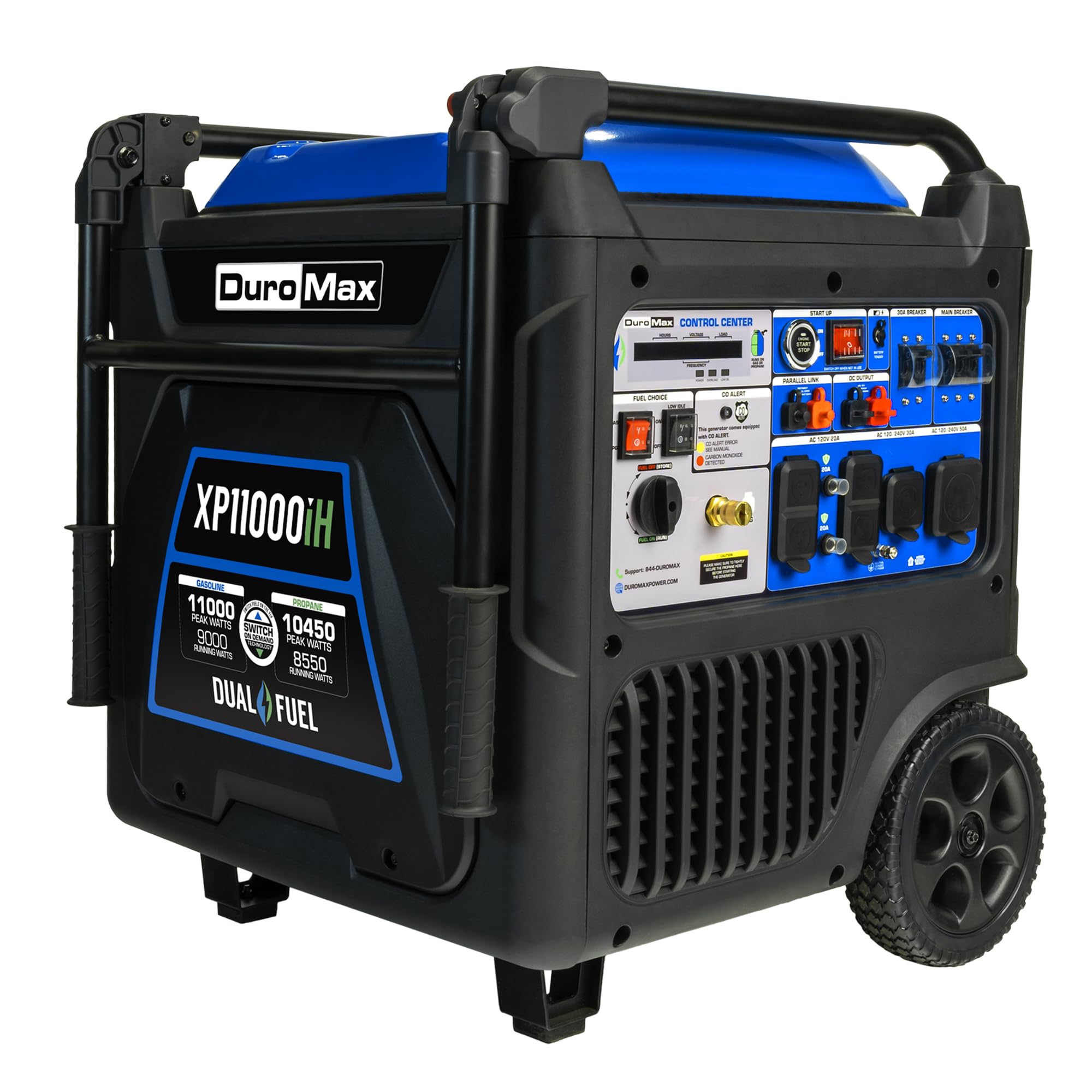
You can connect two of these inverter units together for 22,000 peak watts — a scale-up option no other portable generator here offers.
This DuroMax delivers 11,000 peak watts and 9,000 running watts on gasoline, with dual-fuel capability that also accepts propane. The inverter technology gives you clean, stable power for sensitive electronics like televisions and computers, and the CO Alert feature (a carbon monoxide sensor that shuts down the generator if CO builds up) is a critical safety feature when running it near a home. You can start it with the included remote control, which is convenient when the generator is parked outside in the rain.
One standout feature is the parallel capability: you can connect two XP11000iH units together to double your power to 22,000 peak watts and 18,000 running watts (the parallel kit is sold separately). This makes the generator future-proof if your power needs grow. Customers note it is noticeably quieter and more fuel-efficient than previous non-inverter units, though one buyer mentioned the oil dipstick is difficult to access and the claimed 61 dB noise level may be optimistic according to the maker’s specifications. The Battery Tender keeps the battery charged and ready, so you are not stuck with a dead battery when the power goes out.
At 216 pounds and 26.2 x 25 inches, it requires a hand cart, and some reviewers point out long wait times for replacement parts like the Starting Cup. Still, the combination of inverter efficiency, remote start, and dual-fuel flexibility makes this a top-tier option for the buyer who wants clean power and the option to scale up later.
Parallel power advantage: You can add a second unit later to reach 22,000W — no other portable here offers that.
Part availability risk: Some shoppers say backordered parts lasting over two months, which is a serious concern for an essential backup unit.
Ideal for: homeowners who want inverter-clean power, remote-start convenience, and the option to double their wattage later by adding a second unit.
Not ideal if: you need immediate parts availability or you want natural gas fuel — this unit runs on gasoline and propane only.
3. Westinghouse 12500 Peak Watt Dual Fuel Portable Generator

You get 12,500 peak watts — the highest surge on this list — so it can start a well pump and a water heater at the same time, unlike the Gidrox which runs best under 5,500W.
This Westinghouse puts out 12,500 peak watts on gasoline — the highest peak wattage on this list — and 9,500 running watts, giving you a solid surge margin for starting heavy motors like a well pump or a central AC. It runs on gasoline or propane, and the 6.6-gallon fuel tank delivers up to 12 hours of runtime at half load. Buyers confirm it “runs well pump and water heater simultaneously,” which is the exact scenario most homeowners need from a 10000W class generator. The remote start via included key fob means you can fire it up from inside the house when a storm hits.
Assembly is minimal — buyers report less than 5 minutes from the start — and the unit comes with a 12V battery charger, oil, oil funnel, and a tool kit. The 457cc Westinghouse 4-stroke OHV engine features a cast iron sleeve for durability, plus automatic low-oil shutdown and a carbon monoxide (CO) sensor for safety. It is also transfer-switch ready with a 120V L14-30R 30A outlet and a 120/240V 14-50R 50A outlet, so you can connect it directly to your home’s inlet box. The catch is noise: as an open-frame generator, it is loud, and the manual references a nonexistent Eco switch, confusing some buyers.
At 212 pounds and 27.2 inches long, it is one of the more compact 10000W-class open-frame generators, and reports say it rolls easily on its included wheels. It is rated best by Consumer Reports and Popular Mechanics, and it comes with a 3-year limited service, labor, and parts warranty. Just keep in mind that it loses efficiency above 2,000 feet elevation, though a high-altitude kit fixes that.
What Makes It Stand Out
- 12,500 peak watts — highest surge on this list for starting big motors
- Remote start with key fob; electric and recoil backup
- Transfer-switch ready: 50A and 30A outlets included
- Compact for an open-frame unit; wheels for easy moving
Things to Consider
- Loud open-frame operation — not for quiet neighborhoods
- 6.6 gallon tank versus the Pulsar’s 8 gallon tank
- Efficiency drops at elevations over 2,000 feet without a kit
Best suited for: homeowners who need a proven, portable dual-fuel generator with remote start and enough surge to handle a well pump plus water heater simultaneously.
Worth noting: it is loud and the fuel tank is 6.6 gallons versus the Pulsar G12KBN-SG’s 8-gallon tank, meaning more frequent refueling on long outages.
4. Pulsar PGD105TiSCO Tri Fuel Inverter Generator

At 62 dB versus the All Power America unit at 76 dB, this inverter generator is better suited for overnight use near a bedroom window.
This Pulsar is the quietest full-size 10000W-class generator you can buy — it operates at 62 dB, which is about the level of a normal conversation. At that noise level, versus the All Power America unit at 76 dB, it is a strong choice if you need to run a generator overnight near a bedroom window or in a neighborhood with noise restrictions. It is a tri-fuel machine that runs on gasoline (10,500 peak / 8,500 running watts), propane (9,500 / 8,000), or natural gas (8,400 / 6,800), and it comes with the hoses and regulator for all three fuels right in the box.
The inverter technology produces clean power safe for sensitive electronics, and the digital control center shows you hours, voltage, load, and frequency at a glance. Owners mention it “powered home during Hurricane Beryl via natural gas,” which speaks to the reliability of having a fuel line that runs indefinitely. One owner reported the generator runs a 3,000 square-foot home with two AC units totaling 5 tons (with soft starts). The 6.9-gallon fuel tank provides up to 9 hours of runtime at half load — shorter than the Westinghouse’s 12 hours, but that is the trade-off for the quieter inverter operation.
At 247 pounds and 31.4 inches tall, it is the heaviest portable on this list, and it measures 22.8 inches wide versus the All Power America unit at 24 inches. It also comes with a caveat: one customer observed a failed start during the break-in period, likely due to a defective fuel selector knob. Overall, though, the combination of tri-fuel flexibility, 62 dB operation, and a digital display makes it a premium inverter option for buyers who want quiet, clean power during long outages.
The quietest option here: At 62 dB versus the All Power America generator at 76 dB, this is a meaningful difference if you are running it overnight next to a house.
Fuel trade-off: On natural gas, the running watts drop to 6,800W, so you lose about 20% of your peak power compared to gasoline — factor that into your load calculation.
Choose this if: you want tri-fuel flexibility (especially natural gas), quiet inverter operation, and clean power that is safe for all your electronics.
Consider the limits: the 9-hour runtime at half load is 9 hours versus the Westinghouse at 12 hours, and natural gas output is significantly lower than gasoline.
5. Generac Guardian 10kW Home Standby Generator

A permanently installed unit that turns on by itself when the grid goes down — no fuel cans, no cords, no manual start.
This is a fundamentally different machine from every other generator on this list. The Generac Guardian is a permanent standby unit — it sits outside your home on a concrete pad, is wired directly into your electrical panel via a 100-amp 16-circuit transfer switch (included), and connects to your existing natural gas or liquid propane line. When the power goes out, it starts itself automatically within seconds, runs for as long as the gas line flows, and shuts off when utility power returns. You never touch a fuel can, run an extension cord, or manually start it.
It produces 10,000 watts of “True Power” with under 5% harmonic distortion, which is clean enough for all household electronics. The G-Force engine is purpose-built by Generac and designed for long, low-maintenance life — one buyer says their previous Generac unit lasted 24 years. The Mobile Link Wi-Fi connectivity lets you monitor the generator’s status and maintenance alerts from your phone, so you know if it needs service before the next outage. The aluminum enclosure is weather-resistant, and noise levels are comparable to a lawn mower (quieter inside the house than outside).
The catch is installation. This requires a licensed electrician and, if using natural gas, a plumber to run the gas line — installation costs can be significant and vary heavily based on the distance from your electrical panel and gas meter. It is also the most expensive option on this list, sitting at the premium price tier. But if you want true whole-house automation that your family can rely on without any manual steps during a storm, this is the only option that delivers that.
The Automation Advantage
- Automatic startup and shutdown — no manual intervention needed
- Runs on natural gas or propane with unlimited fuel supply (gas line)
- 5-year limited warranty and USA engineering
- Wi-Fi monitoring for remote status checks
Installation Reality
- Requires professional installation by an electrician; costs vary widely
- Premium price compared to portable generators
- Permanent installation — not portable or transferable
Perfect for: homeowners who want a low-maintenance whole-house backup that runs on natural gas and starts automatically, with no manual refueling or cord management.
Not for: renters or anyone who needs a portable generator — this is a permanent investment that requires professional installation and a fixed location.
6. Pulsar G12KBN-SG Heavy Duty Dual Fuel Generator

You get an 8-gallon tank versus the Westinghouse’s 6.6-gallon tank, so you can run for up to 12 hours without refueling on gasoline.
This Pulsar gives you 12,000 peak watts and 9,500 running watts on gasoline, with dual-fuel capability for LPG as a backup. The 8-gallon tank versus the Westinghouse’s 6.6-gallon tank helps enable up to 12 hours of operation at half load on gasoline. Customers note it “powers 2600 sq ft house, AC, freezer, fridge, TVs, microwave on 50A hookup,” and one reviewer ran it for 16 hours without refueling — proof of the large tank. The control panel includes four 120V 20A AC outlets, a 120V/240V 30A twist-lock outlet, and a 120V/240V 50A outlet, so it is ready for transfer switch hookup or direct RV connection.
The 457cc engine features electric start with a maintenance-free battery included, and the durable powder-coated frame is built for heavy use. Assembly takes about 15 minutes, and the unit comes with a mobility kit, propane hose, spark plug wrench, and tools. One caveat: it requires a break-in period with 3 oil changes, and some reviewers point out it is loud but acceptable for an open-frame generator. The metal fuel tank includes a fuel gauge, so you know exactly how much gas remains.
At 214 pounds and 28.5 inches long, it is slightly heavier than the Westinghouse but still rolls on its included wheel kit. A few buyers reported delivery delays — some waited about a month with no seller contact — and one unit arrived DOA (dead on arrival), though the replacement process worked. Overall, this is a reliable mid-range dual-fuel generator with an excellent fuel capacity that covers a large home’s essential loads.
Fuel capacity king: The 8-gallon tank versus the Westinghouse’s 6.6-gallon tank can reduce refueling stops during long outages.
Delivery risk: Some shoppers say month-long shipping delays and issues with freight carriers that require garage delivery; order well before storm season.
Best for: homeowners who prioritize long runtime between refuels — the 8-gallon tank gives you up to 12 hours at half load on gas.
Be aware: this open-frame unit is loud, and delivery can be unpredictable; plan for freight-style shipping delays.
7. All Power America Dual Fuel Portable Generator 10000 Watt
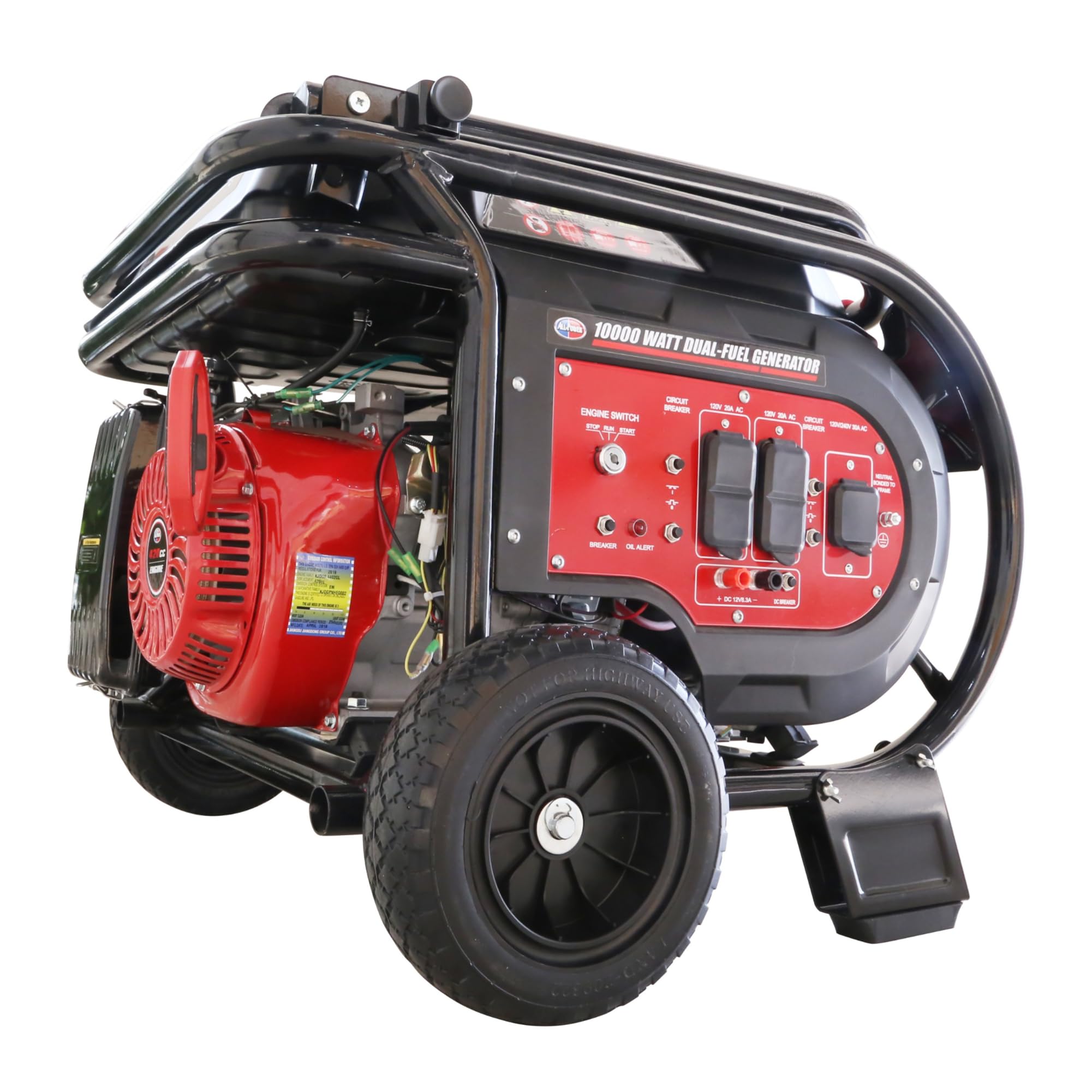
The most affordable dual-fuel 10000W generator here — buyers report it powers a well pump, two fridges, and a 12k BTU AC all at once.
This All Power America generator delivers 10,000 peak watts and 8,000 running watts on gasoline (8,500 peak / 7,000 running on propane) at a budget-friendly price point. Owners mention it “powers well pump, 2 fridges, 12k BTU AC, TV, lights,” which covers the critical loads of a typical home during an outage. The 8-gallon fuel tank gives you up to 10 hours of runtime at half load with the 420cc JD engine — a 4-stroke, air-cooled workhorse that is easy to maintain.
It runs on gasoline or propane, and switching fuels is straightforward. The control panel offers four 120V outlets, a 120/240V twist-lock outlet, and a 12V DC outlet for charging batteries. The electric start works with a maintenance-free battery included, and there is also a manual recoil start as backup. Assembly is quick — customers note adding oil and gas, and it is ready to go. The wheel kit and retracting steer handle make it easy to move around the yard or into storage.
At 76 dB, this is the loudest generator on this list — versus the Pulsar PGD105TiSCO at 62 dB. It also does not have a low-idle speed switch, so it runs at full RPM even when the load is light, which wastes fuel. One user highlighted the unit started dying after about an hour in cold weather, though most reviews are very positive for the price. At 235 pounds and 31 inches long, it is a heavy machine, but the included flat-free wheel kit helps. If you need a reliable 10000W dual-fuel generator on a tight budget and can handle the noise, this is your pick.
The Budget Appeal
- Dual-fuel (gas and propane) at the lowest price point on this list
- 8-gallon fuel tank provides 10-hour runtime at half load
- Proven real-world load: well pump, two fridges, AC, and lights
- Includes wheel kit and electric start with battery
The Noise and Refinement Cost
- 76 dB — loudest generator on this list; not for quiet neighborhoods
- No low-idle switch, so it runs at full RPM at all times
- Some reliability concerns: a buyer reported failure in cold weather
Reach for this if: you want the most affordable dual-fuel 10000W generator that still has enough power for your well pump, fridge, and lights during an outage.
Look elsewhere if: quiet operation matters — this unit runs loud at 76 dB, and the lack of a low-idle switch means it drinks fuel even when powering just a few items.
Understanding the Specs
Peak Watts vs Running Watts
Peak (or surge) watts are the brief jolt of power a motor needs to start up — your well pump or AC compressor might need double its running watts for a split second. Running (or rated) watts are what the generator can deliver continuously. If the peak watts of your biggest motor exceed the generator’s peak output, the motor will not start. If the total running watts of everything you plug in exceed the generator’s running watts, the breaker trips. Always plan for the starting surge of your largest appliance, not just the steady draw.
Total Harmonic Distortion (THD)
THD measures how “clean” the electricity is. A conventional generator produces power with 6-20% THD, which is fine for resistive loads like space heaters, incandescent lights, and older refrigerator motors. Inverter generators produce under 3% THD, which is safe for sensitive electronics — laptops, phones, modern TVs, and anything with a switched-mode power supply. If you plan to run a computer or a smart TV, look for an inverter model or one that explicitly states “under 3% THD.”
Runtime at Half Load
Manufacturers advertise runtime “at 50% load,” which means the generator is powering about half of its running wattage. For a 10,000W running generator, a 12-hour runtime at half load means it will run for 12 hours while supplying about 5,000W of power. If you are running near the generator’s full capacity, the runtime will drop significantly — often by 30-50%. Use the half-load runtime as a best-case estimate and assume you will refuel sooner if the outage demands more power.
Dual Fuel vs Tri-Fuel
A dual-fuel generator runs on gasoline and propane. A tri-fuel generator adds natural gas, which is ideal if you have a natural gas line — you get unlimited fuel during a storm without storing gas cans. The trade-off is power output: natural gas typically produces about 10-20% fewer watts than gasoline. Check your generator’s specs for each fuel type, because the running watts on natural gas may be too low to start your well pump or central AC.
FAQ
Will a 10000W generator run my whole house?
What is the difference between a portable generator and a standby generator?
Can I run a 10000W generator on propane?
How long will a 10000W generator run on one tank of gas?
Do I need a transfer switch to connect a generator to my house?
What is a CO sensor on a generator and why does it matter?
Can I use a 10000W generator with my RV?
What is the difference between an inverter generator and a conventional generator?
How do I maintain a 10000W generator?
Will a 10000W generator start my central AC?
Final Thoughts: The Verdict
For most buyers, the best 10000w generator winner is the
Product prices and availability are accurate as of the date/time indicated and are subject to change. Any price and availability information displayed on Amazon at the time of purchase will apply to the purchase of this product. As an Amazon Associate I earn from qualifying purchases.
CERTAIN CONTENT THAT APPEARS ON THIS SITE COMES FROM AMAZON. THIS CONTENT IS PROVIDED "AS IS" AND IS SUBJECT TO CHANGE OR REMOVAL AT ANY TIME.
Amazon and the Amazon logo are trademarks of Amazon.com, Inc. or its affiliates.