
A 100-foot HDMI cable is a different animal than the 6-footer behind your TV. Copper hits a wall at around 50 feet—signal degradation, pixel sparkles, and random black screens become your new reality. The fix isn’t a thicker copper wire; it’s active optical fiber that converts your signal to light, making distance irrelevant.
I’m Min — the co-founder and writer behind Gadgets Feed. I’ve spent dozens of hours comparing long-run HDMI cables, analyzing optical vs. copper construction, bandwidth ceilings, and the real-world failure points that leave projector owners stuck with a blank wall.
You need a cable that won’t choke your signal over distance, and this guide breaks down the seven best options to help you land the right 100ft hdmi cable for your home theater or gaming setup without wasting money on the wrong tech.
How To Choose The Best 100Ft HDMI Cable
A long HDMI cable is a structural decision, not an accessory. If you pick the wrong type, you will fight signal dropouts, handshake failures, and intermittent black screens. Three factors decide if a cable actually works at 100 feet.
Fiber Optic vs. Copper: The 50-Foot Rule
Standard passive copper HDMI cables hit hard signal loss beyond 50 feet. At 100 feet, copper simply cannot maintain 18Gbps or higher bandwidth without active boosting. Fiber optic cables use a laser-driven photoelectric converter inside each connector to turn electrical signals into light, which travels the full 100 feet with zero degradation. Any 100-foot cable worth buying is an active optical cable (AOC). If a listing doesn’t say “optical” or “fiber optic,” it will likely fail at 4K HDR.
Bandwidth and Resolution Targets
The cable’s data rate in Gbps determines what resolution and refresh rate it can sustain. A cable rated for 18Gbps can handle 4K@60Hz, which is fine for most movies and projectors. A 48Gbps cable unlocks 8K@60Hz, 4K@120Hz, and variable refresh rate (VRR) for gaming. If you own a PS5, Xbox Series X, or plan to run high-refresh PC gaming to a distant TV, do not settle for 18Gbps—aim for the full HDMI 2.1 spec at 48Gbps.
Directionality and In-Wall Rating
Every fiber optic HDMI cable is unidirectional. One end is labeled “Source” (connect to your console or PC) and the other “Display” (connect to your TV or projector). Plug them backward and you get a blank screen. If you plan to run the cable inside a wall, check for a CL2 or CL3 fire safety rating. Regular cables without this rating fail electrical code for in-wall installation. A KL3-rated jacket, like the one on the BENFEI 8K Fiber Optic cable, is the standard for permanent runs.
Quick Comparison
On smaller screens, swipe sideways to see the full table.
| Model | Category | Best For | Key Spec | Amazon |
|---|---|---|---|---|
| BENFEI 8K HDMI 2.1 Fiber Optic | Fiber Optic | Best Overall – In-wall rated 48Gbps run | 48Gbps / CL3 Rated | Amazon |
| FIBBR Fiber Optic HDMI 2.1 | Fiber Optic | Best Value – 48Gbps at a lower cost | 48Gbps / 3.2 oz | Amazon |
| OREI 8K AOC Fiber Optic | Active Optical | Premium Build – Gold-plated + nylon jacket | 48Gbps / Nylon Braided | Amazon |
| Snowkids 8K Fiber Optic | Fiber Optic | Durable – Military-grade tensile nylon | 48Gbps / 25k flex cycles | Amazon |
| RUBMUD 8K HDMI 2.1 Fiber | Fiber Optic | Thin & Flexible – Easy conduit routing | 48Gbps / Slim profile | Amazon |
| Highwings 8K Fiber Optic | Fiber Optic | Budget-Friendly – Entry-level long-run cable | 48Gbps / Braided jacket | Amazon |
| grofyllaa 4K HDMI 2.0 | Passive Copper | Budget-Friendly – Short-run 4K office use | 18Gbps / 4K@60Hz | Amazon |
In‑Depth Reviews
1. BENFEI 8K HDMI 2.1 Fiber Optic Cable 100 Feet
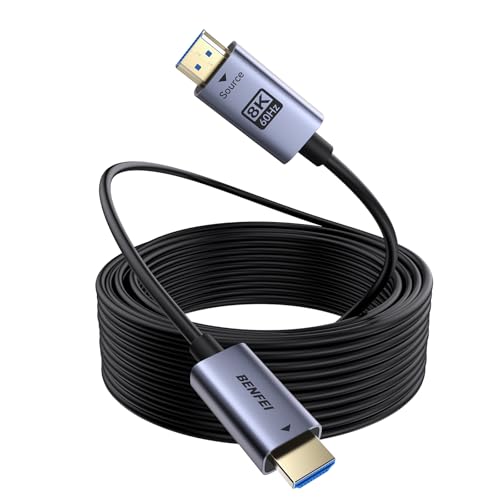
The BENFEI fiber optic cable hits the perfect intersection of specs, safety rating, and price. It delivers the full HDMI 2.1 bandwidth of 48Gbps, meaning 8K@60Hz and 4K@240Hz are fully supported, with VRR to eliminate tearing and eARC for uncompressed surround sound. Every critical detail for a long run is accounted for here.
What separates the BENFEI from cheaper options is its CL3 in-wall fire safety rating. If you are running this cable inside a wall—which is the entire point of a 100-foot cable—you need CL2 or CL3 certification to meet electrical code. The cable uses fiber optic cores that are thinner and lighter than copper equivalents, making it easier to pull through conduit without snagging.
Directionality is clearly marked with “Source” and “Display” ends. Customer reviews consistently report stable 4K@60Hz and 1080p signals over the full 100 feet without dropouts, and the 18-month warranty adds peace of mind. This is the benchmark for a permanent long-run HDMI installation.
Why it’s great
- Full 48Gbps bandwidth with VRR and eARC
- CL3 safety rated for permanent in-wall installs
- Thin, flexible fiber core for easier conduit routing
Good to know
- Unidirectional—plugging ends backward will yield no signal
- Standard sleeve can snarl if not carefully coiled
2. FIBBR Fiber Optic HDMI Cable 100 ft 2.1 8K
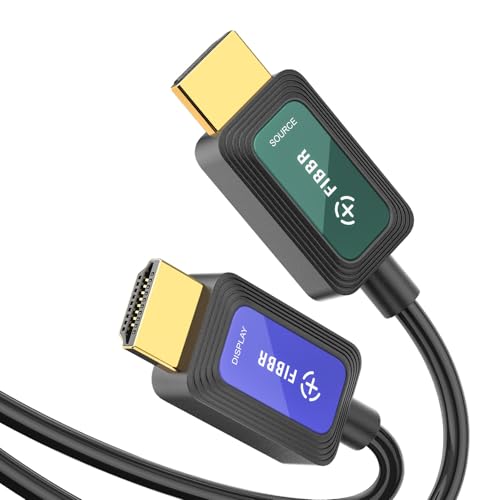
The FIBBR cable delivers the same 48Gbps HDMI 2.1 backbone as the BENFEI but at a lower entry point, making it the strongest value proposition in this list. It supports 8K@60Hz and 4K@120Hz with dynamic HDR, VRR, ALLM, and DSC—everything a PS5 or Xbox Series X owner needs for high-refresh gaming across a room.
FIBBR uses YOFC fiber optic cores, which are immune to EMI and RFI interference. This matters when running a 100-foot cable alongside power lines, networking gear, or near appliances. The cable is 50% thinner and lighter than equivalent copper cables, weighing only 3.2 ounces for the full 100-foot run. That makes ceiling and wall routing dramatically easier than wrestling with a heavy copper snake.
One important caveat: cables longer than 66 feet do not support ARC or eARC. FIBBR explicitly notes this, so you will need a separate audio connection (optical or HDMI on a shorter cable) for sound return. But for pure video transmission at 4K@120Hz, this cable matches performance with cables that cost more than double.
Why it’s great
- Full 48Gbps HDMI 2.1 spec at a competitive price point
- Ultra-thin and lightweight—3.2 oz for easy routing
- EMI/RFI immune for runs near power cables
Good to know
- Does not support ARC or eARC at 100 ft length
- Unidirectional—check orientation before installation
3. OREI 8K HDMI 2.1 Cable 100ft – AOC Active Optical Fiber
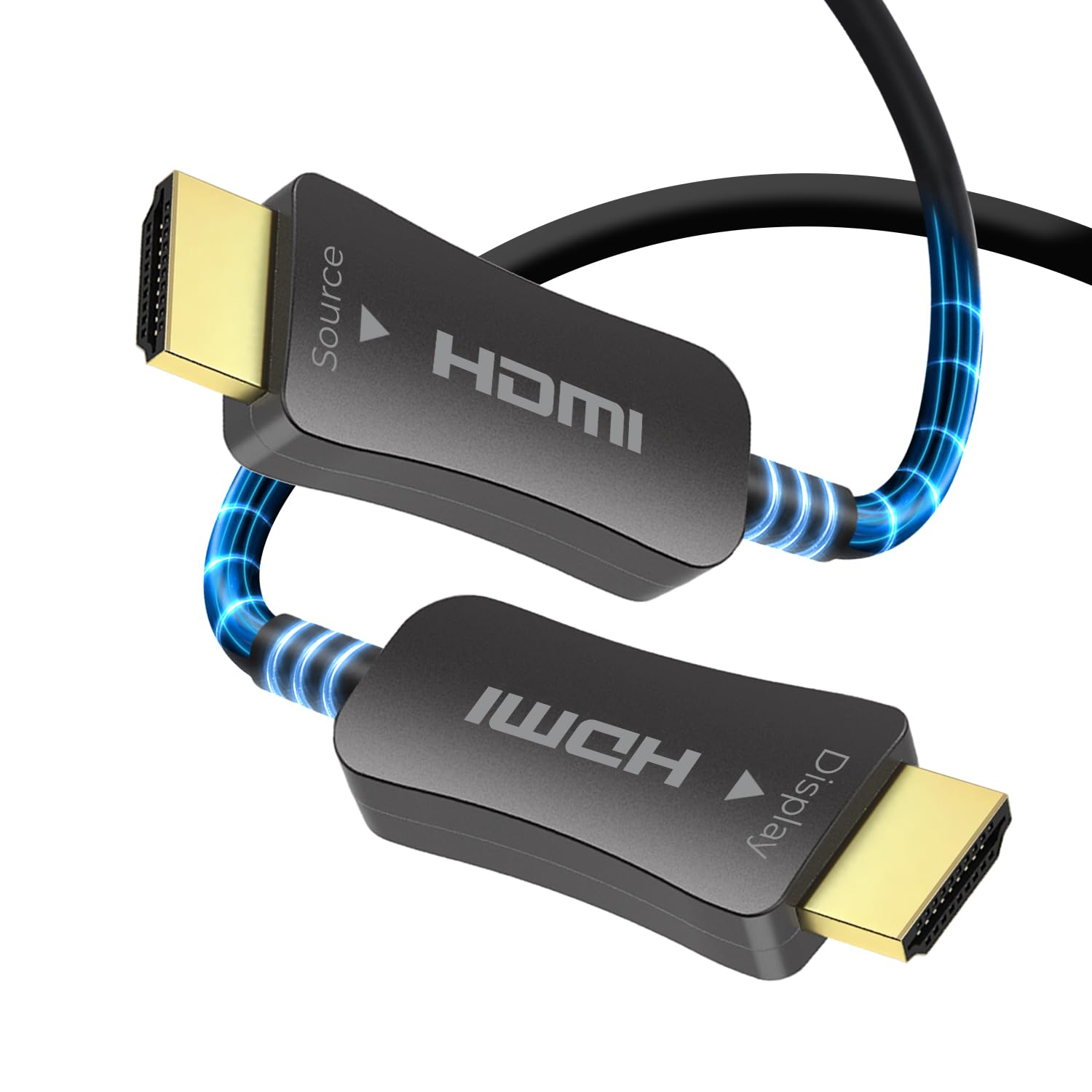
OREI builds its 100-foot cable with a hybrid active optical construction that combines fiber cores for long-distance signal integrity with a durable nylon PVC outer jacket. The result is a cable that handles 48Gbps bandwidth, supports 8K@60Hz and 4K@120Hz with HDR10+ and Dolby Vision, and provides eARC for uncompressed audio return—a feature the FIBBR cable lacks.
The connectors are gold-plated and housed in metal, with stress-relief sleeves that protect the delicate photoelectric converters at each end. OREI markets this cable for professional integrators, and the build quality reflects that audience. The EMI-free optical transmission means you can run this cable right next to a power line without introducing static or signal artifacts into your picture.
There is one reliability concern: some users report that AOC cables running at full 48Gbps bandwidth can overheat at the connector ends, causing intermittent dropouts after a week or two of use. This is a known issue with active optical cables pushed to their bandwidth ceiling for long periods. For most users running 4K@60Hz, this cable performs flawlessly, but those pushing 4K@120Hz HDR 4:4:2 continuously should monitor for potential failure.
Why it’s great
- Supports eARC for audio return at 100 ft
- Durable nylon PVC jacket with gold-plated metal connectors
- EMI/RFI immune for complex AV rack setups
Good to know
- Some units may develop dropouts under sustained 48Gbps load
- Unidirectional and not very bendy near the connector ends
4. Snowkids 8K HDMI Fiber Optic Cable Long 2.1 100FT

Snowkids rates this cable for 25,000 flex cycles thanks to its military-grade tensile nylon braiding and SR flexible strength design at the connector joints. If your installation requires bending the cable around corners, through tight conduits, or along baseboards that get moved periodically, this durability spec matters. Most fiber optic cables fail at the connector-to-cable junction when subjected to repeated stress.
Electrically, it delivers the full 48Gbps HDMI 2.1 specification with 8K@60Hz, 4K@120Hz, eARC, VRR, QFT, QMS, and ALLM. The gold-plated ports resist oxidation over years of use in humid basement or outdoor projector environments. Backward compatibility covers HDMI 1.4 through 2.0b, so it will work with older gear without handshake issues.
The stiffness that gives the cable its durability also makes it less ideal for temporary connections. Reviewers note the cable is stiff and harder to coil for frequent setup and teardown. It is best suited for a permanent installation where the cable is routed once and left in place. For mobile setups like a conference room projector that gets packed away, consider a more flexible option.
Why it’s great
- Rated for 25,000 flex cycles—extremely durable
- Military-grade tensile nylon braided jacket
- Full HDMI 2.1 support including eARC and VRR
Good to know
- Very stiff cable—poor for temporary or portable setups
- Some users report eARC/CEC issues in complex A/V systems
5. RUBMUD 8K HDMI 2.1 Cable 100ft Fiber Optic

The RUBMUD cable prioritizes flexibility and a slim profile over heavy-duty armor. It uses a thin fiber optic core with gold-plated connectors protected by a zinc alloy housing, rated for over 20,000 bending cycles. The slim diameter makes it the best option for routing through conduit, under carpet, or along tight cable raceways where thicker cables get stuck.
Bandwidth hits the full 48Gbps with support for 8K@60Hz, 4K@120Hz, 2K@240Hz, dynamic HDR, Dolby Vision, Dolby Atmos, VRR, ALLM, QFT, QMS, and DSC. It is backward compatible with HDMI 2.0 and 1.4 devices. The two-year warranty is better than most competitors offer, signaling confidence in the cable’s reliability over time.
Real-world performance using this cable to link a PC with an RTX 5080 to a TV in another room shows flawless 4K 144Hz HDR with G-Sync active, even over the full 100-foot length. The primary trade-off is that the connector heads are bulkier than the slim cable body, so you need clearance around your HDMI ports. The unidirectional ends are clearly labeled, but the larger connectors can be hard to plug into recessed ports on soundbars or wall-mounted TVs.
Why it’s great
- Thin and flexible profile—easiest for conduit routing
- Two-year warranty for long-term confidence
- Supports full HDMI 2.1 including 4K 144Hz G-Sync
Good to know
- Bulkier connector heads may not fit recessed ports
- Unidirectional—mistakes mean a wasted installation
6. Highwings 8K60HZ HDMI Fiber Optic Cable 2.1 100FT

The Highwings cable brings fiber optic HDMI 2.1 capability to a budget-friendly price point. It supports 48Gbps bandwidth with 8K@60Hz and 4K@120Hz, eARC, and variable refresh rate—the same core specs as cables costing much more. The braided jacket provides a good grip and protects the fiber core from minor abrasion during installation.
The cable uses an optical fiber core that eliminates electromagnetic interference and radiation, which is critical for long runs near other electronics. Signal transmission is effectively instantaneous at the speed of light, with no compression or delay. For a game console owner who just needs reliable 4K@120Hz across a living room, this cable delivers without overspending.
The trade-offs come in build finesse. The cable is stiff—one user reported difficulty plugging it into a soundbar with limited rear clearance. The connectors are solid but not as refined as the OREI or BENFEI equivalents. Reviewers had no issues with signal quality once the cable was seated properly, but the stiffness means it is not ideal for setups requiring frequent disconnection.
Why it’s great
- Entry-level price for full 48Gbps fiber optic HDMI 2.1
- Braided outer jacket for cable protection
- EMI-free optical transmission for clear signal
Good to know
- Stiff cable—hard to maneuver into tight spaces
- No in-wall fire rating for permanent installations
7. grofyllaa 4K HDMI Cable 100FT, High Speed HDMI 2.0
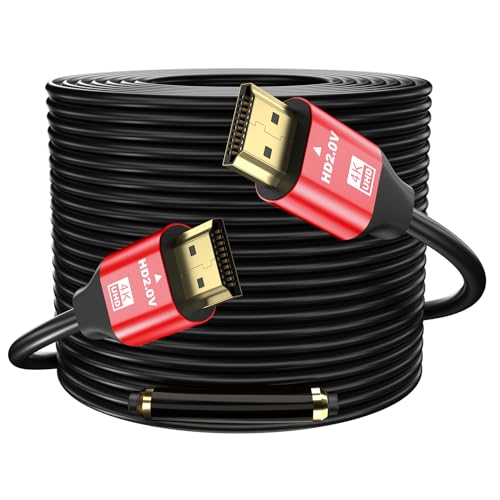
The grofyllaa cable is the odd one out in this list—it is a passive copper cable, not fiber optic. At 100 feet, copper is pushing far beyond its reliable range. The cable is rated for 18Gbps (HDMI 2.0 spec) which supports 4K@60Hz and 2K@120Hz, with gold-plated connectors and HDCP 2.2/2.3 compliance. For a basic office meeting room or a Blu-ray player at 1080p, it can work.
Customer reviews paint a mixed picture. One user had success running a Blu-ray player at 1080p from a laptop to a basement TV. Another reported that the unshielded cable caused random TV disconnects and graphical bugs that only resolved when the cable was moved away from other power cords. This is exactly the interference problem that fiber optic cables are designed to solve—copper acts as an antenna at long distances.
The value proposition is simple: this is the lowest-cost 100-foot HDMI cable available. But the reliability ceiling is low. If your use case is streaming 1080p video in a clean electrical environment with no interference sources, it will probably work. For 4K HDR gaming or a permanent in-wall installation, the grofyllaa is not the right tool and should be skipped in favor of a fiber optic alternative.
Why it’s great
- Lowest-cost option for budget-constrained setups
- Gold-plated connectors for corrosion resistance
- HDCP 2.2/2.3 compliant for streaming devices
Good to know
- Passive copper—prone to signal loss at 100 ft
- Unshielded design picks up EMI interference from nearby cables
- Not suitable for 4K HDR or high-refresh gaming at this length
FAQ
Do I need an active optical cable for a 100-foot HDMI run?
Can I use a 100ft HDMI cable for 4K 120Hz gaming on a PS5?
Does a 100ft fiber optic HDMI cable support eARC?
Final Thoughts: The Verdict
For most users, the 100ft hdmi cable winner is the BENFEI 8K HDMI 2.1 Fiber Optic because it delivers full 48Gbps bandwidth with CL3 in-wall safety rating, eARC support, and the peace of mind of a solid warranty at a reasonable mid-range price. If you want the best value without sacrificing HDMI 2.1 specs, grab the FIBBR Fiber Optic HDMI. And for a permanent installation requiring maximum durability and flexible routing, nothing beats the RUBMUD 8K Fiber Optic for its slim profile and two-year warranty.