
Your live set sounds hollow, the vocals are buried, and every gain adjustment introduces a fresh layer of noise. A 12-channel mixing board is supposed to be your command center, but picking the wrong one means fighting feedback, clipping, and muddy preamps instead of focusing on the performance.
I’m Min — the co-founder and writer behind Gadgets Feed. I’ve spent countless hours analyzing frequency response curves, EIN specs, and construction methods across dozens of analog and digital mixers to separate the boards that deliver clean, usable gain from those that just add to the noise floor.
Whether you are routing a four-piece band, building a podcast studio, or wrangling a rack of synthesizers, finding the best 12 channel mixing board comes down to matching preamp quality, routing flexibility, and connectivity to your specific signal flow.
How To Choose The Best 12 Channel Mixing Board
A 12-channel mixer is a significant investment in your audio chain. The right board saves you hours of post-production cleanup; the wrong one introduces problems you cannot EQ away. Focus on the specific inputs you need, the preamp quality, and how the board fits your live or studio workflow.
Input Topology: XLR Combo vs. Line-Only
A true 12-channel board often counts stereo pairs as two channels. Verify how many of those inputs accept XLR for condenser mics (with phantom power) versus 1/4″ line-level only. If you need to mic six sources simultaneously with balanced XLR cables, you need at least six mic preamps—many budget boards only offer four.
Preamp Quality and Headroom
The measurable spec is Equivalent Input Noise (EIN), expressed in dBu. A preamp rated at -128 dBu or lower (like the Zoom L-12) is exceptionally quiet. Higher numbers like -60 dBu indicate a noisy preamp that will add hiss to quiet sources. Budget boards often omit this spec, which is a red flag for critical recording.
Routing: Aux Sends, Subgroups, and Inserts
Auxiliary sends let you create separate monitor mixes for performers. Subgroups (or bus routing) group several channels under one fader for master control. Inserts (per-channel send/return) are essential for applying outboard compression without affecting the entire mix. The more routing options you have, the more complex your setup can be.
Quick Comparison
On smaller screens, swipe sideways to see the full table.
| Model | Category | Best For | Key Spec | Amazon |
|---|---|---|---|---|
| Mackie ProFX12v3+ | Premium Analog | Streaming & Studio | 24-bit / 192 kHz USB-C | Amazon |
| Zoom LiveTrak L-12 | Hybrid Recorder | Multitrack Recording | 14-track SD recording | Amazon |
| Behringer X AIR XR18 | Digital Mixer | Remote Mixing | 16 MIDAS preamps | Amazon |
| SOUNDCRAFT EPM12 | Premium Analog | Transparent Signal Path | Swept-mid EQ | Amazon |
| Mackie 1202VLZ4 | Analog Workhorse | Broadcast & Live | 60 dB gain range | Amazon |
| Yamaha MG12 | Analog Workhorse | Band Rehearsal & Gigs | D-PRE preamps | Amazon |
| Pyle PMXU128BT | Value Analog | Live MC & Music | 7-Band EQ | Amazon |
| Behringer Xenyx 1202SFX | Entry-Level Analog | Synth & Small Rig | Built-in effects | Amazon |
| Depusheng DT12 | Budget Entry | Basic Open Mic | Bluetooth streaming | Amazon |
In‑Depth Reviews
1. Mackie ProFX12v3+
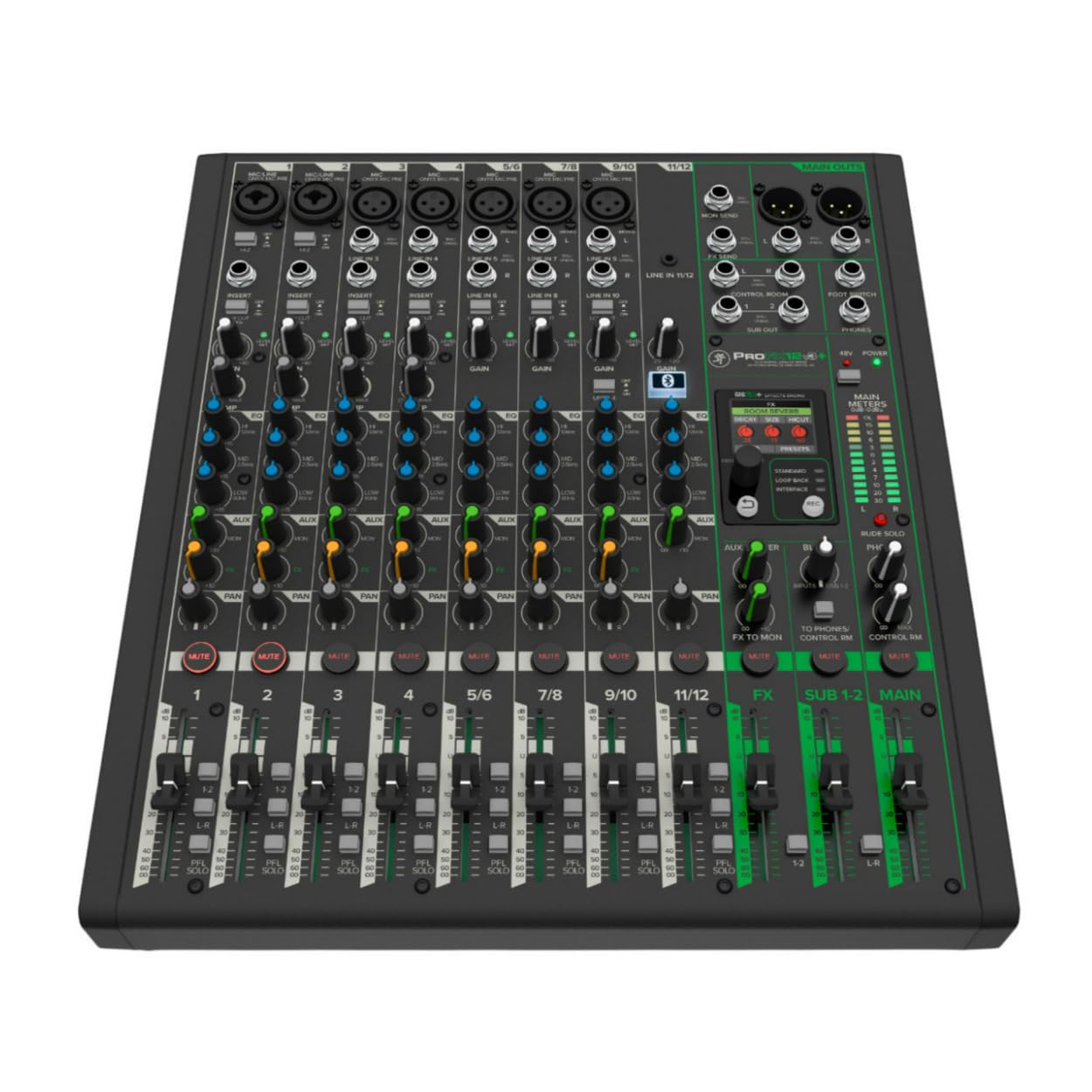
The ProFX12v3+ bridges the gap between an analog console and a modern production hub. Its 24-bit / 192 kHz USB-C audio interface supports three recording modes — Standard for the full mix with effects, Loopback for streaming that incorporates computer audio, and Interface mode for capturing channels 1-2 dry. The Onyx preamps deliver a measured headroom that keeps the noise floor inaudible even at high gain.
The GigFX+ effects engine is a standout feature for a 12-channel mixer at this level. You get 12 presets that can be edited and saved directly on the color LCD screen, covering reverb, delay, chorus, and modulation — applied via a dedicated FX bus so it does not muddy your dry signal. Bidirectional Bluetooth with Mix Minus automatically prevents feedback when taking phone calls on a podcast stream.
Build quality is classic Mackie steel, but the compact 13-inch depth means it fits on a crowded desktop. One-knob compression on the mic channels simplifies dynamic control without requiring an outboard compressor. This is the most versatile single-box solution for a musician or podcaster who needs pro-grade sound with zero external equipment for effects or computer connectivity.
Why it’s great
- Three-mode USB-C interface for recording, streaming, or dry capture
- Editable GigFX+ effects with visual LCD feedback
- Bidirectional Bluetooth with Mix Minus for phone calls
Good to know
- Only two subgroups; large bands may want more bus routing
- Effects library is high-quality but limited to 12 presets
2. Zoom LiveTrak L-12

The Zoom L-12 is not just a mixer — it is a 14-track standalone recorder that writes directly to SD card at 24-bit / 96 kHz. This makes it the most powerful tool for a band that wants to capture live practice or a gig without a laptop. All 12 input channels plus a stereo master track are recorded individually, giving you full multitrack editing capability in your DAW after the show.
Five dedicated headphone outputs with independent monitor mixes are a game-changer for rehearsal rooms. Each musician gets their own blend of instruments and vocals via the aux sends, controlled from individual knobs on the top panel. The preamps measure -128 dBu EIN, which is exceptionally quiet and rivals dedicated microphone preamps costing several hundred dollars alone.
The L-12 also functions as a USB audio interface with 12 inputs and 4 outputs for DAW integration. Its battery-powered option (6 AA batteries) means you can record a remote field session without hunting for a wall outlet. The form factor is surprisingly compact at 17.5 inches wide and only 2.78 inches tall, fitting into a backpack alongside a laptop.
Why it’s great
- 14-track simultaneous SD recording with zero computer required
- Five separate headphone mixes for your entire band
- Ultra-low -128 dBu EIN preamps for clean gain
Good to know
- Internal compression is always applied and cannot be bypassed
- Plastic chassis feels less rugged than all-metal competitors
3. Behringer X AIR XR18

The XR18 abandons physical faders entirely, putting full digital control on an iPad/Android tablet via its built-in Wi-Fi router. This is the right choice when you need to mix from the middle of the room or backstage. The 16 fully programmable MIDAS-designed mic preamps are legendary in the budget digital market for their low noise and wide gain structure.
Every channel gets a full suite of processing: 4-band parametric EQ, compressor, gate, and a dedicated effects send, all without touching outboard gear. The 18×18 bidirectional USB interface lets you record every channel directly to your DAW. The unit also features Dugan-style auto-mixing, which automatically manages gain sharing between multiple open microphones—ideal for panel discussions or sermons.
Rack-mountable in a 3U space, the XR18 is the most portable full-featured digital mixer in this list. The trade-off is total reliance on a tablet or phone for operation; losing Wi-Fi mid-show means losing control of the mix. A wired Ethernet connection provides a failsafe. The XR18 is the only digital board here and delivers routing complexity impossible on analog competitors.
Why it’s great
- Sixteen MIDAS preamps with program recall for each channel
- Full suite of digital processing per channel (EQ, comp, gate)
- Rack-mountable 3U form factor saves stage space
Good to know
- Built-in Wi-Fi can be unreliable in RF-congested venues
- No physical faders means no tactile mixing without a tablet
4. SOUNDCRAFT EPM12

The Soundcraft EPM12 represents old-school analog engineering where the design goal is absolute transparency. With 12 mono inputs plus 2 stereo inputs, it offers a 14-input capacity while maintaining a signal path that is remarkably clean and neutral. The 3-band EQ features a swept mid (variable frequency) on every mono channel, which is a professional-level tool for notching out specific problem frequencies in a live room without affecting the rest of the mix.
Insert points are present on every mono input channel and the main outputs, making it easy to patch in a compressor or graphic EQ without breaking the signal flow. The XLR outputs are transformer-balanced, providing excellent common-mode rejection even over long cable runs. The RCA phono inputs for playback and record outputs give you a simple way to play backing tracks without consuming a line input.
The chassis is built like a tank at 14.77 pounds — noticeably heavier than anything else in this list, which speaks to the internal power supply and metal construction. The only notable omission is a power switch; the mixer is live as soon as you plug it in. It lacks built-in effects and USB connectivity, so this is strictly for users who want a pristine analog path and already own the outboard gear or interface they need.
Why it’s great
- Swept-mid EQ on all mono channels for surgical frequency control
- Insert jacks on every mic input for outboard processing
- Transformer-balanced outputs for noise rejection
Good to know
- No power switch — active as soon as power cable connects
- No built-in effects or USB audio interface
5. Mackie 1202VLZ4

The 1202VLZ4 is a legend in the small-format mixer world for a reason: its ultra-wide 60 dB gain range allows you to amplify a ribbon microphone to usable levels without introducing noise. The four Onyx mic preamps are the same design found in Mackie’s larger consoles, delivering -129 dBu EIN and a clean signal that requires minimal EQ correction.
The VLZ4 architecture uses high-headroom line inputs that accept a +28 dBu signal before clipping, so you can plug in hot line-level gear like drum machines or synthesizers without hitting the red. Three-bus routing lets you send channels to a subgroup for group compression or separate monitor feeds. Every input channel also has a mute button and a dedicated -20 dB pad for handling extreme source levels.
The chassis is all metal with an internal power supply — no wall wart to lose. It is compact for its feature set at 6.5 pounds. The downside is a complete lack of built-in effects and no USB connectivity. You will need an external interface for computer recording and outboard FX for reverb or delay. The headphone volume is tied to the main mix, so independent headphone monitoring is limited.
Why it’s great
- 60 dB of clean gain ideal for quiet or ribbon microphones
- +28 dBu headroom for hot synthesizer inputs
- Metal chassis with internal power supply
Good to know
- No built-in effects or USB audio interface
- Headphone output not independent of main mix
6. Yamaha MG12
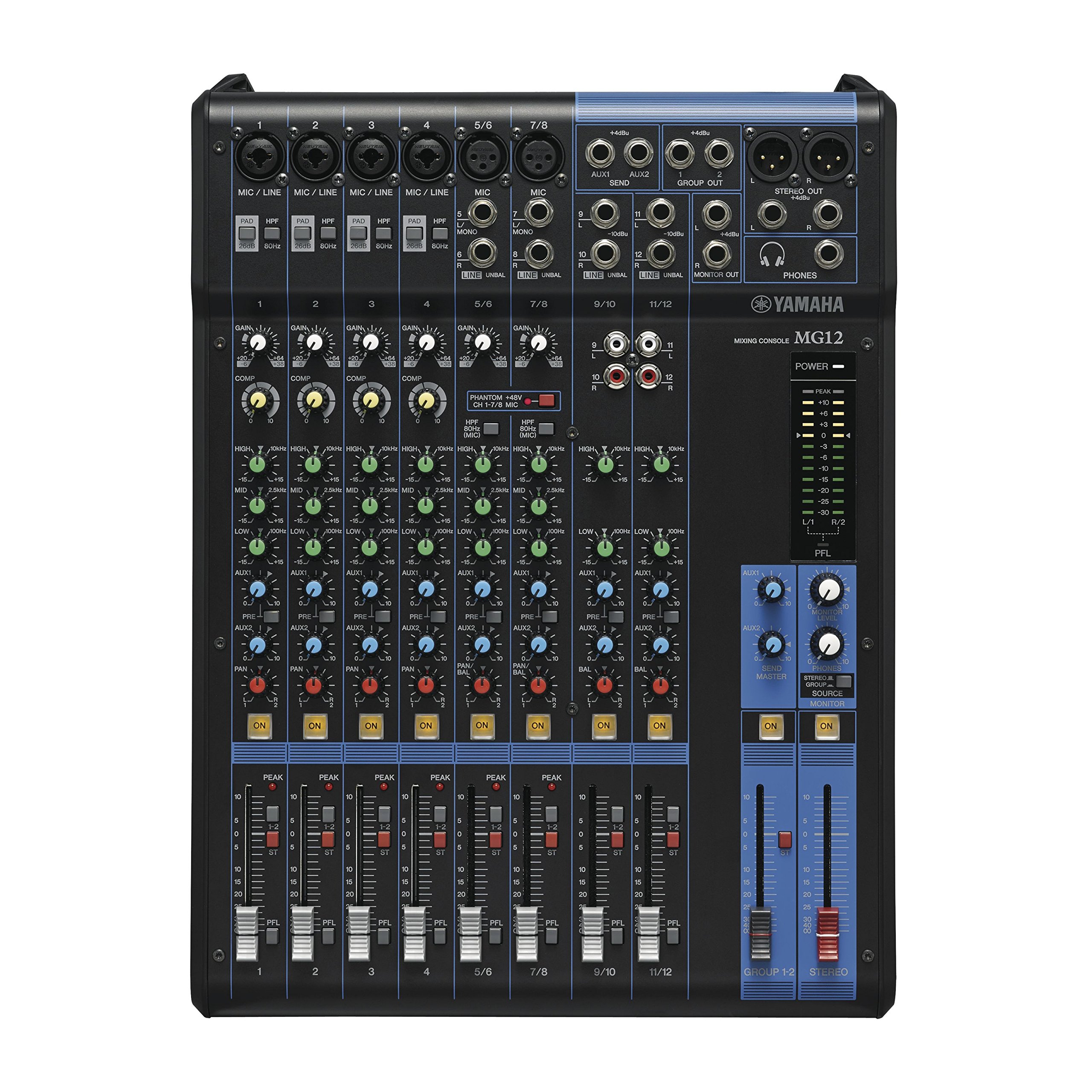
The Yamaha MG12 is built around the D-PRE preamp, which uses an inverted Darlington circuit for a high input impedance that preserves the natural character of dynamic microphones. The four mic preamps can handle 48V phantom power for condenser mics, and the channel 1-2 inputs include a Hi-Z switch for plugging a guitar or bass directly into the board without an external DI box.
One-knob compressors on channels 1-4 provide instant dynamic control for vocals or acoustic instruments — a feature usually reserved for higher-end consoles. The 3-band EQ has a sweepable mid on the first four channels and fixed mids on the remaining channels. The metal chassis feels solid and the internal universal power supply accepts any voltage worldwide, making it a reliable travel companion for international gigs.
The MG12 is a workhorse that gets out of the way. Its sound is clean but not sterile, with enough headroom for a four-piece band. A significant omission is insert jacks — you cannot patch outboard gear into individual channels, which limits dynamic processing options without a separate effects rack. Some users also report hiss at higher gain settings when using synthesizers, so gain staging is important with this unit.
Why it’s great
- D-PRE preamps with high impedance preserve microphone character
- One-knob compressors on channels 1-4 simplify live dynamics
- Internal universal power supply works worldwide
Good to know
- No insert jacks on individual channels
- Can introduce hiss with quiet synthesizer sources at high gain
7. Pyle PMXU128BT

The Pyle PMXU128BT is the value option that does not cut corners on input count. It offers 12 XLR combo inputs — more mic preamps than most boards at twice its price. Each channel has a 3-band EQ, and the master section includes a 7-band graphic EQ for final system tuning, which is extremely rare in this price tier.
Bluetooth wireless streaming lets you play backing tracks from a phone directly into a channel, and the USB soundcard interface records the master mix to a computer. The 16 DSP effects, while not studio-grade, are usable for adding reverb or delay to a vocal during a live performance without external gear. The 12-segment LED meter with a clip indicator helps with gain staging on the fly.
The build is plastic but the weight (10.59 pounds) and size suggest a thick chassis that will survive regular transport. Some users report that the USB connection can be finicky and the built-in effects are basic rather than inspiring. For a church group, coffee shop performer, or MC who needs many mic inputs on a tight budget, this board delivers essential functionality without breaking the bank.
Why it’s great
- Twelve XLR combo inputs — most in its price range
- 7-band graphic EQ for master output shaping
- Bluetooth streaming and USB recording included
Good to know
- DSP effects are basic and not adjustable
- USB connectivity can be intermittent
8. Behringer Xenyx 1202SFX

The Xenyx 1202SFX is explicitly designed for content creators and synth enthusiasts. Twelve 1/4″ TRS line inputs give you abundant connectivity for drum machines, synthesizers, and samplers. Four Xenyx mic preamps handle vocal mics when needed, and the 3-band EQ on every channel is sufficient for tonal shaping on stage.
The built-in effects processor offers 99 voices of reverb, delay, and chorus, accessible via a dedicated FX return and send control. This is a major convenience for a musician who wants ambience without an outboard effects unit. USB connectivity allows it to function as a streaming audio interface, though it only sends the stereo master mix rather than individual channels.
The form factor is notably compact — smaller than a laptop and lighter than a paperback book at 4.5 pounds. This makes it the most portable option for sidewalk gigs, suitcase DJ setups, or a spare mixer in a touring rack. The main compromise is that the 12-channel count includes four channels with mic preamps and eight line-only channels, so it is not suited for a scenario where you need to mic many sources simultaneously.
Why it’s great
- Twelve TRS line inputs perfect for synthesizers and drum machines
- 99-voice effects processor built-in
- Extremely lightweight and compact for portable use
Good to know
- Only four channels have XLR mic preamps
- USB sends stereo mix only, not individual channels
9. Depusheng DT12

The Depusheng DT12 is the budget board that prioritizes connectivity variety. It has 12 channels, each with an XLR microphone input and 1/4″ line input, plus Bluetooth wireless streaming that can mix an external source with your microphones or instruments. +48V phantom power means you can use condenser microphones without an external power supply.
The chassis is an ultra-thin 1.6 inches tall, using sealed rotary knobs that resist dust from stage environments. The 3-band EQ per channel and the 10-segment stereo output meter provide the visual feedback needed for live gain staging. It includes both XLR and RCA inputs and outputs, plus 1/4″ send and return for connecting an external effects processor.
The preamps are functional but not noise-free — the EQ only boosts or cuts preset frequencies rather than offering sweepable control, and the built-in effects are described as terrible in real-world user feedback. The Bluetooth range is limited to 15 feet. This is a board for a beginner musician setting up their first open mic night or a small event where absolute audio purity is not the primary concern. Customer support is responsive for troubleshooting.
Why it’s great
- XLR and 1/4″ input on every channel for mic or line sources
- Bluetooth input for wireless music streaming
- Ultra-thin 1.6-inch profile for tight rack fits
Good to know
- EQ is limited to fixed frequency bands, not sweepable
- Built-in effects lack quality; external FX recommended
FAQ
Can a 12-channel mixing board record individual tracks to a computer?
How many microphones can I plug into a 12-channel mixer?
What is the difference between analog and digital mixers in this category?
Final Thoughts: The Verdict
For most users, the best 12 channel mixing board winner is the Mackie ProFX12v3+ because it combines premium Onyx preamps with a versatile USB-C audio interface and editable digital effects in a single compact package. If you need full multitrack recording without a computer, grab the Zoom LiveTrak L-12. And for a fully digital workflow with processing on every channel, nothing beats the Behringer X AIR XR18.