
Filling a 120-inch diagonal canvas with a sharp, vibrant image isn’t just about buying the brightest box on the shelf. The gap between a muddy, washed-out 120-inch picture and one that rivals a commercial cinema comes down to specific choices in light engine technology, lens shift capability, and ambient light rejection strategy that most buyers overlook until the first movie night flops.
I’m Min — the co-founder and writer behind Gadgets Feed. I’ve spent countless hours comparing 3LCD vs. DLP architectures, analyzing lumen charts, and breaking down color gamut specs to find which projectors actually deliver a compelling, fatigue-free 120-inch picture without forcing you into a blacked-out bunker.
This guide focuses on the projectors and screens that can actually hold their own at this massive size — the premium, mid-tier, and entry-level options that make the 120 inch projector experience genuinely impressive rather than just physically large.
How To Choose The Best 120 Inch Projector
Choosing a projector for a 120-inch display is a different game than picking one for a small portable setup. The larger the image, the more every flaw — from color uniformity to black level to fan noise — is magnified. Here are the critical factors to weigh before you commit to a massive screen.
Light Engine: Laser vs. Bulb vs. Hybrid
Traditional UHP lamp projectors can be bright but generate significant heat and degrade over time. Laser and hybrid laser-LED sources offer longer life (20,000-30,000 hours) and more consistent brightness. For a 120-inch canvas, a laser or hybrid source is often the smarter long-term investment, as they maintain their peak luminance without the gradual dimming that plagues aged bulbs.
Lumens and Ambient Light
The standard rule of thumb is that you need at least 1,000 lumens for every 40-50 diagonal inches in a dark room. For a 120-inch screen with any ambient light, 3,000 to 4,000 lumens is your real starting point. However, high brightness can wash out black levels — which is why a screen with a modest ambient light rejecting (ALR) coating can drastically improve perceived contrast without needing a brighter projector.
Resolution: True 4K vs. Pixel-Shifted 4K
On a 120-inch canvas, the difference between native 4K and pixel-shifted 4K is more noticeable than on a smaller screen. Native 4K (8.3 million distinct pixels) delivers razor-sharp text and fine details. Pixel-shifted 4K can still be impressive, but the slight softness becomes visible on a surface that large. If you plan to sit closer than 10 feet, native 4K is the safer bet.
Quick Comparison
On smaller screens, swipe sideways to see the full table.
| Model | Category | Best For | Key Spec | Amazon |
|---|---|---|---|---|
| Epson Home Cinema 3800 | Premium Home Theater | Cinema purists wanting 3LCD color and lens shift | 3000 Lumens | Amazon |
| BenQ W2720i | Premium Smart | Accurate colors out of the box for review | 2500 Lumens | Amazon |
| Hisense C2 Ultra | Premium Laser | Triple laser color and 240Hz gaming | 3000 Lumens | Amazon |
| NexiGo TriVision Ultra | Hybrid Flagship | Zero laser speckle with Dolby Vision | 2600 Lumens | Amazon |
| Dangbei MP1 MAX | Laser Flagship | Integrated Google TV with streaming | 3100 Lumens | Amazon |
| XGIMI Horizon S Max | Portable Premium | IMAX Enhanced with built-in flexible stand | 3100 Lumens | Amazon |
| Optoma UHD38x | Gaming Pure | True 4K gaming at a lower price point | 4000 Lumens | Amazon |
| Optoma GT2100HDR | Short Throw Laser | Large image in very tight spaces | 4200 Lumens | Amazon |
| MIGO 120 Inch Motorized Screen | Motorized Screen | Tab-tensioned screen for a flat surface | 2.0 Gain | Amazon |
| Epson EX3290 | Business / Education | Bright multi-purpose with dual HDMI | 4000 Lumens | Amazon |
| YODOLLA 120 Inch Floor Screen | Motorized Floor Screen | Retractable floor-rising screen for UST | 160° Viewing Angle | Amazon |
In‑Depth Reviews
1. Epson Home Cinema 3800

The Epson Home Cinema 3800 remains a benchmark in the sub- home theater class. Its 3-chip 3LCD design delivers 100% of the RGB color signal across every frame, which translates to a noticeably richer and more uniform color saturation than single-chip DLP projectors can achieve — especially critical on a 120-inch canvas where color uniformity is easily tested by the human eye.
With 3,000 lumens of both color and white brightness, it can fill a 120-inch screen with a vibrant image even with some ambient light present. The powered lens shift (vertical and horizontal) is a luxury at this price point, allowing you to mount the projector on a high shelf or ceiling without tilting the chassis and introducing trapezoidal distortion. The pixel-shifting 4K PRO-UHD processing, while not native 4K, produces a sharp image that upscales 1080p content exceptionally well.
The build quality is solid, though the fan in Dynamic mode is audible — most owners run it in ECO or Natural mode where it’s quiet enough to forget during a movie. The rear-firing dual 10W speakers are functional but not immersive; a dedicated sound system is the expected pairing for a 120-inch setup. Overall, the 3800 offers the most balanced package of brightness, color fidelity, and installation flexibility.
Why it’s great
- 3LCD technology eliminates the rainbow effect visible on large screens
- Exceptional lens shift makes installation easy in almost any room
- 100,000:1 dynamic contrast delivers solid black levels for its class
Good to know
- Fan noise in Dynamic mode is noticeable during quiet scenes
- Native resolution is pixel-shifted 4K, not native 4K
- Built-in speakers are underpowered for a dedicated theater
2. BenQ W2720i
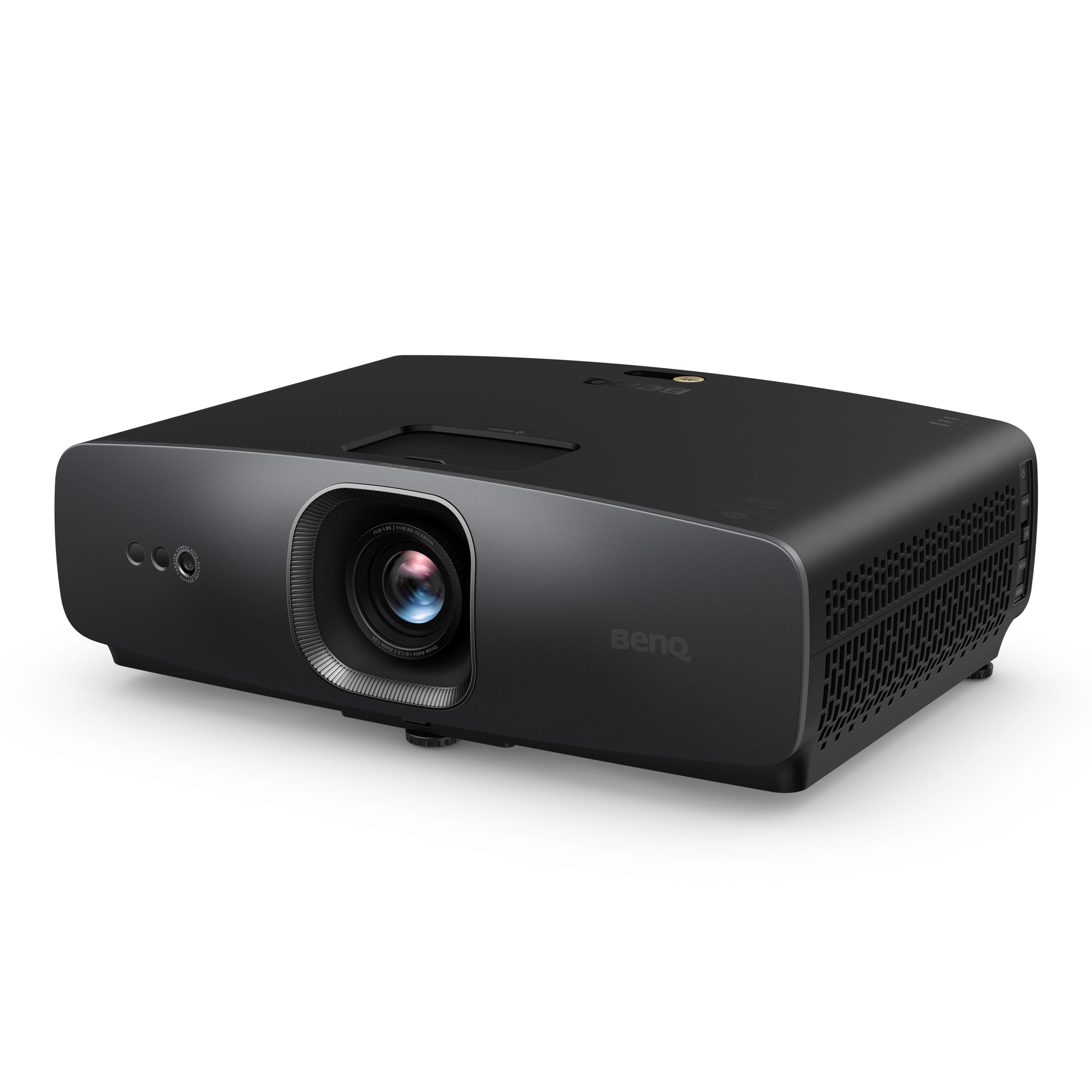
The BenQ W2720i is built for the videophile who obsesses over color accuracy out of the box. It achieves 90% of the DCI-P3 color gamut with a factory-calibrated Delta E of less than 3 — meaning the colors on your 120-inch screen will look almost exactly as the director intended, without hours of manual calibration. This is a rare capability for a projector in the premium mid-range.
Its 2,500-lumen LED light source is not the brightest on this list, but it’s optimized for a controlled-light home theater rather than a living room with sunlit windows. The 2,000,000:1 contrast ratio is excellent for an LED projector, producing deep blacks that hold their own against many laser competitors. The built-in Android TV interface with AI Cinema Mode is genuinely useful, adapting the picture to ambient conditions without the need for an external streaming stick.
One notable detail for gaming fans: the W2720i supports 4K at 120Hz input on its HDMI 2.1 ports, which is rare among projectors. The trade-off is that the fan can be heard cycling when the AI mode is disabled, and the physical design assumes a stationary ceiling mount. For the buyer who prioritizes accurate color over all else, this BenQ is a top contender.
Why it’s great
- Factory-calibrated Delta E < 3 for out-of-box accuracy
- 30,000-hour LED light source with no lamp replacement needed
- HDMI 2.1 with 4K 120Hz input for smooth gaming
Good to know
- 2,500 lumens is best for dark-room use only
- AI Cinema Mode can introduce audible clicking as it adjusts
- Relatively heavy at 21 pounds for portable use
3. Hisense C2 Ultra

The Hisense C2 Ultra is a technological powerhouse that brings triple-laser light engine technology into a relatively portable chassis. Its 3,000 ANSI lumens of pure laser light produce a color gamut covering 110% of BT.2020, resulting in reds and greens that look almost over-saturated compared to lesser projectors — but in a controlled theater environment, it creates a genuinely stunning, HDR-rich image on a 120-inch screen.
Features like the built-in 360° gimbal for angle adjustment, 1.67x optical zoom, and Magic Auto Adjustment system make physical setup incredibly flexible and fast. The 240Hz refresh rate at 1080p and 120Hz at 4K place it among the best gaming projectors available. The integrated JBL speakers, while not a replacement for a discrete audio system, are surprisingly robust for late-night viewing.
The main caveat is the price — it sits at the top of our list for a reason. The VIDAA operating system is responsive but some users report minor laser speckle on certain white background environments, though a matte screen surface mitigates this. For the buyer who wants the very best color and brightness for their 120-inch theater today, the C2 Ultra is the standard to beat.
Why it’s great
- Triple laser technology delivers best-in-class color gamut
- 240Hz / 4K 120Hz support for competitive gaming
- Built-in gimbal and optical zoom simplify placement
Good to know
- Premium price that exceeds many mid-range projectors
- Minor laser speckle may appear on untreated white walls
- Slightly less throw ratio flexibility than some competitors
4. NexiGo TriVision Ultra

The NexiGo TriVision Ultra uses a unique hybrid light source that merges tri-color LED and tri-color laser into one engine. The major advantage of this hybrid approach is that it virtually eliminates the laser speckle that can make laser projectors look grainy on large screens. Combined with Dolby Vision and HDR10+ support, the 2,600-lumen output yields a smooth, cinematic image on a 120-inch surface that feels refined rather than artificially sharp.
Gamers will appreciate the 4.2ms input lag in gaming mode, which is among the lowest we’ve seen in this category. The trio of HDMI 2.1 ports, including eARC support, is generous for a device of this size. The hidden storage slot for a Fire TV Stick is a thoughtful touch that keeps the setup clutter-free. The included Google TV interface is responsive and snappy.
The 100,000:1 dynamic contrast ratio is excellent, though the Full Fade to Black feature is effective enough to make dark scenes feel genuinely immersive. The 30W speakers produce more body than most built-in audio solutions, but a soundbar is still recommended for a full theater experience. The TriVision Ultra is an excellent choice for the buyer who wants a noise-free, speckle-free, ultra-low-latency 4K experience at 120 inches.
Why it’s great
- Hybrid light source eliminates laser speckle completely
- Ultra-low 4.2ms input lag for serious gaming
- Triple HDMI 2.1 ports with eARC for easy connectivity
Good to know
- 2,600 lumens is slightly lower than pure-laser alternatives
- Odd pixel structure can cause slight softness in corners
- Fan speed can cycle audibly during operation
5. Dangbei MP1 MAX
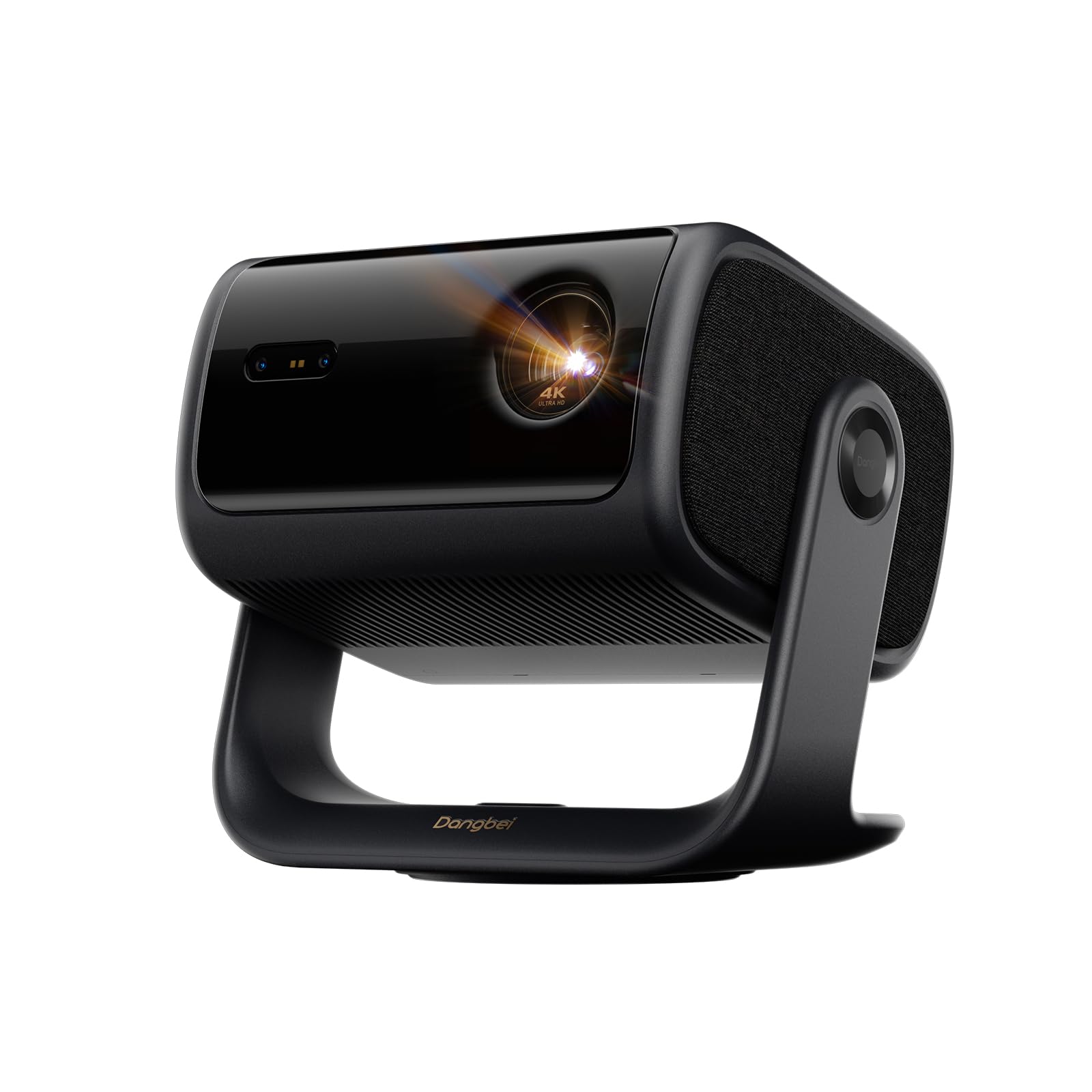
The Dangbei MP1 MAX punches well above its price point by combining a triple laser + LED hybrid engine with Google TV on a single device. The 3,100 ISO lumens output is bright enough to fill a 120-inch screen with punchy color even in a living room with blinds partially open. The 110% BT.2020 color gamut coverage is competitive with projectors costing twice as much, and the Delta E of less than 1 is genuinely impressive for this class.
Setup is simplified by the built-in adjustable stand with 360° horizontal and 135° vertical tilt, eliminating the need for an external mount. The InstanPro AI system handles auto focus, keystone correction, and obstacle avoidance with an accuracy that rivals dedicated smart projectors. The 2x12W speakers with Dolby Audio and DTS:X support provide enough volume for a medium-sized room without external speakers.
The main limitation is the single HDMI 2.1 port (with eARC), which can be a bottleneck if you have multiple sources. The Google TV interface is clean but blocks VPN installation — a minor issue for casual streamers but a deal-breaker for some. The MP1 MAX is the strongest overall value for anyone wanting a high-brightness 4K laser projector with a smart OS included.
Why it’s great
- Triple laser + LED hybrid delivers 110% BT.2020 with no speckle
- Built-in adjustable stand removes the need for ceiling mounts
- Google TV with Netflix built-in for direct streaming
Good to know
- Single HDMI port can be limiting for multi-source setups
- Google TV interface blocks VPN app installation
- Slightly softer image detail than native 4K competitors
6. XGIMI Horizon S Max

The XGIMI Horizon S Max brings IMAX Enhanced and Dolby Vision certification to the portable projector market — a rare combination that means certified content will display with the correct aspect ratio and enhanced contrast on your 120-inch screen. Its 3,100 ISO lumens and native 4K resolution produce an exceptionally clean image with minimal screen-door effect, even at close viewing distances.
The ISA 5.0 intelligent system handles all the hard work: auto focus, auto keystone, obstacle avoidance, and wall color adaptation. The flexible built-in stand allows for ceiling projection without a bracket. The 2x12W Harman Kardon speakers are among the best built-in audio we’ve tested, with 360° surround technology that actually creates a convincing soundstage without external speakers.
Like the Dangbei, the single HDMI port is a notable limitation, and the fan becomes audible in high brightness mode. The pixel-shifting buzz, described by some users as akin to a mini fridge, can be distracting in quiet rooms. For the buyer who wants a true IMAX-certified home theater experience with zero installation headache, the Horizon S Max is a compelling choice.
Why it’s great
- IMAX Enhanced and Dolby Vision certified for premium content
- ISA 5.0 intelligence makes setup completely hands-off
- Harman Kardon speakers are full-bodied for built-in audio
Good to know
- Single HDMI port limits source expansion
- Pixel-shifting buzz audible in quiet scenes
- Fan noise increases in high brightness mode
7. Optoma UHD38x

The Optoma UHD38x is a dedicated gaming projector that prioritizes raw brightness and fast response time. With 4,000 lumens of output, it can punch through ambient light to deliver a vivid 120-inch image during a Saturday afternoon sports league or gaming session. It accepts a 4K HDR signal and uses pixel-shifting to deliver a sharp picture, though it’s not native 4K.
The 1,000,000:1 contrast ratio provides solid dynamic range, and the game mode minimizes input lag effectively. The all-glass lens system delivers good edge-to-edge focus uniformity, which is critical for a surface as large as 120 inches. Setup requires precise mounting because the lack of lens shift means small adjustments cause big movements on screen.
The reliability record is the main concern — there are multiple reports of DMD chip failures after the warranty expires, including units that have been repaired multiple times. The 1.1x zoom range is also restrictive. For the budget-conscious gamer who needs a bright 120-inch image today and is prepared to take a risk on long-term reliability, the UHD38x offers excellent immediate performance.
Why it’s great
- 4,000 lumens provides excellent daytime brightness
- True 4K input with HDR and HLG support
- Ultra-responsive for gaming with low input lag
Good to know
- Reports of DMD failure after moderate use
- Limited 1.1x zoom and no lens shift
- Remote requires direct line-of-sight to the sensor
8. Optoma GT2100HDR

The Optoma GT2100HDR is a short throw laser projector that can cast a massive, bright image from a very short distance — a game changer for rooms where you can’t mount a projector across the entire ceiling. With 4,200 lumens and a laser light source rated for 30,000 hours, it delivers consistent brightness that won’t degrade over time, making it ideal for daily use on a 120-inch screen.
The native 1080p resolution with 4K input support is a step below the true UHD competitors, but the 300,000:1 dynamic contrast and 10-bit color processing produce an image that looks sharper than its spec sheet suggests. It runs cool and quiet thanks to its energy-efficient DuraCore laser technology, and the compact footprint means it fits on a low shelf or media console without dominating the space.
Setup is straightforward: place it close to the screen and adjust the focus. The digital shift feature is handy for fine-tuning. The main drawbacks are the 1080p native resolution (which is noticeable on 120 inches if you sit close) and a stiff focus ring that some users reported. There are also occasional reliability reports of units failing to turn on out of the box. For the short throw enthusiast learning the ropes, the GT2100HDR delivers enormous brightness in a compact package.
Why it’s great
- Short throw design fits in tight spaces and avoids ceiling mounting
- 30,000-hour laser light source for worry-free long-term use
- 4,200 lumens is bright enough for a fully lit room
Good to know
- Native 1080p resolution is soft on a 120-inch screen
- Stiff focus ring makes precise adjustment difficult
- Some reported units arrive with fault codes out of the box
9. MIGO 120 Inch Motorized Screen
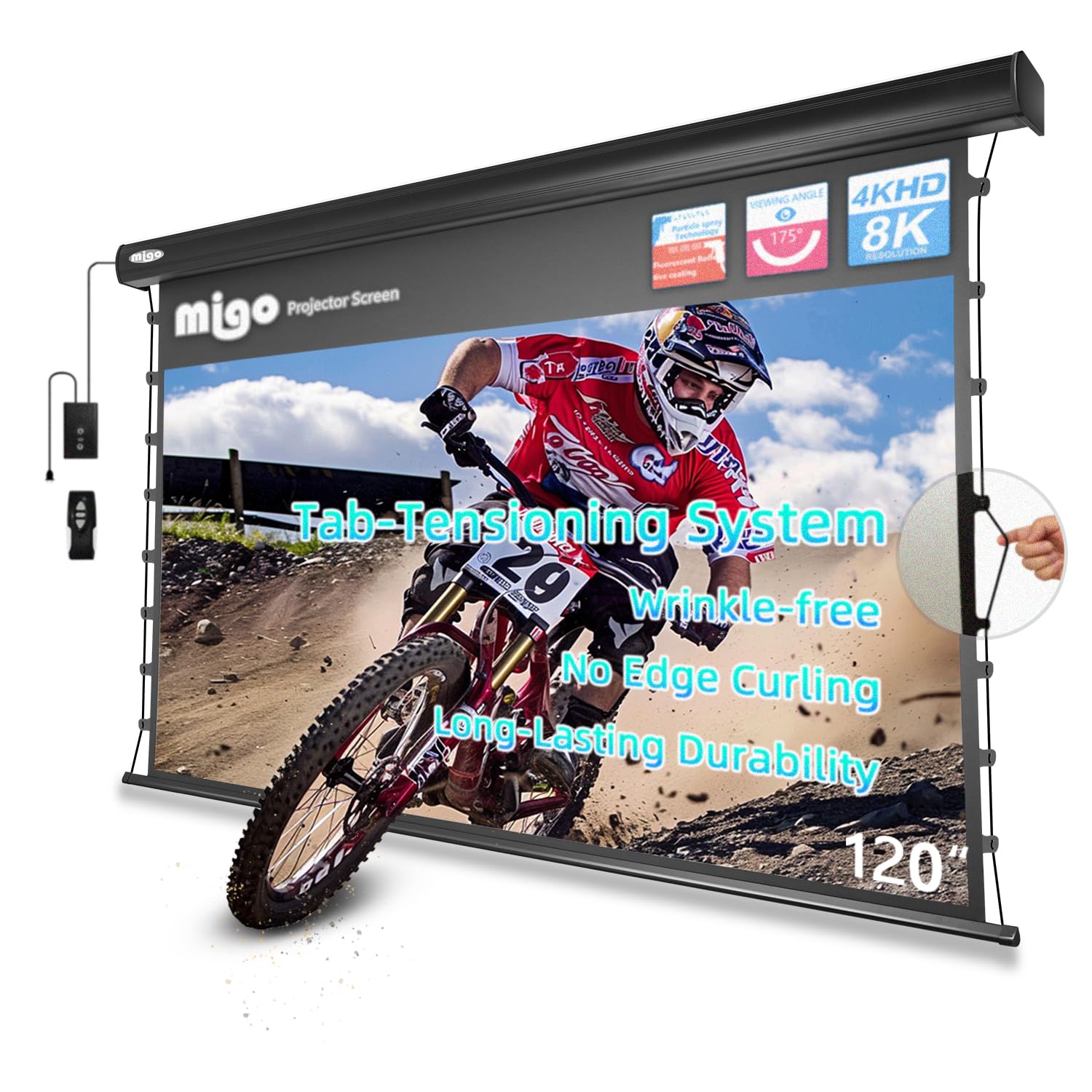
The MIGO tab-tensioned screen is a critical component that is often undervalued in a 120-inch setup. The tab-tension system uses side tensioning combined with a 9lb bottom weight to keep the fabric perfectly flat — no waves, no ripples, no V-shaped distortion that plagues cheaper pull-down screens. The 2.0 gain material boosts the perceived brightness of any projector, making a 3,000 lumen source feel like 6,000.
The grey crystal surface provides partial ambient light rejection, which helps maintain contrast in rooms that aren’t completely dark. The 175° viewing angle ensures that the image remains bright and uniform from any seat in the house. The motor is impressively quiet, with RF remote control that works up to 16 feet away. Installation is flexible with five mounting options including both ceiling and wall mounts.
The main trap is that the screen is marketed as an ALR screen but is not truly ambient light rejecting — it’s a grey material with partial rejection. For ultra-short throw (UST) projectors, performance is average at best. The weight (18 pounds) requires two people for secure mounting. For buyers with a standard or short throw projector looking for a flat, motorized screen, the MIGO delivers excellent quality for the price.
Why it’s great
- Tab-tension system keeps the screen perfectly flat across 120 inches
- 2.0 gain material boosts projector brightness effectively
- Quiet motor and RF remote for convenient operation
Good to know
- Not a true ALR screen — ambient light rejection is limited
- Requires a bright projector (2500+ lumens) for best results
- Heavy build demands two-person installation
10. Epson EX3290
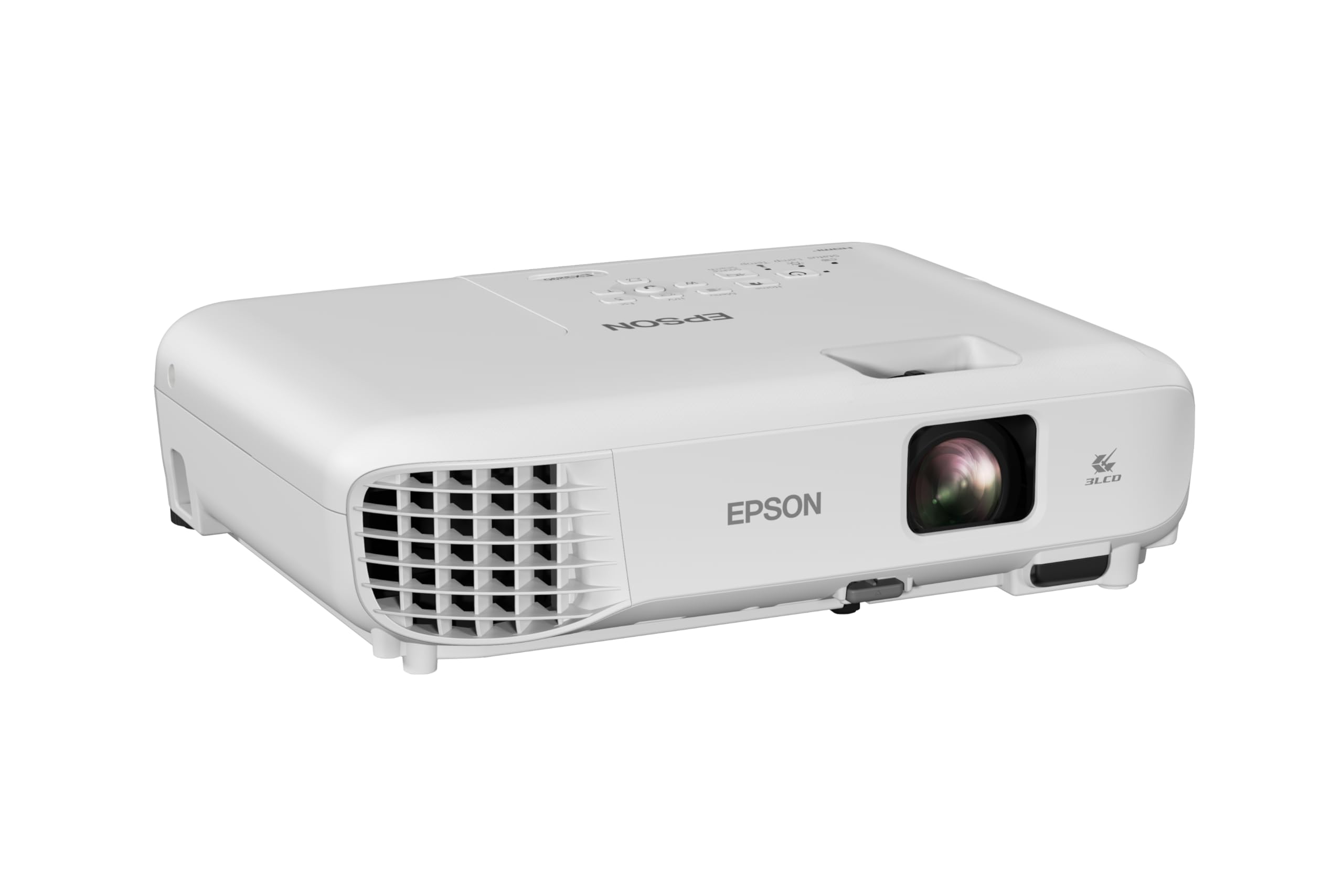
The Epson EX3290 is a practical, no-frills workhorse that brings 4,000 lumens of 3LCD brightness to the entry-level market. At this price point, it’s one of the most affordable projectors capable of filling a 120-inch screen with enough light to remain watchable with some ambient light. The 3-chip 3LCD design means it avoids the rainbow effect that DLP projectors can show on large screens.
The WXGA (1280 x 800) resolution is the main compromise — it’s not 1080p, let alone 4K. On a 120-inch screen, the lower pixel count is visible, especially for text and fine detail. The 16,000:1 contrast ratio is adequate but won’t deliver the deep blacks that theater enthusiasts crave. Dual HDMI ports offer solid connectivity, and the built-in speaker is passable for basic presentations or casual movie night.
The fan noise in standard mode is loud, and the throw distance required for a 120-inch image can be surprisingly long. The plastic build feels durable but not luxurious. The EX3290 is ideal for a school auditorium, church hall, or budget-conscious home user who needs a large image without demanding 4K resolution or cinema-quality blacks.
Why it’s great
- 4,000 lumens of 3LCD brightness at a very accessible price
- No rainbow effect — comfortable for long viewing sessions
- Dual HDMI ports for multi-device connectivity
Good to know
- WXGA resolution is visibly soft on a 120-inch canvas
- Fan is extremely loud in normal brightness mode
- Long throw distance makes it hard to fill a 120-inch screen in small rooms
11. YODOLLA 120 Inch Floor Screen
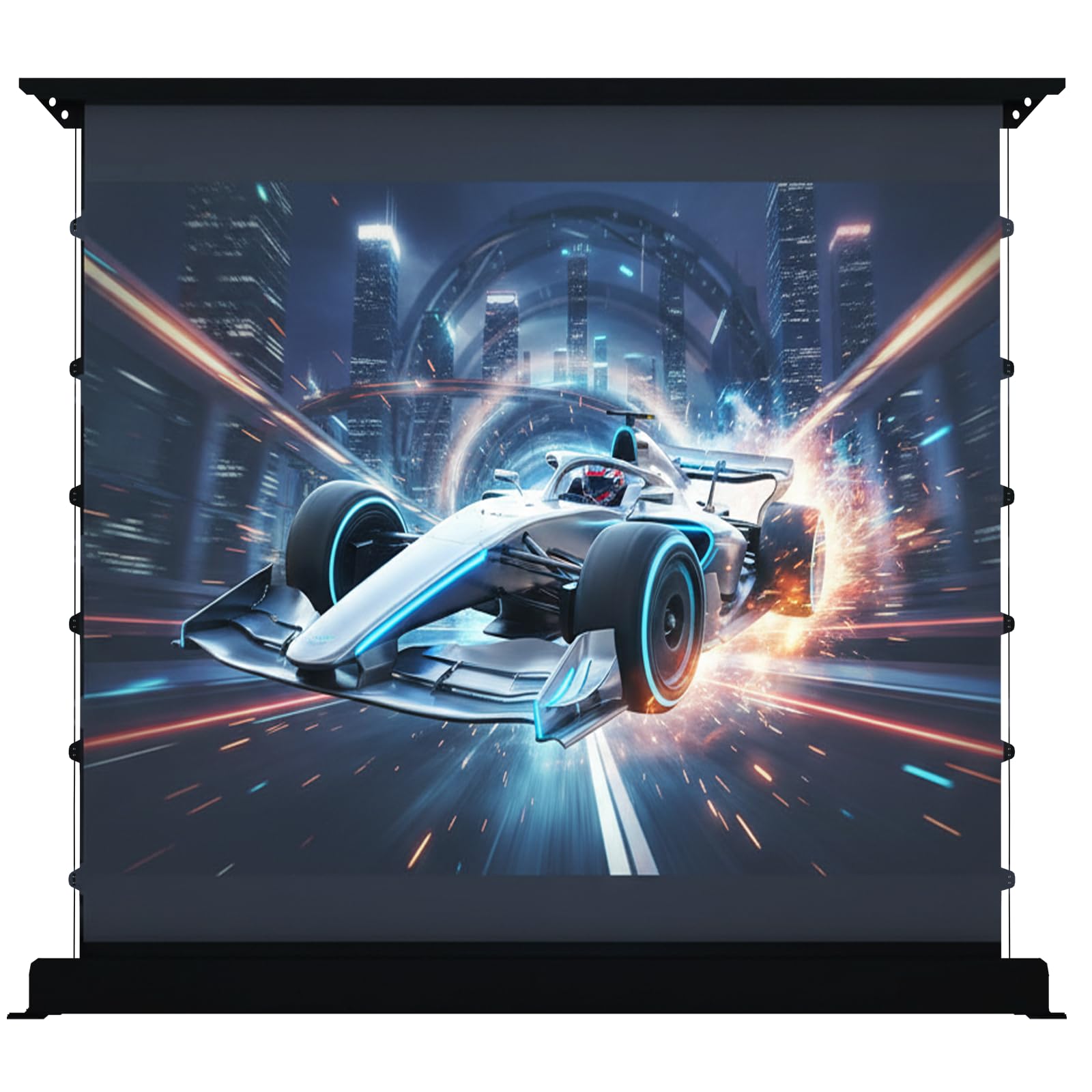
The YODOLLA screen is a motorized floor-rising projection screen designed specifically for ultra-short throw (UST) projectors. It rises out of a low-profile housing to create a 120-inch flat surface without requiring ceiling or wall mounting. The matte finish provides a 160° viewing angle, making it suitable for group viewing situations.
The main appeal is convenience: when not in use, the screen retracts into its base, taking up minimal floor space. The aluminum enclosure gives it a solid commercial-grade feel. The screen is compatible with both UST and standard throw projectors, and the motor operation is smooth and quiet.
The biggest risk is that the product listing data shows many customer reviews for a green screen version rather than a projector screen — meaning the 120-inch version has very few verified cinema-use reviews. The 63-pound weight makes it a permanent piece of furniture rather than a portable solution. For the UST projector owner who wants a clean, retractable screen without drilling into walls, the YODOLLA offers a functional if unproven solution.
Why it’s great
- Floor-rising design avoids wall or ceiling installation
- Matte finish with 160° viewing angle works in wide rooms
- Aluminum housing feels durable and commercial-grade
Good to know
- Very few verified reviews for the 120-inch model
- 63 pounds is heavy and immobile once placed
- May require stakes for outdoor stability in wind
FAQ
How far back does a standard throw projector need to be for a 120-inch screen?
Is 1080p resolution too low for a 120-inch screen?
Can a single-chip DLP projector avoid the rainbow effect on a 120-inch screen?
Final Thoughts: The Verdict
For most users, the 120 inch projector winner is the Epson Home Cinema 3800 because its 3LCD color, lens shift flexibility, and proven reliability make it the most complete package for a permanent home theater installation. If you want true native 4K resolution with Dolby Vision and the best gaming performance, grab the Hisense C2 Ultra. And for a budget-friendly entry into the 120-inch world with excellent brightness, nothing beats the Epson EX3290.