
Your laptop’s battery bar is dropping, you’ve got three more stops to make, and the only power source in sight is the 12-volt cigarette lighter socket. A standard wall charger is useless here, and a bulky power inverter wastes energy converting DC to AC and back again. The direct solution is a charger that accepts 12V DC input natively, delivering the precise voltage your notebook demands without that wasteful double conversion.
I’m Min — the co-founder and writer behind Gadgets Feed. I’ve spent countless hours analyzing voltage regulation, amperage curves, tip compatibility matrices, and safety certifications for dozens of 12V notebook power adapters to cut through the noise in this narrow utility category.
Whether you’re a field technician, a road warrior, or someone who works from an RV, selecting the right power supply means understanding connector types, wattage overhead, and build quality. This guide breaks down the best options in the 12v notebook charger market to keep your screen bright and your battery full on the move.
How To Choose The Best 12V Notebook Charger
A 12V notebook charger is a specialized accessory, not a one-size-fits-all purchase. The wrong choice can mean a loose connection, a device that refuses to charge, or in the worst case, damage to your laptop’s power management system. Focus on four core decision points to narrow the field.
Connector Type & Tip Selection
The most common failure point is physical incompatibility. Older laptops with barrel jacks require pin-center-polarity identification and precise outer diameter — typically 4.5mm, 5.5mm, or 7.4mm — to establish a clean power path. Universal chargers with sixteen or more interchangeable tips cover most Dell, HP, Lenovo, and older Asus models. Newer machines use USB-C with Power Delivery, where the charger negotiates voltage (5V, 9V, 15V, 20V) over a digital handshake. Buying a fixed-tip model for a USB-C laptop will leave you stranded; buying a USB-C-only model for a barrel-jack machine is equally futile.
Wattage Headroom & Current Rating
Every laptop power supply outputs a specific wattage — 45W, 65W, 90W, or 120W are common tiers. A 12V charger must deliver at least your laptop’s maximum draw. If your Dell Latitude pulls 90W at peak load, a 65W adapter will trickle-charge slowly or drain the battery under heavy use. Aim for 20% overhead: a 100W charger safely supports a 90W laptop and can also fast-charge a phone through a secondary USB port. Current rating in amps is less important than total wattage because the voltage outputs vary — always check the combined DC and USB power budget.
Safety Certifications & Build Quality
The 12V environment in a vehicle is electrically noisy — voltage spikes from the alternator or starter motor can exceed 30V momentarily. A charger without over-voltage protection, short-circuit prevention, and temperature monitoring can fry your laptop’s motherboard. UL listing is the gold standard for North American buyers; CE and RoHS compliance indicate responsible manufacturing. The connector’s strain relief, plug fit in the cigarette lighter socket, and cable jacket thickness (TPE vs. woven nylon) separate units that last two years from those that die in two months.
Quick Comparison
On smaller screens, swipe sideways to see the full table.
| Model | Category | Best For | Key Spec | Amazon |
|---|---|---|---|---|
| PWR+ USB-C PD3 | Premium USB-C | USB-C laptops & Steam Deck | 90W PD 3.0, 10 ft cable, UL-listed | Amazon |
| BatPower 120W | High-Wattage USB-C | Surface Book & high-power USB-C | 120W USB-C PD, dual USB-A ports | Amazon |
| Helpers Lab 108W Universal | Universal Tip Kit | Mixed-brand household fleets | 108W, 16x DC tips, QC 3.0 port | Amazon |
| PWR+ Dell Barrel | Fixed Dell Barrel | Dell Latitude & Inspiron users | 90W, 10 ft cord, 19.5V 4.62A | Amazon |
| Belker 100W Universal | Value Universal | Budget-conscious multi-device users | 100W, 16x tips, USB-C + USB-A | Amazon |
| YURCIPWE 100W USB-C | Budget USB-C | Entry-level USB-C charging | 100W PD 3.0, 18W USB, compact | Amazon |
In‑Depth Reviews
1. PWR+ USB-C PD3 Laptop CAR Charger

The PWR+ USB-C PD3 charger earns the top spot because it nails the two things that matter most for a 12V notebook charger: safety certification and real-world power delivery. It carries a unique UL listing, meaning an OSHA-authorized lab verified its over-voltage, short-circuit, and thermal protections. The 90W Power Delivery 3.0 profile negotiates smoothly with Dell XPS 13/15, MacBook Pro 13-16”, Lenovo X1 Carbon, and even a Steam Deck — customers report full-power charging of 65W laptops without the 5V fallback failure that plagues cheaper PD adapters.
The extra-long 10-foot cord is a deliberate design win. In a sedan, it reaches from the front cigarette lighter to the back seat; in a cargo van, it lets you keep the charger in the dash while the laptop sits on a passenger seat. The male USB-C connector is mechanically robust with reinforced strain relief, though owners caution that bending the plug sharply can damage the internal PCB. Build quality is consistently described as “solid” with a compact footprint that doesn’t crowd adjacent 12V ports.
PWR+ backs this unit with a 24-month exchange warranty from their Washington-based support team — the strongest after-sale coverage among the premium tier. The only gap is compatibility: this charger is exclusively USB-C. If your laptop still uses a proprietary barrel jack, you’ll need a tip kit model. For the growing majority of modern notebooks that charge via USB-C, this is the most confident buy on the list.
Why it’s great
- UL certified for genuine electrical safety
- 10-foot cable provides excellent reach in any vehicle
- Full 90W PD 3.0 reliably charges 65W+ laptops
Good to know
- USB-C only — not compatible with barrel-jack laptops
- Male connector is brittle if bent sharply
2. BatPower 120W USB-C Car Charger

The BatPower 120W delivers the highest single-port wattage in this roundup, making it the only candidate that can genuinely sustain a Microsoft Surface Book at full load or charge a 120W-capable Dell Precision workstation on the road. Most USB-C car chargers cap out at 90W or 100W; this unit pushes past that threshold with a 120W PD profile, plus two additional USB-A ports with Quick Charge 3.0 that share a combined 36W budget for phones and accessories.
The 12-24V DC input range is wide enough to handle a semi-truck’s 24V electrical system or a standard passenger car without modification. Owners running the unit from LiPo batteries (22.2V nominal) report fast, stable charging with no undervoltage glitches. The physical build is dense and compact — about four ounces with a housing that fits flush in shallow 12V sockets. The package includes both a black and a white USB-C cable, a thoughtful redundancy for travel.
Reliability reports are mixed. Multiple verified buyers report the unit working flawlessly for three to five months then failing — often the USB-C port stops negotiating voltages above 5V. BatPower honors an 18-month warranty with replacement shipments, and customer support is responsive, but the failure pattern suggests a component weakness in the PD controller. For those who need 120W today and accept that it may need to be warrantied within the first year, the raw power delivery is unmatched.
Why it’s great
- 120W PD — highest wattage of any charger tested
- Wide 12-24V input works in cars, trucks, and boats
- Two USB-A QC 3.0 ports for simultaneous phone charging
Good to know
- Multiple reports of PD failure after 3-5 months
- 120W rating cannot be shared across all ports simultaneously
3. Helpers Lab 108W Universal Car Charger

If your household owns laptops from three different brands — say an aging Toshiba with a round 4.5mm barrel, an HP with a slim 7.4mm tip, and an Asus with a different pinout — the Helpers Lab 108W universal charger is the only smart play. Its selector dial and 16 included DC connectors cover virtually every OEM barrel standard in circulation. The voltage selector supports 16V, 18.5V, 19V, 19.5V, and 20V outputs, matching most business-class notebooks from the last decade.
The secondary USB port packs Quick Charge 3.0, delivering up to 18W for phones and tablets. One long-term owner reported running this charger reliably for over four years in a campervan setup, replacing a competitor unit that melted due to inadequate thermal management. That longevity is a strong signal: the over-temperature protection and polycarbonate housing appear effective at dissipating the heat generated by 108W of DC-DC conversion inside a closed vehicle.
The downsides are ergonomic. The tip selection process is manual — you must match the tip to the selector dial position — and the included user manual is minimal. The cigarette lighter plug is long and may not sit flush in recessed sockets. The cable length is adequate at roughly five feet but noticeably shorter than the PWR+ offerings. For a family fleet or a shared vehicle, the tip variety outweighs these inconveniences.
Why it’s great
- 16-piece tip kit covers Dell, HP, Lenovo, Asus, Toshiba, and more
- Proven thermal design — long-term durability reports exceed four years
- QC 3.0 USB port fast-charges modern smartphones
Good to know
- Tip selection requires matching dial position — not truly plug-and-play
- Cable is shorter than premium competitors
4. PWR+ Dell Laptop CAR Charger (Barrel)

Owners of older Dell Latitude, Inspiron, and Vostro machines with the standard 7.4×5.0mm barrel connector have a clear specialist in the PWR+ fixed-tip 90W charger. This unit skips the universal tip complexity and delivers a single, clean 19.5V 4.62A output tailored to Dell’s power specification. The 10-foot power cord matches the company’s USB-C sibling — long enough to route from a dash port to a rear-seat work station without tension.
UL listing is a standout at this price level. Third-party barrel chargers frequently lack proper certification, risking unstable voltage that can trigger Dell’s “Unknown AC Adapter” warning or, worse, damage the system board. PWR+ buyers confirm the charger passes Dell’s power negotiation without errors, even with laptops that draw 90W under simultaneous CPU and GPU load. The red LED indicator on the 12V plug gives instant visual confirmation of power delivery, and the velcro cable strap keeps the cord tidy in a glovebox.
The 19.5V output is fixed, which limits this charger to machines that expect that exact voltage. It will not properly charge a Lenovo ThinkPad that requires 20V, nor will it work with USB-C laptops at all. One user reported the unit generated noticeable radio-frequency interference (RFI) on AM bands after 18 months of use — an uncommon but documented issue with long cable runs in close proximity to antenna feeds. For single-brand Dell users, the focused compatibility and safety certification make this a smart, straightforward choice.
Why it’s great
- UL-listed for complete electrical safety assurance
- 10-foot cord is among the longest available for a barrel charger
- Firm 19.5V output eliminates Dell AC adapter warnings
Good to know
- Fixed voltage and barrel pin — not compatible with USB-C or other brands
- Potential for RFI interference in sensitive audio environments
5. Belker 100W Universal Laptop Car Charger

The Belker 100W universal charger is the entry-level champion for a reason: it bundles 16 interchangeable connectors and a USB-C plug into one package at a price that undercuts most dedicated chargers. The voltage range spans 5V to 20V in multiple increments (5V, 9V, 12V, 15V, 16V, 18.5V, 19V, 19.5V, 20V), covering the vast majority of consumer and business laptops that charge via barrel or USB-C. The 100W maximum output comfortably powers 65W and 90W machines without bottlenecking.
Build quality is a step above commodity-level chargers. The TPE enclosure has a soft-touch feel and includes surge protection and short-circuit prevention circuitry. Several owners operate this unit inside RV propane-furnace setups, demanding consistent 12V power in a noisy electrical environment. The 12-month Belker warranty provides a safety net that generic no-name adapters lack.
The primary risk is longevity consistency. While many units last for years, an unusual number of verified one-star reviews describe catastrophic failure — the PD trigger chip dropping output to 5V after four to ten months of light use, turning the charger into a slow phone charger. This pattern suggests variability in the PD controller IC batch. If you buy the Belker, stress-test it immediately and keep the warranty documentation accessible. It is also not suitable for 120W-class laptops like the larger MacBook Pros or Surface Book 3.
Why it’s great
- Exceptional value — 16 tips, USB-C, and 100W for an entry-level price
- Wide voltage selection covers most barrel and USB-C laptops
- Surge protection and TPE housing boost durability
Good to know
- Intermittent PD controller failure reported in some batches
- Not designed for laptops requiring more than 100W
6. YURCIPWE 100W USB-C Car Charger
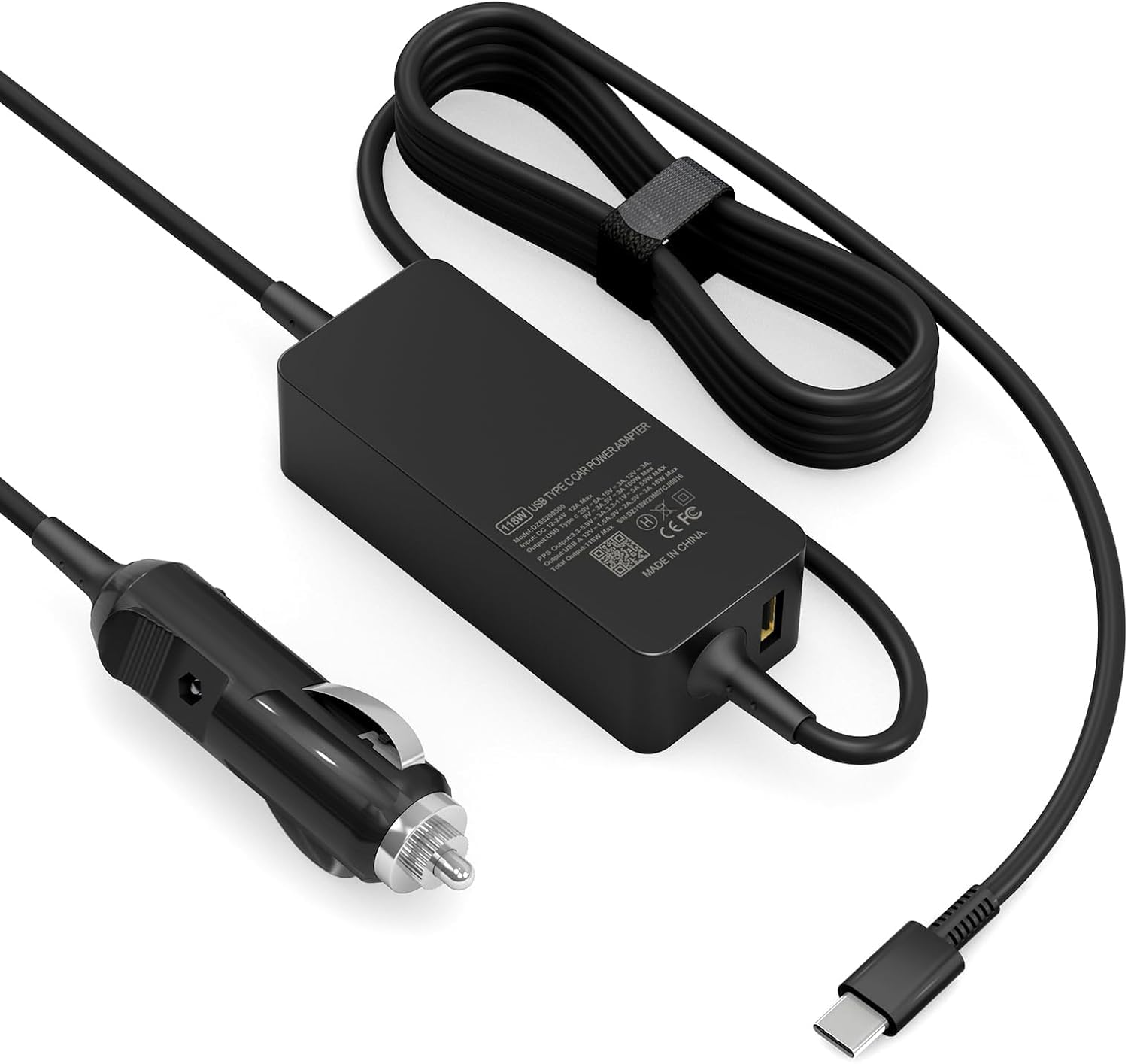
The YURCIPWE 100W charger is the most affordable USB-C PD option in this guide, and it delivers exactly what the spec sheet promises if you get a good unit. The PD 3.0 protocol supports 5V/3A, 9V/3A, 12V/3A, 15V/3A, 19V/5A, and 20V/5A profiles — enough to power a 75W Dell Latitude or a 65W HP Spectre while simultaneously charging an Android phone at 18W through the secondary USB port. The flat polycarbonate body slips into a bag without snagging.
Owners who use this charger daily in their work trucks report exactly the experience they needed: they can run their laptop from the vehicle battery without idling the engine all day. The compact heat sink design keeps temperatures manageable even during extended 100W pulls, unlike cheaper chargers that throttle after twenty minutes. The input range (9V-32V DC) is wider than most competitors, directly supporting heavy trucks and 24V marine systems without a step-down converter.
The gamble is reliability. More than one review describes a first unit that worked beautifully for years, followed by a replacement that failed after six weeks. The PD controller and DC-DC converter appear to have batch variance. YURCIPWE does not prominently advertise a warranty period, making a failed unit a total loss unless Amazon’s return window is still open. If you stay within the return period, this charger offers the best performance-per-dollar ratio of any model here. Keep your receipt and test it immediately.
Why it’s great
- Lowest entry point for 100W USB-C PD charging
- Wide 9V-32V input range accommodates trucks and boats
- Flat, compact body stows easily in a laptop bag
Good to know
- Quality control variance — some units fail within weeks
- No clear warranty coverage outside Amazon return window
FAQ
Can I use a 12V notebook charger with a 24V truck electrical system?
What happens if my universal charger doesn’t have the right tip adapter?
Is a 65W 12V charger enough for my 90W laptop?
Final Thoughts: The Verdict
For most users, the 12v notebook charger winner is the PWR+ USB-C PD3 because it combines UL safety certification, a full 90W of PD 3.0 power, and an extra-long cable in a compact, durable package with exceptional warranty support. If you need a universal tip kit to charge multiple brands out of one adapter, grab the Helpers Lab 108W Universal — its 16-tip coverage and long-term thermal reliability make it the best pick for mixed fleets or RV households. And for raw maximum wattage to drive a Surface Book or high-power workstation, nothing beats the BatPower 120W, though the PWR+ remains the safer overall recommendation for consistent daily use.