
Building a dedicated machine for mid-90s PC gaming means navigating a world of ISA slots, DOS drivers, and VGA timings that modern hardware simply doesn’t understand. A genuine Windows 95 era rig, or a faithful modern recreation, delivers the authentic CRT glow and joystick port compatibility that no emulator can perfectly replicate.
I’m Min — the co-founder and writer behind Gadgets Feed. I’ve spent years analyzing the retro computing market, tracking the shift from salvaged industrial SFF PCs to purpose-built mini-consoles that capture the exact 386 and 486 era experience. (And Homer 🐱 supervised the entire compatibility test from his spot on the warm CRT monitor).
Whether you crave the physical click of a period-correct keyboard or the hassle-free plug-and-play of a modern micro console, this guide cuts through the nostalgia to find the real hardware that delivers. These are the very best options for a 1995 gaming pc build, ranked and compared for serious retro enthusiasts.
How To Choose The Best 1995 Gaming PC
A mid-90s gaming PC is defined by its processor architecture, operating system, and expansion capabilities, not raw clock speed. Knowing the difference between a 386 SX, a 486 DX, and a Pentium is essential.
Processor and Platform Era
The CPU dictates which games are playable. A 386 SX (16 or 25 MHz) handles early DOS titles like Wolfenstein 3D and Commander Keen, but struggles with Doom. A 486 DX (33-66 MHz) is the sweet spot for Doom, Duke Nukem 3D, and early Windows 95 games. A Pentium is required for Quake and later 3D accelerated titles. Match the CPU to the game library you intend to run.
Expansion and Connectivity
Look for ISA slots for a true Sound Blaster 16 or AWE64 card. A VGA port, a DB9 serial port for the mouse, and a DB25 parallel port for a joystick are hallmarks of the era. Modern mini consoles won’t have these, so decide if you want a period-correct machine or an HDMI convenience box.
Quick Comparison
On smaller screens, swipe sideways to see the full table.
| Model | Category | Best For | Key Spec | Amazon |
|---|---|---|---|---|
| Pocket 386 | Portable Retro Laptop | True DOS on the Go | 386 SX / 640×480 VGA | Amazon |
| The A500 Mini | Mini Console | Amiga 500/1200 Games | 720p HDMI / 25 Games | Amazon |
| The C64 Maxi | Full-Size Micro Console | Commodore 64 Library | 720p HDMI / 64 Games | Amazon |
| ColecoVision Flashback | Plug-and-Play Console | 60s-80s Arcade Hits | 240p Output / 60 Games | Amazon |
| Optiplex GX780 | Refurbished SFF PC | Windows XP Era Gaming | Core 2 Duo / 4GB RAM | Amazon |
| Atari Gamestation Go | Portable Console | Atari 2600/5200/7800 | 7″ LCD / 200+ Games | Amazon |
| Atari 2600 (Renewed) | Original Hardware | Authentic 2600 Cartridges | 4-Switch Woodgrain Model | Amazon |
| Atari 400 Mini | Mini Console | Atari 8-bit Computer Games | 720p HDMI / CXStick | Amazon |
| Atari Flashback 12 | Plug-and-Play Console | Atari 2600 Value Gaming | 720p HDMI / 130 Games | Amazon |
In‑Depth Reviews
1. Retro Pocket 386 CPU XT PC Laptop

This is the real deal for anyone who wants native DOS gaming without emulation overhead. The Pocket 386 runs a genuine 386 SX processor embedded in an Ali M6117 chip, paired with a VGA graphics card that is compatible with CL-GD542X drivers. It boots into MS-DOS 6.22 and can run classic Sierra adventures, early id Software titles, and Apogee shareware with period-accurate speed.
The built-in OPL3 sound card handles Adlib and Sound Blaster Pro music standards, a major win over software emulation. The 4:3 LCD, while small, uses a physical keyboard with authentic key feel and an integrated mouse function mapped to the keyboard’s directional keys. It runs on a rechargeable battery, offering roughly 1.5 hours of play time, and supports VGA output to an external monitor for a true 640×480 experience.
Setup requires some DOS knowledge — you will need to configure autoexec.bat and config.sys for memory management. Users report the battery can drain and reset BIOS settings, but the enthusiast community has workarounds. This is for the collector who wants tangible authenticity, not a casual plug-and-play gadget.
Why it’s great
- Native 386 SX hardware runs DOS and early Windows games with perfect timing
- OPL3-compatible sound card delivers authentic FM synthesis and MIDI
- Compact portable form factor with VGA out for CRT connection
Good to know
- Battery drain can reset CMOS settings requiring a BIOS reconfiguration
- 386 SX is too slow for many 1995-era Pentium games like Quake
- Requires manual DOS setup — not for beginners
2. The A500 Mini

The A500 Mini emulates the entire Amiga 500, 600, and 1200 line using WHDLoad, giving you access to the vast library of classic European and American computer games. It comes preloaded with 25 titles including Speedball 2, Worms: The Director’s Cut, Another World, and The Chaos Engine — all playable in 720p HD with optional CRT scanline filters and multiple aspect ratios.
But the real power here is expandability. Via USB, you can load your own legally owned ADF disk images, and firmware updates have continued to improve compatibility. The included two-button mouse and eight-button gamepad cover most needs, though some users prefer a USB SNES controller for platformers. The ability to rewind up to 30 seconds of gameplay is a welcome modern convenience for notoriously difficult Amiga games.
It is worth noting that this is an emulation box, not native hardware. Input lag is minimal but present, and the controller is slightly stiff out of the box. Purists seeking cycle-exact timing for demos should look to a real A1200, but for playing the catalog, this is the most accessible route.
Why it’s great
- Extensive Amiga 500/1200 game compatibility via WHDLoad
- Easy USB loading of additional games and applications
- Rewind and save state features reduce 90s-era frustration
Good to know
- Stiff joystick may need replacement for comfortable gameplay
- Not a cheap alternative — a Raspberry Pi offers similar power for less
- No support for Amiga 3000/4000 AGA titles without mods
3. The C64 Maxi Micro Console

The C64 Maxi is a full-size reproduction of the iconic Commodore 64, not a scaled-down mini. It includes a completely functional keyboard that you can actually type BASIC programs on, just like in the 1980s. Preloaded with 64 games, including classics like Paradroid, Impossible Mission, and Uridium, it offers ready-to-go nostalgia through a simple carousel interface.
Connectivity is robust with multiple USB ports for joysticks, mice, and keyboards. You can also mount disk and tape images from a USB stick to play any legally owned C64 software. The package includes a recreation of the classic Competition Pro joystick. HDMI output at 720p with 50/60Hz support, plus CRT filters, makes it look great on modern displays while retaining the feel.
The price is steep for what is essentially a dedicated emulation box, and some users report the keyboard membrane requires a firm press to register. The included joystick is functional but not built for heavy use. For those who want the physical presence and keyboard of a C64 without the fuss of floppy drives and RF cables, this is the ultimate solution.
Why it’s great
- Full-size authentic keyboard with PETSCII characters for BASIC coding
- Plug-and-play HDMI with no monitor or RF adapter needed
- Four save slots per game for progress retention
Good to know
- Expensive compared to running VICE on a Raspberry Pi
- Membrane keyboard can miss presses if not hit firmly
- Included games are hit-or-miss; library may require USB loading
4. ColecoVision AtGames Flashback
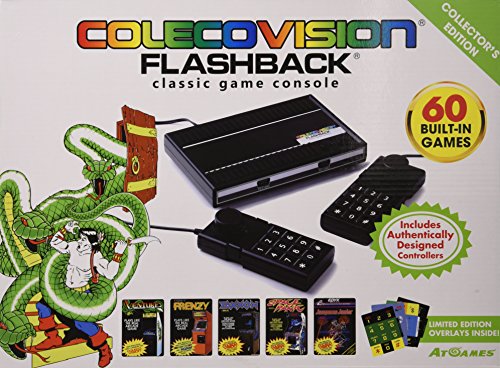
The ColecoVision Flashback is condensed but authentic for its time. It includes 60 classic ColecoVision titles spanning arcade ports like Zaxxon and Venture to platformers like Jumpman Junior. The emulation accuracy is solid — games like The Heist run at the correct frame rate, which is more than some budget boxes manage. The included controllers have overlays for certain games, adding to the tactile nostalgia.
Video output is standard definition composite, not HDMI, which means it looks best on a CRT or a monitor that handles analog input well. The unit is plug-and-play: just connect to power and a TV via the included composite cable. Setup is straightforward, making it a good entry point for someone who wants to play ColecoVision games without tracking down original cartridges.
The controllers are replicas and feel less robust than the originals. The game selection is decent but misses several major hits. The overall build is light and plasticky. For a dedicated ColecoVision fan, it fills a niche that no other modern console does, but it is a niche product.
Why it’s great
- 60 preloaded ColecoVision games with accurate emulation
- Easy plug-and-play setup with no cartridge hassles
- Includes controller overlays for a more authentic feel
Good to know
- Composite video only — not compatible with modern HDMI-only TVs
- Controllers are a downgrade in quality from originals
- Small game library compared to Atari or Amiga collections
5. Dell Optiplex GX780 SFF Desktop

The Optiplex GX780 is a refurbished small form factor PC that comes preloaded with Windows XP Professional, making it the best option for running mid-to-late 90s and early 2000s PC games. It features a Core 2 Duo CPU, 4GB of RAM, and integrated Intel GMA X4500 graphics with a dedicated 1GB memory allocation. The included 17-inch LCD monitor and wired mouse and keyboard make it a complete setup out of the box.
This machine is ideal for Windows 95, 98, and XP titles like Age of Empires II, Half-Life, SimCity 3000, and the first generation of 3D accelerated games. The small form factor saves desk space, and the DVD-ROM drive lets you install from original discs. The Core 2 Duo provides enough headroom for DOSBox emulation as well, so you can run older DOS games in a window.
The integrated graphics are not powerful enough for more demanding late-90s titles like Unreal Tournament at high settings. Some units arrive with minor damage (crushed mouse, defective monitor) due to shipping, so inspect the package carefully. This is a practical workhorse for the Windows gaming era, not a showpiece.
Why it’s great
- Complete ready-to-use setup with monitor, keyboard, and mouse
- Runs Windows 95/98 and XP games with excellent compatibility
- Small footprint and quiet operation for a desktop of this era
Good to know
- Integrated GPU struggles with early 3D accelerated titles
- Shipping can damage components; check mouse, monitor, and ports
- Limited upgrade path due to proprietary Dell motherboard
6. My Arcade Atari Gamestation Go
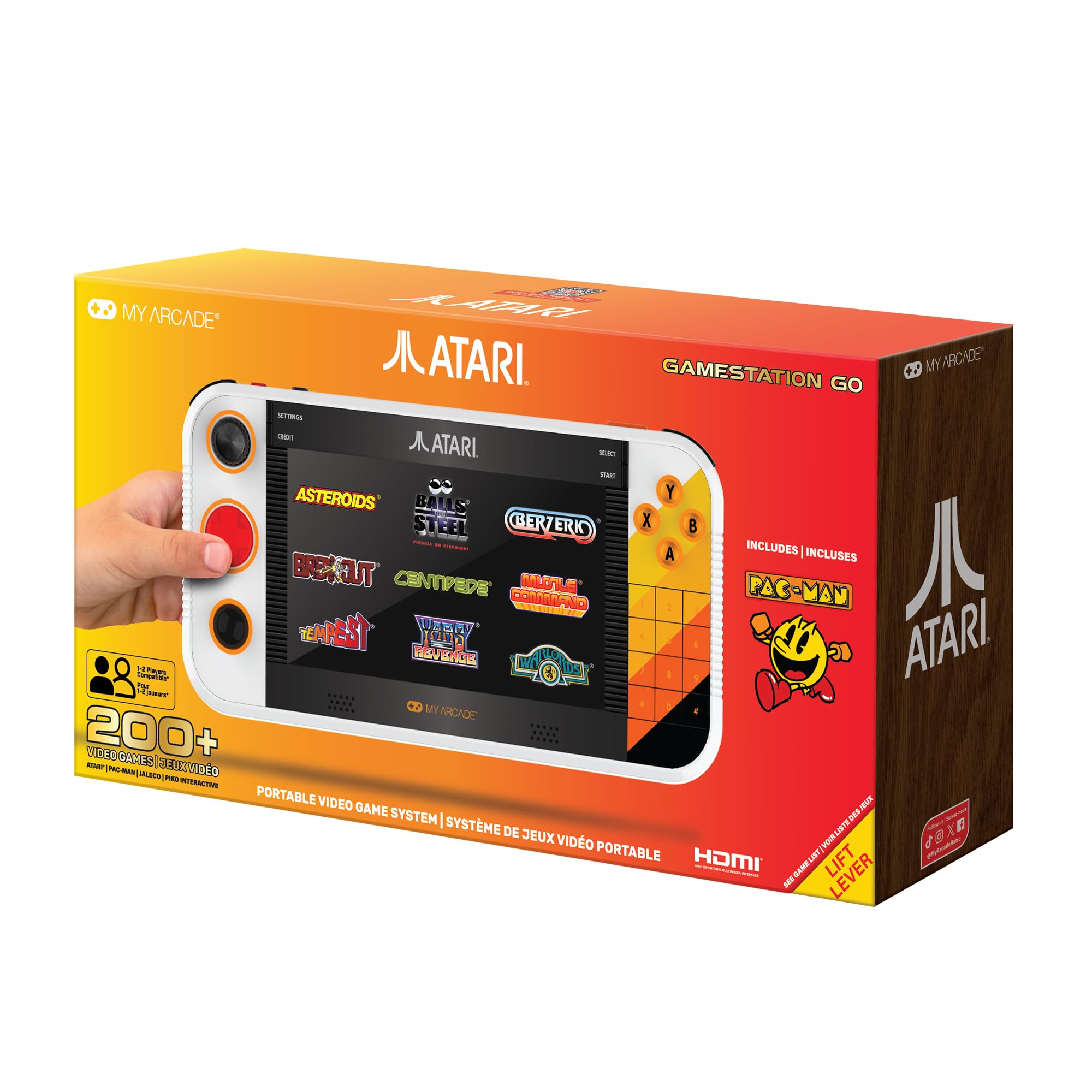
The Gamestation Go is a portable handheld with a massive 7-inch display that can also connect to a TV via HDMI. It comes preloaded with over 200 officially licensed Atari games spanning the 2600, 5200, and 7800 libraries, including Pac-Man, Asteroids, and Yars’ Revenge. The unique SmartGlow system illuminates only the controls needed for the currently loaded game, reducing the confusion of the massive button layout.
The control scheme is comprehensive: a paddle, a d-pad, a trackball, a numeric keypad, shoulder bumpers, and standard ABXY buttons. This means nearly every Atari game can be played with its intended controller type. It also supports microSD card expansion for adding more games, and Wi-Fi for firmware updates. The built-in rechargeable battery gives several hours of play time.
Firmware updates have fixed initial bugs like screen ratio issues and poor vector game rendering. The 7-inch screen, while large, is not high-resolution and can show backlight bleed. It is more of a toy than a professional game preservation device, but for casual Atari fans, it is a fun, versatile package.
Why it’s great
- 200+ games with paddle, trackball, and standard controls built in
- Large 7-inch screen ideal for retro gaming on the go
- SmartGlow illuminates active controls, simplifying the learning curve
Good to know
- Missing major titles like Pitfall and Frogger from the library
- Screen quality is average with potential backlight bleed
- MicroSD expansion requires reboot to switch storage sources
7. Atari 2600 (Renewed)

This is a refurbished original Atari 2600, the four-switch woodgrain model that defined the late 1970s and early 1980s. This is not a modern emulation box — it is the actual hardware. It requires original Atari 2600 cartridges, so the game library is whatever you can find at flea markets or online. The included controller is the classic CX40 joystick with a single fire button.
The console has been cleaned, tested, and repackaged with a new power supply. It includes an RF switch for connecting to a TV — note that most modern smart TVs lack an RF input, so you may need a coax-to-composite adapter or a dedicated CRT. The picture is analog, with the characteristic rainbow banding and RF noise that purists love.
This option is for collectors who want the real experience: the weight of the console, the click of the switches, the feel of the CX40. It will not run newer titles or provide HDMI convenience. The renewed units can vary in condition, but reputable sellers often offer a 90-day warranty for peace of mind.
Why it’s great
- Genuine original hardware for the most authentic experience
- Plays any 2600 cartridge without compatibility issues
- Cleaned and tested with new power supply for reliability
Good to know
- Requires a TV with RF input or an adapter for modern sets
- No built-in games — you must source cartridges separately
- Condition can vary; check seller reviews before buying
8. Atari 400 Mini

The Atari 400 Mini is a tiny recreation of the classic Atari 400 home computer, complete with a reimagined CXStick joystick. It emulates the entire line of Atari 8-bit computers (400, 800, 800XL, 1200XL) as well as the Atari 5200 console. It outputs at 720p via HDMI with support for PAL and NTSC formats, CRT scanline filters, and multiple aspect ratios including the original 4:3.
It comes preloaded with 25 games including Star Raiders, Centipede, and Miner 2049er. The real value is the ability to load your own legally owned ROMs from a USB drive — it supports disk, cartridge, and cassette image files. The CXStick joystick has eight integrated buttons plus a fire button, offering more functionality than the original CX40. You can also connect a standard USB gamepad or keyboard.
The controller is stiff out of the box and some users find the accidental reset button placement frustrating. The interface for loading custom games is basic — there is no artwork or carousel, just a file list. For die-hard Atari 8-bit fans who want a clean HDMI solution for Star Raiders, this is the best dedicated device.
Why it’s great
- Emulates all Atari 8-bit computers and the 5200 console
- HDMI output with CRT filters for a clean modern display
- Custom ROM loading via USB keeps the library endless
Good to know
- Stiff controller with easy-to-bump reset button
- No USB-PD support — requires an older USB-A power source
- Basic file interface for custom games with no metadata
9. Atari Flashback 12 Gold
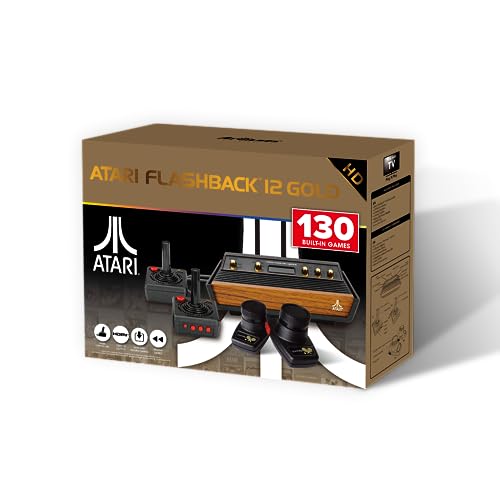
The Atari Flashback 12 Gold is the most accessible entry point for reliving the Atari 2600 era. It comes with 130 built-in games, including Activision classics like Pitfall and River Raid, plus many Atari 2600 staples. The console outputs at 720p via HDMI for a sharp, clean picture on modern TVs. Setup is truly plug-and-play: connect the HDMI cable, plug in the Micro USB power, and start playing.
The included wired joysticks are a modern take on the CX40 with red side buttons. They are functional but noticeably looser than the originals. The wired paddle controllers have slight input latency, especially noticeable in games like Breakout. The unit itself is a mini console, much smaller than the original Atari, making it easy to pack away or display on a shelf. Firmware updates are available to fix early issues.
The game selection is heavily weighted toward the 2600 library, with fewer 5200 or 7800 titles. Some users report the paddle lag makes paddle-specific games nearly unplayable. For the price, the sheer volume of included games is unmatched, but the emulation quality varies. It is a solid gateway, not a definitive collection.
Why it’s great
- 130 games including hard-to-find Activision and Imagic titles
- Easy USB ROM addition for expanding the library
- Clean HDMI output at 720p with plug-and-play simplicity
Good to know
- Paddle controllers exhibit noticeable input lag
- Joysticks are looser than original CX40s with less tactile feedback
- Some games feel primitive even by retro standards; check the list
FAQ
What CPU do I need for a 1995 Windows 95 gaming PC?
Can I use a modern monitor with a 1995 gaming PC?
Do I need a dedicated sound card for 1995 DOS gaming?
Are these mini consoles a replacement for a real 1995 PC?
Final Thoughts: The Verdict
For most users building a true era-correct machine, the 1995 gaming pc winner is the Retro Pocket 386 because it delivers native DOS hardware in a portable package with an OPL3 sound card and VGA output. If you want a hassle-free modern setup with an incredible library, grab the The A500 Mini. And for the purest Windows 95 experience with a complete desktop setup, nothing beats the Optiplex GX780.