
A muddy midrange and a piercing, harsh treble are the unmistakable signs of a speaker system that lacks a proper crossover. Without a dedicated frequency divider, your tweeters struggle with bass they were never designed to handle, while your woofers waste energy trying to reproduce high-end detail they physically cannot produce. The result is a congested, fatiguing listening experience that no amount of equalizer adjustment can truly fix.
I’m Min — the co-founder and writer behind Gadgets Feed. I’ve spent hundreds of hours analyzing the technical specs of passive crossovers, from inductor gauge and capacitor type to crossover slope alignment and impedance matching, to identify the models that deliver clean, balanced sound.
Whether upgrading a vintage stereo or building a custom car audio system, the best 2 way speaker crossover can transform your setup by ensuring that each driver only receives the frequencies it was built to reproduce.
How To Choose The Best 2 Way Speaker Crossover
Selecting the right passive crossover is not just about price. The core electrical parameters — impedance, power handling, crossover point, and slope — must align with your specific woofers, tweeters, and amplifier output. Ignoring these specs often leads to blown tweeters or a lifeless, recessed midrange.
Crossover Point and Slope Alignment
The crossover frequency (measured in Hertz) is the threshold where the low-pass filter hands off to the high-pass filter. A 2,500 Hz crossover point is common for pairing a 6.5-inch woofer with a dome tweeter, while a 3,000 Hz point suits smaller woofers. The slope, measured in dB per octave, determines how aggressively frequencies are cut. A 12 dB/octave slope is gentle and musical, while an 18 dB/octave slope offers steeper protection for fragile tweeters.
Impedance and Power Handling
A crossover designed for an 8-ohm load will not filter correctly if your woofer is rated at 4 ohms. The crossover’s internal components are tuned to a specific impedance; mismatching can shift the crossover point and damage drivers. Power handling (RMS vs. peak) must also exceed your amplifier’s output to prevent component failure.
Tweeter Protection and Attenuation
Tweeters are the most vulnerable part of any speaker system. Look for crossovers that include a polypropylene capacitor and a self-resetting fuse or PTC device in the high-pass section. Attenuation switches (often -3 dB or -6 dB) allow you to match the tweeter’s output to the woofer’s sensitivity, preventing a bright, unbalanced sound.
Quick Comparison
On smaller screens, swipe sideways to see the full table.
| Model | Category | Best For | Key Spec | Amazon |
|---|---|---|---|---|
| Dayton Audio XO2W-2.5K | Premium | Reference Home Audio | 12 dB/octave Linkwitz-Riley | Amazon |
| DS18 PRO-CFX | Premium | High-Power Car Audio | 300W RMS, Tweeter Attenuation | Amazon |
| DriSentri 450W | Mid-Range | Custom Home Builds | 450W, Switchable 2850/2900 Hz | Amazon |
| Fydun 300W | Mid-Range | Versatile Car Audio | 300W, Solderless Plug | Amazon |
| Audiopipe CRX-203 | Value | Budget Car Upgrade | 200W RMS, Gold Terminals | Amazon |
| Audiopipe 300W 2-Pack | Value | Multi-Speaker Systems | 150W RMS per crossover | Amazon |
| HiQltyla WEAH-2002 | Budget | Entry-Level Tweeter Add | 220W Peak, 3000 Hz Point | Amazon |
In‑Depth Reviews
1. Dayton Audio XO2W-2.5K 2-Way Speaker Crossover 2,500 Hz

The Dayton Audio XO2W-2.5K is designed around the Linkwitz-Riley alignment at 12 dB per octave, widely regarded as the gold standard for summing a flat, phase-coherent response at the crossover point. Its 18-gauge inductors keep DC resistance minimal, which preserves damping factor and ensures tight bass control even with moderately efficient woofers.
Home audio enthusiasts rebuilding classic speakers like the Dynaco A10 or Peavey 115TLS report that this crossover eliminates a muddy, congested midrange and restores clarity to the upper registers. The board is larger than typical budget units, which aids heat dissipation and allows for clean, accessible wiring channels.
The low-pass section supports both 4-ohm and 8-ohm woofers, making it flexible for custom cabinet builds. The high-pass section is optimized for 8-ohm tweeters, and the fixed 2,500 Hz crossover point is ideal for 6.5-inch to 8-inch woofers paired with standard dome or horn tweeters.
Why it’s great
- Precise Linkwitz-Riley 12 dB/octave alignment.
- Low-resistance 18-gauge inductors.
- Flexible low-pass for 4 or 8 ohm loads.
Good to know
- Larger board may not fit inside small speaker cabinets.
- No tweeter attenuation switch included.
2. DS18 PRO-CFX 2-Way Car Audio Passive Crossover (2 Pack)

DS18’s PRO-CFX handles a serious 300 watts RMS per crossover, making it one of the most robust passive units in this class. The steel and ABS hybrid enclosure is built like a small amplifier, with screw-down terminals that are clearly labeled for input, woofer, and tweeter connections.
The standout feature is the tweeter attenuation switch offering 0 dB, -3 dB, and -6 dB settings. This allows you to match hot tweeters to less sensitive woofers without adding external L-pads, which is a major advantage for car audio systems where space is limited.
Owners consistently praise the clarity and separation this unit provides, but note its physical size — 6.3 inches long — can make it difficult to mount inside door panels. Plan to secure it near the amplifier or in a remote equipment rack. The lack of ceramic capacitors is a plus for audiophiles seeking a neutral tonal balance.
Why it’s great
- 300W RMS power handling with tweeter attenuation.
- Rugged metal and plastic enclosure.
- Clearly labeled, screw-down terminal blocks.
Good to know
- Large footprint requires careful placement.
- Self-tapping screws not included for mounting.
3. DriSentri 2pcs 2 Way Crossover 450W 4-8 Ohm
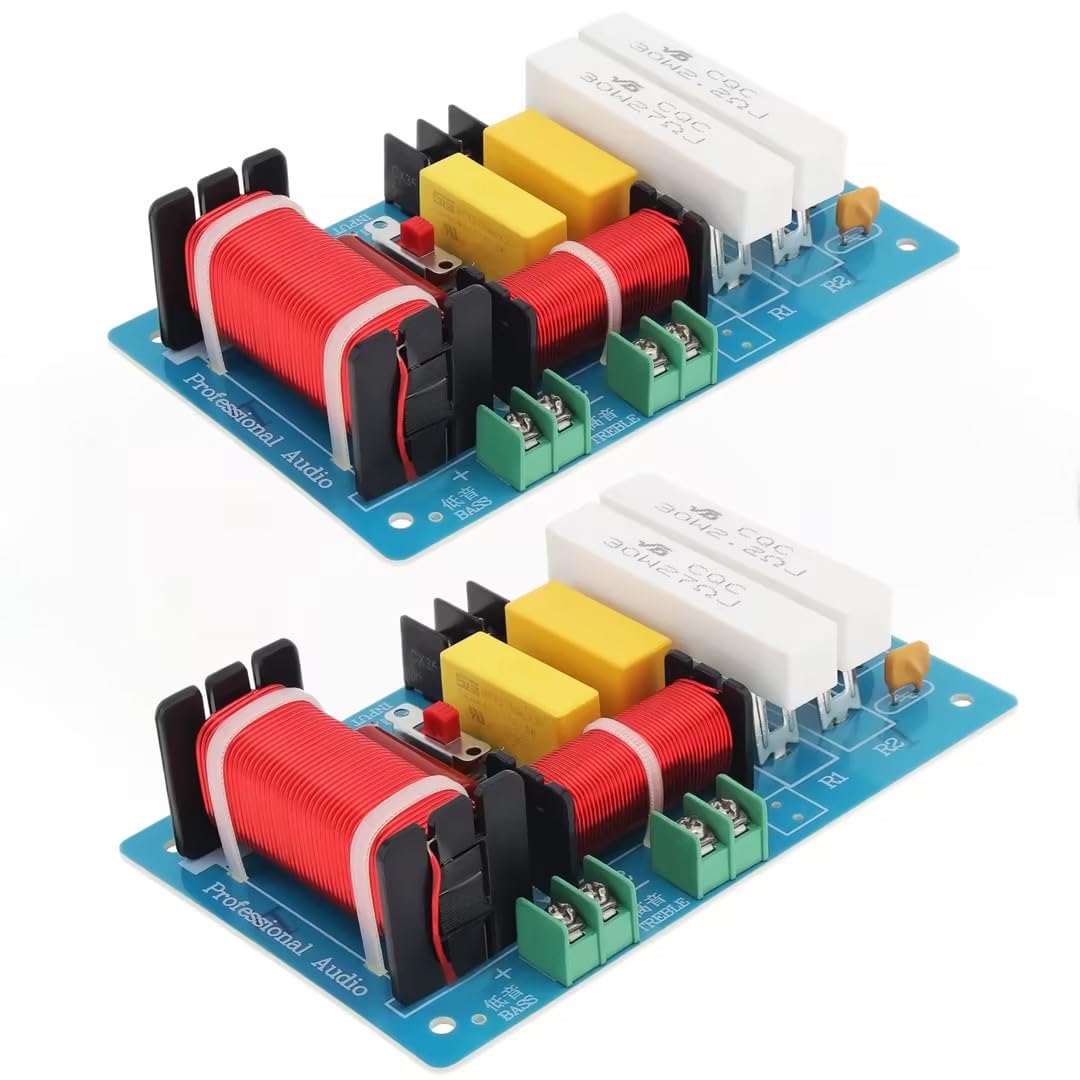
This two-pack from DriSentri offers a switchable crossover point between 2,850 Hz and 2,900 Hz, giving the user a small degree of fine-tuning to match specific driver combinations. The low-pass section uses a second-order 12 dB/octave slope, while the high-pass employs a third-order 18 dB/octave slope to provide extra protection for the tweeter.
A polypropylene audio capacitor feeds the tweeter, which produces a smoother, more rounded high-frequency response compared to standard electrolytic caps. The second layer of protection comes from a self-recovery fuse that silences the tweeter during a transient overload and automatically resets once the condition clears.
Home audio builders have successfully used these crossovers in projects like restoring Baby Advent speakers, pairing a new 6.5-inch mid-woofer with a ported cabinet. The 450-watt peak rating leaves enough headroom for most home and moderate car audio applications.
Why it’s great
- Switchable 2850/2900 Hz crossover point.
- Polypropylene tweeter capacitor for smooth highs.
- Self-recovery fuse protects against power spikes.
Good to know
- Screw-down input posts feel less rigid than expected.
- Dual 18 dB slopes may sound too steep for some audiophiles.
4. Fydun 300 Watts 2 Way Crossover Universal Heat Dissipation

The Fydun crossover is engineered with a solderless plug-in socket system, which simplifies installation for those who prefer not to solder. The high-gloss, double-layer ABS housing is designed for heat dissipation, an important factor when the crossover is mounted inside a vehicle door cavity or behind a dash panel.
A dedicated bass inductor improves the low-pass section’s ability to handle lower frequencies, which helps prevent door woofers from bottoming out when the system is pushed. The overcurrent protection adds an extra layer of safety for the tweeter channel, reducing the risk of a blown driver during high-output passages.
Users report that pairing this crossover with component speakers — like Hertz K165s — produces a clean, fatigue-free sound even at high volume. The unit is compact enough to fit under a steering wheel or behind a glove box, making it a practical choice for tight vehicle spaces.
Why it’s great
- Solderless plug-in terminals for quick installation.
- Overcurrent protection on tweeter circuit.
- Compact ABS housing with heat dissipation design.
Good to know
- Bass inductor adds weight to the unit.
- No adjustable crossover frequency point.
5. Audiopipe CRX-203 2-Way 4-Ohm Car Audio Passive Crossover

The Audiopipe CRX-203 is a no-frills 2-way crossover that uses high-grade polymer capacitors and gold-plated screw terminals to minimize signal loss. It splits the amplified signal between a woofer (20 Hz to 5.6 kHz) and a tweeter (5.6 kHz and above), with a total RMS handling of 200 watts.
Ferrite and air-cooled spools are used in the inductor section to reduce saturation and distortion at higher power levels. While the terminals are functional, they are very small; owners recommend using carefully crimped fork connectors to get a solid bite without damaging the threads.
This crossover works best as a budget-friendly upgrade for car audio systems where the goal is to add a pair of tweeters to existing coaxial speakers. DIY builders have also used it to retrofit vintage home speakers, replacing deteriorated capacitors and wiring with modern components housed in the compact ABS chassis.
Why it’s great
- Gold-plated screw terminals resist corrosion.
- Ferrite and air-cooled inductors for linear performance.
- 200W RMS rating is sufficient for most factory upgrades.
Good to know
- Small terminals require care during installation.
- Fixed crossover point at 5.6 kHz may be too high for some tweeters.
6. Audiopipe 300 Watts 2 Way Crossover (2 Pack) CRX-203

This two-pack from Audiopipe delivers 150 watts RMS per crossover with a peak rating of 300 watts. The woofer high-pass is set at 20 Hz to 4.3 kHz, while the tweeter low-pass covers 3.39 kHz to 20 kHz, creating a small overlap zone that can help blend the transition between drivers.
The ABS enclosure is lightweight but durable, and the gold-plated screw terminals are identical in quality to the single-pack CRX-203. For a system running two 6×8-inch woofers and two tweeters from a single 2-channel amplifier, this pair makes wiring straightforward and clean.
Users upgrading from factory crossovers often hear an immediate improvement in clarity and soundstage width. The 12-volt DC input voltage rating confirms these are intended for automotive use, where the electrical system is nominally 12V. No documentation is included beyond basic labeling, but the terminal markings are intuitive enough for a confident DIY installer.
Why it’s great
- Two-pack saves money for multi-speaker builds.
- 150W RMS per crossover is reliable for daily driving.
- Gold-plated terminals for consistent conductivity.
Good to know
- Limited documentation included in the package.
- No tweeter protection circuit beyond standard capacitor.
7. HiQltyla WEAH-2002 2 Way Speaker Crossover (2 Pack)

The HiQltyla WEAH-2002 is a budget-friendly two-pack designed for adding tweeters to an existing car audio system. It uses a 16mm professional electrodeless capacitor and metallized thin-film inductors to filter at a fixed 3,000 Hz crossover point. The 220-watt peak rating is moderate, so it pairs best with a factory or low-power aftermarket head unit.
The transparent coffee-colored ABS shell allows you to see the internal components, and the dual-flow heat dissipation design helps manage temperature in enclosed spaces. Convenient screw terminals eliminate the need for soldering, which lowers the barrier to entry for first-time installers.
Customer experiences vary significantly. Many users report a noticeable improvement in sound clarity and ease of installation. However, a small number of units have arrived with internal component damage or cannot handle the power output from even a factory radio, resulting in a blown fuse or no output. This inconsistency in quality control makes it a gamble, but the price for a two-pack is low enough to be worth the risk for a basic project.
Why it’s great
- Two-pack pricing is very budget-conscious.
- Transparent housing with heat dissipation design.
- Screw terminals allow solderless installation.
Good to know
- Inconsistent quality control on internal components.
- Cannot reliably handle high-power amplifier output.
FAQ
Can I use a 2-way car audio crossover in a home speaker cabinet?
What happens if I use a 4-ohm crossover with 8-ohm speakers?
How do I know if my tweeter needs a -6 dB attenuation setting?
Final Thoughts: The Verdict
For most users, the best 2 way speaker crossover winner is the Dayton Audio XO2W-2.5K because its Linkwitz-Riley 12 dB/octave alignment provides the most transparent and phase-coherent sound for both home and car audio applications. If you want adjustable tweeter output for a high-power car system, grab the DS18 PRO-CFX. And for a versatile build with tweeter protection, nothing beats the DriSentri 450W 2-pack.