
Your RV, truck, or boat WiFi setup is only as strong as the antenna pulling in the signal. A weak stock antenna or a misaligned omni-directional unit can leave you buffering at the campsite or losing the hotspot on the highway. The right auto WiFi antenna turns a flickering connection into a reliable data link, whether you are pointed at a campground router or a far-off cell tower.
I’m Min — the co-founder and writer behind Gadgets Feed. For this guide, I processed hundreds of customer field reports and spec sheets on 7 different auto WiFi antennas, analyzing real-world gain figures, connector types, cable loss characteristics, and mounting options to separate signal-boosting winners from devices that just add cable clutter.
This breakdown covers omni-directional, directional Yagi, and multi-band MIMO designs so you can pinpoint the best auto wifi antenna for your specific vehicle, router, and coverage goal.
How To Choose The Best Auto WiFi Antenna
Selecting the right antenna for your vehicle starts with understanding your primary signal source. Campground WiFi, a home router at a fixed location, and a cellular hotspot each demand a different antenna pattern and frequency range. You also need to account for the physical constraints of mounting on a metal vehicle surface and the length of coaxial cable required to reach your router inside the cabin. Every foot of cable introduces signal loss, so an antenna with a higher dBi rating but a long, low-quality cable can perform worse than a moderate-gain model with a premium shielded lead.
Directional vs. Omni-Directional Pattern
A directional Yagi antenna concentrates its beam into a narrow arc, often 25 to 40 degrees wide, providing much higher gain on a specific target. This is ideal if you park in a known spot and can aim at a single WiFi router or cell tower. An omni-directional antenna radiates equally in all horizontal directions, offering convenience when you are moving or when the signal source changes position. The trade-off is lower peak gain, typically 5 to 10 dBi, versus 17 to 25 dBi from a Yagi. If you travel frequently and need to connect from any angle without re-aiming, an omni is the more practical choice for your vehicle.
Connector Compatibility and Cable Quality
Not all antennas use the same connector. Your router, modem, or USB adapter likely has an RP-SMA female port, while some high-end cellular modems use N-Female or SMA male. A mismatch forces you to buy an adapter, and each adapter adds insertion loss. The cable itself is equally critical: thin RG174 cable loses 2-3 dB over 10 feet at 2.4 GHz, wiping out much of the gain from a high-dBi antenna. Look for LMR-200 or RG-8X low-loss coax for runs longer than 6 feet. The magnetic base models often integrate the cable, so check its specification before assuming it delivers full rated gain to your device.
Gain and Frequency Range
For pure WiFi at 2.4 GHz and 5 GHz, a 7-10 dBi omni or a 17-25 dBi Yagi is typical. If you also want to boost 4G LTE or 5G cellular data, you need a wideband antenna covering 600-6000 MHz. Multi-band antennas usually have lower peak gain (5-10 dBi) because they must perform across a very broad spectrum, but they give you flexibility to switch carriers or use both WiFi and cellular from the same external antenna. A MIMO antenna with two or four ports can double or quadruple throughput on compatible modems by using spatial multiplexing, which is especially useful for RV home internet setups.
Quick Comparison
On smaller screens, swipe sideways to see the full table.
| Model | Category | Best For | Key Spec | Amazon |
|---|---|---|---|---|
| Proxicast ANT-128-004 | LPDA Yagi | Multi-band cellular + WiFi | 9/11 dBi, 600-6000 MHz | Amazon |
| Proxicast ANT-126-002 | Omni Wideband | Marine/RV 5G & WiFi | 10 dBi, 600-6000 MHz | Amazon |
| weBoost Overland 311248 | Signal Booster Antenna | Drive Reach booster kit | 5G/LTE, NEMA rated | Amazon |
| Slinkdsco 4×4 MIMO | MIMO Omni | 5G home internet speed | 4×4 MIMO, 698-6000 MHz | Amazon |
| Kaunosta 25 dBi Yagi | Directional Yagi | Extreme long range 2.4 GHz | 25 dBi, RP-SMA, 50 cm | Amazon |
| BearExtender MB01 | Magnetic Omni | USB adapter range boost | 7 dBi, RP-SMA, 11 ft cable | Amazon |
| Tupavco TP513 | Directional Yagi | Point-to-point WiFi bridge | 17 dBi, N-Female pigtail | Amazon |
In‑Depth Reviews
1. Proxicast ANT-128-004 LPDA Antenna

The Proxicast ANT-128-004 is a true multi-tool for auto WiFi and cellular. This Log Periodic Dipole Array (LPDA) delivers 9 dBi gain at the low end of its sweep and 11 dBi at the high end, covering 600-6000 MHz in a single package. That means it pulls in 4G LTE, 5G sub-6, CBRS, and WiFi simultaneously. Users report consistent 15+ dB gain over stock antennas and a dramatic increase in detectable access points after switching from a factory omni. The narrow beamwidth focuses energy precisely on the target tower or router, making it ideal for stationary RV setups or long-term campsites where you can aim once and leave it.
Build quality stands out in this category. The weather-resistant housing has survived five years in the field for some of Proxicast’s commercial customers, and the plastic radome keeps birds and spiders from nesting on the elements. Every review highlights that the mounting bracket holds secure through highway travel and heavy winds. A few buyers note the N-Female connector requires an adapter cable (RP-SMA to N-type) for most consumer routers, adding roughly to the total install cost. Consider that a minor investment for the range and reliability this antenna brings to your vehicle’s connectivity.
Real-world tests show the ANT-128-004 pulling in a usable LTE signal at over 8 kilometers with a Netgear Nighthawk M1, achieving 8 Mbps down on Band 12 at 700 MHz. For WiFi duty, it converts a 73% (-61 dB) signal with dropouts into a solid 100% (-45 dB) link. If you need one antenna that handles every frequency band from a fixed position, this LPDA is the clear choice. Its premium price reflects the broad frequency agility and proven durability that cheaper Yagis cannot match.
Why it’s great
- Ultra-wide 600-6000 MHz coverage works for 5G, LTE, WiFi, and CBRS
- Consistent 9-11 dBi gain with narrow beam for focused long-range links
- Weatherproof housing proven over years of outdoor vehicle use
Good to know
- Requires a separate N-Female to RP-SMA pigtail for most consumer routers
- Directional pattern demands precise aiming at the signal source
2. Proxicast ANT-126-002 Omni-Directional Antenna

The Proxicast ANT-126-002 is the omni-directional counterpart to the LPDA above, offering the same wideband 600-6000 MHz coverage but with a 360-degree radiation pattern. This makes it the go-to choice for mobile applications where you cannot predict the direction of the nearest tower. At 10 dBi peak gain, it outperforms typical 5 dbi marine antennas while still fitting a sleek white ABS radome that measures only 9.1 inches tall. The integrated N-Female connector eliminates the need for a separate ground plane, simplifying installation on RV roofs, boat cabins, or truck bed rails.
Customer feedback consistently praises the jump from 2 bars to 5 bars after mounting this antenna on an RV roof with direct line-of-sight to a cell tower. One user on a Netgear Nighthawk 1100 measured a 10-20 dB increase and speeds of 25/10 Mbps in a spot that previously struggled to maintain a data session. The all-stainless mounting bracket resists corrosion in marine environments, and the aerodynamic shape reduces wind load at highway speeds. A few reports mention that the required 50-ohm coaxial cable must be thick (3/8 inch) to keep losses low over longer runs, so budget for quality RG-8X or similar if your router sits far from the roof entry point.
While the ANT-126-002 cannot match the range of a directional Yagi aimed at a single target, its convenience in a moving vehicle is unmatched. You can drive into a new campground, park, and have a usable signal without climbing up to adjust an antenna. It also works as a secondary omni in a MIMO pair if you combine it with the ANT-128-004. For RVers and boaters who value simplicity and consistent coverage from any angle, this premium omni is the smartest single-antenna investment.
Why it’s great
- Omni pattern needs no aiming, perfect for mobile and changing locations
- Full 600-6000 MHz band covers 5G, 4G, and WiFi in one radome
- Stainless steel bracket and aerodynamic design survive highway weather
Good to know
- Requires high-quality low-loss coax for runs over 6 feet
- Does not include the coaxial cable or modem pigtail adapter
3. weBoost Overland Antenna 311248

The weBoost Overland Antenna is purpose-built as the external companion for the Drive Reach cell signal booster kit, and it excels in that role. Rated to U.S. military and NEMA standards for dust and moisture, this antenna survives the harsh conditions of overland travel — mud, rain, and desert heat. It is 5G compatible and works across all major U.S. carriers including Verizon, AT&T, and T-Mobile. The 15-foot attached cable gives you ample reach from the rear ladder or bed rail mount down to the booster unit inside the vehicle.
Real-world reports from RVers confirm that the Overland Antenna maintains at least two bars of signal even in remote areas where phones showed no service. One user in a rural desert location paired it with T-Mobile home internet and achieved high-speed, lag-free gaming from a spot that previously could not hold a connection. The antenna folds down when not needed, reducing the risk of tree branch damage. Several buyers note that the package does not include the mounting bracket or nut — you must reuse the mount from your existing weBoost kit or purchase one separately. That is an oversight for first-time buyers, but the antenna itself delivers exactly as promised.
If you already own a weBoost Drive Reach, this is the only outside antenna you should consider for your vehicle. Its sealed construction and foldable design are clearly engineered for off-road use. The premium price reflects the FCC-approved pairing with the booster amplifier, ensuring legal operation and maximum power transfer. For overlanders and full-time RVers who rely on a cellular booster, this antenna turns a weak 1-bar flicker into a stable connection that supports streaming, video calls, and work-from-road duties.
Why it’s great
- NEMA and military durability rating for extreme off-road conditions
- FCC-approved pairing with Drive Reach booster for legal maximum power
- Foldable design reduces damage risk when not in use
Good to know
- Mounting bracket and nut are not included in the box
- Works only with weBoost Drive Reach booster kits, not standalone routers
4. Slinkdsco 4×4 MIMO Omni Antenna
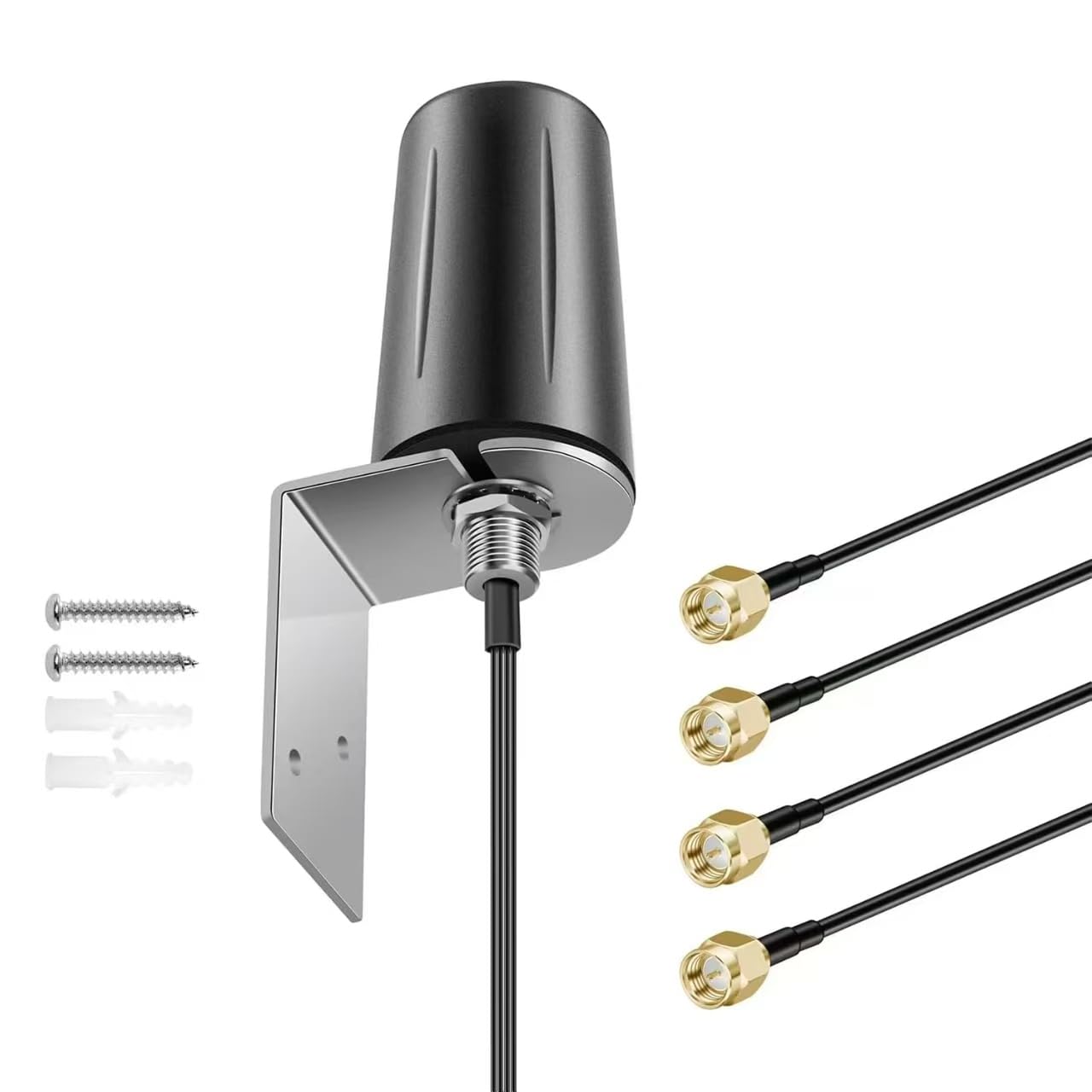
The Slinkdsco 4×4 MIMO antenna is a low-profile omni designed specifically to exploit multiple spatial streams on compatible 5G and 4G LTE modems. Its four internal antennas feed four separate SMA male pigtails, allowing a router like the T-Mobile home internet gateway or a Cradlepoint to use all four MIMO channels simultaneously. Users have reported massive speed jumps — from 120-200 Mbps up to 610 Mbps on T-Mobile 5G after replacing the stock internal antenna with this external unit. The 5 dBi gain is modest, but the MIMO multiplexing gain is what drives the throughput improvement, not raw gain.
The antenna covers 698-6000 MHz, making it compatible with both sub-6 5G and all legacy LTE bands. Its slim 8x8x2-inch footprint fits on a window sill, under an eave, or on a small roof bracket without looking obtrusive. The 10-foot RG174 cables are thin, which helps with routing through tight seals, but RG174 has higher loss than LMR-200 at longer runs. A few customers saw negligible improvement or even worse performance, likely due to the thin cable or suboptimal placement where the four internal elements could not achieve sufficient spatial separation. Proper outdoor installation in an open area is critical for MIMO to function correctly.
For users with a 4×4 MIMO-capable modem who are stuck with slow speeds inside a metal-skinned RV or van, this antenna offers the simplest path to dramatic speed increases. It requires no aiming, no ground plane, and no complex setup. The price sits in the mid-range, and the 2-year warranty from Slinkdsco adds some peace of mind. If your gateway supports carrier aggregation and MIMO, this antenna unlocks the potential your modem already has.
Why it’s great
- 4×4 MIMO can triple or quadruple data speeds on compatible modems
- Low-profile 8×8-inch form factor fits tight vehicle installations
- Wide 698-6000 MHz band covers every major 5G and LTE frequency
Good to know
- Thin RG174 cables lose significant signal over long runs
- MIMO benefits require a modem with four cellular antenna ports
5. Kaunosta 25 dBi Yagi Antenna

The Kaunosta 25 dBi Yagi is one of the highest-gain 2.4 GHz directional antennas you can mount on a vehicle, and it delivers extreme range when aimed correctly. The 50-centimeter aluminum alloy body is surprisingly lightweight and includes a 1.5-meter RP-SMA pigtail plus a wall mount bracket. Being strictly 2.4 GHz, it works perfectly for WiFi and some 2.4 GHz IoT devices, but not for 5 GHz WiFi or cellular bands. Customers have used it to extend a WiFi link over 100 meters in a single direction, and one buyer set up a chain of solar WiFi extenders using two of these Yagis to push signal to a distant surveillance camera.
The waterproof aluminum construction survives outdoor mounting, and the gold-plated RP-SMA connector resists corrosion. However, the extreme 25 dBi gain comes with a very narrow beamwidth — typically around 10 degrees. That means even a slight shift in wind or a bump from a passing truck can knock the signal off target. Several customers reported that the antenna worked well when stationary but lost alignment during travel. The price is very affordable for such high gain, making it tempting for hobbyists and long-range point-to-point links, but the narrow beam limits its practicality on a moving vehicle unless you have a clear, fixed target and negligible vibration.
For stationary use — say, parked at a seasonal campsite aimed at a distant WiFi source — this Yagi provides unmatched range at a low cost. Pair it with a high-power USB adapter for the best results. The 1-year warranty from Kaunosta is decent for this price tier. Just be aware that the narrow beamwidth demands a sturdy mount and patience during alignment.
Why it’s great
- 25 dBi gain is among the highest available for 2.4 GHz WiFi
- Waterproof aluminum body survives outdoor vehicle mounting
- Very affordable for the extreme gain it provides
Good to know
- Extremely narrow beamwidth loses alignment easily on a moving vehicle
- 2.4 GHz only — no support for 5 GHz WiFi or cellular bands
6. BearExtender MB01 Magnetic Omni

The BearExtender MB01 is a straightforward magnetic-base omni antenna that solves the most common auto WiFi problem: a weak stock antenna on a USB adapter or router. Its heavy-duty magnet holds firmly to any metal roof or hood, and the 11-foot LMR-200 low-loss coax preserves signal over the full length. In an A-B test, the stock antenna on a BearExtender USB adapter lost signal at 300 feet line-of-sight, while the MB01 maintained a connection to 1050 feet — a 3x range improvement. The 7 dBi blade-style element is detachable, and the RP-SMA connector fits most USB adapters and routers with detachable antennas.
One RV owner used the MB01 to move the antenna from inside a metal shed to outside, jumping from 2 bars to 5 bars on a simple internet radio setup just 15 feet from the router. The magnetic base holds the antenna securely even in highway winds, and the cable is thick enough to prevent crushing under a closed window or door. A few customers received a female RP-SMA connector instead of the advertised male, so double-check the connector gender before purchase if you are mating to a specific adapter. The package does not include a WiFi receiver — this is strictly the antenna and base unit.
For under , the BearExtender MB01 delivers the most predictable performance improvement for anyone using a USB WiFi adapter with an external antenna port. The combination of a strong magnet, a properly rated LMR-200 cable, and a decent 7 dBi omni element makes it the ideal budget upgrade for car, RV, or truck WiFi. It also works as a replacement antenna for compatible routers, making it a versatile accessory to keep in your vehicle’s emergency kit.
Why it’s great
- Permanent-magnet base holds secure on metal roofs at highway speeds
- LMR-200 coax minimizes signal loss over the full 11-foot cable run
- Tripled WiFi range from 300 ft to 1050 ft in real-world line-of-sight test
Good to know
- Connector gender may vary — verify RP-SMA male or female for your device
- Does not include a WiFi adapter; antenna only
7. Tupavco TP513 17 dBi Yagi

The Tupavco TP513 is a 17 dBi Yagi that consistently outperforms its modest price tag. It is designed for bridging WiFi networks between two distant points, making it a strong candidate for a stationary vehicle aimed at a known router or a seasonal RV site with line-of-sight to a property. The 25-degree horizontal and 24-degree vertical beamwidth is wide enough to tolerate minor misalignment, unlike ultra-narrow 25 dBi Yagis. One customer used it to connect to a hotspot half a mile away, maintaining 70-100% signal strength with clear line-of-sight and a 1W Alfa adapter. The N-Female pigtail connector is weather-resistant and standard for outdoor installations.
The compact and rugged housing includes pole-mount hardware, but the mounting pole is sold separately. Multiple users noted that the thin coaxial cable that comes with the antenna is not ideal; swapping it for a thicker 14-gauge low-loss cable improved reception noticeably. Another reviewer pointed out that you may need to invest ~ in a quality RP-SMA to N-type adapter and extension cable to connect it to a consumer USB adapter, bringing the total setup cost closer to . That still beats many higher-priced Yagis in performance. One buyer did not see any improvement over a factory omni on a Reolink camera, which may indicate the camera’s antenna port or power limitations rather than a fault in the Yagi itself.
For the money, the TP513 is a reliable directional antenna that works well in fixed outdoor applications. Its 17 dBi gain offers a practical sweet spot — high enough for significant reach but not so narrow that aiming becomes a constant battle. If you are setting up a point-to-point link from your RV to a cabin router or a remote WiFi hotspot, the Tupavco TP513 delivers dependable range and signal quality at a very competitive price.
Why it’s great
- 17 dBi gain provides strong range with a forgiving 25-degree beamwidth
- Weatherproof aluminum housing with included pole-mount brackets
- Proven ability to connect at 0.5+ miles with proper alignment
Good to know
- Stock thin cable should be replaced with low-loss coax for best results
- N-Female connector requires an adapter for most USB WiFi adapters
FAQ
Can I use a 25 dBi Yagi while driving?
What does 4×4 MIMO mean for my RV internet speed?
Will a WiFi antenna work with my cellular hotspot?
Why does my antenna come with an N-Female connector instead of RP-SMA?
Final Thoughts: The Verdict
For most users, the best auto wifi antenna winner is the Proxicast ANT-128-004 because it combines ultra-wideband 600-6000 MHz coverage with reliable 9-11 dBi gain and proven weather durability for stationary RV and campsite use. If you need an omni that works without aiming from a moving vehicle, grab the Proxicast ANT-126-002. And for the best value when you already own a cell booster, nothing beats the weBoost Overland Antenna 311248.