
Our readers keep the lights on and my morning glass full of iced black tea. As an Amazon Associate, I earn from qualifying purchases.
Specs are compiled from manufacturer listings and verified buyer reviews and can change over time — please confirm the key details on the product page before buying.
A blown fuse at the wrong moment can shut down your day — the dryer halts mid-cycle, the well pump goes silent, a vintage amp goes dark. The real problem is finding a 20 amp fuse that actually does its job for years, not weeks. This guide sorts the genuine heavy-lifters from the ones that can cause bigger trouble, so you grab the right box and get back to running your home or gear.
I’m Min — the founder and writer behind Gadgets Feed. This guide is built by comparing the manufacturers’ published specifications and the patterns across verified customer reviews, so you get each pick’s real strengths and trade-offs instead of marketing spin.
Whether you are protecting a motor, an outboard boat engine, or an old fuse panel, choosing the 20 amp fuses that match your exact circuit type is the difference between a ten-year run and a melted holder.
Our Picks at a Glance


How To Choose The Best 20 Amp Fuses
Picking the wrong 20-amp fuse is like using the wrong key — it either won’t fit, or it will let too much current through and cause damage. The three things to check are the fuse type (time-delay vs. fast-acting), the physical shape (cartridge, glass, or plug), and the class rating (RK5, CC, or G). Match those three, and you have a fuse that threads in, holds steady on motor startups, and pops exactly when it should.
Time-Delay vs. Fast-Acting
A time-delay or “slow-blow” fuse tolerates a brief surge — like when a refrigerator compressor or a well pump kicks on. A fast-acting glass fuse will blow the moment it sees that same surge, even though nothing is actually wrong. For motors, pumps, and any circuit with a startup spike, always go time-delay. For sensitive electronics like a radar detector or a 12V inverter, stick with fast-acting for immediate protection.
Plug Fuses vs. Cartridge Fuses
Plug fuses screw into an Edison or rejection base — you will find them in older residential panels (the round, glass-window type). Cartridge fuses are cylindrical and clip into fuse holders, common in industrial panels, marine systems, and some appliances. The two are not interchangeable; always check your panel or equipment for the correct mounting style.
Interrupting Rating and Voltage
The interrupting rating tells you the maximum fault current the fuse can safely stop without exploding. A class RK5 fuse like the Bussmann FRN-R handles up to 200kA, making it safe for main panels. A small glass fuse might handle 1kA. Pair the fuse with your system’s voltage rating (125V, 250V, 600V) — if you put a 32V fuse on a 120V line, it will arc and fail catastrophically.
Quick Comparison
| Model | Best For | Type | Interrupting Rating | Voltage | Amazon |
|---|---|---|---|---|---|
| Bussmann BP/FRN-R-20★ Best Overall | Motor & main panel | Dual-element time-delay cartridge | 200kA | 250V | Amazon |
| Bussmann LP-CC-20Premium Pick | Industrial control circuits | Time-delay Class CC cartridge | 200kA | 600V | Amazon |
| Blue Sea Systems AGC Fuses | DC circuits & electronics | Fast-acting glass | — | 125V AC / 250V AC | Amazon |
| Eaton Bussmann AGA-20 | Outboard motors & hard-to-find spots | Fast-acting glass (short 1/4 x 5/8 in) | 1kA at 32V AC | 32V AC | Amazon |
| Bussmann SL-20PK4 | Older household fuse panels | Time-delay rejection-base plug | — | 125V | Amazon |
| EPLZON 20A Cartridge Fuse Kit | Modern truck & trailer circuits | MCASE low-profile cartridge | 1kA at 32 VDC | 32 VDC | Amazon |
| Bussman TL-20PK4 | Standard household screw-in panels | Time-delay plug | — | — | Amazon |
In‑Depth Reviews
1. Bussmann BP/FRN-R-20 20 Amp Fusetron Dual Element Time-Delay Current Limiting Class RK5 Fuse, 250V UL Listed (Pack of 2)
Our pick — over 4.5★ from 200+ verified ratings; the strongest balance of quality and price.
The industrial-grade fuse that buyers report buying a decade apart because it simply does not blow prematurely.
This is the fuse you want when a motor startup surge (like a well pump or a furnace blower) would destroy a cheap fast-acting glass fuse on day one. The dual-element design holds steady through an inrush current five times the amp rating for at least eight seconds, giving any motor time to spin up without a nuisance trip. It protects against overloads, ground faults, and single-phasing on three-phase systems, all while carrying a 200kA interrupting rating at 250V.
Owners mention these fuses last for years — one reviewer bought a set, replaced them a decade later, and called them a “good inexpensive product that works very well.” The pack gives you two fuses, enough to cover a critical circuit and keep a spare. Customers consistently cite functionality and value for money as top reasons for choosing this pack.
Compared to the Bussmann LP-CC-20 below: the FRN-R is significantly larger (5.5 x 2.75 x 0.56 inches versus 1 x 1 x 1 inches), so ensure your fuse holder has the space. But if you have the room, the RK5 class delivers the same 200kA interruption in a more budget-friendly package.
What wins people over
- Withstands motor inrush current five times rated load for 8 seconds without blowing
- Dual-element design handles both short-circuit and sustained overload protection
- Owners routinely get a decade or more between replacements
The honest trade-off
- Large physical size (5.5 inches long) may not fit compact fuse blocks
- Two-pack is enough for a single circuit; you need two boxes if protecting multiple motors
Reach for this if: you have a motor, pump, or main panel that needs time-delay protection and a rugged 200kA interrupting rating.
Look elsewhere if: your equipment uses a glass fuse form-factor or you need a 32V automotive-style fuse.
2. Bussmann LP-CC-20 – Pack Of 10 – Low Peak Current Fuse 20A
The compact workhorse for industrial control panels that need high-voltage, high-fault protection in a tiny package.
The LP-CC-20 is a Class CC fuse, meaning it packs a 200kA interrupting rating and a 600V AC / 300V DC rating into a body that measures just 1 x 1 x 1 inches. That is one-tenth the volume of the FRN-R above, making it the go-to when panel space is tight. It is time-delay, so it handles motor control circuit startup surges, yet it responds fast enough to protect sensitive downstream components.
The ten-pack means you can stock a whole cabinet or carry spares for multiple machines. Its compact copper body and through-hole mounting suit both new builds and retrofits. The modest number of ratings (24) makes this a specialized choice, but those who need it appreciate the high voltage ceiling and small footprint. Delivery and exact fit are the consistent themes in owner feedback.
Why it stands out
- Rated for 600V AC — usable in higher-voltage industrial gear that 250V fuses cannot touch
- Class CC rejection design prevents installing a wrong amp rating
- Ten fuses per pack at a generous count for multi-circuit setups
The honest trade-off
- Premium pricing reflects the specialized Class CC form factor
- Only 24 ratings available — a niche product with a smaller owner base
Grab this for: industrial control panels, HVAC equipment, and any 480V/600V circuit that demands a high interrupting rating in a tiny space.
skip it if: your equipment uses standard cartridge or plug-type fuses — the Class CC footprint will not fit.
3. Bussmann SL-20PK4 20 Amp Time Delay Loaded Link Rejection Base Plug Fuse, 125V UL Listed, 4-Pack
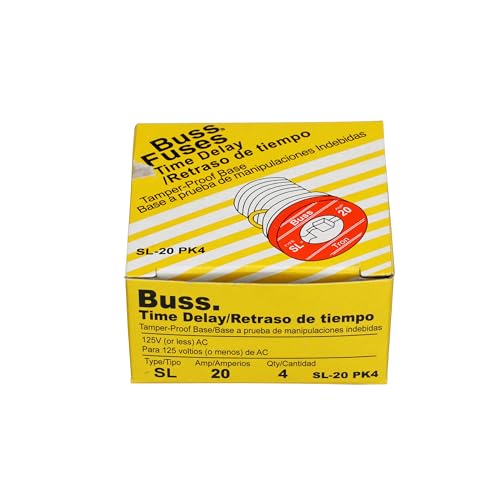
The old-house hero that prevents you from accidentally screwing in a 30-amp fuse where a 20 belongs.
If you live in a home with a round screw-in fuse panel (common in pre-1960s construction), this is the one you need. The “rejection base” design physically prevents a higher-amp fuse from being threaded into a 20-amp circuit, which is a standout for safety — no more guessing or dangerous over-fusing. They are time-delay, so the startup draw from a refrigerator or a window air conditioner will not trip them unnecessarily.
Each fuse measures 1.25 inches in diameter and 1.25 inches tall — the standard plug fuse size — and they screw into SA adaptors for older Edison-base panels. Owners praise the “perfect fit” and “solid build quality,” and appreciate the four-pack value over buying singles. Quality and value-for-money earn the most praise from buyers.
What makes it a must
- Rejection base prevents installing a higher amp fuse than the circuit was designed for — a critical safety feature
- Time-delay handles motor startup surges without nuisance trips
- Four fuses per pack at a price that beats the hardware store
The honest trade-off
- Will not thread into a standard Edison base without an SA adaptor; check your panel before buying
- Only rated for 125V, so unsuitable for 240V circuits like a dryer or range
Best for: anyone with an older residential fuse panel (125V circuits) who wants safe, time-delay protection and a four-pack convenience.
Think twice if: you need a cartridge-style fuse or a higher voltage rating — this is strictly a 125V plug fuse.
4. Eaton Bussmann Glass Fuse, 20A, 1kA at 32V AC, 5 PK AGA-20-1 Each
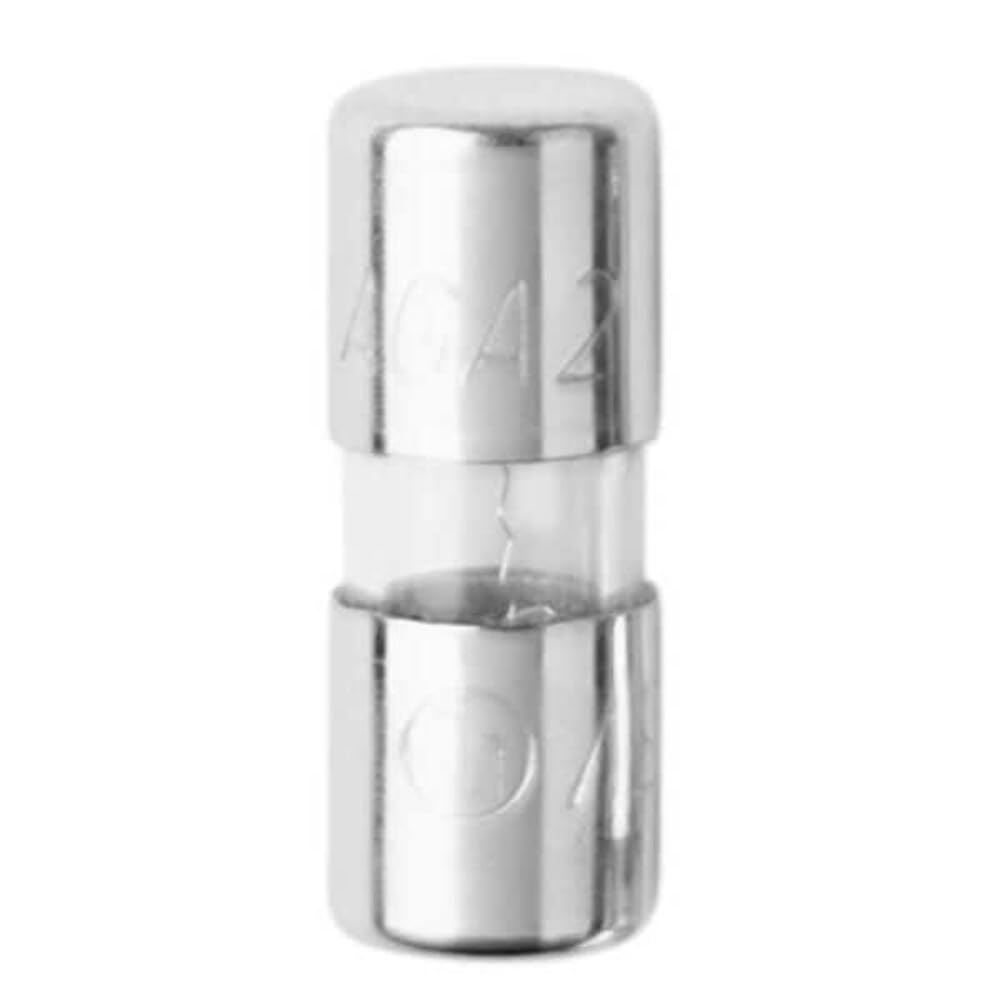
The tiny glass tube that saves you 80% versus the same fuse from an outboard motor dealer.
The AGA-20 is a short 1/4 x 5/8 inch glass fuse designed for low-voltage 32V AC applications — most famously, vintage Evinrude and Johnson outboard motors. Its compact size makes it a perfect fit where a standard AGC or 3AG fuse is too long. Owners who searched for this hard-to-find size report entering the “AGA 20” code written on their old blown fuse and getting an exact match that worked great.
The five-pack delivers good value, with one buyer calculating an 80% savings compared to the OEM outboard motor part. At just 9.07 grams each, they are also among the lightest fuses in this roundup, which matters for portable and marine gear where ounces count. The 1kA interrupting rating at 32V AC is adequate for small engine and marine circuits.
what separates it
- Short 1/4 x 5/8 inch size fits applications where a standard 1-1/4 inch glass fuse is too long
- Five-pack at a price that beats OEM marine parts by 80%
- Perfect match for Evinrude and other outboard motor circuits
The honest trade-off
- Rated for 32V AC only — do not use on standard 120V household circuits
- Fast-acting type, so not suitable for motor startups with high inrush current
Pick this if: you need a short glass fuse for a marine outboard, a small engine, or any 32V AC device that requires the AGA-20 size.
Avoid it if: your application is a 120V or higher-voltage circuit, or if you need a time-delay fuse.
5. 20A 20AMP 32V FMM MCASE 608820 Micro Cartridge Fuses Low-Profile Fuses Kit (Pack of 10pcs)
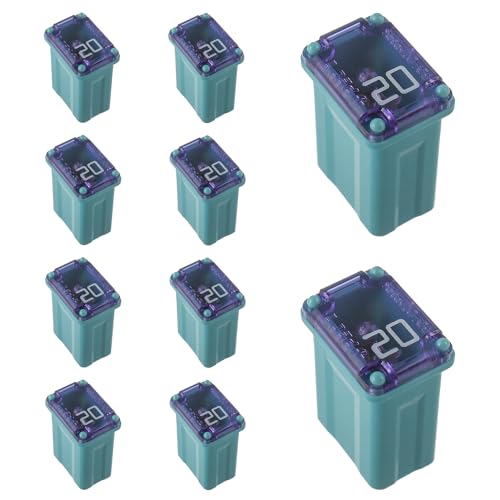
The oddly-shaped micro cartridge that owners of modern Ram trucks call a “perfect fit” for tail lights and brake controls.
The EPLZON MCASE fuse is a time-delay cartridge built for 32 VDC systems — specifically, the low-profile FMM-style fuse (a compact blade fuse shape) found in many modern trucks and trailers. Customers note it working smoothly in Ram 1500 tail light circuits and trailer brake controllers, calling the odd shape “hard to find” elsewhere. The ten-pack gives you plenty of spares for a vehicle fuse box that uses these special cartridges.
It handles up to 1kA at 32 VDC, with an insertion force of 44.1N maximum and extraction force between 4N minimum and 24.5N maximum — standard specs that match the OEM fit. The operating temperature range of -40°F to 248°F means it will function in extreme cold and under-hood heat. While the owner base is small (51 ratings), every single one is a five-star review.
Where it shines
- Low-profile MCASE form factor fits Ram trucks and modern trailer systems where standard fuses do not work
- Ten fuses per pack — enough to cover a full vehicle fuse box and then some
- Wide operating temperature range (-40°F to 248°F) for extreme environments
The honest trade-off
- Limited to 32 VDC — not for 120V or higher AC circuits
- Brand (EPLZON) is less established than Bussmann for heavy industrial use
Grab this for: any 2020+ Ram truck, trailer brake controller, or power accessory that uses the MCASE low-profile fuse shape.
Pass it by if: your vehicle uses standard ATO or mini blade fuses — the MCASE footprint is completely different.
6. Bussman TL-20PK4 20 Amp Time Delay Plug Fuses 4 Count

The no-fuss screw-in that keeps old apartment fuse panels working without the rejection-base confusion.
The TL-20PK4 is the standard Edison-base plug fuse — the classic round fuse with a glass window that shows if the metal strip is intact. Unlike the SL rejection-base version above, this one threads directly into any standard screw-in fuse holder without needing an adaptor. It is time-delay, so it can handle the startup surge of a refrigerator or a furnace motor without popping.
Owners like the quality and the price, with several noting the value of getting them delivered to the door versus a hardware store run. The four-pack covers a typical panel’s critical circuits. Made in Mexico by Bussmann, these carry the same reputation for reliability as the rest of the lineup, though the build materials (copper) and surface-mount design point to general residential use rather than heavy industrial.
Why it works
- Screws directly into standard Edison-base fuse panels — no special adaptor needed
- Time-delay design prevents nuisance trips from motor or compressor startups
- Four-pack is a practical quantity for a single panel
The honest trade-off
- No rejection feature, so a higher-amp fuse could theoretically be installed by mistake — not as safe as the SL series
- Rated voltage is not listed on the specs, so verify compatibility with your 125V panel
Reach for this if: you have a standard Edison-base fuse panel and want a straightforward, time-delay plug fuse without adaptors.
Pick the SL version instead if: you want the safety of a rejection base that prevents over-fusing your circuits.
7. Blue Sea Systems AGC Fuses
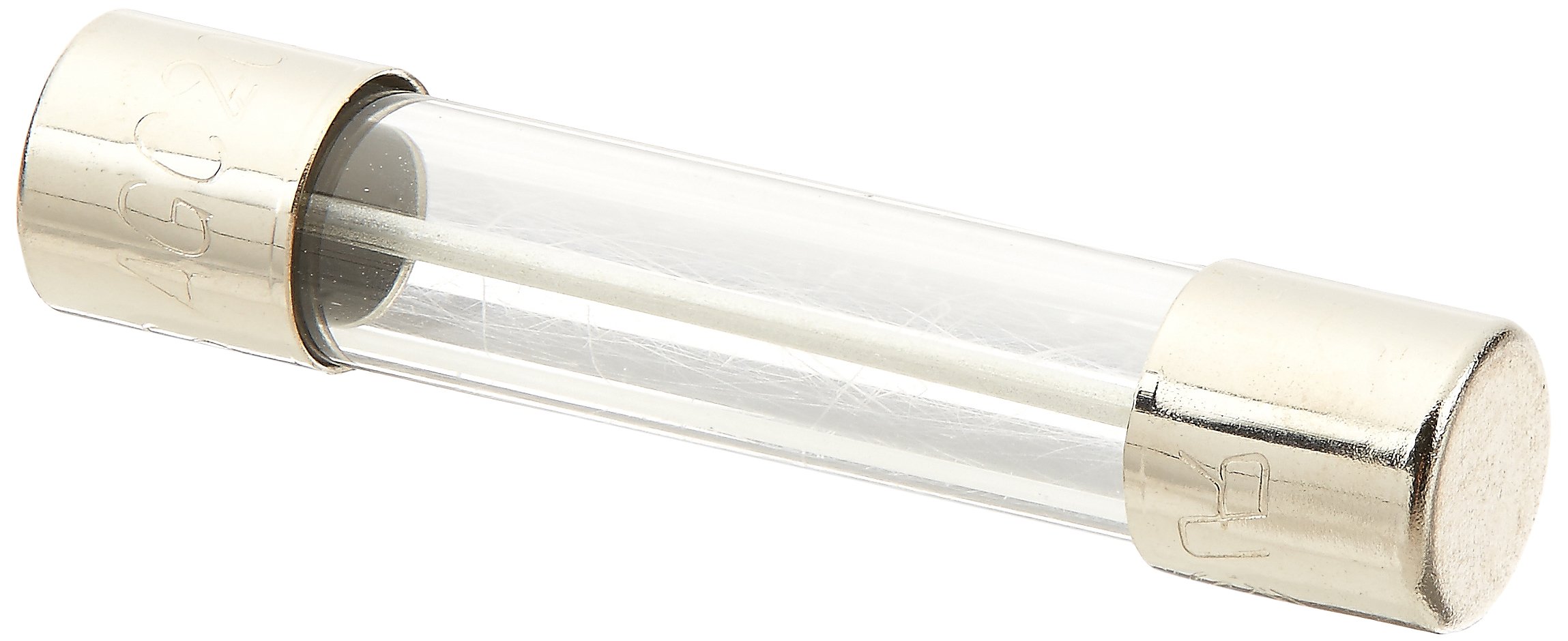
The standard 1-amp AGC glass fuse that marine and 12V electronics owners turn to for small-current protection.
These are 1-amp (not 20-amp) fast-acting glass fuses from Blue Sea Systems, a well-known marine electrical brand. Owners use them in radar detectors, car 12V inverters, Traxxas battery chargers, and linear power supplies where the crowbar protection needs to trip quickly. The glass body offers a visible indication of a blown element, so you can check at a glance without pulling each fuse.
Reliability and quality get the most positive mentions, but durability is a recurring concern, with reports of units arriving broken. One reviewer noted a fuse failing to blow in an 8A resistive heater circuit, which caused the holder to melt — a serious reminder to verify your circuit’s 1-amp rating and not use these for higher-current applications. The mismatch between a 1-amp fuse and a 20-amp keyword is clear: these belong in low-current DC circuits only.
When it works
- Reliable performance for low-current DC electronics like radar detectors, inverters, and chargers
- Glass body allows fast visual check for blown fuses
- Compatible with Blue Sea Systems’ ST Glass Fuse Blocks
The honest trade-off
- These are 1-amp fuses, not 20-amp — do not buy for a 20A circuit
- Durability concerns from units arriving broken, plus a report of a fuse failing to blow under overload
Best for: a 1-amp DC protection job in a marine or 12V electronics panel — when you need a fast-acting glass fuse for a low-current circuit.
Absolutely not for: any 20-amp circuit. Verify your amp rating before buying.
Understanding the Specs
Interrupting Rating
This is the maximum fault current a fuse can safely stop without shattering. A Class RK5 fuse like the Bussmann FRN-R handles 200kA — enough for a main industrial panel. A small glass fuse might handle only 1kA. Always match the interrupting rating to your system’s potential fault current; underrated fuses can arc explosively.
Time-Delay vs. Fast-Acting
A time-delay fuse tolerates a brief surge (like a motor starting) and then blows if the overcurrent continues. A fast-acting fuse blows the instant current exceeds the rating — good for sensitive electronics, bad for anything with a startup spike. The dual-element design in Class RK5 fuses is the most sophisticated form of time-delay.
Class RK5 and Class CC
These are UL-defined fuse classes. RK5 fuses (like the FRN-R) are current-limiting and have a 200kA interrupting rating. Class CC fuses (like the LP-CC-20) are smaller, rejection-style (different physical size prevents wrong amp installation), and also carry high interrupting ratings in a compact package.
Voltage Rating
A 32V fuse on a 120V line will arc through and fail catastrophically. The voltage rating printed on the fuse is the maximum it can safely open. 125V plug fuses are for standard US residential circuits. 250V or 600V cartridge fuses are for heavier equipment. DC-rated fuses like the MCASE are for vehicle electrical systems only.
FAQ
Will a Bussmann SL rejection-base fuse fit my standard fuse box?
Can I use a time-delay 20 amp fuse for a lighting circuit?
What does a “dual-element” fuse do differently?
How long do 20 amp fuses typically last in a home panel?
Can I replace a blown 20 amp fuse with a 30 amp fuse in a pinch?
What is the difference between AGC, AGA, and FMM fuse types?
What voltage rating do I need for a household 120V circuit?
Do I need a fuse with a 200kA interrupting rating for my home panel?
Can I use a fast-acting glass fuse in a motor circuit?
How do I tell if my fuse panel needs a rejection-base or standard plug fuse?
Final Thoughts: The Verdict
For the majority of shoppers, the 20 amp fuses winner is the Bussmann BP/FRN-R-20 because its dual-element design handles motor surges without nuisance trips, carries a 200kA interrupting rating (the maximum fault current it can safely stop), and owners routinely get a decade of service from a single set. If you need a compact fuse for an industrial control cabinet, grab the Bussmann LP-CC-20 — it packs 600V and 200kA into a one-inch cube. And for an older home fuse panel, the Bussmann SL-20PK4 rejection-base plug fuses (which prevent inserting the wrong amperage) deliver safety and convenience in a four-pack.
How We Picked
We do not accept paid placement. Every pick is matched to a real buyer and a real use-case; we do not hands-on test units.
Sources & Methodology
Specifications: manufacturer listings and product documentation. Review insights: verified customer reviews, as of July 2026. Pricing: not shown on this page (it changes often); check the current price via the retailer link.
As an Amazon Associate, Gadgets Feed earns from qualifying purchases. This does not affect which products we feature.