
A 21:9 ultrawide monitor doesn’t just add width — it fundamentally changes how you work and play. You trade the bezels of a dual-monitor setup for a single, seamless canvas that fills your periphery, whether it’s a sprawling spreadsheet, a timeline in Premiere Pro, or an open-world game where the horizon never cuts off. The panel technology — VA, IPS, or QD-OLED — dictates your contrast, color accuracy, and response time, making the choice between deep blacks and wide viewing angles a real trade-off you need to weigh.
I’m Min — the co-founder and writer behind Gadgets Feed. I’ve spent weeks cross-referencing specifications, sorting through dense tables of refresh rates, color gamuts, and panel types to find the monitors that deliver real-world value without burying you in marketing speak.
This guide distills the specs that matter — contrast ratio, refresh rate, color coverage, and connectivity — into a clear path to finding the best 21:9 ultrawide monitor for your setup, whether that’s a workhorse or a OLED flagship.
How To Choose The Best 21:9 Ultrawide Monitor
The jump from 16:9 to 21:9 is about 33% more horizontal real estate, but not every panel delivers the same experience. Understanding the interplay between panel type, resolution, and refresh rate is the only way to avoid buyer’s remorse.
Panel Type: VA vs IPS vs OLED
VA panels (Samsung, Dell, INNOCN) offer stellar native contrast — often 3000:1 — delivering deep blacks that make dark games and movies pop. The trade-off is narrower viewing angles and, on some units, slight black-level smearing in fast motion. IPS panels (LG) give you wide, consistent colors and excellent viewing angles, but contrast typically sits at 1000:1, so blacks look gray in a dark room. QD-OLED (Alienware, LG’s WOLED) obliterates both with infinite contrast, perfect blacks, and response times under 0.1ms — but comes at a premium and carries burn-in risk if used for static productivity for years.
Resolution and Pixel Density
The sweet spot is 3440 x 1440 (WQHD) — it’s manageable for a mid-range GPU and offers roughly 110 PPI on a 34-inch panel, making text crisp without scaling issues. The 5120 x 2160 (5K2K) panels, like the Samsung Odyssey G7 or INNOCN 45C1R, push pixel count closer to a 4K 16:9, demanding a high-end GPU (RTX 4070 Ti or better) to drive games at their native resolution. Avoid 2560 x 1080 on anything over 29 inches — the pixel density is noticeably soft for text and UI elements.
Refresh Rate and Adaptive Sync
For productivity, 100Hz or 120Hz is a clear upgrade from 60Hz — mouse movement feels fluid, and scrolling is noticeably smoother. Gamers should target 165Hz or 180Hz for competitive titles. Adaptive sync (FreeSync Premium or G-Sync Compatible) is essential to eliminate tearing; most modern monitors support both, but check for VESA AdaptiveSync certification for guaranteed low-latency VRR. A 1ms response time is standard, but QD-OLED panels achieve 0.03ms, virtually eliminating ghosting.
Quick Comparison
On smaller screens, swipe sideways to see the full table.
| Model | Category | Best For | Key Spec | Amazon |
|---|---|---|---|---|
| LG 39GX90SA-W | OLED | Competitive gaming + media | 240Hz / 0.03ms / 800R | Amazon |
| Alienware AW3425DW | QD-OLED | Elite image quality + productivity | 240Hz / 1800R / 99.3% DCI-P3 | Amazon |
| Dell U3818DW | IPS | Professional productivity | 3840×1600 / USB-C KVM | Amazon |
| Samsung Odyssey G7 40″ | VA | High-res gaming + HDR | 5120×2160 / 180Hz / HDR600 | Amazon |
| INNOCN 45C1R | VA | Super ultrawide + value | 5120×1440 / 120Hz / 32:9 | Amazon |
| Dell S3425DW | VA | Home office + casual gaming | 120Hz / USB-C 65W / 3000:1 | Amazon |
| LG 34WQ73A-B | IPS | Color-critical work + MacBook | USB-C 90W / Built-in KVM | Amazon |
| ASUS TUF VG34VQ3B | VA | High-refresh budget gaming | 180Hz / 1ms / 4000:1 | Amazon |
| Alienware AW3425DWM | VA | Immersive budget gaming | 180Hz / 1ms / 1500R | Amazon |
| Samsung ViewFinity S50GC | VA | Entry-level ultrawide work | 100Hz / HDR10 / PIP/PBP | Amazon |
| Secretlab Magnus Arm | Mount | Heavy-duty ultrawide mounting | Up to 57″ / 18-35 lbs | Amazon |
In‑Depth Reviews
1. LG 39GX90SA-W 39-inch Ultragear WQHD OLED Curved Gaming Monitor
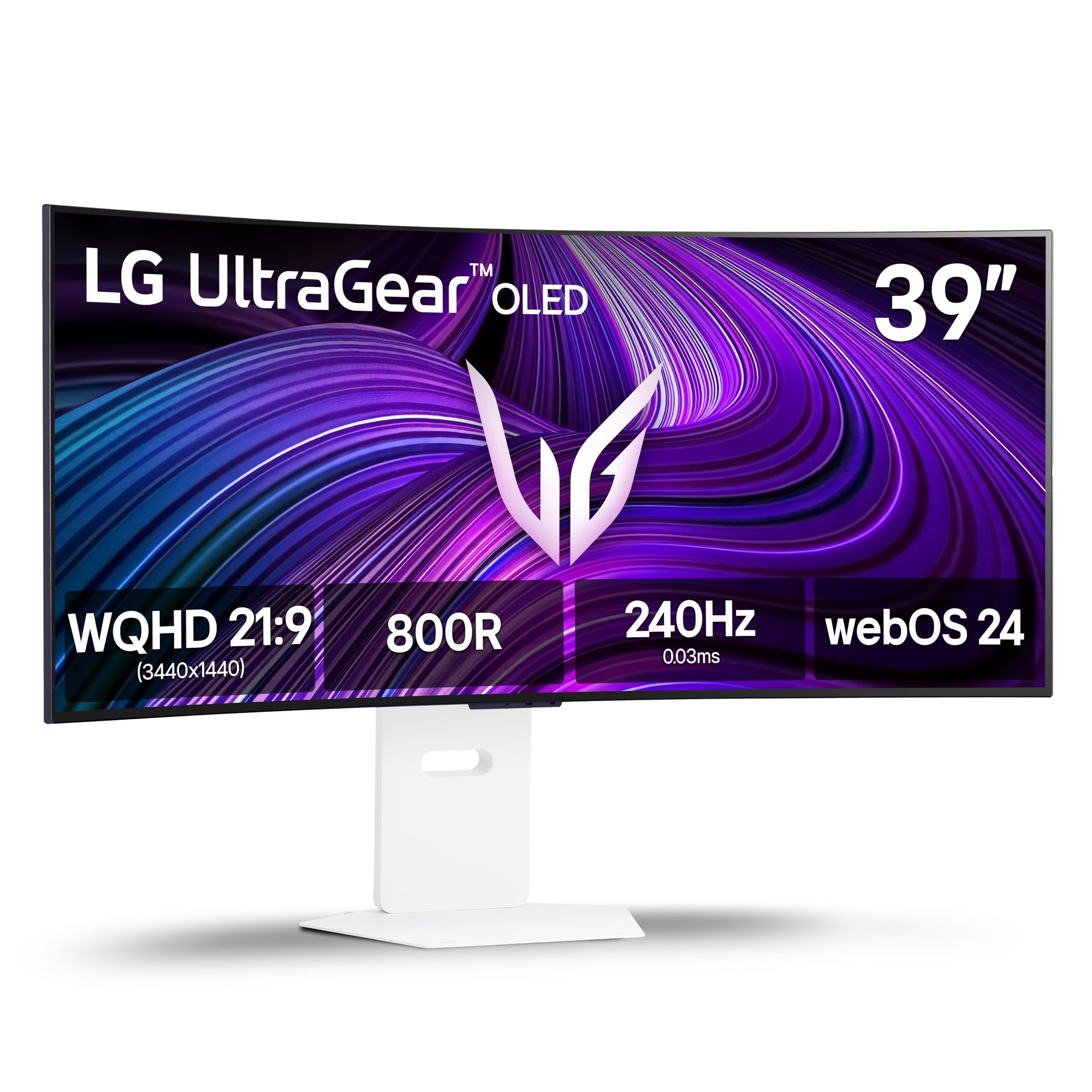
The 39GX90SA-W is a 39-inch WQHD OLED panel with an aggressive 800R curve — the steepest in this lineup — designed to wrap the screen around your field of view. The 240Hz refresh rate and near-instant 0.03ms gray-to-gray response time put it in a different speed tier than any VA or IPS monitor here, while the 1.5M:1 contrast ratio and DisplayHDR True Black 400 certification deliver perfect black levels and highlights that actually pop. LG’s webOS integration means you can stream Netflix or cloud game via GeForce NOW directly from the monitor without a PC connected.
Peak brightness hits 1300 nits in HDR small highlights, which makes specular reflections in games like Cyberpunk 2077 look genuinely bright rather than merely adequate. The anti-glare coating on the OLED panel minimizes reflections better than the glossy Alienware QD-OLED, which is a significant advantage if your desk faces a window. The built-in 2-year warranty covers the OLED panel, and the included OLED Care tools (pixel cleaning, logo luminance adjustment) help mitigate long-term burn-in risk for mixed-use scenarios.
The 800R curve is immersive but takes adjustment — straight lines in productivity apps can appear slightly distorted at the edges if you’re sitting closer than 70cm. The stand is fully adjustable (height, tilt, swivel), though some users report HDR flicker over HDMI when VRR is enabled; sticking to DisplayPort or USB-C resolves the issue cleanly. At this price, it’s the most complete high-speed gaming + media ultrawire package available.
Why it’s great
- 240Hz OLED with 0.03ms response — unmatched motion clarity
- 800R curve creates genuine peripheral immersion for gaming
- webOS built-in eliminates need for external streaming device
Good to know
- HDR flicker reported over HDMI with VRR; use DP or USB-C
- Steep curve may distort text edges in productivity use
- Peak brightness (275 cd/m² SDR) is lower than some VA panels
2. Alienware 34 240Hz QD-OLED Curved Gaming Monitor (AW3425DW)

The AW3425DW uses a Samsung QD-OLED panel at 34 inches with a gentler 1800R curve, balancing immersion with productivity-friendly geometry. The 3440 x 1440 resolution on QD-OLED delivers DCI-P3 99.3% coverage and Delta E < 2 out of the box — accurate enough for photo editing without calibration. The 240Hz refresh rate and 0.03ms response time match the LG in speed, but the glossy QD-OLED coating produces richer, more saturated colors in a controlled lighting environment, making games like Horizon Forbidden West look exceptionally vibrant.
VESA DisplayHDR TrueBlack 400 certification means black levels are truly infinite, and peak brightness hits 1000 nits for small HDR highlights. The included Alienware sticker, microfiber cloth, and premium packaging reflect the higher-tier branding. The stand is fully adjustable (height, tilt, swivel) and the build feels solid — no plastic creak when adjusting. The 3-year warranty from Dell is a step above most competitors and covers the OLED panel against burn-in for that period.
The glossy screen is a double-edged sword: colors pop, but reflections are more visible in bright rooms compared to the LG’s anti-glare coating. Text clarity on QD-OLED at 110 PPI is slightly compromised by the subpixel layout — some users report minor fringing on white text on dark backgrounds, though a ClearType adjustment largely resolves it. It’s less suited to static productivity marathons than an IPS panel, but for mixed gaming and content creation, it’s a top-tier choice.
Why it’s great
- QD-OLED color volume is visibly richer than WOLED
- 1800R curve is immersive without distorting productivity apps
- 3-year burn-in warranty provides peace of mind
Good to know
- Glossy screen picks up reflections in bright rooms
- Text fringing requires ClearType tuning for optimal clarity
- Lower SDR brightness (~250 cd/m²) than premium VA panels
3. Dell U-Series 38″ 4K UHD 1600p Ultra Wide Screen LED-Lit Monitor (U3818DW)

The Dell U3818DW is a 38-inch IPS panel with a 3840 x 1600 resolution — effectively a 16:10 4K monitor stretched to 21:9, giving you more vertical pixels (1600 vs 1440) than standard ultrawides. The 2300R curve is subtle, barely perceptible, which makes it ideal for professionals who find aggressive curves distracting in CAD or code editing. The IPS panel delivers 99% sRGB coverage and a factory-calibrated Delta E < 2, making it a reliable choice for photo editing and design work.
The stand is a highlight — fully adjustable with height, tilt, swivel, and a 21.25-inch maximum height that accommodates sit-stand desks. The built-in KVM lets you share a keyboard and mouse between a desktop and laptop, while USB-C delivers up to 65W power to the connected device. The six USB 3.0 downstream ports and Bluetooth 4.0 support reduce cable clutter significantly. Dell’s Easy Arrange software (part of Dell Display Manager) lets you snap windows into preset grids, making multitasking seamless.
The 60Hz refresh rate is adequate for productivity but a clear downgrade if you’re coming from a 120Hz+ monitor — scrolling web pages won’t feel as fluid. The 1000:1 contrast ratio is typical for IPS, meaning blacks in a dimly lit room will look grayish. At this premium, you’re paying for build quality, warranty (Dell’s advanced exchange is excellent), and color accuracy rather than gaming performance. It’s the best pick here for pure workstation use.
Why it’s great
- 3840×1600 gives more vertical screen space than any 1440p ultrawide
- USB-C KVM with 65W PD simplifies cable management
- Fully adjustable stand with industry-leading height range
Good to know
- 60Hz refresh rate feels sluggish after using higher refresh panels
- IPS contrast ratio of 1000:1 means blacks are not deep
- Premium price without HDR or high-refresh gaming features
4. Samsung 40″ Odyssey G7 (G75F) WUHD Curved Gaming Monitor
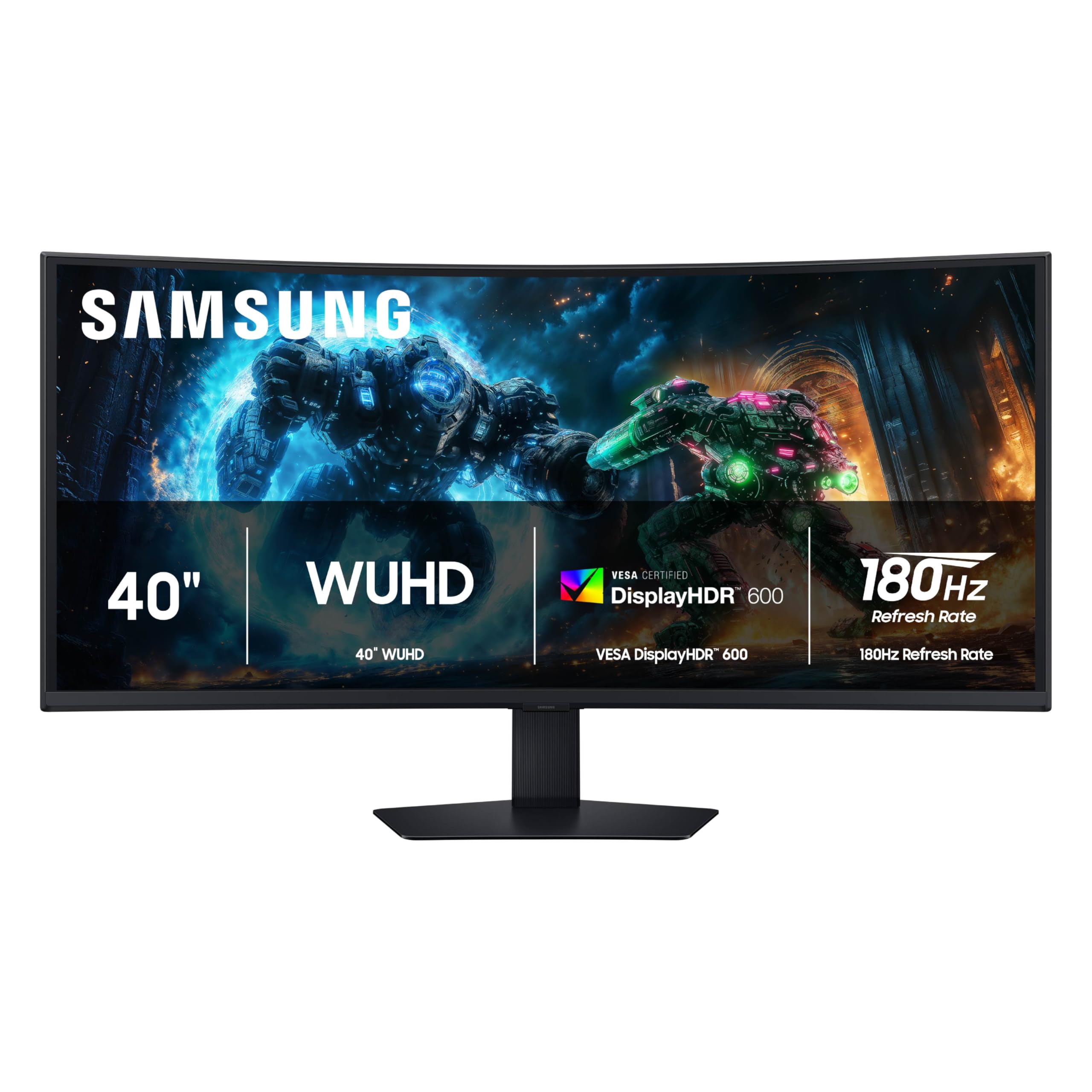
The Odyssey G7 G75F is a 40-inch VA panel with a 5120 x 2160 resolution — “WUHD” — delivering pixel density comparable to a 32-inch 4K monitor (roughly 140 PPI). The 1000R curve is aggressive, matching the curvature of the human eye at close distance, which creates a genuinely immersive field of view in racing and flight sim games. The 180Hz refresh rate and 1ms GtG response time keep motion smooth, while VESA DisplayHDR 600 certification delivers brighter highlights (600 nit peak) than any standard VA panel in this list.
The VA panel’s 3000:1 native contrast ratio means blacks are significantly deeper than IPS — HDR content looks punchy without needing local dimming zones. AMD FreeSync Premium Pro certification ensures low-latency VRR with HDR enabled, which is rare at this price point. The included stand offers height and swivel adjustment, though the base is notably wide (taking up desk space). Samsung’s menu system is logical, and the OSD includes a dedicated FPS counter and virtual crosshair for gaming.
Driving 5120 x 2160 at 180Hz requires serious GPU horsepower — an RTX 4080 or RX 7900 XTX is the practical minimum for modern titles, even with DLSS/FSR. The 10-bit color depth is supported only via DisplayPort 1.4 with DSC enabled; HDMI 2.1 supports it natively. Calibration out of the box leans oversaturated (Samsung’s Vivid preset), so spending 10 minutes on color tuning is recommended. It’s a top-tier high-resolution gaming monitor that also serves as an excellent productivity panel for professionals who need the extra vertical resolution.
Why it’s great
- 5120×2160 resolution with 140 PPI for crisp text and detail
- 1000R curve and 180Hz deliver immersive, smooth gameplay
- HDR600 and 3000:1 contrast outperform IPS for dark scenes
Good to know
- Requires high-end GPU (RTX 4080+) to drive native resolution
- Stand base is wide and may not fit smaller desks
- Out-of-box color saturation needs manual calibration
5. INNOCN 45C1R 45″ 5K2K Ultrawide Curved Gaming Monitor

The INNOCN 45C1R is a 45-inch VA panel with a 5120 x 1440 resolution at a 32:9 aspect ratio — essentially two 27-inch 1440p monitors side-by-side without a bezel. The 1500R curve wraps the massive screen around your field of view, making it a natural fit for racing sim rigs where peripheral vision matters. The 120Hz refresh rate and Adaptive-Sync (G-Sync Compatible) keep motion smooth, though the VA panel’s 6ms typical response time means you’ll notice some ghosting in dark transitions compared to OLED panels.
The connectivity is generous: DisplayPort 1.4, two HDMI 2.1 ports, USB-C with 90W Power Delivery, a USB-B upstream port, two USB-A downstream ports, and an RJ45 Ethernet jack. The USB-C hub supports laptop connectivity with video, data, and charging over a single cable — ideal for MacBook users who want to keep a clean desk. PIP/PBP support lets you view input from two sources simultaneously, which is rare at this price point for a 32:9 panel.
An RTX 3070 or RX 6700 XT is the practical floor for gaming. The built-in speakers are mediocre, and the stand offers only height adjustment (no swivel or tilt). The VESA mounting system has been noted as awkward — standard VESA 100×100 brackets may not fit without modification. For the price, it’s the most screen real estate you can buy without jumping to a premium-tier monitor.
Why it’s great
- 32:9 45-inch panel replaces dual monitors without bezels
- USB-C 90W PD with Ethernet for single-cable laptop docking
- PIP/PBP support for dual-source viewing
Good to know
- VA panel ghosting is noticeable vs OLED in dark transitions
- Stand only adjusts height; no tilt or swivel
- VESA mount compatibility may require alternative brackets
6. Dell 34 Plus USB-C Curved Monitor (S3425DW)

The Dell S3425DW is a 34-inch VA panel with a 3440 x 1440 resolution, 3000:1 native contrast ratio, and a 120Hz refresh rate that hits the sweet spot for productivity and light gaming. The VA panel delivers deep blacks (noticeably better than any IPS alternative at this price) and 99% sRGB coverage with 95% DCI-P3 — good enough for casual photo editing and graphic design. The 300 cd/m² brightness is adequate for most indoor environments, and the anti-glare coating keeps reflections manageable.
USB-C connectivity with 65W Power Delivery means you can charge a laptop and transmit video over a single cable — a feature usually reserved for more expensive monitors. The built-in speakers have been redesigned from the previous generation, offering more volume and deeper frequency response, though they still won’t replace dedicated speakers. The stand is fully adjustable (height, tilt) and the ash white color scheme is a refreshing departure from the standard black, though it may not suit all setups.
The 120Hz refresh rate is a significant upgrade over 60Hz for office work — scrolling through documents and web pages feels fluid. The 0.03ms response time (MPRT) is an advertised figure that relies on overdrive; in practice, VA black-level smearing is present in dark scenes, though it’s not severe. The limited port selection (HDMI, USB-C, and a single USB-A downstream) means you’ll need a separate hub for multiple peripherals. The recessed VESA mount design requires specific brackets, which is an annoying oversight.
Why it’s great
- 3000:1 contrast ratio for deep blacks in a mid-range panel
- USB-C with 65W PD simplifies desktop cable management
- 120Hz refresh rate improves productivity fluidity
Good to know
- Only one USB-A downstream port; limited peripheral connectivity
- Recessed VESA mount requires non-standard bracket assembly
- VA black-level smearing present in fast dark scenes
7. LG UltraWide QHD 34-Inch Curved Computer Monitor (34WQ73A-B)

The LG 34WQ73A-B is a 34-inch IPS panel with a 3440 x 1440 resolution and a subtle 2300R curve that’s barely noticeable — ideal for professionals who prioritize color consistency over immersion. The IPS panel delivers 99% sRGB coverage with factory calibration, making it a reliable choice for photographers, graphic designers, and video editors who need predictable color across the entire screen width. The 300 cd/m² brightness is lower than some competitors, but in a controlled studio environment, it’s perfectly adequate.
The USB-C port delivers 90W Power Delivery — enough to charge a 16-inch MacBook Pro at full speed while carrying video and data, all over a single cable. The built-in KVM (LG’s Dual Controller) lets you control two computers with one keyboard and mouse, which is a significant productivity boost. Reader Mode reduces blue light without the yellow tint common on other monitors, and Flicker Safe eliminates PWM flicker at all brightness levels. The Dynamic Action Sync and Black Stabilizer features are clearly borrowed from LG’s gaming lineup and reduce input lag in casual gaming.
The 60Hz refresh rate is the main limitation here — it’s a productivity-focused panel, and the 1000:1 contrast ratio means blacks look grayish in a dark room. Some units exhibit backlight bleed along the edges, which is common for IPS but can be distracting in dark movie scenes. The picture-only manual is frustrating, but setup is straightforward. It’s an excellent choice for MacBook users who want good color, USB-C power delivery, and KVM functionality without paying for a premium-tier display.
Why it’s great
- IPS color accuracy with 99% sRGB for color-critical work
- USB-C 90W PD charges a 16-inch MacBook Pro at full speed
- Built-in KVM simplifies dual-computer workflow
Good to know
- 60Hz refresh rate is a downgrade if you’re used to higher refresh
- IPS contrast ratio of 1000:1 results in gray blacks in dark rooms
- Backlight bleed can be present on some units
8. ASUS TUF Gaming 34″ Ultra-Wide Curved Monitor (VG34VQ3B)

The ASUS TUF VG34VQ3B is a 34-inch VA panel with a 3440 x 1440 resolution, a 1500R curve, and a 180Hz refresh rate that punches well above its price tier. The 4000:1 static contrast ratio is the highest in this list — deeper blacks than even the Dell S3425DW — making dark games like Diablo 4 or Resident Evil look genuinely atmospheric. The 1ms MPRT response time combined with ASUS ELMB SYNC (Extreme Low Motion Blur) reduces ghosting significantly, though ELMB cannot be used simultaneously with FreeSync Premium.
FreeSync Premium provides low-framerate compensation (LFC) for smooth VRR down to 48Hz, which is great for console gaming or GPU-limited scenarios. The 90% DCI-P3 color gamut is slightly lower than the Alienware’s QD-OLED, but for competitive gaming where motion clarity matters more than color volume, it’s a fair trade-off. The OSD includes DisplayWidget Center for mouse-based control, and the included L-shaped screwdriver makes VESA mount installation easier.
The built-in speakers are terrible — tinny, quiet, and lacking any bass — so plan on using external speakers or a headset. The stand is non-adjustable (no height or swivel, only tilt), which is a significant drawback for ergonomics at this price. The advertised 1370.4 lumens brightness is likely a misprint (it’s standard ~300 cd/m²). For the price, it’s the best pure gaming performance you can get in a 21:9 format, but the stripped-down OSD and flimsy stand reflect cost-cutting.
Why it’s great
- 180Hz refresh rate with 4000:1 contrast for immersive dark gaming
- ELMB SYNC reduces motion blur without sacrificing brightness
- FreeSync Premium with LFC for tear-free gaming
Good to know
- Stand is non-adjustable (no height or swivel)
- Built-in speakers are unusably quiet and tinny
- ELMB cannot be used simultaneously with FreeSync
9. Alienware 34 Curved Gaming Monitor (AW3425DWM)

The Alienware AW3425DWM is a 34-inch VA panel with a 3440 x 1440 resolution and a 1500R curve, packing a 180Hz refresh rate and 1ms GtG response time into an aggressively designed chassis. The VESA DisplayHDR 400 certification and 95% DCI-P3 color coverage produce vibrant, punchy colors that look notably better than the ASUS TUF’s 90% coverage. The 3000:1 contrast ratio delivers deep blacks typical of VA, making it a solid choice for both immersive gaming and occasional movie watching.
AMD FreeSync Premium and VESA AdaptiveSync certification ensure tear-free gameplay with low latency, and the included HDMI 2.1 and DisplayPort 1.4 cables support the full 180Hz at 10-bit color. The stand is a significant upgrade over the ASUS — it offers height, tilt, and swivel adjustment, plus the build quality feels robust. The anti-glare coating is effective, and the hardware-based low blue light solution reduces eye strain without the yellow tint of software-based filters. The dedicated console mode auto-detects and optimizes settings for PlayStation 5 and Xbox Series X.
The VA panel exhibits some black-level smearing in very fast dark transitions — it’s not a OLED killer by any stretch. The built-in speakers are basic (no claimed wattage in specs), and the rear RGB lighting is limited to the Alienware logo (no ambient lighting strips). On sale, it frequently drops to the budget-friendly range, making it a compelling option for gamers who want 180Hz performance and a quality stand without paying for QD-OLED. It’s a Monitor Arm product for mounting heavy ultrawides.
Why it’s great
- 180Hz with 95% DCI-P3 and HDR400 for vibrant, smooth gaming
- Fully adjustable stand (height, tilt, swivel) at a budget-friendly price
- FreeSync Premium + VESA AdaptiveSync certified for tear-free VRR
Good to know
- VA panel shows black-level smearing in fast dark scenes
- Basic built-in speakers are not suitable for primary audio
- Rear RGB limited to logo only; no ambient lighting
10. Samsung 34″ ViewFinity S50GC Series Ultrawide QHD Monitor

The Samsung ViewFinity S50GC is a 34-inch VA panel with a 3440 x 1440 resolution and a 100Hz refresh rate, designed as the most affordable entry point into the 21:9 format. The 3000:1 contrast ratio delivers decent blacks for the price, and HDR10 support maps to 1 billion colors — though the 300 cd/m² brightness means HDR is more theoretical than impactful. The ambient light sensor automatically adjusts brightness based on room lighting, which is a surprising inclusion at this tier.
The PIP and PBP functionality lets you view input from two sources simultaneously, which is rare in budget monitors and useful for monitoring a second PC or console. AMD FreeSync keeps the 100Hz refresh rate tear-free in casual gaming, though the 5ms response time (GtG) means you’ll notice some motion blur in fast-paced titles. The near-bezelless design looks clean on a desk, and Eye Saver Mode (blue light reduction) plus Flicker Free certification make it comfortable for 8-hour work sessions.
The built-in speakers are very weak — adequate for system sounds but not for media consumption. The stand is wobbly and offers only tilt adjustment, so a VESA mount is recommended for stability. Some users have reported that macOS configuration can be finicky, with the monitor defaulting to 50Hz instead of 100Hz in certain setups, requiring a custom resolution utility (BetterDisplay) or a DisplayPort connection. Protected film removal requires care — peeling from the wrong direction can cause permanent shadowing on the panel. It’s a solid, no-frills ultrawide for budget-conscious users who prioritize width over speed.
Why it’s great
- Lowest-cost entry to 3440×1440 21:9 with 100Hz refresh
- PIP/PBP support for dual-source viewing
- Ambient light sensor auto-adjusts brightness
Good to know
- Stand is wobbly with tilt-only adjustment
- 5ms response time shows motion blur in fast games
- macOS may require custom utility to reach 100Hz
11. Secretlab Magnus Monitor Arm (Heavy Duty Edition)

The Secretlab Magnus Monitor Arm is a heavy-duty gas-spring arm designed specifically for ultrawide monitors up to 57 inches and 18 to 35 pounds, including the massive Samsung Odyssey Neo G9 57-inch. The premium tensile spring mechanism provides smooth, dynamic height adjustment, and the detachable dual VESA-mounted handles let you reposition without touching the screen glass. The VESA plate uses a double lock mechanism to keep heavy monitors secure, while the 2-step hook-and-lock design simplifies the mounting process.
The built-in cable management uses magnetic cable sheaths that snap on and off — no cable ties or zip ties needed. The top-screw C-clamp mount accommodates desk thicknesses from 10mm to 50mm, and the all-metal construction feels extremely solid. The arm supports full articulation: height, tilt, swivel, and pan, with enough reach to position a 45-inch monitor in a comfortable viewing zone. It’s compatible with Secretlab Magnus desks but also works with standard desks within the thickness range.
At this weight capacity, the arm is noticeably large and heavy (6 kg / 13.2 lbs), and the base clamp footprint may interfere with desk grommets or cable trays. Some users report minor bounce when typing aggressively on a monitor this size, though it’s far less than cheaper arms. The price is premium — comparable to Ergotron HX — but the magnetic cable management and dedicated heavy-duty tilt pivot justify it for owners of 45-inch or 57-inch panels. It’s not designed for standard 24-inch monitors; stick to the standard Secretlab arm for smaller setups.
Why it’s great
- Rated for monitors up to 57″ and 35 lbs — handles the heaviest ultrawides
- Magnetic cable management sheaths hide cables cleanly
- Double lock VESA plate ensures security for expensive panels
Good to know
- Large clamp footprint may conflict with desk cable trays
- Some bounce is present on large monitors during typing
- Premium priced compared to standard monitor arms
FAQ
Is 3440×1440 at 34 inches sharp enough for text work?
Can my RTX 3060 drive a 3440×1440 ultrawide at 100Hz or more?
What does the 1500R or 1800R curve number mean for daily use?
Do I need a monitor arm for a 34-inch ultrawide?
Final Thoughts: The Verdict
For most users, the 21:9 ultrawide monitor winner is the LG 39GX90SA-W because it combines a 240Hz OLED panel with a steep 800R curve for unmatched immersion, plus webOS for standalone media streaming. If you want deeper color volume and a longer warranty, grab the Alienware AW3425DW for its QD-OLED panel and 3-year burn-in protection. And for productivity-first professionals, nothing beats the Dell U3818DW with its 3840×1600 resolution, USB-C KVM, and fully adjustable stand.