
Wiring a high-draw 220-volt appliance—be it a welder, air compressor, electric range, or dryer—demands a plug that handles sustained current without melting or arcing. The wrong plug introduces resistance, heat buildup, and a fire risk that no homeowner should tolerate.
I’m Min — the co-founder and writer behind Gadgets Feed. I’ve spent hundreds of hours cross-referencing UL listings, terminal torque ratings, conductor compatibility tables, and real-user durability reports to separate the plugs that deliver safe, reliable connections from those that cut corners on material specs.
This guide evaluates every critical spec, from blade conductivity to strain relief design, so you can confidently buy the right best 220 3 prong plug for your specific high-voltage equipment without risking an overload or a loose connection.
How To Choose The Best 220 3 Prong Plug
Selecting the correct 220‑volt plug means matching the NEMA configuration, amperage rating, and wire gauge acceptance to your specific appliance. Ignoring any one of these three factors can lead to a plug that either won’t fit your receptacle or can’t safely carry your equipment’s peak draw.
NEMA Configuration and Amperage Matching
The NEMA designation tells you the plug’s voltage, amperage, and grounding arrangement. For 220‑volt three‑prong plugs, the two most common families are the 6‑series (grounded, used for welders, compressors, and EV chargers) and the 10‑series (non‑grounding, found on older ranges and dryers). A 6‑30P plug handles 30‑amp circuits, while a 6‑50P handles 50‑amp circuits. Never assume “250 volt” covers all—confirm the exact NEMA number stamped on your existing plug or receptacle before buying.
Material Quality and Certifications
A 220‑volt plug must endure high temperatures and repeated plug/unplug cycles. Look for solid brass blades (not plated steel) for maximum conductivity and corrosion resistance. The housing should be a thermoplastic or nylon blend that resists impact and chemical exposure. UL or ETL listing is non‑negotiable—it means an independent lab verified the plug’s insulation, creepage distance, and flame retardancy at the rated voltage.
Wire Gauge Acceptance and Strain Relief
Most 30‑amp plugs accept #10 to #6 AWG conductors, while 50‑amp plugs often need to handle #6 AWG or even #4 AWG. Check the plug’s terminal size and the integrated strain‑relief bushing to ensure your cable fits snugly. A plug with a poorly matched strain relief can pull the wires loose inside the housing, creating a high‑resistance connection that overheats silently.
Quick Comparison
On smaller screens, swipe sideways to see the full table.
| Model | Category | Best For | Key Spec | Amazon |
|---|---|---|---|---|
| Leviton 931 | Premium | Industrial‑grade reliability | Solid brass blades, interchangeable 30/50A | Amazon |
| Veepeak RM‑650HP | Mid‑Range | Easy‑grip handle for frequent unplugging | 3‑hole handle, flame‑retardant PVC housing | Amazon |
| AIDA 4504 | Mid‑Range | Compressor/welder replacement | Accepts up to #4 AWG, self‑grounding | Amazon |
| Acbroad AD0066 | Mid‑Range | High‑visibility yellow, easy grip | ETL listed, extra metal terminal included | Amazon |
| AIDA 10‑30/10‑50P | Mid‑Range | Old‑home dryer/range replacement | NEMA 10‑30P/10‑50P, accepts #10‑#6 AWG | Amazon |
| Eastman 61269 | Budget | Quick range cord replacement | 6‑ft cord, 40A, 8‑gauge wire | Amazon |
| Certified Appliance 90‑1088 | Budget | Long‑run range cord installation | 10‑ft cord, 50A, 6‑gauge wire | Amazon |
In‑Depth Reviews
1. Leviton 931 30/50 Amp, 250 Volt, Plug, Angle, Grounding, Black

The Leviton 931 is the commercial‑grade benchmark for 220‑volt three‑prong plugs. Its thermoplastic shell is tough enough to survive repeated impacts on a job‑site floor, and the hinged front shell makes internal access far cleaner than screw‑captive designs. The interchangeable blade system ships with both 30‑amp and flat 50‑amp blades, eliminating the need to stock two separate plugs for different circuits.
Solid brass blades provide maximum conductivity, and the color‑coded terminals simplify wiring for anyone who has stripped a cable before. The angle design keeps the cord flush against the wall, saving space behind a range or compressor. Multiple users running 250‑volt air compressors and welders report zero loosening or heat buildup even after months of daily cycling.
The only minor drawback is that the printed instructions omit a precise wire‑stripping diagram, though Leviton’s customer service can email one. At this build quality, it is the plug electricians reach for when they want one‑and‑done reliability.
Why it’s great
- Two blade sets (30A & 50A) included in one package
- Tough thermoplastic shell resists cracking
- Angled housing frees up space behind appliances
Good to know
- No stripping diagram in the box
- Not designed for NEMA 10‑series non‑grounding outlets
2. Veepeak NEMA 6-50P/6-30P Plug Replacement, 30/50 Amp 250 Volts

The Veepeak RM‑650HP earns its mid‑range slot with a design feature that matters every time you plug in: a three‑hole handle that gives you a solid mechanical grip during insertion and removal. For anyone who has struggled to pull a smooth‑sided welder plug from a tight receptacle, this handle is a genuine safety upgrade—it reduces the risk of yanking on the cable itself.
The body uses UV‑resistant, flame‑retardant PVC, and the brass terminals and blades deliver the conductivity you need for 250‑volt loads up to 50 amps. It ships with both 30‑amp and 50‑amp blade sets, and the integrated strain‑relief clip and bushing lock your cable firmly in place. Users consistently praise how cleanly it handles #8 AWG copper stranded wire.
ETL listed and backed by clear installation instructions, the Veepeak is an ideal choice for anyone who wants a premium feel without paying a premium badge markup.
Why it’s great
- Ergonomic handle makes plugging/unplugging much safer
- Flame‑retardant housing adds a layer of fire safety
- Both 30A and 50A blades included
Good to know
- PVC body slightly less impact‑resistant than nylon
- Handle adds a little width in very tight spaces
3. AIDA NEMA 6-30P & 6-50P, 30 & 50 Amp, 250 Volt, 3-Prong Heavy Duty Angle Plug

The AIDA 4504 stands out for its ability to accept conductors up to #4 AWG, making it the best option when you have heavier‑gauge cable on a 50‑amp welder or compressor circuit. The self‑grounding design simplifies installation by eliminating one extra bonding step, and the moisture‑, chemical‑, and abuse‑resistant nylon housing handles garage environments far better than standard PVC.
Solid brass blades ensure maximum conductivity at 250 volts, and the right‑angle profile keeps the cord hugging the wall rather than sticking straight out. Users have reported this plug surviving over a year on an 80‑gallon air compressor without any loosening or heat damage. The dual 30‑amp and 50‑amp blade configuration also makes it a flexible spare for multiple tools.
UL listed and backed by lifetime technical support, this AIDA plug is a safe, rugged choice for heavy‑duty stationary equipment.
Why it’s great
- Accepts up to #4 AWG — rare in this price tier
- Self‑grounding reduces wiring complexity
- Nylon housing resists chemicals and impacts
Good to know
- Not suitable for ungrounded NEMA 10‑series outlets
- Some users needed to file the common pin for a perfect fit into Leviton receptacles
4. Acbroad Nema 6-30P/Nema 6-50P 30A/50A 250V Welder Rewirable Power Plug
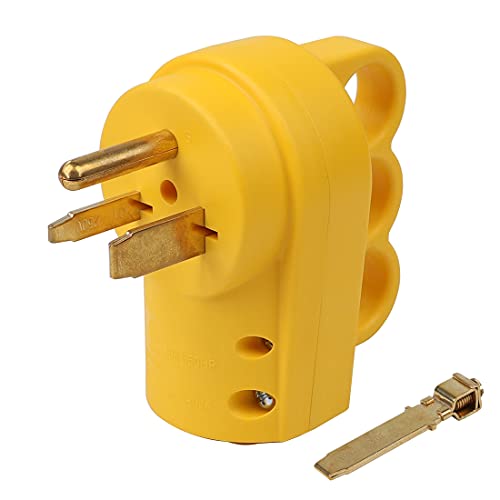
The Acbroad AD0066 uses bright yellow PVC/rubber construction that makes it impossible to lose against a dark garage wall, and the integrated finger holes provide a secure grip for unplugging. This plug ships with an extra metal terminal pin so you can configure it as either a 6‑30P or a 6‑50P—handy for shops that switch between a 30‑amp welder and a 50‑amp plasma cutter.
The housing is rugged enough to survive being stepped on, and the strain relief grips SOOW and STOOW cable jackets tightly without cutting into the insulation. Users who installed these on 240‑volt compressors and kilns consistently note the high‑visibility color and the ease of wiring. The ETL listing provides third‑party safety validation.
If you want a plug that is both highly visible and comfortable to pull, the Acbroad delivers without breaking the budget.
Why it’s great
- Bright yellow color for high visibility in workshops
- Finger holes make for easier, safer unplugging
- Extra terminal pin included for dual‑configuration use
Good to know
- Plastic/rubber body feels less rigid than nylon alternatives
- Not designed for NEMA 10‑series non‑grounding outlets
5. AIDA NEMA 10-30P & NEMA 10-50P Plug, 30 & 50 Amp, 125 & 250 Volt, 3-Prong Non‑Grounding Angle Plug

If your home still uses the older 3‑wire range or dryer connection without a dedicated ground, this AIDA plug is the correct NEMA 10‑30P/10‑50P configuration. It covers both 30‑amp and 50‑amp circuits by way of interchangeable blades, and the solid brass construction provides the conductivity needed for 125/250‑volt dual‑voltage appliances.
The right‑angle housing keeps the cord tucked behind the appliance, and the nylon shell resists the heat and moisture common in laundry rooms. Terminals are clearly marked for fast wiring, and the plug accepts #10 through #6 AWG conductors. Users replacing old‑home dryer connections report that it matches the original plug dimensions exactly, making for a straightforward swap.
UL listed and designed specifically for non‑grounding 3‑wire circuits, this is the plug to buy when your receptacle lacks an equipment‑grounding conductor.
Why it’s great
- Correct NEMA 10‑series for ungrounded old‑home circuits
- Dual 30A/50A blades eliminate separate purchases
- Nylon shell resists heat and moisture
Good to know
- Not compatible with modern grounded NEMA 6‑series outlets
- One user reported a soft ground terminal screw that required careful torquing
6. Eastman 3-Prong Electric Range Cord, 40 Amps, 6 Foot Length, Grey, 61269
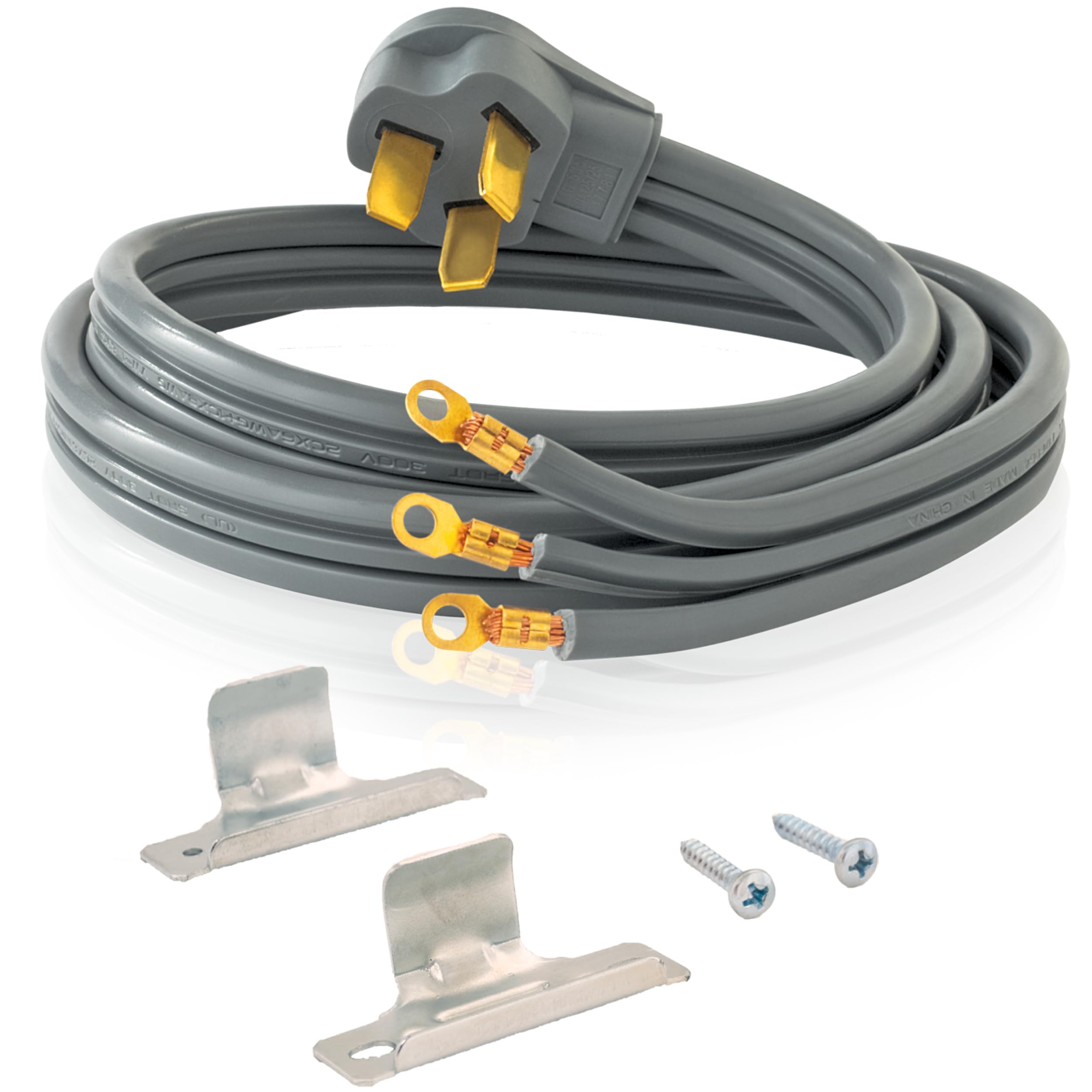
The Eastman 61269 is a complete 6‑foot range cord with a 40‑amp, 250‑volt, 3‑prong NEMA 10‑50P plug already molded on. It uses two 8‑gauge wires and one 10‑gauge wire with eyelet connectors on the appliance side, so you do not need to buy a separate plug and wire it yourself—just strip, crimp, or screw the eyelets onto your range terminal block.
The grey PVC jacket is flexible enough to route behind a tight range install, and the cord is UL listed for peace of mind. Users switching out hardwired ranges for plug‑and‑play setups praise the value versus local big‑box pricing, and the 6‑foot length is adequate for most standard range placements.
If you need a turnkey solution rather than a raw plug to wire yourself, this Eastman cord saves time and eliminates wiring errors for first‑time installers.
Why it’s great
- Complete cord with pre‑molded plug — no separate wiring needed
- Flexible jacket routes easily in tight spaces
- UL listed and cheaper than most hardware‑store equivalents
Good to know
- 40‑amp rating limits use on 50‑amp range circuits
- Eyelet connectors may need crimping if not pre‑attached
7. Certified Appliance Accessories 50-Amp Appliance Power Cord, 3 Prong Range Cord, 10 Feet

When your range receptacle sits awkwardly far from the appliance cutout, the 10‑foot Certified Appliance cord saves you from needing an extension or a receptacle relocation. This 50‑amp, 250‑volt, 3‑prong cord uses 6‑gauge copper wire with three pre‑attached eyelet connectors on the appliance end and a right‑angle 90‑degree NEMA 10‑50P plug on the other.
The strain‑relief clamp and screws are included, and the gray PVC jacket is thick enough to resist kinking. While the cord is not UL listed (the manufacturer states the length exceeds UL’s threshold for listing), the 5‑year warranty offers some coverage. Users stacking dryers or installing ranges in new locations consistently mention the generous length making the job possible without junction boxes.
For anyone who needs a full 10 feet of reach on a 50‑amp range circuit, this Certified Appliance cord is the most practical budget‑friendly option available.
Why it’s great
- 10‑foot length solves long‑run installation problems
- 6‑gauge copper wire handles 50‑amp loads safely
- Right‑angle plug conserves space behind the appliance
Good to know
- Not UL listed (listed as a design limitation, not a failure risk)
- Heavier cord (3.6 lbs) makes routing slightly stiffer than shorter cords
FAQ
Can I use a NEMA 6‑50P plug on a 30‑amp circuit?
What is the difference between a NEMA 6‑series and a NEMA 10‑series plug?
Final Thoughts: The Verdict
For most users, the best 220 3 prong plug winner is the Leviton 931 because its interchangeable blades, solid brass terminals, and thermoplastic durability make it a true set‑and‑forget solution for welders, compressors, and ranges alike. If you want a more ergonomic grip with an integrated handle, grab the Veepeak RM‑650HP. And for old‑home non‑grounding circuits, nothing beats the AIDA NEMA 10‑30/10‑50P for a safe, code‑correct replacement.