
Our readers keep the lights on and my morning glass full of iced black tea. As an Amazon Associate, I earn from qualifying purchases.
Specs are compiled from manufacturer listings and verified buyer reviews and can change over time — please confirm the key details on the product page before buying.
An oxygen sensor socket sits deep inside your engine bay where a regular socket just cannot reach around the wiring. You need a tool that slips over the sensor without crushing the wires, then bites hard enough to break free years of corrosion. The wrong one rounds the sensor head and turns a ten-minute job into an afternoon of frustration.
I’m Min — the founder and writer behind Gadgets Feed. This guide is built by comparing the manufacturers’ published specifications and the patterns across verified customer reviews, so you get each pick’s real strengths and trade-offs instead of marketing spin.
You are swapping an oxygen sensor on a Ford 4.6L or a Honda Pilot bank-2 sensor, and you need a socket that will not slip off and bloody your knuckles. This breakdown of the best 22mm oxygen sensor socket options helps you pick the right one the first time — so you do not have to make a second trip to the parts store.
Quick Picks
- OEMTOOLS 33625246 7/8″ (22MM) O2 Sensor Wrench — Top Performer
- CTA Tools 2064 Thin Wall Oxygen Sensor Socket — Tight Fit Specialist
- Powerbuilt 1/2-Inch Drive x 7/8-Inch (22mm) Oxygen Sensor Socket — Smart Value
- ARES 70323-22mm 1/2-inch Drive Heated Oxygen Sensor Socket — Offset Leverage
- JEUCLEL 7/8″ 22mm O2 Oxygen Sensor Wrench — Flex Head Budget
How To Choose The Best 22mm Oxygen Sensor Socket
Picking the right socket is not about brand loyalty. It is about fit, bite, and access. You need to know what makes a socket actually work on a seized sensor versus one that just slips off and rounds the hex.
Wire-Gate or Solid?
A side slot (the wire gate) lets you slip the socket over the sensor without snipping the wiring harness. Without it, you have to disconnect the plug first, which is not always possible in a cramped bay. The slot width and length vary — a narrow slot can make threading thick wires harder, so check the dimensions if you have bulky connectors.
Drive Size: 1/2-Inch vs 3/8-Inch
Most 22mm oxygen sensor sockets come in a 1/2-inch square drive, which is the standard for high-torque removal. A 1/2-inch drive paired with a breaker bar delivers the leverage you need to crack a sensor that has been baking in exhaust heat for years. Some buyers prefer a 3/8-inch drive for lighter work, but the 1/2-inch is the most common for this job.
Wall Thickness and Overall Length
A thin-wall socket is the difference between fitting inside a tight sensor cavity and being too fat to even reach the hex. If your car has heat shields or a narrow recess around the sensor, a standard socket may not physically fit. A longer socket (around 90mm and up) also helps you reach sensors buried deep in the engine bay — like bank-2 sensors on many SUVs.
Quick Comparison
On smaller screens, swipe sideways to see the full table.
| Model | Best For | Drive Size | Material | Length | Amazon |
|---|---|---|---|---|---|
| OEMTOOLS 33625246 | Swivel head grip on Ford engines | 1/2-inch | Chrome Vanadium Steel | 10.5 Inches | $22.02Amazon |
| CTA Tools 2064 | Thin-wall fit in tight cavities | 1/2-inch & 1-inch hex | Metal | 3.5 Inches / 90mm | $19.86$21.77Amazon |
| Powerbuilt 648442 | Slotted drive grip on budget | 1/2-inch | Chrome Vanadium Steel | 2.5 Inches depth | $15.39Amazon |
| ARES 70323 | Offset reach in tight spots | 1/2-inch | Chrome Vanadium Steel | 10 Inches | $15.12Amazon |
| JEUCLEL Flex Ratcheting | Budget flex-head versatility | — | Chrome Vanadium Steel | — | $14.25Amazon |
In‑Depth Reviews
1. OEMTOOLS 33625246 7/8″ (22MM) O2 Sensor Wrench

The swivel-head socket that refused to slip on a stuck Nissan Titan sensor.
When a sensor has been baking in place for years, the OEMTOOLS 33625246 is the one you reach for. OEMTOOLS engineered it for Ford 4.6L and 5.4L engines, but it fits most 7/8-inch (22mm) sensors across Ford, GM, Chrysler, Toyota, Honda, and Nissan makes. Its Posi-Grip system (a textured grip that holds the flat sides of the sensor) lets you apply steady torque without the socket rounding the hex head — buyers report that after other wrenches broke off on a Nissan Titan, this one did the job “with no effort at all.”
The swivel head lets you work around heat shields, manifolds, and angled sensor positions where a straight socket just cannot align. At 10.5 inches long and 0.9 pounds, it offers hefty leverage without being unwieldy. It uses a 1/2-inch square drive, and the chrome vanadium steel with a chrome-plated finish resists corrosion from exhaust heat. A buyer on a 2005 Cadillac STS 4.6L Northstar confirmed the solid build prevented any slipping or rounding — essential for a sensor in a tight engine bay.
One honest note: OEMTOOLS states this wrench will NOT fit all vehicles, especially sensors with heat shields, recessed locations, or limited clearance. Measure your access space before ordering. Unlike the ARES 70323, which uses an offset design for leverage, the OEMTOOLS relies on its swivel head and Posi-Grip to deliver torque at tricky angles — a different approach that some find more secure on softer sensor heads.
What Gives It The Edge
- Posi-Grip system prevents slipping and rounding on corroded sensors
- Swivel head reaches sensors blocked by heat shields and manifolds
- 10.5-inch length delivers serious leverage for breaking tight sensors loose
Where It Falls Short
- Will not fit heavily recessed sensors or sensors with heat shields — check clearance
- Designed for Ford engines, so fit on other makes varies despite broad compatibility
- No wire gate slot; you must disconnect the wiring harness before using it
Best for: Anyone dealing with a tight, stuck oxygen sensor on a Ford 4.6L/5.4L or similar domestic engine who wants anti-slip grip and swivel access.
Watch out for: The lack of a wire gate means you must unplug the sensor harness first — not ideal for every location.
2. CTA Tools 2064 Thin Wall Oxygen Sensor Socket

The thin-wall socket that slides into cavities where standard sockets cannot go.
If you own a Korean car like a 2011 Kia Optima or a 2015 Hyundai Santa Fe, you probably know the frustration of a socket that is too wide to fit around the sensor. The CTA Tools 2064 solves that with a thin-wall design — the tapered end has an outside diameter of just 29.80mm. Buyers confirm it fits “inside tight cavity around O2 sensor wires” where traditional sockets were “too thick.” One reviewer removed and replaced a sensor in about five minutes on a 2006 Toyota Matrix.
This socket measures 3.5 inches (90mm) overall with a 72.7mm oxygen sensor opening, giving it the length to reach deeper sensor positions. It offers two drive options: a 1/2-inch square drive for ratchets and breaker bars, plus a 1-inch external hex drive so you can use a standard wrench for extra torque in confined spaces. At only 5.6 ounces, it is lightweight but the metal construction feels sturdy. The CTA Tools is noticeably longer than the Powerbuilt (which has a 2.5-inch depth) and the ARES (10 inches overall but with a short flange), giving it an advantage when you need to reach a sensor tucked up high in the engine bay.
One honest trade-off: because it is designed for access around sensor wires, this socket works best for installing a new sensor. For a sensor that has been in place for a long time, you will still need penetrating oil and a breaker bar — the thin walls do not add much torque leverage. Unlike the OEMTOOLS which has a Posi-Grip to prevent rounding, the CTA Tools relies on its slim profile for fit, not extra bite.
Right Tool for Tight Spots: The thin 29.80mm tapered end slips into sensor cavities that block standard sockets, and the dual drive (1/2-inch square plus 1-inch hex) gives you multiple ways to apply torque.
Reach for this when: You are working on a car with a narrow recess around the oxygen sensor, especially Korean models like Kia or Hyundai that need thin sidewalls to fit.
Skip it for: Heavily corroded or seized sensors that need maximum torque — the thin walls do not help you break them loose without extra tools.
3. Powerbuilt 1/2-Inch Drive x 7/8-Inch (22mm) Oxygen Sensor Socket
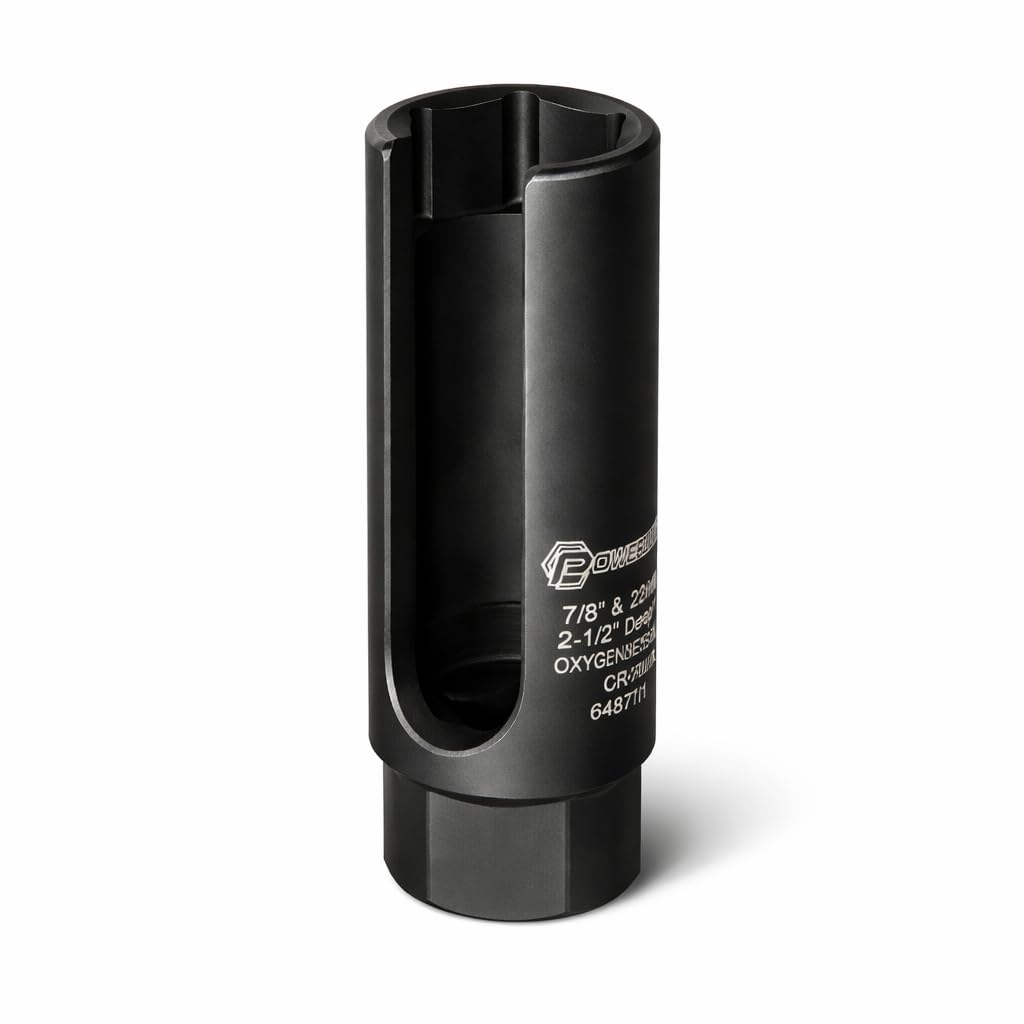
A solid, affordable socket with a side wire gate that does the basics really well.
The Powerbuilt 648442 is the kind of tool you grab for a standard O2 sensor swap and it just works. It is built from chrome vanadium steel with heat treatment and a phosphate coating for corrosion resistance. The side wire gate measures 0.3 inches wide by 2.2 inches long, letting you pass the sensor wiring through without damage. One buyer called it a “solid 1/2″ drive O2 sensor socket” that worked well on a 2006 Honda Accord sensor number two — and at a price that saved them compared to a shop visit.
The unique slotted square drive design improves the ratchet grip, helping keep your tool in place during high-torque use. It has a 2.5-inch depth to fit over longer sensors, and you can use it with either a 1/2-inch drive ratchet or a 7/8-inch end wrench on the external hex. At just 0.5 pounds, it is lightweight enough to maneuver in tight spots without tiring your wrist. Unlike the CTA Tools 2064 which has a tapered 29.80mm outside diameter for thin-wall access, the Powerbuilt uses a standard wall thickness and relies on its side gate for wire management.
Owners mention one clear limitation: this socket can slip and round off a tight sensor. A review notes the socket “flexes too much to break loose old tight sensor” and recommends using a 22mm deep 6-point socket with liquid wrench instead for stubborn ones. Another buyer said the 7/8-inch socket fit loosely on their sensor and slipped, causing a knuckle injury. This is a fine socket for routine swaps, but keep your penetrating oil handy for the rusted ones — unlike the OEMTOOLS, which has a Posi-Grip anti-slip system, the Powerbuilt does its best work on sensors that are not fully seized.
What You Get
- Side wire gate (0.3″ x 2.2″) lets you keep the wiring harness attached during removal
- 2.5-inch depth covers longer sensors without bottoming out
- Chrome vanadium steel with phosphate coating resists corrosion from exhaust heat
The Catch
- Can slip and round off tight or corroded sensor heads — use penetrating oil first
- Only 1/2-inch drive; no 3/8-inch option, which some buyers found inconvenient
- Standard wall thickness may not fit into extremely narrow sensor cavities
A good value pick if: You are doing a routine oxygen sensor swap on a car where the sensor is accessible and not seized — the side wire gate saves you from unclipping the harness.
Look elsewhere for: Rust-belt cars or sensors that have been in place for many years — the Powerbuilt can slip and round the hex head under high torque.
4. ARES 70323-22mm 1/2-inch Drive Heated Oxygen Sensor Socket

The offset socket that reaches bank-2 sensors other tools cannot touch.
The ARES 70323 stands out for its offset design — the socket is angled so you can apply extra leverage in spots where a straight socket binds against the engine bay. It is built from high-strength chrome vanadium steel with a manganese phosphate coating to resist corrosion from exhaust soot and weather. The slotted design lets you remove oxygen sensors with the wiring harness still attached, which saves you from having to hunt down a disconnected plug in a dark engine bay. A buyer on a 2006 Honda Pilot confirmed that it was “long enough to reach bank 2 sensor 2” — a common problem spot on that vehicle.
The ARES is 10 inches long, giving it good reach for deep sensors, and it fits a range of European and Asian makes including Ford, Toyota, Nissan, Mercedes, and BMW. It uses a 1/2-inch drive, so you can pair it with a breaker bar for extra torque. Unlike the CTA Tools 2064 which is a thin-wall straight socket with dual drive options, the ARES uses an offset head to get around obstructions. And unlike the Powerbuilt which can slip under high torque, the ARES has a solid chrome vanadium steel build that buyers found “good quality” and effective on tough sensors.
There is a real limitation, though. One buyer found the flange to be “mighty short” — the short flange fits tight locations but prevents a breaker bar flex head from engaging at some angles due to shoulder binding. Another warned that for a “stuck oxygen sensor,” this socket can round off the sensor head, making the job worse. The offset design helps with leverage in tight spots, but if your sensor is seized, you may still need a dedicated removal tool with a stronger bite. The ARES does not have a Posi-Grip like the OEMTOOLS — it relies on the offset for mechanical advantage instead of anti-slip features.
Offset Advantage: The angled offset head gives you leverage around engine bay obstructions that would block a straight socket, making it the right choice for bank-2 sensors on many SUVs and trucks.
Best suited for: Reaching oxygen sensors in awkward positions on European and Asian vehicles, especially where a straight socket will not align due to engine bay geometry.
Not the one for: A fully seized and corroded sensor — the offset can slip and round the hex; try a dedicated anti-slip socket or penetrating oil first.
5. JEUCLEL 7/8″ 22mm O2 Oxygen Sensor Wrench
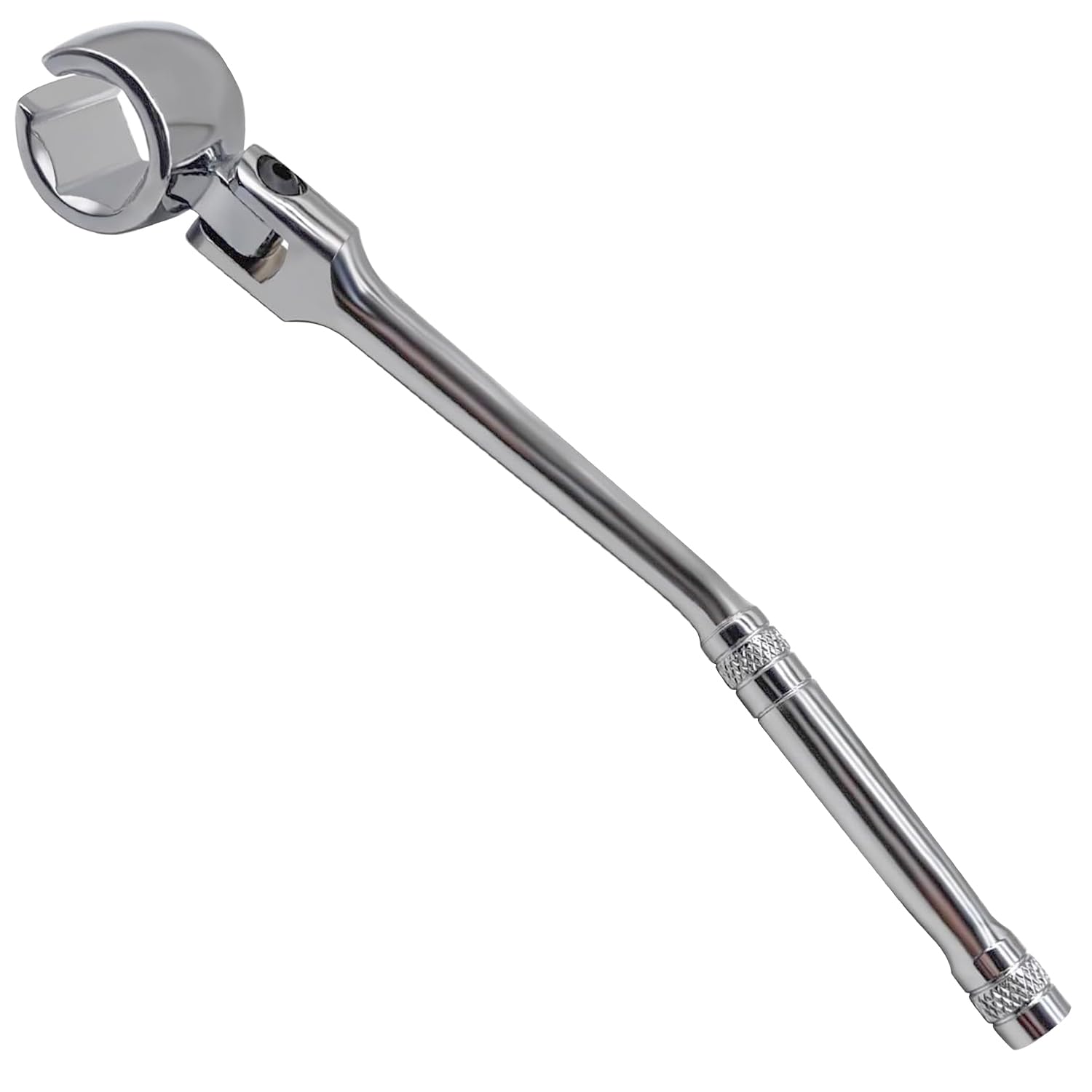
A flex-head wrench with a curved handle for getting around tight manifolds on a budget.
The JEUCLEL takes a different approach from the others — instead of a socket that fits on a ratchet, it is a wrench with a flexible head and an ergonomically curved handle. That curved handle gives you extra leverage when you are reaching upwards from under the car, which is exactly the angle you face with many upstream oxygen sensors. It is made from chrome vanadium steel and is compatible with most domestic cars, including Ford 4.6L and 5.4L modular engines, plus any 7/8-inch (22mm) sensor. The flex head lets you pivot the wrench around heat shields and manifolds, similar to the OEMTOOLS swivel head but in a wrench format.
Buyers appreciated the fast delivery and found it a “nice must have tool” for the toolbox. One reviewer noted it is “gonna come in handy for reaching tight places.” At this price point, it is the most affordable flex-head option in this list. Unlike the Powerbuilt and ARES which use a slotted socket design with a 1/2-inch drive for high torque, the JEUCLEL is a manual wrench — you supply the leverage through the curved handle and flex head. It is noticeably less expensive than the OEMTOOLS 33625246, making it a smart choice for a DIYer who needs a specialized tool for one specific job without a big investment.
The honesty check: one buyer called it “garbage” and said it is “made of crapium,” suggesting the chrome vanadium steel may not hold up under extreme torque. For a sensor that is lightly corroded and in a reachable position, this wrench works fine. For a fully seized sensor, you will want something with more sturdy construction and higher torque capacity. The JEUCLEL also lacks a wire gate slot — unlike the Powerbuilt and ARES — so you will need to disconnect the sensor wiring before using it.
Why It Earns a Spot
- Flex head and curved handle help you reach sensors in awkward upward positions
- Chrome vanadium steel construction at a budget-friendly price
- Compatible with Ford 4.6L and 5.4L modular engines plus most domestic makes
Real Drawbacks
- Mixed reviews on build quality — may not survive high-torque removal of a seized sensor
- No wire gate slot; you must disconnect the sensor harness first
- Wrench format limits maximum torque compared to a 1/2-inch socket and breaker bar
Grab this for: A one-time sensor swap on an accessible domestic car where you need a flex head to get around a heat shield — the curved handle saves your wrist.
Maybe skip if: You are dealing with a heavily corroded, years-old sensor on a rust-belt car — the construction may not handle the torque without damage.
Understanding the Specs
Chrome Vanadium Steel (Cr-V)
This is the most common material for oxygen sensor sockets. It offers a good balance of hardness and toughness to handle the high torque needed to break a sensor loose without snapping the tool. The better sockets also add a coating — manganese phosphate (ARES) or chrome plating (OEMTOOLS) — to resist exhaust-heat corrosion that would rust a plain steel tool in months.
Wire Gate Slot
A side cutout in the socket that lets you slide the tool over the sensor wiring without cutting or disconnecting the harness. The slot width (typically around 0.3 inches) and length (2.2 inches on the Powerbuilt) determine whether you can pass bulky connectors through. A socket without a wire gate forces you to unplug the sensor before you can start — sometimes impossible in a cramped engine bay.
FAQ
Will a 22mm oxygen sensor socket fit all cars?
Can I use a regular deep socket instead of an oxygen sensor socket?
What does the side wire gate do on these sockets?
Should I get a 1/2-inch drive or a 3/8-inch drive oxygen sensor socket?
How do I prevent the socket from slipping and rounding my sensor?
Can an oxygen sensor socket reach bank 2 sensor 2 on a Honda Pilot?
What is the difference between a thin-wall socket and a standard socket?
Do I need an impact-rated oxygen sensor socket?
Final Thoughts: The Verdict
For most DIYers, the 22mm oxygen sensor socket that covers the widest range of cars and toughest conditions is the OEMTOOLS 33625246 because its Posi-Grip system and swivel head handle both the torque and the tight angles better than any other pick here. If you need a thin-wall socket for a narrow cavity like those on Korean cars, grab the CTA Tools 2064 — its 29.80mm tapered end slides in where standard sockets jam. And for the smart budget choice that still includes a side wire gate, the Powerbuilt 648442 delivers solid chrome vanadium steel construction without the premium price of the specialist tools.
How We Picked
We do not accept paid placement, and we did not hands-on test every unit. Instead, we match each pick to a real buyer and use-case by comparing the manufacturers’ published specifications against the patterns in verified customer reviews — so you get each pick’s real strengths and trade-offs instead of marketing copy.
Sources & Methodology
Specifications: manufacturer listings and product documentation. Review insights: verified customer reviews, as of July 2026. Pricing: not shown on this page (it changes often); check the current price via the retailer link.
As an Amazon Associate, Gadgets Feed earns from qualifying purchases. This does not affect which products we feature.
Product prices and availability are accurate as of the date/time indicated and are subject to change. Any price and availability information displayed on Amazon at the time of purchase will apply to the purchase of this product. As an Amazon Associate I earn from qualifying purchases.
CERTAIN CONTENT THAT APPEARS ON THIS SITE COMES FROM AMAZON. THIS CONTENT IS PROVIDED "AS IS" AND IS SUBJECT TO CHANGE OR REMOVAL AT ANY TIME.
Amazon and the Amazon logo are trademarks of Amazon.com, Inc. or its affiliates.