
Choosing the right ultrawide gaming monitor means navigating a tight set of decisions around panel type, refresh rate, and curvature. The 3440 x 1440 resolution hits a sweet spot, offering significantly more horizontal real estate than standard 1440p without demanding the GPU power of a full 4K panel. For immersive single-player titles and competitive shooters alike, this format delivers a noticeable advantage in situational awareness and visual depth.
I’m Min — the co-founder and writer behind Gadgets Feed. I’ve spent countless hours analyzing the technical specifications and market positioning of the latest 21:9 gaming displays to find the monitors that genuinely deliver on their performance promises.
This guide breaks down the best options available right now, focusing on measurable metrics like refresh rate, response time, color gamut, and adaptive sync support to help you pick the ideal 3440 x 1440 gaming monitor for your setup and budget.
How To Choose The Best 3440 X 1440 Gaming Monitor
The most common mistake buyers make is prioritizing refresh rate over panel technology. A 240Hz IPS panel cannot match the pixel response, contrast, or HDR performance of a 175Hz QD-OLED. At this price point and screen size, the panel type should be your primary filter. Below are the three factors that separate an excellent ultrawide from a mediocre one.
Panel Technology: OLED vs QD-OLED vs IPS
Standard OLED (WOLED) panels use a white OLED layer with a color filter, delivering deep blacks and excellent contrast but with slightly lower color volume compared to QD-OLED. Quantum Dot OLED panels combine a blue OLED backlight with a quantum dot layer to produce incredibly wide color gamuts — often exceeding 99% DCI-P3 — and higher peak brightness for HDR content. IPS panels in this category provide decent color accuracy but cannot approach the infinite contrast ratio or per-pixel response speed of either OLED variant. For a gaming monitor at 3440 x 1440, QD-OLED currently offers the best balance of color vibrancy, motion clarity, and HDR punch.
Refresh Rate and Adaptive Sync
Refresh rates in this segment range from 120Hz to 240Hz. The jump from 120Hz to 175Hz is perceptible in fast-paced shooters and racing games, while 240Hz provides an incremental advantage for competitive players with high-frame-rate hardware. Adaptive sync technology — whether G-Sync, G-Sync Compatible, FreeSync Premium, or FreeSync Premium Pro — eliminates screen tearing by synchronizing the monitor’s refresh rate to the GPU’s frame output. FreeSync Premium Pro adds HDR support and low framerate compensation, making it a strong feature set for AMD GPU owners.
Curvature and Ergonomics
Ultrawide monitors rely on curvature to maintain consistent viewing distance across the full width of the screen. The most common curves are 1800R and 1500R, while newer premium models push to 800R for extreme immersion. A steeper curve wraps the display further into your peripheral vision but can distort straight lines in productivity apps. Height adjustment, tilt, and swivel are essential for long gaming sessions — a stand that only offers tilt is a red flag. VESA mount compatibility (typically 100x100mm) allows for aftermarket arm setups that free up desk space.
Quick Comparison
On smaller screens, swipe sideways to see the full table.
| Model | Category | Best For | Key Spec | Amazon |
|---|---|---|---|---|
| LG 34GX90SA-W | Premium OLED | Highest Motion Clarity | 240Hz / 0.03ms / 800R | Amazon |
| Acer Predator X34 | Premium OLED | Console & PC Hybrid | 240Hz / HDMI 2.1 / 800R | Amazon |
| ASUS ROG Strix XG34WCDG | Premium OLED | Burn-in Protection | 175Hz / OLED Care Pro | Amazon |
| Alienware AW3423DW | Premium OLED | G-Sync Ultimate | 175Hz / G-Sync Ultimate | Amazon |
| AOC Agon PRO AG346UCD | Mid-Range OLED | Best Value OLED | 175Hz / G-Sync Compatible | Amazon |
| Philips Evnia 34M2C6500 | Mid-Range OLED | Brightest HDR OLED | 175Hz / 1000 nits peak | Amazon |
| Alienware AW3420DW | Budget Premium IPS | Entry-Level Ultrawide | 120Hz / G-Sync / IPS | Amazon |
In‑Depth Reviews
1. LG 34GX90SA-W
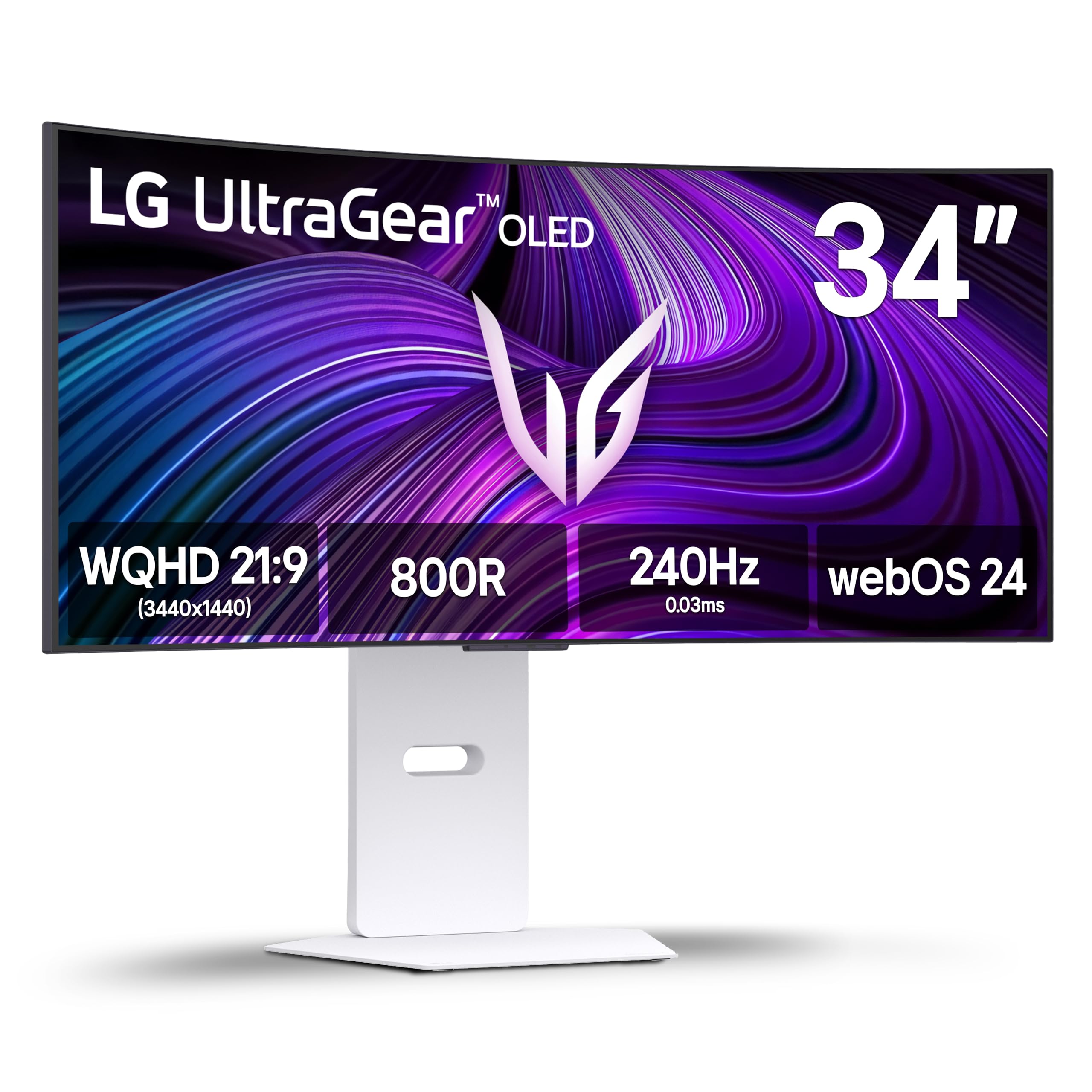
The LG 34GX90SA-W takes the top spot by combining a blistering 240Hz refresh rate with a 0.03ms GtG response time and a steep 800R curve. This panel is a first-gen WOLED implementation that still manages 1300-nit peak brightness in HDR highlights, giving it real punch in dark-room gaming scenarios. The 800R curvature wraps the 34-inch ultrawide around your peripheral vision more aggressively than any 1500R or 1800R panel, creating a genuinely immersive cockpit-style experience for racing and flight sims.
<
LG includes its webOS smart platform, which adds native access to Netflix, Prime Video, and cloud gaming services like NVIDIA GeForce NOW and Amazon Luna without needing a PC connected. The connectivity suite is forward-looking with HDMI 2.1, DisplayPort 1.4, and a USB Type-C port supporting 65W power delivery. AMD FreeSync Premium and G-Sync Compatible certification ensure tear-free gameplay across both GPU ecosystems. White colorway and anti-glare surface complete a premium package that prioritizes speed and immersion above all else.
The 800R curve can take some adjustment for desk workflow — straight lines in spreadsheets or design apps will appear slightly bowed. The built-in speakers are usable for casual content consumption but lack bass for immersive gaming. Text clarity is good for a WRGB OLED subpixel layout, though not quite as sharp as a dedicated 4K panel for productivity-heavy use. For pure gaming performance at 3440 x 1440, this is the fastest monitor on the list.
Why it’s great
- 240Hz refresh rate with 0.03ms response — fastest motion clarity in class
- 800R curvature provides unmatched peripheral immersion
- HDMI 2.1 input enables full-bandwidth 240Hz on next-gen consoles
Good to know
- Aggressive 800R curve distorts productivity workflows
- Built-in speakers are basic and lack low-end response
- WOLED subpixel layout slightly reduces text sharpness vs QD-OLED
2. Acer Predator X34

Acer’s Predator X34 brings a 240Hz OLED panel to the table with full HDMI 2.1 support, making it one of the few ultrawides that can run 3440 x 1440 at 240Hz from a PlayStation 5 or Xbox Series X. The 800R curvature matches the LG’s aggressive wrap, and the OLED panel delivers 99% DCI-P3 color gamut coverage with VESA DisplayHDR True Black 400 certification. The 0.01ms pixel response time effectively eliminates ghosting, giving it a slight edge over the 0.03ms panels in purely competitive scenarios.
The integrated KVM switch is a rare and valuable feature in this category — it lets you control two connected devices with a single keyboard and mouse, ideal for a gaming PC and work laptop sharing the same display. The USB Type-C port delivers 90W power delivery, which can charge a high-performance laptop while transmitting display and data signals. FreeSync Premium Pro certification adds HDR support to the variable refresh rate pipeline, a benefit for AMD GPU users that standard FreeSync lacks.
Reports of aggressive image retention prevention pop-ups during gameplay and occasional sleep-mode handshake issues with certain GPUs are the main reliability concerns. The built-in speakers output 5W per channel, which is adequate for casual use but lacks the clarity for competitive audio cues. The matte OLED finish helps control reflections in bright rooms but slightly reduces perceived contrast compared to glossy QD-OLED panels.
Why it’s great
- True HDMI 2.1 inputs for 240Hz on PS5 and Xbox Series X
- Built-in KVM switch and 90W USB-C PD for multi-device setups
- Ultra-fast 0.01ms pixel response for competitive gaming
Good to know
- Image retention prevention pop-ups interrupt gameplay
- Sleep-mode handshake issues reported with some GPU configurations
- Matte coating reduces contrast compared to glossy QD-OLED alternatives
3. ASUS ROG Strix XG34WCDG
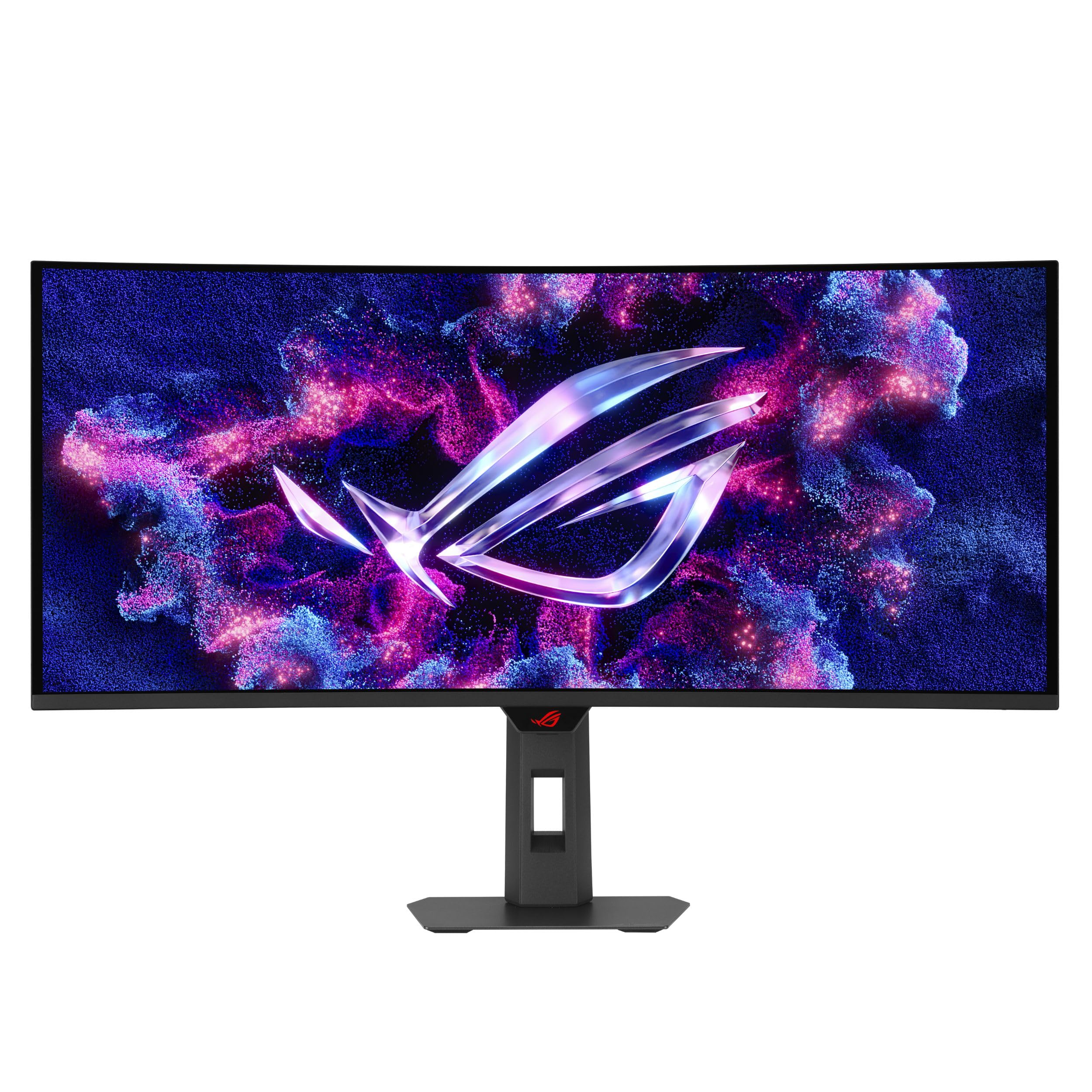
The ASUS ROG Strix XG34WCDG uses a 34-inch QD-OLED panel with 175Hz refresh rate, 0.03ms response time, and a true 10-bit color depth covering 99.3% of the DCI-P3 gamut. What sets this monitor apart is ASUS’s OLED Care Pro suite, which includes a Neo Proximity Sensor that detects when the user steps away and automatically switches the screen to black to reduce burn-in risk. The Delta E < 2 color accuracy out of the box makes it suitable for photo and video editing alongside gaming duties.
ASUS includes the DisplayWidget Center application, which lets you adjust monitor settings using a mouse instead of the OSD joystick — a quality-of-life improvement for users who frequently switch between game modes and color profiles. The 1800R curvature is more conservative than the 800R options from LG and Acer, making it a better fit for mixed-use desks where productivity and gaming share screen time. G-Sync Compatible certification ensures smooth tear-free gameplay with NVIDIA GPUs.
The Neo Proximity Sensor has been reported as unreliable by some users, occasionally triggering unintended black screens during gameplay. The monitor lacks built-in speakers entirely, which is typical for high-end gaming OLEDs but still an inconvenience for console users. ELMB (Extreme Low Motion Blur) only functions via DisplayPort with VRR disabled, limiting its usefulness for laptop users who lack a DP output. The 3-year warranty includes burn-in coverage, providing peace of mind for long-term ownership.
Why it’s great
- Neo Proximity Sensor reduces burn-in risk automatically
- Delta E < 2 color accuracy out of box for creative work
- DisplayWidget Center allows mouse-based OSD adjustments
Good to know
- Proximity sensor can trigger false blackouts during use
- No built-in speakers limit console convenience
- ELMB only works via DisplayPort with VRR disabled
4. Alienware AW3423DW

The Alienware AW3423DW was one of the first QD-OLED gaming monitors on the market and remains a strong contender thanks to its G-Sync Ultimate certification and 175Hz refresh rate. The 1800R curve provides a balanced immersive experience without the distortion issues of steeper curves, and the 1,000,000:1 contrast ratio delivers the deep blacks and specular highlights that OLED is known for. Creator Mode allows switching between DCI-P3 and sRGB color spaces with adjustable gamma, supporting both gaming and color-critical work.
The Legend 2.0 design language includes customizable AlienFX stadium-loop lighting, 360-degree ventilation for heat management, and a centralized OSD joystick. Alienware backs the panel with a three-year burn-in warranty, which is the best in the industry and addresses the primary concern of OLED adoption. The 0.1ms GtG response time (real-world rated, not marketing) ensures near-instantaneous pixel transitions for motion clarity.
HDMI 2.0 ports limit console bandwidth to 100Hz at 3440 x 1440, making it less suitable for PS5 and Xbox Series X users who want the full refresh rate. The pixel refresh cycle triggers every four hours of cumulative use and takes roughly seven minutes, which can interrupt gaming sessions or workflow. Some units have reported G-Sync brightness flickering, a known issue with first-generation G-Sync Ultimate modules in OLED panels. The fan inside the monitor produces occasional spin-up noise that some users find distracting in quiet rooms.
Why it’s great
- G-Sync Ultimate certification for tear-free variable refresh rate
- Three-year burn-in warranty — best coverage in the category
- Creator Mode with DCI-P3 and sRGB gamma adjustment
Good to know
- HDMI 2.0 ports limit console to 100Hz at 3440×1440
- Pixel refresh cycle interrupts use every 4 hours
- Internal fan can produce distracting spin-up noise
5. AOC Agon PRO AG346UCD

The AOC Agon PRO AG346UCD delivers a glossy QD-OLED panel at a price point that undercuts most competitors by a significant margin. The 34-inch screen runs at 175Hz with a 0.03ms response time and includes VESA DisplayHDR 400 True Black certification. The glossy coating enhances perceived contrast and color saturation compared to matte OLEDs, making games look punchier without the haze that anti-glare treatments introduce. AOC includes a 4-year warranty, which surpasses the typical three-year coverage and signals confidence in the panel’s longevity.
G-Sync Compatible certification ensures smooth gameplay with NVIDIA GPUs, and the ergonomic stand offers 150mm height adjustment, tilt, and swivel for customizable positioning. The built-in PSU eliminates the external power brick — a welcome design choice for cable management. The panel includes an internal heatsink for OLED care and offers an HDR 1000 MAX mode that pushes brightness beyond the DisplayHDR 400 baseline for supported content.
The V-shaped stand base has a large footprint that conflicts with smaller desks and may interfere with mouse pad placement. Some users report a “Logo Detection” bug that can hide the OSD menu. The screen protector on initial units is notoriously difficult to remove, with the yellow pull-tab failing and leaving adhesive residue under the bezel, requiring careful manual cleanup. Text clarity is good for a QD-OLED but not on par with a high-PPI IPS panel for extended productivity sessions.
Why it’s great
- Glossy QD-OLED coating delivers superior color saturation and contrast
- 4-year warranty — best coverage in its price tier
- Built-in PSU eliminates external power brick
Good to know
- Large V-shaped stand base consumes significant desk space
- Screen protector removal can leave adhesive residue
- Logo Detection bug may interfere with OSD menu access
6. Philips Evnia 34M2C6500
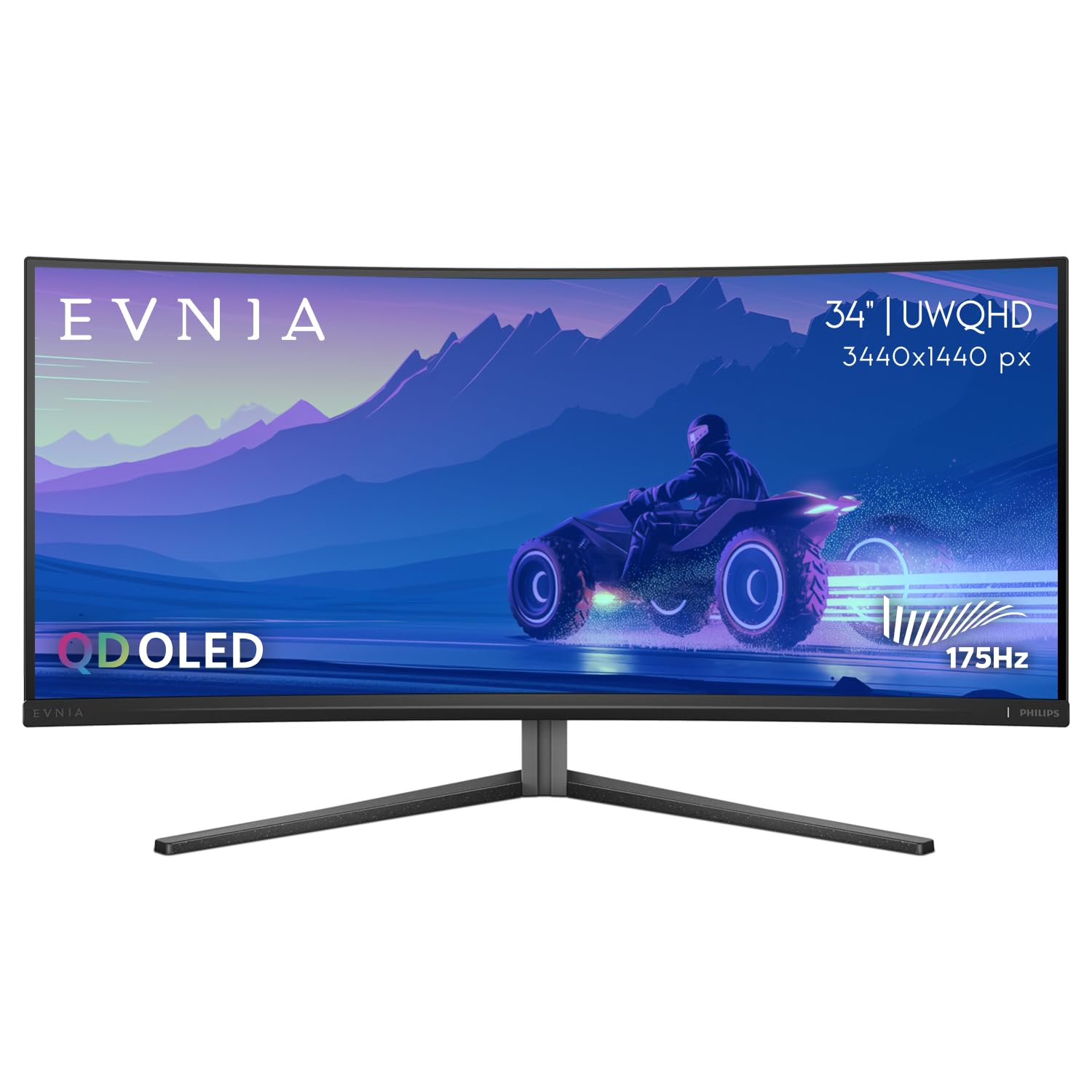
Philips enters the ultrawide OLED space with the Evnia 34M2C6500, a QD-OLED panel that boasts a 1000-nit peak brightness — higher than most competitors in this class. The 175Hz refresh rate and Adaptive Sync via FreeSync provide smooth gameplay, while the 1800R curvature hits a comfortable middle ground between immersion and productivity usability. The 1,000,000:1 contrast ratio delivers the expected deep blacks and vibrant colors that make HDR games like Cyberpunk 2077 and Alan Wake 2 look spectacular.
The stand, while mostly plastic, feels sturdy and offers full height adjustment along with tilt and swivel. Philips includes an Ambiglow backlighting system that projects colors onto the wall behind the monitor, though its synchronization with on-screen content is delayed and lacks the precision of Philips’s higher-end Ambilight TVs. The 4-year advanced replacement warranty is a standout feature, matching AOC for coverage length and offering peace of mind for early adopters.
Quality control appears inconsistent, with multiple users reporting dead pixels or DOA units on first delivery. The pixel refresh notification cannot be easily disabled and will pause the screen for several minutes after every four hours of cumulative use. The OSD menu feels cheap with audible toggle clicks, and many options remain greyed out, suggesting either firmware limitations or feature segmentation. No built-in speakers are included, which is expected at this tier but still worth noting for console users.
Why it’s great
- 1000-nit peak brightness for impactful HDR highlights
- Comfortable 1800R curve balances immersion and productivity
- 4-year advanced replacement warranty included
Good to know
- Inconsistent QC with dead pixels reported on first units
- Pixel refresh notifications cannot be disabled
- Ambiglow backlight sync has noticeable delay
7. Alienware AW3420DW

The Alienware AW3420DW represents the previous generation of ultrawide gaming monitors, using an IPS Nano Color panel with 3440 x 1440 resolution, 120Hz refresh rate, and native G-Sync via a dedicated module. While it cannot match OLEDs in contrast or response time, it delivers 98% DCI-P3 color coverage and a crisp anti-glare surface with 3H hardness for durability. The 1900R curve is subtle enough for comfortable productivity use while still providing some immersive wrap for gaming.
The build quality is excellent, with a sturdy stand that offers height, swivel, and tilt adjustments, plus AlienFX customizable RGB lighting on the stand, logo, and power button. G-Sync with the dedicated module works at the full 120Hz refresh rate range, providing tear-free gameplay without the compatibility quirks sometimes seen with G-Sync Compatible panels. The matte white Lunar Light finish with dark silver accents looks premium on a desk and hides fingerprints better than black gloss finishes.
The 120Hz refresh rate is noticeably behind the 175Hz and 240Hz OLED competition for competitive gaming, and the 2ms response time introduces perceptible ghosting in fast-paced scenes compared to OLED’s near-instant pixel transitions. Brightness tops out at 350 cd/m², which is adequate for SDR content but falls short for HDR impact — this monitor lacks any DisplayHDR certification. HDMI 1.4 ports limit console use to 60Hz at 3440 x 1440, and IPS glow is present in dark corners, especially on larger ultrawide panels.
Why it’s great
- Dedicated G-Sync module for reliable variable refresh rate
- 98% DCI-P3 color coverage with Nano Color IPS technology
- Premium build quality with sturdy stand and RGB lighting
Good to know
- 120Hz refresh rate trails behind OLED competitors
- No HDR certification limits brightness and contrast
- HDMI 1.4 limits console to 60Hz
FAQ
What GPU do I need to drive a 3440 x 1440 gaming monitor at high refresh rates?
Is QD-OLED worth the premium over WOLED for gaming?
Can a PS5 or Xbox Series X run 3440 x 1440 at 240Hz?
How much desk space do I need for a 34-inch ultrawide monitor?
What is burn-in on OLED gaming monitors and how do I prevent it?
Final Thoughts: The Verdict
For most gamers, the best 3440 x 1440 gaming monitor is the LG 34GX90SA-W because its 240Hz refresh rate, 800R curve, and OLED contrast deliver the highest motion clarity and immersion currently available in a 34-inch form factor. If you want HDMI 2.1 for console compatibility and a KVM for desk efficiency, grab the Acer Predator X34. And for budget-conscious buyers seeking QD-OLED quality without the premium price, nothing beats the value of the AOC Agon PRO AG346UCD.