
If you need a 12-volt, 35 amp-hour battery that fits a mobility scooter, powers a solar gate opener, or runs a trolling motor at speed three for four hours, you already know the frustration: standard sealed lead-acid packs can die after a couple of hundred cycles, leaving you stranded or replacing them every other year. The 35/2 form factor (roughly 7.7 by 5.2 by 6.1 inches) is the default size for countless off-grid, medical, and marine applications, but the chemistry inside — AGM, GEL, or lithium — determines how long that power actually lasts. This guide isolates the real-world trade-offs so you buy exactly what your system demands.
I’m Min — the co-founder and writer behind Gadgets Feed. I spent dozens of hours cross-referencing capacity curves, BMS specifications, terminal types, and real owner verification reports across multiple vendors to identify the batteries that actually deliver their rated 35Ah in deep-cycle service.
After analyzing gel, AGM, and LiFePO4 chemistries side by side, the verdict is clear: the 35/2 battery that balances upfront cost with long-term reliability depends heavily on whether you prioritize raw starting power, deep-cycle endurance, or maintenance-free longevity in extreme weather.
How To Choose The Best 35/2 Battery
A 35/2 battery isn’t a single chemistry — it’s a size class. Before you click buy, map your application to the three primary chemistries available in this footprint: AGM, GEL, and LiFePO4. Each behaves differently under continuous discharge, extreme temperatures, and float charging.
Chemistry Deep Dive: AGM vs. GEL vs. Lithium
AGM (Absorbent Glass Mat) batteries use fiberglass mats to hold the electrolyte, offering low internal resistance for high burst currents — ideal for starting engines or powering inverters. GEL batteries suspend the electrolyte in silica gel, which provides superior performance in both hot and cold climates and a slower self-discharge rate, making them a stronger choice for solar gate openers or seasonal equipment. LiFePO4 (lithium iron phosphate) delivers 5,000+ cycles versus roughly 300–500 for lead-acid, weighs less than nine pounds, and includes a built-in Battery Management System (BMS) that prevents overcharge, over-discharge, and short circuits, but requires a compatible LiFePO4 charger or MPPT solar controller.
Terminal Type Matters More Than You Think
Batteries in the 35/2 class ship with nut-and-bolt (NB), flag (FLAG), or marine terminals. Nut-and-bolt terminals are the most secure for high-vibration environments like UTVs or liftgates. Flag terminals, common in UPS backup units and some Kubota lawn mowers, sit flush and require a spade connector. Marine terminals combine a threaded post and a wing-nut side post for easy hookup to trolling motors. Measure your existing cable lugs before ordering — a terminal mismatch means buying adapters or replacing connectors.
Capacity vs. Reserve Capacity vs. CCA
While the listed amp-hour (Ah) rating tells you the total stored energy, reserve capacity (RC) and cold cranking amps (CCA) reveal how that energy behaves under load. Reserve capacity is the minutes a fully charged battery can deliver 25 amps before dropping to 10.5 volts — essential for trolling motors and inverter loads. CCA, conversely, measures the current available at 0°F for 30 seconds and matters only if you’re starting an engine. A 35Ah solar battery should have a high RC but minimal CCA; a starting battery should be the reverse.
Quick Comparison
On smaller screens, swipe sideways to see the full table.
| Model | Category | Best For | Key Spec | Amazon |
|---|---|---|---|---|
| GOLDENMATE 12V 30Ah LiFePO4 | Lithium | Deep-cycle solar & marine | 5000+ cycles, IP67, BMS | Amazon |
| Mighty Max ML35-12 GEL | GEL | Solar gate & extreme temps | 12V 35Ah, Nut & Bolt terminal | Amazon |
| Power Sonic PS-12350 | AGM | Long-life AGM replacement | 35Ah at 20-hr, 24 lb | Amazon |
| VMAXTANKS V35-857 | AGM Marine | Trolling motor & Goal Zero Yeti | 75-min RC, marine terminal | Amazon |
| Interstate SLA1155 | AGM | Lawn mower & UPS backup | Flag terminal, 22.1 lb | Amazon |
| ExpertPower 35Ah GEL 2-Pack | GEL | Mobility chair & solar shed | 2-pack, sealed gel, 24 lb each | Amazon |
| Goodyear 35-AGM | AGM Automotive | Vehicle starting & aux battery | 55Ah, 650 CCA, 100 RC | Amazon |
In‑Depth Reviews
1. GOLDENMATE 12V 30Ah LiFePO4 Battery
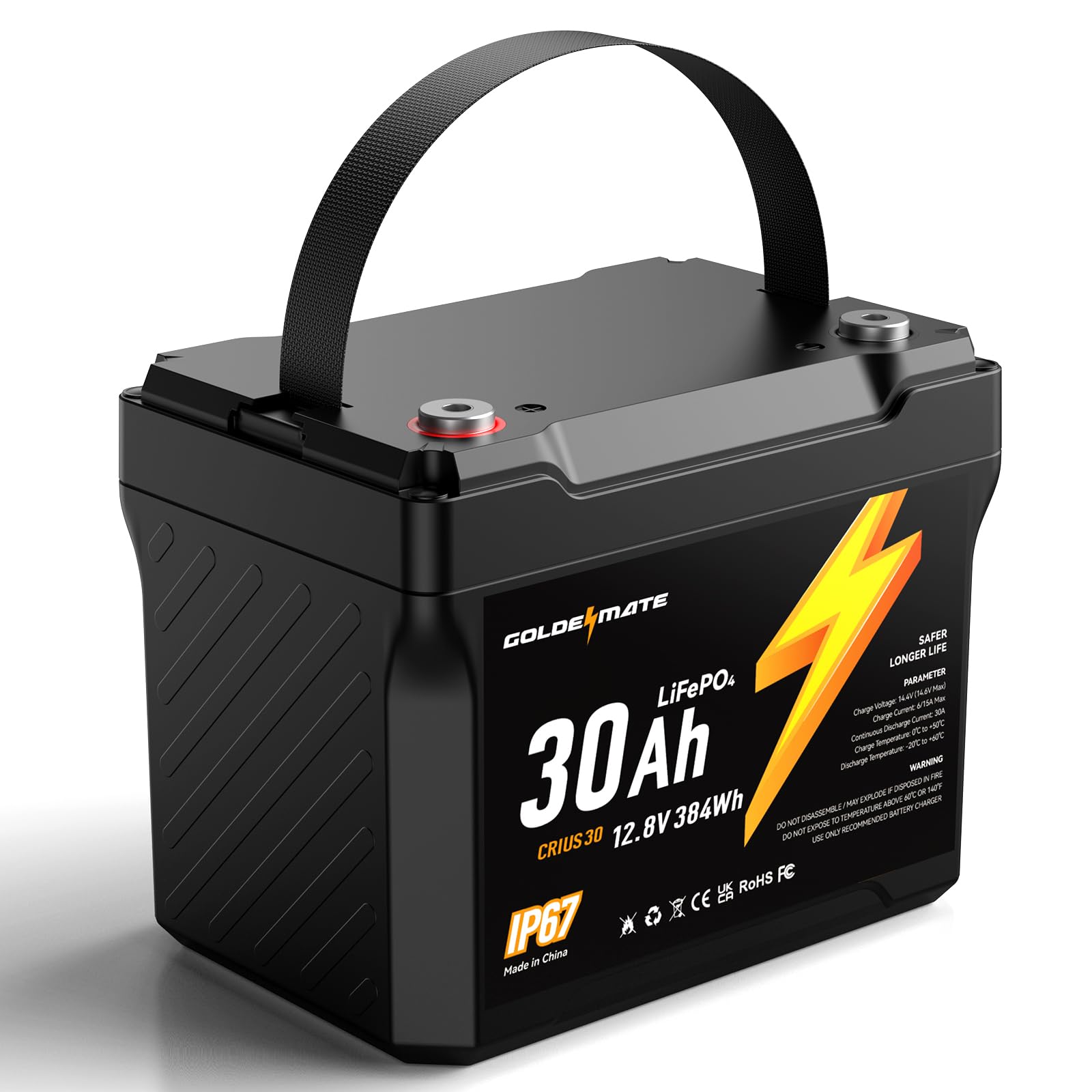
The GOLDENMATE CRIUS 30 is the best choice for anyone who wants a single battery that handles solar, marine, RV, and off-grid duty without the weight penalty of lead-acid. At only 8.6 pounds, it’s roughly one-third the weight of an equivalent 35Ah AGM pack, and its Grade A LiFePO4 cells are rated for over 5,000 full depth-of-discharge cycles — compared to the 300–500 cycles typical of a sealed lead-acid unit. A built-in 30A BMS protects against overcharge, over-discharge, over-current, and short circuits, giving you the peace of mind that the battery simply won’t fail due to user error.
Real owners confirm that this battery powers a kayak fish finder with chartplotter for an entire day without voltage sag, and that two units in parallel (40Ah total) sustain a 1.4A solar camera and LED setup overnight with minimal depletion from a 200W panel. The IP67 rating means you can mount it in an exposed location — a hatch, a truck bed, a marine console — without worrying about rain or spray. The included BMS also handles low-temperature charging cutoff, preventing the lithium cells from being damaged below freezing.
Two caveats: this battery delivers 30Ah, not 35Ah, so if you absolutely need the full 35Ah capacity in a single unit, you’ll need to look at the lead-acid options below. It also requires a LiFePO4-specific charger or an MPPT solar controller set to the lithium profile — plugging a standard lead-acid charger into this battery will not deliver a full charge and may trigger the BMS prematurely. For most solar, camping, and electronics applications, however, the weight savings and cycle life make this the battery to beat.
Why it’s great
- 5000+ deep cycles vs. ~300 for lead-acid, lasting over a decade in daily use
- 8.6 pounds — roughly 60% lighter than comparable AGM/GEL batteries
- IP67 waterproof housing allows outdoor mounting without a protective box
- Built-in 30A BMS eliminates risk of overcharge or short-circuit damage
Good to know
- Rated for 30Ah, not the full 35Ah — check your runtime math carefully
- Requires a LiFePO4 charger or MPPT solar controller for proper charging
- Maximum continuous discharge of 30A may limit heavy inverter loads
2. Mighty Max Battery ML35-12 GEL

The Mighty Max ML35-12 GEL is the go-to 35Ah sealed battery when your application lives outdoors in extreme temperature swings. Unlike AGM batteries that can dry out and lose capacity in sustained heat, the thick gel paste inside this battery resists both high summer temperatures and the slow, cold self-discharge that plagues flooded lead-acid cells. Owners report that one unit installed on a Mighty Mule gate opener with a 50W solar panel and a Wyze camera runs 24/7 with zero voltage drop, recovering fully even after cloudy days — the ideal behavior for a solar-trickle-charge scenario.
The nut-and-bolt (NB) terminals provide a more secure connection than flag terminals when the battery is mounted in a UTV, ATV, or power wheelchair that experiences constant vibration. At 7.68 x 5.0 x 7.0 inches, it fits standard U1-style battery boxes, though one owner noted it was slightly too tall for an Atwood U1 box — always measure your tray height before ordering. The GEL electrolyte is completely non-spillable and produces no fumes, making it safe for indoor use in medical devices or UPS systems.
Also, some owners found that the battery didn’t stay charged as long as they expected in an electric wheelchair, which likely points to the chair’s charger not matching the GEL profile. For slow, steady solar or gate applications, this GEL battery outperforms its AGM cousins.
Why it’s great
- Gel electrolyte holds up in temperature extremes from summer heat to winter cold
- Nut-and-bolt terminals stay tight under vibration in UTVs, gates, and wheelchairs
- Slower self-discharge than AGM — retains charge longer during seasonal storage
- Non-spillable and fume-free for indoor medical or UPS installations
Good to know
- May be too tall (7.0 inches) for some U1 battery boxes — always measure the tray height
- GEL profile requires a compatible charger; standard AGM float chargers may undercharge it
- Lower burst current compared to AGM — not ideal for engine starting
3. Power Sonic PS-12350
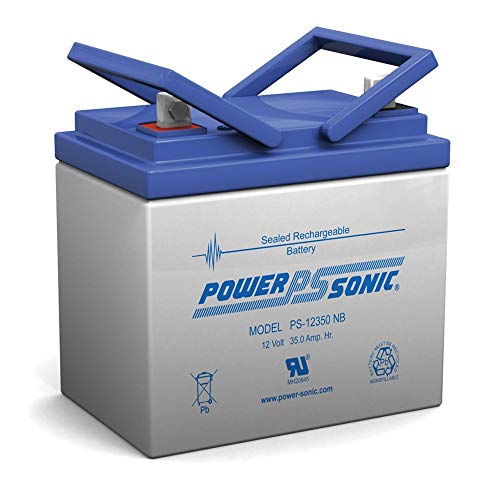
Power Sonic has been a staple in the sealed lead-acid industry for decades, and the PS-12350 exemplifies why. This 35Ah AGM battery delivers a solid combination of deep-cycle endurance and float-charge reliability, with a 20-hour rate that provides a full 35 amp-hours and a 10-hour rate of 33 amp-hours for more aggressive discharge scenarios. Owners report that these batteries have powered side-by-side sound systems and winches since 2016 with only one cell failing after years of service, and they serve as exact replacements for vertical lifts and scooter packs lasting over four years.
The Absorbent Glass Mat construction keeps the electrolyte suspended between the plates, allowing for a lower internal resistance than GEL — meaning the PS-12350 can deliver higher surge currents for inverter startup and winch operation. The valve-regulated, spill-proof design means you can mount it on its side or even end, which is critical if you’re stuffing it into a cramped scooter compartment or a lift-gate battery tray. The ABS case resists vibration and impact, so it won’t crack under the pounding of a bumpy trail.
The main caution with any AGM battery is that deep discharges below 50% state of charge accelerate aging. One owner reported that a unit wouldn’t hold charge after being run down by a small fan — that’s a classic symptom of sulfation from deep discharge combined with a charger that didn’t fully recover the battery. If you use the PS-12350 for deep-cycle service, pair it with a smart AGM charger that has a reconditioning mode. For general backup power, mobility, and moderate inverter loads, this is one of the most proven 35Ah AGM batteries available.
Why it’s great
- Proven reliability in side-by-sides, lifts, and scooters — many units exceed 4 years of service
- Low internal resistance AGM design delivers strong surge current for inverters and winches
- Valve-regulated and spill-proof for flexible mounting orientations
- ABS case withstands vibration and impact in off-road and industrial use
Good to know
- Deep discharges below 50% can cause sulfation and premature failure
- Requires a smart AGM charger for optimal long-term life; a basic trickle charger will undercharge
- Warranty and customer service response volume can be inconsistent
4. VMAXTANKS V35-857 AGM

The VMAXTANKS V35-857 is built specifically for the marine and portable power market, with a reserve capacity of 75 minutes that directly translates to longer trolling motor runs. VMAXTANKS publishes real-world estimates: 1.2 hours at full throttle on a 30-pound thrust motor, 3.5 hours at medium speed, and 5.8 hours at low speed — numbers you can actually plan a fishing trip around. The marine terminal (a combination of threaded post and side wing-nut) makes hooking up a Minn Kota or MotorGuide trolling motor plug straightforward without adapter rings.
Military-grade plates provide extra durability for deep-cycle use, and the AGM construction means no water refilling and zero maintenance. Owners have successfully used it as a direct drop-in replacement for the Goal Zero Yeti 400’s internal battery, adding runtime without exceeding the 400W inverter limit. The V35-857 measures 7.7 x 5.0 x 6.1 inches and weighs 26 pounds, fitting the standard Group U1 footprint found in most smaller trolling motor battery trays.
Like any AGM, the V35-857 does not appreciate being discharged below 10.5 volts repeatedly — one owner noted that capacity dropped significantly after under three years of use, likely from deep cycles without a proper charger. VMAXTANKS recommends their BC1204 or BC1205 charger to maintain the battery’s health. If you need a battery that can survive seasonal storage on a boat without charging, consider the GEL options above; for weekly fishing trips where you need consistent runtime, this is the best marine-specific 35Ah battery available.
Why it’s great
- 75-minute reserve capacity provides real-world trolling motor runtime estimates from the manufacturer
- Marine terminals work directly with standard trolling motor plugs without adapters
- Military-grade plates handle deep cycling better than standard AGM batteries
- Direct drop-in size for Goal Zero Yeti 400 and similar portable power stations
Good to know
- AGM chemistry still vulnerable to capacity loss if regularly discharged below 10.5V
- Requires VMAXTANKS BC1204/BC1205 or equivalent smart charger to avoid damage
- Weight of 26 pounds is heavier than lithium alternatives of similar capacity
5. Interstate Batteries SLA1155

The Interstate Batteries SLA1155 carries the legacy of a brand that’s been in the battery business since 1952, and this 12V 35Ah sealed lead-acid unit is the exact spec that powers thousands of Kubota lawn mowers, emergency lighting systems, and UPS backup units. The flag terminal design (a flat spade terminal) is standard on many Japanese mowers and commercial UPS systems, so if you’re replacing a battery in a Deere, Grasshopper, or APC unit, this is likely the same terminal pattern you’ll find. Owners confirm it fits the Grasshopper 225 battery shelf without modification and started the mower on the first try after a full charge.
The AGM/VRLA construction means no acid spills, no water refills, and no venting requirements, making it safe for indoor UPS enclosures and shed installations. Interstate’s 12-month warranty backs the battery, and the company has a nationwide network of All Battery Center locations for recycling. Many owners have used these in Drive mobility scooters with great success, noting that the batteries last longer and hit harder than the OEM packs they replaced.
Reliability reports are mixed: while the majority of owners see 1–3 years of service, there are reports of batteries failing within six months, particularly in Kawasaki Mule applications where the battery may be subjected to repeated deep discharges from winch use. The SLA1155 is a standard AGM, not a deep-cycle marine battery, so it’s best suited for starting and float-charge applications rather than daily deep cycling. If your application involves a lawn mower or a wall-mounted UPS, this is a safe pick; if you plan to drain it below 50% regularly, look at the VMAXTANKS or GOLDENMATE instead.
Why it’s great
- Flag terminal matches Kubota, Deere, and APC UPS battery connectors exactly
- Nationwide Interstate battery recycling program and 12-month warranty
- Maintenance-free AGM design is safe for indoor use in UPS and medical equipment
- Proven fit in mobility scooters, often outperforming OEM replacements
Good to know
- Not a true deep-cycle battery — repeated deep discharges can cause premature failure within 6 months
- Price is on the higher side for a standard AGM; some owners find better value in dedicated lawn/garden batteries
- Flag terminals require spade connectors — may not match existing ring-terminal cables without an adapter
6. ExpertPower 12V 35Ah GEL 2-Pack
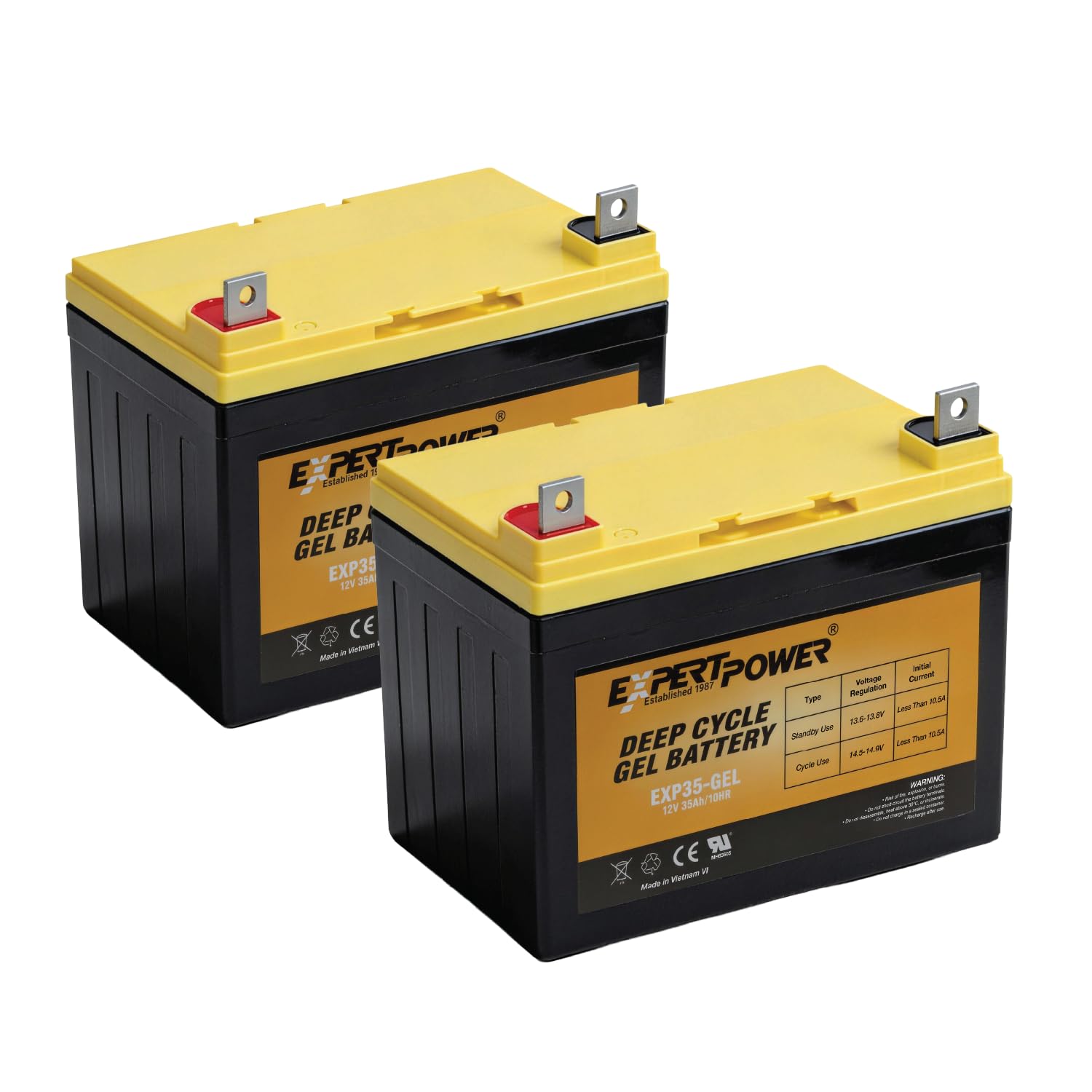
The ExpertPower 35Ah GEL 2-Pack delivers two sealed gel batteries at a price that beats buying individual units from larger brands. If you need to wire a pair in series for 24V solar array storage or in parallel for 70Ah of capacity in a mobility scooter, this is the most economical way to get gel chemistry in the 35/2 form factor. Owners report that these batteries work superbly in Jazzy ES power chairs, providing more speed and longer charge life than the standard AGM packs they replaced.
The gel electrolyte gives the ExpertPower batteries a rugged edge in solar applications: they can be mounted in a potting shed or outdoor cabinet and charged by a small photovoltaic array with a timer or photocell switch. One owner used them to run a 2,000W inverter for lighting in a garden shed, cycling daily with no problems. The stud terminals accept ring terminals securely, and the batteries arrived well-packaged in two separate shipments with protective caps on each terminal.
There are a couple of practical considerations: the carry handle on these batteries can interfere with fitment in some scooter battery compartments, requiring slight modification. Additionally, because the two batteries ship separately, they may arrive on different days, so factor in a potential delay if you need both at once. Finally, these are gel batteries, so they require a gel-specific charger — a standard automotive charger set to the AGM mode may not deliver the correct absorption voltage. For anyone seeking a twin-pack for a 24V solar setup or a dual-battery mobility chair, this gives you twice the capacity at roughly the same price as a single premium unit.
Why it’s great
- Two 35Ah gel batteries for roughly the price of one premium AGM — huge value for dual-battery setups
- Gel chemistry excels in solar trickle-charge applications with daily cycling
- Owners report improved speed and battery life in Jazzy power wheelchairs
- Stud terminals accept standard ring terminals for secure connection
Good to know
- Carry handle may need modification to fit some scooter and mobility compartments
- Ships in two separate packages — may not arrive simultaneously in all cases
- Requires a gel-specific charger; an AGM charger will not fully charge a GEL battery
7. Goodyear 35-AGM Battery
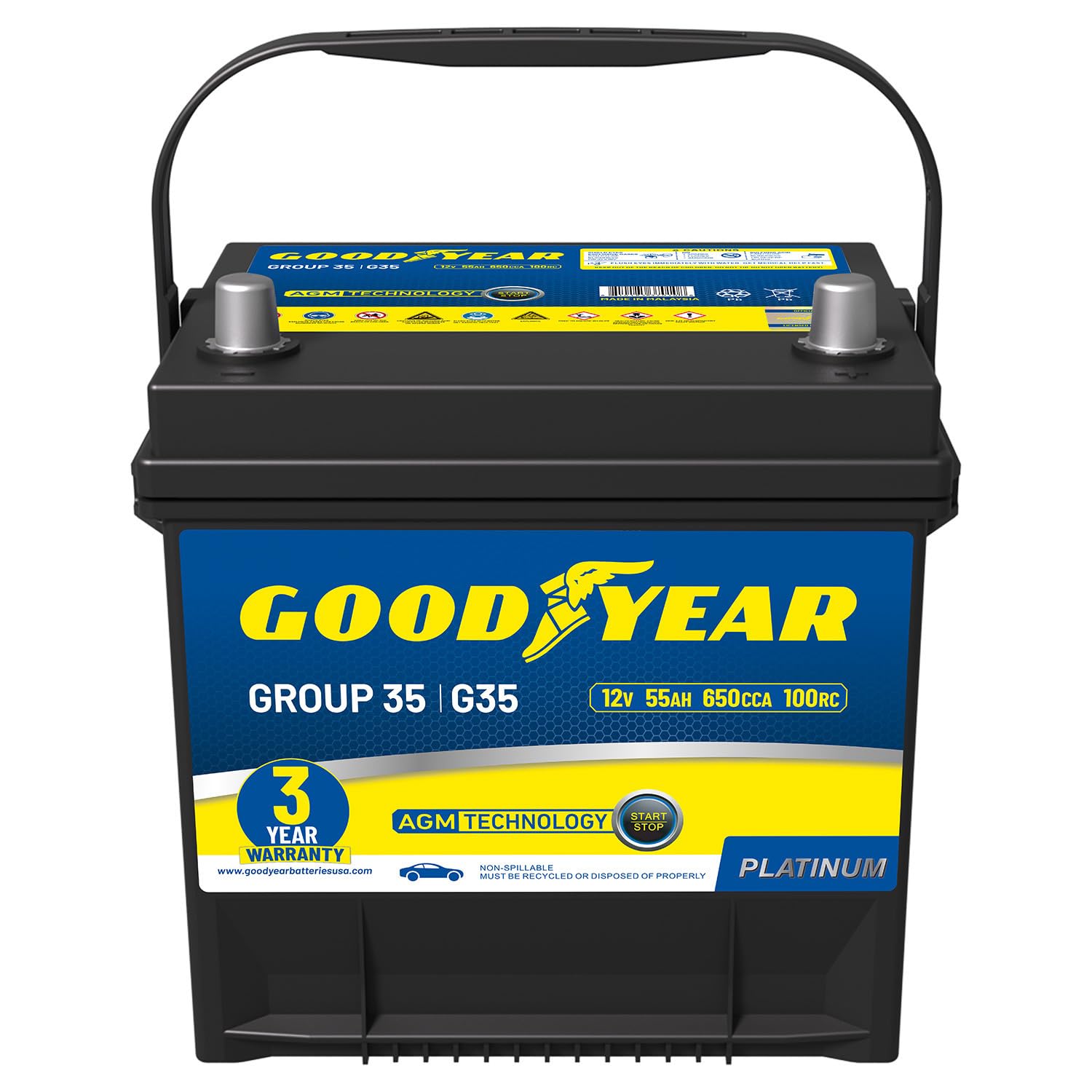
The Goodyear 35-AGM is a Group 35 automotive battery that delivers 55Ah and 650 cold cranking amps, making it the most powerful battery on this list — but it’s not a 35/2 deep-cycle battery in the traditional sense. It’s a high-performance starting battery designed for vehicles that need strong cranking power in extreme cold, such as a 2021 Jeep Wrangler Rubicon auxiliary battery or a Mercedes E350 second battery. Owners report a perfect fit for these applications, with the stop/start system becoming functional again after a short drive following installation.
The AGM construction upgrades the battery over a standard flooded unit: owners who switched from a conventional lead-acid to this Goodyear AGM noted that LED headlights were noticeably brighter and no longer flickered at idle, thanks to the higher consistent voltage that AGM technology maintains. The 100-minute reserve capacity also provides a solid buffer for running accessories like winches, lights, and sound systems with the engine off. A 36-month warranty provides above-average backing for an automotive battery.
Two important distinctions set this battery apart. First, its physical dimensions are 9.0 x 7.0 x 8.87 inches — significantly larger than the 7.7 x 5.2 x 6.1 inch footprint of a standard 35/2 deep-cycle battery, so it will not fit in a U1 scooter tray or a solar gate box. Second, warranty enforcement has drawn complaints: one owner whose battery failed at six months could not get a replacement because Amazon and Goodyear both claimed the other was responsible. If you’re buying for a vehicle that requires a Group 35 starting battery, this is a strong, high-CCA performer. If you need a 35/2 deep-cycle battery for solar or mobility, look at the GEL or lithium options above.
Why it’s great
- 650 CCA provides reliable starting in freezing winter conditions
- 100-minute reserve capacity powers accessories like lights and winches with the engine off
- AGM construction delivers higher consistent voltage than flooded lead-acid — visibly brighter headlights
- Universal fit for Group 35 vehicles including Jeep Wrangler, Mercedes, and Ford models
Good to know
- Physical footprint is larger than standard 35/2 deep-cycle batteries — check your tray dimensions
- Not designed for deep-cycle service; repetitive discharge below 50% will shorten life
- Warranty claims may face finger-pointing between Amazon and Goodyear
FAQ
Can I replace a 35Ah AGM battery with a GEL battery in the same size?
How many 35/2 batteries do I need to run a 30-pound trolling motor all day?
What happens if I use a standard car battery charger on a LiFePO4 battery?
Final Thoughts: The Verdict
For most users, the 35/2 battery winner is the GOLDENMATE 30Ah LiFePO4 because it delivers over ten times the cycle life at one-third the weight of lead-acid, making it the most cost-effective choice over a multi-year timeline. If you want a battery that thrives in extreme temperatures and absorbs slow solar trickle charging, grab the Mighty Max ML35-12 GEL. And for a reliable marine deep-cycle battery that fits your trolling motor and your Goal Zero Yeti, nothing beats the VMAXTANKS V35-857 AGM.