
The line between a flat panel and a window into another world is defined by how effectively a monitor handles depth, contrast, and motion. For a 3D Gaming Monitor, the critical battle is fought not just in resolution or refresh rate, but in the panel’s ability to render true blacks, eliminate ghosting, and maintain clarity during rapid camera movements—the very elements that break or sell the illusion of three-dimensional space.
I’m Min — the co-founder and writer behind Gadgets Feed. I’ve spent countless hours dissecting technical specifications, analyzing panel technologies from VA to QD-OLED, and comparing real-world performance metrics like response time overshoot, color volume under HDR, and adaptive sync ranges to separate the truly immersive displays from the glossy marketing claims.
The challenge is that not every high-refresh monitor delivers the ghost-free, high-contrast experience required for convincing depth perception. This guide cuts through the noise to help you select the best 3d gaming monitor that matches your hardware and budget.
How To Choose The Best 3D Gaming Monitor
The perception of depth on a flat screen is a trick of light, motion, and contrast. An excellent 3D gaming monitor relies on a panel that can produce infinite blacks and rapid pixel transitions without smearing. Here are the three pillars to evaluate before making a purchase.
Panel Technology: OLED is the Baseline
For a convincing sense of depth, the panel must display true black—not dark gray. Traditional IPS and VA panels use a backlight that inevitably leaks some light, crushing shadow detail and flattening the image. OLED panels, including QD-OLED and WOLED variants, achieve per-pixel illumination, meaning each pixel can turn off completely. This produces an infinite contrast ratio, which is essential for rendering the volumetric space and deep shadows that make a 3D scene feel tangible. If you are serious about immersion, an OLED panel is the starting point, not a luxury.
Refresh Rate and Motion Clarity
Depth perception is heavily reliant on motion clarity. When the camera pans quickly, a slow response time creates blur, which collapses the 3D illusion. Aim for a monitor with a 240Hz refresh rate and a response time of 0.03ms (GtG) or lower. This combination ensures that the transition between frames is nearly instantaneous, preserving edge definition and spatial awareness during high-speed gameplay. Technologies like OLED’s fast pixel response eliminate ghosting, while ULMB or ELMB Sync can further reduce perceived blur without sacrificing brightness.
Adaptive Sync: Tear-Free Immersion
Screen tearing is the arch enemy of immersion. When the monitor’s refresh rate is out of sync with the GPU’s frame output, the image splits horizontally, breaking the viewer’s focus and flattening the perceived depth. Adaptive sync technologies like AMD FreeSync Premium Pro or NVIDIA G-Sync Compatible synchronize the display’s refresh rate with the graphics card’s frame rate, eliminating tearing and stutter. This creates a continuous, fluid image that allows the brain to process depth cues without interruption. Verify your GPU brand and ensure the monitor supports the appropriate adaptive sync standard.
Quick Comparison
On smaller screens, swipe sideways to see the full table.
| Model | Category | Best For | Key Spec | Amazon |
|---|---|---|---|---|
| ASUS ROG Strix XG27AQDMG | Premium OLED | High-refresh 1440p gaming with glossy color | 240Hz / 0.03ms / Glossy WOLED | Amazon |
| LG 27GX790B-B Ultragear | Dual Mode OLED | Competitive esports and bright-room gaming | 540Hz QHD / 720Hz HD / DP 2.1 | Amazon |
| Alienware AW3425DW | Ultrawide QD-OLED | Cinematic ultrawide immersion and multitasking | 240Hz / 0.03ms / 1800R Curve | Amazon |
| MSI MPG 321URX QD-OLED | 4K QD-OLED | 4K gaming with premium HDR and productivity | 240Hz / 0.03ms / 32-inch 4K | Amazon |
| Samsung Odyssey G8 G81SF | 4K QD-OLED | 4K gaming with anti-glare and high PPI | 240Hz / 0.03ms / 166 PPI 4K | Amazon |
| ASUS ROG Strix XG32UCG | Dual Mode IPS | Versatile 4K and high-FPS FHD gaming | 160Hz 4K / 320Hz FHD / 0.3ms | Amazon |
| Acer Predator X27U W1 | Budget QD-OLED | Entry-level OLED with great color accuracy | 240Hz / 0.03ms / 1440p QD-OLED | Amazon |
| CRUA 32″ Curved VA | Value 4K VA | Budget-friendly 4K with curve for immersion | 240Hz / 4K VA / 1500R Curve | Amazon |
| KTC H32P22P | Mid-Range 4K IPS | Budget 4K for modeling and casual gaming | 165Hz / 1ms / 4K Fast IPS | Amazon |
| LG 34GS95QE Ultragear | Ultrawide OLED | Extreme curve for peripheral immersion in FPS | 240Hz / 0.03ms / 800R Curve | Amazon |
| Samsung Odyssey 3D G90XF | Glasses-Free 3D | Native autostereoscopic 3D without glasses | 165Hz / 1ms / Autostereoscopic OLED | Amazon |
In‑Depth Reviews
1. ASUS ROG Strix 27” 1440P OLED Gaming Monitor (XG27AQDMG)

The ASUS ROG Strix XG27AQDMG uses a third-generation glossy WOLED panel that produces full-screen brightness levels previously reserved for matte finishes, while retaining the deep blacks and vibrant color saturation that make OLED displays so compelling for 3D depth. The custom heatsink and advanced airflow design actively manage thermals to reduce the risk of burn-in, which is a primary concern for long gaming sessions.
At 240Hz with a 0.03ms response time, motion clarity is exceptional. The ROG-exclusive OLED Anti-flicker technology reduces flicker during refresh rate fluctuations, preserving the smooth visual continuity necessary for immersive depth perception. The uniform brightness setting ensures consistent luminance across the entire panel, which is critical for maintaining shadow detail in darker game environments.
The included stand offers full ergonomic adjustment—tilt, swivel, pivot, and height—making it easy to position the screen for optimal viewing angles. The 3-year warranty includes burn-in coverage, providing peace of mind for a premium investment. This monitor delivers a near-reference experience for high-refresh 1440p gaming where contrast and motion clarity are paramount.
Why it’s great
- Glossy WOLED panel produces incredible color vibrancy and infinite contrast for depth perception
- OLED anti-flicker technology maintains smooth visuals during frame rate shifts
- 3-year warranty with burn-in coverage protects the investment
Good to know
- No built-in speakers, requiring external audio solution
- Auto-dimming feature for screen protection can be distracting until disabled
- Text clarity is slightly less sharp than high-end IPS panels, though adequate for gaming
2. LG 27GX790B-B 27” Ultragear QHD OLED Gaming Monitor
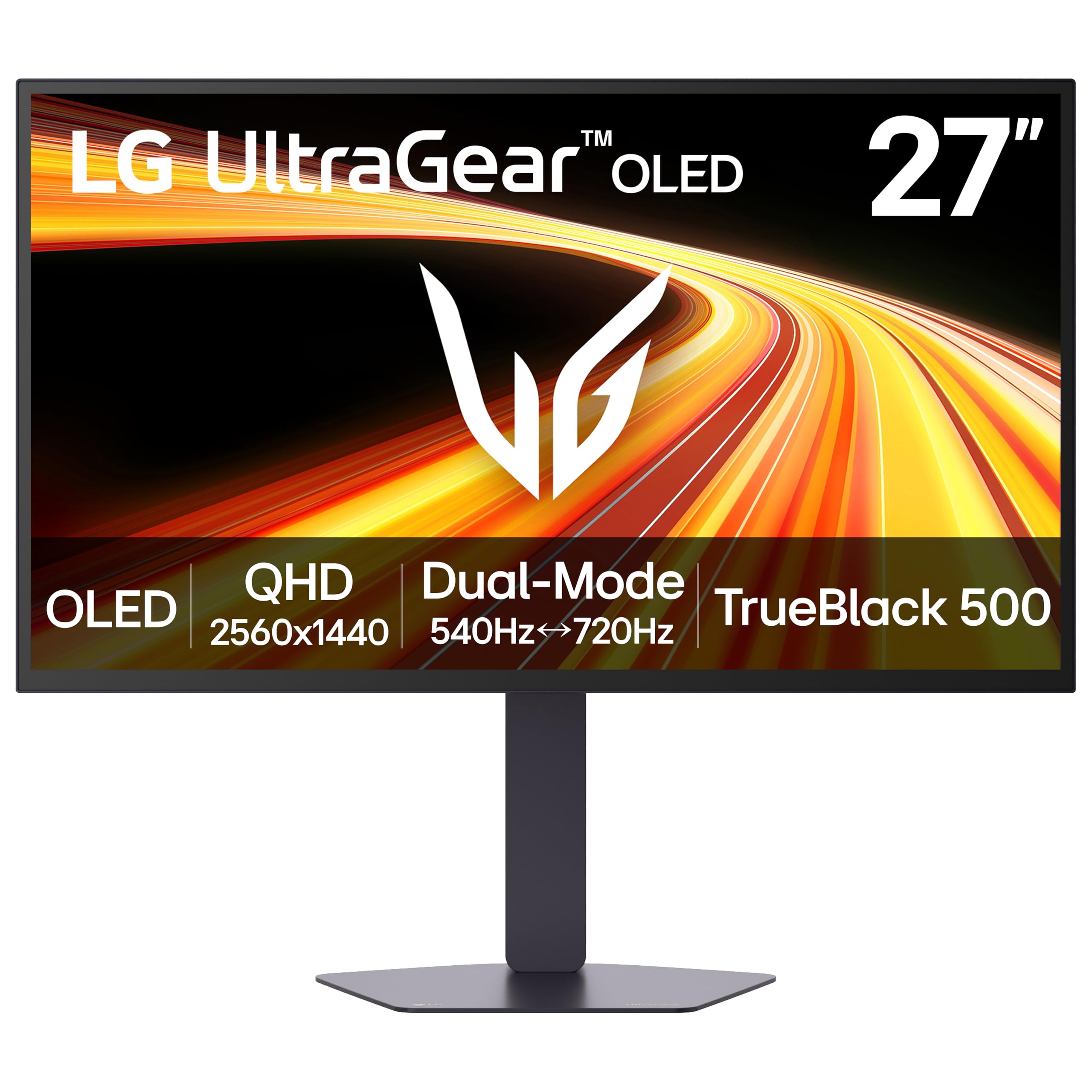
LG’s 4th Gen Primary RGB Tandem OLED technology on the 27GX790B-B pushes typical brightness to 335 nits, a significant improvement over earlier OLED gaming monitors, making it suitable for rooms with ambient light. The Dual Mode feature allows toggling between QHD (3440 x 1440) at 540Hz and HD (1920 x 1080) at 720Hz via a hotkey, giving competitive gamers unprecedented fluidity for esports titles where every millisecond counts.
The 0.02ms GtG response time is the fastest on this list, virtually eliminating reverse ghosting. Combined with DisplayPort 2.1, which provides enough bandwidth for uncompressed 720Hz output, the motion clarity is unparalleled. The UL-verified Perfect Reproduction certification ensures that the monitor faithfully renders game content in both dark and bright scenes, preserving the depth cues that create the 3D illusion.
VESA DisplayHDR True Black 500 certification and a 1.5 million:1 contrast ratio deliver shadow detail that goes beyond standard HDR 400 panels. The anti-glare matte finish is effective in bright rooms, which is a welcome feature for users who game in variable lighting conditions. This is the monitor for users who prioritize raw speed and brightness above all else.
Why it’s great
- Dual Mode enables 540Hz QHD or 720Hz HD for extreme motion clarity
- DisplayPort 2.1 provides enough bandwidth for uncompressed high-refresh output
- Higher typical brightness (335 nits) than most OLED monitors reduces glare issues
Good to know
- Proprietary power cable is a minor inconvenience for cable management
- Large bottom bezel may be distracting for those with high aesthetic standards
- Max refresh rate at native resolution rarely achievable in modern AAA titles
3. Alienware 34 240Hz QD-OLED Curved Gaming Monitor (AW3425DW)

The Alienware AW3425DW combines a 34-inch QD-OLED panel with a 1800R curve and a 21:9 aspect ratio to create an ultrawide viewing experience that naturally fills the user’s peripheral vision. The 99.3% DCI-P3 color coverage and Delta E<2 color accuracy ensure that the monitor reproduces colors with the precision required for HDR content, where gradient transitions in skies and shadows contribute to the sense of volumetric depth.
With a 240Hz refresh rate and 0.03ms response time, fast-paced scenes in racing and flight simulators remain crisp and fluid. The VESA DisplayHDR TrueBlack 400 certification means that dark areas of the screen are truly black, without the gray haze common on LCD ultrawides. This allows objects to pop against dark backgrounds, reinforcing the spatial separation that drives 3D perception.
The build quality includes a sturdy stand with height, tilt, and swivel adjustments. Connectivity includes DisplayPort, HDMI, and USB ports. The glossy QD-OLED finish provides excellent color pop, though it may reflect ambient light in bright rooms. For users who want an ultrawide monitor that delivers cinematic immersion without sacrificing competitive gaming performance, this is a top contender.
Why it’s great
- 21:9 ultrawide aspect ratio expands peripheral vision for deeper immersion
- QD-OLED panel delivers 99.3% DCI-P3 with true blacks and high color volume
- VESA DisplayHDR TrueBlack 400 provides excellent shadow detail in dark scenes
Good to know
- Glossy screen may cause reflections in brightly lit rooms
- Text clarity out of the box may require ClearType tweaking for productivity use
- OLED burn-in risk is present, though mitigated by pixel refresh features
4. MSI MPG 321URX QD-OLED, 32″ 4K UHD Gaming Monitor

The MSI MPG 321URX is a 31.5-inch QD-OLED monitor that hits the sweet spot of 4K resolution (3840 x 2160) with a 240Hz refresh rate. The 0.03ms GtG response time eliminates ghosting, while the DCI-P3 99% color gamut and Delta E≤2 accuracy ensure that the HDR content is rendered faithfully. The VESA DisplayHDR True Black 400 certification allows for black levels that make shadows feel volumetric and objects appear to float within the scene.
OLED Care 2.0 provides multiple burn-in prevention features, including pixel shift, taskbar detection, and a logo detection system that reduces the brightness of static elements. This is particularly important for users who intend to use this monitor for productivity as well as gaming. The KVM function with Picture-in-Picture and Picture-by-Picture modes adds versatility for multi-device setups.
Connectivity includes HDMI 2.1, DP 1.4a, and a USB Type-C port that delivers up to 90W of power delivery, which is enough to charge a laptop while sending a video signal. The 4-way adjustable stand provides height, tilt, swivel, and pivot adjustments. This monitor offers a balanced mix of gaming and productivity features without compromising on the HDR performance that makes 3D scenes pop.
Why it’s great
- 4K resolution at 32 inches provides high pixel density for sharp text and fine details
- OLED Care 2.0 includes multiple burn-in prevention measures for peace of mind
- USB-C with 90W power delivery simplifies single-cable laptop connections
Good to know
- Requires a powerful GPU to drive 4K at 240Hz in modern games
- Stand is large and occupies considerable desk space
- QD-OLED can exhibit a slight purple tint in direct sunlight, though not noticeable indoors
5. SAMSUNG 27-inch Odyssey QD-OLED G8 (G81SF)
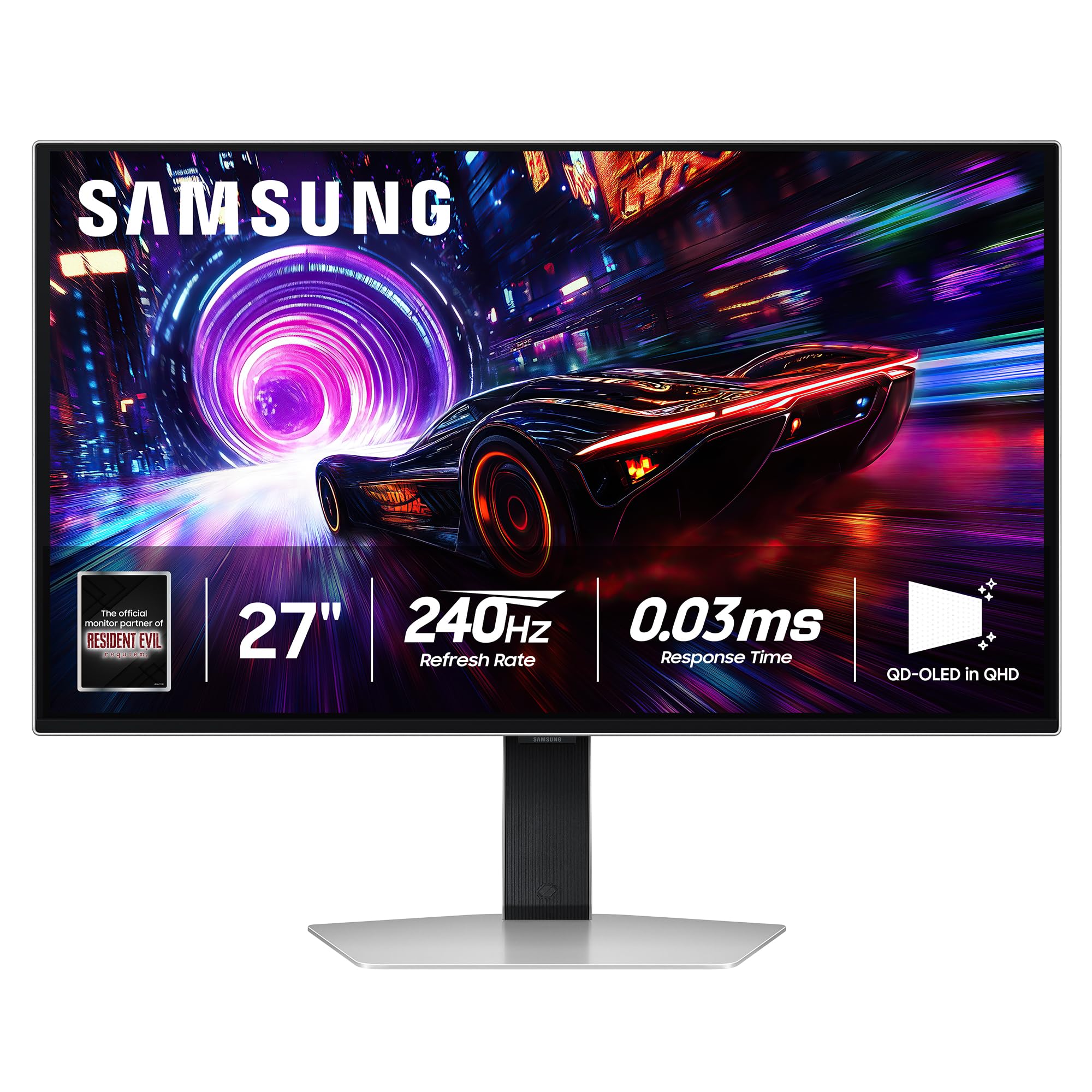
The Samsung Odyssey G8 G81SF packs a 4K QD-OLED panel into a 27-inch frame, resulting in a pixel density of 166 PPI. This high density makes text and fine details exceptionally sharp, which is a rare advantage for an OLED gaming monitor. The Glare Free technology reduces reflections by 54% compared to conventional anti-reflection films, which is a significant advantage for maintaining contrast and black levels in rooms with overhead lighting or windows.
The 240Hz refresh rate and 0.03ms response time provide fluid motion, while AMD FreeSync Premium Pro and G-Sync compatibility ensure tear-free gameplay. The VESA DisplayHDR TrueBlack 400 certification delivers the deep blacks expected from a QD-OLED panel. The Dynamic Cooling System, featuring a Pulsating Heat Pipe, diffuses heat five times faster than graphite sheets, reducing the core temperature and preventing burn-in.
The thermal modulation system uses algorithms to automatically control brightness and prevent overheating, while the logo and taskbar detection features reduce brightness on static elements to avoid burn-in. The CoreSync and CoreLighting Plus features project on-screen colors onto the ambient area, enhancing the immersive feel. This monitor is an excellent choice for users who need high PPI for work and gaming in a brightly lit environment.
Why it’s great
- 166 PPI delivers exceptionally sharp text and fine details for a 27-inch 4K display
- Glare Free coating reduces reflections without sacrificing contrast
- Advanced thermal management system helps prevent burn-in and maintain longevity
Good to know
- Some units have reported dead pixel clusters after limited use, so check warranty details
- The mini joystick button for OSD navigation can be finicky
- Warranty paperwork may show 1 year instead of the advertised 3 years; verify before purchase
6. ASUS ROG Strix 32” 4K HDR Gaming Monitor (XG32UCG)
The ASUS ROG Strix XG32UCG uses a Fast IPS panel with a dual-mode feature that allows users to switch between 4K at 160Hz and Full HD at 320Hz. This is a practical solution for gamers who want the detail of 4K for single-player titles and the extreme smoothness of 320Hz for competitive multiplayer games. The 0.3ms response time (minimum) is fast enough to keep motion blur minimal during high-speed gameplay.
The ELMB Sync technology allows the monitor to use backlight strobing in conjunction with variable refresh rate, eliminating ghosting and tearing simultaneously. This is a rare combination that provides excellent motion clarity without the usual trade-off in brightness. The 95% DCI-P3 color gamut and ASUS advanced gray-scale tracking ensure smooth color gradation, which helps maintain the depth cues in HDR content.
Connectivity includes DisplayPort, HDMI, and USB Type-C with DP Alt mode, allowing for a clutter-free single-cable connection to a laptop. The DisplayWidget Center software enables monitor settings adjustments using a mouse, which is more convenient than navigating the physical OSD menu. This monitor is ideal for users who play both single-player and competitive games and want one display that handles both well.
Why it’s great
- Dual mode (4K 160Hz / FHD 320Hz) covers both high detail and high speed
- ELMB Sync works with variable refresh rate to eliminate both blur and tearing
- USB-C with DP Alt mode simplifies connection to laptops
Good to know
- IPS panel has lower contrast ratio than OLED, affecting depth perception in dark scenes
- 0.3ms response time is minimum, not sustained GtG across all transitions
- Requires a high-end GPU to fully utilize the 4K 160Hz or 320Hz modes
7. Acer Predator X27U W1bmiipprx 26.5″ QD-OLED
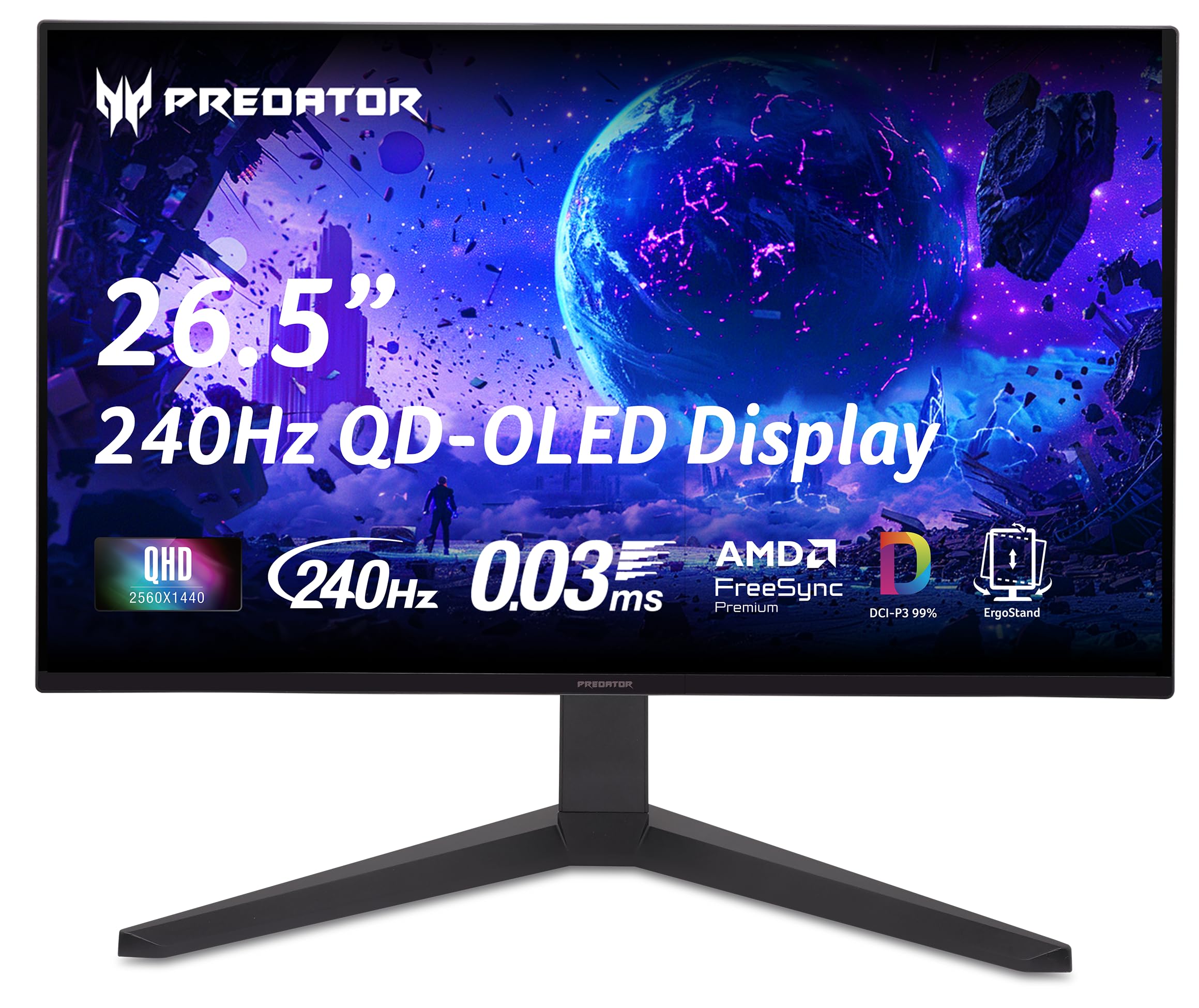
The Acer Predator X27U W1 offers a 26.5-inch QD-OLED panel with a 240Hz refresh rate and 0.03ms response time at a price point that makes OLED accessible without breaking the bank. The DCI-P3 99% color gamut and Delta E<2 color accuracy deliver the same vibrant colors and deep blacks that make QD-OLED panels so effective for 3D immersion. The ZeroFrame design minimizes bezels, maximizing the visible screen area.
AMD FreeSync Premium eliminates screen tearing and stuttering, while the 10-bit color depth ensures smooth gradations in shadows and highlights. The included stand offers height, pivot, swivel, and tilt adjustments. The built-in speakers, while not audiophile-grade, are a convenient addition for users who want a clean desk setup without external speakers.
The trade-off at this price point is a slightly lower peak brightness compared to premium OLED models, and the build quality is predominantly plastic. However, for users who want to experience the depth and contrast of QD-OLED without spending premium prices, this monitor delivers the core experience effectively. It represents the best entry point into the high-refresh OLED ecosystem.
Why it’s great
- Affordable entry point into QD-OLED gaming with 240Hz refresh rate
- Deep blacks and vibrant colors transform 3D depth perception
- ZeroFrame design provides a near-bezel-less appearance for immersive viewing
Good to know
- Plastic build feels less premium than aluminum-framed competitors
- Peak brightness is dimmer than premium OLED models, even at 100%
- OSD menu lacks some advanced settings like sharpness control
8. LG 34GS95QE 34-inch Ultragear OLED Curved Gaming Monitor

The LG 34GS95QE features an aggressive 800R curve, which is the steepest curvature available in a mainstream gaming monitor. This curve wraps the 34-inch OLED panel around the user’s field of view, bringing the edges of the screen into the peripheral vision and creating a sensation of being surrounded by the game world. The 21:9 aspect ratio further extends the horizontal field of view, which is particularly effective for racing and flight simulators.
The 240Hz refresh rate and 0.03ms response time are standard for high-end OLED, but the true differentiator is the anti-glare with low-reflection display coating, which minimizes light reflections and helps maintain black levels in moderately lit rooms. The VESA DisplayHDR TrueBlack 400 certification ensures that blacks remain deep, preserving the shadow detail needed for volumetric depth.
Connectivity includes HDMI 2.1 and DisplayPort 1.4, supporting the full 240Hz refresh rate. The stand offers height, tilt, and swivel adjustments. The burn-in prevention features, including pixel shift and pixel cleaning, must be enabled manually. This monitor is best suited for users who want an extreme curve to maximize peripheral immersion, particularly in single-player and simulation games.
Why it’s great
- 800R curve is the most aggressive curvature, maximizing peripheral immersion
- Anti-glare and low-reflection coating preserves black levels in bright rooms
- OLED infinite contrast delivers true black levels for enhanced depth
Good to know
- Aggressive curve may reduce immersion in slower, cinematic games for some users
- Menu button on the back is awkwardly placed and can cause hand cramps
- Burn-in prevention settings must be manually enabled; not active out of the box
9. CRUA 32″ Curved Gaming Monitor, 4K UHD 240Hz VA
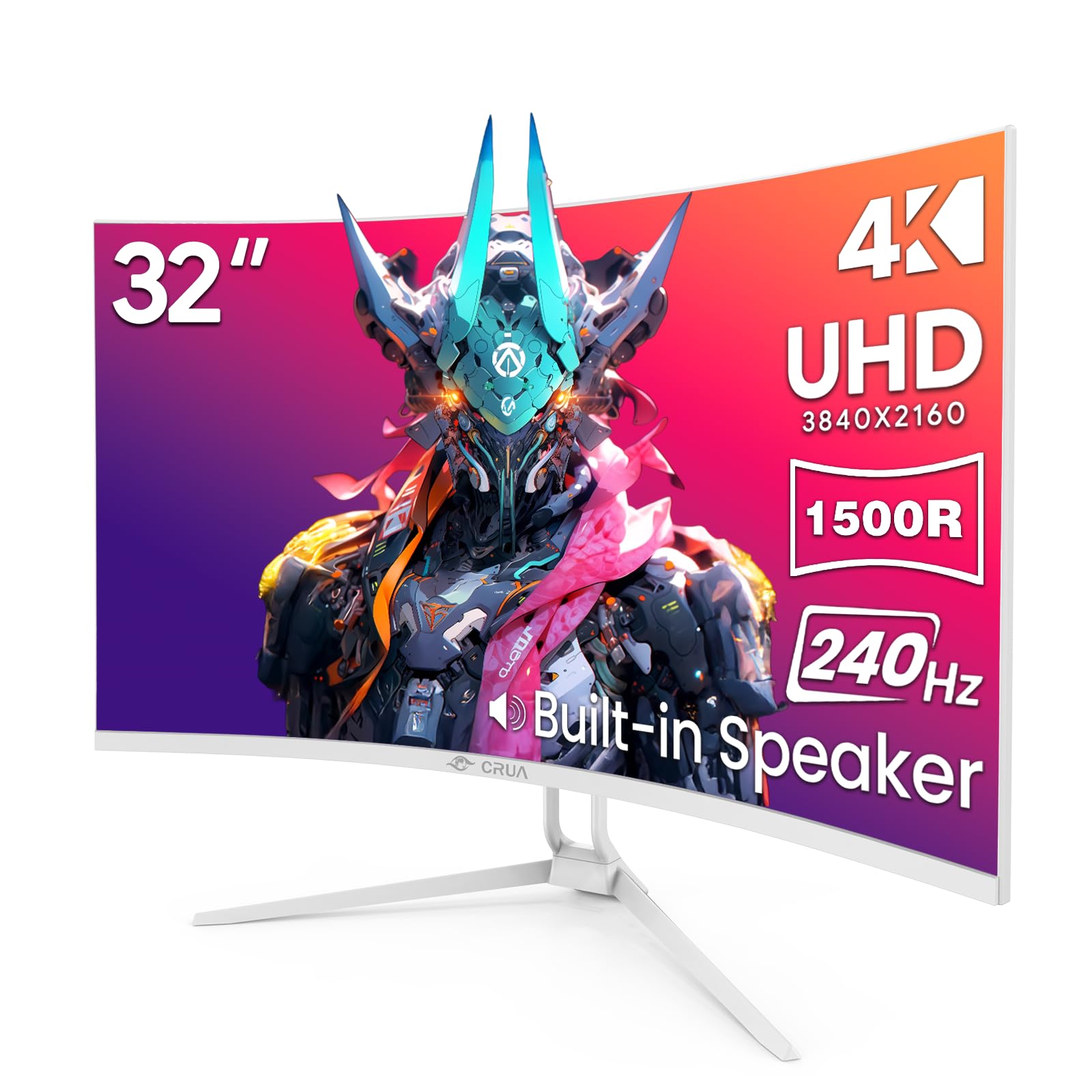
The CRUA 32-inch curved gaming monitor uses a VA panel with a 1500R curve, offering a combination of 4K resolution and a 240Hz refresh rate at an entry-level price point. VA panels typically provide better contrast than IPS, with a 3000:1 contrast ratio that improves black levels and shadow detail compared to standard IPS monitors. The 120% sRGB color gamut ensures decent color vibrancy for the price.
The 1500R curve helps immerse the user by matching the natural curvature of the human eye, though it is far less aggressive than the 800R curve on the LG panel. AMD FreeSync is supported to reduce screen tearing. The monitor includes a variety of connectivity options, including HDMI 2.1 and DP 1.4, making it compatible with both PCs and next-gen consoles.
This monitor’s primary value lies in its feature set at the price point. It is a good choice for users who want a large 4K display with a high refresh rate and a curved panel but are not yet ready to invest in OLED technology. The build quality and color accuracy are not on par with premium panels, but for general gaming and content consumption, it delivers a solid experience.
Why it’s great
- Combines 4K resolution with 240Hz refresh rate at a very accessible price
- VA panel provides 3000:1 contrast ratio for better depth than IPS
- 1500R curve enhances immersion without being too aggressive
Good to know
- VA panels can exhibit black smearing in fast transitions, reducing motion clarity
- Color accuracy and brightness are lower than OLED or high-end IPS alternatives
- Stand assembly can be difficult, and build quality feels budget-oriented
10. KTC 32 Inch 4K Gaming Monitor, 165Hz Fast IPS (H32P22P)
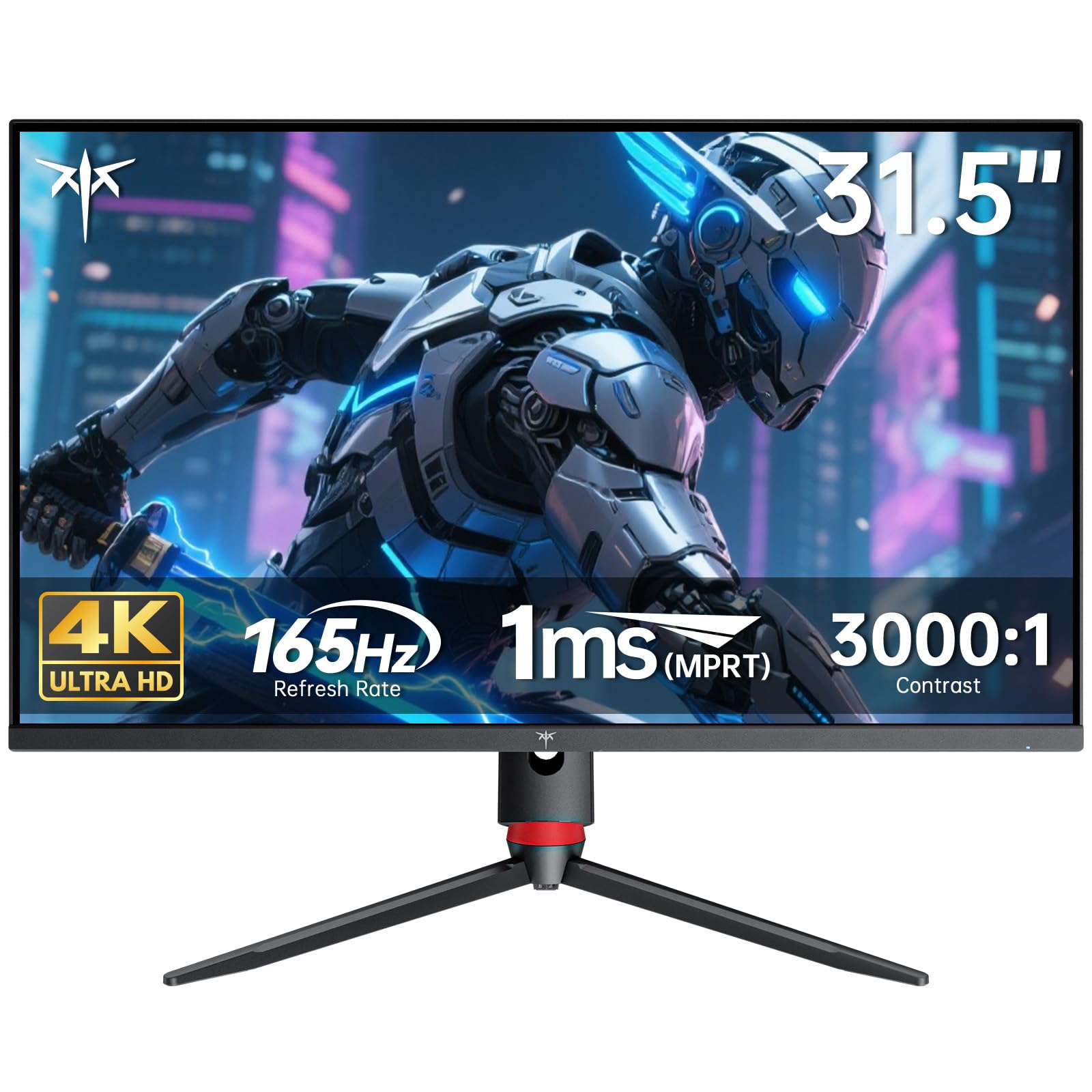
The KTC H32P22P is a 32-inch 4K gaming monitor that uses a Fast IPS panel to achieve a 165Hz refresh rate and a 1ms MPRT response time. The IPS technology provides excellent viewing angles and color consistency, while the 3000:1 contrast ratio is higher than typical IPS panels, offering better shadow detail for a more immersive experience. The 121% sRGB color gamut provides vibrant colors suitable for both gaming and content creation.
Adaptive Sync supports both FreeSync and G-Sync, reducing screen tearing across a wide range of GPUs. The monitor includes HDMI 2.1 and DP 1.4 ports, making it compatible with next-gen consoles at 4K 120Hz. The included stand offers height and tilt adjustments, and the VESA mount allows for flexible wall mounting.
This monitor is a practical choice for users who need a large 4K display for both gaming and productivity tasks like 3D modeling or video editing, where IPS color accuracy is valued. The primary limitation is the lack of OLED-level contrast, which means black levels will appear gray in dark scenes. It is a solid mid-range option that balances resolution, refresh rate, and features.
Why it’s great
- 4K resolution at 165Hz offers a good balance of sharpness and fluidity
- IPS panel provides wide viewing angles and accurate colors for productivity
- Supports both FreeSync and G-Sync for broad GPU compatibility
Good to know
- IPS contrast is lower than VA or OLED, reducing depth in dark scenes
- Some units may have a small non-active display area on the edges
- Menu system has a learning curve and may require time to adjust
11. Samsung 27-inch Odyssey 3D G90XF, 4K, 165Hz

The Samsung Odyssey 3D G90XF is a unique product in this category: it is the only monitor on this list that offers true glasses-free autostereoscopic 3D. The monitor uses a lenticular lens and eye-tracking camera to direct different images to each eye, creating a genuine stereoscopic depth effect without requiring the user to wear any special glasses. The base panel is a 27-inch OLED with 4K resolution and a 165Hz refresh rate.
The AI-powered 2D-to-3D conversion can transform standard videos and games into stereoscopic 3D in real time. The monitor includes built-in dual speakers that provide directional sound to match the 3D visuals. The Odyssey 3D Hub serves as a gateway to supported games and allows users to adjust 3D settings. The Edge Lighting feature projects screen colors onto the surrounding area to enhance immersion.
The main caveat is that the 3D functionality is software-dependent, and support for games and applications is currently limited. The 3D effect works best with an Nvidia RTX GPU, and users report mixed results with AMD cards. For users who want the next frontier of 3D immersion and are willing to work within the limitations of the current ecosystem, this monitor offers a glimpse into the future. For most users, however, the standard high-refresh OLED options on this list will provide a more consistently satisfying experience.
Why it’s great
- True glasses-free stereoscopic 3D is a genuinely unique and immersive experience
- AI 2D-to-3D conversion allows watching any video content in 3D
- Underlying OLED panel provides good baseline image quality for standard 2D gaming
Good to know
- 3D game support is limited and may require mods or specific Nvidia GPUs
- Samsung Odyssey 3D Hub software can be buggy or crash on some systems
- High price premium for a feature set that is still in its early stages
FAQ
Is a 240Hz refresh rate necessary for good 3D depth perception?
Can a standard IPS monitor deliver a convincing 3D gaming experience?
Will the Samsung Odyssey 3D monitor work with any video card for the 3D effect?
What is the difference between QD-OLED and WOLED for 3D gaming monitors?
Final Thoughts: The Verdict
For most users, the best 3d gaming monitor winner is the ASUS ROG Strix XG27AQDMG because its glossy WOLED panel provides the deepest contrast and most vibrant colors for immersive depth at a high 240Hz refresh rate, backed by a 3-year burn-in warranty. If you want extreme speed for competitive gaming, grab the LG 27GX790B-B with its 540Hz Dual Mode and DisplayPort 2.1. And for the purest ultrawide cinematic immersion, nothing beats the Alienware AW3425DW with its 34-inch QD-OLED panel and 1800R curve.