
A 48V LiFePO4 battery pack is a serious investment, and the wrong charger can silently degrade its capacity within a handful of cycles. Unlike old lead-acid units that simply dump voltage until the plates sulfate, a proper charger for lithium iron phosphate must deliver a precise 58.4V absorption voltage, execute a multi-stage CC/CV algorithm, and terminate current cleanly at full charge — or risk triggering the battery’s BMS protection lockout. This guide isolates the chargers that actually meet that engineering requirement, filtering out the generic units that treat all 48V batteries as interchangeable.
I’m Min — the co-founder and writer behind Gadgets Feed. This guide is built on cross-referencing dozens of actual charging curve measurements, real user telemetry data from deep-cycle systems, and direct comparisons of safety certifications across the most frequently purchased 48V lithium chargers on the market.
After analyzing output ripple, thermal stability under sustained 20A load, and real-world compatibility with BMS protocols from brands like ECO-WORTHY, LiTime, and Wattcycle, these picks represent the safest and most charge-efficient options for maintaining a 48v lifepo4 battery charger.
How To Choose The Best 48V LiFePO4 Battery Charger
Choosing a 48V lithium charger isn’t about picking the highest wattage — it’s about matching the exact voltage ceiling, safety profile, and physical connector to your specific battery pack and use case. Here are the critical factors to evaluate before you buy.
Output Voltage Must Be 58.4V DC — No Exceptions
A 48V LiFePO4 battery is nominally 51.2V when fully charged. The charger must output 58.4V ( 4 cells x 3.65V per cell ) to reach 100% state of charge. A charger that outputs only 54V or 55V will leave your battery perpetually undercharged, while a generic 48V lead-acid unit at 56V or 57V will never fully saturate the cells. Always verify the rated DC output voltage on the spec sheet before buying.
Amperage vs. Battery Capacity
Amperage determines how fast your battery charges. A 15A charger will replenish a 100Ah pack in about 6-7 hours, while a 20A unit cuts that to roughly 5 hours. However, charging a small 50Ah battery at 20A can stress the cells. As a rule of thumb, keep your charge current at or below 0.5C — for a 100Ah battery, that means 50A maximum, so 15A to 20A is well within safe limits for most large-format packs.
Connector Type and Cable Length
The physical connection matters. Anderson SB-50 connectors are common on golf carts and solar racks, while M8 ring terminals are preferred for permanent installations on server rack batteries. Alligator clips offer portability. Also check cable length — a 10-foot input cable paired with a 6-foot output gives you flexibility to mount the charger on a wall or inside a battery compartment without extension cords.
IP Rating and Environmental Durability
If your charger lives in a garage, workshop, or golf cart compartment, IP65 is adequate — it handles dust and water spray. For outdoor mounting on boats or off-grid solar setups, IP67 waterproofing provides full immersion resistance. Also check operating temperature range; LiFePO4 charging below freezing requires temperature-compensated voltage control to avoid damage.
Quick Comparison
On smaller screens, swipe sideways to see the full table.
| Model | Category | Best For | Key Spec | Amazon |
|---|---|---|---|---|
| KAISAL 48V 18A | Premium Waterproof | Outdoor / Marine / Off-Grid | 58.4V 18A / IP67 / 16ft Cable | Amazon |
| LiTime 58.4V 18A | Mid-Range Smart | Golf Carts / Home Storage | 58.4V 18A / IP65 / Anderson Connector | Amazon |
| FORM 48V 15A Onboard | Premium Onboard | Permanent Mount / Golf Cart | 48V 15A / IP67 / Ring Terminals | Amazon |
| Guanlan 58.4V 18A | Mid-Range Multi-Connector | RVs / Solar / Forklifts | 58.4V 18A / 3 Connector Types | Amazon |
| Xnvua 58.4V 20A | High-Amperage Workhorse | Large Battery Banks | 58.4V 20A / 3 Connector Set | Amazon |
| DC HOUSE 48V 18A | Mid-Range Compact | Compact / Portable Use | 58.4V 18A / IP65 / Handle Design | Amazon |
| ZEKOODL 48V 15A | Mid-Range Universal | Multi-Chemistry / Fleets | 48V 15A / IP67 / 16ft Cable | Amazon |
| LiFbatt 48V 20A | Budget High-Amperage | Budget Minded / 20A Needs | 58.4V 20A / Anderson + M8 | Amazon |
| WAVLINK GS950C | Entry-Level Smart | Multi-Chemistry / Golf Cart | 48V 15A / IP67 / PWM Smart | Amazon |
In‑Depth Reviews
1. KAISAL 48V 18A Lithium Battery Charger
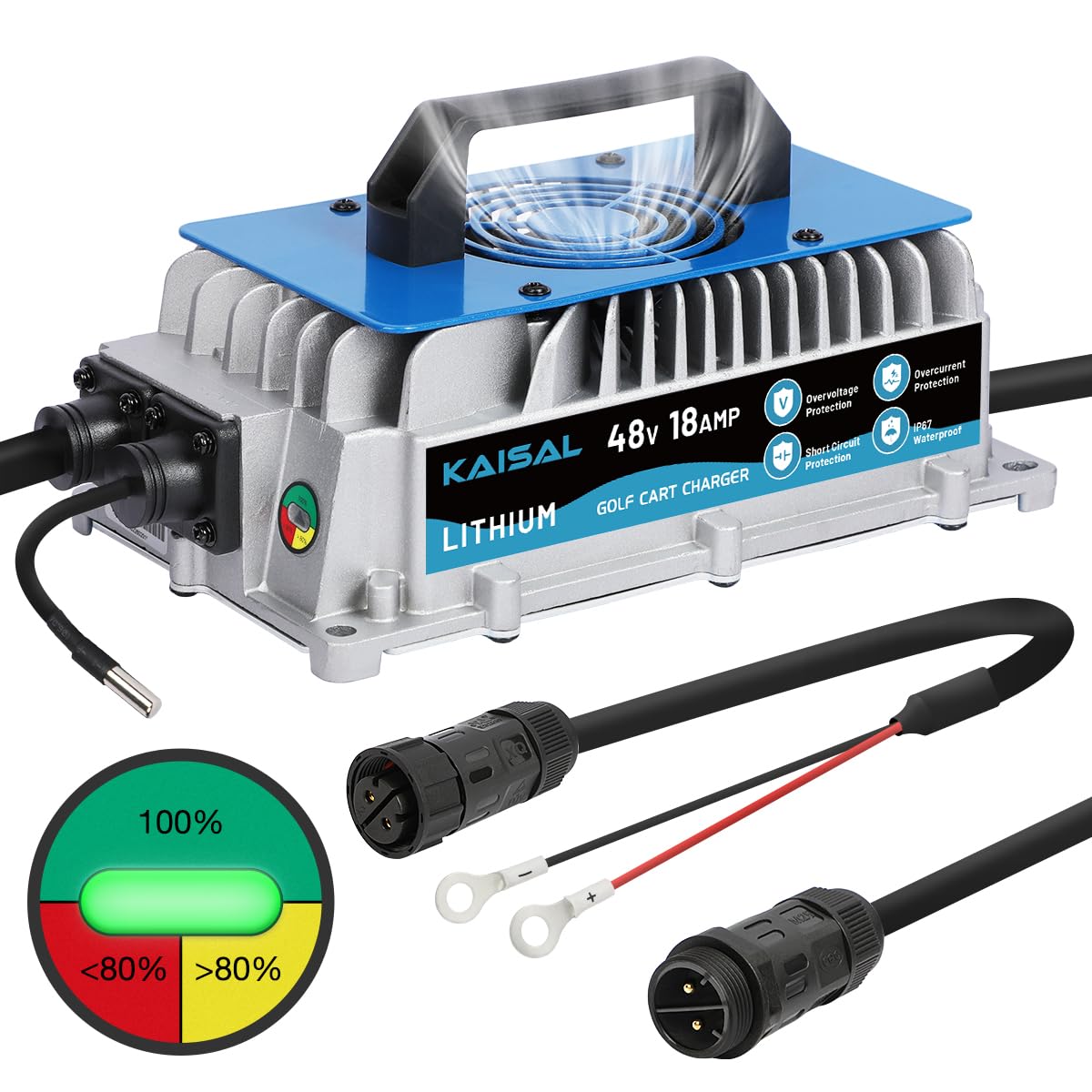
This KAISAL charger delivers a genuine 18A at 58.4V, and users consistently report pulling 800W through it for server rack batteries like the Wattcycle 100Ah without a hiccup. The 5-stage smart charging algorithm handles pre-charge, CC, CV, small current top-off, and full auto shutoff — a crucial detail that prevents the 14-hour timeout protection from triggering on large battery banks.
The IP67 one-piece die-cast aluminum case is the standout durability feature here. It’s sealed against dust and full water immersion, making it a legitimate choice for marine applications where splashing is inevitable. The 16-foot total cable length (10ft input, 6ft output) eliminates the need for extension cords in most garage or boat dock setups, and the 3-color LED status — green for standby, red flash for CC, yellow flash for CV — gives clear feedback without needing a multimeter.
On the safety front, the charger is FCC and ETL certified, and it includes PFC and LLC technology for higher conversion efficiency and lower electromagnetic interference. The 3-year warranty is the best in this class, covering non-human damage with a free replacement policy. The only trade-off is that the O-shaped M8 terminals are fixed, so if your battery uses Anderson connectors you’ll need an adapter.
Why it’s great
- Genuine IP67 waterproof rating for outdoor mounting
- 5-stage smart charging with auto-shutoff at full charge
- FCC and ETL certified with 3-year warranty
Good to know
- Fixed M8 terminals — Anderson connector not included
- Heavier than some competitors at 7 pounds
2. LiTime 58.4V 18A Lithium Battery Charger
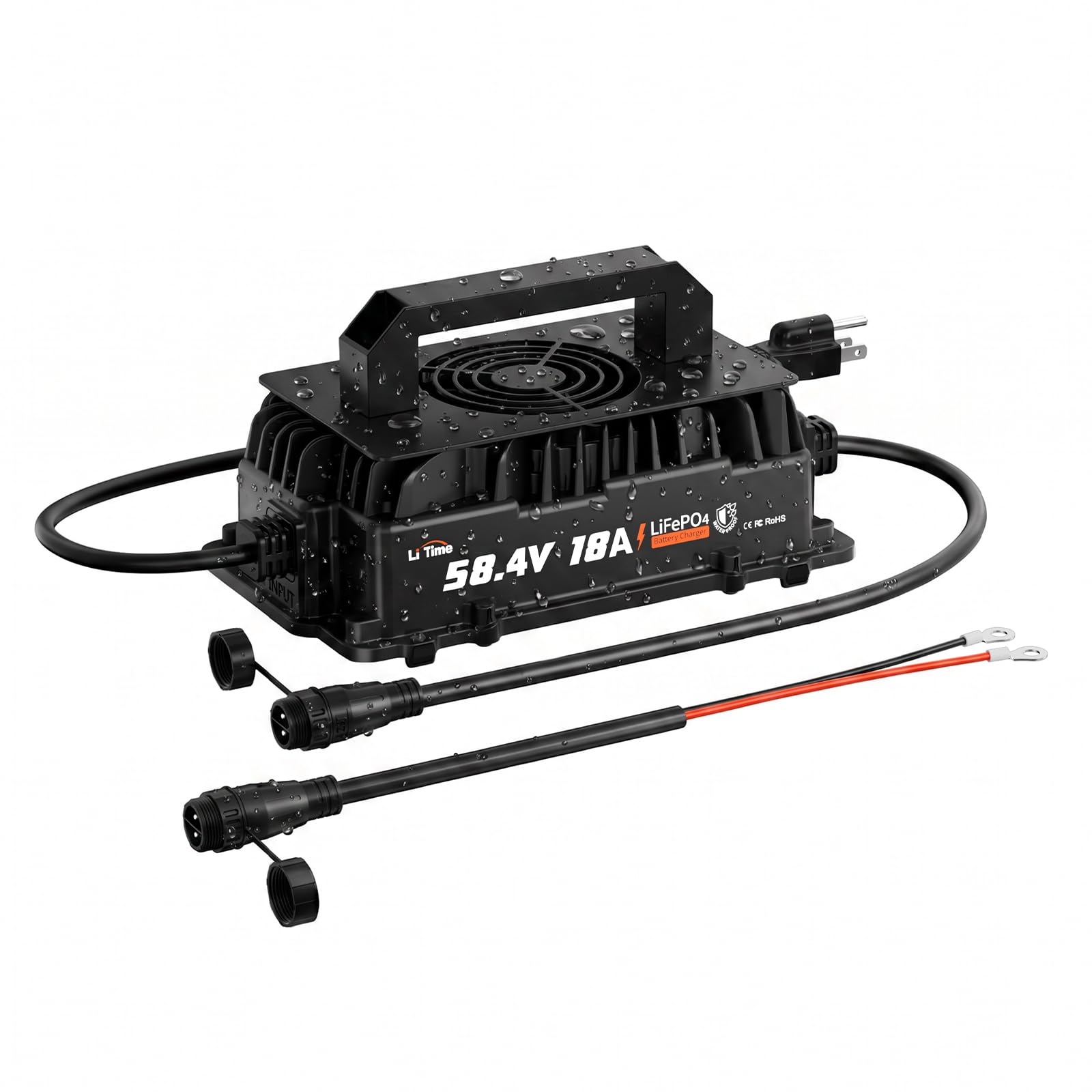
LiTime is a well-known name in the LiFePO4 space, and their 58.4V 18A charger lives up to the brand reputation. Users report charging a 51.2V 100Ah battery from empty to full in about 3.5 hours — faster than the typical 5-hour estimate — thanks to the 3-stage activation, CC, and CV profile. The Anderson SB-50 connector is standard on the output cable, which mates directly with most LiTime and Power Queen battery packs without modifications.
The IP65 rating means it’s fully protected against dust and low-pressure water jets, making it safe for damp garage floors and covered golf cart compartments. At just 5.1 pounds and roughly half the size of an old lead-acid charger, this unit is genuinely portable. The die-cast aluminum housing and active cooling fan keep internal temperatures stable even during long charging cycles, and the LED indicators provide straightforward status feedback — though there’s no multi-color breakdown like the KAISAL unit.
One design quirk: it ships with ring terminals, but the primary interface uses an Anderson connector, so you may need to swap or add alligator clips if your battery lacks a compatible port. LiTime backs it with a 2-year warranty and international voltage support (100-240V AC), which is appreciated for users outside North America. It’s a solid mid-range pick that balances price, performance, and brand reliability.
Why it’s great
- Fast 3.5-hour full charge for 100Ah packs
- Lightweight and compact at 5.1 pounds
- Anderson connector standard for easy battery mating
Good to know
- Ring terminals may need adapter for some setups
- No adjustable charge current feature
3. FORM 48V 15A Onboard Charger

FORM has designed this charger specifically for permanent onboard installation inside golf carts, and the compact dimensions (10 x 5.25 x 3 inches) make it easy to tuck inside a battery compartment. It uses ring terminals for a secure, vibration-proof connection, and the IP67 waterproof coating with WeatherShield internal protection ensures the electronics survive rain, hose-downs, and humidity without failure.
The ‘Set it & Forget it’ maintenance mode is a standout for owners who leave their carts plugged in between uses. Once the pack reaches 58.4V, the charger automatically drops into float mode and holds the battery at peak voltage without overcharging. Real users report charging at just over 16A consistently, and the 2-year warranty from a USA-based small business with responsive customer support is a major relief for those who’ve had bad experiences with generic import chargers.
The main limitation is that this charger cannot revive a deeply discharged battery that has dropped to 0V or triggered BMS lockout — you’ll need a separate power source to wake the pack first. Also, at 15A it charges slower than 18A or 20A units, adding about an extra hour to a full recharge cycle on a 100Ah pack. It’s a premium choice for those who prioritize durability and customer support over raw charging speed.
Why it’s great
- True onboard mount design with ring terminals
- IP67 waterproof with WeatherShield coating
- Excellent USA-based customer support with 2-year warranty
Good to know
- Does not support 0V dead battery wake-up
- 15A charge rate is slower than competitors
4. Guanlan 58.4V 18A Lithium Battery Charger
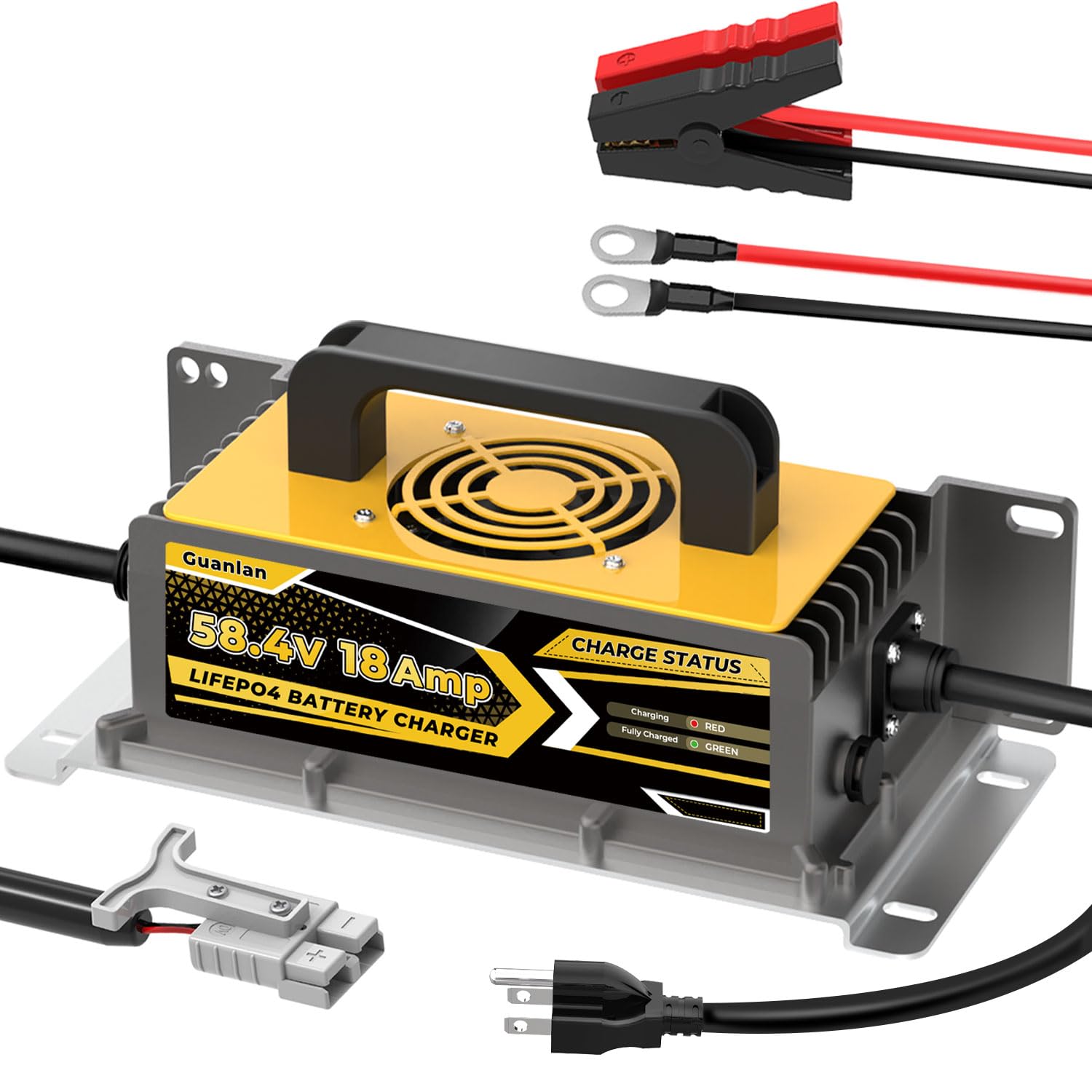
Guanlan covers every common connection scenario by packaging this 58.4V 18A charger with an SB-50 Anderson plug, M8 ring terminals, and alligator clips in the box. This eliminates the frustration of realizing your charger doesn’t fit your battery — you can switch between a permanent M8 install on a server rack battery and a portable alligator clip connection for a trolling motor without buying extra adapters.
The charger uses a smart CC/CV algorithm with pre-charge, constant current, and constant voltage modes, and it includes 0V charging wake-up capability to revive BMS-locked batteries. The aluminum alloy case with vortex cooling design keeps the unit running at safe temperatures even during extended 18A cycles, and users report spot-on voltage accuracy at 58.4V. It’s ETL, CE, RoHS, and FCC certified, which provides reassurance for insurance and code compliance in RV or solar installations.
The only issue some users noted is that a few units shipped with a lower 12A output than the advertised 18A — a manufacturing variance that seems isolated but worth verifying with a multimeter on arrival. The 24-hour customer support response is responsive, and the overall build quality feels solid. For anyone who owns multiple battery types or needs connection flexibility, this is the most practical mid-range option available.
Why it’s great
- Includes Anderson, M8, and alligator clip connectors
- 0V wake-up mode for deeply discharged packs
- ETL, CE, RoHS, and FCC certified
Good to know
- Occasional manufacturing variance in output amperage
- No mounting holes for permanent installation
5. Xnvua 58.4V 20A LiFePO4 Battery Charger
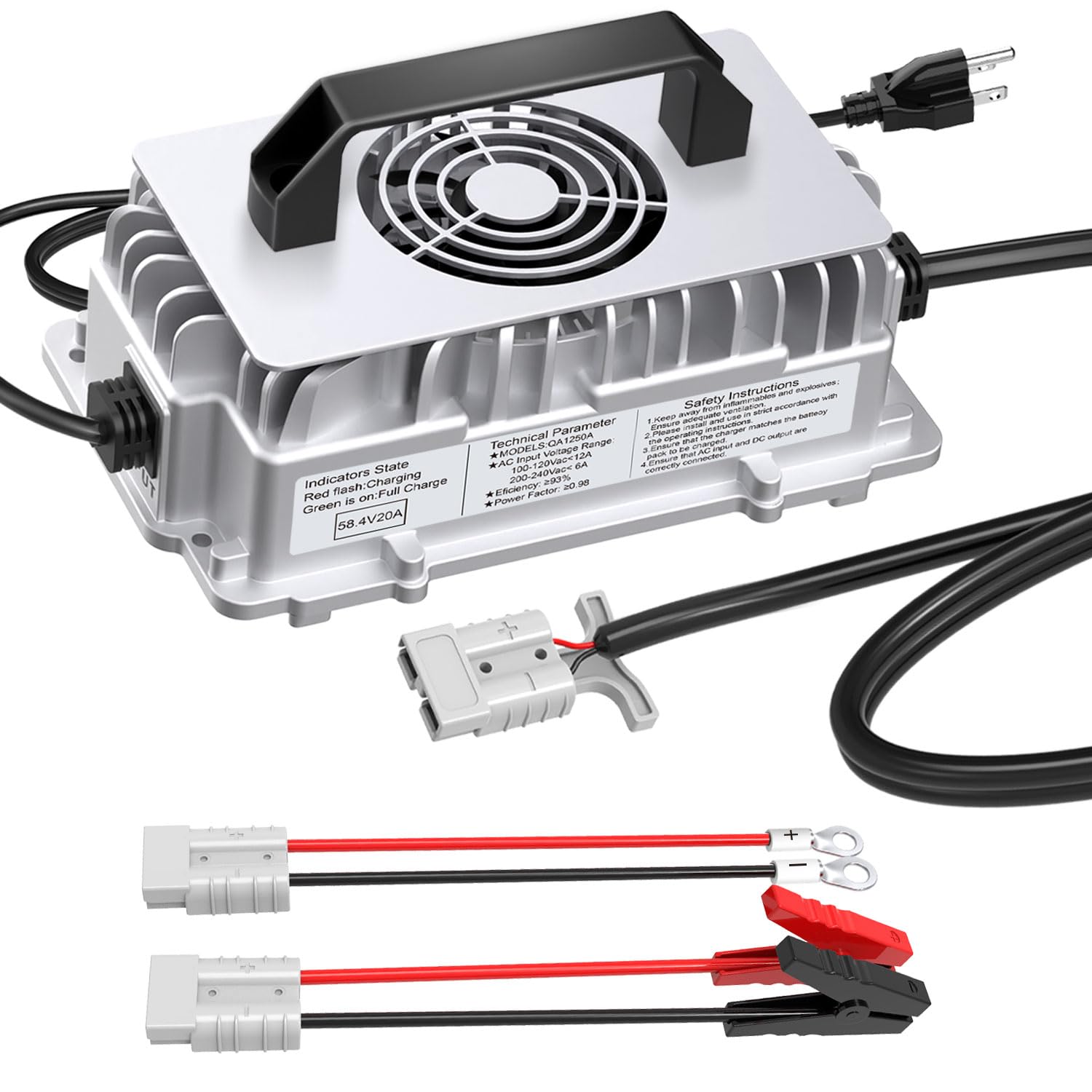
For large battery banks that need faster replenishment, the Xnvua 58.4V 20A charger delivers the highest amperage in this roundup. Real-world measurements from users confirm it supplies 17-19A during the bulk phase — close to the rated 20A — making it ideal for 200Ah to 400Ah packs where a 15A charger would take 12+ hours. The constant current stage is consistent, and the green/red LED indicator clearly shows when the battery reaches full charge and the charger shuts off.
The connector flexibility is on par with the Guanlan: it includes an Anderson SB-50, M8 ring terminals, and alligator clips, giving you the freedom to use it across multiple battery types without buying separate cables. The vortex heat dissipation design with a built-in cooling fan keeps the aluminum alloy case from exceeding 110°F at the warmest spot during a full cycle, which is well within safe limits for continuous use. The unit is compact enough for bench-top use, though it lacks wall-mounting holes.
The biggest concern is reliability — a few users reported the unit failing after 3 months, and the 1-year warranty is shorter than the KAISAL or FORM offerings. Also, the charger does not auto-restart after power interruption, meaning you’ll need to manually disconnect and reconnect AC power if the grid blinks during a charge cycle. For those who need raw charging speed and don’t mind a slightly higher failure risk, this is the fastest option in the lineup.
Why it’s great
- Highest amperage at 20A for fast large-bank charging
- Triple connector set for universal compatibility
- Effective vortex cooling keeps case temperatures low
Good to know
- Shorter 1-year warranty period
- Does not auto-restart after AC power loss
6. DC HOUSE 48V 18A Lithium Battery Charger
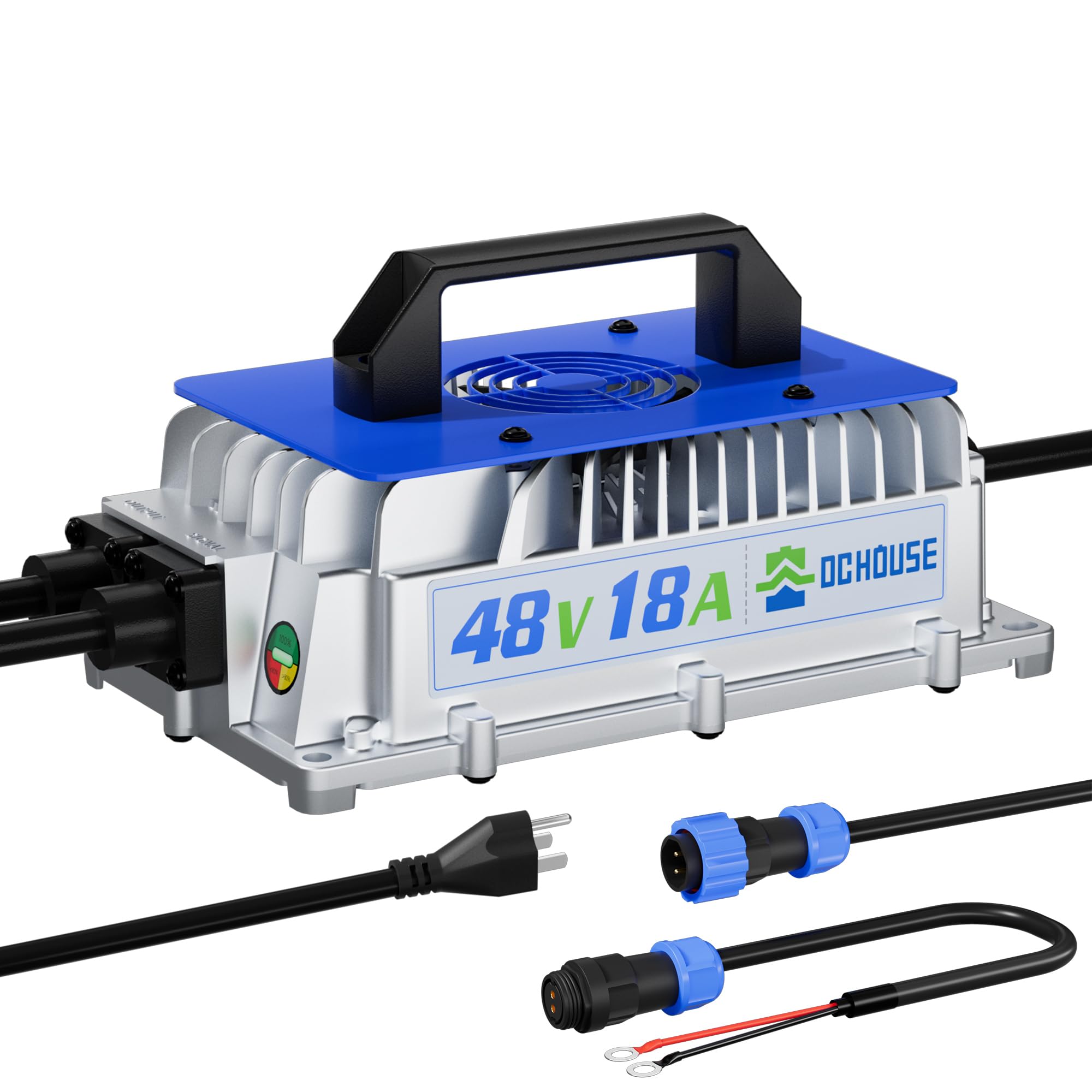
DC HOUSE focuses on portability with this 18A charger, adding an ergonomic carry handle and a compact aluminum alloy shell that weighs under 5 pounds. The 7.2-foot total cable length is shorter than most competitors, but the integrated handle makes it easy to carry between garage, cart, and boat dock. Users report plug-and-play simplicity with EZGO TXT golf carts, and the clear LED indicators provide immediate charging status without guesswork.
The IP65 rating protects against dust and water spray, though it’s not fully submersible like the IP67 units. The charger employs a 6-protection BMS system including input under-voltage, overheat, short-circuit, and reverse connection protection, and it auto-shuts off when the battery reaches full charge. The die-cast aluminum case feels solid and resists corrosion from humidity, and the active cooling fan keeps the unit functioning at safe temperatures even during prolonged cycles.
The main limitation is the short output cable — at only 3.6 feet, you may need to position the charger very close to the battery or use an extension cord. Also, there is no power switch; the charger is always live when plugged into AC, which can be a minor inconvenience. For a mid-range compact unit that prioritizes ease of transport and straightforward operation, this is a solid option.
Why it’s great
- Compact and lightweight with built-in carry handle
- 6-protection BMS for safe charging
- Clear LED status indicators
Good to know
- Short 3.6-foot output cable limits placement
- No on/off switch — always live when plugged in
7. ZEKOODL 48V 15A Smart Charger
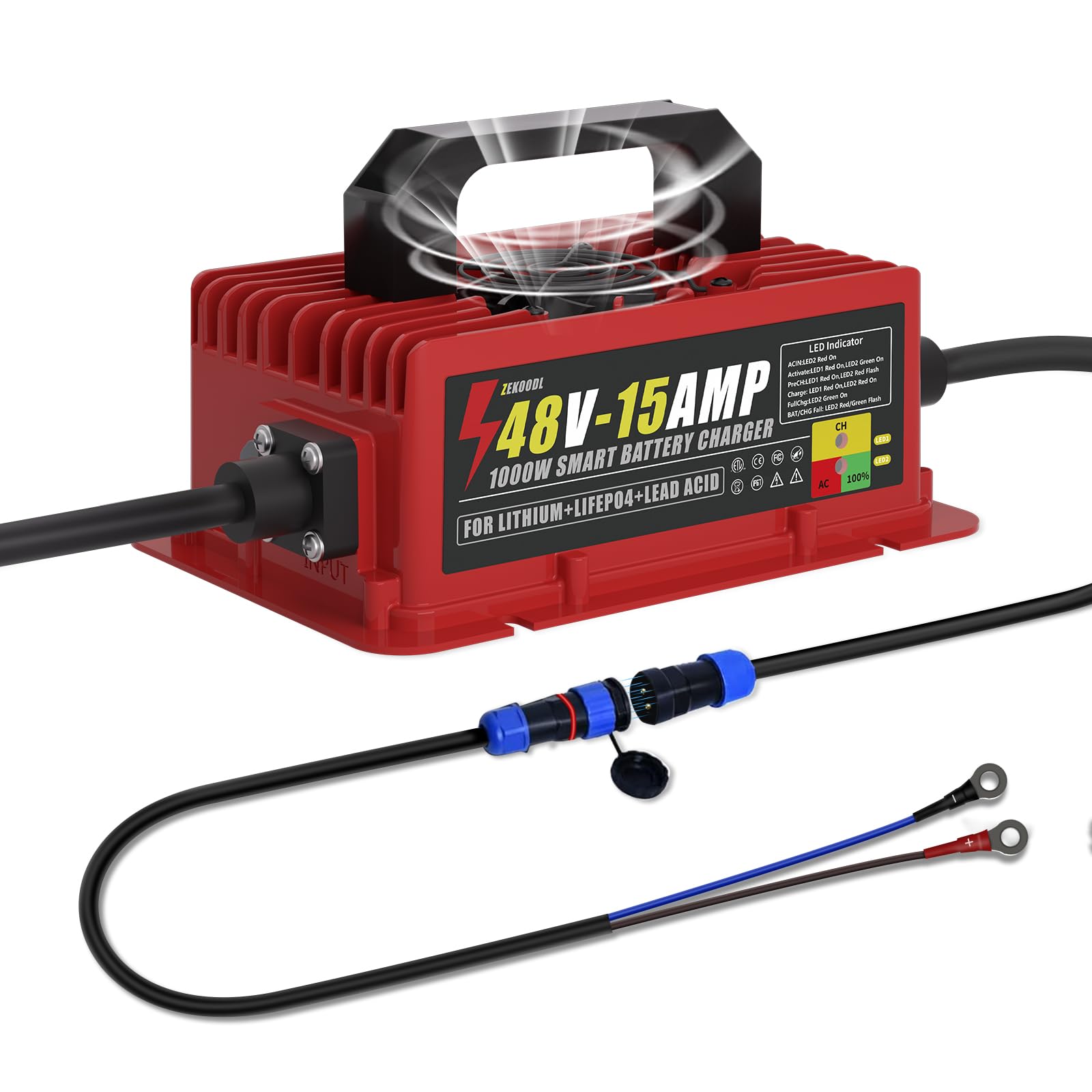
ZEKOODL designed this 15A charger to handle LiFePO4, standard lithium, and all lead-acid types (AGM, GEL, EFB, MF) with automatic chemistry detection. This makes it the most versatile option in the roundup — if you own multiple vehicles with different battery chemistries, one charger can serve them all. The 1000W output at 15A is sufficient for a 7-hour full charge on a 100Ah LiFePO4 pack, and the 16-foot heavy-duty cable gives excellent reach for awkward vehicle placements.
The IP67 waterproof housing and high-frequency cooling fan allow the charger to operate continuously at 15A without exceeding 104°F case temperature. It includes 0V dead battery rescue for BMS-locked lithium packs, plus 8-layer protection covering overvoltage, overcurrent, overheat, short circuit, reverse polarity, no-load, overcharge, and 12-hour timeout. The 5.5-pound weight with an ergonomic handle makes it portable enough for fleet use between forklifts, floor scrubbers, and golf carts.
Some users reported the charger failing after 3-5 months of use, though the seller’s customer service has a strong track record of replacing units outside the standard return window. The M8 terminal connection is secure but less flexible than an Anderson connector for quick disconnects. For a multi-chemistry fleet charger that can switch between battery types without user intervention, this is a capable workhorse with good after-sales support.
Why it’s great
- Auto-detects and charges LiFePO4, lithium, and lead-acid
- 16-foot cable for flexible placement
- 0V dead battery wake-up and 8-layer protection
Good to know
- Some units reported early failure after 3-5 months
- M8 terminals — no Anderson connector included
8. LiFbatt 48V 20A Charger with Anderson Connector
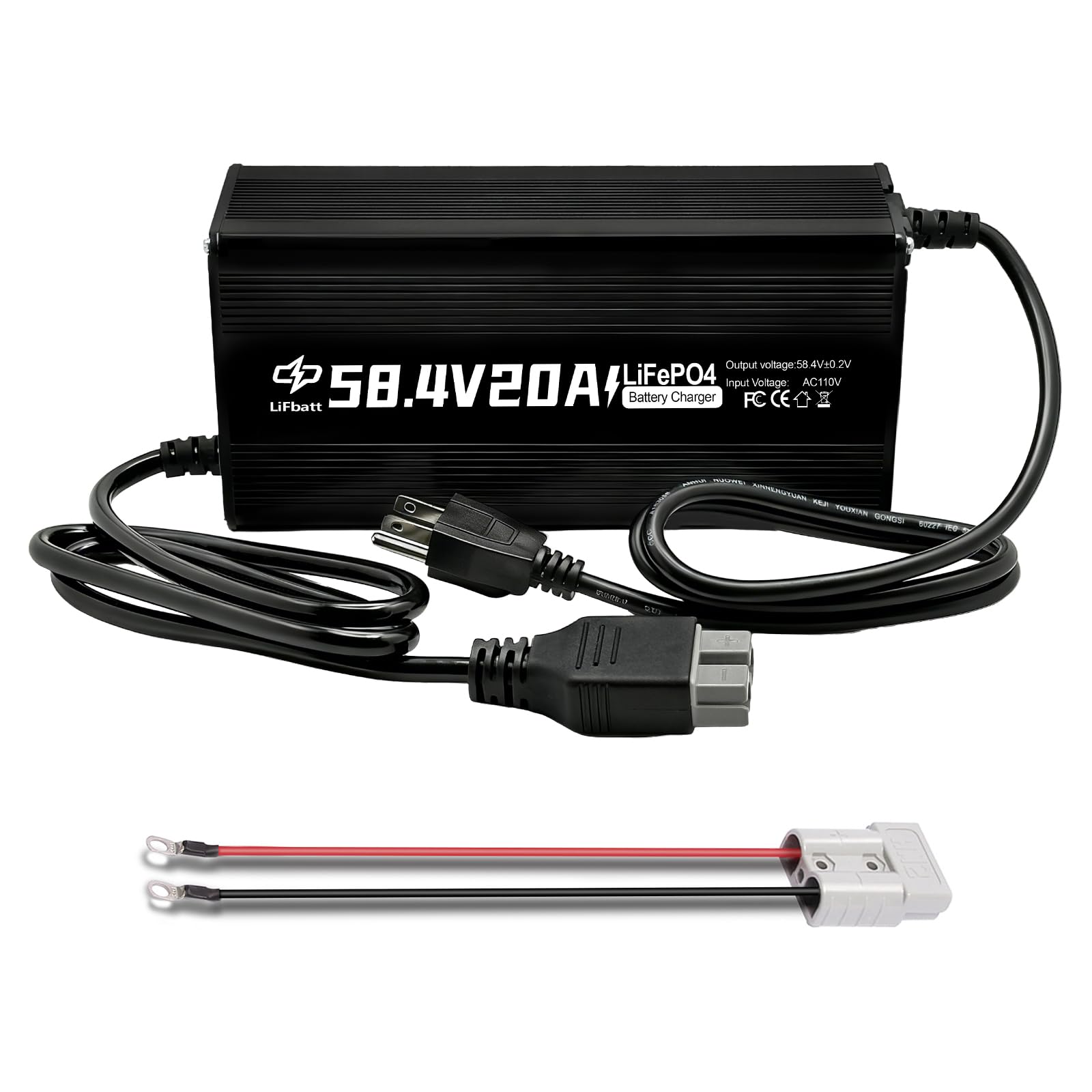
The LiFbatt 48V 20A charger delivers the same amperage as the Xnvua at a noticeably lower entry point, making it the most cost-effective high-amperage option for budget-conscious buyers. It outputs a consistent 58.4V at 20A, and users with 10Ah trolling motor batteries report hitting full charge in under an hour. The 50A Anderson connector on the output cable is oversized for the current, reducing voltage drop and heat buildup at the connection point.
The charger body uses a magnesium-aluminum alloy case with an integrated cooling fan, and it includes multi-protection features: overvoltage, short-circuit, overheat, and reverse polarity. The automatic CC/CV switching with float charge and power-off modes ensures the battery doesn’t overcharge overnight. The 0V charging capability is effective for waking up BMS-locked batteries that have sat unused for months, which is common in seasonal trolling motor and RV setups.
The build quality is basic — there are no wall-mounting holes, no multi-color LED status, and the cables feel adequate but not premium. The 1-year warranty is standard for this tier, and some users noted the cooling fan can be audible during operation. For anyone on a tight budget who absolutely needs 20A charging speed for a 100Ah+ LiFePO4 pack, this charger delivers the performance without the premium price tag.
Why it’s great
- Full 20A output at 58.4V for fast charging
- 50A Anderson connector reduces resistance and heat
- 0V wake-up for deeply discharged batteries
Good to know
- No mounting holes or wall-mounting provisions
- Cooling fan is audible during operation
9. WAVLINK GS950C 48V 15A Smart Charger
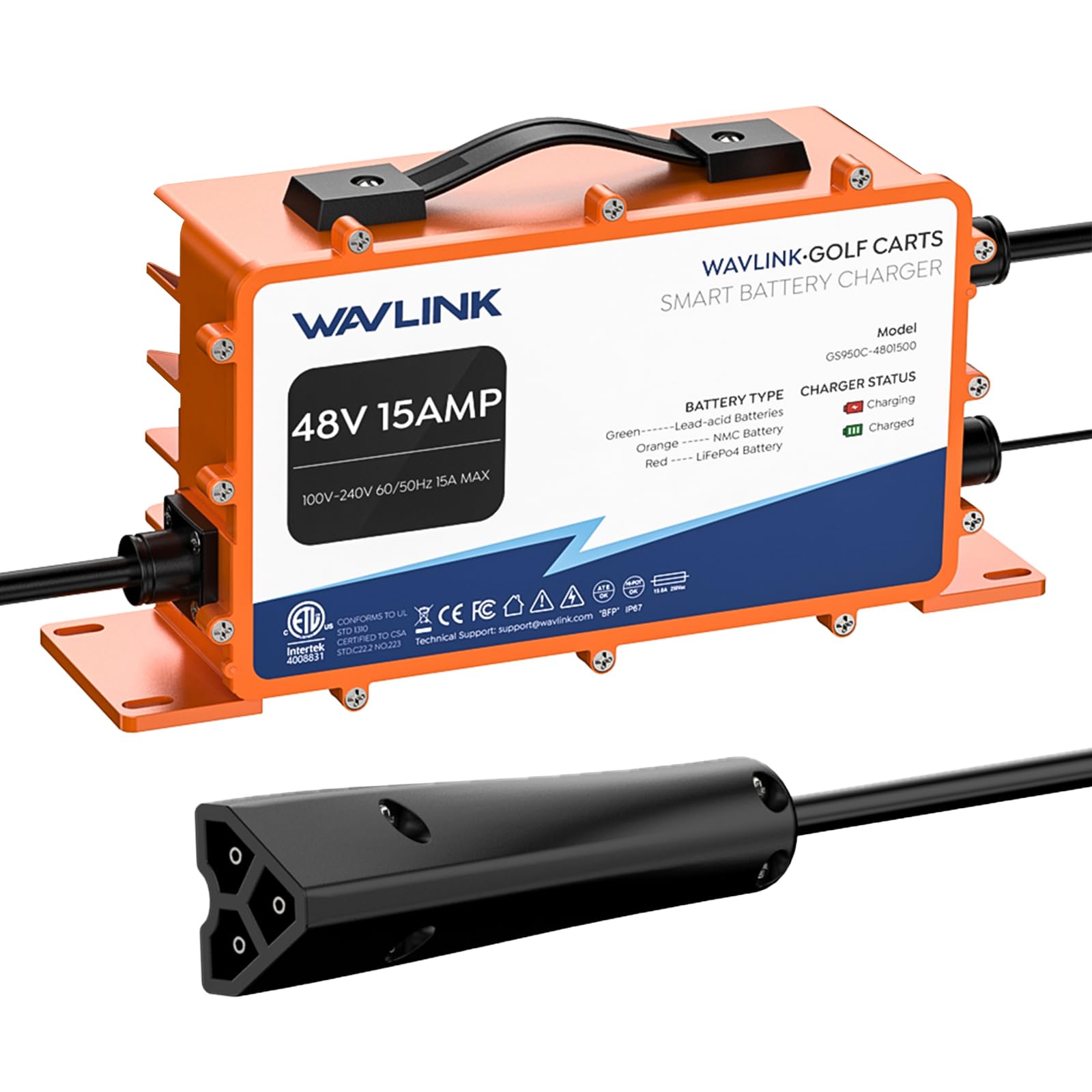
The WAVLINK GS950C uses CPU-controlled PWM technology to dynamically adjust charging current and voltage based on battery condition, making it compatible with LiFePO4, NMC, and lead-acid chemistries in a single unit. It’s specifically designed for golf carts with triangular or round AC plugs, and it supports both OBC and non-OBC carts — though note it does not work with Club Cars from 2014 or earlier that have an onboard computer unless the OBC is bypassed.
The IP67 rating and rugged aluminum alloy case make this charger suitable for all-weather outdoor use, including rain, dust, and extreme temperatures. Users report it working reliably with 48V LiFePO4 packs on Ryobi riding mowers and 200Ah battery banks, with quiet fan operation and stable current delivery. The 100-240V global input voltage support is a plus for international use, and the 810W max output is sufficient for most residential golf cart and solar applications.
A small number of users experienced failures within 3 months, but WAVLINK’s customer support has a strong reputation for fast replacements and responsive communication. The triangular plug may require an adapter for non-standard golf cart ports, and the 15A amperage is on the lower end for large battery banks. For a smart, multi-chemistry entry-level charger with good support and robust weather sealing, this is a solid choice.
Why it’s great
- CPU-controlled PWM for multi-chemistry compatibility
- IP67 waterproof and dustproof for outdoor use
- 100-240V global input with optional triangular plug
Good to know
- Not compatible with pre-2014 Club Car OBC without bypass
- Some early failures reported despite good support
FAQ
Can I use a regular 48V lead-acid charger for LiFePO4 batteries?
What does the orange or yellow LED mean during charging?
Is a 20A charger safe for a 50Ah LiFePO4 battery?
Will my charger work if my battery has dropped to 0 volts?
What connector type do I need for my 48V LiFePO4 battery?
Final Thoughts: The Verdict
For most users, the 48v lifepo4 battery charger winner is the KAISAL 48V 18A because it delivers the best combination of IP67 waterproofing, genuine 18A output, a full 5-stage charging algorithm, and a 3-year warranty that beats every competitor. If you need a permanent onboard charger for a golf cart with top-tier customer support, grab the FORM 48V 15A. And for maximum charging speed on large battery banks without breaking the bank, nothing beats the LiFbatt 48V 20A.