
When a digital multimeter’s auto-ranging delay makes you miss a split-second voltage spike, or its LCD refresh rate can’t track a capacitor’s slow decay curve, you realize some jobs demand the immediate, visual feedback of a swinging needle.
I’m Min — the co-founder and writer behind Gadgets Feed. I’ve spent countless hours combing through technical datasheets, customer reliability reports, and bench-test feedback to isolate the analog meters that deliver honest DC accuracy, robust safety ratings, and the kind of build that survives a toolbag rotation.
Whether you are aligning vintage radio stages, troubleshooting industrial relay panels, or teaching someone the fundamentals of voltage division, finding the right tool matters. This guide cuts through the noise to help you buy a best analog multimeter that matches your specific work and budget.
How To Choose The Best Analog Multimeter
Picking an analog meter isn’t about chasing the highest digit count. You need to evaluate sensitivity, range coverage, safety fusing, and mechanical build to match the voltage levels and environments you actually work in.
Sensitivity & Meter Loading
Analog meters draw current from the circuit under test. A higher DC sensitivity (e.g., 20 kΩ/V vs. 8 kΩ/V) means the meter loads the circuit less, giving you a truer voltage reading — critical when working on high-impedance stages like vacuum tube grids or transistor bias dividers. Always check the specification on the dial face or manual.
Safety Fusing & Overload Protection
Unlike digital meters with robust input protection, many cheap analog meters ship with minimal or no fusing on the current ranges. Look for units with ceramic fuse tubes on the mA and 10A jacks, and at least CAT II 600V rating. A fused meter can survive a misprobe onto a live mains line; an unfused one becomes a smoking hazard.
Scale Legibility & Mirror Plates
A mirrored scale is not a luxury — it eliminates parallax error by forcing you to align the needle with its reflection before reading. Wide arc scales with bold markings and color-coded zones (like the dB and battery-test tracks) reduce misreads under shop lights or in dim panels.
Quick Comparison
On smaller screens, swipe sideways to see the full table.
| Model | Category | Best For | Key Spec | Amazon |
|---|---|---|---|---|
| Sanwa YX-360TRF | Premium Analog | Bench-top precision & antique radio work | DC sensitivity 20kΩ/V | Amazon |
| Tekpower TP8260L | Mid-Range Analog | Back-lit readings & transistor checking | Built-in back light | Amazon |
| Tekpower TP7040 | Mid-Range Analog | General purpose with protective holster | Mirrored scale plate | Amazon |
| NJTY S471 | Entry-Level Analog | Audio dB & transistor hFE testing | Triple fuse tubes | Amazon |
| Aicevoos AS-7199A | Entry-Level Analog | High-voltage AC/DC up to 2500V | 11 functions / 24 ranges | Amazon |
| Klein Tools MM325 | Digital (Hybrid) | Drop-proof & lead-alert safety | 6.6-ft drop rated | Amazon |
| AstroAI DM6000AR | Digital (Hybrid) | TRMS, capacitance & temperature | 6000 counts TRMS | Amazon |
In‑Depth Reviews
1. Sanwa YX-360TRF Linear Analog Multimeter
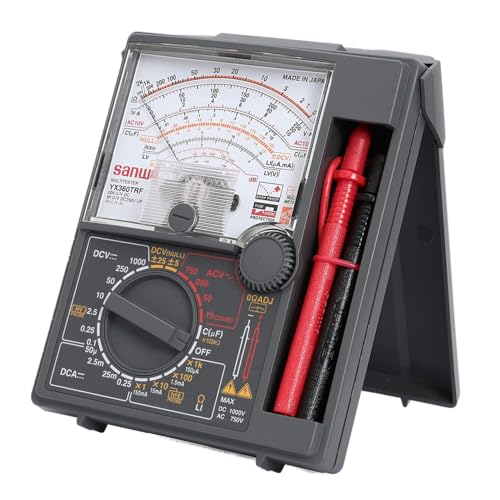
The Sanwa YX-360TRF sits at the top of the analog heap because it delivers the build quality, linear scale accuracy, and thoughtful ergonomics that professionals expect from a Japanese-made instrument. With a full 20 kΩ/V DC sensitivity, this meter loads high-impedance circuits minimally — a critical advantage when measuring bias voltages in tube audio amplifiers or obsolete transistor radios. The mirrored scale covers 22 ranges including DCV, ACV, DC current, and resistance up to 2 MΩ, all laid out on an oversized dial that eliminates squinting. Owners consistently report excellent correlation with reference-grade bench meters on DC voltage checks.
This unit is not pocket-sized — it is a bench tool, but the integrated folding stand and captive test lead storage make it surprisingly portable for service calls. The needle response is damped just enough to settle quickly without overshoot, which speeds up nulling tasks like peaking IF transformers. The test leads that ship with the meter are flexible and terminated with shrouded banana plugs that fit standard multimeter probes and alligator clips. Multiple users restoring antique tube gear note the YX-360TRF nails the voltage readings they need for bias and screen supply adjustments.
The only concession to modernity is the plastic case instead of the old phenolic resin, but the mold quality is excellent and the battery compartment uses standard AAA cells. If you need one analog meter that blends laboratory-grade accuracy with everyday utility, the Sanwa justifies its cost with repeatable readings and a decades-long reputation. It is the clear first choice for anyone serious about analog measurement.
Why it’s great
- High DC sensitivity (20kΩ/V) for minimal circuit loading on tube/transistor gear.
- Mirrored scale eliminates parallax and improves reading repeatability.
- Captive test leads and integrated case/stand design for organized transport.
Good to know
- Not pocket-sized; best suited for bench or service bag use.
- Resistance range tops out at 2 MΩ — insufficient for some leakage checks.
2. Tekpower TP8260L Analog Multimeter with Back Light

The Tekpower TP8260L addresses the one universal frustration with analog meters — reading the scale in dim lighting — by integrating a blue LED back light that illuminates the arc. This feature alone makes it a strong candidate for field technicians who work inside panels, basements, or unlit service rooms. Beyond the glow, the TP8260L packs a full 20-range VOM with DC/AC voltage up to 1000V, DC current to 10A, and a transistor checking dock (hFE) for PNP and NPN types. The mirrored scale is present and the meter is rated to CAT II 600V with a protective holster included in the package.
Owners commonly report DC voltage accuracy within 3% of full scale, which is solid for a mid-range analog instrument. The rotary switch is lubricated from the factory and indexes cleanly across positions without slop — a detail some budget meters skip. The back light is activated by a dedicated button, but a few users note that long activation on the x10K range slightly drops needle reading due to the LED draw; it remains usable for trend checks rather than absolute precision. The continuity buzzer is present but described as slow-responsive compared to modern digital units.
The main caveats are the 10A unfused jack (use caution on high-energy circuits) and the bundled test leads, which work but feel thin next to the meter’s solid body. Upgrading to silicone leads from a brand like Probe Master transforms the feel. For anyone who works in low-light conditions or wants an analog meter with a transistor test feature built into the dial plate, the TP8260L is a rare, purpose-built find that justifies a slight budget stretch over basic no-brand alternatives.
Why it’s great
- Integrated blue LED back light for scale visibility in dim workspaces.
- Transistor test dock (hFE) for quick PNP/NPN gain checks.
- CAT II 600V rating with a protective holster for daily carry.
Good to know
- 10A jack is unfused — avoid high-energy current measurements.
- Stock test leads are basic; consider upgrading for better feel.
3. Tekpower TP7040 20-Range AC/DC Analog Multimeter

The Tekpower TP7040 (rebadged from Mastech) is the kind of no-nonsense analog VOM that field electricians and hobbyists reach for decade after decade. The first thing you notice is the weight — a full pound of molded plastic and metal core that feels dense and balanced in hand. The dial rotates with smooth detents across 20 ranges, covering DCV (0.1V–1000V), ACV (10V–1000V), DCA (50µA–250mA), and resistance (X1–X10K). A mirrored scale arc sits beneath a domed window, and a red protective holster wraps the body to absorb drops onto concrete floors.
DC voltage accuracy consistently lands within 3% of full-scale deviation when checked against an HP 3457A bench meter, and the AC readings skew about +2% at 60 Hz — more than adequate for mains troubleshooting. The three resistance ranges use a single 1.5V AA cell, and the zero-ohm adjuster works smoothly across the scale. Users who repair vintage pinball machines and arcade power supplies praise the TP7040 for its ability to track slow voltage ramps and capacitor bleed rates that digital meters struggle to visualize. The audible continuity beeper is faint but functional.
The only downsides are the lack of a fold-out kickstand (the meter sits flat or in the holster) and a thin plastic window that scratches if wiped with a dirty rag. The test leads are notably better than the TP8260L’s kit — heavy-duty, flexible, and terminated with sharp probes. For a general-purpose analog meter that balances cost with a rugged chassis, mirrored scale, and reliable accuracy, the TP7040 is a top-tier value pick. It earns its place in any tool bag without breaking the bank.
Why it’s great
- Heavy, durable build with a protective holster for field use.
- Mirrored scale and 20 ranges cover almost every home/shop need.
- DC accuracy within 3% — competitive with meters costing three times as much.
Good to know
- No fold-out stand; meter sits flat or uses the holster as a prop.
- The domed window is prone to micro-scratches; clean gently.
4. NJTY S471 Analog Pointer Multimeter
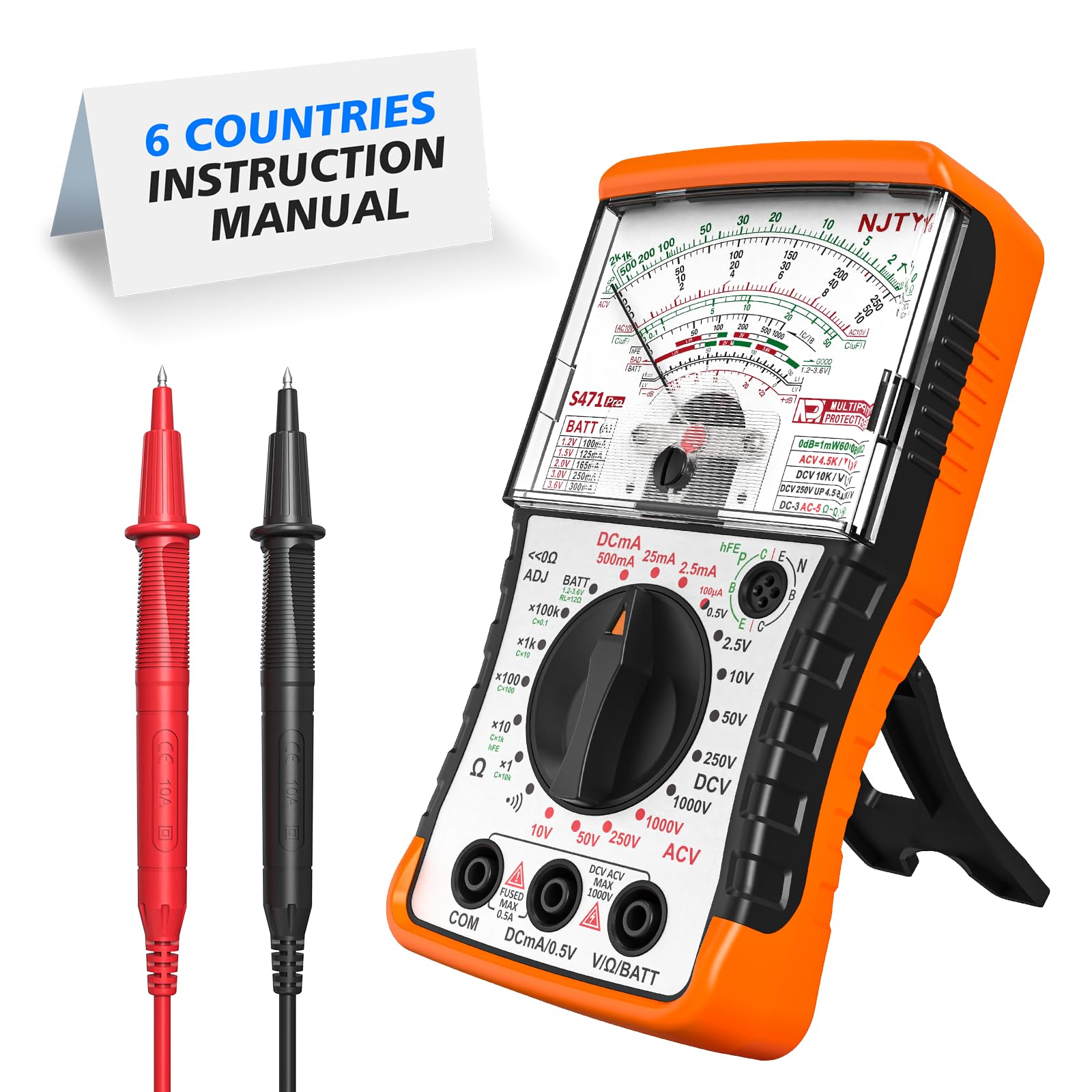
The NJTY S471 punches above its weight class by offering measurement functions typically reserved for mid-range VOMs — including a dB audio level scale, transistor hFE gain testing, and a dedicated battery load test. The standout safety feature is triple fuse tubes: two spare fuses are stored inside the case for instant swap when the main 250mA or 10A fuse blows on an overload. That kind of foresight is rare in entry-level analog meters and saves downtime on the bench. The needle is responsive without excessive overshoot, and the dial uses clear color-coded zones for voltage, current, and resistance ranges.
One of the most appreciated details among radio hobbyists is the dB scale, which lets you perform stage-by-stage audio level checks on AM/FM receivers and guitar amplifiers without reaching for a separate VU meter. The hFE test socket accepts both PNP and NPN transistors in the standard E-B-C layout. The meter also includes a 10A DC current range fused separately from the mA ranges, reducing the risk of blowing the sensitive low-current fuse when probing higher loads. Users confirm the DC voltage accuracy is sufficient for alignment work where relative trend matters more than absolute value.
A few users mention that the S471 lacks a polarity indicator for DC voltage — the needle swings backward if leads are reversed, which could confuse a beginner but is standard analog behavior. The included leads are adequate but not premium. For a low-cost analog meter with an unusually generous safety fuse system, a full transistor test station, and audio dB capability, the NJTY S471 is a smart buy for the budget-conscious technician who refuses to compromise on safety fundamentals.
Why it’s great
- Triple fuse tube design with two spares onboard for rapid field swap.
- dB audio level scale plus hFE transistor gain socket expand capability.
- Dedicated 10A fused input reduces risk on higher-current circuits.
Good to know
- No polarity indicator — needle reverses on wrong DC connection.
- Test leads are functional but not heavy-duty; consider upgrading for frequent use.
5. Aicevoos AS-7199A Pointer Multimeter
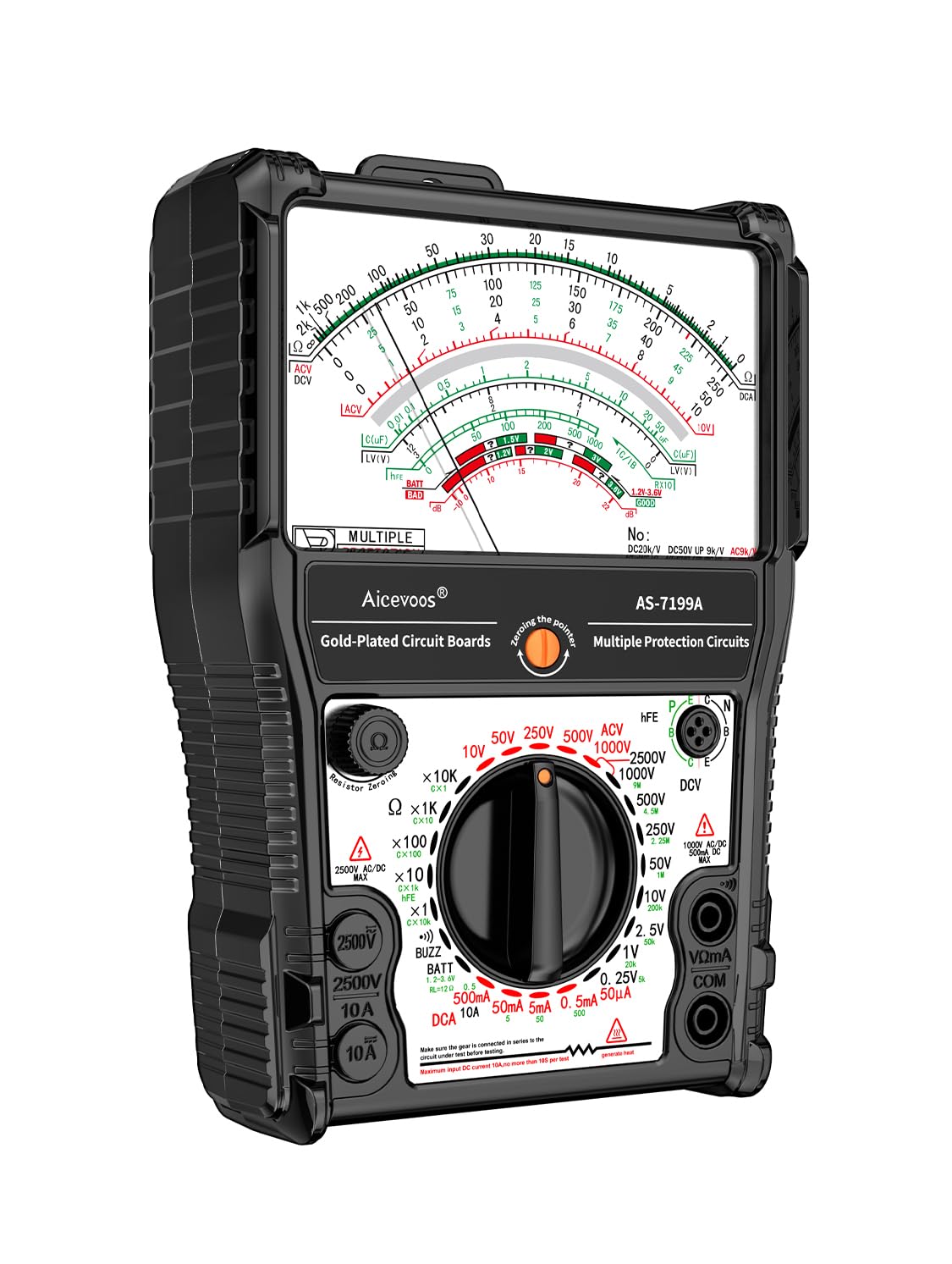
The Aicevoos AS-7199A stands apart from the crowd with an advertised AC/DC voltage ceiling of 2500V — double what most analog meters on this list can handle. This makes it a legitimate option for industrial maintenance electricians who occasionally work on 480V three-phase panels and want headroom for surge testing or motor drive checks. The meter packs 11 functions across 24 ranges, including standard voltage, current, resistance, continuity beep, transistor check, LV detection, and remote control infrared signal testing — a quirky but welcome addition for appliance repair.
Physically, the AS-7199A is compact but features a well-designed back stand, a magnet for attaching to metal enclosures, and hanging holes for pegboard storage. The mirrored scale is present and readable. DC voltage accuracy across the lower ranges (2.5V–250V) is decent, but some users note the resistance scale reads a few ohms low on the X1 range — a common concession at this tier that can be ignored for most continuity and component checks. The plug color coding (black/red) is not sharply differentiated, so check polarity by reading the jack markings rather than wire color.
The biggest trade-off for the 2500V capability is the lack of a fused 10A input; the current jacks are unfused, so use extreme care when measuring current on unknown circuits. For home and auto use, the AS-7199A is overkill on voltage but perfectly usable for everything else. It’s a niche pick best reserved for technicians who actually need the expanded voltage ceiling and can respect the safety boundaries of an unfused current input.
Why it’s great
- Rare 2500V AC/DC range for heavy industrial or high-voltage testing.
- Back stand, magnet mount, and hanging holes for versatile placement.
- Remote control signal detection function for appliance diagnostics.
Good to know
- Current input jacks are unfused — know your circuit before probing.
- Resistance X1 range may read a few ohms low; factor in offset.
6. Klein Tools MM325 Digital Multimeter
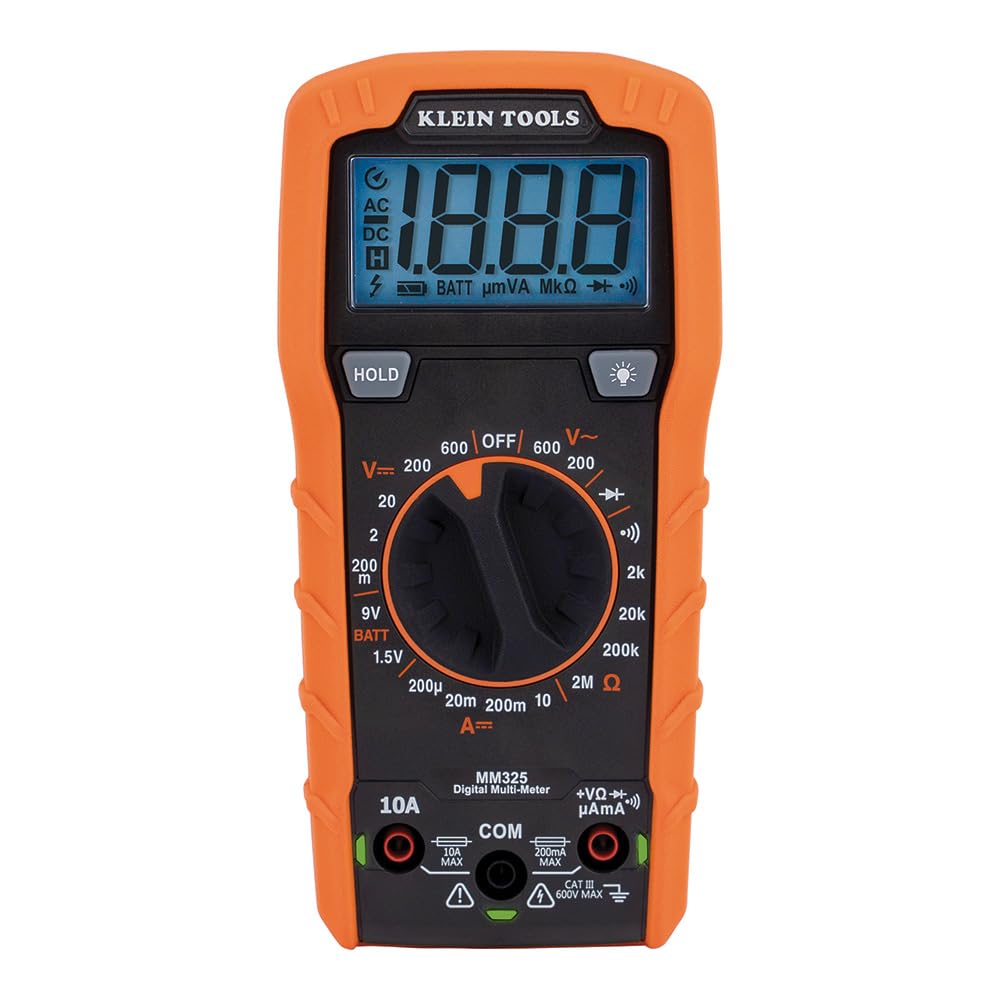
The Klein Tools MM325 is a digital manual-ranging meter, but it earns a place in this guide because it bridges the gap for users who want analog’s simplicity in one hand and digital’s precision in the other. The manual-ranging dial forces you to select the range — the same deliberate action you make on an analog VOM — which trains new techs to think about voltage levels before probing. The standout safety feature is the Lead-Alert system: bright LEDs on the meter body illuminate to confirm you have inserted the test leads into the correct jacks for the selected function. This reduces the risk of plugging into the 10A jack while measuring voltage, a classic beginner mistake.
The MM325 measures AC/DC voltage up to 600V, DC current up to 10A, resistance to 2 MΩ, and includes diode and continuity tests. The backlit LCD display is clear even in dimly lit breaker panels. Build quality is exceptional for the price point: the meter is rated to survive a 6.6-foot (2-meter) drop onto concrete, and the orange rubber boot absorbs shock without cracking. The dual-AA battery compartment is tool-access only, preventing mid-job battery ejections. Homeowners and apprentice electrician reviewers consistently mention it replaced a Fluke that was too expensive to risk on daily carry.
The main omissions are the lack of a milliamp range (so small-signal current measurements are off the table), and the meter is slightly bulky for shirt-pocket carry — it fits comfortably in a tool pouch instead. The test lead holders on the back and the optional magnetic hanger (sold separately) add hands-free utility. If your work is primarily residential or light commercial electrical troubleshooting and you want a meter that can survive a ladder drop, the Klein MM325 delivers professional-grade toughness at a mid-range investment.
Why it’s great
- 6.6-foot drop-rated chassis with overmold boot for field durability.
- LED Lead-Alert lights confirm correct test lead placement.
- Manual-ranging dial reinforces deliberate range selection for new users.
Good to know
- No milliamp (mA) range — cannot measure small-signal DC current.
- Magnetic hanger is optional accessory, not included.
7. AstroAI Digital Multimeter DM6000AR TRMS

The AstroAI DM6000AR is a feature-packed digital multimeter that serves as the perfect companion to an analog VOM. While it lacks a needle, it delivers True RMS AC readings (6000 counts) for non-sinusoidal waveforms found in VFD drives and switching power supplies — a task analog meters cannot perform. The meter measures AC/DC voltage up to 1000V, AC/DC current, resistance, capacitance up to 20,000 µF (far beyond the typical 200 µF limit), frequency, duty cycle, diode, continuity, and temperature via an included K-type thermocouple. This makes it the most versatile single tool on the list for any electronics bench or automotive diagnostic kit.
The autoranging function works quickly, and the continuity beeper is near-instantaneous — a vast improvement over the sluggish buzzers found on many analog meters. The backlit LCD is large, offers a 6000-count resolution, and includes a data hold button and auto-shutoff to conserve battery (two AAA cells, included). The leads are decent and terminate in standard shrouded banana plugs. The included magnetic hanging strap clips to the back for hands-free viewing on metal panels. Users repairing Xbox consoles, PC power supplies, and automotive circuits repeatedly praise the DM6000AR as the best value-for-features meter under typical budget constraints.
The only criticisms are the instructions being slightly inaccurate regarding the external current clamp (you use voltage mode, not current mode) and the temperature probe is cheap and drifts at room temperature. The double ceramic fuse protection (F400mA/600V and F10A/600V) provides genuine overload safety. For anyone who needs a modern, high-spec digital meter alongside their analog needle, the AstroAI DM6000AR is the obvious choice — it covers everything an analog meter cannot while costing a fraction of a Fluke 87.
Why it’s great
- True RMS 6000-count resolution for accurate AC readings on non-sine waveforms.
- Capacitance measurement up to 20,000 µF — essential for power supply diagnostics.
- Dual ceramic fuse protection (400mA + 10A) with CAT II 600V safety rating.
Good to know
- Instructions contain a small error for external current clamp usage.
- Included K-type thermocouple is low quality; upgrade for temperature-critical work.
FAQ
Why would I choose an analog multimeter over a digital one for circuit testing?
What does 20 kΩ/V mean on an analog meter and why does it matter?
Can an analog multimeter measure AC current or is it DC only?
How do I properly adjust the zero-ohm control on an analog VOM before measuring resistance?
Final Thoughts: The Verdict
For most users, the best analog multimeter winner is the Sanwa YX-360TRF because it combines Japanese build precision, 20 kΩ/V sensitivity, and a mirrored scale that holds up to bench and field demands. If you work in dim service panels and need a back-lit scale, grab the Tekpower TP8260L. And for a rugged general-purpose beater that balances cost with tough holster protection, nothing beats the Tekpower TP7040.