
A 24-inch 4K monitor packs 184 pixels per inch — that is denser than a 27-inch 4K panel and even sharper than a 32-inch 4K display. The payoff is OS-level UI elements scaling crisply without the heavy GPU load of 5K or 6K panels, making it an ideal sweet spot for users who prioritize text clarity and desk space conservation over sheer screen real estate.
I’m Min — the co-founder and writer behind Gadgets Feed. For this guide I cross-referenced sRGB and DCI-P3 gamut coverage data, refresh rate tiers, connectivity standards (Thunderbolt 4 versus USB-C 3.2 versus HDMI 2.1), and ergonomic adjustability specs across seven competing 4K 24-inch and near-24-inch monitors to identify which models actually deliver on their resolution promise without hidden caveats.
Whether you are building a dual-monitor coding station or a color-accurate editing rig for a compact desk, this analysis helps you separate genuine 4K clarity from marketing gloss. This is your definitive resource for choosing the best 4k 24 inch monitor that fits your workflow and budget.
How To Choose The Best 4K 24 Inch Monitor
Most buyers default to 27-inch 4K monitors, but a 24-inch 4K panel delivers a noticeably higher pixel density — 184 PPI versus 163 PPI on a 27-inch 4K screen. That tighter pixel pitch makes text look sharper, which matters for developers, writers, and designers working with dense spreadsheets or code editors. The challenge is that fewer manufacturers produce true 24-inch 4K models compared to the glut of 27-inch options, so connectivity and panel quality vary significantly across the available picks.
Pixel Density vs Desk Space
A 24-inch 4K monitor at 184 PPI renders macOS HiDPI mode perfectly at 200% scaling, giving you the equivalent of a 1920×1080 workspace with retina-sharp text. The same resolution on a 27-inch monitor forces users to choose between slightly larger UI elements at native scaling or moderate pixel savings at 150% scaling. If your desk can only fit a 24-inch depth, the higher PPI of a 24-inch 4K panel makes every line of text look cleaner without sacrificing workspace.
Connectivity and Power Delivery
Not all 4K 24-inch monitors support USB-C with power delivery. Thunderbolt 4 models like the ViewSonic VP2488-4K can deliver up to 100W to a MacBook while carrying a 4K signal over a single cable, eliminating the need for a separate power brick. Cheaper models often rely on HDMI 2.0 or DisplayPort 1.2, which still handle 4K at 60Hz but require separate USB-A or USB-C cables for peripherals. Verify the monitor’s USB-C wattage rating if you plan to use it as a laptop dock.
Color Gamut and Panel Calibration
For photo and video editing, sRGB coverage above 99% is the baseline; DCI-P3 coverage above 90% matters for HDR content creation. Pantone-validated monitors such as the ViewSonic VP2488-4K guarantee that out-of-box colors match the Pantone Matching System, which saves hours of calibration time. Budget-friendly 24-inch 4K panels often cap out at 99% sRGB with no DCI-P3 rating, making them fine for office work but insufficient for professional creative workflows.
Quick Comparison
On smaller screens, swipe sideways to see the full table.
| Model | Category | Best For | Key Spec | Amazon |
|---|---|---|---|---|
| ViewSonic VP2488-4K | Premium | Mac color accuracy | 24″, 98% DCI-P3, Thunderbolt 4 100W | Amazon |
| LG 27G850A-B UltraGear | Gaming | High-refresh 4K gaming | 27″, 240Hz, DisplayPort 2.1, HDR600 | Amazon |
| Dell S2725QS Plus | Productivity | Mixed work and light gaming | 27″, 120Hz, FreeSync Premium, 1500:1 | Amazon |
| ASUS VY27UQ | Value | Budget-friendly 4K office | 27″, IPS, HDR10, Eye Care Plus | Amazon |
| LG 27UP650K-W | Mid-Range | Color work and spreadsheets | 27″, 95% DCI-P3, DisplayHDR 400 | Amazon |
| INNOCN 27C1U-D | Mid-Range | USB-C laptop docking | 27″, 65W USB-C PD, DeltaE<2 | Amazon |
| InnoView 23.8″ Portable | Portable | On-the-go 4K second screen | 23.8″, 100% sRGB, 2.2 kg | Amazon |
In‑Depth Reviews
1. ViewSonic VP2488-4K 24 Inch 4K Mac-Ready Monitor
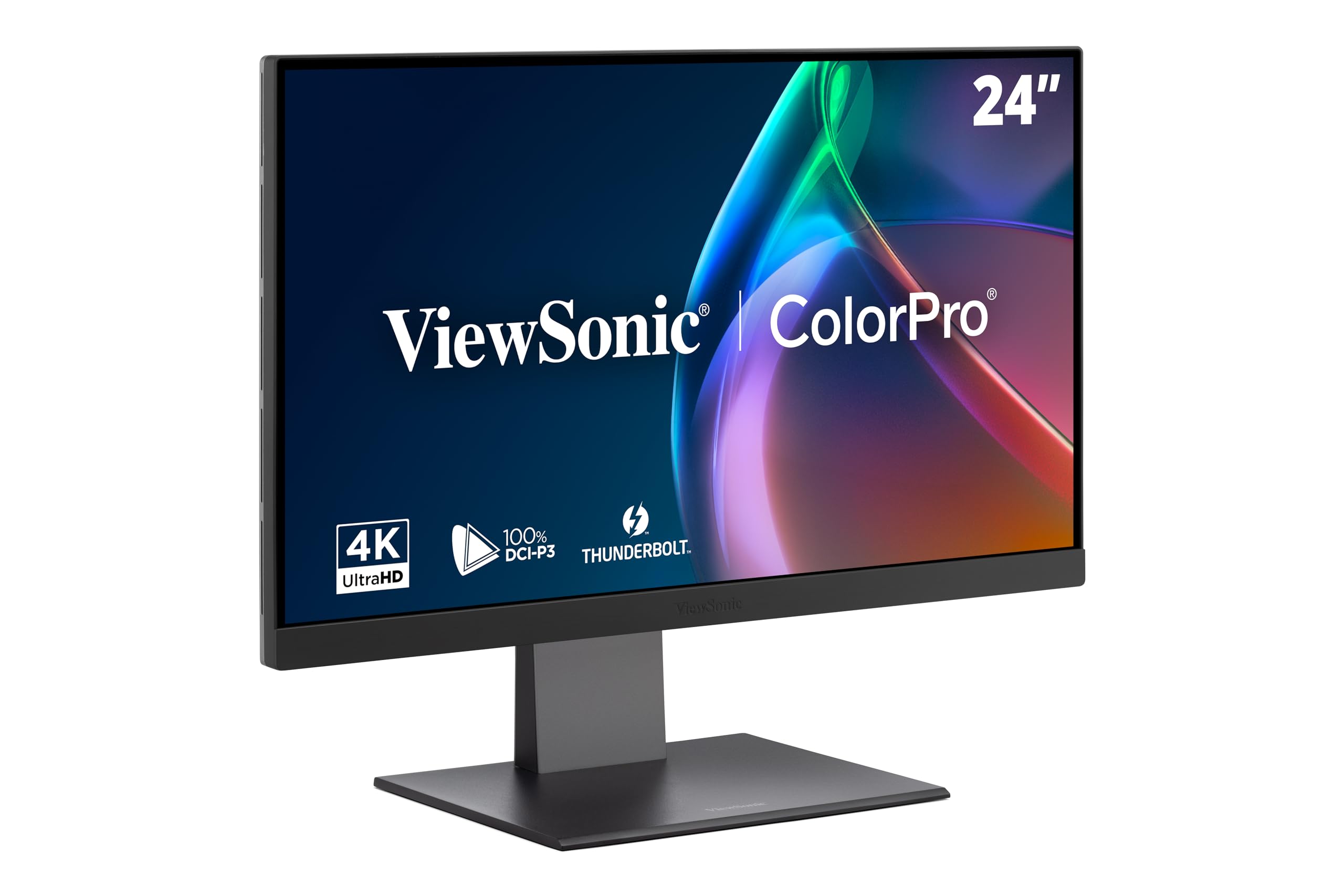
The ViewSonic VP2488-4K is the rare true 24-inch 4K monitor with a pixel density of 184 PPI, which makes macOS text rendering look noticeably sharper than any 27-inch 4K panel. Its Thunderbolt 4 port delivers up to 100W of power delivery, so a single cable connects a MacBook Pro at full charge while carrying 4K 60Hz video, USB data, and audio — no separate power brick needed. Pantone validation and 98% DCI-P3 coverage ensure out-of-box color accuracy that matches Apple’s own Retina displays.
The ergonomic stand offers tilt, swivel, pivot, and height adjustment, which is essential for aligning a 24-inch panel in a multi-monitor setup. Daisy chaining via Thunderbolt 4 lets you run two VP2488-4K units from one host port, a feature rarely seen on monitors in this size class. The 500-nit peak brightness handles HDR content better than most sub-600-nit competitors, though the 1300:1 contrast ratio is typical for IPS black levels.
Some users have reported USB reconnection bugs after the monitor enters sleep mode, and the OSD menu can feel cluttered with calibration options. The compact chassis also lacks a headphone jack, which is an inconvenience for desk setups that rely on wired audio. Despite these quirks, no other 24-inch 4K monitor combines Thunderbolt 4, Pantone validation, and full ergonomic adjustment at this level of quality.
Why it’s great
- True 24-inch 4K panel with 184 PPI for razor-sharp text
- Thunderbolt 4 supports 100W charging and daisy chain
- Pantone validated with 98% DCI-P3 for color-accurate editing
Good to know
- No headphone jack
- USB reconnection issues after sleep reported by some users
- Premium pricing compared to larger 4K alternatives
2. LG 27G850A-B 27-inch UltraGear 4K Gaming Monitor

LG’s UltraGear 27G850A-B pushes the 4K 27-inch concept into true gaming territory with a dual-mode panel that runs native 4K at 240Hz and switches to 1080p at 480Hz for competitive shooters. The Nano IPS Black technology delivers a 2000:1 contrast ratio — nearly double typical IPS panels — while maintaining the 178-degree viewing angles that IPS is known for. VESA DisplayHDR 600 certification and 99% DCI-P3 coverage make this one of the brightest, most color-rich gaming monitors available at this price tier.
DisplayPort 2.1 support is the key differentiator here: it provides enough bandwidth to run 4K at 240Hz with 10-bit color and no chroma subsampling, whereas older DP 1.4 monitors cap out at 144Hz for 4K. The 1ms GtG response time virtually eliminates ghosting, and G-Sync Compatible certification ensures tear-free frame delivery with Nvidia GPUs. The built-in Switch app lets you split the screen into up to six sections, though this is more useful for productivity than gaming.
Quality control has been inconsistent: some units arrive with dead pixels or firmware issues that cause the monitor to become unresponsive when toggling HDR mid-game. The 1080p 480Hz mode also lacks integer scaling, so the image appears slightly softer than native 1080p panels. Without USB-C display input, MacBook users will need an adapter for full functionality. For PC gamers who want the highest refresh rates at 4K today, this monitor is the fastest IPS option on the market.
Why it’s great
- Dual-mode 4K 240Hz / 1080p 480Hz for versatile gaming
- DisplayPort 2.1 for uncompressed 4K high-refresh output
- Nano IPS Black delivers 2000:1 contrast and 99% DCI-P3
Good to know
- No USB-C display input
- 1080p mode lacks integer scaling
- Mixed quality control reports
3. Dell 27 Plus 4K Monitor S2725QS

Dell’s S2725QS offers a rare combination in the mid-range 4K monitor space: a 120Hz refresh rate with AMD FreeSync Premium at a price that undercuts most 144Hz competitors by a significant margin. The 27-inch IPS panel delivers 99% sRGB coverage and a 1500:1 contrast ratio that gives blacks noticeably more depth than the typical 1000:1 budget panel. ComfortView Plus reduces harmful blue light to 35% without shifting colors yellow, so all-day coding sessions don’t cause eye fatigue.
The integrated speakers produce fuller sound than most built-in monitor audio, with deeper frequency response and wider decibel range compared to the previous generation. The ultra-thin bezels and ash white finish make it a clean aesthetic fit for modern desk setups. HDMI 2.1 is included in the box, which is essential for achieving 120Hz at 4K with consoles like the PS5.
Some units exhibit a subtle yellow tint out of the box, and the matte anti-glare coating introduces a slight grain that can be distracting for users accustomed to glossy displays. Competitive FPS players will notice minor ghosting at 120Hz, as the panel’s response time isn’t optimized for esports. For office productivity, creative work, and casual gaming, this monitor strikes an excellent balance between smoothness and clarity.
Why it’s great
- 4K 120Hz with FreeSync Premium at a competitive price
- 1500:1 contrast ratio for better depth than typical IPS
- ComfortView Plus reduces eye strain without color shift
Good to know
- Some units have yellow tint issues
- Matte coating adds subtle grain
- Not ideal for competitive FPS due to ghosting
4. LG 27UP650K-W 27-inch Ultrafine 4K IPS Monitor

The LG 27UP650K-W targets users who need wide color gamut for photo editing or video work without reaching professional creative pricing tiers. Its 95% DCI-P3 coverage — validated through real-world reviews — is exceptional for a sub- monitor and ensures HDR content viewed through DisplayHDR 400 retains accurate skin tones and saturated reds. The matte screen surface handles reflections well in bright offices, and the white chassis fits lighter desk aesthetics.
Ergonomics are where this monitor shines: a fully adjustable stand with height, tilt, and pivot adjustment is included, which is rare at this price point. The Black Stabilizer feature brightens shadow details in games without washing out highlights, and Dynamic Action Sync reduces input lag for casual gaming. The on-screen joystick control makes navigating settings fast compared to button-based competitors.
The lack of USB-C connectivity means MacBook users need an HDMI or DisplayPort cable plus a separate USB hub for peripherals. Built-in speakers are absent, so external speakers or headphones are mandatory for audio. The 60Hz refresh rate is adequate for productivity but won’t satisfy users who want smooth scrolling in macOS or light gaming.
Why it’s great
- Wide 95% DCI-P3 gamut for color-accurate content creation
- Full ergonomic stand with height, tilt, and pivot
- Effective matte coating reduces glare
Good to know
- No USB-C or built-in speakers
- 60Hz refresh rate limits smoothness
- No USB hub for peripheral connection
5. INNOCN 27C1U-D 27-inch 4K USB-C Monitor

The INNOCN 27C1U-D is built around USB-C convenience: a single Type-C port delivers 65W of power delivery plus 4K video and data, so a MacBook Air or Pro connects and charges through one cable. The factory calibration targets DeltaE<2, which means out-of-box color accuracy is close to professional-grade for sRGB workflows. The frameless design and 178-degree viewing angles make it a strong candidate for multi-monitor setups where consistency across panels matters.
The stand supports swivel, pivot, height, and tilt adjustment, giving you full ergonomic flexibility without aftermarket arms. The 8-bit+FRC panel produces 1.07 billion colors, which smooths gradients in photo editing where 8-bit panels show banding. HDR400 certification provides moderate peak brightness, enough for HDR video playback in dim rooms but not for full HDR grading.
The built-in speakers are weak — adequate for system alerts but not for music or dialogue. The OSD buttons are unintuitive, requiring menu diving for basic adjustments like brightness and contrast. HDMI colors can appear washed out compared to USB-C or DisplayPort input, so the USB-C connection is strongly recommended for best image quality. For laptop users who value single-cable docking, this monitor is a strong mid-range option.
Why it’s great
- USB-C with 65W power delivery for single-cable laptop setup
- Factory-calibrated DeltaE<2 for accurate sRGB color
- Full ergonomic stand with pivot and height adjustment
Good to know
- Weak built-in speakers
- OSD buttons are clunky
- HDMI input shows washed-out colors
6. ASUS 27″ 4K Eye Care Monitor VY27UQ

The ASUS VY27UQ proves that a budget 4K monitor can still deliver a genuinely good IPS panel with 99% sRGB coverage and 10-bit color depth for smooth gradients. The Eye Care Plus suite includes a Color Augmentation mode that helps users with color-vision deficiency distinguish between hues — a feature virtually nonexistent in this price segment. Adaptive Sync eliminates tearing during casual gaming, and the 5ms response time is acceptable for non-competitive titles.
The HDR10 support is more of a software toggle than a true high-dynamic-range experience: the 350-nit peak brightness lacks the luminance to produce convincing specular highlights. The built-in speakers are usable for podcasts and voice calls but distort at higher volumes. The plastic build feels less premium than competitors, though the 3-year warranty provides some peace of mind.
The antibacterial coating on the bezel and hotkeys is a thoughtful hygiene addition for shared workspaces. The included DisplayWidget software lets you adjust brightness, contrast, and blue light settings from the desktop without reaching for the OSD buttons — a convenience feature typically reserved for pricier monitors. At this price, the VY27UQ is the entry-level 4K monitor that sacrifices HDR and build quality for a genuinely good IPS panel and useful eye care software.
Why it’s great
- Accurate 99% sRGB panel with 10-bit color depth
- Eye Care Plus includes Color Augmentation for color-vision deficiency
- Free DisplayWidget software for desktop OSD control
Good to know
- 350 nits peak brightness limits HDR effectiveness
- Plastic build feels less premium
- Built-in speakers distort at higher volumes
7. Innoview 23.8″ 4K Large Portable Monitor

The Innoview 23.8-inch portable monitor delivers genuine 4K UHD resolution in a package that weighs only 2.2 kg, making it possible to carry a high-PPI second screen for laptop travel. The 100% sRGB coverage and IPS panel provide color accuracy that exceeds most portable monitors, which typically use lower-quality TN or VA panels. The 180-degree adjustable kickstand lets you lay the monitor flat for collaborative work or angle it for single-user viewing.
Connectivity is straightforward: USB-C and HDMI inputs work with laptops, tablets, phones, and gaming consoles including PS5, Xbox, and Nintendo Switch. The 2000:1 contrast ratio gives blacks more depth than many portable 4K competitors, which often struggle below 1000:1. The integrated carrying handle in the kickstand simplifies transport, and the slim profile slides easily into a laptop bag.
Some units have exhibited power failures after several months of use, though Innoview’s customer service replaces defective units within 48 hours according to multiple reports. The 60Hz refresh rate is standard for portable monitors but limits smoothness for FPS gaming. At 23.8 inches, it is large enough to function as a primary monitor in a temporary setup but still small enough to fit on an airline tray table. For professionals who need a true 4K second screen on the road, this is the most capable portable option available.
Why it’s great
- True 4K UHD resolution in a 2.2 kg portable form factor
- 100% sRGB coverage for accurate mobile color work
- Wide device compatibility with USB-C and HDMI
Good to know
- 60Hz refresh rate limits smooth gaming
- Some units have reported power failures after months
- Large for portable use but still bag-friendly
FAQ
Is a 24-inch 4K monitor too small to see the resolution benefit?
Can a 24-inch 4K monitor run at 144Hz or higher?
What cable do I need to run a 24-inch 4K monitor at full resolution?
Final Thoughts: The Verdict
For most users, the best 4k 24 inch monitor winner is the ViewSonic VP2488-4K because it combines true 24-inch 4K PPI with Thunderbolt 4 charging, Pantone validation, and full ergonomic adjustment — a rare combination in this size class. If you want high-refresh smoothness for gaming, grab the LG 27G850A-B UltraGear for its dual-mode 240Hz/480Hz panel and DisplayPort 2.1 support. And for single-cable laptop docking on a budget, nothing beats the INNOCN 27C1U-D with its 65W USB-C power delivery and factory-calibrated DeltaE<2 accuracy.