
Blowing a scene up to 150 inches without losing sharpness or washing out colors is the singular challenge that separates a proper home theater 4K projector from a mere room filler. The market is flooded with pixel-shifted “4K compatible” models, but true native or effective 4K projection requires a high-lumen light engine and precise optics to resolve detail across the entire diagonal. Without both, your movie night looks soft and dim, especially if any ambient light creeps in.
I’m Min — the co-founder and writer behind Gadgets Feed. I spend my hours dissecting DLP and laser projection architectures, comparing ISO lumen ratings against ANSI benchmarks, and studying real-world contrast ratios from thousands of verified buyer reports.
This guide separates the signal from the noise by evaluating brightness, color volume, and gaming latency side by side. Whether you’re outfitting a dedicated dark room or a bright living space, you’ll find the best 4k projector for home that matches your specific setup and budget.
How To Choose The Best 4K Projector For Home
Selecting a 4K projector for your living space requires more than picking the highest spec sheet. You must consider your room’s ambient light, the projector’s throw distance versus your wall size, and whether the native contrast can handle dark movie scenes without crushing shadow detail. Below are the three critical pillars that determine real-world performance.
Brightness: ISO Lumens vs ANSI Lumens
Brightness is the single most misread spec in projection. ANSI lumens measure a projector’s light output across a fixed grid pattern, while ISO lumens use a different standard that often yields a higher number for the same hardware. A model rated at 3000 ISO lumens may appear as bright as a 2400 ANSI lumen unit. For a living room with windows, you need at least 2000 ANSI or 2500 ISO lumens to maintain a punchy HDR image. Dedicated dark rooms can get away with 1500 lumens, provided the contrast ratio is high enough to retain black levels.
Light Engine: LED, Lamp, or Triple Laser
Traditional lamp-based projectors (UHP mercury bulbs) deliver high brightness for the dollar but degrade over 3000–5000 hours and require replacement bulbs. LED light sources last 20,000+ hours but often cap brightness around 1500 lumens. Triple laser engines now dominate the premium tier, offering 25,000–30,000 hours of life, instant on/off, and Rec.2020 color coverage above 100% — critical for HDR10+ and Dolby Vision content. The trade-off is cost, but the long-term total ownership is lower if you keep the unit for five years or more.
Installation Flexibility: Lens Shift, Optical Zoom, and Throw Ratio
Unless your room is perfectly shaped around a centered projector, you need horizontal and vertical lens shift or a generous optical zoom range. Digital keystone correction degrades resolution and introduces artifacts. A wide throw ratio (e.g., 0.9–1.5:1) lets you fill a 120-inch screen from 8–14 feet without moving furniture. Ultra short throw (UST) models with a 0.21:1 ratio sit inches from the wall, eliminating ceiling mount complexity but requiring a flat, non-textured wall or a special ALR screen for best results.
Quick Comparison
On smaller screens, swipe sideways to see the full table.
| Model | Category | Best For | Key Spec | Amazon |
|---|---|---|---|---|
| XGIMI Horizon Pro | Mid-Range | Auto setup ease | 1500 ISO Lumens | Amazon |
| ViewSonic PX701-4K | Mid-Range | Competitive gaming | 240Hz / 4.2ms | Amazon |
| LG CineBeam HU70LA | Mid-Range | Smart TV integration | LED 30K hours | Amazon |
| JMGO N1S Ultimate | Premium | Daylight brightness | 3300 ISO Lumens | Amazon |
| AWOL LTV-3000 Pro | Premium | Ultra short throw + 3D | 0.25:1 Throw | Amazon |
| Valerion VisionMaster Pro2 | Premium | Optical zoom + gaming | 15000:1 Contrast | Amazon |
| Hisense C2 Ultra | Premium | Portable triple laser | 3000 ANSI Lumens | Amazon |
| NEBULA X1 | Premium | Surround sound bundle | 3500 ANSI Lumens | Amazon |
| XGIMI Horizon 20 Max | Premium | Ultra-bright flagship | 5700 ISO Lumens | Amazon |
| Epson 5050UB | Premium | Deep blacks (+ lens memory) | 1,000,000:1 Contrast | Amazon |
| NexiGo Aurora Pro MKII | Premium | Dynamic contrast UST | 30000:1 Contrast | Amazon |
In‑Depth Reviews
1. XGIMI Horizon Pro 4K Projector

The Horizon Pro delivers an excellent balance of brightness, native 4K resolution, and auto-adjustment features that remove the frustration of manual alignment. Its 1500 ISO lumens are sufficient for a dedicated dark room or a light-controlled living area, and the dual 8W Harman Kardon speakers produce room-filling sound that bypasses the need for an external soundbar in smaller setups.
Android TV 10.0 with Chromecast built-in provides instant access to 5000+ apps, though Netflix requires a workaround since the native app is absent. The 60Hz MEMC motion compensation keeps fast-paced action smooth, and the TÜV low-blue-light certification adds eye comfort during long viewing sessions. Casual gamers will appreciate the low input lag in game mode.
Long-term owners report no dead pixels or color shift after five years of daily use, underscoring the durability of the LED light source. The main drawback is the limited 1500 lumen ceiling — daytime viewing with full ambient light will wash out HDR highlights. For a dedicated home theater room, this is a refined, near-frictionless experience.
Why it’s great
- True 4K DLP with crisp 8.29 million pixels
- Auto keystone, focus, and screen alignment work flawlessly
- Built-in Harman Kardon speakers sound surprisingly full
Good to know
- No native Netflix streaming app included
- 1500 ISO lumens require a dark or dim room for HDR impact
2. Valerion VisionMaster Pro2 Triple Laser
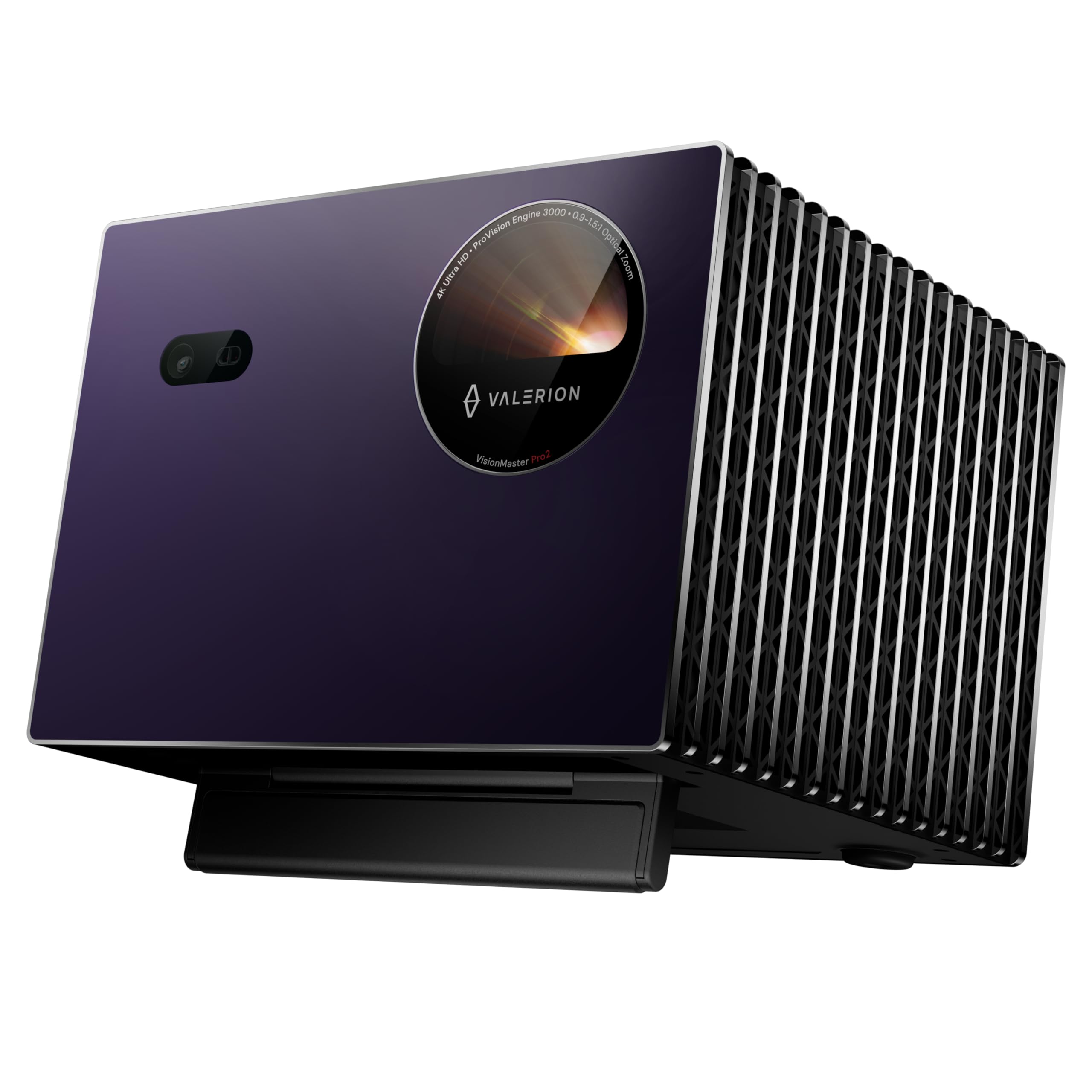
The VisionMaster Pro2 sets a new benchmark in the premium-tier by combining a 3000 ISO lumen triple laser engine with a 15,000:1 native contrast ratio, delivering deep blacks that rival LCD-based competitors. The OpticFlex Lens System (0.9–1.5 throw ratio) preserves full 4K resolution across the zoom range, avoiding the brightness loss typical of digital zoom. Owners consistently report an almost 3D-like image depth.
Gamers benefit from a 4ms input lag at 240Hz, alongside dedicated modes for FPS and RPG. The MT9618 chipset with 4GB RAM ensures snappy Google TV navigation and fast app switching. The Enhanced Black Level (EBL) technology handles letterbox bars admirably, though some users note subtitle blooming in extreme contrast scenes which can be mitigated through calibration.
Physical installation requires careful alignment since the short throw ratio may need digital zoom for very large screens beyond 150 inches, potentially softening the image. The fan remains quiet enough for dialogue-driven scenes, and the ISF-certified calibration gives videophiles a reliable starting point. This projector competes with units costing twice as much.
Why it’s great
- Excellent 15,000:1 native contrast for deep blacks
- 4ms input lag with 240Hz for smooth competitive gaming
- Future-proof 4GB / 128GB chipset for fast streaming
Good to know
- EBL can cause subtitle blooming in dark scenes
- Optical zoom range may require careful placement for max screen size
3. JMGO N1S Ultimate Triple Laser 4K

The N1S Ultimate breaks the price barrier for a daylight-ready triple laser projector. At 3300 ISO lumens, it maintains a vibrant, contrast-rich image even with moderate ambient light — something most mid-range units cannot claim. The 110% Rec.2020 color gamut produces deeply saturated reds and greens that make HDR content pop without appearing artificial.
Its 360° horizontal and 135° vertical gimbal mount allows you to project onto ceilings or walls without repositioning the base, a feature unique in this price bracket. The built-in 20W subwoofer and Dolby Digital+ support produce enough bass for casual viewing, though purists will want external speakers for cinematic dynamics. Google TV 3.0 with official Netflix support removes the app compatibility headache.
Some users note that the built-in UI can feel sluggish after daily use, and the digital zoom lacks a true optical alternative for fine-sizing. The triple laser module shows minor speckle on high-gain screens, but a matte white surface resolves it. Overall, this is the most lumen-dense laser projector under .
Why it’s great
- 3300 ISO lumens handle daytime light exceptionally
- Gimbal design offers unmatched placement flexibility
- Official Netflix license and Google TV onboard
Good to know
- UI can lag after extended use
- No optical zoom; sizing relies on digital zoom only
4. Hisense C2 Ultra Triple Laser Portable

Hisense packs its flagship triple laser technology into a portable form factor with the C2 Ultra, delivering 3000 ANSI lumens and a 2000:1 native contrast ratio. The 1.67x optical zoom is a standout feature — it maintains full 4K resolution and brightness as you resize the image, giving you flexibility across different room layouts without sacrificing quality.
IMAX Enhanced and Dolby Vision certification mean the projector maps HDR content with dynamic metadata, preserving highlight detail in bright outdoor scenes. The 240Hz support at 1080p and 120Hz at 4K keeps gaming fluid, and the “Designed for Xbox” auto-detection reduces latency automatically. The JBL speakers produce clear dialogue, though they lack low-end heft compared to dedicated sound systems.
The 360° gimbal and all-metal body give it a premium feel, but the throw distance required for a 100-inch screen is longer than some competitors, which may challenge smaller rooms. The VIDAA OS is responsive and includes native Netflix, but some users report occasional banner ads on the home screen. For a portable laser that punches above its weight class, the C2 Ultra is a compelling contender.
Why it’s great
- 1.67x optical zoom preserves 4K clarity at any size
- Dolby Vision and IMAX Enhanced for accurate HDR
- 240Hz gaming with low latency and Xbox auto-detection
Good to know
- Needs more throw distance than average for a 100-inch image
- VIDAA OS home screen may display static banner ads
5. NEBULA X1 Triple Laser 4K with Satellite Speakers
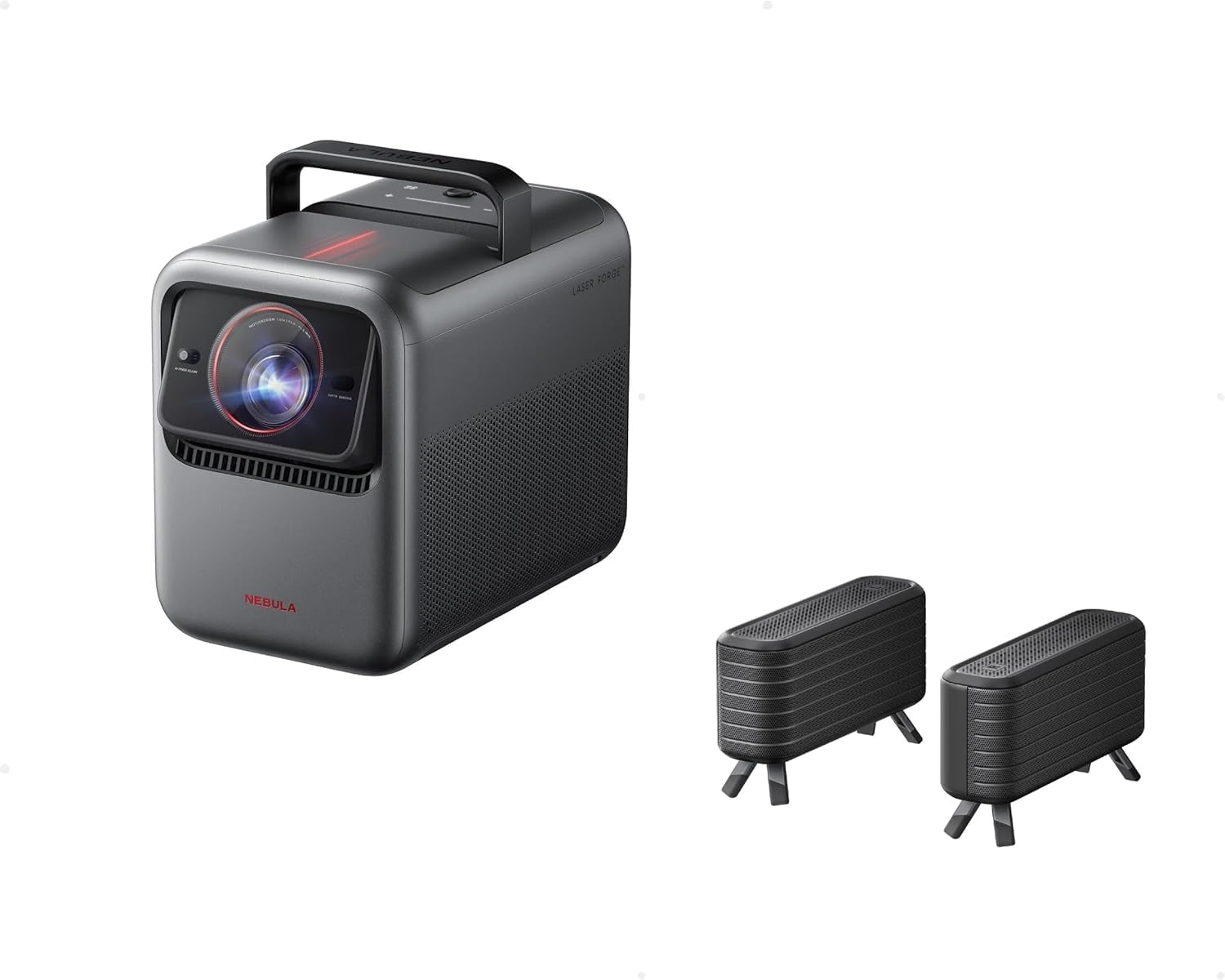
The NEBULA X1 from Anker pushes brightness to 3500 ANSI lumens while using a patented triple-laser optical engine that covers 110% of Rec.2020. The 6-blade iris yields a native 5000:1 contrast, which NebulaMaster software boosts to a staggering 56,000:1 — this dynamic range pulls shadow detail from dark scenes without crushing the floor.
The bundled 4.1.2 wireless satellite speakers create a 200W surround sound stage with 25ms wireless latency, effectively eliminating the need for a separate audio system in medium-sized rooms. The liquid cooling system keeps fan noise under 26 dB, so quiet dialogue remains intelligible. The motorized 25° micro gimbal allows ceiling projection without a mount.
However, the 60Hz input limit prevents 120Hz gaming, which is a notable gap at this price point. Some users report inconsistent quality control on first units, requiring a replacement to get the advertised image quality. The remote lacks an Input Select button and a backlight, making night use less convenient. For cinephiles prioritizing brightness and audio integration over gaming, the X1 delivers a tremendous all-in-one package.
Why it’s great
- 3500 ANSI lumens for bright-room viewing
- 56,000:1 dynamic contrast with excellent black levels
- 200W satellite speakers create true surround sound
Good to know
- Limited to 60Hz input — no high-refresh gaming
- Some units shipped with minor cosmetic or QC issues
6. XGIMI Horizon 20 Max Triple Laser
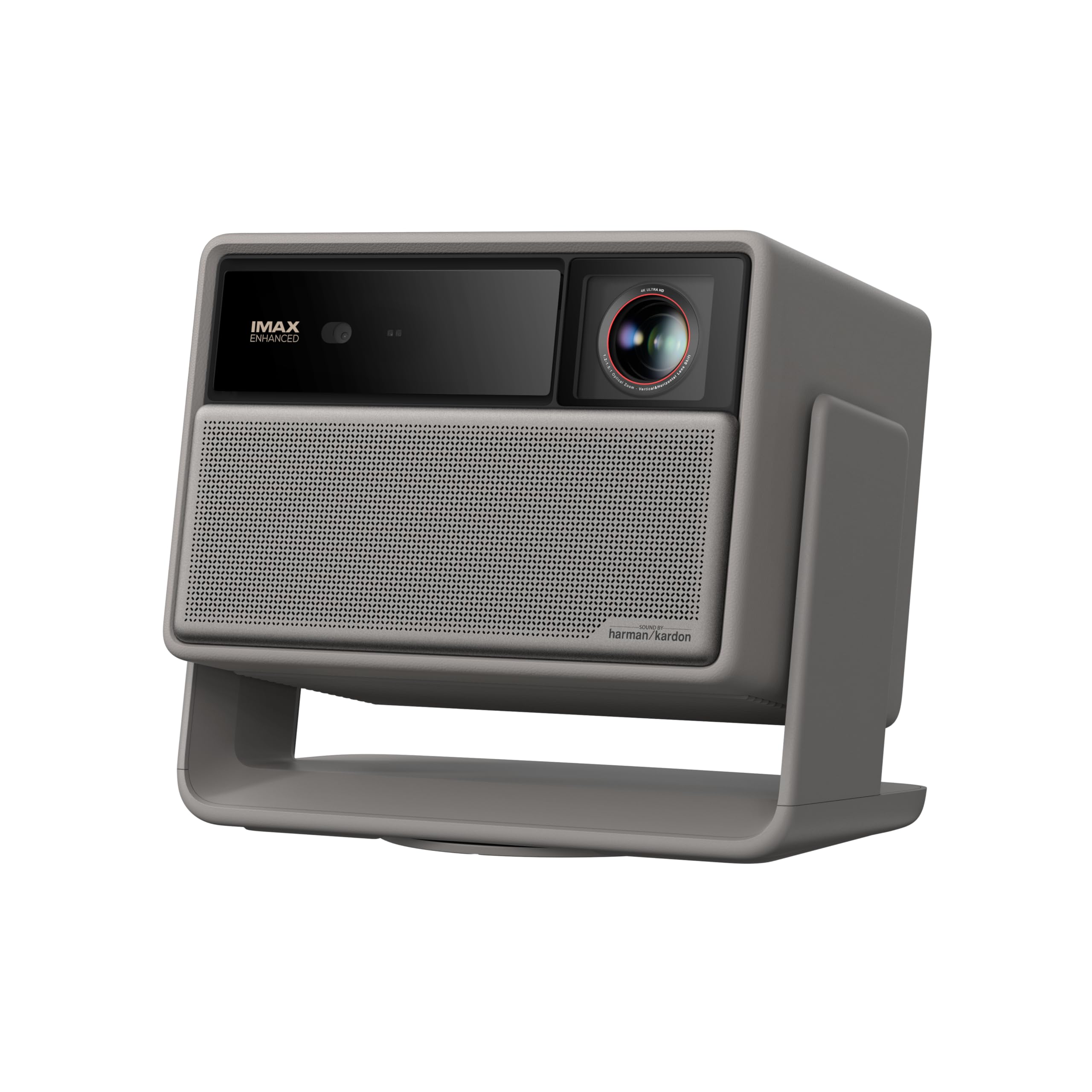
The Horizon 20 Max is the brightest consumer projector on this list at 5700 ISO lumens, powered by XGIMI’s X-Master RGB triple laser engine. This level of flux makes it one of the few projectors that can replace a television in a brightly lit room without sacrificing detail. The 20,000:1 contrast ratio and 110% BT.2020 coverage produce colors that remain saturated even in high ambient light.
Motorized lens shift and optical zoom enable placement flexibility without digital distortion — a rarity among portable laser units. The 1ms input lag at 240Hz is the fastest here, making it ideal for competitive gamers who demand instantaneous response. The Harman Kardon speakers are among the best integrated audio we’ve tested, with a neutral profile that handles both dialogue and music well.
Some users report visible laser speckle on white walls and a subtle rainbow effect on high-contrast text, though most viewers don’t notice it during movie content. Actual sustained brightness in standard mode measures closer to 3600–3900 lumens, still impressive but short of the advertised peak. For a premium living room replacement, however, the Horizon 20 Max sets a new brightness bar.
Why it’s great
- 5700 ISO lumens bright enough for daytime TV replacement
- Motorized lens shift and optical zoom for easy placement
- 1ms input lag at 240Hz for esports-level gaming
Good to know
- Laser speckle may be visible on smooth white surfaces
- Sustained brightness in standard mode is lower than peak rating
7. Epson Home Cinema 5050UB 4K PRO-UHD

The Epson 5050UB remains the gold standard for deep blacks in a sub- projector, thanks to its 3LCD architecture and dynamic iris that achieve a 1,000,000:1 contrast ratio. While it uses pixel-shifting to reach 4K rather than native DLP, the advanced processing and full 10-bit HDR pipeline produce a cinematic image that DLP enthusiasts often praise for its lack of rainbow artifacts.
Motorized lens memory lets you switch between 16:9 and 2.35:1 aspect ratios at the touch of a button — a must-have for serious home theaters with anamorphic screens. The 2600 lumen brightness is sufficient for a dark room, but it falls short of laser-based competitors in ambient light scenarios. Gamers will find the latency acceptable for casual play but not competitive.
The unit is large and heavy at 25 pounds, requiring a robust ceiling mount. Some users report a 15-second HDMI handshake delay when switching to 4K HDR content, which can be resolved with fiber optic HDMI cables. For a purist home theater with controlled lighting, the 5050UB’s black level performance is still unmatched by most laser projectors under .
Why it’s great
- 1,000,000:1 contrast with superb black level performance
- Motorized lens memory for 16:9 and 2.35:1 switching
- No rainbow effect — 3LCD is comfortable for sensitive viewers
Good to know
- Large and heavy (25 lbs) — needs a sturdy mount
- 2600 lumens less competitive in bright rooms vs laser units
8. NexiGo Aurora Pro MKII Tri-Color Laser UST

The Aurora Pro MKII distinguishes itself in the ultra short throw category with its ALPD 5.0 laser engine and Scene Adapt Engine (SAE) that dynamically adjusts laser output frame-by-frame to achieve a 30,000:1 contrast ratio. The 0.21:1 throw ratio means it can produce a 150-inch image from just inches away from the wall, making it ideal for tight living rooms where ceiling mounting is impossible.
Dolby Vision and HDR10+ support ensure tone-mapped accuracy across a wide variety of content, while the 4.2ms–8ms gaming latency in 4K 120Hz mode is excellent for a UST — a segment traditionally plagued by higher input lag. The 60W built-in speakers with Dolby Atmos processing provide adequate room-filling sound, though a dedicated AVR and speaker setup will unlock its full potential.
Some users report that the projector requires a high-quality ALR screen to control ambient light, as the 2400 lumen brightness can appear washed out on a bare white wall during daytime. A few units have experienced overheating and shutdown issues, though NexiGo’s support on the AVS forums is responsive. For a feature-dense UST that covers both movie and gaming needs, the Aurora Pro MKII delivers exceptional value.
Why it’s great
- 30,000:1 dynamic contrast with Scene Adapt Engine
- Ultra-short 0.21:1 throw for 150-inch images in tight spaces
- 4.2ms–8ms gaming latency at 4K 120Hz
Good to know
- Needs an ALR screen for best daytime performance
- Some units reported overheating; check support responsiveness
9. AWOL VISION LTV-3000 Pro UST Triple Laser

The LTV-3000 Pro is a niche standout as the world’s first UST projector with a dedicated center channel speaker, mapping dialogue directly to the screen area for clear vocals without external speakers. Its triple laser engine covers 107% BT.2020 and 147% DCI-P3, producing cinema-grade color volume that rivals commercial digital projectors. The 2000 lumen brightness is best paired with AWOL’s ALR screen for daytime use.
Active 3D support is a rare inclusion at this level, and when paired with a 3D Blu-ray player, the depth effect is genuinely immersive without the ghosting that plagues lesser DLP units. Dolby Vision HDR dynamically optimizes each frame, pulling highlight detail from sunbursts and explosions that can look blown out on cheaper projectors. The 0.25:1 throw ratio fits on most media cabinets without issue.
The 60Hz refresh rate cap limits gaming to cinematic titles, and the built-in speakers — while functional for dialogue — lack the frequency range for explosive action scenes without a subwoofer. Some users note that the menu system is primitive and that 3D mode must be re-enabled after each power cycle. For a dedicated home cinema that prioritizes color accuracy and 3D immersion, the LTV-3000 Pro is a specialized but excellent choice.
Why it’s great
- Built-in center channel improves dialogue clarity
- Exceptional 147% DCI-P3 color gamut for cinema-like color
- Active 3D support with minimal ghosting
Good to know
- 60Hz limit — not ideal for fast-paced gaming
- 3D mode needs manual re-enabling after power off
10. ViewSonic PX701-4K Home Theater Projector

The PX701-4K brings high-refresh gaming to a budget-friendly tier with 240Hz at 1080p and a 4.2ms input lag that rivals dedicated gaming monitors. The 3200 ANSI lumen lamp produces a bright, punchy image even with some ambient light, and the 12,000:1 contrast ratio (dynamic) keeps black levels acceptable for the category. It’s a strong candidate for a mixed-use scenario where gaming and movie nights share the same space.
SuperColor technology and HDR/HLG support deliver a wider color gamut than typical entry-level DLP projectors, though HDR highlights can appear clipped in very bright scenes due to the lamp’s limited dynamic range. The auto vertical keystone and 4-corner adjustment make tabletop or ceiling setup straightforward, and the dual HDMI inputs allow permanent connection to a streaming device and a console.
The 1.1x optical zoom is modest, and the lamp life (up to 20,000 hours in SuperEco) is shorter than LED or laser alternatives. Some units have arrived with defective bulbs or grinding fans, though replacements generally work perfectly. For the price, the PX701-4K delivers the fastest gaming performance of any DLP projector in this range, making it a smart entry point.
Why it’s great
- 240Hz / 4.2ms input lag for ultra-competitive gaming
- 3200 ANSI lumens provide bright, vibrant daytime image
- Auto vertical keystone and 4-corner adjustment for easy setup
Good to know
- Lamp-based light source requires bulb replacement after ~4000 hours
- 1.1x optical zoom limits placement flexibility
11. LG CineBeam HU70LA DLP LED 4K Projector

The HU70LA is a compact, wheel-less LED projector that uses a 4-channel LED light source to eliminate the rainbow effect common in single-chip DLP units. Its 1500 lumen brightness is best suited for a dedicated dark room, where the 4K UHD resolution (via XPR pixel shifting) delivers sharp, detailed images up to 140 inches. The LED engine is rated for 30,000 hours — nearly 10 years of average use — with no bulb replacements.
Integrated LG smart TV platform with Magic Remote provides a polished streaming experience, including built-in Chromecast and Bluetooth pairing. The remote’s pointer function makes navigating menus intuitive, and the 1.25x remote focus zoom allows fine-tuning screen size without moving the projector. HDR10 with Dynamic Tone Mapping adjusts contrast frame-by-frame, preserving shadow detail in dark scenes.
The HU70LA is dim compared to lamp and laser competitors, limiting its use to rooms with excellent light control. Some users report that the smart home hub features (Alexa integration) are poorly implemented, and the lack of Netflix pre-installed means you’ll likely rely on an external 4K stick. For a long-lasting, rainbow-free, and well-designed entry into 4K projection, the HU70LA remains a solid smart option.
Why it’s great
- Long-lasting LED light source (30,000 hours)
- Polished LG smart TV platform with Magic Remote pointer
- No rainbow artifacts — comfortable for sensitive viewers
Good to know
- 1500 lumens require a fully dark room for best image
- Smart home and Alexa features are poorly implemented
FAQ
What throw ratio do I need for a 120-inch screen in a small room?
Is pixel-shifted 4K as good as native 4K on a 120-inch screen?
How does a triple laser projector affect color accuracy compared to LED?
Final Thoughts: The Verdict
For most users, the best 4k projector for home winner is the Valerion VisionMaster Pro2 because it delivers premium triple-laser contrast, true optical zoom, and ultra-low gaming latency at a competitive price. If you want a daylight-ready portable projector with a built-in gimbal, grab the JMGO N1S Ultimate. And for a dedicated dark-room theater with unmatched black levels and lens memory, nothing beats the Epson Home Cinema 5050UB.