
Our readers keep the lights on and my morning glass full of iced black tea. As an Amazon Associate, I earn from qualifying purchases.
Specs are compiled from manufacturer listings and verified buyer reviews and can change over time — please confirm the key details on the product page before buying.
For live-streaming a church service, lecture, or event, avoid cameras that hunt for focus, whir loudly, or lose the speaker. A 4K PTZ camera (Pan-Tilt-Zoom) handles movement, zoom, and tracking automatically.
This guide compares manufacturers’ specs and verified customer reviews to reveal each camera’s real strengths and trade-offs.
These 4K PTZ cameras are selected for houses of worship, corporate boardrooms, and live-streaming studios, matching features to your production needs.
Quick Picks
- Prisual Ultra 4K PRO NDI PTZ Camera Gen 5 — Pro Broadcast
- FoMaKo K600NW 4K 60fps NDI PTZ Camera — Best Value 60fps
- Tenveo 4K NDI 6 & NDI HX3 PTZ Camera — Durable Workhorse
- TONGVEO 4K NDI PTZ Camera — All-in-One Output
- OBSBOT Tail Air NDI Streaming Camera 4K — Portable Travel Pick
- PTZOptics Move 4K 30x Auto-Tracking PTZ Camera — Premium Install
How To Choose The Best 4K PTZ Camera
Choose a PTZ camera by matching your room size, content type, and existing gear.
Optical Zoom vs. Digital Zoom
Optical zoom uses the camera’s glass to bring subjects closer without losing picture quality, keeping a speaker sharp from the back of the room. Digital zoom crops the picture, lowering resolution and adding grain. For large spaces, a camera with a 20x or 30x optical zoom is a better choice than one relying on digital zoom.
NDI Certification and Connectivity
NDI (Network Device Interface) lets you send video over your regular Ethernet network through a single cable, instead of running separate HDMI, SDI (Serial Digital Interface), and power lines. Officially certified NDI cameras guarantee stable performance with streaming software like OBS and vMix. Non-certified cameras may still work but can have higher latency (a delay between the action and what you see) or connection issues. Look for PoE (Power over Ethernet) support, so one cable carries both data and power.
AI Auto-Tracking Quality
Basic AI tracking only follows a person’s face, which means it can lose the subject if they turn around or if something blocks their face. Better systems combine face and body recognition so the camera keeps tracking even during a partial obstruction. Most cameras also let you switch between presenting mode (one person fixed in frame) and auto-framing mode (a group stays centered).
Frame Rate and Sensor Size
A 4K 30fps camera is fine for typical streaming, but 4K 60fps makes motion noticeably smoother for fast-paced content like esports or concerts. The sensor size affects how well the camera handles dimly lit rooms—larger sensors, like a 1/1.8-inch CMOS, collect more light, producing cleaner video without extra noise.
Quick Comparison
On smaller screens, swipe sideways to see the full table.
| Model | Best For | Max Zoom | Max Framerate | Connectivity | Amazon |
|---|---|---|---|---|---|
| Prisual Ultra 4K PRO NDI | Professional broadcast | 20x Optical, 16x Digital | 4K 60fps | NDI, HDMI 2.0, SDI, PoE | $1,048.99$1,299.00Limited time dealAmazon |
| FoMaKo K600NW | Smooth 60fps streaming | 20x Optical, 16x Digital | 4K 60fps | NDI, HDMI, 3G-SDI, PoE | $649.00$699.00Amazon |
| Tenveo 4K NDI PTZ | Durable live production | 20x Optical, 8x Digital | 4K 30fps | NDI, HDMI, USB 3.0, PoE | $459.00Amazon |
| TONGVEO 4K NDI PTZ | All-in-one output options | 20x Optical | 4K 30fps | NDI, HDMI, SDI, USB 3.0, PoE | $459.00Amazon |
| OBSBOT Tail Air NDI | Portable travel streaming | 4x Digital | 4K 30fps | NDI, HDMI, USB-C, Wi-Fi | $424.00$499.00Amazon |
| PTZOptics Move 4K 30x | Large-room commercial installs | 30x Optical, 16x Digital | 4K 60fps | NDI, HDMI, 3G-SDI, PoE | $2,595.00Amazon |
In‑Depth Reviews
1. Prisual Ultra 4K PRO NDI PTZ Camera Gen 5
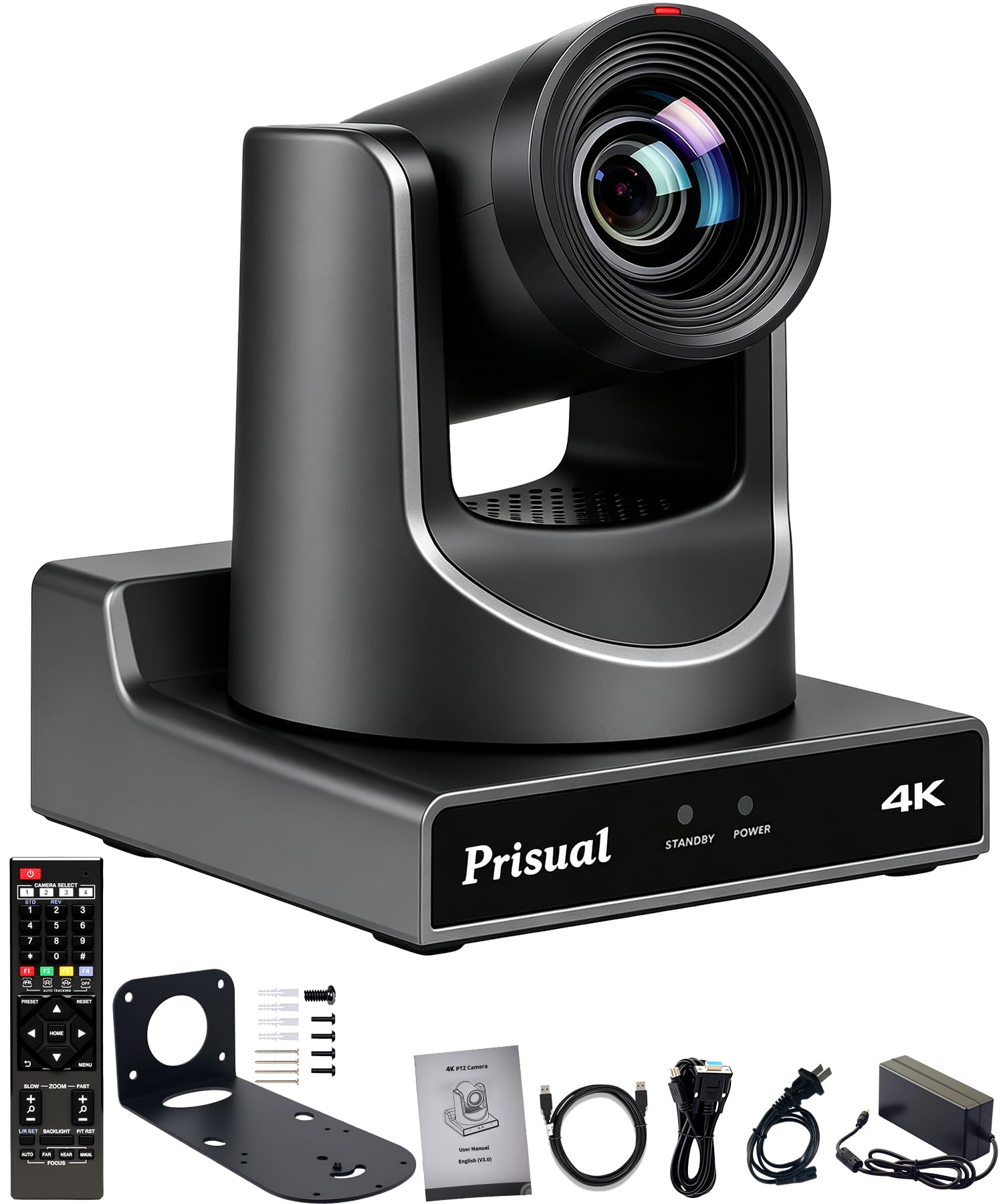
The Prisual delivers smooth 4K at 60fps with an 8.42MP sensor that handles dim rooms without washing out.
This camera is built for houses of worship and professional live studios that cannot afford a missed moment. You get ultra-smooth 4K video at 60 frames per second, powered by a 1/1.8-inch UHD CMOS sensor with 8.42 megapixels — so even in a low-light sanctuary or conference hall, the picture stays crisp instead of noisy. The 20x optical zoom and 16x digital zoom let you pull tight on a pastor or presenter without losing the sharpness you need for broadcast.
The Gen5 AI tracking is the standout feature here. You press F3 on the remote to start tracking, and the camera automatically adjusts framing from a wide shot to a close-up while remembering 4 different zones. Buyers report the NDI support works great with OBS and that the camera itself is silent — one owner mentioned the synchronous belt drive keeps movements quiet during a sermon, so there is no mechanical whir distracting the congregation.
Setup is straightforward because the camera ships with DHCP networking; press *#4 on the included IR remote to see the IP address displayed on the HDMI output. The biggest trade-off compared to the FoMaKo K600NW is that the Prisual uses a metal housing that owners say lasts well, while the FoMaKo offers an even lower entry price for similar 4K 60fps streaming — but the Prisual comes with official NDI certification and a 3-year warranty that gives confidence for critical events.
What makes it shine
- True 4K at 60fps via HDMI 2.0 with zero compression.
- Gen5 AI tracking remembers 4 zones and tracks even when face is briefly blocked.
- Silent synchronous belt drive means no camera noise during quiet moments.
A couple of caveats
- IP controller setup can require a TeamViewer session with support for resolution.
- Built-in media does not include a tally light; that is a separate purchase.
Reach for this if: your main concern is clean 4K 60fps video in a dim room, backed by official NDI certification and a long warranty for mission-critical streaming.
Look elsewhere if: your budget is tighter and you can settle for 4K 30fps — the Tenveo or FoMaKo options cost less and still deliver great results.
2. FoMaKo K600NW 4K 60fps NDI PTZ Camera
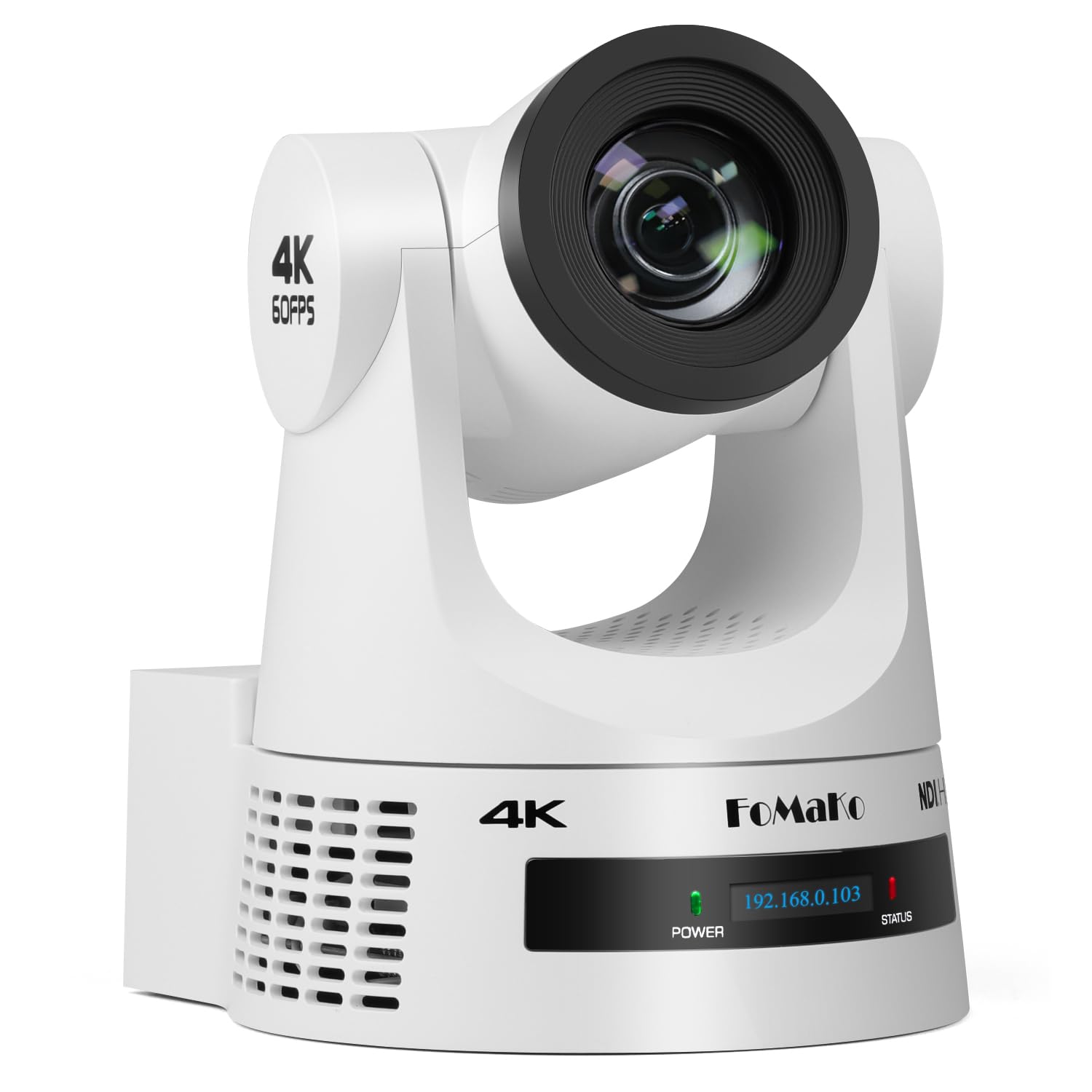
This is the most affordable way to get genuine 4K 60fps NDI output with a wide set of pro connectors.
If you do not need the higher-resolution sensor of the Prisual but you still want buttery-smooth 60fps video, the FoMaKo K600NW delivers it at a noticeably lower cost. The camera outputs 4K 60fps over both HDMI and NDI, and it also includes a 3G-SDI port for long cable runs up to 300 feet — perfect for a multi-camera worship service or a live production where you need to run a cable across a hall.
The platform supports up to 255 presets (10 via the included IR remote), and the Gen 3 AI tracking lets you adjust tracking sensitivity, figure size, and what happens when the target is lost. Owners mention the camera connects nearly plug-and-play and works well with other brands inside a live switcher, though one reviewer noted the IR remote has an angle issue when the camera is mounted from the back.
Compared to the Tenveo 4K NDI, the FoMaKo gives you that higher 60fps frame rate while the Tenveo sticks to 4K 30fps — a clear advantage if you are shooting fast movement like a dance performance or a product launch. The trade-off is that the Prisual’s larger 1/1.8-inch sensor handles low light better, but for most well-lit stages and conference rooms, the FoMaKo holds up just fine.
Standout features
- Real 4K 60fps output over NDI and HDMI without breaking the budget.
- 3G-SDI port for long-distance video runs without extra gear.
- Up to 255 presets give you flexibility for complex multi-shot productions.
Notable drawbacks
- Initial network setup can be tricky — one buyer needed HDMI to configure DHCP.
- Documentation has some translation issues that make certain settings unclear.
Choose this when: you want the smoothest motion possible at a mid-range price, especially for recording fast-moving speakers, esports, or live concerts.
Pass on this if: you need the best low-light performance or a metal chassis — the Prisual or PTZOptics are more rugged for dim environments.
3. Tenveo 4K NDI 6 & NDI HX3 PTZ Camera
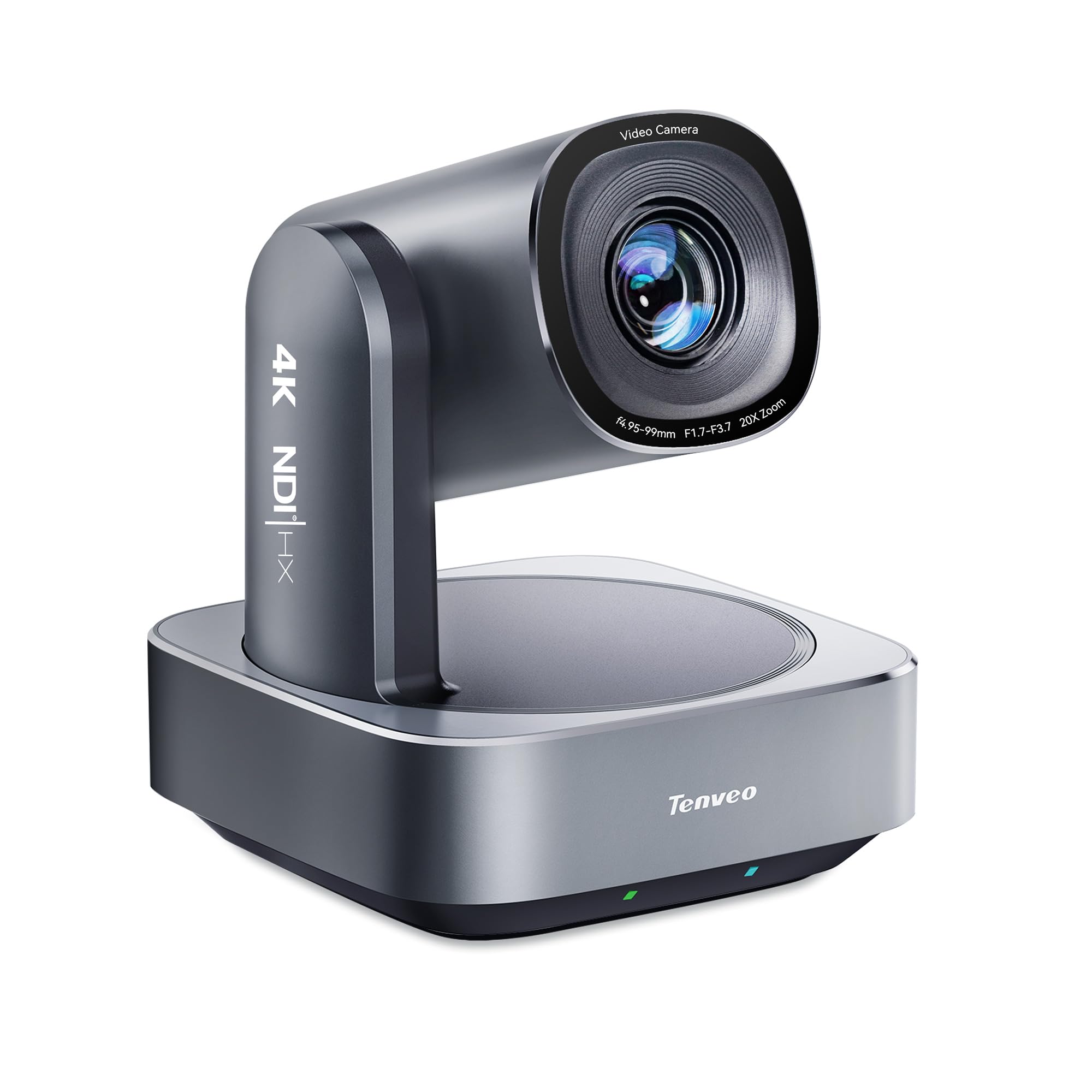
The Tenveo combines a 20x optical zoom with an 8x digital zoom, versus the OBSBOT Tail Air’s 4x digital zoom.
This camera is designed for streamers who need a reliable main camera that can zoom far without losing detail. It is equipped with a 1/2.8-inch CMOS sensor rated at 8.29 megapixels, and the 20x optical zoom plus 8x digital zoom means you can go from a wide 63° angle to a tight close-up on a speaker all the way at the back of a large room. The NDI HX3 certification keeps latency low even on a shared network.
Customers note this camera is “extremely durable after 3 years of heavy streaming use” — a level of reliability that is rare in this price range. The AI humanoid and face auto-tracking can lock onto a target even when something blocks them momentarily, and you can switch between presenting and auto-framing modes. Some users note the PTZ controls in OBS can be a little erratic through the plugin, but the camera works smoothly with standalone PTZ Optics software.
The Tenveo has 8x digital zoom, versus the OBSBOT Tail Air’s 4x digital zoom, so you get noticeably tighter close-ups when you are fully zoomed in. It also supports PoE, meaning one Ethernet cable delivers power and data — unlike the OBSBOT which relies on an internal battery that one buyer mentioned died after 13 months, leaving the camera unusable. That makes the Tenveo a safer long-term choice for fixed installations.
What it does best
- 3-year user reports of heavy daily streaming with no issues — rare durability.
- 20x optical + 8x digital zoom covers both wide rooms and distant subjects.
- PoE simplifies wiring to one cable for power, data, and control.
Things to note
- No built-in microphone — you will need a separate audio source.
- Some users found the PTZ plug-in for OBS causes random gear-skip movements.
Go with this if: you want a proven, long-lasting 4K PTZ camera for daily streaming where optical range matters more than 60fps.
Skip this if: you need built-in audio or absolutely flawless OBS plug-in control — those are available on other picks.
4. TONGVEO 4K NDI PTZ Camera

The TONGVEO offers HDMI, SDI, USB 3.0, and NDI all in one package so you can connect to any existing switcher.
This camera fills the gap for production teams that already own an ATEM switcher or long SDI cables. The TONGVEO gives you professional-grade SDI output that runs up to 300 feet without needing an extra converter, plus HDMI and USB 3.0 — meaning it works with almost any streaming setup from the start. The 20x optical zoom and AI auto-tracking combine both facial and human body recognition, so if the subject’s body is blocked the camera keeps tracking once their face reappears.
Reviewers point out that even in low-light situations the image stays sharp with less fiddling compared to a Logitech webcam. Several owners mention the camera is a great value for its price, and one reviewer who also owns a PTZOptics Move 4K noted the TONGVEO gives comparable image quality for a fraction of the investment. The downside is that the IR remote feels a bit clunky, and network streaming (IP/NDI) maxes out at 1080p, not the full 4K you get over HDMI or USB.
Compared to the Tenveo above, the TONGVEO adds an SDI port which the Tenveo lacks, making it a better fit for traditional broadcast workflows. The TONGVEO also supports PoE and includes a wall mount bracket with screws in the box, so you are ready to ceiling-mount it immediately — no extra parts needed.
Key advantages
- SDI, HDMI, USB 3.0, and NDI outputs give you maximum compatibility with pro gear.
- AI tracking uses both face and body recognition for more reliable subject lock.
- PoE and included wall mount make ceiling installation a single-cable job.
Limitations
- NDI and IP streams are capped at 1080p, not full 4K.
- The IR remote is a bit awkward to use, especially compared to a dedicated controller.
Best pick for: anyone who already owns an ATEM switcher or runs SDI cables and wants one camera that outputs to every major format without adapters.
Look past this if: you need full 4K over your network stream — the FoMaKo or Prisual deliver 4K over NDI without compromise.
5. OBSBOT Tail Air NDI Streaming Camera 4K

The OBSBOT is a tiny 4K PTZ camera smaller than a cola can that runs on battery for on-the-go streaming.
This is the only battery-powered camera in the lineup, making it ideal for streamers, YouTubers, and pastors who need to move between rooms without dragging cables. It weighs 344.5 grams and fits in a small bag, yet it still delivers 4K resolution and a 320° horizontal rotation with 180° vertical tilt. The AI tracking works on humans, animals, and objects, and you can control it via hand gestures, a remote, or the Obsbot Start app.
Reviewers love the sharp 23mm f/1.8 lens and how the UVC mode lets it act as a simple plug-and-play webcam for Zoom or Teams. However, the 4x digital zoom is very limited compared to the 8x or 16x of other picks — zooming in past 2x already starts to soften the image. One buyer warned that after 13 months the battery died and the camera would not function without a working battery, which is a serious concern for long-term use.
This is the only camera with a battery, so it is a trade-off: you get portability, but the internal battery is not user-replaceable, and the digital zoom cannot match the optical range of the Tenveo or PTZOptics. If you plan to use this as a fixed camera day after day, the Tenveo or TONGVEO are more reliable options.
Why you might love it
- Truly portable — battery-powered and weighs under 350 grams.
- AI tracking handles humans, animals, and objects with gesture control.
- UVC mode turns it into a standard webcam for any streaming app.
Where it falls short
- 4x digital zoom only — cannot optically zoom like the 20x options above.
- Battery is not user replaceable and one owner reported it failing after 13 months.
Choose this if: you need an ultra-portable PTZ camera for mobile streaming, outdoor events, or traveling between venues without carrying a full rig.
Avoid it if: the camera will stay in a fixed ceiling or wall mount — the battery degrades over time and the zoom range is too short for large rooms.
6. PTZOptics Move 4K 30x Auto-Tracking PTZ Camera
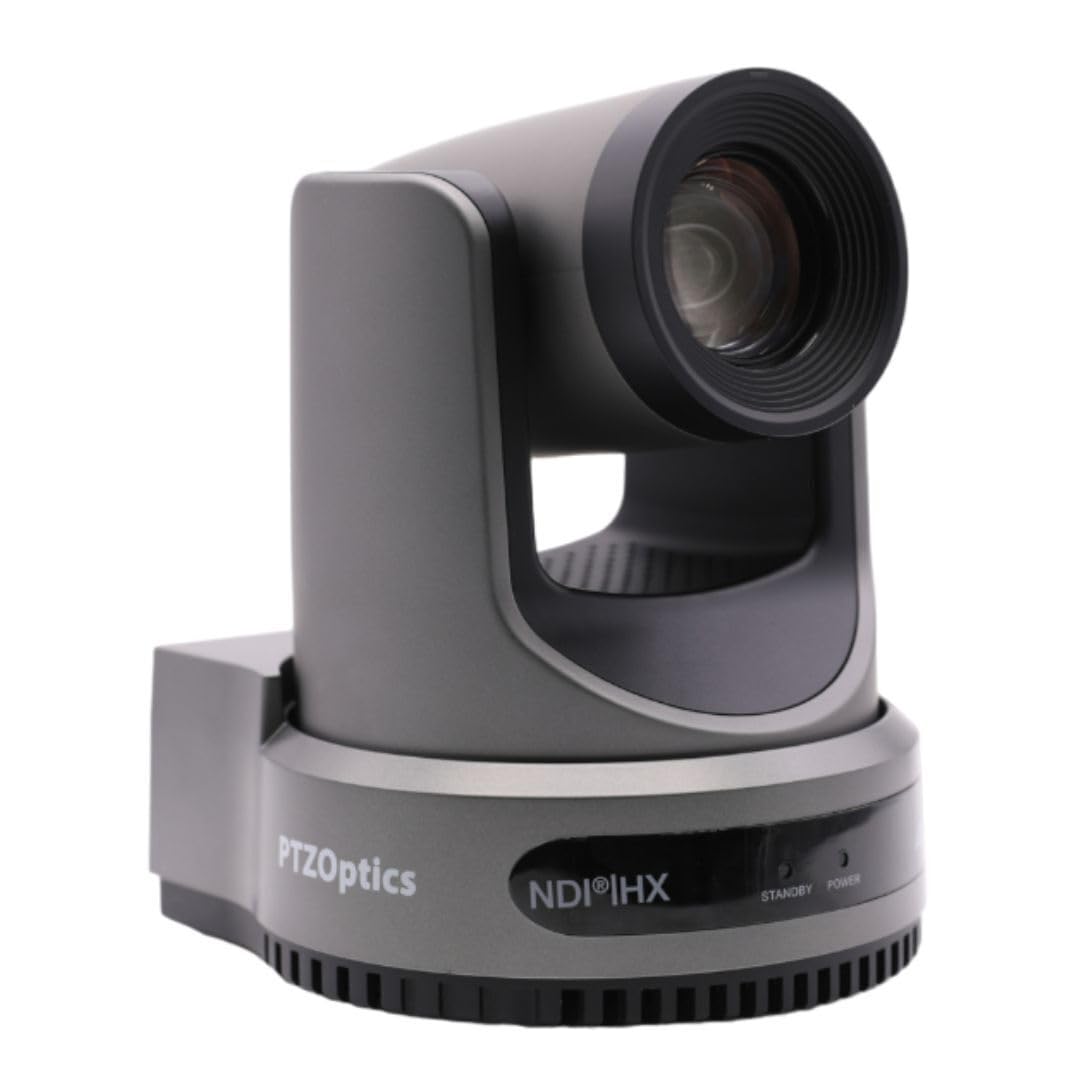
The PTZOptics offers the longest optical range of any camera here with a 30x zoom and a next-gen Sony sensor.
This is the heavy lifter for large auditoriums, conference centers, and sanctuaries where the camera needs to sit all the way at the back of a 200-foot room and still grab a tight close-up. The 30x optical zoom is paired with a next-generation Sony UHD CMOS sensor that delivers 4K at 60fps, and a built-in tally light shows you (or the operator) whether the camera is live or in preview mode — a small detail that saves confusion in multi-camera productions.
The camera supports simultaneous outputs via NDI, USB, and IP, plus your choice of SDI or HDMI. You get multiple exposure modes including Program, Aperture Priority, Shutter Priority, and Manual, so you can dial in exactly the look you want for a sunlit stage or a dim theater. Buyers love the 3D noise reduction and how quiet the PTZ mechanism operates, but one reviewer pointed out a significant reliability issue: the camera does not remember preset positions between sessions, which is a problem for a completely automated broadcast where you need consistent shots every time.
At 30x optical zoom, the PTZOptics outranges every other pick in this list — the Tenveo and TONGVEO top out at 20x. The price is also substantially higher, which makes sense if your room is very large or you need the professional credentials of an established brand. If your room is smaller than 100 feet, the 20x zoom on the Tenveo or FoMaKo still gives you plenty of reach for a much lower investment.
Pro-level strengths
- 30x optical zoom brings distant stages and presenters into sharp frame.
- Built-in tally light immediately shows live/preview status during multi-cam shoots.
- Simultaneous NDI, USB, IP, and SDI/HDMI outputs cover every workflow.
Important downsides
- Does not remember preset positions between power cycles — a dealbreaker for automated setups.
- The web interface and iPhone app have poor image quality and confusing controls.
Reach for this when: your venue is a large room that demands the longest zoom reach available and you need a built-in tally light for multi-camera productions.
Look elsewhere if: you cannot have an operator manually adjust presets each session, or your room is small enough that 20x zoom covers everything — the Tenveo or TONGVEO will save you a lot of money.
Understanding the Specs
Optical Zoom vs. Digital Zoom
Optical zoom uses the camera lens to magnify the image physically, so 20x optical zoom keeps the picture sharp at maximum reach — it is the number that matters when you need to see a person’s face from the back of a church or auditorium. Digital zoom just crops the image and enlarges the remaining pixels, which lowers resolution and introduces grain. A camera with 20x optical zoom is far more useful for large rooms than one relying on digital zoom, no matter how many digits that digital number is.
NDI Certification and PoE
NDI (Network Device Interface) allows video, audio, and control signals to travel over a standard Ethernet network. An officially certified NDI camera has been tested by NewTek to work reliably with streaming software like OBS and vMix. PoE (Power over Ethernet) lets a single Ethernet cable carry both the power and the data, so you do not need a separate power outlet near the camera — a huge advantage when mounting a camera on a ceiling or far wall.
FAQ
Do I need NDI or can I use HDMI for my church stream?
What is the difference between NDI HX3 and full NDI?
How far can a 20x optical zoom camera actually see?
Can I use a 4K PTZ camera without a dedicated operator?
Do I need separate audio equipment for these PTZ cameras?
Can I control the PTZ camera from a smart phone or tablet?
What does PoE mean for installation?
How long do PTZ cameras typically last before needing replacement?
Do all PTZ cameras support 4K over NDI?
Can I mix different brands of PTZ cameras in the same live production?
Final Thoughts: The Verdict
For most buyers, the best 4K PTZ camera is the Prisual Ultra 4K PRO NDI because it delivers official NDI certification, smooth 4K 60fps video, and a large 1/1.8-inch sensor that sees clearly even in dim rooms. If you want the same 60fps smoothness at a lower price, grab the FoMaKo K600NW. And for the longest optical reach in a giant auditorium, the standout is the PTZOptics Move 4K 30x — just make sure you are comfortable with the setup quirks and preset-recall issue.
How We Picked
We do not accept paid placement, and we did not hands-on test every unit. Instead, we match each pick to a real buyer and use-case by comparing the manufacturers’ published specifications against the patterns in verified customer reviews — so you get each pick’s real strengths and trade-offs instead of marketing copy.
Sources & Methodology
Specifications: manufacturer listings and product documentation. Review insights: verified customer reviews, as of July 2026. Pricing: not shown on this page (it changes often); check the current price via the retailer link.
As an Amazon Associate, Gadgets Feed earns from qualifying purchases. This does not affect which products we feature.
Product prices and availability are accurate as of the date/time indicated and are subject to change. Any price and availability information displayed on Amazon at the time of purchase will apply to the purchase of this product. As an Amazon Associate I earn from qualifying purchases.
CERTAIN CONTENT THAT APPEARS ON THIS SITE COMES FROM AMAZON. THIS CONTENT IS PROVIDED "AS IS" AND IS SUBJECT TO CHANGE OR REMOVAL AT ANY TIME.
Amazon and the Amazon logo are trademarks of Amazon.com, Inc. or its affiliates.