
Our readers keep the lights on and my morning glass full of iced black tea. As an Amazon Associate, I earn from qualifying purchases.
Specs are compiled from manufacturer listings and verified buyer reviews and can change over time — please confirm the key details on the product page before buying.
Getting clear, punchy sound from a pair of 4×6 speakers — without them rattling apart at highway speeds — is tough when many budget models sound thin or blow out the first time you turn up the volume. This guide sorts the specs that matter from the marketing noise, so you know which pair is a real upgrade and which is a temporary fix.
I’m Min — the founder and writer behind Gadgets Feed. This guide is built by comparing the manufacturers’ published specifications and the patterns across verified customer reviews, so you get each pick’s real strengths and trade-offs instead of marketing spin.
Replacing blown factory speakers in an older truck or hunting for a noticeable audio upgrade in a modern sedan depends on understanding power handling (how much power the speaker can handle without distorting), cone material (what the main vibrating surface is made of), and tweeter design (the part that handles high notes) — then matching them to your vehicle and listening habits.
Quick Picks
- Polk Audio DB462 DB+ Series 4″ x 6″ Coaxial Speaker — Best Overall
- KICKER 51KSC4604 KS-Series 4×6 Coaxial Speakers — Pro-Grade Upgrade
- Rockford Fosgate P1462 Punch 4″x6″ 2-Way Coaxial Speakers — Audiophile Choice
- SoundXtreme 4×6 3-Way 220 Watts Coaxial Car Speakers — Best Value
- Pyle 3-Way Universal Car Stereo Speakers – 300W 4″ x 6″ Triaxial — Budget Pick
How To Choose The Best 4×6 Car Speakers
Picking the right pair starts with matching the speaker to your car’s electrical system and your expectations. A high-power speaker on a weak factory head unit will never reach its potential, while a low-sensitivity speaker might leave you turning the volume knob with nothing to show for it.
Power Handling: RMS is the Real Number
Manufacturers list a “peak power” number that is a short burst, not sustainable volume. The RMS (Root Mean Square) rating — the speaker’s continuous power limit, which is typically lower — is the spec you use to match a speaker to your stereo or amplifier. Match RMS to your amp’s per-channel output to get clear sound without distortion or damage.
Tweeter Type and Sound Signature
The tweeter reproduces the highest frequencies. A silk dome tweeter (like on the Polk Audio DB462) gives a warmer, smoother high end. A piezo tweeter (like on the Pyle PL4163BK) is durable but can sound harsh at high volume. A PEI (Poly-ether Imide) dome (like on the SoundXtreme) sits in between, offering a balanced sound for the price.
Sensitivity: How Loud from Low Power
Measured in dB (decibels), sensitivity tells you how much sound a speaker produces from a given amount of power. A higher sensitivity (like 88dB) means the speaker gets louder with less power — a critical spec if you are keeping your factory stereo without an external amp.
Quick Comparison
On smaller screens, swipe sideways to see the full table.
| Model | Best For | Peak Power | Tweeter | Sensitivity | Amazon |
|---|---|---|---|---|---|
| Polk Audio DB462 | Rugged All-Weather Use | 150W | 3/4″ Silk Dome | — | $86.50Amazon |
| KICKER KS-Series | Premium Sound Upgrade | — | .5″ PEI Dome | — | $99.99Amazon |
| Rockford Fosgate P1462 | High-Fidelity with Amp | 70W Max | Silk Dome | — | $109.99Amazon |
| SoundXtreme ST-460 | Budget-Friendly Upgrade | 220W | 1/2″ PEI Dome | 88dB | $31.99Amazon |
| Pyle PL4163BK | Cheap Factory Replacement | 300W | 3/4″ Piezo | — | $25.64$29.99Amazon |
In‑Depth Reviews
1. Polk Audio DB462 DB+ Series 4″ x 6″ Coaxial Speaker

The all-weather champ that cranks clean sound even with the doors off.
If you drive a Jeep, a boat, an ATV, or anything that lives outside a climate-controlled garage, this is the speaker built to survive it. The DB462 carries an IP56 marine certification (meaning it resists splashes and humidity), with coated steel baskets tested for salt-fog, UV, and humidity. Its 150W peak power and 50-22kHz frequency response — a 2.5x wider range than the KICKER KS-Series which tops out at 20 KHz — deliver highs that stretch further and lows that hit deeper. The 3/4″ silk dome tweeter and built-in crossover keep vocals crisp without the harsh edge you get from cheaper materials.
Buyers report it “handles abuse (mud, high speeds)” and still delivers “great sound quality even with doors/top off at 55mph.” That is real durability you cannot fake. The trade-off is a common one: the mounting holes do not always line up with older dash layouts, and the install can be painful — especially on a Jeep YJ that requires pulling the entire dash. But once they are in, the sound drowns road noise even at highway speeds.
The Defining Strength
- IP56 marine rating handles rain, mud, and direct spray
- Wider frequency range than the KICKER KS (50-22kHz vs. up to 20 KHz)
- Silk dome tweeter delivers smooth, non-fatiguing highs
The Real-World Cost
- Mounting bracket fitment can be tricky — expect to drill or modify
- Low bass distorts at very high volume; adding bass blockers helps
Your go-to if: you need a speaker that survives mud, rain, and highway speed while sounding better than factory.
Reconsider if: you want the highest possible peak power or instant bolt-in fit on some vehicles.
2. KICKER 51KSC4604 KS-Series 4×6 Coaxial Speakers
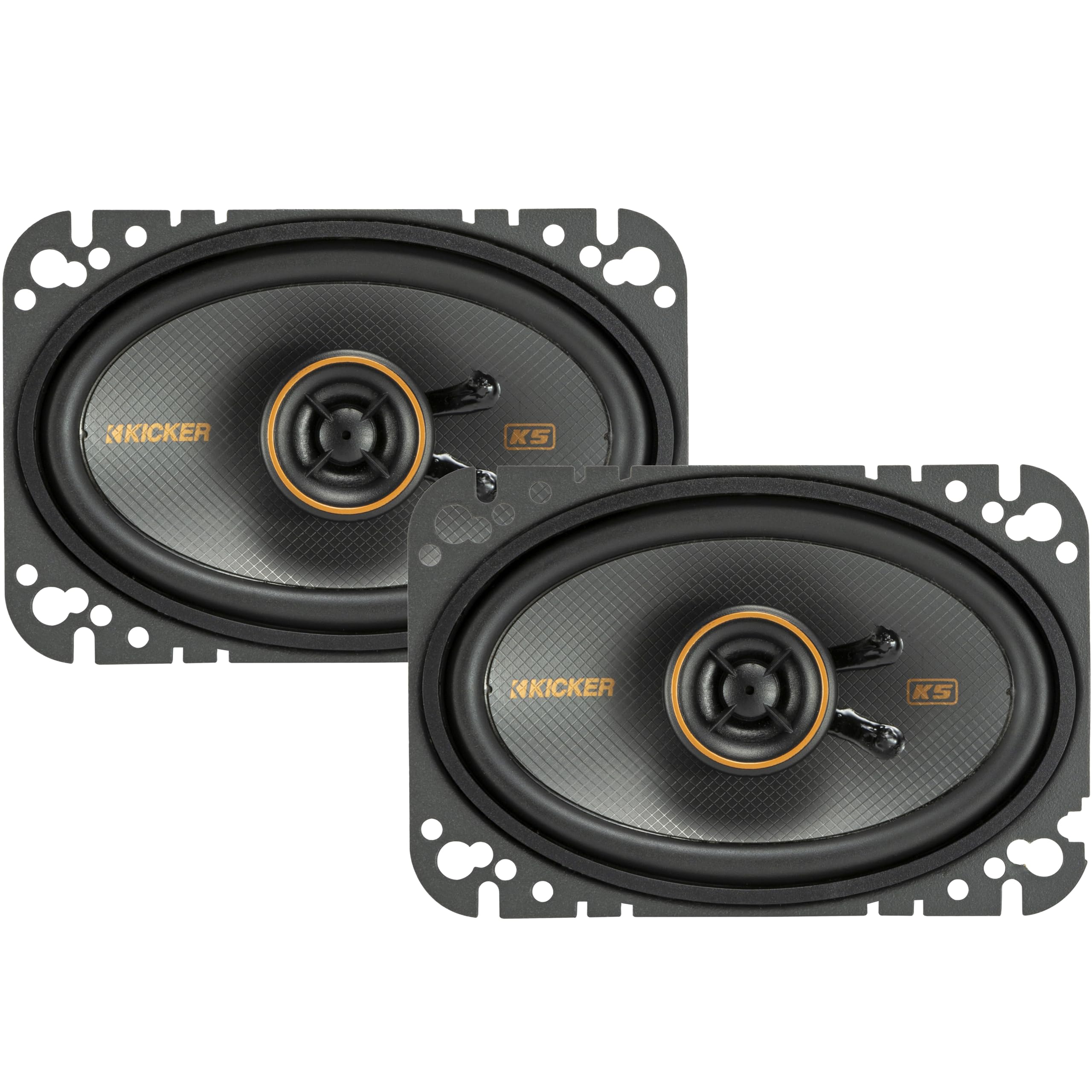
Concert-level volume with studio-grade detail for the discerning ear.
KICKER completely redesigned the KS-Series with new internally dampened polypropylene cones and tough rubber surrounds, aiming for “pounding bass” without losing midrange detail. The.5″ PEI dome tweeter is recessed almost flush, meaning the speaker fits vehicles with tight dash clearance — a lifesaver for newer Subaru and Jeep models where space is at a premium. The frequency response tops out at 20 KHz, which is narrower than the Polk DB462’s 22 KHz, but the KS-Series compensates with a punchy, authoritative low end that buyers call “strong bass, crisp audio quality, louder.”
One reviewer who upgraded their VA WRX stock speakers reported it was “a huge upgrade” even with the factory head unit, noting easy installation with just an adapter and a bracket. Another fitted them into a 2024 Subaru Crosstrek dash using the correct connectors and a small screwdriver, calling it “100% improvement over OEM.” The catch: the included 100µF capacitors are not needed if you are running a 4-ohm amp with a crossover, and some vehicles require grinding about 1/8″ of plastic from mounting pods for a full seat — but the included brackets cover GM, Chrysler, Toyota, and more.
Why It Stands Out
- Zero tweeter protrusion for near-universal vehicle fitment
- Internally dampened cones deliver strong bass without distortion
- Includes multiple mounting brackets for domestic and import cars
What to Watch
- May need minor plastic trimming on some factory pods
- Best with an external amplifier to unlock full potential
Reach for this if: you want maximum volume and bass punch from a 4×6 and plan to pair it with a good amplifier.
skip it if: you need a fully drop-in fit with zero modification to the vehicle panels.
3. Rockford Fosgate P1462 Punch 4″x6″ 2-Way Coaxial Speakers

crisp highs and punchy bass from a brand that serious car audio fans trust.
The Punch P1462 is designed for people who treat their car audio seriously. Rated at 35 Watts RMS and 70 Watts Max, these speakers are built for clarity over brute force — with a Flex Fit basket that adapts to odd-shaped factory speaker locations where standard 4x6s might not align. Mounting diameter is 3.76″ x 6.01″ with a 1.89″ mounting depth, and Rockford recommends drilling new screw holes with a 1/8″ drill bit if the factory pattern does not match. The result is a speaker that owners mention has “extremely loud and crisp” output, though bass is described as “not deep” by several owners.
One buyer fitted them to a 2005 Ford Ranger door with a direct bolt-in, and another installed them in a 2006 Ford Explorer in 30 minutes using pigtail adapters — they called the sound quality “satisfactory” for a stock vehicle. The honest trade-off is right in the specs: at 35W RMS, these need an external amplifier to really shine. Without it, the sound is clear but lacks the low-end thump of the KICKER KS-Series. Grilles are not included, so factor that into your install cost.
Signature Strength
- Flex Fit basket accommodates irregular mounting holes in older vehicles
- 1-year Rockford Fosgate warranty and legendary build quality
- Strong magnet and quality terminals that do not bend easily
The Fine Print
- Grilles not included — you must buy or reuse them separately
- Requires an amplifier (60W RMS or more) for distortion-free loudness
- Bass is accurate but not deep; consider a subwoofer for full range
Best suited for: the audio enthusiast who will pair these with a good amp and wants articulate, fatigue-free listening.
Not the pick if: you need a speaker that pounds on its own without external amplification.
4. SoundXtreme 4×6 3-Way 220 Watts Coaxial Car Speakers

Solid performance at a price that leaves room for other upgrades.
For the budget-conscious buyer who still wants a real audible step up from factory paper cones, the SoundXtreme ST-460 delivers. Rated at 220 watts peak per pair with a recommended power range of 10-50 watts RMS per channel, these speakers work well with factory stereos. The 88dB sensitivity means they get louder on less power — a big plus if you are not adding an amplifier. The polypropylene mid-woofer cone and polyester foam surround handle everyday listening without distortion. A 1/2″ Poly-ether Imide (PEI) balanced dome tweeter handles the highs, giving a well-rounded sound signature.
“Great speakers for the price!” is the consistent buyer verdict. One owner fitted them into a 2005 Jeep Wrangler, another into a 1990 Pontiac Firebird, and a third into a 1989 Silverado dash — noting the magnets are larger than the originals, so the fit is snug. The package includes speaker wire and screws, making it a true plug-and-play replacement. The main limitation is ceiling: at 10-50W RMS, they cannot sustain the volume levels for competition builds or open-top highway use at high speed where you need every watt.
Smart Buy
- 88dB sensitivity produces good volume from a stock head unit
- 3-way design adds a dedicated midrange driver for fuller sound
- Comes with speaker wire, screws, and manual — everything to install
Know Before You Buy
- Magnets are larger than factory — tight fit in some dash locations
- Not built for extreme volume; stay within 50W RMS per speaker
Reach for it if: you want a clear, balanced upgrade for daily driving without spending on an amp.
Look elsewhere if: you plan to push high power through the speakers or need a truly weatherproof design.
5. Pyle 3-Way Universal Car Stereo Speakers – 300W 4″ x 6″ Triaxial
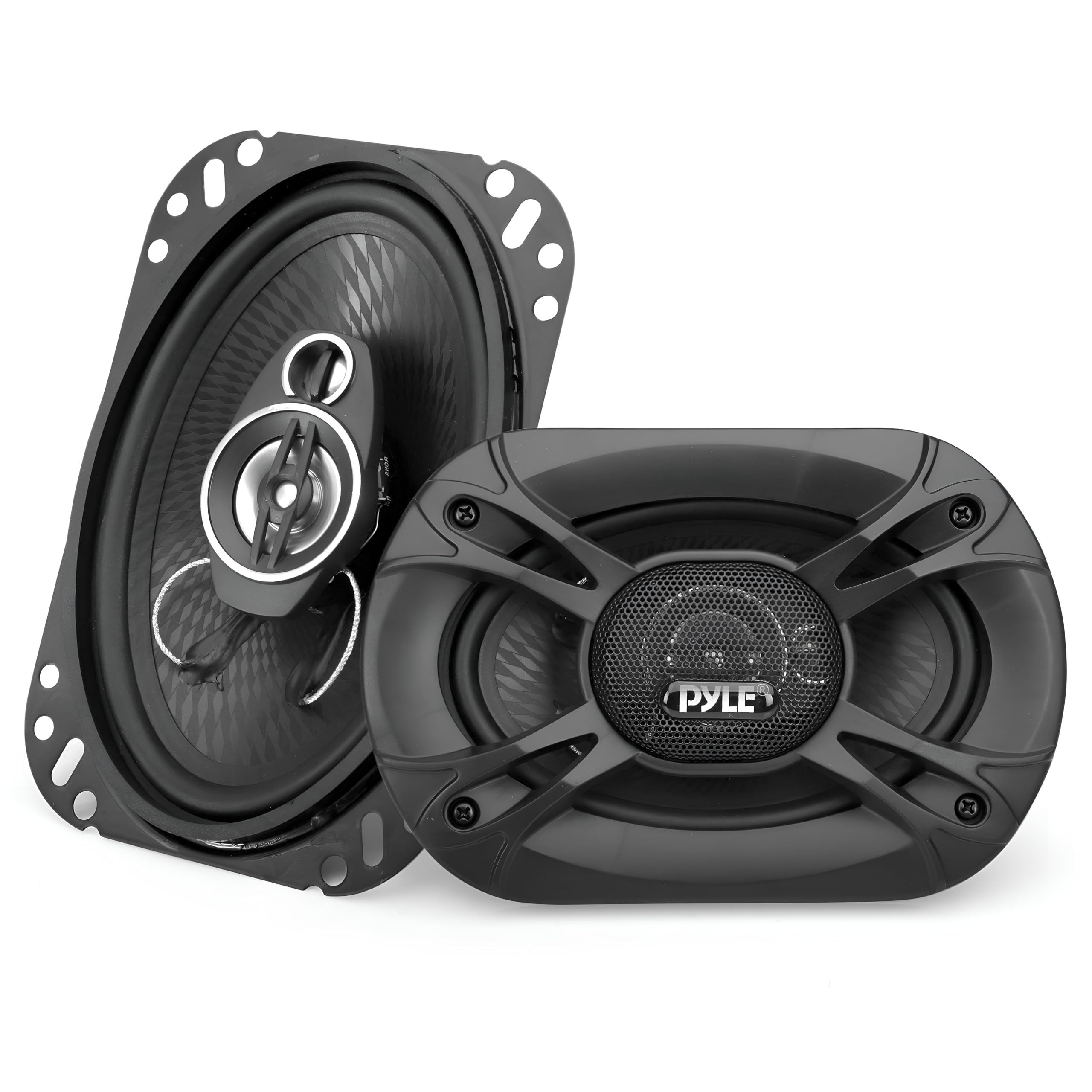
The cheapest way to replace blown factory speakers without losing your lunch.
The Pyle PL4163BK is a no-frills triaxial speaker with a 300W peak power rating — a 2.0x wider gap than the 150W Polk — that looks impressive on paper. Inside, you get a 4″ x 6″ poly injection cone, a 20oz high-density rubber magnet boot, dual 1″ ASV voice coils (designed to resist corrosion), and a 1.81″ mounting depth that fits most doors and side panels. The 3/4″ piezo tweeters and 1″ neodymium film dome midrange aim to fill out the sound spectrum. But the real-world feedback tells a more honest story: reviewers call them “ok speakers for the price” and note they are “not particularly loud,” with some suspecting the small-gauge wiring limits output.
One buyer’s frank review reads: “They work well for a cheap speaker replacement and were easy enough to install. Make a good cheap replacement if you aren’t looking for quality sounding speakers.” Another owner who upgraded from Alpine 2-way speakers was “amazed” by the sound — showing that if you are coming from blown or very basic factory speakers, these are a significant step up. The included grilles, cables, and mounting hardware make installation straightforward. The honest take: these are for the absolute minimum budget, not for anyone who cares about audio quality.
The Case for It
- 1.81″ mounting depth fits older cars with shallow doors and dash
- Includes grilles, cables, and all mounting hardware
- ASV voice coils resist corrosion better than standard copper
Where It Falls Short
- Low volume output — buyers consistently note it is not loud
- Piezo tweeters can sound harsh at higher frequencies
- Wiring gauge is small, potentially limiting power delivery
Grab these if: your factory speakers are dead and you need a working replacement for the lowest possible outlay.
Not for you if: you want a real audio upgrade, plan to add an amplifier, or care about sound quality.
Understanding the Specs
RMS Power vs. Peak Power
RMS (Root Mean Square) is the continuous power a speaker can handle all day. Peak power is a short burst the speaker can survive for a split second — usually 2-3 times the RMS number. When matching speakers to your stereo or amp, always match the RMS rating. If your head unit delivers 15W RMS per channel, a speaker rated for 50W RMS will never sound its best because it needs more power to wake up.
Sensitivity (dB)
Sensitivity measures how loud a speaker gets with a given amount of power, usually 1 watt at 1 meter. A higher number — 88dB vs. 84dB — means the speaker produces more volume from the same amp or head unit. Every 3dB increase is roughly a doubling of perceived loudness. For factory stereos (low power), look for 88dB or higher.
Tweeter Type and Material
The tweeter handles high frequencies. Silk dome tweeters (like on the Polk and Rockford) are known for a smooth, warm sound that is easy to listen to for long periods. Piezo tweeters (like on the Pyle) are extremely durable but can sound harsh. PEI (Poly-ether Imide) dome tweeters (like on the KICKER and SoundXtreme) are a middle ground: balanced, clear, and relatively affordable. Material matters to your ears.
Impedance (Ohms)
Impedance is the electrical resistance the speaker presents to the amplifier. Most car speakers are 4 ohms, which is the standard for factory and aftermarket stereos. A 2-ohm speaker pulls more current and gets louder from the same amp but can overheat a weak head unit. Stick with 4 ohms unless you specifically know your amp is rated for lower impedance.
FAQ
Will any 4×6 car speaker fit my car?
What is the difference between 2-way and 3-way coaxial speakers?
Do I need an amplifier for 4×6 car speakers?
Can I use 4×6 car speakers in a boat or motorcycle?
What does CEA rating mean for car speakers?
Why do my new 4×6 speakers sound distorted at high volume?
Do 4×6 speakers need a break-in period?
Should I replace 4×6 speakers with a different size adapter?
What wattage 4×6 speakers should I get for my stock stereo?
Final Thoughts: The Verdict
Across the board, the 4×6 car speakers winner is the Polk Audio DB462 because it combines genuine weather durability with the widest frequency range and a smooth silk dome tweeter that sounds great in any condition. If you want the highest possible output and bass punch from a 4×6, grab the KICKER KS-Series. And for a budget-friendly everyday upgrade that pairs well with a factory stereo, the SoundXtreme ST-460 delivers reliable performance without the cost.
How We Picked
We do not accept paid placement, and we did not hands-on test every unit. Instead, we match each pick to a real buyer and use-case by comparing the manufacturers’ published specifications against the patterns in verified customer reviews — so you get each pick’s real strengths and trade-offs instead of marketing copy.
Sources & Methodology
Specifications: manufacturer listings and product documentation. Review insights: verified customer reviews, as of July 2026. Pricing: not shown on this page (it changes often); check the current price via the retailer link.
As an Amazon Associate, Gadgets Feed earns from qualifying purchases. This does not affect which products we feature.
Product prices and availability are accurate as of the date/time indicated and are subject to change. Any price and availability information displayed on Amazon at the time of purchase will apply to the purchase of this product. As an Amazon Associate I earn from qualifying purchases.
CERTAIN CONTENT THAT APPEARS ON THIS SITE COMES FROM AMAZON. THIS CONTENT IS PROVIDED "AS IS" AND IS SUBJECT TO CHANGE OR REMOVAL AT ANY TIME.
Amazon and the Amazon logo are trademarks of Amazon.com, Inc. or its affiliates.