
Car cabins are terrible acoustic environments, and your factory head unit almost certainly lacks the precision to fix it. A dedicated graphic equalizer lets you surgically pull down booming resonances and push up swallowed vocals, turning a muddy soundstage into something you can actually place instruments in.
I’m Min — the co-founder and writer behind Gadgets Feed. I’ve spent hundreds of hours comparing the noise floors, line-driver voltages, and band-center frequencies of car audio processors to separate signal-cleaners from noise-injectors.
Whether you need to dial out a 200 Hz trunk-rattle on your daily commute or want full DSP control for a competition build, this guide covers the best 5 band equalizer for every serious install.
How To Choose The Best 5 Band Equalizer
Five bands give you just enough sliders to correct the three most common car-cabin problems (sub-bass cancellation, 200–400 Hz muddiness, harsh 4–10 kHz glare) without the complexity of a full 31-band unit. The trick is picking bands centered on the frequencies you actually need to move.
Check the Center Frequencies
A cheap 5 band equalizer may offer fixed bands at 75 Hz, 200 Hz, 2 kHz, and 20 kHz — useful for general shaping but useless if your subwoofer resonance lives at 55 Hz. Higher-end units let you sweep the center of each band, so you can park the filter right on the problem note. If you run a single sub, a variable crossover between 45 Hz and 180 Hz matters more than a fifth slider.
Line Driver Voltage and Noise Floor
Every equalizer above a certain price point includes a line driver that boosts the pre-amp signal to between 5V and 9V. Higher voltage lets you keep your amplifier’s gain low, which reduces hiss and alternator whine. Look for a signal-to-noise ratio above 100 dB and Total Harmonic Distortion at or below 0.005% — anything higher injects audible grit into clean playback.
Analog vs. Digital (DSP) Control
Most 5 band equalizers in the budget-to-mid range use analog sliders that physically cut or boost fixed frequencies. Digital Signal Processors (DSP) allow parametric EQ, adjustable crossover slopes (12 dB/octave vs. 24 dB/octave), and per-channel time alignment. If you run a multi-amp system with separate tweeters, mids, and subs, a DSP costs more but delivers phase-coherent tuning that analog sliders cannot match.
Physical Fit and Connectivity
Car equalizers come in Half-Din or Full-Din chassis sizes. Half-Din units fit under a single-DIN head unit or inside an ashtray slot. Count your RCA outputs: you need at least two stereo pairs (front and rear) if you run a four-channel amp, and three pairs if you want a dedicated subwoofer output with its own level control. Pre-amp input sensitivity range (typically 50 mV to 3V) determines whether the EQ works with low-voltage head units or aftermarket radios.
Quick Comparison
On smaller screens, swipe sideways to see the full table.
| Model | Category | Best For | Key Spec | Amazon |
|---|---|---|---|---|
| Taramps Pro 2.4D DSP | Digital DSP | Multi-amp builds with time alignment | 5-band parametric input EQ + 4 output crossovers | Amazon |
| Douk Audio EQ5 Tone | Home Preamp | Desktop/bookshelf speaker correction | 75/400/800/4K/10K Hz bands + VU meter | Amazon |
| American Bass AB-5B-ECV | Car Graphic | Precision tuning with voltmeter monitoring | 7V line driver + built-in digital voltmeter | Amazon |
| Audiopipe EQ-57MOTO | Car Graphic | Clean 5-band with 7V output | 60/250/1k/4k/16k Hz bands, 18dB boost/cut | Amazon |
| Audiobank AB-EQ05 | Car Graphic | Budget in-dash upgrade | 5 bands + 7 VRMS line driver | Amazon |
| Planet Audio PEQ10 | Car 4-Band | Simple sub + main speaker shaping | 75/200/2k/20k Hz bands, sub filter 45-180Hz | Amazon |
In‑Depth Reviews
1. Taramps Pro 2.4D DSP
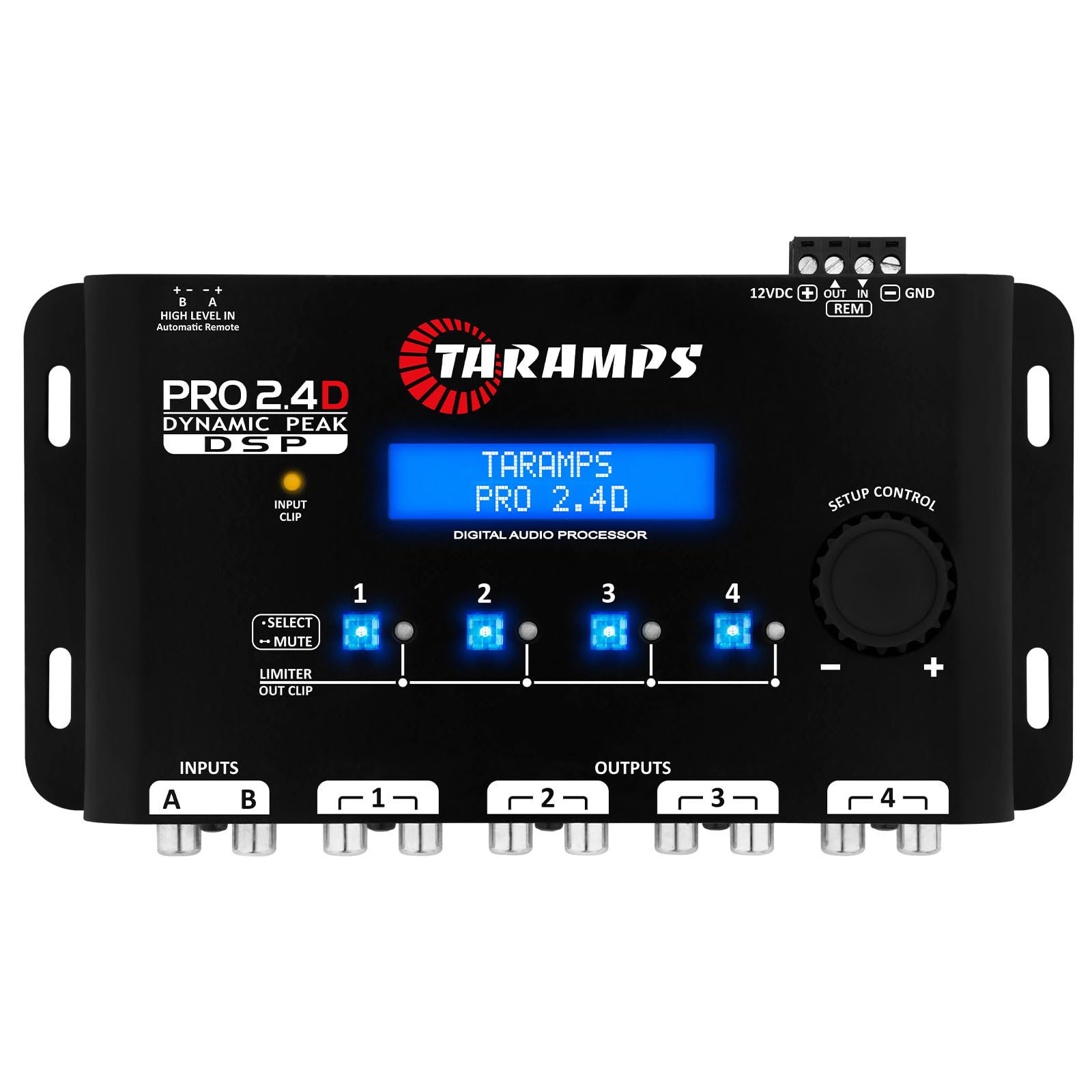
The Taramps Pro 2.4D is a full digital signal processor, not a slider-based analog equalizer, which means each of its five input bands can be tuned with a sweepable center frequency between 40 Hz and 20,000 Hz. The 12 built-in presets and parametric output EQ let you dial in crossover slopes per channel — a huge advantage if you’re running separate tweeters, mids, and a subwoofer on dedicated amplifiers.
It accepts both RCA and high-level inputs, making it compatible with factory head units that lack pre-amp outputs. The peak and RMS limiter functions protect your speakers from accidental distortion during aggressive EQ boosts. The anti-pop circuit eliminates the thump that often plagues budget processors during power-on.
The trade-off is a steep learning curve. There is no printed manual in the box, and the interface requires some trial-and-error even for experienced installers. For anyone serious about a multi-amp setup, though, this DSP offers more tuning resolution than any analog 5-band unit at its price tier.
Why it’s great
- Fully parametric 5-band input EQ with variable center frequencies
- Peak/RMS limiter prevents speaker damage from over-boost
- Accepts high-level input for factory radio integration
Good to know
- No printed instructions included; requires online research
- Auto-on function may not trigger correctly with amplified signal sources
2. Douk Audio EQ5 Tone

The Douk EQ5 Tone is a desktop pre-amplifier with a 5-band graphic equalizer centered at 75 Hz, 400 Hz, 800 Hz, 4 kHz, and 10 kHz, designed for home stereo or computer speaker systems rather than car dashboards. Each band uses an independent op-amp stage, so you can boost 400 Hz for vocal presence without shifting the phase of the 10 kHz air band.
It includes Bluetooth 5.0 for wireless streaming and a pair of large 45 mm VU meters that provide real-time signal level feedback. The bypass switch lets you compare the processed versus raw signal instantly, which is useful for hearing exactly what your EQ changes are doing to the mix. The upgraded version adds adjustable pointer speed and brightness control for the meters.
Some users report an initial hum that resolves after swapping to higher-quality RCA cables. The compact DC 5V power supply means you can power it from a USB port, though that also limits the maximum clean output voltage compared to a dedicated car audio line driver.
Why it’s great
- Dual VU meters with adjustable brightness and pointer speed
- Bluetooth 5.0 built in for wireless music streaming
- Independent op-amps per band for clean frequency separation
Good to know
- No remote control included for volume or bypass toggling
- USB-powered 5V supply limits line driver headroom
3. American Bass AB-5B-ECV
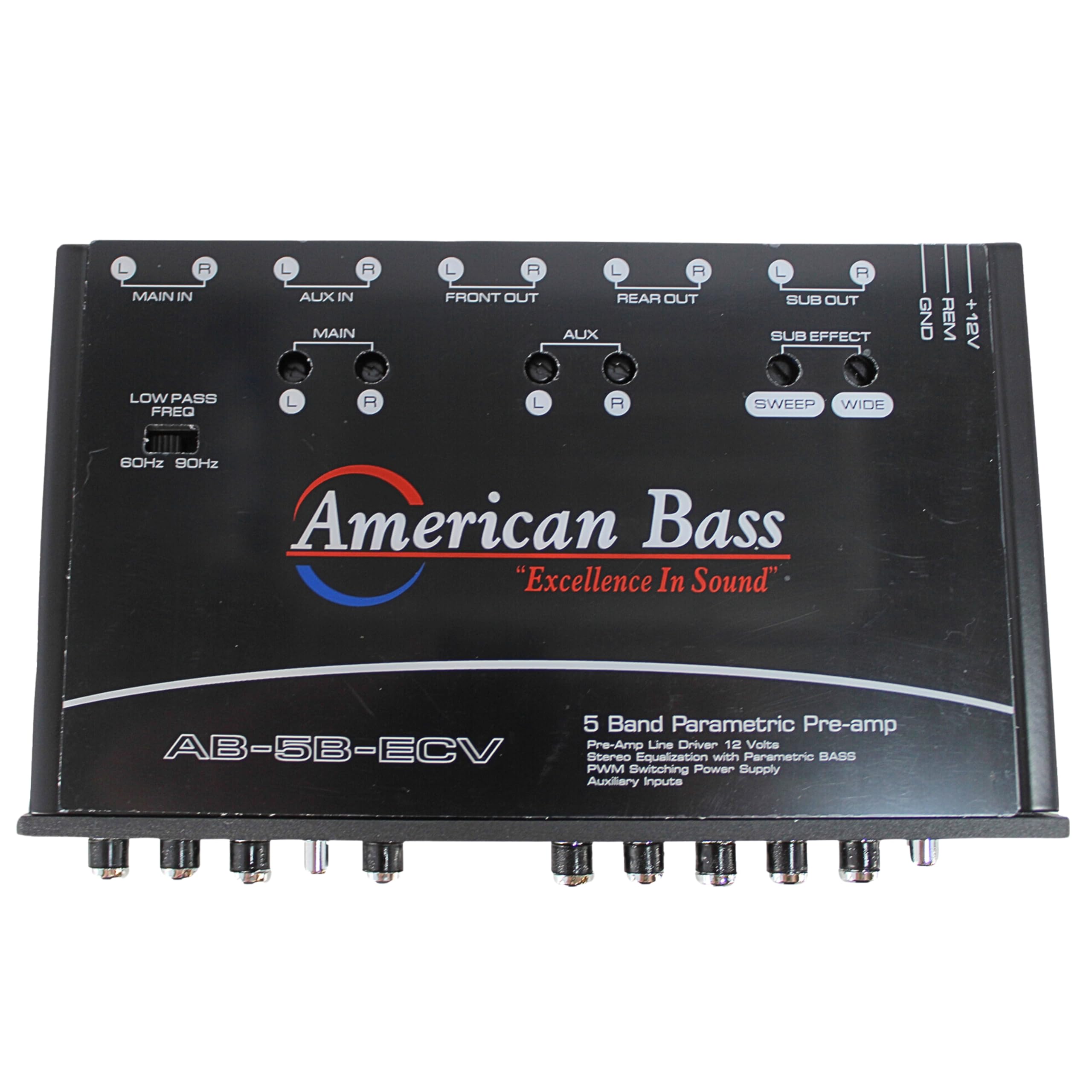
The American Bass AB-5B-ECV packs a 7V line driver and a built-in digital voltmeter into a Half-Din chassis, giving you both voltage monitoring and five-band graphic EQ control in one unit. The voltmeter reads your car’s electrical system in real time, which is critical for spotting voltage drops during bass-heavy passages that could clip your amplifier.
Its active gain pre-amp, master volume, and separate left/right sensitivity controls allow you to balance the input signal from your head unit before it reaches the EQ stage. The subwoofer output has its own dedicated level control and adjustable crossover frequency, letting you dial in the sub without affecting the main speakers.
User reports indicate occasional early failures, with some units blowing fuses or flickering on bumps. The THD rating of 0.05% is higher than the best analog competitors, so critical listeners may notice a slight haze compared to cleaner units from Audiopipe or Taramps.
Why it’s great
- Built-in digital voltmeter shows electrical system health at a glance
- Individual left/right sensitivity controls for input matching
- Dedicated subwoofer level control with crossover
Good to know
- THD of 0.05% is less clean than 0.005% alternatives
- A small number of units have shown durability issues with fuses
4. Audiopipe EQ-57MOTO
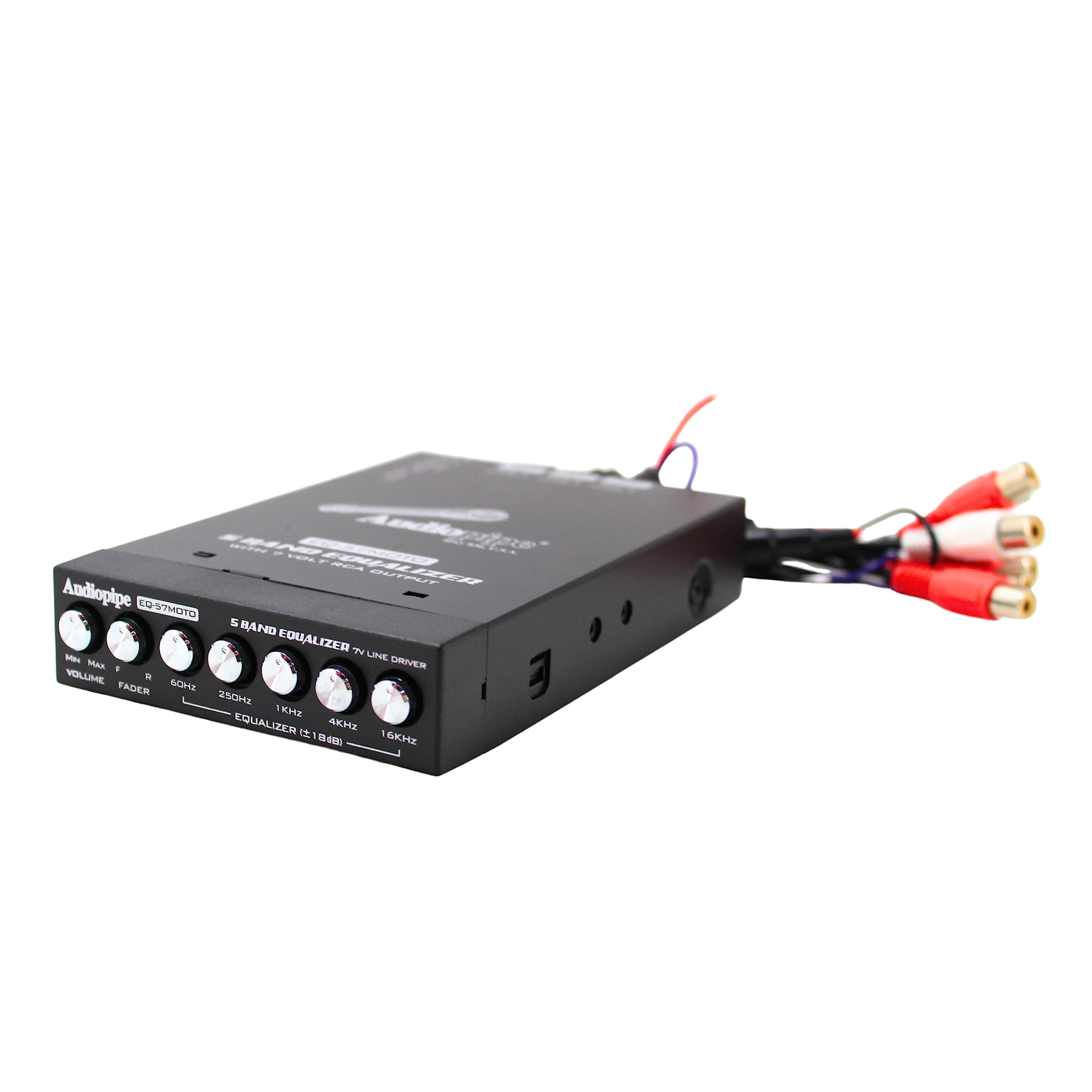
The Audiopipe EQ-57MOTO is a compact 5-band graphic equalizer with center frequencies dialed for car audio: 60 Hz for sub-bass punch, 250 Hz for low-mid body, 1 kHz for vocal presence, 4 kHz for cymbal attack, and 16 kHz for air. Each band supports a generous 18 dB boost or cut, giving you enough range to correct even extreme cabin nulls.
It uses nickel-plated RCA connectors and locking knobs that resist wear over years of use. The half-Din chassis is small enough to fit inside an old car’s ashtray or under a single-DIN radio. With a 7V maximum output and a signal-to-noise ratio of 100 dB, it preserves headroom without adding audible noise when you run your amplifier gains low.
The EQ-57MOTO lacks a dedicated subwoofer control or variable crossover, so you will need either a separate bass knob or a subwoofer amplifier with its own built-in crossover. Some users report that the unit picks up alternator whine if the ground wire is not properly secured, so pay attention to the installation location.
Why it’s great
- Nickel-plated locking knobs prevent accidental setting changes
- Compact chassis fits in tight dash spaces
- Very low THD of 0.005% for clean signal transfer
Good to know
- No dedicated subwoofer output or crossover
- Pickiness with ground connection can cause alternator noise
5. Audiobank AB-EQ05

The Audiobank AB-EQ05 is an in-dash 5-band graphic equalizer with a 7V RMS line driver, fader control, and an auxiliary input for connecting a phone or MP3 player. It outputs through three stereo RCA pairs, which is enough to feed a front/rear speaker amp plus a separate subwoofer channel without splitting cables.
The sensitivity control lets you match the input level from a wide range of aftermarket head units, preventing the distortion that happens when you overdrive the pre-amp stage. The fader helps balance the front-to-rear speaker blend without reaching for your head unit controls.
Build quality is a mixed bag. A number of users have reported the unit flickering on and off after a few months, likely due to a poor solder joint on the power input. If you are willing to risk intermittent behavior for the lowest entry price into a 5-band EQ with a line driver, this unit fits the bill, but the reliability data suggests it may not survive long in a high-vibration vehicle.
Why it’s great
- Three stereo RCA outputs for full front/rear/sub support
- 7V RMS line driver helps keep amplifier gain low
- Fader control enables balance without touching the head unit
Good to know
- Several reports of power flickering on road bumps
- Typical warranty period is short, raising long-term value risk
6. Planet Audio PEQ10

The Planet Audio PEQ10 is a 4-band equalizer (not 5-band) with a variable subwoofer filter adjustable from 45 Hz to 180 Hz. Its bands are fixed at 75 Hz, 200 Hz, 2 kHz, and 20 kHz, which covers the essential sub-low, low-mid, presence, and air ranges. The variable phase shift selector lets you match the subwoofer timing to the main speakers for smoother bass transition.
It includes a remote subwoofer level control, so you can dial bass up or down from the driver’s seat without reaching behind the dash. The night illumination pulses to the music, which is a cosmetic bonus for evening drives.
It is built from durable materials, and the 7V maximum output voltage is comparable to more expensive units. The main limitation is the missing fifth band — you cannot separately adjust the 400–800 Hz vocal range that often builds mud in sedan trunks.
Why it’s great
- Variable subwoofer filter (45–180 Hz) for precise bass tuning
- Remote subwoofer level control included
- Pulsing illumination adds visual appeal at night
Good to know
- Only 4 bands; no dedicated mid-range vocal slider
- No digital display or voltmeter for monitoring
FAQ
Can I run a 5 band equalizer with a factory stereo that has no RCA outputs?
Does a 5 band equalizer fix alternator whine or ground loop noise?
What is the difference between a graphic equalizer and a DSP?
Final Thoughts: The Verdict
For most users, the best 5 band equalizer winner is the Audiopipe EQ-57MOTO because it delivers a clean 7V line driver with 0.005% THD and sensible car-audio frequency bands at a mid-range price that avoids both the flimsiness of budget units and the complexity of full DSP. If you want fully parametric control with peak limiters for a multi-amp build, grab the Taramps Pro 2.4D DSP. And for a desktop home stereo setup with Bluetooth and VU meters, nothing beats the Douk Audio EQ5 Tone.