
Tethering your laptop to a smartphone turns your work sessions into battery-draining guessing games, throttles video calls after a few gigs, and forces you to babysit a connection that drops the moment a notification comes in. A dedicated 5G portable WiFi device eliminates those compromises by engineering a connection around a cellular-first architecture that your phone was never designed to provide.
I’m Min — the co-founder and writer behind Gadgets Feed. For this guide, I’ve spent over forty hours combing through carrier band compatibility tables, real-world throughput reports, and battery performance data across nine distinct 5G hotspot models to separate genuine performance from marketing claims.
Whether you need reliable internet for remote work in an RV, backup connectivity during power outages, or seamless travel data across continents, the right device depends on carrier support, battery capacity, and simultaneous device limits. This guide breaks down the best options to help you choose the ideal best 5g portable wifi hotspot for your specific needs.
How To Choose The Best 5G Portable WiFi
A 5G hotspot is a multi-year connectivity investment. Choosing by price alone often leads to carrier compatibility nightmares or battery performance that forces you to stay tethered to a wall outlet. Focus on these factors instead.
Carrier Compatibility and Band Support
Not all 5G hotspots work with all carriers. Devices sold as “AT&T prepaid” models may refuse a Verizon SIM entirely due to locked firmware or missing band support. Look for unlocked devices that explicitly list bands n2, n5, n12, n14, n30, n66, and n77 for AT&T, or n260 and n261 for Verizon mmWave. A device that supports sub-6GHz only will still deliver solid speeds, but you will miss the multi-gigabit peaks that mmWave provides in dense urban areas.
Battery Capacity and Power Bank Functionality
Battery capacity measured in mAh dictates how long your connection lasts away from power. A 4500mAh unit might survive a full workday with moderate use, while a 6400mAh battery can push past eight hours of active tethering. Many hotspots also double as power banks — useful for topping off a phone in a pinch, but drawing power from the hotspot cuts its own runtime significantly.
Device Limits and WiFi Standard
Entry-level models connect up to 16 devices; premium units like the Nighthawk M7 Pro handle 64. If you are sharing the connection across laptops, tablets, streaming sticks, and smart home gear in an RV, a higher device limit prevents connection drops. WiFi 6 support also matters — it handles multiple simultaneous streams far more efficiently than WiFi 5, reducing latency when several devices are active.
Quick Comparison
On smaller screens, swipe sideways to see the full table.
| Model | Category | Best For | Key Spec | Amazon |
|---|---|---|---|---|
| NETGEAR Nighthawk M7 Pro | Premium | Multi-gigabit speeds, 64 devices | 5.8 Gbps, WiFi 7, mmWave | Amazon |
| GlocalMe Numen Air 5G | Premium | Global travel, no SIM needed | 2.5 Gbps, CloudSIM, 16 devices | Amazon |
| GL.iNet GL-XE3000 (Puli AX) | Premium | Business continuity, dual SIM | 6400mAh battery, Wi-Fi 6, OpenWrt | Amazon |
| Cudy P5 | Mid-Range | Dual SIM failover, advanced VPN | 3.4 Gbps, AX3000, band locking | Amazon |
| TravelWiFi Sapphire 5G | Mid-Range | Global roaming, tri-band WiFi | 5GB free data, CloudSIM, 10 devices | Amazon |
| SIMO Solis 5G | Mid-Range | No-contract global data, 135+ countries | 1GB/month lifetime data, IP54 | Amazon |
| Solis Edge 5G | Mid-Range | Ultra-light travel, 140+ countries | 78.8g, 12GB/year data bundle | Amazon |
| TCL Linkzone 5G UW | Budget-Friendly | Verizon/GSM, touchscreen controls | 4500mAh battery, 32 devices | Amazon |
| Franklin A50 5G | Budget-Friendly | AT&T prepaid, power bank use | 5000mAh battery, WiFi 6, 20 devices | Amazon |
In‑Depth Reviews
1. NETGEAR Nighthawk M7 Pro Mobile Hotspot 5G mmWave

The Nighthawk M7 Pro is the only hotspot on this list supporting both mmWave and sub-6GHz 5G bands with WiFi 7, delivering theoretical multi-gigabit throughput up to 5.8 Gbps. Its 64-device capacity and 2,000 sq. ft. coverage make it the obvious choice for power users, remote teams, or anyone treating a hotspot as their primary internet connection rather than a backup.
Real-world performance on the T-Mobile network showed reliable live streaming in areas with known coverage gaps, and the unlocked design accepts prepaid SIMs from multiple carriers. The LCD passcode security and URL filtering add a layer of parental control that few portable hotspots offer.
The catch is that the renewed unit sometimes ships locked to AT&T — verify unlock status immediately upon arrival. The premium price reflects true carrier-grade hardware, not a toy, and the battery life will not last a full day under heavy mmWave use without a top-up.
Why it’s great
- Multi-gigabit speeds with mmWave support and WiFi 7
- Supports up to 64 devices simultaneously
- Excellent range covering up to 2,000 sq. ft.
Good to know
- Renewed units may arrive locked to AT&T — verify first
- Premium tier pricing may be overkill for casual users
- mmWave drains battery faster than sub-6GHz
2. GlocalMe Numen Air 5G Mobile Hotspot
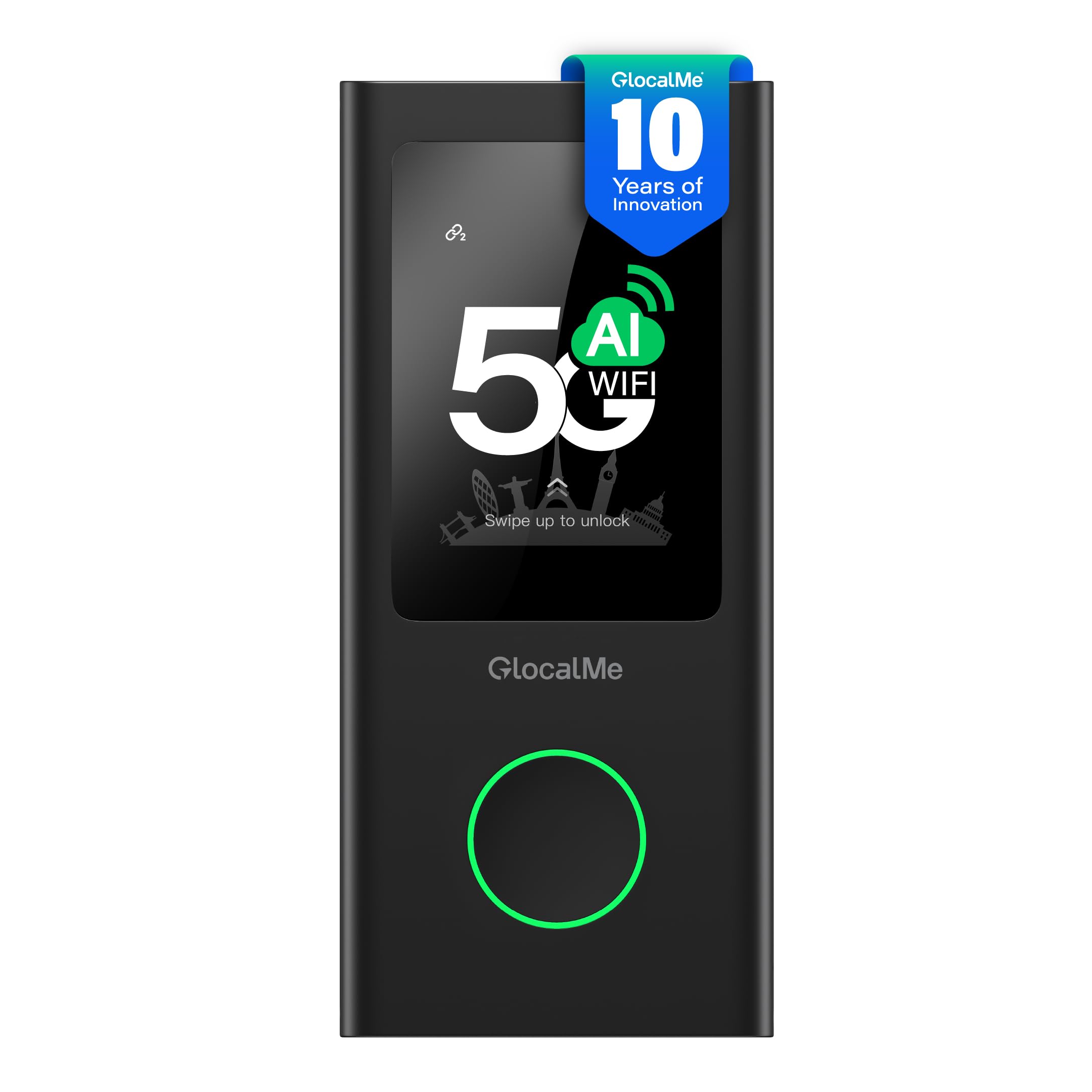
The Numen Air 5G bypasses the SIM card hurdle entirely with GlocalMe’s patented CloudSIM technology, connecting to over 390 operator networks across 140+ countries without requiring a physical SIM swap. Its theoretical 2.5 Gbps speed over 5G is backed by a 2.4-inch LCD touchscreen that displays data usage, signal strength, and connected devices in real time.
In practice, users report solid performance with physical SIM cards — a Google-Fi data-only SIM delivered 80-110 Mbps outdoors with fast boot times under 10 seconds. The unit doubles as a power bank, though using that feature cuts its already modest battery life. It connects up to 16 devices, making it suitable for a family sharing a connection on vacation.
The main drawback is that the CloudSIM data plans are not cheap for heavy usage — topping 100GB in a week triggers throttling that makes streaming difficult. The device is best for travelers who need reliable connectivity across borders without hunting for local SIMs.
Why it’s great
- CloudSIM works in 140+ countries without physical SIM swaps
- Fast performance with both virtual and physical SIMs
- Intuitive LCD touchscreen for monitoring data and settings
Good to know
- Data plan pricing is expensive for heavy usage
- Battery life is average; power bank feature drains it faster
- Requires app for initial setup
3. GL.iNet GL-XE3000 (Puli AX) 5G Router
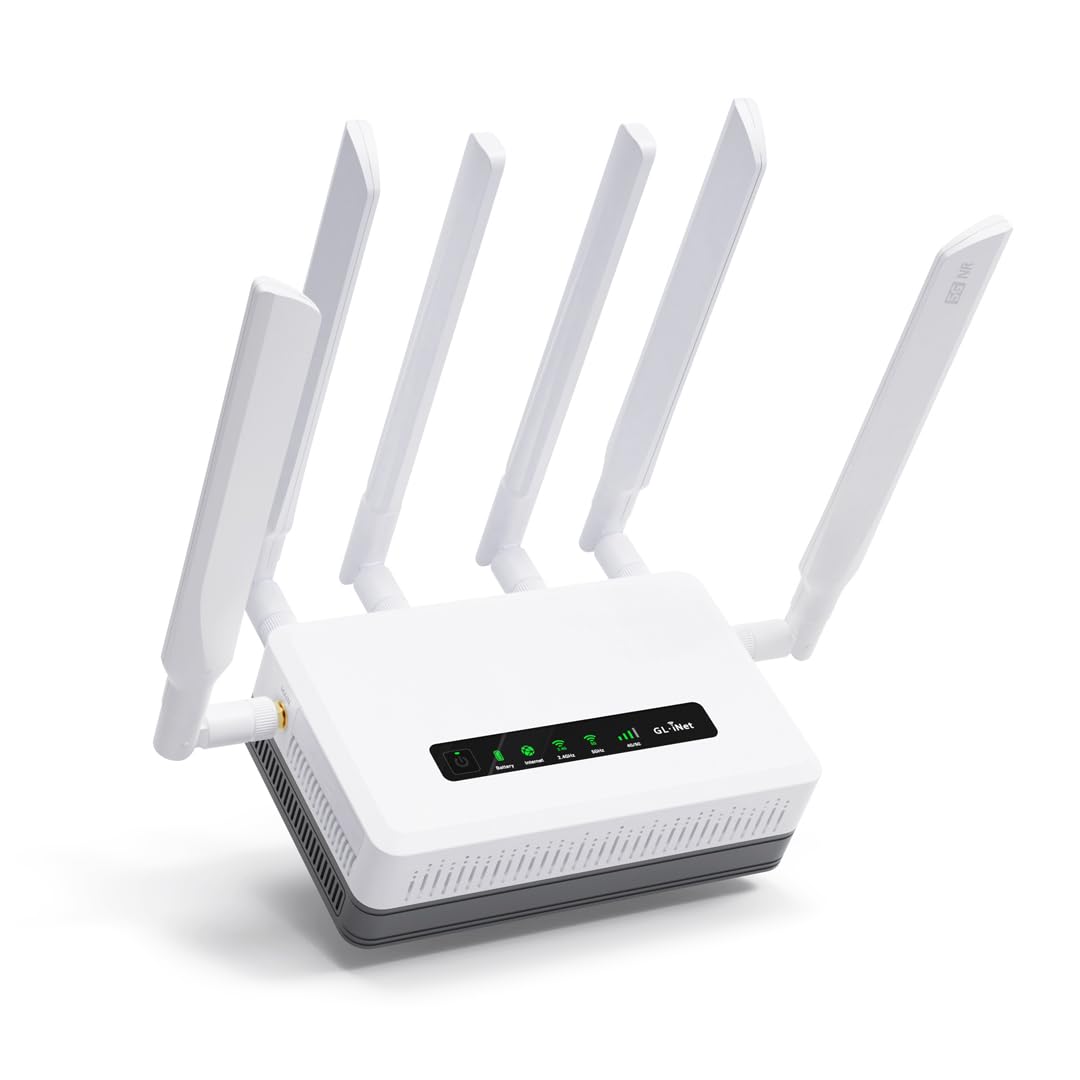
The Puli AX is less a pocket hotspot and more a portable enterprise router with a 6400mAh battery that delivers up to eight hours of continuous connectivity. It supports dual SIM slots with automatic failover, making it ideal for maintaining business-critical connections at construction sites, remote offices, or events where downtime costs money.
WiFi 6 delivers up to 2402 Mbps on the 5GHz band with MU-MIMO, and the OpenWrt firmware unlocks over 5,000 plugins for advanced networking — VPN tunneling with WireGuard hits 300 Mbps. Users report that the router handles 5G signals in rural areas where phone hotspot signals fail, and the wall-mount kit makes permanent installation straightforward.
The unit is bulky compared to pocket-sized hotspots, and the dual SIM slots share a single IMEI, which caused initial setup confusion with some carriers. The premium price reflects its industrial reliability rather than consumer portability.
Why it’s great
- Dual SIM failover keeps business connections alive
- OpenWrt firmware offers deep customization
- 6400mAh battery provides 6-8 hours of runtime
Good to know
- Bulkier than pocket hotspots — not for daily carry
- Dual SIM shares single IMEI causing carrier confusion
- Premium price reflects enterprise-grade hardware
4. Cudy New 5G NR SA NSA AX3000 WiFi 6 CPE Router P5

The Cudy P5 packs a Qualcomm SDX62 chipset — the same modem found in many flagship smartphones — delivering 5G NR downlink speeds up to 3.4 Gbps under NSA and dual-band WiFi 6 at AX3000 speeds. Its dual SIM slots with WAN failover and advanced band locking make it a favorite among users who need to force a specific carrier frequency for optimal performance.
In practice, the router works reliably with T-Mobile and AT&T 5G SIMs, and the detachable 5dBi antennas improve signal reception in marginal coverage areas. The VPN support includes PPTP, L2TP, OpenVPN, WireGuard, IPsec, and Zerotier, making it a strong choice for remote workers who require secure encrypted tunnels back to corporate networks.
The catch is that Verizon SIMs are not compatible — users report the device failing to connect even after troubleshooting. The setup process is also not beginner-friendly; expect to spend time in the admin panel configuring band locks and TTL settings.
Why it’s great
- Powerful Qualcomm SDX62 modem for fast 5G speeds
- Advanced band locking and TTL controls for power users
- Detachable antennas improve reception in weak signal areas
Good to know
- Not compatible with Verizon — check carrier support first
- Setup is complex and requires networking knowledge
- Runs warm during sustained high-speed use
5. TravelWiFi Sapphire 5G Mobile Hotspot

The Sapphire 5G differentiates itself with preloaded 5GB of free global data out of the box and tri-band WiFi that avoids congestion in crowded venues. Its CloudSIM technology automatically selects the strongest available carrier across multiple countries without requiring any SIM card swaps, and the large touch screen provides granular control over network monitoring and settings.
Users traveling through Northern Europe reported that the Sapphire maintained connections when international cell service failed, and the central navigation button makes menu navigation feel more like a phone than a router. The data plans are flexible — buy by day, month, region, or GB through the companion app.
The downsides are significant: some users reported that the device failed to connect to networks in Europe 90% of the time despite the website claiming coverage, and the data plans are not competitive with local SIM pricing. For light travelers who want zero-hassle global access, it works; for heavy data users, it falls short.
Why it’s great
- 5GB free global data included to start
- Tri-band WiFi reduces interference in congested areas
- CloudSIM works without physical SIM swaps
Good to know
- European coverage is inconsistent despite advertised claims
- Data plans are expensive compared to local SIM cards
- Only supports 10 connected devices
6. SIMO Solis 5G WiFi Mobile Hotspot

The Solis 5G Hotspot bundles a lifetime data plan — 1GB per month forever — that covers 135+ countries, making it the most compelling option for light travelers who need emergency connectivity without monthly bills. The IP54 ruggedized design protects against dust and water splashes, and the 2.4-inch LCD touchscreen gives quick access to data usage and signal strength.
Setup takes under a minute via QR code scanning, and the virtual multi-carrier network samples several cellular providers to find the strongest signal. Users living in areas with limited cell coverage report that the Solis reliably acts as a backup when cable internet goes down, with download speeds around 250 Mbps on the unlimited tier before throttling to 20-30 Mbps.
The 1GB monthly free data is fine for texts and maps, but serious use requires purchasing additional data bundles. The unlimited plan throttles after 100GB in a week, making it unsuitable for heavy streaming or gaming without paying for extra high-speed data.
Why it’s great
- Lifetime 1GB/month free global data included
- IP54 rugged design handles travel abuse
- Virtual multi-carrier network picks strongest signal
Good to know
- 1GB free data is only for light emergency use
- Unlimited plan throttles after 100GB in a week
- Requires fast charger for optimal battery performance
7. Solis Edge 5G Hotspot by SIMO
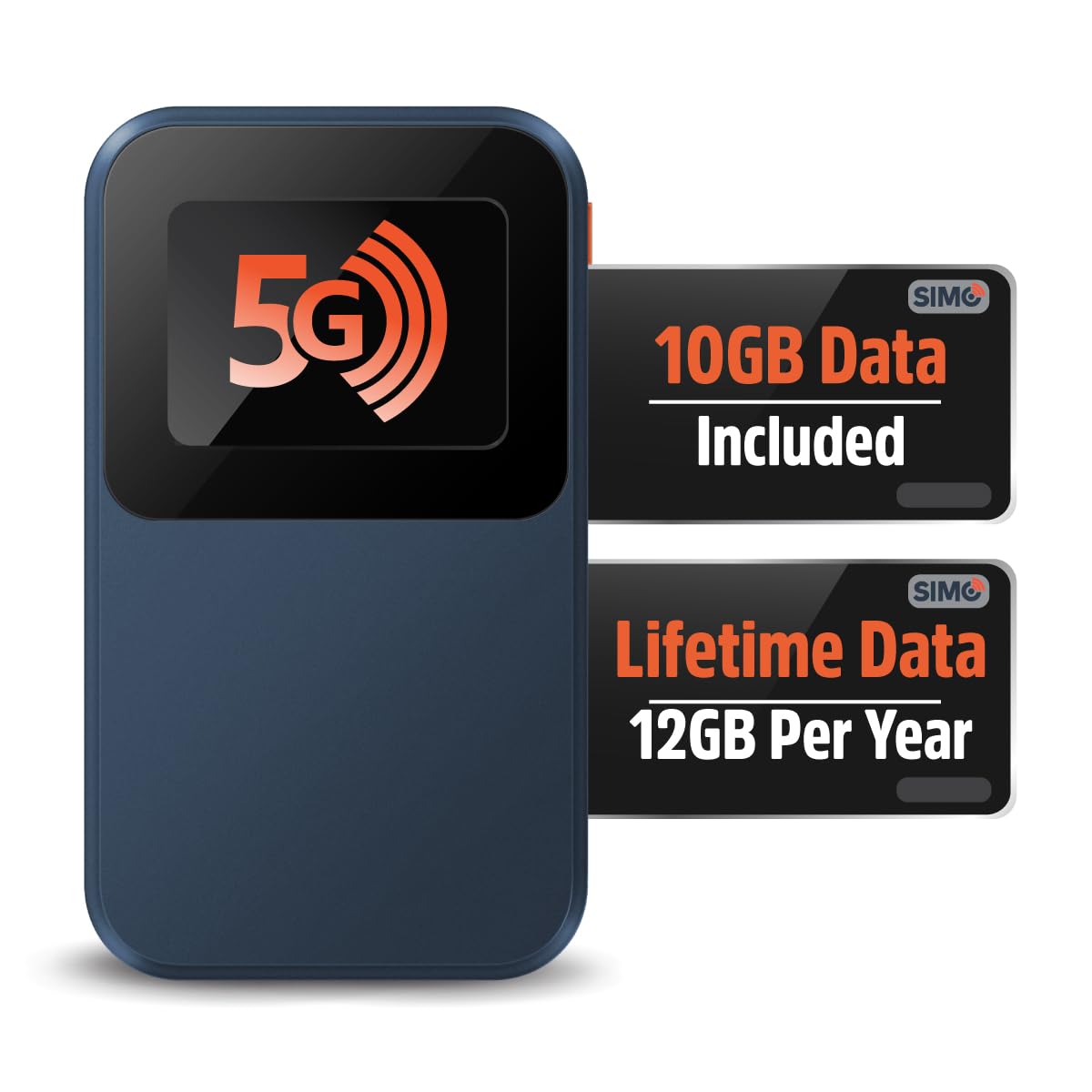
Weighing just 78.8 grams, the Solis Edge is the lightest 5G hotspot on the market — barely heavier than a credit card. Its Explorer Bundle includes both a lifetime data plan (1GB per month, 12GB per year) and an additional 10GB of global data, giving 22GB total for first-year travelers with no monthly commitment.
SignalScan technology automatically connects to the strongest mobile carrier signal across 300+ networks in 140+ countries. Users report the device held service for an entire 10-hour day in Tokyo without needing a recharge, and it easily fits into a small purse or pocket. The app-based control system allows pay-as-needed data top-ups without contracts.
The main limitation is speed under load — the tiny form factor means a smaller antenna array, so it does not match the raw throughput of larger units like the Nighthawk or Numen Air. Heavy VPN use also causes intermittent disconnections, making it better for casual browsing and navigation than business-critical tasks.
Why it’s great
- Ultra-light 78.8g design fits in any pocket
- 22GB total first-year data with no monthly contract
- SignalScan finds strongest carrier automatically
Good to know
- Not reliable for VPN-heavy business use
- Speeds are lower than larger 5G hotspot units
- Data top-ups for heavy usage add up quickly
8. TCL Linkzone 5G UW (MW513U)

The TCL Linkzone 5G UW is identical hardware to Verizon’s own hotspot but sold unlocked for a fraction of the cost, supporting both Verizon and GSM networks. Its 4500mAh battery can charge other devices via USB-C while still providing 5G connectivity for up to 32 devices simultaneously.
The easy-to-read touchscreen makes network management straightforward, and the unlocked flexibility means you can pair it with cheap prepaid plans like US Mobile’s Warp SIM for significantly lower monthly costs than carrier-locked alternatives. Users report that it transmits 4G WiFi without overheating — a common complaint with phone tethering — and avoids the throttling issues that plague phone-based hotspot usage.
The major reliability concern is that some units develop boot-loop issues after a few weeks of light use, particularly when more than two users are connected. The build quality does not match premium competitors, and the touchscreen interface can feel sluggish compared to the Nighthawk or GlocalMe offerings.
Why it’s great
- Unlocked for both Verizon and GSM carriers
- Same hardware as Verizon’s model for much less
- Touchscreen interface for easy monitoring
Good to know
- Some units develop boot-loop issues after weeks
- Touchscreen interface can feel sluggish
- Build quality is entry-level
9. Franklin A50 5G Hotspot

The Franklin A50 5G delivers WiFi 6 dual-band connectivity and supports up to 20 devices with a removable 5000mAh battery that also functions as a power bank for charging your phone. Its Qualcomm SDX62 modem supports AT&T’s 5G bands including n2, n5, n12, n14, n30, n66, and n77, covering both low-band and mid-band spectrum.
The 2.4-inch display provides remote management and security features, and users report that once activated at an AT&T store, the device delivers fast, reliable internet for streaming to smart TVs, phones, and laptops. The built-in power bank feature is genuinely useful for topping off a drained phone during a travel day.
The main issues are carrier lock-in and hardware reliability. The device is AT&T prepaid only and cannot be activated outside that network — activation errors with code SSACT-501 indicate the IMEI is tied to another account. Additionally, multiple users reported battery swelling after extended use, requiring replacement within a couple of years.
Why it’s great
- Removable 5000mAh battery with power bank function
- WiFi 6 supports up to 20 connected devices
- Built-in display for remote management
Good to know
- Locked to AT&T prepaid — not carrier-unlocked
- Activation errors are common with pre-owned units
- Battery swelling reported after extended use
FAQ
Can I use a 5G portable WiFi hotspot as my primary home internet connection?
What carrier bands do I need for my 5G hotspot to work?
Is a 5G hotspot faster than using my phone as a hotspot?
Do I need a SIM card for a CloudSIM hotspot to work?
How long does the battery last on a 5G portable WiFi hotspot?
Final Thoughts: The Verdict
For most users, the best 5g portable wifi winner is the NETGEAR Nighthawk M7 Pro because it combines mmWave support, WiFi 7, and a 64-device capacity that future-proofs your connectivity for years. If you travel internationally and want zero SIM card hassle, grab the GlocalMe Numen Air 5G for its CloudSIM convenience across 200+ countries. And for business continuity with dual SIM failover and OpenWrt customization, nothing beats the GL.iNet GL-XE3000 (Puli AX).