
Selecting the right 5G test equipment is no longer just about measuring signal strength — it requires instruments capable of resolving complex modulation schemes, pinpointing interference across millimeter-wave bands, and validating network performance under load. Whether you are commissioning a private 5G NR cell, troubleshooting base station backhaul, or certifying cable infrastructure for small-cell deployments, the hardware you choose directly determines whether you walk away with actionable data or a false positive.
I’m Min — the co-founder and writer behind Gadgets Feed. My approach to evaluating 5G test equipment involves cross-referencing datasheet claims with real-world measurement dynamics, analyzing how each instrument handles dynamic range, phase noise, and sweep speed across sub-6 GHz and mmWave frequencies, and filtering out tools that only look good on paper.
This guide cuts through the marketing noise to help you identify the most reliable 5g test equipment for your specific workflow — from portable spectrum analyzers and vector network analyzers to copper verifiers and cable certifiers.
How To Choose The Best 5G Test Equipment
5G test equipment spans a wide spectrum, quite literally. Choosing the wrong category of instrument — a cable verifier instead of a spectrum analyzer, for example — can leave you blind to the root cause of a network fault. Focus on three pillars: frequency coverage, measurement type, and field usability.
Frequency Range and Band Support
5G deployments occupy two broad frequency regimes: sub-6 GHz (FR1) and millimeter-wave (FR2, 24–40 GHz and beyond). A 2.1 GHz spectrum analyzer cannot see n41 at 2.5 GHz or n78 at 3.5 GHz, let alone n260 at 39 GHz. For sub-6 GHz work, equipment covering 9 kHz to at least 7.5 GHz offers headroom for 5G NR carriers and Wi-Fi 6E coexistence analysis. For mmWave, you will need instruments with downconverters or native support above 24 GHz — typically found in premium benchtop analyzers.
Measurement Type: VNA vs. Spectrum Analyzer vs. Cable Tester
A vector network analyzer (VNA) measures impedance, return loss, and group delay — essential for antenna tuning and filter alignment. A spectrum analyzer measures signal amplitude across frequency, critical for detecting interference and verifying power spectral density. Cable testers (copper verifiers or certifiers) check wiremap, length, and PoE class, which matters for small-cell backhaul over existing Cat6A infrastructure. Many modern portable instruments blur these lines — the SeeSii TinySA Ultra+ functions as both a spectrum analyzer and a signal generator, while the LibreVNA 2.0 acts as a full 2-port VNA with basic spectrum measurement capability. Pick the measurement core that matches your primary task.
Dynamic Range, Phase Noise, and RBW
Resolution bandwidth (RBW) determines how close two signals can be and still be resolved separately — 1 Hz RBW is standard on professional analyzers. Displayed average noise level (DANL) around -161 dBm/Hz enables seeing weak signals near the noise floor. Phase noise below -98 dBc/Hz at 10 kHz offset preserves modulation accuracy when measuring 5G NR waveforms with high-order QAM. For field portable units, expect trade-offs: the RF Explorer ISM Combo offers -110 dBm typical noise with 0.5 dBm amplitude resolution, while the Siglent SSA3021X delivers -161 dBm/Hz DANL and 1 Hz RBW — a massive sensitivity gap that matters when hunting low-level interference.
Portability, Battery Life, and Build Quality
Field 5G troubleshooting demands instruments that survive a drop from a ladder, operate for a full shift, and offer one-handed usability. Look for magnetic hangers, detachable silicone leads, and easy-grip rubber overmolds. Battery capacity in mAh — rather than vague “hours” claims — is the honest metric: a 5000 mAh cell will outlast a 2000 mAh pack under continuous sweep. For bench work, weight and footprint matter less, but USB-C charging and compact form factors reduce clutter.
Expandability and Software Ecosystem
Modular test equipment such as the Fieldpiece HS33 supports accessory heads that expand its function over time, saving you from replacing the entire meter. PC-connected instruments like the LibreVNA 2.0 rely on open-source software (NanoVNA-Saver, LibreVNA GUI) for data export, calibration storage, and advanced trace math — ideal for engineers who want to script automated test sequences. Standalone handheld analyzers typically include internal storage and report generation via USB or SD card. Choose an ecosystem that integrates with your existing workflow rather than forcing you into a proprietary silo.
Quick Comparison
On smaller screens, swipe sideways to see the full table.
| Model | Category | Best For | Key Spec | Amazon |
|---|---|---|---|---|
| SeeSii TinySA Ultra+ ZS407 | Spectrum Analyzer | Wideband 5G & Wi-Fi 6E field sweeps | 100kHz–7.3GHz, 5000mAh battery | Amazon |
| AURSINC LibreVNA 2.0 | Vector Network Analyzer | Full 2-port S-parameter measurements | 100kHz–6GHz, 100dB dynamic range | Amazon |
| Seesii NanoVNA-F V3 | Vector Network Analyzer | Antenna tuning and filter alignment | 1MHz–6GHz, 801 scan points | Amazon |
| Siglent SSA3021X | Spectrum Analyzer | Lab-grade 5G interference analysis | 9kHz–2.1GHz, -161dBm/Hz DANL | Amazon |
| Fluke Networks MS-POE | Cable Verifier | PoE class detection and copper certification | Cat5–6A, PoE Class 0–8 to 90W | Amazon |
| Fieldpiece SC440 | Clamp Meter | HVAC/R electrical diagnostics on 5G RRHs | True RMS, VFD, inrush current, 9V batt | Amazon |
| Fieldpiece HS33 | Stick Multimeter | Modular HVAC/R diagnostics in tight spaces | 400A clamp, K-type thermocouple to 1000°F | Amazon |
| RF Explorer ISM Combo | Spectrum Analyzer | ISM-band interference hunting and site surveys | 240–960MHz & 2.35–2.55GHz, -115dBm | Amazon |
| Henkion LT-600T | Multifunction Cable Tester | All-in-one LAN and fiber verification | TDR, OPM, PoE++ detect, 4″ IPS touch | Amazon |
In‑Depth Reviews
1. SeeSii TinySA Ultra+ ZS407
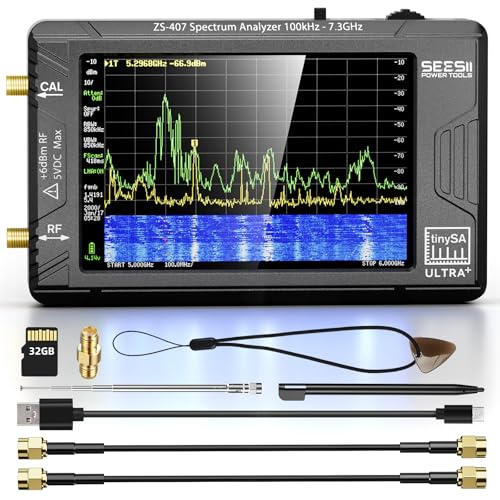
The SeeSii TinySA Ultra+ ZS407 pushes the boundaries of what a handheld spectrum analyzer can achieve at this price point. Covering 100 kHz to 7.3 GHz, it reaches well into the 5G NR FR1 bands (n77, n78, n79) and even touches Wi-Fi 6E at 6 GHz. The 4-inch HD touchscreen with 480×320 resolution and up to 450 scan points provides enough detail to identify spurious emissions and adjacent-channel interference in the field.
Beyond spectrum analysis, the ZS407 doubles as an RF signal generator producing MF/HF/VHF sine waves (100 kHz–900 MHz) and UHF square waves (800 MHz–6.3 GHz), making it valuable for filter characterization and receiver sensitivity tests without bringing a second box. The 5000 mAh battery delivers roughly 10 hours of continuous operation, which comfortably covers a full shift of drive testing or site surveys.
Calibrated up to 8 GHz and running the latest V0.5.4 hardware, the unit includes ESD protection and a 32 GB MicroSD card for data logging. The built-in self-calibration routine and template-based trace configuration simplify repeatable measurements. For professionals who need wideband frequency coverage without dragging a benchtop unit into the field, the TinySA Ultra+ is a compelling anchor tool.
Why it’s great
- 7.3 GHz span covers 5G NR FR1, Wi-Fi 6E, and satellite downlinks
- 2-in-1 signal generator and spectrum analyzer saves bench space
- 10-hour runtime with USB-C charging suits all-day field use
Good to know
- Input is delicate — external attenuators and DC block strongly recommended
- Touch screen responsiveness is decent but not at smartphone levels
2. AURSINC LibreVNA 2.0
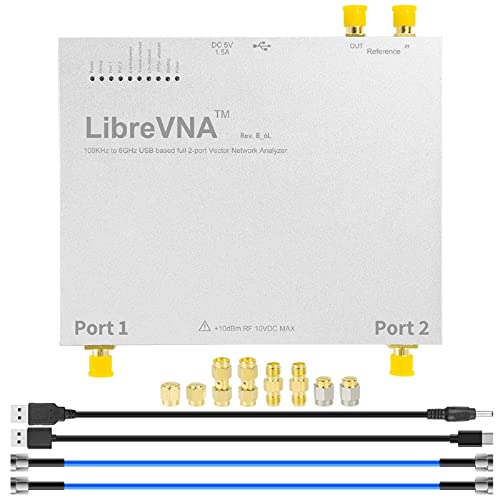
The LibreVNA 2.0 is an open-source, USB-based full 2-port vector network analyzer that delivers performance typically associated with instruments costing ten times more. Covering 100 kHz to 6 GHz with a 16-bit ADC and 6-layer PCB design, it achieves up to 100 dB of effective dynamic range and over 90 dB of S12 port isolation below 3 GHz. This makes it genuinely useful for characterizing 5G NR antenna matching networks, SAW/BAW filter stopbands, and cable insertion loss up to 6 GHz.
The open-source architecture (LibreVNA GUI on Windows, Linux, and macOS) gives engineers full control over sweep parameters, calibration sets, and trace math — unlike proprietary firmware that locks you into predefined test routines. The unit can scan over 10,000 points of full dual-port measurements in under one second, which is fast enough for production-level tuning. It also supports basic spectrum analysis and CW signal generation, though the manufacturer is upfront that these are secondary functions, not replacements for dedicated instruments.
The package includes SOLT calibration standards (OPEN, SHORT, LOAD), two SMA cables, and both USB-C data and power cables. Setup requires a high-power USB port — a powered hub is recommended for field laptops. For RF engineers and network technicians who need precise S-parameter measurements without a benchtop budget, the LibreVNA 2.0 is a legitimate workhorse.
Why it’s great
- 100 dB dynamic range rivals benchtop VNAs for filter and antenna work
- Open-source software ecosystem allows custom scripting and automation
- Full 2-port measurement up to 6 GHz with 16-bit ADC resolution
Good to know
- Requires external PC — no built-in display for standalone use
- Port isolation degrades above 3 GHz; harmonics used for 6 GHz coverage
3. Seesii NanoVNA-F V3
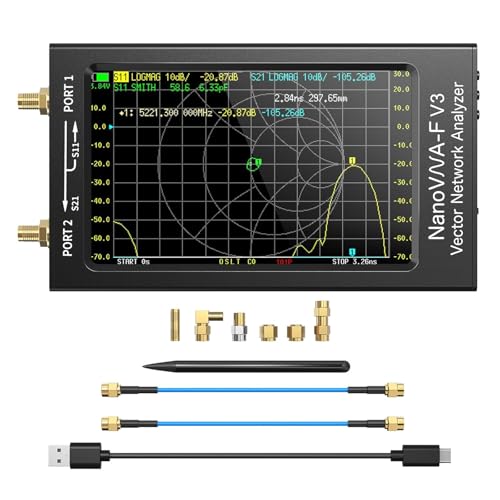
The NanoVNA-F V3 is an upgraded iteration of the popular open-source VNA platform, now covering 1 MHz to 6 GHz without relying on harmonic mixing — a crucial improvement that yields cleaner S11 and S21 traces across the entire band. With 801 scan points and support for Log Mag, Phase, Smith R+jX, VSWR, and Group Delay display formats, it provides the visualization depth needed for fine-tuning 5G NR antenna arrays and cavity duplexers.
The all-metal chassis provides better electromagnetic shielding than previous plastic-housed models, reducing stray coupling during sensitive measurements. The 4.3-inch color display shows complex traces clearly, and the unit ships with a gold-plated SMA calibration kit and two RG405 cables. Built-in 4500 mAh battery charges via USB-C in about three hours, though real-world continuous use runs closer to 2.5 hours at medium brightness — shorter than advertised, so plan for mid-shift recharges.
Software compatibility with NanoVNA-Saver and PC control software extends the instrument’s utility beyond the standalone screen. For field antenna installation and filter alignment, the V3’s portability and frequency range make it a strong partner to a full spectrum analyzer, covering the impedance side of the measurement equation.
Why it’s great
- True fundamental mixing to 6 GHz avoids harmonic artifacts in traces
- 801 scan points give fine frequency resolution for narrowband filter tuning
- Metal chassis improves shielding and durability for field use
Good to know
- Battery life closer to 2.5 hours under continuous high-brightness sweep
- Some units experience quality control issues; verify function on arrival
4. Siglent Technologies SSA3021X

The Siglent SSA3021X is a desktop spectrum analyzer that brings genuine lab-grade sensitivity to the 9 kHz to 2.1 GHz range. With a displayed average noise level of -161 dBm/Hz and phase noise of -98 dBc/Hz at 10 kHz offset (1 GHz carrier), it can resolve interference signals that handheld analyzers miss entirely — critical when hunting for low-level 5G NR desensitization issues or verifying out-of-band emissions compliance.
The 1 Hz minimum resolution bandwidth allows separating closely spaced carriers, and the all-digital IF architecture ensures stable, repeatable amplitude measurements. The included tracking generator (essential for scalar network analysis) enables filter tuning and cable frequency response characterization without needing a separate VNA. Users should note the instrument does not retain settings across power cycles, and the lack of a kickstand makes it tippy on cluttered benches.
For engineers working on 5G FR1 interference hunting, base station spurious verification, or production-level filter inspection, the SSA3021X offers a clear advantage over portable alternatives in sensitivity and RBW granularity — albeit at the cost of portability. It is the right choice when your measurement requires seeing signals at -160 dBm.
Why it’s great
- Exceptional -161 dBm/Hz DANL identifies weak interference signals
- Built-in tracking generator eliminates need for external stimulus
- 1 Hz RBW resolves adjacent 5G NR carriers with high precision
Good to know
- Only covers up to 2.1 GHz — insufficient for 3.5 GHz 5G bands
- Does not retain settings across power cycles; no built-in kickstand
5. Fluke Networks MS-POE

The Fluke Networks MS-POE is the go-to copper cable verifier for 5G small-cell backhaul installation, confirming that existing Cat5e or Cat6A runs can deliver PoE class power up to 90W and maintain 10 GbE link integrity. It detects 802.3at/af/bt PSE sources, negotiates with LLDP-aware switches to report the maximum available class, and measures cable length up to 460 meters with 0.3-meter resolution.
The oversized backlit LCD shows intuitive icons for wiremap, length, PoE class, and switch-advertised speed — no interpretation required in the field. The rugged rubberized grip and integrated RJ45 port (no dongles) streamline troubleshooting on active networks. IntelliTone digital and analog toning help locate specific cables in dense bundle runs without disconnecting live gear.
The main limitation is that the MS-POE tests the switch-advertised speed rather than the cable’s actual bandwidth capability — a known scenario where a cable that passes on the MS-POE still fails certification on a proper tester. For final acceptance testing of in-building 5G backhaul, pair this verifier with a full certifier. For day-to-day troubleshooting and PoE validation, it is the fastest tool in the bag.
Why it’s great
- PoE class detection up to 90W covers all 802.3bt devices
- Intuitive UI and rugged design save time in active network environments
- Length measurement with 0.3m resolution for fault localization
Good to know
- Does not test actual cable bandwidth — only switch-advertised speed
- Premium price point; remote ID kits sold separately
6. Fieldpiece SC440 True RMS Clamp Meter

While not directly a 5G RF instrument, the Fieldpiece SC440 clamp meter earns its place on this list for the electrical diagnostics side of 5G site installation. Remote radio heads (RRHs) require accurate AC/DC supply verification, inrush current measurement, and temperature monitoring — all covered by the SC440’s True RMS sensing, 400A AC clamp, and K-type thermocouple input.
The meter measures voltage, microamps DC for flame diode checks (relevant for gas-powered backup generators at cell sites), capacitance, frequency, and resistance. The high-voltage LED and beeper provide safety feedback when probing near energized distribution panels. Detachable silicone leads and alligator probe tips enable one-handed testing on crowded breaker panels — a practical consideration when commissioning power feeds for new 5G cabinets.
A minor workflow quirk: the meter requires pressing the “Select” button after power-on to switch between amp readings and continuity beep, which takes a few seconds to become habitual. The included carrying case and thermocouple are ready out of the box. For technicians who handle both RF cabling and site power infrastructure, the SC440 bridges that gap competently.
Why it’s great
- True RMS sensing delivers accurate VAC readings on VFD-driven RRH fans
- Measures capacitance, microamps, and temperature for comprehensive HVAC/R diagnostics
- Detachable leads and magnetic hanger enable safe one-handed use on panels
Good to know
- Must press Select after power-on to access amp and continuity modes
- 9V battery powered — battery life is adequate but not rechargeable
7. Fieldpiece HS33 Expandable Stick Multimeter
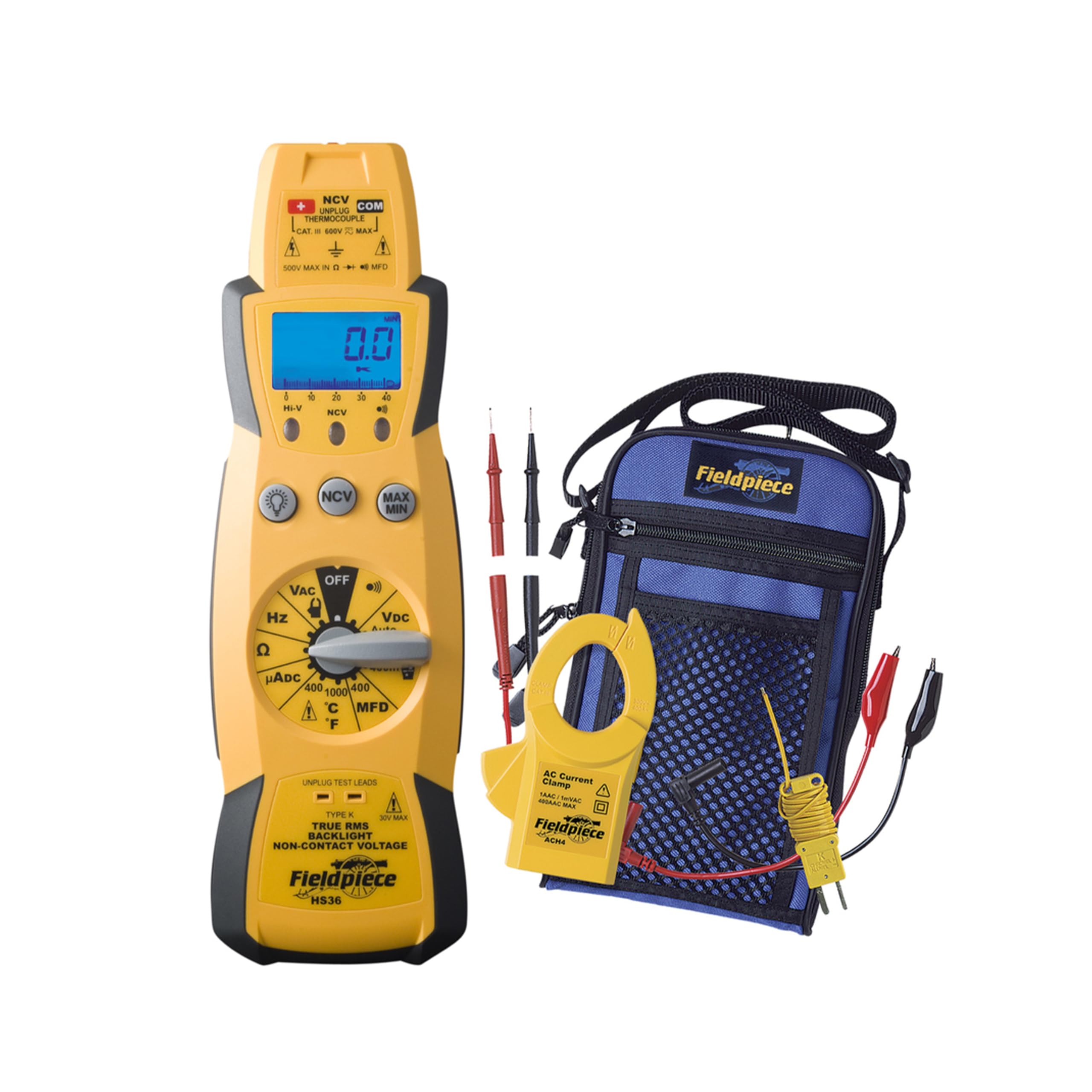
The Fieldpiece HS33 is a stick-style multimeter designed specifically for HVAC/R field work, with a unique expandable modular architecture. It measures voltage, microamps, capacitance, and temperature (up to 1000°F via K-type thermocouple) while also including a 400A AC clamp for current testing — all in a compact form factor that fits into tight equipment spaces around 5G base station cooling systems and power distribution units.
The real differentiator is compatibility with Fieldpiece accessory heads: you can add vacuum gauge, manometer, or refrigerant scale heads without buying a new meter, making the HS33 the core of an evolving toolkit. The built-in magnetic hanger, detachable silicone leads, and alligator clips enable hands-free operation on elevated racks or inside cabinets. Durable ABS housing with rubberized bumpers protect against drops common on active construction sites.
The long stick design (with or without the clamp attached) can feel unwieldy in very confined spaces, and the electronics may require recalibration after exposure to extreme weather. For technicians who need one meter that adapts to both 5G site electrical checks and HVAC system diagnostics, the HS33’s expandability justifies its mid-range position.
Why it’s great
- Modular accessory head system grows with your toolkit without replacing the meter
- Built-in magnetic hanger and detachable leads enable safe field testing
- Temperature measurement up to 1000°F covers extreme thermal diagnostics
Good to know
- Long stick design can feel awkward in very tight enclosures
- Electronics may need recalibration after harsh environmental exposure
8. RF Explorer ISM Combo

The RF Explorer ISM Combo is a handheld spectrum analyzer purpose-built for the ISM bands most relevant to wireless microphones, RC equipment, and early 5G small-cell deployment in the 2.4 GHz range. It covers 240–960 MHz and 2.35–2.55 GHz, with a typical noise floor of -110 dBm and amplitude resolution of 0.5 dBm — sufficient for identifying occupied channels and interference sources before commissioning wireless gear.
The device has a proven track record in venue frequency coordination for wireless microphones and in-field interference hunting for RC aircraft operations. Its compact size (9.6 ounces) and simple menu structure make it accessible for technicians who need a quick baseline scan without deep RF engineering training. One user successfully compared its accuracy against a lab analyzer during FCC certification pre-scanning, and the RF Explorer held its own within practical margins.
The main limitation is frequency coverage: it stops at 2.55 GHz, so it cannot see 5G NR n78 (3.5 GHz) or n260/n261 mmWave bands. The unit also has a known packaging issue where the 2.4 GHz whip antenna may be missing upon arrival. For ISM-band site surveys and basic interference hunting, it is a capable and portable companion — but not a general-purpose 5G tool.
Why it’s great
- Excellent accuracy for its class — validated against K lab analyzers
- Lightweight and intuitive for quick ISM-band interference scans
- Battery-powered portability suits venue and RC field surveys
Good to know
- Frequency range limited to 2.55 GHz — misses most 5G NR sub-6 bands
- 2.4 GHz whip antenna occasionally missing from package; verify contents
9. Henkion LT-600T Multifunction Cable Tester
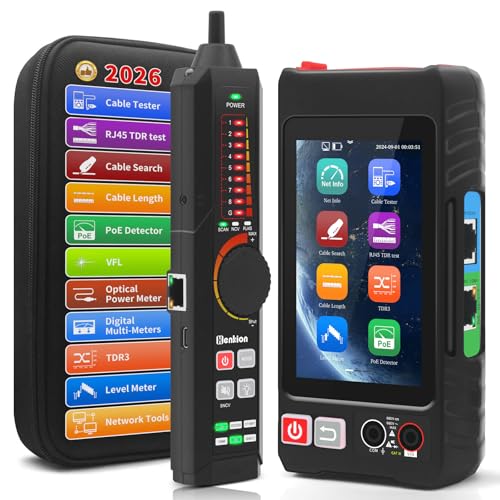
The Henkion LT-600T is a multifunction cable tester that punches well above its price category by combining TDR, DMM, optical power meter, VFL, PoE++ detection, and Ethernet network testing into a single 4-inch IPS touch display device. For 5G backhaul and fronthaul installations where fiber and copper coexist, this consolidation eliminates the need to carry three separate tools.
The TDR function measures cable break-points and short circuits up to 1200 meters, while the RJ45 TDR mode tests pair status, length, attenuation reflectivity, impedance, skew, and opens up to 3000 meters with ±3% accuracy. The network tool suite — IP discovery, PING test, LLDP/CDP detection, port flashing, and PPPoE dial — transforms a basic cable tester into an active network validation device. The 4000 mAh rechargeable battery in both emitter and receiver means no hunting for 9V cells.
Navigation is slightly slower than premium Fluke equivalents, and the touch screen feels less responsive under bright sunlight. The LT-600T is best suited for technicians managing mixed copper/fiber 5G small-cell backhaul who want a single compact device for initial verification, paired with a professional certifier for final sign-off.
Why it’s great
- Combines TDR, OPM, VFL, DMM, and PoE++ in one budget-friendly unit
- Network tools (IP scan, LLDP, PING) verify active Ethernet links
- Rechargeable 4000 mAh battery in both main and remote units
Good to know
- Slower navigation and touch response compared to Fluke-class gear
- Not a substitute for full cable certification on live 5G backhaul
FAQ
Can a sub-6 GHz spectrum analyzer measure 5G mmWave bands?
What is the difference between a VNA and a spectrum analyzer for 5G testing?
Why does 5G test equipment require better phase noise than 4G LTE tools?
What does displayed average noise level (DANL) mean for field 5G troubleshooting?
Is the SeeSii TinySA Ultra+ suitable for 5G NR field measurements?
Final Thoughts: The Verdict
For most users, the best 5g test equipment winner is the SeeSii TinySA Ultra+ ZS407 because its 7.3 GHz span, integrated signal generator, and 10-hour battery life cover the widest range of sub-6 GHz 5G NR field tasks without requiring a benchtop. If you need full 2-port vector network analysis for antenna and filter work, the AURSINC LibreVNA 2.0 delivers lab-grade dynamic range in a compact USB form factor. And for technicians focused on small-cell backhaul, the Fluke Networks MS-POE remains the gold standard for copper verification and PoE validation — just pair it with a proper certifier for final acceptance.