
Choosing a 6-volt deep cycle battery is the single most important decision for anyone running a golf cart, off-grid solar array, RV house bank, or marine trolling motor system. The wrong selection — whether flooded or AGM, under-specced amp-hours, or incompatible terminal type — leads to premature failure, sagging voltage under load, and costly replacements long before the warranty expires.
I’m Min — the co-founder and writer behind Gadgets Feed. I specialize in analyzing the technical specifications and real-world longevity data of deep cycle batteries to help buyers cut through marketing claims and pick a power source that actually delivers its rated capacity over hundreds of cycles.
This guide compares the top contenders across flooded, AGM, and high-capacity chemistries, evaluating cycle life, amp-hour density, and build quality to help you find the best 6 volt deep cycle battery for your specific energy demands and budget.
How To Choose The Best 6 Volt Deep Cycle Battery
Not all 6V deep cycle batteries store energy the same way. The internal chemistry, plate thickness, and terminal design dictate whether a battery lasts three years or eight, and whether you can safely discharge it to 80 percent without damage. Understanding a handful of core specs will prevent a frustrating early failure.
Amp-Hour (Ah) Rating at the C20 Rate
The C20 rate measures how many amps a battery can deliver steadily over 20 hours before dropping to 10.5 volts. A 225Ah battery at the C20 rate provides 11.25 amps for 20 hours. If you plan to run a 50 amp load — like a large inverter or an electric motor — the effective capacity drops below the stated number. Match the C20 rating to your average daily load times two to avoid excessive depth of discharge that shortens lifespan.
Flooded vs. AGM Chemistry
Flooded lead-acid (FLA) batteries require periodic water top-ups, vent flammable hydrogen gas, and must remain upright. They tolerate overcharging better and cost less per amp-hour. Absorbed Glass Mat (AGM) batteries are sealed, spill-proof, vibration-resistant, and can be mounted in any orientation. They recharge faster and accept higher depth of discharge — typically 80 percent versus 50 percent for FLA — but come at a premium price. AGM is the smarter choice for mobile applications like RVs and boats or sensitive electronics.
Terminal Type and Group Size
GC2 (golf cart) form factor is the most common 6V deep cycle group size, measuring roughly 10.25 x 7.1 x 11 inches. Terminals vary widely: SAE post, M8 threaded insert, flat copper pads, or flagged UTL. Using adapters adds resistance and potential failure points. Confirm the terminal configuration matches your existing cables or battery tray before purchasing.
Quick Comparison
On smaller screens, swipe sideways to see the full table.
| Model | Category | Best For | Key Spec | Amazon |
|---|---|---|---|---|
| VMAX XTR6-235 (Qty 2) | AGM Premium | High-cycle RV & inverter | 235Ah, 500 min reserve capacity | Amazon |
| US Battery US1800XC2 (6-pack) | Flooded Fleet | Commercial golf cart & solar | 208Ah at C20, 392 min @ 25A | Amazon |
| NPP NP6-225Ah | AGM Value | Solar bank & backup power | 225Ah, M8 (T16) terminal | Amazon |
| Go Power GP-AGM-224-6V | AGM Solar | Residential off-grid PV | 224Ah, 1.4 milliohm resistance | Amazon |
| VMAX6-225 GC2 | AGM Military | Off-grid cabin & dry camping | 225Ah, 5-8 year float life | Amazon |
| Weize GC2 240Ah | AGM Mid-Range | Golf cart & scissor lift | 240Ah, SAE post & M8 terminal | Amazon |
| Mighty Max ML200-6 | AGM Budget | Small solar & wheelchair | 200Ah, internal thread terminal | Amazon |
In‑Depth Reviews
1. VMAX XTR6-235 (Qty 2)

The VMAX XTR6-235 is the most robust AGM 6V battery in this comparison, packing 235 amp-hours with a staggering 500-minute reserve capacity. That reserve rating means this battery can sustain a 25-amp load for over eight hours before dropping below 10.5 volts — critical for overnight inverter use in a motorhome or continuous medical equipment.
Each battery weighs 78 pounds, a full 10 pounds heavier than most GC2 competitors, which correlates directly with thicker lead plates and longer cycle life. Verified buyers who replaced standard AGM batteries report the XTR6-235 delivering 12 hours of dry camping runtime to 50 percent depth of discharge, with no measurable degradation after two years of regular use. The dual pack price positions it as a premium investment, but the per-cycle cost often beats cheaper options that fail after 18 months.
Wired in series for 12-volt house banks or in parallel for higher capacity 6V systems, these batteries handle high-amp inverters and heavy solar charging without voltage sag. The sealed AGM construction allows mounting in any orientation, making them ideal for tight compartments where ventilation is limited.
Why it’s great
- Exceptional 500-minute reserve capacity for long inverter runtime
- Heavy 78-pound build indicates thick plates and long cycle life
- Sealed AGM with zero maintenance and any-orientation mounting
Good to know
- Premium price point, sold as a 2-pack only
- Limited one-year warranty for a premium battery
- Under 80 pounds per battery requires careful handling during installation
2. US Battery US1800XC2 (Pack of 6)
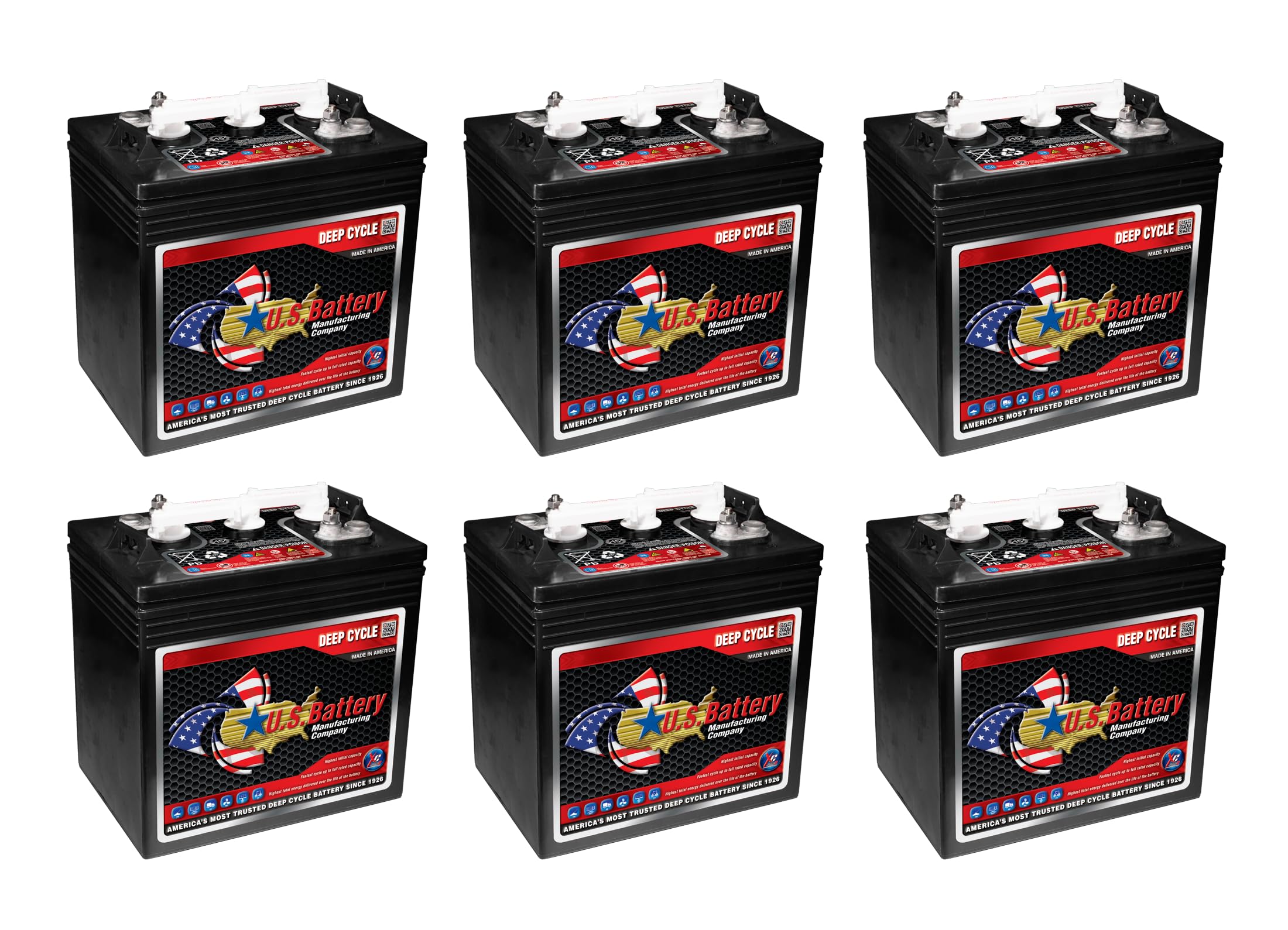
The US Battery US1800XC2 is a flooded lead-acid workhorse designed for commercial golf cart fleets and high-cycling solar installations. Its 208Ah rating at the C20 rate, combined with 392 minutes of discharge at 25 amps, delivers sustained pulling power for 48V golf cart systems and 24V industrial floor equipment. The six-battery package provides a complete drop-in replacement for T-105 banks.
Unlike AGM counterparts, these batteries require periodic distilled water top-ups and must remain upright in a ventilated compartment. The trade-off is a significantly lower amp-hour cost and a genuine 12-month manufacturer warranty with responsive customer support — verified buyers report direct phone calls from US Battery representatives to coordinate delivery logistics. The molded-in UTL terminals accept standard golf cart cables without adapters.
Buyers report outperforming previous 6-pack purchases, holding charge above 60 percent after two to three weeks of intermittent use. The 58-pound weight per battery is manageable for a single person to lift, and the included lifting straps simplify installation. For off-grid cabins or solar arrays where routine maintenance is not an imposition, these flooded batteries deliver the best capacity-per-dollar ratio on this list.
Why it’s great
- Lowest cost per amp-hour among all tested batteries
- 392-minute discharge at 25 amps for sustained runtime
- Direct replacement for standard T-105 and T-605 batteries
Good to know
- Requires water top-ups and must remain upright
- Vents hydrogen gas during charging — needs ventilation
- 50 percent depth of discharge recommended for best cycle life
3. NPP NP6-225Ah
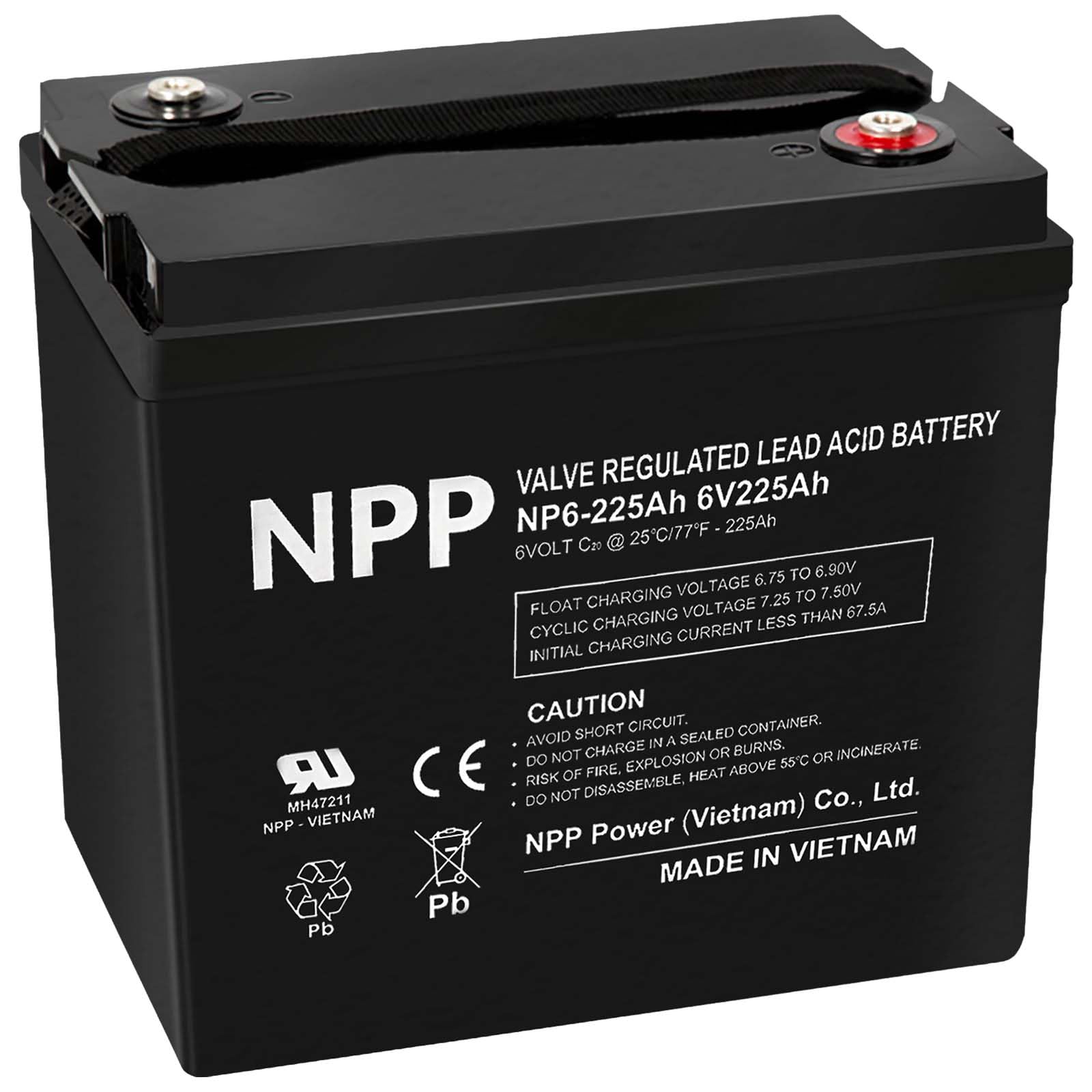
The NPP NP6-225Ah offers a rare combination of 225 amp-hours and an M8 threaded insert terminal at a mid-range price point that undercuts most premium AGM brands. The T16 (M8) terminal provides a secure, high-torque connection for heavy-gauge ring terminals without the risk of post corrosion common on standard SAE posts. This makes it particularly suitable for permanent solar system wiring where resistance must be minimized.
NPP operates six manufacturing facilities and holds UL, CE, and ISO certifications, lending credibility to their 24-hour after-sales support team based in Los Angeles. Buyers using these in 48V solar banks report perfect compatibility with charge controllers and inverters, though there have been isolated reports of polarity reversal on some units — easily corrected by reversing cables, but worth confirming with a multimeter before installation. A second purchase user built an 8-battery bank and recommends the setup for 5+ year service life in high-temperature environments.
Sealed lead-acid construction means zero maintenance and no venting requirements. At 65 pounds, it is lighter than most GC2 AGMs while delivering 225Ah of rated capacity. For budget-conscious DIY solar builders and RV owners who want a reliable AGM without paying a premium for the brand name, the NPP NP6-225 is the smart compromise.
Why it’s great
- 225Ah capacity at a competitive mid-range price
- M8 threaded terminal for low-resistance connections
- Zero maintenance sealed lead-acid construction
Good to know
- Inconsistent polarity labeling reported on some units
- Lower cycle life compared to premium AGM competitors
- Replacement cell repair is possible but rarely practical
4. Go Power GP-AGM-224-6V

The Go Power GP-AGM-224-6V is engineered specifically for solar and inverter applications, with its 1.4 milliohm internal resistance enabling fast acceptance of charging current from solar panels and multi-stage inverter chargers. The 224Ah C20 rating translates to roughly 11.2 amps continuous for 20 hours, and independent testing has shown actual capacity slightly exceeding the stated number — a rarity in a market where over-claimed ratings are common.
Integrated carrying handles make this 67-pound battery easier to lift into tight RV compartments, and the sealed AGM construction eliminates off-gassing risk inside living spaces. The two-year manufacturer warranty is longer than most competitors in the same tier, though a small number of user reports indicate complete failure within the first year — underscoring the importance of checking manufacturing date codes upon delivery. The battery arrived fully charged for most buyers, with some reporting delivery speeds weeks ahead of estimated dates.
Wiring two of these in series produces a 12V 224Ah bank rated for residential solar use, and the consistent discharge curve is well-suited for lead-acid compatible charge controllers. For the premium price, you are paying for verified capacity and low internal resistance rather than marketing hype.
Why it’s great
- Verified capacity matching or exceeding C20 rating
- Low 1.4 milliohm internal resistance for fast recharging
- Built-in carrying handles for easier installation
Good to know
- Occasional early-life failure reported by some users
- Premium price compared to similarly rated competitors
- GC2 size may not fit every battery tray without measurement
5. VMAX6-225 GC2

The VMAX6-225 GC2 uses military-grade alloy construction and is specified for a float service life of 5 to 8 years — a longevity claim backed by user reports of these batteries exceeding 3 years of full-time off-grid use with solar panels and a 400W inverter. The 225Ah rating and 8mm screw-in post terminals provide a clean, high-current interface that outperforms clamp-style connections in vibration-prone environments like travel trailers and off-road campers.
Buyers report two VMAX6-225 batteries wired in series for a 12V system running LED lighting, a 12V mattress pad, device charging, and a 400W inverter for two full days of dry camping with voltage still holding at 12V. The 200W solar array recharged the bank to 12.6-12.7V within 5 to 6 hours of good sun. The sealed non-spillable design is approved for air, ground, and maritime transport, making it one of the few options suitable for boat and plane-mounted systems without hazmat restrictions.
At 77 pounds, it is among the heaviest single GC2 batteries on the market, a direct indicator of thicker plates and higher lead content. The one-year warranty is shorter than expected for a premium AGM, but the battery’s track record with long-distance overlanders and off-grid cabins suggests the build quality often outlasts the warranty period.
Why it’s great
- 5-8 year float service life with proper charging
- Military-grade alloy construction for vibration resistance
- Approved for air, ground, and maritime transport
Good to know
- Very heavy at 77 pounds per battery
- Only a 1-year manufacturer warranty
- Requires authorized seller purchase for warranty validity
6. Weize GC2 240Ah
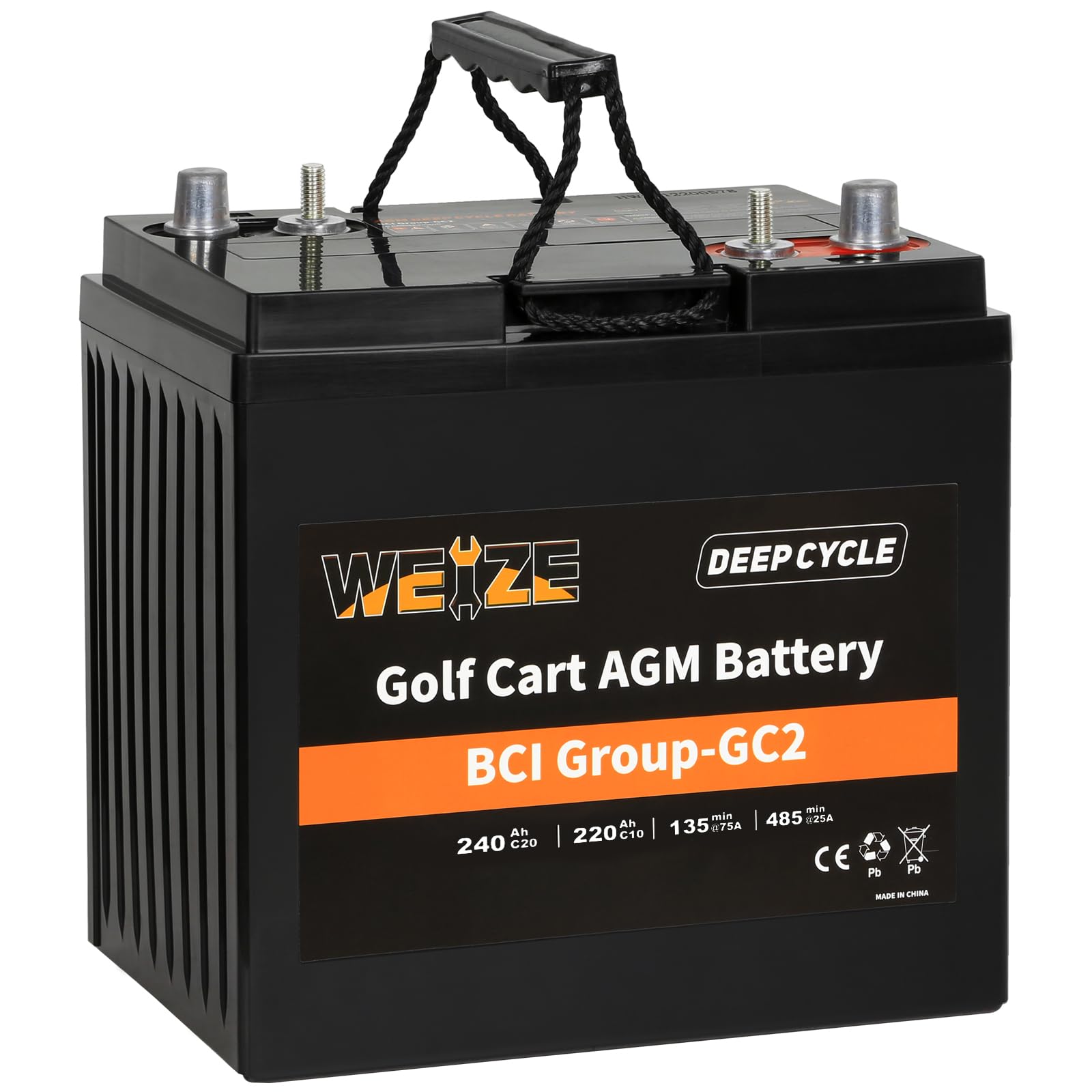
The Weize GC2 240Ah claims the highest amp-hour rating among all GC2 AGM batteries in this comparison, delivering 240Ah at the C20 rate with a dual terminal configuration that includes both standard SAE posts and SAE/M8 inserts. This dual-terminal design provides flexibility for both clamp-style battery cables and ring terminal connections, making it backwards compatible with older golf carts and RV systems without requiring adapters.
The AGM-GEL hybrid technology uses 99.99 percent virgin lead for grid plates and carbon-active material to reduce internal resistance. Buyers switching from flooded wet cells report a noticeable improvement in charge retention, with batteries holding charge much longer between uses. The two-year warranty provides one of the longest coverage periods among mid-range options, although a few users noted that these batteries require a lithium-specific charger profile for optimal performance — despite being lead-acid AGM units.
Weighing 67 pounds, it is lighter than both VMAX options while offering higher rated capacity, suggesting the use of thinner plates that may sacrifice cycle life for weight savings. For golf cart owners who prioritize daily range over multi-year longevity, this trade-off can be perfectly acceptable.
Why it’s great
- Highest rated capacity at 240Ah among GC2 AGMs
- Dual terminal design (SAE post + M8 insert)
- Competitive price with 2-year warranty
Good to know
- May require lithium-compatible charger for optimal performance
- Thinner plates may reduce cycle life compared to heavier AGMs
- Heavier than standard flooded GC2 but lighter than premium AGMs
7. Mighty Max ML200-6

The Mighty Max ML200-6 is the entry-level 6V deep cycle battery that balances a 200Ah capacity with the lowest price point in this comparison. Its internal thread (INT) terminal system uses machine screws to secure ring terminals directly into the lead post, creating a clean connection that eliminates the risk of post corrosion common on exposed SAE posts. UL certification adds confidence for safety-critical applications like medical scooters and backup sump pumps.
At 66 pounds, it is lighter than most 200Ah+ AGM batteries, and its dimensions (12.05 x 6.65 x 8.94 inches) are taller and narrower than standard GC2 footprint — be sure to measure your battery tray before purchase. Buyers have successfully used these in motorized wheelchairs, small RV setups, and 12V camera systems wired in series. One verified buyer ran a 10-day dry camping trip with two batteries in parallel, never dropping below 70 percent charge.
There are serious durability concerns. Some buyers report catastrophic failure after a single season of use, with Interstate Battery technicians confirming the batteries would not accept a charge after storage. The manufacturer’s warranty support has been criticized, with claims of refusal to honor replacements even within the warranty window. For temporary power solutions or budget-restricted builds where early failure is an acceptable risk, the ML200-6 can work — but it is not a set-and-forget solution for long-term off-grid living.
Why it’s great
- Most affordable 200Ah 6V deep cycle battery available
- UL certified for safety in scooters and medical devices
- Internal thread terminal prevents post corrosion
Good to know
- Risk of catastrophic failure after storage as reported by users
- Non-standard dimensions may not fit GC2 trays
- Manufacturer warranty support is unreliable
FAQ
Can I replace flooded 6V batteries with AGM without changing my charger?
What is the best voltage for a 6V deep cycle battery bank?
How do I safely store a 6V deep cycle battery for the winter?
What does the GC2 group size actually mean?
Final Thoughts: The Verdict
For most users, the best 6 volt deep cycle battery winner is the VMAX XTR6-235 (Qty 2) because its 500-minute reserve capacity and thick-plate AGM construction deliver verified runtime and cycle life that outlast cheaper alternatives. If you want the highest amp-hour density without the premium price, grab the Weize GC2 240Ah. And for commercial golf cart fleets or ground-up solar builds where routine maintenance is acceptable, nothing beats the US Battery US1800XC2 (Pack of 6) for capacity per dollar and proven industrial durability.