
A desktop that fits in your palm yet carries enough memory to run multiple virtual machines, compile code, or host a media server isn’t a futuristic concept — it’s today’s 64GB RAM Mini PC. These compact powerhouses have evolved from basic office boxes into genuine workstations, capable of handling AI inference, 4K video editing, and heavy data analysis without breaking a sweat or taking up your entire desk.
I’m Min — the co-founder and writer behind Gadgets Feed. When evaluating these systems, I focus on processor architecture, thermal design power limits, memory bandwidth, and I/O throughput — the specs that determine real-world multitasking performance rather than marketing hype.
Whether you’re a developer needing local LLM capacity, a trader running quad displays, or a creative professional editing 8K footage, this guide breaks down the best options available. This is your definitive resource for finding the absolute best 64gb ram mini pc that matches your specific workload and budget.
How To Choose The Best 64GB RAM Mini PC
Selecting the right mini PC with 64GB of RAM involves more than just counting gigabytes. The processor, graphics solution, storage interface, and connectivity all determine whether your investment delivers sustained performance or becomes a bottleneck.
Processor Architecture: x86 vs. Mobile vs. AI-Centric
The CPU dictates how efficiently 64GB of RAM is utilized. Current options range from Intel 12th-gen Alder Lake (like the i5-12500T) to AMD’s latest Ryzen AI 9 HX 370 with Zen 5 cores. For AI workloads, look for NPU (Neural Processing Unit) support — AMD’s XDNA 2 architecture offers up to 55 TOPS, enabling local LLM processing without cloud dependency. Intel’s Core Ultra series also includes a dedicated NPU for Copilot+ features.
Graphics and Display Output
Integrated graphics have come a long way. The AMD Radeon 890M (RDNA 3.5) can rival entry-level discrete GPUs in 1080p gaming, while Intel’s UHD Graphics 770 handles productivity but struggles with AAA titles. For multi-monitor setups, check the number of 4K or 8K outputs — some units offer four simultaneous 4K displays via HDMI, DisplayPort, and USB4. OCuLink ports allow eGPU expansion for serious rendering or gaming.
Storage and Expandability
64GB RAM is often paired with PCIe 4.0 NVMe SSDs for balanced performance. Look for dual M.2 slots to enable RAID configurations or separate OS and data drives. Memory expansion capability also matters — some LPDDR5X units are soldered and non-upgradable, while DDR4/DDR5 SODIMM systems allow future upgrades to 96GB or 128GB.
Quick Comparison
On smaller screens, swipe sideways to see the full table.
| Model | Category | Best For | Key Spec | Amazon |
|---|---|---|---|---|
| GMKtec EVO-X2 | Premium | AI & Heavy Gaming | AMD Ryzen AI Max+ 395 (16C/32T) | Amazon |
| MINISFORUM AI X1 Pro-370 | Premium | Professional Workstations | AMD Ryzen AI 9 HX 370 (12C/24T) | Amazon |
| ACEMAGIC M1A Pro | Premium | Workstation + eGPU | Intel i9-13900HK + ARC A770 | Amazon |
| TOPGRO T1-Pro | Premium | Gaming | Intel i9-13900HK + RTX 4060 | Amazon |
| Dell Pro Micro Plus | Mid-range | Enterprise Deployments | Intel Core Ultra 5 235T (14C) | Amazon |
| Beelink SER9 MAX | Mid-range | Gaming & Creative | AMD Ryzen 7 H 255 (8C/16T) | Amazon |
| Lenovo ThinkCentre M70q | Mid-range | Business & Office | Intel i5-10400 (6C/12T) | Amazon |
| Reatan X8 | Premium | AI Development | AMD Ryzen AI 9 HX 470 (12C/24T) | Amazon |
| Reatan HX 470 | Premium | High-End AI & Gaming | AMD Ryzen AI 9 HX 470 (12C/24T) | Amazon |
| HP Desktop Tower | Budget-friendly | Home Office | Intel i5-12500T (6C/12T) | Amazon |
| CyberGeek 5700U | Budget-friendly | Entry-Level Multitasking | AMD Ryzen 7 5700U (8C/16T) | Amazon |
In‑Depth Reviews
1. GMKtec EVO-X2 AI Mini PC

The GMKtec EVO-X2 represents the absolute pinnacle of what a mini PC can achieve, powered by the AMD Ryzen AI Max+ 395 — a 16-core, 32-thread beast with 64MB of L3 cache. The 64GB of LPDDR5X memory running at 8000MT/s across eight channels provides unprecedented bandwidth, delivering 1.5x faster performance than standard DDR5 SODIMM configurations. This architecture allows the integrated Radeon 8060S graphics to utilize the full 64GB pool as VRAM, enabling local LLM runs like Deepseek 32B and AAA gaming at 1080p with maximum details.
The triple cooling system with dual turbo fans and a dedicated DDR5/SSD fan maintains whisper-quiet operation at just 35dB in Quiet Mode, while three power modes (54W, 85W, and 140W) let you balance performance and acoustics. Quad 8K output via HDMI 2.1, DisplayPort, and dual USB4 ports, combined with WiFi 7 and Bluetooth 5.4, future-proofs this machine for years. The onboard SD 4.0 card reader is a rare but welcome addition for photographers and videographers.
Documented issues include some units arriving with defective I/O ports and the plastic chassis feeling less premium than expected given the price point. Additionally, AMD ROCm does not currently support the integrated GPU, limiting AI development to CPU-bound workflows — a notable caveat for machine learning engineers expecting CUDA-level support.
Why it’s great
- 32-thread CPU with industry-leading memory bandwidth
- Radeon 8060S iGPU rivals RTX 4060 in gaming
- Three performance modes plus silent operation
Good to know
- LPDDR5X is soldered and non-upgradable
- Some quality control issues reported
- ROCm does not support integrated GPU
2. MINISFORUM AI X1 Pro-370

The MINISFORUM AI X1 Pro-370 leverages AMD’s latest Zen 5 architecture with the Ryzen AI 9 HX 370, delivering 12 cores and 24 threads boosted to 5.1GHz. With 80 total TOPS and a 50 TOPS NPU, this mini PC fully unlocks all Copilot+ features — including Recall, live translation, and Studio Effects — making it a genuine AI-first workstation. The Radeon 890M graphics with 16 RDNA 3.5 CUs handle 1080p gaming comfortably while supporting eGPU expansion via the dedicated OCuLink port.
Storage flexibility is exceptional with three M.2 2280 PCIe 4.0 slots supporting up to 12TB total capacity, while dual SO-DIMM slots allow RAM expansion to 96GB. Quad display output (HDMI, DP, and dual USB4) combined with dual 2.5GbE LAN ports make this ideal for software-defined networking, NAS applications, or financial trading desks. The whisper-quiet cooling system maintains low noise even during sustained loads, and the fingerprint reader with Windows Hello adds enterprise-grade security.
While the aluminium chassis feels premium, some users note that the included 120W power adapter feels underpowered for peak loads, potentially limiting sustained performance in Turbo mode. The price point also positions it firmly in workstation territory — overkill for basic office tasks but excellent value for power users running multiple VMs, CAD software, or AI model inference.
Why it’s great
- 50 TOPS NPU for local AI processing
- OCuLink port for external GPU expansion
- Triple M.2 SSD slots with RAID support
Good to know
- Power adapter may limit peak performance
- Premium price for workstation-class hardware
- No built-in speaker or card reader
3. ACEMAGIC M1A Pro

The ACEMAGIC M1A Pro stands alone in this lineup as the only mini PC featuring a discrete GPU — the Intel ARC A770 with 32GB of dedicated GDDR6 memory — paired with a 14-core i9-13900HK processor. This combination delivers genuine desktop-class performance for AI workloads like Stable Diffusion, Blender rendering, and Premiere Pro editing, tasks that choke integrated graphics. The 54W TDP sustained cooling system keeps both CPU and GPU running efficiently during extended rendering sessions without thermal throttling.
The platform supports dual-channel DDR5 memory up to 96GB and dual M.2 NVMe PCIe 4.0 slots up to 4TB, providing massive bandwidth for creative workflows. Four display support (USB4 at 8K 60Hz, dual DP 2.0 at 8K, and dual HDMI 2.0) transforms any desk into a high-efficiency multi-monitor command center. WiFi 6E and 2.5GbE LAN ensure fast connectivity for network-attached storage or collaborative work.
However, the factory Windows installation comes with poorly configured drivers that require a clean install and manual driver updates via Intel’s chipset utility — a significant hurdle for non-technical users. Some units also reported initial RAM fingerprint issues, though customer support resolved those. The price for a discrete GPU workstation is compelling, but factor in the time needed for driver optimization.
Why it’s great
- Discrete ARC A770 GPU with 32GB VRAM
- Dual display at 8K via USB4 and DP 2.0
- Sustained 54W TDP for professional workloads
Good to know
- Factory driver configuration needs manual fixing
- Customer support response times vary
- Not recommended for non-tech users
4. TOPGRO T1-Pro Mini Gaming PC

The TOPGRO T1-Pro is the only system here built from the ground up for gaming, pairing a 14-core i9-13900HK with a proper GeForce RTX 4060 mobile GPU featuring 8GB of GDDR6 memory. The RTX 4060 supports DLSS 3.0 and hardware ray tracing, delivering smooth 1080p gameplay at high settings in titles like Cyberpunk 2077, Fortnite, and Call of Duty. With 64GB of DDR5-5200 memory and a 2TB PCIe 4.0 SSD, loading times are virtually eliminated and texture streaming is seamless.
Customizability extends beyond specs: adjustable RGB lighting with multiple color modes and a fan speed control button let you optimize between silent operation and maximum cooling. Dual HDMI 2.0 outputs support dual 4K 60Hz monitors simultaneously, and the 2.5GbE LAN plus WiFi 6E with Bluetooth 5.3 ensure lag-free online gaming. The included USB recovery drive and responsive WhatsApp support show TOPGRO understands its target audience.
The biggest trade-off is noise — under load, the fans are noticeably loud even at medium settings, though users report that positioning the unit under a desk mitigates the issue. The SSD is also slower than comparable NVMe drives, and rear USB port selection is limited. The price reflects the premium for integrated RTX graphics in a compact chassis, but if gaming is your primary use case, this is the most capable option available.
Why it’s great
- RTX 4060 with DLSS 3.0 and ray tracing
- Adjustable RGB and fan speed controls
- 2TB SSD with large capacity
Good to know
- Fans become loud under gaming load
- SSD performance is entry-level
- Limited rear USB ports
5. Dell Pro Micro Plus

The Dell Pro Micro Plus (the next-gen OptiPlex 7000 MFF) is built for enterprise reliability, featuring the Intel Core Ultra 5 235T with a dedicated 13 TOPS NPU for AI-accelerated business applications. The 14-core design includes performance and efficiency cores managed by Intel’s Thread Director, while 64GB of DDR5 memory handles data analytics, virtualization, and complex Office workflows. The standout feature is quad 4K display support via four DisplayPort outputs — invaluable for trading floors, data centers, or command center operators.
The Micro Form Factor is 90% smaller than traditional towers, with VESA mounting capability behind monitors. Connectivity includes WiFi 6, Bluetooth 5.3, a USB-C port at 20Gbps, and Gigabit Ethernet. The tool-free chassis allows easy access to memory and storage for upgrades, and Dell’s commercial-grade durability testing ensures long-term reliability in 24/7 operation. Windows 11 Pro comes pre-installed with enterprise security features.
However, documented reports of hardware failure within nine months and Dell refusing warranty support raise concerns about long-term viability. The integrated Intel UHD Graphics 770 is fine for productivity but useless for gaming or GPU-accelerated tasks. The price point is steep for the specs compared to consumer mini PCs, but the build quality and serviceability justify it for corporate deployments where reliability is paramount.
Why it’s great
- Quad DisplayPort for multi-monitor workflows
- NPU for AI-accelerated productivity
- Tool-free upgradeable design
Good to know
- Some users experienced early hardware failure
- Integrated GPU limits graphics performance
- Premium pricing for corporate-grade hardware
6. Beelink SER9 MAX

The Beelink SER9 MAX brings AMD’s 4nm Ryzen 7 H 255 processor (8 cores, 16 threads, up to 4.9GHz) to a competitively priced package with 64GB of DDR5 memory and a 1TB PCIe 4.0 SSD. The Radeon 780M graphics with 12 cores at 2600MHz deliver smooth 1080p gaming at 60FPS in titles like DOTA, PUBG, and CS:GO, while supporting triple 4K 120Hz displays via HDMI, DP, and USB-C. The MAX 54W TDP allows sustained performance without aggressive thermal throttling.
What sets the SER9 apart is its expandability: dual M.2 PCIe 4.0 slots support up to 8TB of internal storage, and the RAM can be upgraded to a staggering 256GB — far beyond any competitor. Connectivity is comprehensive with USB4 at 40Gbps with PD and DP alternation, a 10Gbps USB-C, dual USB 3.2 ports, and a 2.5GbE LAN. The included VESA mount and compact chassis (fits in a pocket) make it ideal for portable workstation setups.
The cooling system, while effective, struggles under sustained gaming loads, with some users reporting heat-related instability after months of use. The BIOS is almost completely unlocked, allowing advanced users to tweak UMA buffer settings for better iGPU performance, but this also means less protection against user error. A few reports of system freezes and VPN disconnections suggest quality control could be tighter.
Why it’s great
- RAM expandable up to 256GB DDR5
- Triple 4K 120Hz display support
- Unlocked BIOS for enthusiast tuning
Good to know
- Thermal performance weak point for gaming
- Some units show instability over time
- Unlocked BIOS increases risk for novices
7. Lenovo ThinkCentre M70q

The ThinkCentre M70q is a true business-class machine from Lenovo’s enterprise lineup, packing an Intel i5-10400 (6 cores, 12 threads) with 64GB DDR4 RAM and a 1TB PCIe SSD. The tiny chassis measures just 7 x 7 x 1.4 inches, making it the most space-efficient option here, easily VESA-mounted behind a monitor for a clean all-in-one setup. Dual display output via HDMI and DisplayPort handles productivity workflows, while the integrated Intel UHD Graphics 630 is sufficient for 4K streaming and presentations.
Connectivity is business-oriented: WiFi 6 with external antenna for better range, Bluetooth, a USB-C 3.2 Gen 1 port with always-on charging, and four USB-A ports. The included wired keyboard and mouse reduce setup friction for corporate deployments. The M70q is built to Lenovo’s commercial standards with MIL-SPEC testing, ensuring reliability in demanding environments.
The i5-10400 is a 10th-gen processor — three generations behind current options — which means slower single-thread performance and no support for DDR5 or PCIe 4.0. Some refurbished units arrive missing components like the wireless card or power cord, and the Bluetooth audio quality can be poor without external antennas. At , you’re paying for Lenovo’s enterprise support and build quality rather than raw performance, making this best for IT-managed office fleets rather than power users.
Why it’s great
- Ultra-compact chassis for space-constrained desks
- Lenovo commercial reliability and MIL-SPEC testing
- Includes keyboard and mouse
Good to know
- 10th-gen Intel processor is outdated
- Refurbished units may have missing components
- Integrated GPU limits graphics performance
8. Reatan X8
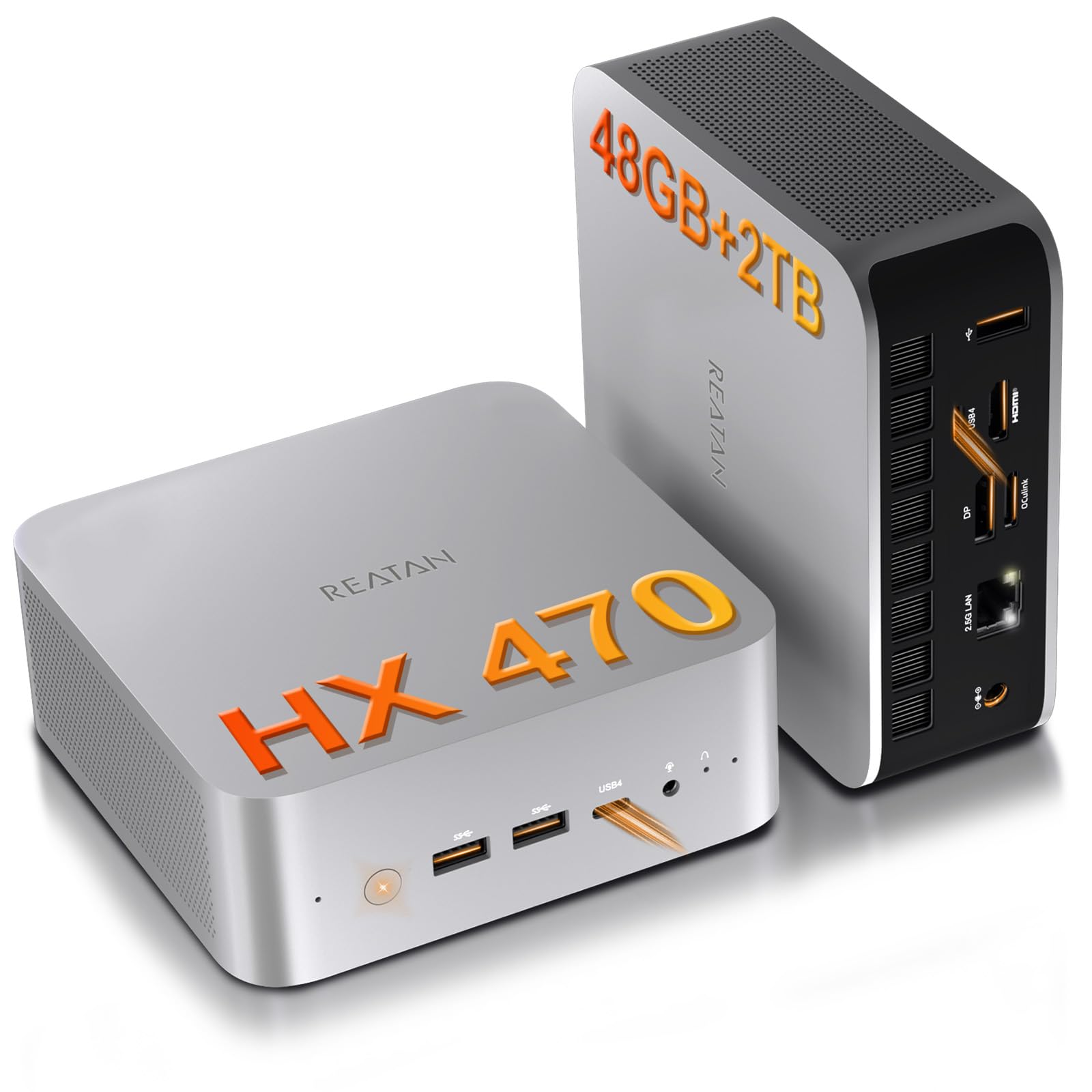
The Reatan X8 is purpose-built for AI development, packing the AMD Ryzen AI 9 HX 470 with 86 total TOPS (55 TOPS from the NPU alone). This enables local processing of complex LLMs, AI image generation with Stable Diffusion, and real-time inference without cloud dependency — a massive privacy and latency advantage. The Radeon 890M graphics at 3100MHz deliver 1080p gaming at 60+ FPS in titles like Cyberpunk 2077, while the dedicated OCuLink port allows direct GPU expansion for heavy rendering workloads.
The X8 ships with 48GB of DDR5 5600MHz (upgradeable to 128GB) and a 2TB PCIe 4.0 SSD, with dual M.2 slots supporting up to 8TB total storage. Quad 8K display output via HDMI 2.1, DisplayPort 2.0, and dual USB4, combined with WiFi 7 and Bluetooth 5.4, make it future-proof for the next decade. The all-metal chassis with Matrix 3D cooling delivers whisper-quiet operation even under sustained AI training loads, and built-in dual microphones and a speaker handle video conferencing without external peripherals.
While the 48GB pre-installed configuration is odd — requiring a single stick upgrade to reach 64GB — the performance is exceptional for the price. The only significant downside is the front-mounted USB-C port orientation, which can be inconvenient for some desk setups. The 3-year technical support and responsive customer service provide peace of mind for this investment.
Why it’s great
- 86 TOPS total AI processing power
- OCuLink for eGPU expansion
- All-metal chassis with silent cooling system
Good to know
- Comes with 48GB RAM, requires upgrade for 64GB
- Front USB-C port only
- No card reader built in
9. Reatan HX 470
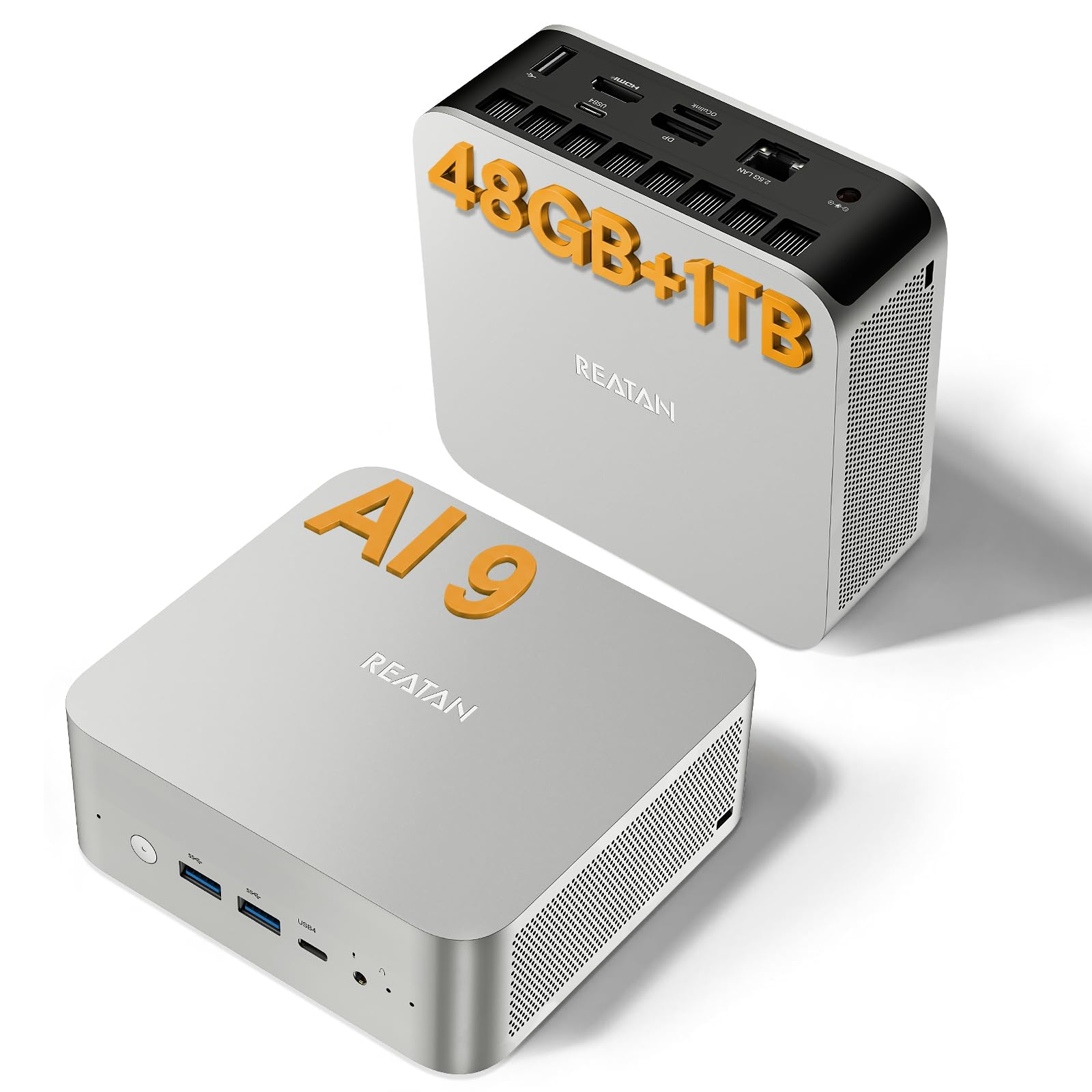
The Reatan HX 470 (distinct from the X8) focuses on the HX 470 processor’s capabilities with a 48GB DDR5 single-stick configuration paired with a 1TB PCIe 4.0 SSD, though it’s upgradeable to 96GB RAM and 8TB storage. The Radeon 890M iGPU with 16 RDNA 3.5 CUs delivers 1080p gaming at medium-high settings with DirectX 12 and hardware ray tracing support, while the 55 TOPS NPU handles local AI tasks via LM Studio and other LLM applications without cloud dependency.
Connectivity is where this unit shines: dual USB4 ports at 40Gbps support eGPU expansion, 8K 60Hz video output, and PD fast charging. WiFi 7 (4.8x faster than WiFi 6) and Bluetooth 5.4 ensure cutting-edge wireless performance, while the 2.5GbE LAN port unlocks software routing and advanced networking. The dual cooling fans and copper heat pipes maintain stable performance even during extended gaming or rendering sessions.
Build quality is exceptional for the price point, with a solid metal body and premium fit and finish. However, some users report the system dying after weeks with blue screen errors, and the customer support response has been inconsistent — one user waited five months for a replacement. The single DIMM configuration is also suboptimal for dual-channel memory performance, though it keeps the upgrade path simple.
Why it’s great
- 55 TOPS NPU for local AI processing
- Dual USB4 with 40Gbps bandwidth
- WiFi 7 and Bluetooth 5.4 connectivity
Good to know
- Single DIMM config limits memory bandwidth
- Some units experience early failure
- Customer support response delays reported
10. HP Desktop Tower
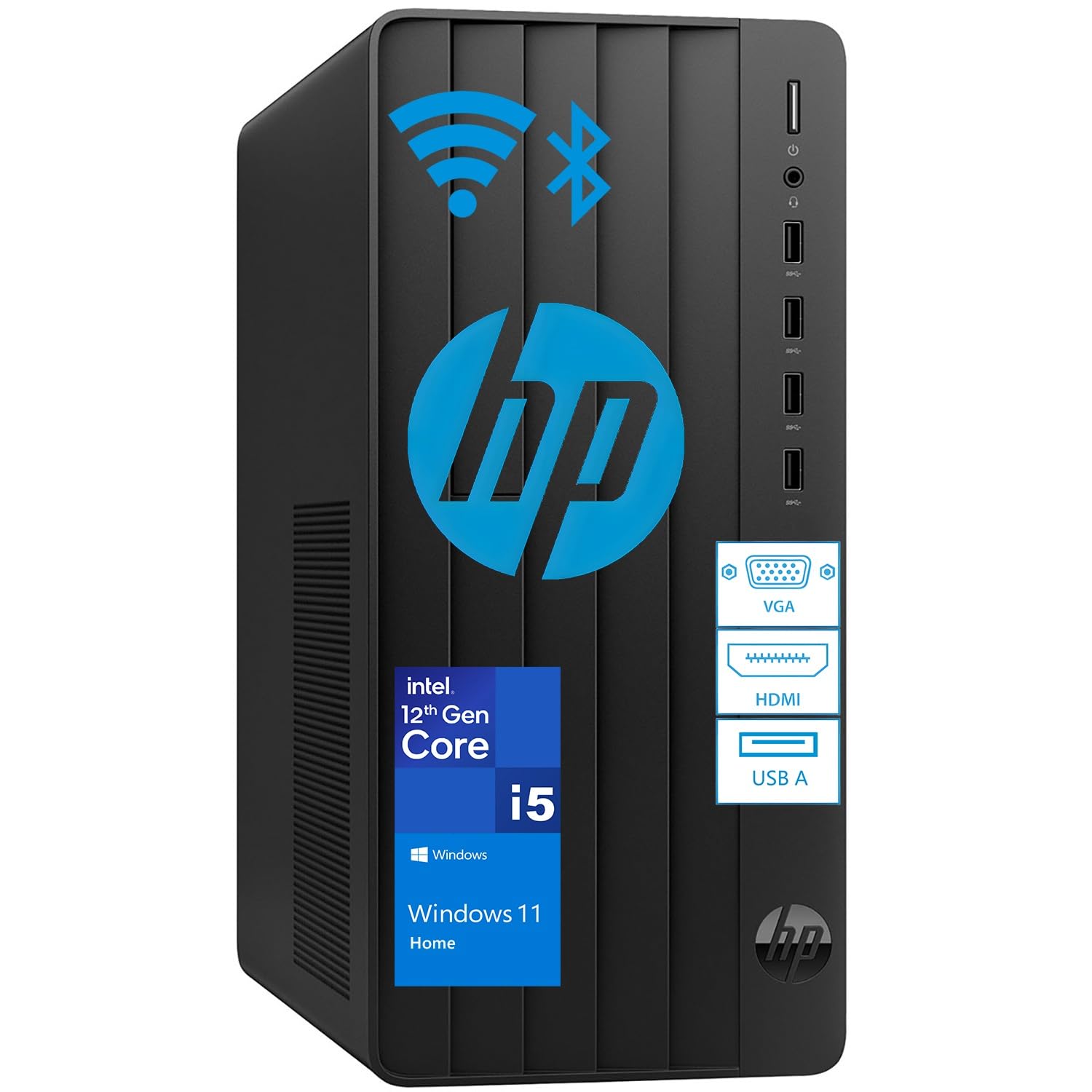
The HP Desktop Tower offers 64GB of DDR4 memory with an Intel i5-12500T processor (6 cores, 12 threads) and a massive 2TB PCIe SSD, making it ideal for home office users who need lots of storage and smooth multitasking. The 12th-gen Alder Lake architecture ensures compatibility with current software and Windows 11 features. The integrated Intel UHD Graphics 770 handles 4K streaming and productivity tasks but is not suitable for gaming or GPU-accelerated workloads.
Connectivity is generous with multiple USB ports, HDMI output, and a full-sized wired keyboard and mouse included. The tower form factor is larger than mini PCs, but still compact enough for most desks. The included Windows 11 Home provides a familiar experience for work and entertainment, and the system boots in seconds thanks to the NVMe SSD.
The i5-12500T TDP is only 35W, meaning it won’t throttle under sustained loads but also won’t match the performance of higher-end mobile processors. Some users report receiving units with only 32GB RAM instead of the advertised 64GB, so verify the configuration upon arrival. At this price point, it’s a capable office machine, but power users should look at more performance-oriented options.
Why it’s great
- 2TB SSD provides massive storage capacity
- 12th-gen Intel processor with modern features
- Includes wired keyboard and mouse
Good to know
- Low-power 35W TDP limits performance
- Some units ship with incorrect RAM capacity
- Integrated GPU not suitable for gaming
11. CyberGeek 5700U

The CyberGeek 5700U delivers 64GB DDR4 RAM and a 1TB PCIe SSD at the most budget-friendly price point in this guide, powered by the AMD Ryzen 7 5700U (8 cores, 16 threads, up to 4.3GHz). The Radeon Graphics (Vega 8) handles 4K triple display output via HDMI, DP, and USB-C, while dual Gigabit Ethernet and WiFi 5 provide connectivity. The waterproof fabric top design and VESA mounting bracket add unique aesthetic and practical value.
Performance is adequate for office work, web browsing, and light multitasking, but the undisclosed Vega 8 GPU (circa 2018) means gaming is not viable — expect sub-30 FPS in most modern titles. The DisplayPort output has been reported as non-functional on some units, preventing proper triple-display setups. Build quality feels budget-conscious, with reports of units freezing, losing connectivity, or requiring frequent reboots after months of use.
Customer support is email-only with no phone option, making troubleshooting difficult. The poor WiFi signal strength and lackluster cooling suggest this unit is best suited as a basic office PC or media center for users who don’t push performance. For the price, the 64GB RAM and 1TB storage are compelling, but reliability concerns make it a risky choice for mission-critical work.
Why it’s great
- 64GB RAM and 1TB SSD at entry-level price
- Triple display output with 4K support
- Compact design with fabric top
Good to know
- Vega 8 GPU from 2018, not for gaming
- DisplayPort and WiFi quality issues reported
- Limited customer support options
FAQ
Can a Mini PC with 64GB RAM handle AAA gaming?
How much upgrade headroom does a 64GB RAM Mini PC typically offer?
What connectivity features matter for a 64GB Mini PC workstation?
Is 64GB RAM overkill for a Mini PC meant for home office work?
Final Thoughts: The Verdict
For most users, the best 64gb ram mini pc winner is the GMKtec EVO-X2 because its 32-thread processor combined with 64GB of 8000MT/s memory and the Radeon 8060S iGPU delivers a perfect blend of AI capability, gaming performance, and silent operation. If you need a discrete GPU for AI rendering and video editing, the ACEMAGIC M1A Pro with its ARC A770 offers workstation-class performance. And for the purest gaming experience in a compact form factor, nothing beats the TOPGRO T1-Pro with its RTX 4060 GPU.