
Dragging a heavy trailer up a steep grade or hammering a manual transmission through deep snow puts your drivetrain under immense stress. One wrong quart of 80/90 gear oil can turn smooth operation into a chorus of whining gears and premature wear that costs thousands to repair.
I’m Min — the co-founder and writer behind Gadgets Feed. I’ve spent many hours cross-referencing viscosity charts, API service classifications, and real-world customer feedback to sort the essential from the marketing noise in this gear oil segment.
This guide cuts through the confusion to help you pick the right 80/90 gear oil for your differential, manual transmission, or final drive, saving you from making an expensive misapplication.
How To Choose The Best 80/90 Gear Oil
Selecting the right gear oil involves more than grabbing the cheapest bottle. The three critical factors are API service classification, viscosity grade accuracy, and the presence of limited-slip additives if your differential requires them.
API GL-4 vs GL-5: Why It Determines Compatibility
API GL-5 oil contains higher levels of extreme-pressure additives, primarily sulfur-phosphorus compounds, which protect hypoid gears under severe shock loading. However, those aggressive additives can corrode yellow metals like brass and bronze found in many older manual transmission synchros. A GL-4 formulation provides adequate protection for manual gearboxes while safeguarding sensitive synchronizer components. Using GL-5 in a transmission that calls for GL-4 leads to premature synchro wear and difficult shifting over time.
Viscosity: 80W-90 vs 85W-90
The “W” indicates winter-grade cold-flow characteristics. An 80W-90 oil flows more readily at sub-zero temperatures, reducing gear drag and improving shift feel during cold starts. The “90” denotes the high-temperature viscosity, which determines film strength at operating temperature. An 85W-90 is thicker when cold but offers identical hot protection. For vehicles driven in freezing climates, an 80W-90 is the better choice; for hot-weather towing, the slightly thicker cold flow of 85W-90 is rarely an issue.
Limited-Slip Differentials: The Friction Modifier Factor
Limited-slip differentials use clutch packs to distribute torque. Standard GL-5 oil is too slippery and can cause the clutches to chatter or grab unevenly. Look for gear oil explicitly labeled “Limited Slip Ready” or “LS,” which contains a friction-modifier additive. Alternatively, you can buy a separate friction-modifier bottle to add to standard GL-5 oil, but pre-blended options offer a more precisely balanced formula.
Quick Comparison
On smaller screens, swipe sideways to see the full table.
| Model | Category | Best For | Key Spec | Amazon |
|---|---|---|---|---|
| Triax Gear Premium LS 80W-90 | Premium Synthetic Blend | Limited-slip differentials & heavy towing | Built-in LS additive; exceeds 120k PSI EP load | Amazon |
| Liqui Moly Gear Oil GL-4 85W-90 | Premium Mineral | Vintage manual transmissions requiring GL-4 | GL-4 compliant; 1-liter bottle | Amazon |
| STAR BRITE Star Tron 80W-90 | Marine Synthetic Blend | Outboard lower units & stern drives | API GL-5 / SAE J2360 rated | Amazon |
| Mobilube HD Plus 80W-90 | Mid-Range Mineral | Heavy-duty equipment & fleet use | Flash point of 202°C | Amazon |
| Valvoline Daily Protection 80W-90 | Value Mineral | Everyday differential & transfer case changes | Temperature range -15°F to 410°F | Amazon |
| Quicksilver 80W-90 Hypoid Gear Oil | Entry-Level Mineral | Motorcycle shaft drives & ATV transmissions | API GL-5 / MT-1 approved | Amazon |
| Lucas Oil 75W-140 Synthetic | Premium Synthetic | High-temp differentials & Harley transmissions | 75W-140 synthetic blend | Amazon |
In‑Depth Reviews
1. Triax Gear Premium LS 80W-90
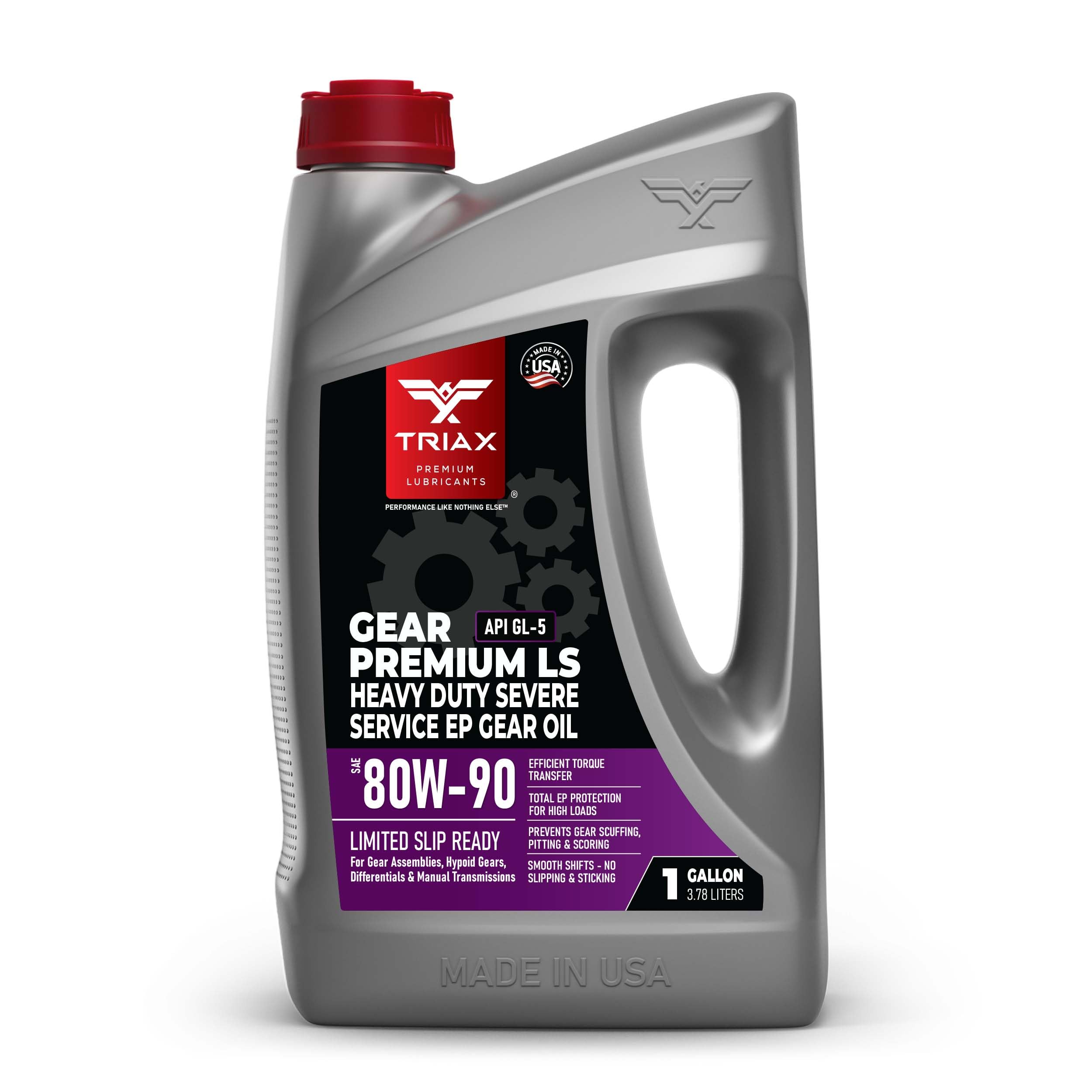
The Triax Gear Premium LS 80W-90 comes in a full gallon pail and packs a proprietary polyphosphate extreme-pressure additive system that exceeds Load Stage 13 requirements, handling over 120,000 pounds per square inch. This oil is explicitly formulated with a built-in limited-slip friction modifier, meaning you don’t need to buy a separate additive bottle — it’s ready for clutch-pack differentials straight from the pail.
NATO military approval and compatibility with the widest OEM specification range on the market make this a serious choice for heavy-duty trucks, SUVs, and off-road rigs. Users report smooth gear engagement with no clunking during transmission rebuild break-in periods on Kawasaki Brute Force ATVs and Land Cruiser differentials, confirming the shear stability holds up under sustained load.
The gallon size offers a lower cost per quart compared to premium quart bottles, though the larger container requires a hand pump or careful measuring for smaller jobs. For anyone rebuilding a differential, servicing a towing vehicle, or running a limited-slip axle that needs dependable film strength, this is the most versatile single purchase.
Why it’s great
- Built-in LS additive eliminates extra purchases
- Extraordinary EP load capacity beyond 120k PSI
- Gallon pail delivers excellent per-quart value
Good to know
- Gallon format can be messy to pour without a pump
- Overkill for light-duty commuter cars
2. Liqui Moly Gear Oil (GL-4) SAE 85W-90

Liqui Moly 20016 is a mineral-based GL-4 gear oil in the 85W-90 viscosity grade, purpose-built for manual transmissions and axle drives that specifically call for API GL-4. The GL-4 rating means it has a lower concentration of aggressive EP additives than GL-5 oils, making it safe for brass synchros and bronze bushings found in older European and Japanese transmissions.
Users running 79 Toyota pickups, 2015 Chrysler Town & Country vans, and Evolution golf cart differentials report noticeably quieter gear operation and smoother shifting under both cold and loaded conditions over thousands of miles. The stable lubricating film resists foaming and keeps the differential cool even during extended highway drives.
The 1-liter (33.8 oz) bottle is slightly smaller than a standard US quart (32 oz), so you get a touch more volume. The included straw spout is a thoughtful detail, though some users still needed a transfer pump for tight transmission fill holes. If your vehicle’s manual explicitly calls for GL-4, this is the safest and most effective choice on the list.
Why it’s great
- Safe for yellow-metal synchros in older gearboxes
- Noticeable noise reduction after application
- Quality German formulation with strong anti-wear package
Good to know
- Not suitable for differentials requiring GL-5
- Straw spout may not fit all fill ports
3. STAR BRITE Star Tron Synthetic Blend 80W-90
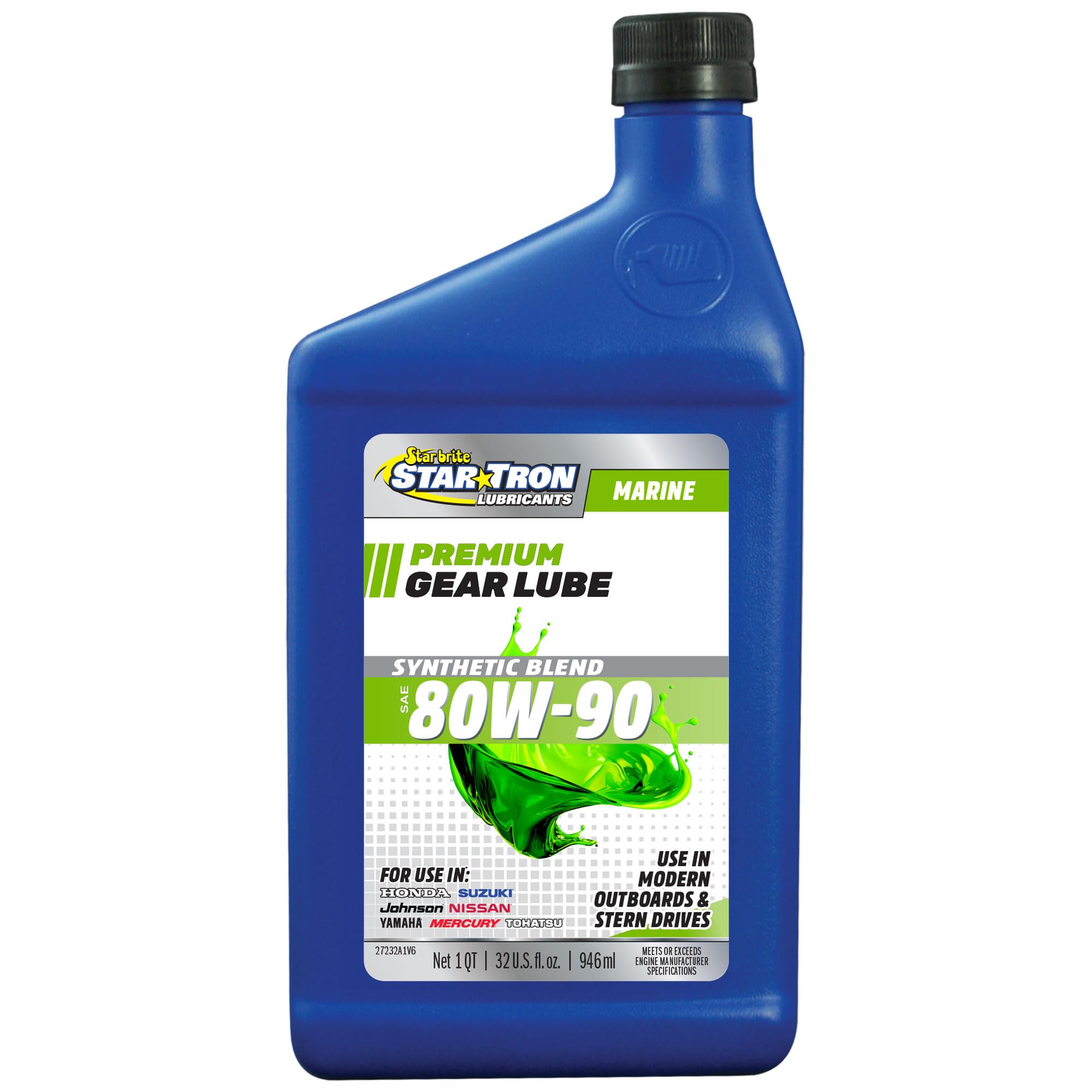
STAR BRITE 027232 is a high-viscosity synthetic blend 80W-90 gear lube engineered specifically for marine outboard lower units and stern drives, meeting API GL-5, API MT-1, SAE J2360, and MIL-L-2105D specifications. The additive package includes extreme-pressure compounds that withstand the constant water exposure and high-rpm operation typical of outboard motors over 100 horsepower.
Boat owners report using this oil in OMC outdrives, Yamaha outboards, and Mercury lower units for multiple seasons without corrosion issues or gear wear. The synthetic blend offers better thermal stability than full mineral oils, which is critical when the lower unit is submerged in warm water while spinning near redline. Users also note that it pumps easily with standard lower-unit pumps, simplifying the annual flush-and-fill procedure.
The quart format is convenient for a single lower-unit change, but the main limitation is its narrow marine focus — it lacks the built-in limited-slip additive required for automotive differentials with clutch packs. For boat owners, however, this is the most trustworthy option at its price point.
Why it’s great
- Excellent corrosion protection for saltwater use
- Meets multiple marine OEM specifications
- Synthetic blend resists thermal breakdown
Good to know
- Not formulated for limited-slip differentials
- Marine-specific, overkill for standard automotive gearboxes
4. Mobilube HD Plus 80W-90

Mobilube HD Plus 80W-90 is a mineral-based, API GL-5 gear oil with a synthetic blend component that delivers excellent thermal stability and a high flash point of 202°C. The formulation prioritizes protection against low-speed / high-torque wear alongside high-speed scoring resistance, making it a strong match for heavy-duty equipment and fleet applications.
Users running this oil in pickup differentials, agricultural equipment, and industrial gearboxes report that it meets or exceeds OEM requirements without the premium price tag of fully synthetic competitors. The corrosion and foaming resistance are solid for a mid-range entry, and the quart bottle is easy to handle for routine changes.
While it is a capable all-rounder, this oil does not include a pre-built limited-slip additive, so owners of clutch-pack differentials will need to buy a separate friction modifier. It also lacks the shear stability of the Triax LS at extreme loads. For standard non-LS differentials and gearboxes, it represents a balanced sweet spot between cost and protection.
Why it’s great
- Excellent high-temp oxidation resistance
- Trusted Mobil formulation with wide OEM approval
- Competitive per-quart cost
Good to know
- Requires separate LS additive for limited-slip axles
- Not fully synthetic — less cold-flow performance
5. Valvoline Daily Protection 80W-90

Valvoline Daily Protection VV831 is a conventional 80W-90 gear oil formulated with extreme-pressure additives to handle towing and hauling loads. It meets API GL-5 and also covers GL-4 applications for non-synchronized manual transmissions, operating reliably across a wide temperature range from -15°F to 410°F.
Real-world users confirm its effectiveness in transfer cases (2007 Acura MDX), Posi-traction differentials requiring non-synthetic oil, and fleet vehicles. The corrosion inhibitors prevent rust during storage, and the thermal breakdown resistance holds up during extended highway drives. At its price point, it delivers dependable protection for everyday driving without the cost of synthetic blends.
The main trade-offs are that it is a conventional oil with less extreme load capacity than premium synthetic blends, and it is not optimized for limited-slip applications — a separate additive may be needed. For budget-conscious DIYers performing routine differential or transfer case changes on standard vehicles, this is a reliable, proven performer.
Why it’s great
- Broad temperature range for year-round use
- 150-year brand trust with consistent formulation
- affordable entry price for routine maintenance
Good to know
- Conventional base oil, less shear stable than synthetics
- Not explicitly formulated for limited-slip diffs
6. Quicksilver 80W-90 Motorcycle Hypoid Gear Oil

Quicksilver 8M0128380 is an API GL-5 / MT-1 rated 80W-90 gear oil designed specifically for motorcycle shaft drive systems and separate clutch transmissions. The formulation provides maximum gear protection against wear, corrosion, and oxidation while maintaining consistent viscosity during high-rpm operation.
Owners of 1984 Honda Nighthawk 650s, 2006 Suzuki C50Cs, and various ATVs report noticeably smoother shifting and reduced gear noise after switching to Quicksilver. The universal-fit compatibility with most shaft-drive motorcycles makes it an easy recommendation for riders who need a single oil for both the transmission and final drive. The quart bottle is the right size for a single motorcycle service.
The most common complaint is the strong sulfurous odor typical of gear oils, but that is inherent to the chemistry rather than a product defect. This oil lacks the built-in limited-slip additive for automotive differentials, so it should not be used in a truck’s LS rear end. For motorcycle final drives, it is a top-tier entry-level choice.
Why it’s great
- Specifically formulated for motorcycle shaft drives
- Smooth, consistent shifting under RPM load
- Universal fit across most bike brands
Good to know
- Pungent gear oil smell during application
- Not recommended for automotive LS differentials
7. Lucas Oil 75W-140 Synthetic Gear Oil

Lucas Oil 10121 is a full-synthetic 75W-140 gear oil designed for high-temperature environments where standard 80W-90 may begin to thin out. The 75W cold rating flows even better than 80W in frigid weather, while the 140 hot rating provides a thicker film for extreme-load differentials and Harley-Davidson transmissions operating at elevated temperatures.
Users running this in 2002 F150 rear differentials with limited-slip report that after 10,000 miles the drained fluid looked nearly new, with no noise or leaks. The formulation has less odor than many competitors and requires no additional friction modifier for most LS applications, though some Ford owners still add Motorcraft modifier for guaranteed chatter prevention.
The 75W-140 viscosity is significantly thicker at operating temperature than standard 80W-90, which can cause increased parasitic drag and slightly reduced fuel economy in light-duty driving. This is a trade-off acceptable for those who tow heavy loads, race, or operate in extreme heat. For standard street use, an 80W-90 remains the more appropriate choice.
Why it’s great
- Superior film strength at high temperature
- Excellent cold-flow for winter starts
- Drained fluid remains clean after 10k miles
Good to know
- Thicker viscosity may slightly reduce fuel economy
- Overkill for standard commuter applications
FAQ
Can I use GL-5 gear oil in a manual transmission that calls for GL-4?
What happens if I use 85W-90 instead of 80W-90?
Do I need a limited-slip additive for my differential?
Can I mix synthetic and conventional 80W-90 gear oil?
Final Thoughts: The Verdict
For most users, the 80/90 gear oil winner is the Triax Gear Premium LS 80W-90 because it combines a built-in limited-slip additive with extreme load capacity exceeding 120,000 PSI in a cost-effective gallon format. If you need a safe GL-4 oil for a vintage manual transmission with bronze synchros, grab the Liqui Moly Gear Oil GL-4 85W-90. And for marine outboard lower units that face constant water exposure and high RPM, nothing beats the STAR BRITE Star Tron Synthetic Blend 80W-90.