
The difference between a blurry speck and a frame-filling portrait of a Bald Eagle comes down to one number: effective focal length. Bird watching cameras must deliver telephoto reach that bridges the gap between where you stand and where the bird actually sits, often hundreds of yards away. Compressing that distance without sacrificing image quality or introducing crippling shake is the central engineering challenge of this category.
I’m Min — the co-founder and writer behind Gadgets Feed. I’ve spent countless hours analyzing superzoom bridges, dedicated telephoto lenses, and mirrorless systems, comparing optical zoom ratios, stabilization stop ratings, and autofocus motor types to find the setups that actually deliver sharp feather detail in the field.
These are the cameras that let you freeze a Blue Jay in flight or count the individual bristles on a Great Horned Owl. This guide ranks the top options to help you find the absolute best bird watching camera for your budget, skill level, and typical shooting environment.
How To Choose The Best Bird Watching Camera
Selecting a bird watching camera is a balancing act between reach, speed, and portability. A camera that can resolve individual wing feathers at 100 yards requires a long effective focal length, a fast and accurate autofocus system, and enough image stabilization to keep the frame steady when your hands are fatigued after hours of carrying it through a marsh.
Effective Focal Length and Optical Zoom
This is the single most important spec. The effective focal length determines how large a distant bird appears in the frame. For serious birding, look for at least 600mm effective — that typically means a 60x optical zoom on a 1/2.3-inch sensor bridge camera, or a 400mm lens on an APS-C body. Without this reach, most passerines and raptors will be tiny specks in the viewfinder.
Image Stabilization Stop Rating
At 1200mm equivalent, your heartbeat becomes visible in the viewfinder. Image stabilization compensates for that micro-movement. A 4-stop optical VR system lets you handhold a supertelephoto lens at shutter speeds four times slower than you otherwise could. For bridge cameras, look for Dual Detect or Power O.I.S. systems rated at 4.5 stops or higher. For interchangeable lenses, look for in-body IBIS combined with lens-based stabilization for the best results.
Autofocus System and Burst Rate
Birds move. Fast. A contrast-detect AF system struggles to lock onto a fast-flying swallow against a bright sky. Phase-detect autofocus with dedicated tracking modes is essential. A burst rate of at least 8 fps gives you a fighting chance of capturing that split-second wing-flap or feeding moment. Some cameras now offer dedicated bird-watching modes that pre-set focus zones and exposure for avian subjects.
Quick Comparison
On smaller screens, swipe sideways to see the full table.
| Model | Category | Best For | Key Spec | Amazon |
|---|---|---|---|---|
| Nikon COOLPIX P1100 | Superzoom Bridge | Ultra-telephoto on a budget | 125x optical, 3000mm effective | Amazon |
| Nikon COOLPIX P950 | Superzoom Bridge | All-around birding value | 83x optical, 2000mm effective | Amazon |
| Canon RF100-500mm L | Interchangeable Lens | Pro-grade image quality | L-series optics, 5-stop IS | Amazon |
| Sigma 60-600mm DN | Interchangeable Lens | Maximum versatility in one lens | 10x zoom, 60-600mm range | Amazon |
| OM SYSTEM 100-400mm | Interchangeable Lens | Weather-sealed MFT system | 200-800mm effective, 3-stop IS | Amazon |
| Sony E 70-350mm G | Interchangeable Lens | Lightweight APS-C travel kit | 525mm effective, 22oz weight | Amazon |
| Canon RF100-400mm | Interchangeable Lens | Entry-level RF telephoto | 5.5-stop IS, Nano USM AF | Amazon |
| Sigma 150-600mm C | Interchangeable Lens | Budget DSLR wildlife lens | 600mm reach on full frame | Amazon |
| Panasonic LUMIX FZ80D | Superzoom Bridge | Affordable 1200mm reach | 60x optical, 20-1200mm zoom | Amazon |
In‑Depth Reviews
1. Nikon COOLPIX P1100

The P1100 is the current king of optical reach in a bridge camera body. Its 125x optical zoom gives you an effective focal length of 3000mm, which means you can fill the frame with a sparrow at 200 yards. The Dual Detect Optical VR delivers 4.0 stops of stabilization, which is borderline adequate for such extreme magnification — a tripod is recommended at maximum zoom, but handholding at 2000mm is feasible in good light.
The dedicated Bird-Watching Mode on the mode dial pre-configures contrast-detect AF for perched subjects, though the continuous tracking struggles with birds in flight. The 16MP backside-illuminated CMOS sensor and EXPEED processor produce sharp JPEGs at base ISO, and the 4K UHD/30p video is usable across the entire zoom range. Weighing just over 2 pounds with the battery, it’s light enough for a day hike.
Image quality is good for a 1/2.3-inch sensor — not on par with APS-C or full-frame — but the trade-off is reach that no interchangeable lens system can match without spending five figures. Built-in Wi-Fi and Bluetooth make sharing to a phone simple, though the USB-C charging is slow.
Why it’s great
- Unbeatable 125x optical zoom with 3000mm effective reach
- Dedicated Bird-Watching Mode for quick setup
- Lightweight body for its focal length capability
Good to know
- Bird-tracking AF is unreliable for fast-flying subjects
- Requires stable support at maximum zoom for sharp results
- Plastic build feels less durable than premium bridge models
2. Nikon COOLPIX P950

The P950 is the gold standard for the price-conscious birder who demands serious telephoto reach. Its 83x optical zoom (24-2000mm equivalent) is enough to capture detailed images of herons, hawks, and songbirds at considerable distance. The Dual Detect Optical VR system provides the equivalent of 5.5 stops of stabilization in Normal mode, one of the highest ratings among fixed-lens superzooms, making handheld shooting at 2000mm far more practical than it has any right to be.
The dedicated Bird Mode and Moon Mode are genuinely useful shortcuts that adjust exposure, contrast, and sharpness for those specific subjects. The 16MP BSI CMOS sensor paired with the EXPEED processing engine delivers crisp daytime images at low ISO. The vari-angle LCD screen and 2359K-dot electronic viewfinder provide clear framing in bright field conditions.
The aperture narrows to f/6.5 at the telephoto end, which limits performance in overcast or wooded conditions. Autofocus is contrast-detect only and can hunt on low-contrast subjects like birds against a gray sky. Battery life is average — carrying a spare is wise for a full day of shooting. Wi-Fi and Bluetooth are built in for easy image transfer.
Why it’s great
- Excellent 83x zoom with 2000mm effective reach
- 5.5-stop Dual Detect Optical VR for handheld telephoto
- Dedicated Bird and Moon scene modes
Good to know
- Small aperture (f/6.5) limits low-light performance
- Contrast-detect AF hunts on low-contrast subjects
- Battery drains quickly with heavy zoom use
3. Canon RF100-500mm F4.5-7.1 L IS USM

This is the lens that separates the enthusiast birder from the pro wildlife photographer. The RF100-500mm L-series delivers the kind of edge-to-edge sharpness, contrast, and color rendition that makes bird feathers pop with detail. The Dual Nano USM autofocus is whisper-quiet and virtually instantaneous, essential for tracking warblers flitting through dense branches or an Osprey diving for a fish.
The optical image stabilization is rated at 5 stops and offers three selectable modes: Standard for stationary subjects, Panning for moving birds, and Mode 3 that only activates during exposure. This lens pairs perfectly with the Canon EOS R5 or R6, and the in-body IBIS combines with the lens IS for even better results. Weather sealing is L-series standard — dust and moisture seals protect against field conditions. The minimum focus distance of 0.9 meters allows for close-up shots of cooperative subjects.
The variable aperture reaches f/7.1 at 500mm, which means you’ll need to push ISO higher in low light. The lens is also heavy at 3 pounds, and the price places it in premium territory. But for image quality, it sets the benchmark that all other birding telephoto zooms are measured against.
Why it’s great
- Exceptional L-series image quality and build
- 5-stop optical IS with multiple stabilization modes
- Fast, silent Dual Nano USM autofocus
Good to know
- Aperture slows to f/7.1 at 500mm requiring higher ISO
- Heavy at 3 pounds; tripod recommended for long sessions
- Premium price point limits accessibility
4. Sigma 60-600mm F4.5-6.3 DG DN OS | Sports

The Sigma 60-600mm is a one-lens-does-all solution for Sony E-mount shooters that doesn’t compromise on image quality. The 10x zoom range covers everything from wide-angle landscape shots to extreme telephoto birding, all in a single optic. The High-response Linear Actuator (HLA) autofocus motor is fast and silent, locking onto birds in flight with impressive reliability on modern Sony bodies.
The optical stabilization system works well at the telephoto end, and the maximum magnification ratio of 1:2.4 lets you fill the frame with a small perched bird from a reasonable distance. The dust and splash-resistant construction is robust enough for field use, and the Dual Action Zoom mechanism allows both rotational zoom and push-pull operation for quick focal length changes during action sequences.
The trade-off is weight — this lens comes in at over 4.5 pounds, so a monopod or tripod is almost mandatory for extended handheld shooting. The variable aperture (f/6.3 at 600mm) requires good lighting or high ISO settings. It is large, heavy, and expensive, but for the shooter who needs one optic for everything from a passing butterfly to a distant eagle, it is unmatched.
Why it’s great
- Unique 10x zoom covers 60-600mm in one lens
- Fast HLA AF motor for tracking moving wildlife
- Dust and splash-resistant build for field use
Good to know
- Heavy at over 4.5 pounds; tripod recommended
- Slow aperture at telephoto end limits low-light use
- High price places it in the premium tier
5. OM SYSTEM Olympus M.Zuiko 100-400mm F5.0-6.3 IS

The Micro Four Thirds system has a built-in advantage for birders: the 2x crop factor turns a 100-400mm lens into a 200-800mm effective reach without adding the weight or cost of a full-frame supertelephoto. The OM SYSTEM (formerly Olympus) 100-400mm IS takes full advantage of this, delivering a compact 2.96-pound package that is comfortable to handhold for hours in the field.
The dust and splashproof construction is genuine weather sealing, meaning this lens can handle light rain, spray, and humid marsh conditions without blinking. The in-lens optical stabilization provides 3 EV steps of shake correction at 800mm equivalent, and when paired with an OM-D or PEN body with IBIS, the total stabilization is even more effective. The minimum focusing distance of 1.3 meters allows for close macro-style detail shots of feathers and nests.
The autofocus, while accurate for static and slow-moving subjects, struggles with birds in flight — it lacks the speed of modern phase-detect systems. The variable aperture (f/6.3 at 400mm) requires bright conditions for optimal results, and the lens is not as sharp as the premium Panasonic Leica 100-400mm. It is, however, excellent value for the reach on micro 4/3 bodies.
Why it’s great
- Excellent 200-800mm effective reach in compact package
- Weather-sealed construction for outdoor use
- Good value for micro 4/3 wildlife system
Good to know
- AF is not fast enough for reliable birds-in-flight capture
- Slow aperture requires bright daylight
- Edge sharpness trails premium alternatives
6. Sony E 70-350mm F4.5-6.3 G OSS

This lens redefines what’s possible in a lightweight APS-C telephoto for Sony shooters. Weighing just 22 ounces, the 70-350mm G OSS is the perfect companion for long hikes where every gram of gear matters. On a Sony A6600 or A6700, the 1.5x crop factor yields an effective 105-525mm focal range — enough to frame larger birds like herons, egrets, and hawks from a respectful distance.
The Optical SteadyShot (OSS) stabilization is remarkably effective at 350mm, allowing sharp handheld shots at shutter speeds as low as 1/60th second. The XD linear motor autofocus is fast, precise, and silent, making it capable of tracking birds in flight on Sony bodies with real-time tracking. Sharpness is excellent from corner to corner, with the G series optics delivering good contrast and color rendition.
The variable aperture reaches f/6.3 at 350mm, which is slow for low-light forest canopy shooting. The lens is also limited to daytime use in practice — shooting Bluebirds under heavy overcast will push ISO uncomfortably high. But as a lightweight, packable telephoto for travel birding, it has no equal in the Sony APS-C lineup.
Why it’s great
- Extremely lightweight at 22 ounces for hiking
- Fast, silent XD linear motor AF for tracking
- Sharp G series optics with good contrast
Good to know
- Aperture too slow for low-light or overcast conditions
- Effective 525mm reach limits small bird photography
- Primarily a daytime lens for larger subjects
7. Canon RF100-400mm F5.6-8 IS USM

For photographers stepping into birding from the Canon EOS R system, the RF100-400mm is the most logical first telephoto lens. It is compact, lightweight, and affordable, offering a 100-400mm range that becomes 160-640mm on an APS-C body like the R7 or R10. The optical image stabilization delivers 5.5 stops of shake correction, making handheld shooting feasible at the long end in good light.
The Nano USM autofocus motor provides fast, smooth, and quiet focusing that pairs well with Canon’s animal detection AF. The minimum focusing distance of 0.89 meters at 200mm (0.41x magnification) allows for pseudo-macro shots of perched birds. The lens barrel is compact enough to fit in a small camera bag alongside a standard zoom, making it a versatile travel companion.
The f/8 aperture at 400mm is the main limitation — it is a slow lens that struggles in anything less than bright sunlight. Image quality is good but not L-series sharp, and the lens lacks weather sealing. For the beginner birder on a Canon R-series camera who needs reach without breaking the bank, this lens delivers.
Why it’s great
- Affordable entry into RF telephoto shooting
- 5.5-stop optical IS for handheld use
- Lightweight and compact for travel
Good to know
- Very slow aperture (f/8) at 400mm
- No weather sealing for damp field conditions
- Image quality not L-series grade
8. Sigma 150-600mm F5-6.3 DG OS HSM Contemporary

The Sigma 150-600mm Contemporary is the classic budget telephoto for Canon DSLR shooters who want 600mm reach without jumping to the premium Sports version. On a crop-sensor body, this lens delivers an effective 240-960mm, giving serious reach for small songbirds at distance. The optical stabilization helps tame the magnification, and the HSM (Hyper Sonic Motor) autofocus is responsive enough for most perched and slow-moving subjects.
The water and oil repellent coating on the front element is a practical feature for field use, and the dustproof and splashproof mount provides some protection against moisture. The lens is sharp in the center at mid-range focal lengths, though it softens at the edges and at 600mm wide open. The certified refurbished designation means it has been manufacturer-refurbished with a full warranty, offering a lower cost of entry.
The build quality is plastic and feels less robust than the Sports version. The autofocus can hunt in low contrast, and the lens is large (over 4 pounds) and front-heavy. You get what you pay for — it is a competent budget option, not a pro lens, but it puts 600mm reach within reach of many more birders.
Why it’s great
- Affordable 600mm reach for Canon DSLR systems
- Effective 240-960mm reach on APS-C bodies
- Water and oil repellent front coating
Good to know
- Softens at the edges and at 600mm
- Plastic build feels less durable than premium options
- AF hunts in low-contrast field conditions
9. Panasonic LUMIX FZ80D (DC-FZ80D)

The FZ80D is Panasonic’s updated superzoom bridge camera that delivers a 20-1200mm equivalent zoom (60x optical) in a lightweight, travel-friendly body. The Power O.I.S. (Optical Image Stabilizer) system is effective at suppressing handshake at the telephoto end, making it possible to get sharp images of perched birds at 1200mm without a tripod in bright daylight. The 4K Photo mode captures 8MP stills at 30 fps, ideal for freezing a bird taking flight.
The 2,360K-dot Live View Finder is bright and clear even in direct sunlight, and the 3-inch touch LCD makes menu navigation and focus point selection intuitive. The USB-C charging is convenient for in-field recharging from a power bank. The post-focus feature lets you select the focal point after the shot, which can save an otherwise blurry bird-in-branch photo.
The 1/2.3-inch sensor is the weakest link — it produces noisy images above ISO 800, and the dark aperture (f/5.9 at 1200mm) means you’ll be shooting at those high ISOs in anything but full sun. The camera lacks Wi-Fi, requiring a card reader for file transfer. For the budget birder who wants zoom range above all else, the FZ80D delivers functional results at a very accessible cost.
Why it’s great
- 60x zoom with 1200mm effective reach
- Power O.I.S. stabilization for handheld telephoto
- 4K Photo 30fps burst for action capture
Good to know
- Small sensor noisy above ISO 800
- No built-in Wi-Fi for direct file transfer
- Dark aperture requires bright light conditions
10. Panasonic LUMIX FZ80D (DC-FZ80D)

This variant SKU of the FZ80D shares the same core hardware as the primary FZ80D — the same 60x optical zoom (20-1200mm equivalent), the same MOS sensor, and the same Power O.I.S. stabilization system. The USB-C charging and compact body make it a practical choice for travelers and beginner birders who want access to supertelephoto reach without investing in interchangeable lenses.
The 4K Photo at 30 fps and post-focus capabilities provide the same flexibility for capturing birds in motion. The Focus Composite function allows you to combine multiple shots with different focus points for a fully sharp final image — useful for birds in complex branch environments. The camera is also well-suited for non-birding uses like landscape and sports, making it a versatile first camera.
The same limitations apply: a small sensor that struggles in low light, a dark telephoto aperture, and no Wi-Fi connectivity. The older FZ80 optics produce softer results than newer competitors, and the autofocus can hunt in low-contrast conditions. It remains a legitimate entry-level option for those who need 1200mm reach at the lowest possible cost.
Why it’s great
- Lowest cost route to 1200mm effective focal length
- USB-C charging with power bank compatibility
- 4K Photo burst mode for action capture
Good to know
- Small sensor and dark aperture limit low-light use
- No Wi-Fi for direct smartphone transfer
- Autofocus hunts on low-contrast subjects
11. Nikon COOLPIX P950 Bundle
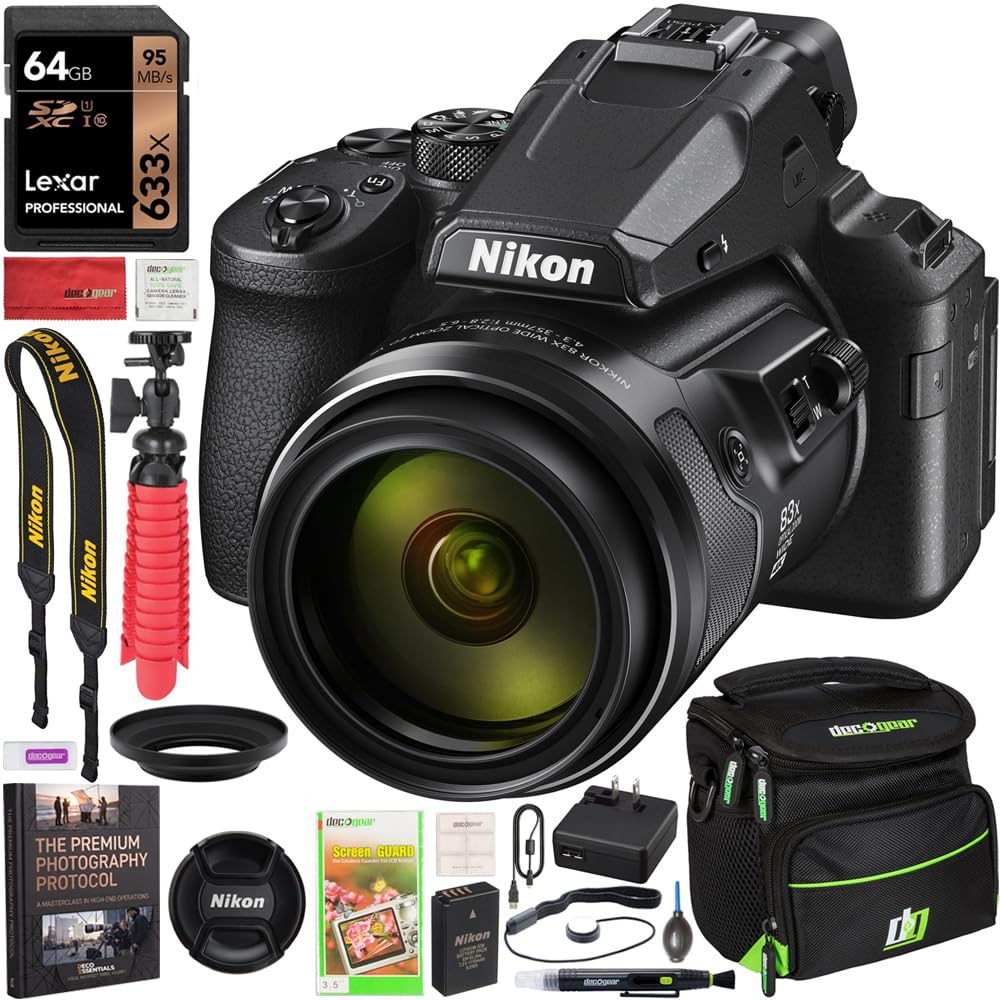
This bundle packages the same excellent Nikon COOLPIX P950 with a set of accessories that new birders actually need: a 64GB SDXC memory card, a compact tripod, a gadget bag case, lens cleaning tools, and an ebook guide. For someone starting from scratch in bird photography, this bundle removes the friction of separately sourcing a memory card and bag.
The P950 itself, as reviewed above, is the best value superzoom bridge camera available — 83x optical zoom (24-2000mm equivalent), 5.5-stop Dual Detect VR, dedicated Bird Mode, and 4K video. The included Lexar 633x UHS-1 card is fast enough for 4K video and continuous burst shooting. The compact tripod is lightweight and acceptable for stabilization, though a sturdier unit is recommended for long-terms serious use.
The bag is small and suited for the camera and accessories, not an extensive lens kit. The ebook is a basic guide. The value is in the convenience of a single purchase, not the quality of the included extras. If you already have a bag, card, and blower, the standalone P950 is a better buy. For true beginners, however, this bundle provides everything needed to start shooting birds immediately.
Why it’s great
- Convenient one-purchase bundle for new birders
- Includes essential accessories like memory card and bag
- Same powerful P950 camera with 83x zoom
Good to know
- Accessories are basic quality; not pro-grade
- Existing users may not need the extras
- Battery life still requires spares for full-day shoots
FAQ
What effective focal length do I need for bird photography?
Is a superzoom bridge camera good enough for birding?
How important is a tripod for bird watching cameras?
Final Thoughts: The Verdict
For most users, the best bird watching camera winner is the Nikon COOLPIX P1100 because it offers unrivaled 125x zoom with 3000mm effective reach at a price that undercuts any interchangeable lens system capable of matching it. If you want the highest image quality and are willing to invest in a system, grab the Canon RF100-500mm L. And for the best balance of reach and value, nothing beats the Nikon COOLPIX P950.