
Stepping into the world of a 90-inch OLED television is about committing to the absolute peak of home cinema performance. This is not a casual purchase; it’s a declaration that you demand perfect blacks, infinite contrast, and color accuracy that smaller or LCD-based screens simply cannot replicate. With sizes pushing past 80 inches, the pixel-level control of self-emissive OLED technology delivers a picture depth that transforms every frame into a lifelike window. However, the landscape of these massive OLEDs is complex, with varying panel technologies, brightness capabilities, and AI processors that significantly affect the final image. Only a careful evaluation of the specific hardware underneath the screen will reveal which model truly justifies its status in this premium tier.
I’m Min — the co-founder and writer behind Gadgets Feed. My analysis for this guide focuses on cross-referencing real-world panel performance data, processor capabilities like neural network counts for AI upscaling, and the nuanced brightness and glare characteristics that define the viewing experience on these ultra-large OLEDs.
After hundreds of hours combing through technical specifications and user feedback, I’ve separated the worthy contenders from the marketing hype to present the definitive guide to the best 90 inch oled tv for your home theater sanctuary.
How To Choose The Best 90 Inch OLED TV
Selecting a TV in this massive 90-inch class requires moving beyond simple resolution and considering the interplay of panel technology, brightness, and processing power. The sheer size amplifies every visual flaw, making high-quality upscaling and uniform brightness critical. You are investing in a centerpiece that will define your viewing experience for the next decade, so the decision must be grounded in specific, measurable specifications.
Panel Technology: OLED evo vs. Standard OLED
The fundamental difference between a standard OLED and an OLED evo panel is in the materials and structure used for the light-emitting pixels. OLED evo panels use a deuterium-based organic compound that allows for significantly higher brightness without degrading the lifespan of the pixels. This is non-negotiable for a 90-inch screen, as the larger surface area demands more luminous power to create a truly impactful HDR image, particularly in rooms with any ambient light. A standard OLED may look stellar in a dark theater, but an evo panel provides the extra headroom needed for a more versatile and cinematic experience.
AI Processor and Neural Networks
The number of neural networks in a TV’s AI processor is the single most important spec for image quality on a screen this massive. A 90-inch display will often be fed 1080p or even 720p content from streaming services or cable boxes. A processor with a high neural network count, such as 128 networks found in premium Samsung models, can intelligently analyze and upscale this content to near 4K quality, adding texture and reducing artifacts. Processors with fewer networks may leave the image looking soft or noisy on such a large canvas.
Brightness, Glare, and Room Integration
Peak brightness in nits and the quality of anti-glare technology are the two pillars of real-world performance. A TV with a 2000+ nit peak brightness, like the LG G5, will make HDR highlights explode off the screen, but that performance is wasted if the panel is highly reflective. Look for models with specialized glare-free or matte finishes that diffuse light. The largest OLEDs are often in bright, open-plan living rooms, and a screen that acts as a mirror will ruin the experience regardless of its peak brightness capabilities.
Quick Comparison
On smaller screens, swipe sideways to see the full table.
| Model | Category | Best For | Key Spec | Amazon |
|---|---|---|---|---|
| LG 97″ OLED evo AI G5 | Premium OLED | Ultimate HDR Brightness | Brightness Booster Max Technology | Amazon |
| TCL 115″ QM7K QD-Mini LED | QD-Mini LED | Size & Brightness Value | Up to LD2500 Local Dimming Zones | Amazon |
| Samsung 98″ QN90F Neo QLED | Premium Neo QLED | Bright Room Performance | 128 Neural Network AI Processor | Amazon |
| LG 83″ OLED evo AI C6H | OLED evo | Cinema/Gaming Combo | α11 AI Processor Gen3 | Amazon |
| Samsung 83″ OLED S90H | OLED | Glare-Free Viewing | NQ4 AI Gen3 Processor | Amazon |
| Sony 77″ BRAVIA XR A80L | OLED | PS5 Optimization | Cognitive Processor XR | Amazon |
| Samsung 98″ QN90D Neo QLED | Neo QLED | Gaming Tech Suite | Motion Xcelerator 144Hz | Amazon |
| Samsung 85″ The Frame Pro | QLED Art TV | Art Display Aesthetics | Glare Free Neo QLED Panel | Amazon |
| TCL 115″ QM89 QD-Mini LED | Premium QD-Mini LED | Maximum Zone Control | Up to 20,000 Local Dimming Zones | Amazon |
In‑Depth Reviews
1. LG 97-Inch Class OLED evo AI 4K G5 Series

The LG G5 series represents the pinnacle of OLED engineering for 2025, delivering the Brightness Booster Max technology that pushes the luminous output of its evo panel to over 2000 nits. This is a critical achievement for OLED, as it finally competes with high-end Mini-LED sets in bright rooms while maintaining the perfect blacks that are OLED’s hallmark. The α11 AI Processor Gen2 handles all the heavy lifting, offering AI Super Upscaling that intelligently refines lower-resolution feeds to look almost native on this massive 97-inch canvas.
For the home theater enthusiast, the inclusion of Dolby Vision and Dolby Atmos is standard, but the G5’s Filmmaker Mode with ambient light sensing ensures the director’s intent is preserved accurately in your specific room. The One Wall Design is also a major practical consideration; the TV mounts flush to the wall with virtually no gap, transforming the space when not in use. The 0.1ms response time and support for 120Hz VRR, G-Sync, and FreeSync Premium also make this a formidable gaming display for console players, though competitive gamers may find the 120Hz cap limiting against 144Hz+ competitors.
Potential owners need to be aware of the physical logistics: at 97 inches, this is a massive and heavy piece of equipment that will require professional installation and a sturdy wall capable of supporting its weight. The remote also lacks a backlight, which is a surprising oversight at this premium price point. However, for the absolute best in OLED contrast, brightness, and processing on the largest practical screen, the LG G5 is the undisputed champion for those who prioritize pure, uncompromised picture quality.
Why it’s great
- Brightness Booster Max delivers exceptional 2000+ nit HDR highlights.
- Flush wall-mount design integrates perfectly into living spaces.
- α11 Gen2 AI processor provides class-leading 4K upscaling.
Good to know
- No backlit remote control, a strange omission for a flagship.
- 120Hz refresh rate is a ceiling for hardcore PC gamers seeking higher.
- Extreme size requires careful measurement for delivery and mounting.
2. TCL 115-Inch QM7K QD-Mini LED

TCL has aggressively entered the ultra-large segment with the QM7K, a QD-Mini LED set that aims to bridge the gap between high-end LCD and OLED. The “QM7K” uses TCL’s Halo Control System, an advanced suite of technologies that allows for up to LD2500 local dimming zones. While it falls short of the infinite contrast of a true OLED, this level of zone control allows for very deep blacks with minimal blooming, creating an image that approaches OLED-like contrast in all but the most demanding side-by-side comparisons.
The key differentiator here is brightness; the QM7K can get significantly brighter than any OLED, making it the superior choice for a very bright family room with large windows. The CrystGlow HVA panel also does an excellent job blocking reflections. Gamers are well catered for with a native 144Hz refresh rate and a Game Accelerator that pushes VRR up to 288Hz, offering a buttery-smooth experience that no current 120Hz OLED can match. The inclusion of an Onkyo 4.2.2 speaker system means the built-in audio is robust enough for casual viewing without a soundbar.
The trade-off for this size and brightness is in the source material. The AIPQ Pro Processor does a competent job upscaling, but it will not match the finesse of higher-end Sony or LG processors on problematic low-bitrate content, where some artifacts can become apparent. The physical size at 115 inches is also a major undertaking; it is a true statement piece that requires significant wall space and dedicated planning. For buyers who prioritize sheer size and brute-force brightness over perfect black levels, the QM7K offers incredible value.
Why it’s great
- Massive 115-inch screen available at a more accessible price point.
- Extremely high peak brightness for well-lit rooms.
- Game Accelerator 288Hz VRR is unmatched for PC gaming.
Good to know
- Upscaling of low-quality content is not as refined as top-tier OLEDs.
- No 3.5mm audio jack can complicate legacy audio setups.
- Built-in speakers are decent but a soundbar is still recommended.
3. Samsung 98-Inch Class Neo QLED 4K QN90F

The Samsung QN90F is not an OLED, but its Neo QLED Mini-LED technology offers a compelling alternative for those who need a screen that can fight intense ambient light without sacrificing contrast. The key weapon here is the NQ4 AI Gen2 Processor, powered by 128 neural networks. This processor is the best in the business for real-time AI upscaling, analyzing every scene to add missing texture and detail, making standard HD cable and streaming content look exceptionally sharp on a 98-inch screen.
Samsung’s “Glare Free” technology is a standout feature, using a specialized matte finish to diffuse light from windows and lamps. This makes the QN90F arguably the most usable ultra-large TV in a bright, open-concept living room. For gamers, the support for up to 4K 165Hz VRR ensures a fluid and responsive experience for next-gen consoles and high-end PCs. The input via rear-facing ports is a bit inconvenient for wall mounting, but the overall design is premium and commanding.
The primary compromise versus an OLED is black level performance. In a dark room, a Mini-LED set cannot achieve the perfect, inky blacks of a self-emissive panel, and some blooming around bright objects on a black background may be visible. The built-in audio is also a weak point, described by many users as subpar, meaning a high-quality soundbar or surround system is an essential pairing. For those living with a bright room and needing the ultimate upscaling, the QN90F is a fantastic choice.
Why it’s great
- Superior anti-glare matte coating handles bright reflections brilliantly.
- 128 neural network AI processor provides best-in-class upscaling.
- High 165Hz VRR support for premium PC and console gaming.
Good to know
- Black levels and blooming control not as good as a premium OLED.
- Built-in audio is notably poor; an external sound system is required.
- Extremely heavy, requiring professional installation and a strong wall mount.
4. LG 83 Inch OLED evo AI C6H Bundle
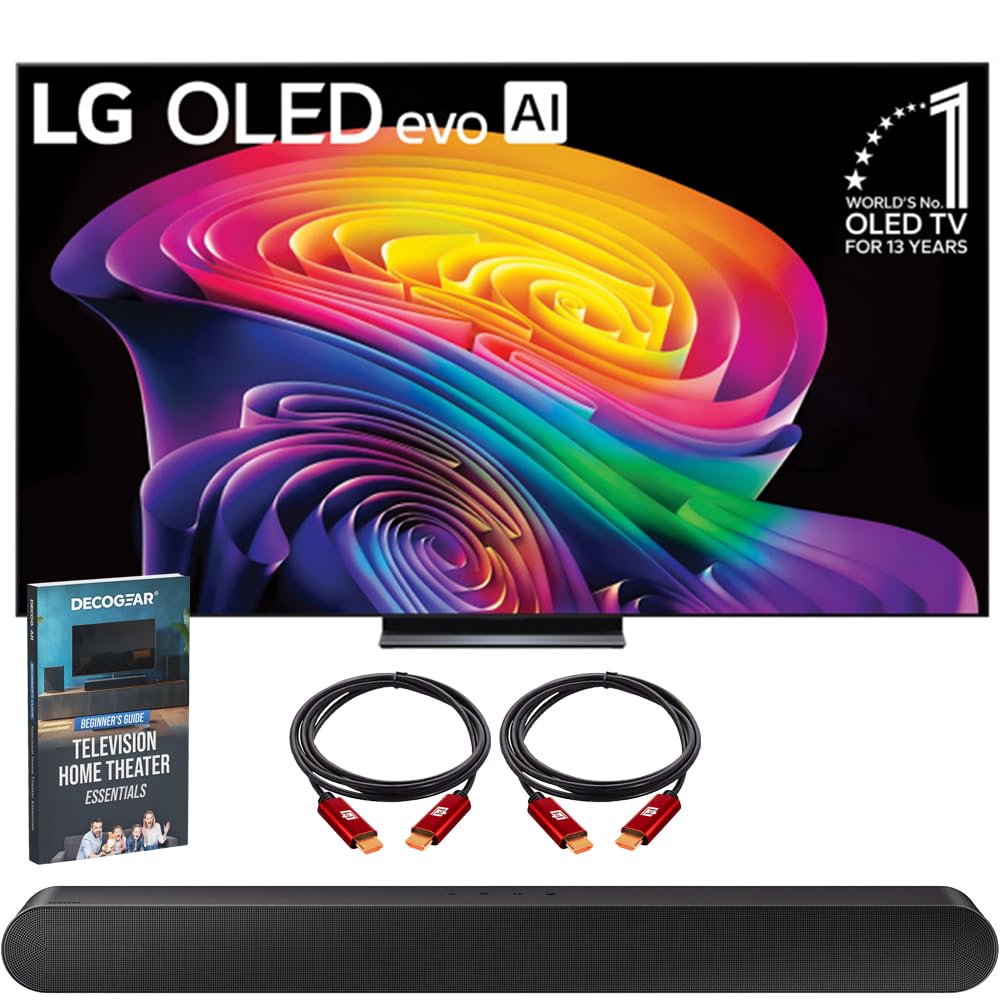
The LG C series has long been the gold standard for the enthusiast who wants top-tier OLED performance without the gallery design premium. The 83-inch C6H continues this legacy with the α11 AI Processor Gen3, which optimizes brightness and color using a dual AI engine. It supports Brightness Booster Pro, making it significantly brighter than previous C-series models, though it still trails the G5 series in raw luminous output. For deep blacks and vibrant colors in a controlled-light room, this is a phenomenal OLED.
This specific bundle adds immediate value by including the Samsung HW-S50B 3.0ch All-in-One Soundbar. This is a smart addition because even a premium OLED’s built-in speakers cannot match the soundstage of a dedicated soundbar for movies and gaming. The C6H also pushes gaming specs to 165Hz VRR, making it a very strong choice for high-frame-rate PC gaming, and supports all major HDR formats including Dolby Vision and Filmmaker Mode.
The 83-inch size is a more manageable entry point than the 97-inch behemoths, often fitting through standard doorways and on standard walls with less hassle. The only real hesitation is the price premium for the OLED panel versus similarly sized Mini-LED alternatives. However, for those who value the pure pixel control and infinite contrast of OLED, the 83-inch C6H paired with a soundbar represents a nearly perfect and very practical home theater package.
Why it’s great
- Classic OLED perfection with perfect blacks and vibrant colors.
- Bundled soundbar elevates the audio experience out of the box.
- 165Hz VRR support makes it a top-tier gaming OLED.
Good to know
- Pre-installed webOS can feel cluttered with ads.
- Brightness is excellent but not the peak of the OLED evo line.
- Stand design is standard; a professional wall mount is suggested.
5. Samsung 83-Inch Class OLED S90H
The Samsung S90H is a compelling OLED offering that leverages Samsung’s expertise in anti-glare technology directly onto a self-emissive panel. This combination is rare and powerful: you get the perfect blacks of an OLED with a matte finish that kills reflections, making it one of the best ultra-large TVs for a bright living room without the bulk of a Mini-LED backlight. The NQ4 AI Gen3 Processor, with its 128 neural networks, is also present here, providing excellent AI motion enhancement and 4K upscaling.
For gamers, the S90H packs a full suite of high-end features: Motion Xcelerator up to 165Hz, NVIDIA G-Sync, and AMD FreeSync Premium Pro. The “OLED HDR+” technology enhances brightness and detail, although it doesn’t match the peak brightness of the QN90F or LG G5 in direct sunlight. The design is sleek with a very thin profile, and the built-in smart TV hub is slick and responsive.
The primary limitation is the lack of Dolby Vision HDR support. Samsung uses its own HDR10+ standard, which is supported by fewer streaming services and physical media. For buyers who prioritize this HDR format, an LG or Sony OLED will be a better fit. However, if you want an OLED that you can actually place in a light-filled, modern home without being a slave to the lighting, the S90H is an inspired and practical choice.
Why it’s great
- Unique Glare Free OLED screen combines perfect blacks with reflection handling.
- Powerful NQ4 AI Gen3 processor for sharp upscaling.
- Excellent gaming features with up to 165Hz VRR support.
Good to know
- Does not support Dolby Vision HDR; uses HDR10+ instead.
- Samsung operating system is feature-rich but can be cluttered.
- Peak brightness is not as high as the best Mini-LED competitors.
6. Sony OLED 77 inch BRAVIA XR A80L

The Sony A80L remains a phenomenal choice for the dedicated cinephile and PlayStation 5 owner, despite being a 77-inch model in a list of larger screens. Its Cognitive Processor XR sets it apart by cross-analyzing the entire picture to focus on the focal point, creating a depth and realism that is unique to Sony. Colors are natural and lifelike, rather than overly saturated, and the upscaling of any SDR or HD content is simply the best in the business for its price tier.
The integration with the PlayStation 5 is seamless, with exclusive features like Auto HDR Tone Mapping and Auto Genre Picture Mode that automatically optimize the TV’s settings based on whether you’re gaming or watching a movie. The Acoustic Surface Audio+ technology, which uses the screen itself as a speaker, creates surprisingly good sound localization and dialogue clarity, reducing the immediate need for a soundbar in many setups. It also supports Dolby Vision and IMAX Enhanced.
The main compulsion to consider against larger screens is the size. At 77 inches, it offers the purest picture but on a smaller canvas than the 83-inch and 97-inch competition. It also lacks the high brightness of the latest LG evo panels, so it is best suited for a darkened room. The Google TV interface is also known to have occasional software glitches. For the absolute best picture quality of this OLED generation within a mid-range footprint, the A80L is an exceptional screen.
Why it’s great
- Unrivaled picture processing and motion handling for movies.
- Perfect PS5 integration with dedicated gaming features.
- Excellent built-in audio thanks to Acoustic Surface Audio+.
Good to know
- 77-inch size is smaller than other options in this comparison.
- Not as bright as LG OLED evo; best for dark room use.
- Google TV interface can occasionally lag or freeze.
7. Samsung 98-Inch Class Neo QLED 4K QN90D

The Samsung QN90D is a 2024 model that remains incredibly relevant due to its focus on gaming performance and its powerful Neo Quantum HDR+ processing. It uses a Quantum Matrix with Mini LEDs to deliver stellar brightness and contrast, and the NQ4 AI Gen2 Processor uses 20 neural networks to drive the 4K AI upscaling. The Motion Xcelerator 144Hz ensures silky-smooth motion for fast-paced games and sports without the blur of lower refresh rate panels.
The audio hardware is a standout, featuring built-in Dolby Atmos and Object Tracking Sound+ technology. This creates a 3D audio bubble where the sound follows the action on screen, providing a significant upgrade over typical TV speakers. The Real Depth Enhancer Pro algorithm adds a palpable sense of dimension to the image, making 4K HDR content look more three-dimensional. The design is sleek with thin bezels.
Like the 90F series, the QN90D’s main limitation is its Mini-LED tech—black levels are excellent but not perfect, and some blooming may be visible in a dark room. The mandatory Samsung account setup is also a minor frustration for some users. The glossy screen can be more reflective than the newer Glare Free models. For the dedicated gamer looking for the largest possible screen with top-tier gaming features and impressive built-in audio, the QN90D is a budget-friendly alternative to the newer generation.
Why it’s great
- 144Hz Motion Xcelerator provides excellent gaming fluidity.
- Object Tracking Sound+ audio delivers impressive immersion.
- Real Depth Enhancer adds tangible picture depth.
Good to know
- Glossy screen is more reflective than newer Glare Free models.
- OLED-like contrast but not true perfect black levels.
- Set-up requires a mandatory Samsung account.
8. Samsung 85-Inch Class The Frame Pro LS03HW
The Frame Pro is a lifestyle TV that prioritizes aesthetic integration into the home, but the 2026 “Pro” model elevates its performance significantly with the inclusion of Glare Free Neo QLED Mini-LED technology. This means it can now deliver a much brighter, more contrast-rich picture than the standard Frame, making it suitable for serious movie and sports viewing in addition to its Art Mode function. The Wireless One Connect box is a brilliant solution for eliminating cable clutter, an essential feature for a TV designed to be a wall-mounted art piece.
The Pantone Validated ArtfulColor ensures that the 5,000+ artworks in the Art Store are displayed with breathtaking color accuracy, and the matte, glare-free screen makes them look like real canvas prints. For TV viewing, the SuperSize Picture Enhancer improves clarity on the large 85-inch screen, and the 120Hz refresh rate handles sports and gaming competently. The Slim Fit Wall Mount is included in the box, which is generous.
The catch is that you are paying a premium for the design and wireless features over raw performance. The Neo QLED picture is very good, but it cannot match the pure black levels of a comparable OLED. The Smart TV interface is also notoriously cluttered with ads, and the Art Mode subscription is an ongoing cost to consider. For design-first buyers who want a TV that disappears into art when not in use, The Frame Pro is the only real choice, and its added brightness makes it more versatile than ever.
Why it’s great
- Glare Free Neo QLED panel is a major upgrade in picture quality.
- Wireless One Connect box eliminates messy cables completely.
- Included Slim Fit Wall Mount for a flush, art-like installation.
Good to know
- Not true OLED; black levels are good but not perfect.
- Art Mode subscription is an additional ongoing cost.
- Smart TV interface can feel cluttered with unsolicited content.
9. TCL 115-Inch QM89 QD-Mini LED

The TCL QM89 is an absolute brute of a television, offering a 115-inch screen with 20,000 local dimming zones and a staggering 5,000 nits of peak brightness. This set is for the buyer who wants the biggest possible screen with the maximum possible light output. The QD-Mini LED “Ultimate” panel gets closer to OLED black levels than any other LCD technology, and the sheer zone count of 20,000 means that blooming is almost entirely eliminated, creating an image of stunning contrast and vibrancy.
The QM89 is built for HDR. Dolby Vision IQ, HDR10+, and HDR10 are all supported, meaning any high dynamic range content will be displayed in its full glory. The TCL AIPQ Ultra Processor with Deep Learning AI handles the massive processing load, running the real-time analysis needed to control all those zones and upscale lower-resolution feeds. The Game Accelerator 240 provides up to 240Hz VRR for gaming, and the built-in speakers are actually solid for a TV of this size.
The compromises are mostly software-related. The Google TV interface, while smooth, can be slow with a large library and can present ads that some users dislike. The remote control feels cheap for a premium product, and the lack of a 3.5mm output is frustrating for connecting older sound systems. Also, at 115 inches and 5000 nits, you are essentially buying a cinema screen for your home, requiring professional installation and careful power planning. If size and sheer spectacle are your priority, the QM89 delivers a world-class experience for the price.
Why it’s great
- Cinema-level 115-inch screen with 20,000 dimming zones.
- Blistering 5,000 nits peak brightness for phenomenal HDR.
- 240Hz VRR Game Accelerator for competitive gaming.
Good to know
- Software interface can be slow and includes ad placements.
- No 3.5mm analog audio output for legacy speakers.
- Extreme size and power draw require professional installation.
FAQ
Is OLED burn-in still a risk on a 90-inch TV?
Can a 90-inch OLED TV fit in a standard elevator or stairwell?
What is the difference between Dolby Vision and HDR10+?
Final Thoughts: The Verdict
For most users, the best 90 inch oled tv winner is the LG 97-Inch G5 OLED evo because it combines the highest peak brightness yet for an OLED with flawless processing and a design that integrates perfectly into the home. If you want pure brute force and maximum picture scale for a brighter environment, grab the TCL 115-inch QM89. And for the best all-around performance and value with a fantastic bundled audio solution, nothing beats the LG 83-inch C6H OLED evo bundle.